
Note: This article contains affiliate links. If you click on these links and make a purchase, we may earn a small commission at no extra cost to you. This helps support our research and content. Read our full affiliate disclosure here.
Picking the right 12,000-BTU portable air conditioner can make the difference between a comfortable room and a hot, restless night. You want a unit that cools quickly, installs without special tools, and runs quietly enough for living rooms or bedrooms. This guide narrows the field to the most practical, well-rounded options and explains how each model was judged. Below are our top shortlisted picks based on real-world usability and measurable specs. Read on to see which units excel at rapid cooling, low noise, energy efficiency, and simple installation so you can match a unit to your space and use case.
Top Picks at a Glance
| Best Overall The best all-around choice for most situations | Line Blaster 12,000 BTU Portable AC |  |
| Best Quality Built to a higher standard if you want something more solid | Midea Duo 12,000 BTU Portable AC |  |
| Best Value The sweet spot between price and what you get | DOMANKI 12000 BTU Portable AC |  |
| Best Budget The cheapest option that still gets the job done reliably | Towallmark 12000 BTU Portable AC |  |
| Top Rated A top-rated pick with lots of positive feedback | Nexaro 12,000 BTU Portable Air Conditioner |  |
| Most Popular A crowd favorite that many people choose with confidence | Shinco SPF1-12C 12,000 BTU Portable AC |  |
| Best Seller A high-volume bestseller chosen again and again | BLACK+DECKER Smart Portable Air Conditioner BPACT12WT |  |
Line Blaster 12,000 BTU Portable AC

| Cooling Power | 12000 british thermal units |
|---|---|
| Floor Area | 550 square_feet |
| Wattage | 1013 watts |
| Noise | 52 db |
| Seasonal Energy Efficiency Ratio (SEER) | 6.6 |
This Line Blaster 12,000 BTU portable air conditioner combines cooling, dehumidifying, and fan modes in a single mobile unit intended for medium to large rooms. It uses R32 refrigerant and a rotary vane compressor to deliver quick cooling; the listing claims it can bring a 550 sq ft space down several degrees within about 15 minutes under test conditions. Controls are straightforward via an LED panel or the included remote, and useful features include a 24-hour timer, sleep mode, automatic restart after power loss, and an auto-evaporative drain that reduces manual emptying. Setup is simple: the package includes a 1.5 m exhaust hose, window slide bar, and adaptor, and the unit rolls on 360 degree casters for repositioning. Practical limitations are typical for portable ACs — it requires venting through a window, makes noticeable noise at maximum output (about 52 dB listed), and its efficiency metrics are modest despite a CEER of 6.6. For buyers wanting an all-in-one, easy-to-install cooling option for single rooms, this model delivers solid performance and convenience.
Best for: Buyers who want a single, mobile solution to cool and dehumidify a medium to large room without professional installation and value convenience features like a remote, timer, and easy maintenance.
Less Ideal for: People seeking the quietest possible operation for bedroom-level silence or those who need whole-house cooling should consider other options.
- Three functions in one unit: cooling, dehumidifying, and fan modes
- Includes remote, 1.5 m exhaust hose, and window slide kit for easy setup
- Auto-evaporative drainage and washable mesh filter simplify maintenance
- 24-hour timer, sleep mode, and automatic restart improve convenience
- Listed noise level around 52 dB can be noticeable at higher fan speeds
- Requires window venting and occupies floor space when in use
Verdict: A practical, feature-packed 12,000 BTU portable AC that balances quick cooling and convenience for single-room use.
Midea Duo 12,000 BTU Portable AC

| Cooling Power | 12000 BTU |
|---|---|
| Floor Area | 450 square_feet |
| Wattage | 1200 watts |
| Noise | 42 db |
| Control Method | App, Remote, Voice |
The Midea Duo MAP12S1TBL-A is a performance-focused 12,000 BTU (10,000 BTU SACC) inverter portable air conditioner built to cool single rooms up to about 450 square feet. Its dual hose-in-hose design draws and exhausts air outdoors to maintain balanced indoor pressure, which helps the unit sustain higher cooling output than typical single-hose portables. The variable-speed inverter compressor improves efficiency and reduces power draw while delivering stronger airflow and extended reach—Midea claims up to 26 feet of throw and a wide 102-degree swing. Controls include an app with Wi-Fi, remote, and voice assistants for convenient scheduling and remote adjustments. Practical benefits are faster whole-room cooling and quieter operation at roughly 42 dB so it can be used in living rooms or bedrooms without intrusive noise. Trade-offs include a relatively heavy, bulky cabinet that affects portability and the need to fit the included exhaust into a window opening, and while energy use is lower than standard portables it still consumes notable power when running at high output.
Best for: Buyers who prioritize rapid, room-scale cooling and efficient long-run performance in a portable format and want smart remote control and quiet operation.
Less Ideal for: People who need an ultra-lightweight, compact unit for frequent moves or those without a compatible window for exhaust installation should consider other solutions.
- Dual hose-in-hose design for balanced indoor air and stronger sustained cooling
- Inverter compressor improves efficiency and reduces energy draw compared with standard portable units
- Wi-Fi, app, remote, and voice control for easy scheduling and remote operation
- Ultra-quiet operation around 42 dB suitable for bedrooms and living areas
- Heavy and relatively large, making frequent repositioning or storage more difficult
- Requires a compatible window opening and proper exhaust installation
Verdict: Choose the Midea Duo if you want a powerful, inverter-driven 12,000 BTU portable AC that delivers faster whole-room cooling with smart controls and quiet operation.
DOMANKI 12000 BTU Portable AC
| Cooling Power | 12000 british thermal units |
|---|---|
| Noise | 48 db |
| Filter Type | Washable |
| Voltage | 115 volts |
| Wattage | 1300 watts |
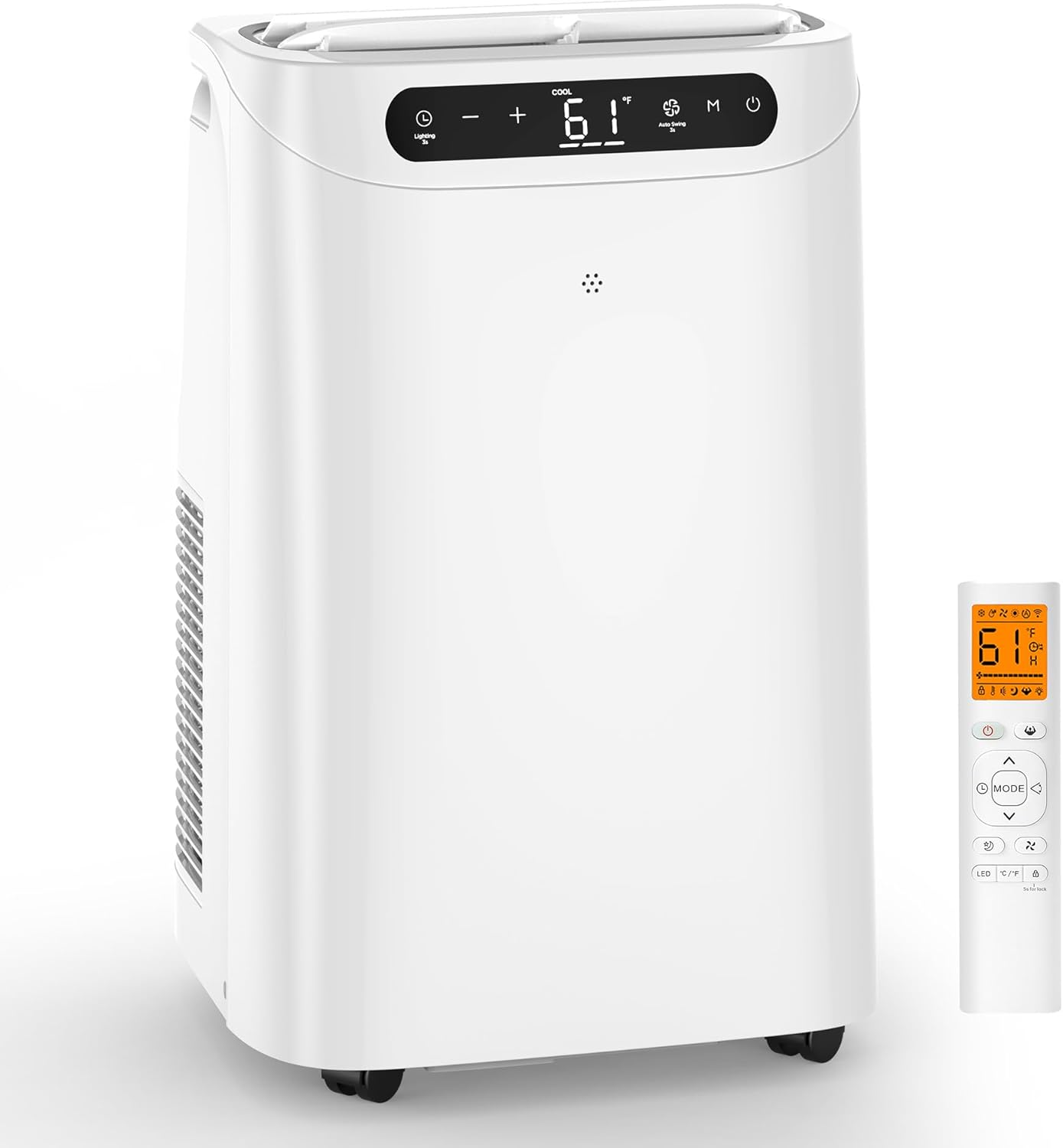
The DOMANKI 12000 BTU portable air conditioner is a compact freestanding unit designed to cool medium rooms quickly while offering dehumidifying and fan-only modes. It uses a turbo mode and a high-efficiency compressor to push up to 224 CFM, and it includes a self-evaporation system so you rarely need to drain condensate during normal cooling use. Controls are available via a front touch panel or a full-function remote, and practical features include a washable reusable filter, 24-hour timer, auto swing, sleep mode that reduces noise to about 48 dB, and child lock. Setup is straightforward with the included window kit, exhaust hose, and adapters, and the unit rolls on swivel casters for repositioning. Trade-offs are typical for portable ACs: it requires an exhaust to the outside to perform efficiently, is fairly heavy for moving between floors, and does not use an inverter compressor so it may be less efficient than inverter models in variable-load situations. For buyers who prioritize a straightforward, feature-rich 12,000 BTU portable option, this model covers the essentials reliably.
Best for: Buyers who want a practical, no-frills 12,000 BTU portable AC that balances fast cooling, low-maintenance operation, and easy setup for medium rooms.
Less Ideal for: People seeking the lightest, most energy-efficient inverter portable models or those who need ultra-quiet units for very noise-sensitive sleeping environments.
- Three-in-one functionality: cooling, dehumidifying, and fan modes in one unit
- Self-evaporation system and washable filter reduce maintenance and eliminate frequent manual draining
- Includes installation kit and exhaust hose for quick, tool-free window setup
- Sleep mode and low-noise operation around 48 dB for overnight use
- Remote control and digital touch panel for convenient operation from a distance
- Heavy at about 65 pounds, making frequent relocation between floors inconvenient
- Uses a non-inverter compressor which can be less energy-efficient under variable load conditions
- Effective cooling requires proper exhaust installation to the outdoors
Verdict: A solid, feature-packed 12,000 BTU portable air conditioner that delivers fast cooling and low-maintenance operation for medium-sized rooms.
Towallmark 12000 BTU Portable AC

| Cooling Power | 12000 british thermal units |
|---|---|
| Noise | 48 db |
| Wattage | 800 |
| Capacity | 3600 cubic feet |
| Controller Type | Remote Control |
This Towallmark portable air conditioner delivers 12,000 BTU cooling capacity and is designed for spot-cooling medium to large rooms. It runs as a 3-in-1 unit with dedicated cooling, a three-speed fan, and a dehumidifier, and it includes a remote, front LED display, 24-hour timer, and sleep mode for quieter overnight use. Setup is straightforward with the included installation kit and castor wheels make it easy to move between rooms. The unit touts a self-evaporating system and a full-water alert to reduce condensate maintenance, and a washable filter simplifies upkeep. Expect typical portable-AC compromises: it is relatively heavy and tall, uses a single exhaust hose window kit, and its stated coverage is best for open-plan spaces rather than tightly sealed large rooms. Noise is listed under 48 dB, so it will be noticeable at higher fan speeds. For buyers focused on straightforward cooling and dehumidifying without smart integrations, this model covers the essentials at a modest feature level.
Best for: Buyers who want a no-frills, budget-minded 12,000 BTU portable AC that handles cooling and dehumidifying for living rooms or shared spaces and prioritizes straightforward setup and basic controls.
Less Ideal for: Those seeking a lightweight, ultra-quiet, or smart-connected air conditioner or anyone needing maximum efficiency for large, tightly sealed areas should consider other options.
- 12000 BTU cooling capacity suitable for medium to large rooms up to advertised coverage
- Three-in-one functionality: cooling, fan with three speeds, and dehumidifier
- Remote control and front LED display for easy operation from across the room
- Self-evaporating design with full-water alert and washable filter reduces maintenance
- Included installation kit and caster wheels make moving and window setup simple
- Unit is relatively heavy and large compared with compact portable ACs
- No smart home connectivity or app control
- Single-hose exhaust limits efficiency compared with built-in or dual-hose systems
Verdict: A practical, budget-oriented 12,000 BTU portable AC that delivers basic cooling, dehumidifying, and simple controls for everyday room use.
Nexaro 12,000 BTU Portable Air Conditioner

| Cooling Power | 14000 british thermal units |
|---|---|
| Floor Area | 550 square_feet |
| Wattage | 900 watts |
| Noise | 46 db |
| Refrigerant | R-32 |
The Nexaro 12,000 BTU portable air conditioner provides straightforward, renter-friendly cooling for large rooms and open layouts. It uses an upward airflow outlet and auto-swing louvers to distribute cool air more evenly instead of blasting directly at occupants, and the unit doubles as a dehumidifier and fan for flexible seasonal use. Setup is tool-free with a universal window kit that fits common window openings, and the built-in caster wheels and handles make moving it between rooms easy. Controls include a long-range remote and a touch panel plus a 24-hour timer and thermostat to manage runtime and comfort. Practical reliability features include an auto-evaporation system that reduces the need to drain water during typical use and a reported quiet sleep mode around 45 dB. Trade-offs are typical for portable ACs: it consumes noticeable power (listed wattage) and will need occasional draining in very humid conditions or continuous heavy cooling, and it occupies floor space where a permanent HVAC solution would not.
Best for: Buyers who prioritize a dependable, easy-to-install portable cooling solution for large rooms and want a unit that minimizes maintenance and redistribution of cool air.
Less Ideal for: Homeowners seeking a permanent or more energy-efficient whole-house solution should consider central or ductless systems instead.
- Even upward airflow with auto-swing louvers for more uniform cooling
- Tool-free universal window kit simplifies installation for renters
- Auto-evaporation reduces manual draining during normal use
- Remote and touch controls plus 24-hour timer and thermostat for convenient operation
- Portable units require regular power and can be less efficient than permanent systems
- May require manual draining during prolonged or very humid operation
Verdict: Choose this Nexaro 12,000 BTU portable AC when you want a reliable, renter-friendly unit that installs quickly and keeps large rooms comfortably cool with minimal upkeep.
Shinco SPF1-12C 12,000 BTU Portable AC

| Cooling Power | 12000 BTU (ASHRAE) / 7500 BTU (SACC) |
|---|---|
| Dehumidification | 43.2 L/day |
| Noise | 52 db |
| Power Source | Corded Electric |
| Control Method | Remote |
The Shinco SPF1-12C is a portable air conditioner intended to cool small to medium rooms and to remove humidity while remaining simple to move and install. It provides dual-rated cooling—12,000 BTU by older ASHRAE test methods and 7,500 BTU SACC for real-world performance—so expect modest cooling for spaces up to about 450 sq ft under ideal conditions but more realistic results in everyday use. The unit includes an exhaust hose and adjustable window sealing kit for quick set up, four casters for room-to-room mobility, and a remote and LED display for convenient control. It also offers three fan speeds, an auto-swing outlet grille, and a dehumidification mode with self-evaporation and a drainage option. Practical drawbacks include a relatively low seasonal efficiency ratio and noticeable noise in cooling modes, so it will use a fair amount of power and can be audible when set to high. The washable filter and basic controls keep maintenance straightforward, and the included accessories make it usable without extra purchases.
Best for: Buyers who value clear real-world performance info and want an all-in-one portable unit with included installation parts and basic controls for occasional to regular spot cooling.
Less Ideal for: People seeking the quietest or most energy‑efficient permanent cooling solution should consider ducted or higher-efficiency alternatives instead.
- Dual-rated cooling that shows both lab (12,000 BTU) and real-world (7,500 BTU SACC) performance for clearer expectations
- Includes exhaust hose, adjustable window sealing kit, and remote so no extra accessories are required for installation
- 3-in-1 modes (cool, fan, dry) plus three fan speeds provide flexible seasonal use
- Washable pre-filter and simple drainage make upkeep straightforward
- Casters and compact form factor make it easy to move between rooms
- Lower seasonal energy efficiency ratio (SEER 2.6) meaning higher electricity use compared with more efficient models
- Noise up to about 52 dB in cooling mode which can be distracting at high fan speeds
Verdict: Choose the Shinco SPF1-12C when you want a moveable 3-in-1 portable AC with clear real-world SACC rating and all necessary installation accessories included.
BLACK+DECKER Smart Portable Air Conditioner BPACT12WT
| Cooling Power | 12000 british thermal units |
|---|---|
| Floor Area | 500 |
| Refrigerant | R410a |
| Control Method | Remote |
| Power Source | Corded Electric |
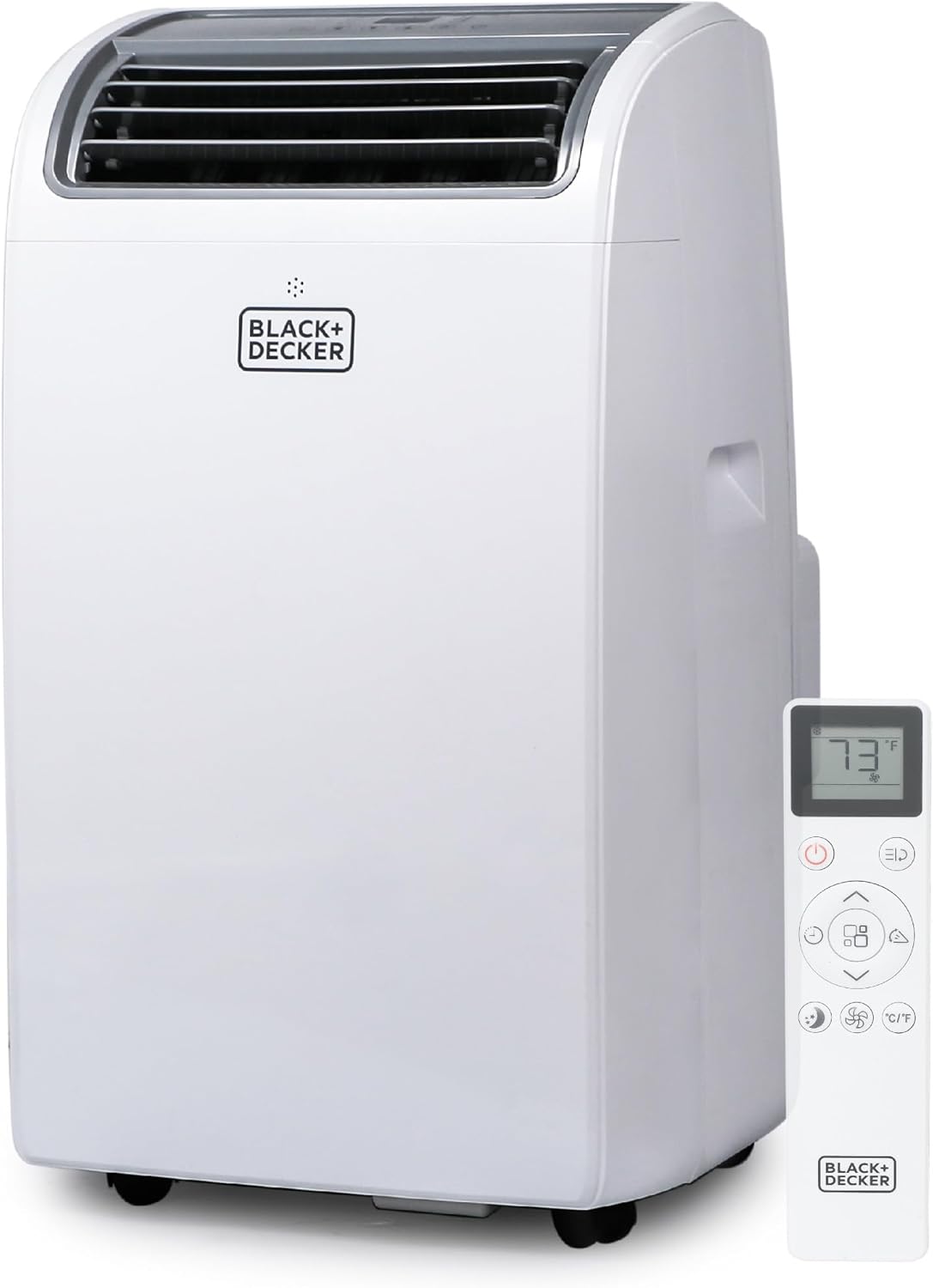
This BLACK+DECKER Smart Portable Air Conditioner is a 3-in-1 unit that cools, dehumidifies, and circulates air for rooms up to about 550 sq ft. It delivers 12,000 BTU (8,350 BTU SACC) cooling with a top-mounted control panel, full-function remote with follow-me thermostat, and Wi-Fi voice control via the BLACK+DECKER app and Alexa or Google Assistant. The unit ships with a comprehensive window/vent kit, exhaust hose, drain hose, and casters and handles for easier movement and seasonal storage. Practical features include a 24-hour timer, sleep mode, washable filter, adjustable louvers, and a small water collection tank for dehumidification. Notable compromises are its weight and footprint compared with smaller models and a midrange noise level typical of portable ACs, so placement and sound-sensitive use should be considered. It is straightforward to install and use, and the smart control features make remote scheduling and temperature adjustments convenient for everyday home use.
Best for: A cautious buyer who values reliable, easy-to-install cooling with smart controls and wants a single unit that also handles dehumidifying and fan duties for medium to large rooms.
Less Ideal for: Those who need an ultra-quiet or very lightweight unit for frequent carrying between locations or for very small rooms where a compact model would suffice.
- Smart Wi-Fi control with app and voice assistant compatibility for remote scheduling and adjustments
- Complete installation kit included for venting to horizontal or vertical windows
- Three-in-one function: cooling, dehumidifying, and fan modes increase seasonal usefulness
- Follow-me remote thermostat and 24-hour timer for precise, convenient temperature control
- Relatively heavy and takes up noticeable floor space compared with smaller portable units
- Noise level is moderate and may be noticeable in very quiet rooms
Verdict: A practical, smart-controlled 12,000 BTU portable AC that combines cooling and dehumidifying with an included venting kit, making it a safe, all-in-one choice for medium to large rooms.
Choosing the Right 12,000-BTU Portable Air Conditioner: Key Factors to Consider
Room Size and BTU Fit
Matching a 12,000-BTU portable air conditioner to the correct room size ensures efficient cooling and reasonable run times. A unit with this nominal capacity typically suits medium rooms, but layout, ceiling height, and sun exposure all affect real-world performance. Measure the room square footage and account for factors like high ceilings or large windows.
Choosing a unit solely based on the BTU rating without considering these variables can lead to short cycling or underperformance. For rooms with heavy sun or poor insulation, a 12,000-BTU machine may need to run longer to maintain set temperatures, which impacts energy cost and wear.
Noise and Intended Use
Noise level is critical if the air conditioner will operate in a bedroom, nursery, or home office. Manufacturers report decibel levels, but real-world noise can vary with fan speed and placement. Consider models with a low-noise or sleep mode and look for separate indoor fan-speed ratings.
If quiet operation matters most, prioritize measured indoor sound ratings and control options that allow lower fan speeds while still maintaining comfort. Remember that settings that reduce noise may increase run time and energy use.
Installation Requirements and Venting Options
Portable air conditioners need a clear exhaust path, usually through a window. Check the exhaust hose length and window kit compatibility before buying. Some units include adjustable window kits suited to different sash types, while others may need custom sealing to prevent warm air infiltration.
Think about where the unit will sit relative to the window and whether a short, straight hose run is possible. Longer or kinked hoses reduce efficiency and increase noise. Also verify whether the unit requires a dedicated outlet or specific electrical considerations.
Energy Use and Operating Cost
A nominal 12,000-BTU rating does not guarantee low operating cost. Look for energy-efficiency metrics and compare them against expected daily run times. Features such as programmable timers, ECO modes, or auto-sleep functions can reduce power draw over extended use.
Estimate monthly operating cost by combining the unit's power draw at typical settings with local electricity rates. Efficient airflow and well-sealed venting also improve effective cooling, reducing compressor run time and lowering energy bills.
Maintenance and Longevity
Routine maintenance affects performance and lifespan. Check how accessible the air filter is and whether it is washable. Drainage design matters: some units collect condensate and have auto-evaporation, while others require manual draining or a drain hose for continuous use in high-humidity environments.
Ease of cleaning the exterior, filter, and condensate paths reduces upkeep time and helps maintain cooling capacity. Also consider warranty coverage and the availability of common replacement parts when planning for long-term ownership.
Controls, Connectivity, and Features
Controls determine how easily you can set and maintain comfortable conditions. Look for clear onboard controls, a responsive remote, and whether the unit offers programmable temperature and timer settings. Some models include app connectivity or voice control, which can simplify daily use but may add complexity.
Other useful features include oscillating louvers for better airflow distribution, a dehumidify-only mode for humid climates, and accessible display indicators for filter cleaning and error codes. Prioritize features that match how you plan to use the unit rather than packing in extras you will not use.
Sizing Tips Beyond the Number
BTU ratings provide a starting point, but you should adjust your expectations based on room specifics. Factors like sun exposure, insulation quality, and room layout change effective cooling demand.
When sizing, calculate square footage and then account for additional heat loads. For example, a sunny room or one with frequent occupancy will need more cooling capacity. Consider using a slightly higher-capacity unit if the space has multiple heat sources or poor insulation.
- Measure the room area and note ceiling height.
- Add capacity for rooms with heavy sun or many occupants.
- Allow extra capacity if the unit must cool several connected spaces.
Placement and Airflow Best Practices
Ideal placement balances short exhaust hose length with clear airflow across the room. Place the unit near the window used for venting but with enough clearance for intake and outflow so it is not blocked by furniture.
Avoid tight corners or recessed alcoves that trap heat around the unit. If possible, direct cooled air toward the primary living area rather than a wall.
- Keep 12–24 inches of clearance on all sides for intake and exhaust.
- Point louvers to promote circulation toward the center of the room.
- Use door dampers or interior fans to shift cool air into adjacent spaces when needed.
Managing Condensate and Humidity
Portable air conditioners both cool and remove moisture. Some models automatically evaporate collected condensate and expel it through the exhaust hose, while others require manual draining or continuous drain setups in humid climates.
If you live in a high-humidity area or plan long run times, prioritize models that support gravity or pump drainage to avoid frequent emptying. Dehumidify mode is useful when you want to reduce dampness without aggressive cooling.
- Understand whether the unit uses self-evaporation or needs manual draining.
- Consider a drain hose routed to a floor drain for continuous operation.
- Use dehumidify mode to reduce humidity without doubling energy use.
Smart Controls and Scheduling
Programmable timers and thermostatic control let you reduce runtime while maintaining comfort. Scheduling the unit to run only during peak heat hours or to cool before occupancy can cut operating cost.
App connectivity and smart-home integration are convenient but check whether the features are reliable and easy to set up. For many buyers, a well-designed remote and clear onboard controls are sufficient.
- Use timers to avoid running the unit when no one is home.
- Lower fan speeds at night to minimize noise while sleeping.
- Verify that app control does not add excessive complexity.
Seasonal Use and Storage
Portable air conditioners are often seasonal purchases. Proper end-of-season maintenance extends service life. Drain and dry internal reservoirs, clean filters, and store the unit in a dry location away from freezing temperatures.
If you plan to move the unit between rooms seasonally, check weight, handle placement, and caster quality to ensure safe relocation.
- Empty and dry condensate systems before storage.
- Clean and store washable filters in a sealed bag.
- Cover the unit to keep dust out during extended storage.
How We Chose the Best 12,000-BTU Portable Air Conditioner
We focused on practical, measurable attributes that matter for portable air conditioners in everyday home use. Our evaluation emphasized cooling capacity and speed, verified as how effectively a 12,000-BTU unit reduces room temperature and maintains setpoints. Noise levels were weighed heavily because many buyers use these units in bedrooms and living areas. Installation and venting flexibility were assessed for ease of setup and compatibility with common window types. Energy efficiency and estimated operating cost were included to reflect typical longer-term expense and environmental impact. Controls and usability covered thermostat accuracy, remote or app control, and simple maintenance features like washable filters and accessible drain ports. We excluded units that do not meet the nominal 12,000-BTU capacity, lack standard safety certifications, or have impractical installation requirements for typical homes. We also filtered out models without documented sound ratings or basic energy-efficiency data. The final list balances performance, convenience, and ongoing operating considerations so buyers can choose with confidence.
Our full evaluation process is outlined in our review methodology.
FAQ
Will a 12,000-BTU portable air conditioner cool a 300-square-foot room?
Often yes, but it depends on ceiling height, insulation, and sun exposure. A 12,000-BTU unit is generally suited for medium rooms, but hot or poorly insulated spaces may require longer run times or supplemental cooling.
How loud are 12,000-BTU portable air conditioners typically?
Noise varies by model and fan speed. Expect higher decibel levels at peak output; look for sleep or low-noise modes if bedroom use is important. Placement and a straight exhaust hose also influence perceived noise.
Do portable air conditioners need a window kit to vent properly?
Yes, most portable units require a venting kit to expel hot air through a window. Window kits differ in compatibility, so confirm the included kit fits your window type or that a suitable kit is available.
How often do I need to drain the condensate?
Drain frequency depends on humidity and the unit's evaporation design. In dry climates, many units self-evaporate during normal use. In humid environments, you may need to empty the reservoir daily or use continuous drainage options.
Can I use a 12,000-BTU portable air conditioner in a bedroom at night?
Usually yes, provided the unit has low-noise settings and you place it for minimal disruption. Selecting a model with a sleep mode and lower fan speeds helps maintain comfort while keeping noise down.
Final Verdict
For most buyers, the best 12,000-BTU portable air conditioner balances effective cooling with manageable noise and simple installation. Prioritize models that match your room size and offer straightforward venting, low indoor sound levels, and energy-saving features. Weigh tradeoffs between noise, runtime, and maintenance needs. If quiet operation matters most, accept slightly longer run times or choose units with proven low-noise modes. If frequent mobility or heavy-duty cooling is required, focus on installation flexibility and drainage options. These priorities will help you select a practical unit that performs well in real-world home use.