
Note: This article contains affiliate links. If you click on these links and make a purchase, we may earn a small commission at no extra cost to you. This helps support our research and content. Read our full affiliate disclosure here.
Finding the right air conditioner deal matters because the wrong unit can cost more to run and fail to keep your space comfortable. Whether you need a window unit for a bedroom or a portable option for an office, picking a model with the right cooling capacity and efficiency changes the long-term cost and comfort of your home. This guide lists the top shortlisted air conditioners for current deals and walks through the features that matter most to homeowners and renters. Below you will find our top picks for air conditioner deals, followed by clear buying guidance and evaluation criteria to help you choose the best unit for your space and budget.
Top Picks at a Glance
| Best Overall The best all-around choice for most situations | Midea U-Shaped 12,000 BTU AC |  |
| Best Quality Built to a higher standard if you want something more solid | TOSOT Cosmo 18,000 BTU Mini-Split |  |
| Best Value The sweet spot between price and what you get | Frigidaire 8,000 BTU Window AC |  |
| Best Budget The cheapest option that still gets the job done reliably | GE 5,000 BTU Window Air Conditioner |  |
| Top Rated A top-rated pick with lots of positive feedback | KINDOJIA 16000 BTU Portable Air Conditioner |  |
| Most Popular A crowd favorite that many people choose with confidence | BLACK+DECKER Portable Air Conditioner BPACT14WT |  |
| Best Seller A high-volume bestseller chosen again and again | Hisense HAP0825TWD Portable Air Conditioner |  |
Midea U-Shaped 12,000 BTU AC

| Cooling Power | 12000 BTU |
|---|---|
| Floor Area | 550 square_feet |
| Noise | 32 db |
| Refrigerant | R-32 |
| Control Method | App, Remote, Touch, Voice |
The Midea U-Shaped 12,000 BTU window air conditioner is built for comfortable cooling in medium to large rooms and balances efficiency, noise performance, and smart features. Its U-shaped form factor lets you keep the window partly open for fresh air and easier installation in single- or double-hung windows, while the inverter rotary compressor provides steady cooling and lower power draw. The unit supports app, remote, touch, and voice controls so you can adjust temperature and fan modes from home or on the go, and claimed operation as low as 32 dBA makes it suitable for bedrooms and living spaces. Energy efficiency is strong for a window unit, with a 15 CEER rating and inverter-driven savings. Practical drawbacks are its weight and window fit requirements, which mean you should confirm the opening size and plan for at least two people for installation, and it does not list heating capability. For buyers seeking a quieter, energy-conscious window AC with modern smart controls, this model offers a solid all-around package.
Best for: Buyers who want a quiet, energy-efficient window AC with smart controls and fresh-air friendly installation for cooling medium to large rooms.
Less Ideal for: People who need a lightweight, ultra-compact unit for very small windows or who require a unit with built-in heating.
- U-shaped design allows window to remain open and simplifies installation
- Inverter rotary compressor for steady cooling and improved energy efficiency
- Multiple control options including app, remote, touch, and voice
- Low noise operation around 32 dBA suitable for bedrooms
- Rated to cool up to 550 sq ft with 12,000 BTU capacity
- Relatively heavy and requires specific window opening sizes for proper fit
- No heating function listed for year-round use
Verdict: A quiet, energy-conscious 12,000 BTU window AC with U-shaped design and full smart controls that balances performance and modern convenience.
TOSOT Cosmo 18,000 BTU Mini-Split

| Cooling Power | 18000 british thermal units |
|---|---|
| Heating Capacity | 19,100 BTU/h |
| SEER2 | 20 |
| Voltage | 230 volts |
| Control Method | Voice |
The TOSOT Cosmo 18,000 BTU mini-split is a wall-mounted ductless inverter system designed to cool and heat single rooms or open living spaces efficiently. It delivers 18,000 BTU cooling and about 19,100 BTU heating capacity while using an inverter compressor that keeps operation quiet and responsive to load changes. Built-in Wi‑Fi and app plus voice control let you adjust temperature and modes remotely, and the unit includes dehumidification for improved comfort. The rated SEER2 around 20 means it runs more efficiently than many conventional systems, which reduces runtime and energy waste during long cooling seasons. Practical benefits include low noise levels suitable for bedrooms, wide operating ambient temperature range for year-round use, and a 16.4 ft copper line set for standard installs. Important limitations are that professional installation is required, the unit runs on 208–230V power so it needs compatible electrical service, and shipping/handling is heavier than smaller window units because the system ships in multiple packages.
Best for: Buyers who prioritize strong seasonal performance and low operating costs and want a quiet, app-controllable system for cooling and heating a single room or open living area.
Less Ideal for: People seeking a plug-and-play or portable solution, or those without compatible 230V electrical service or access to professional HVAC installation.
- High efficiency operation with SEER2 around 20 for lower energy use
- Quiet inverter compressor operation suitable for bedrooms and offices
- Wi‑Fi and voice control with app and remote for convenient adjustments
- Provides both cooling and heating down to very low ambient temperatures
- Includes a 16.4 ft copper line set for standard installation distance
- Requires 208–230V electrical supply and professional installation
- Ships in multiple heavy packages which can complicate delivery and installation coordination
Verdict: Choose this high-efficiency, quiet mini-split if you want strong year-round performance with app and voice control for a single-room or living-area installation.
Frigidaire 8,000 BTU Window AC
| Cooling Power | 8000 BTU |
|---|---|
| Floor Area | 350 square_feet |
| Wattage | 714 watts |
| Refrigerant | R-32 |
| Noise | 55 db |
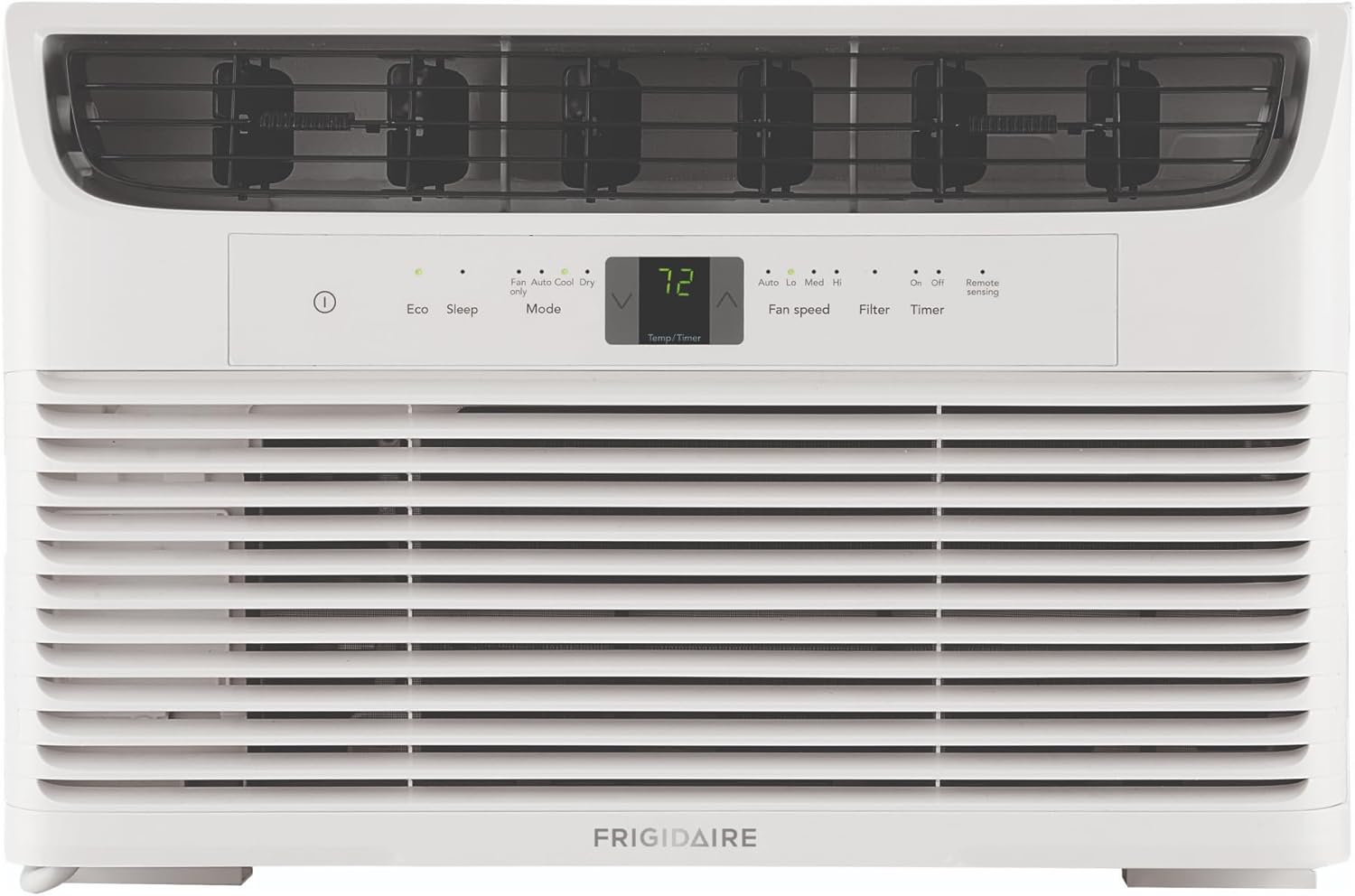
The Frigidaire FHWC083TC1 is an 8,000 BTU window air conditioner built for straightforward cooling in small to mid-size rooms. It provides three fan speeds, multi-directional airflow, a 24-hour timer and a remote for convenient day-to-day control, plus modes such as Eco, Sleep and Dry to tune performance and energy use. Maintenance is simple thanks to a washable pre-filter and a Clean Filter reminder, and it runs at roughly 54–55 dBA for relatively quiet operation in bedrooms. The unit uses R-32 refrigerant and a rotary scroll compressor and reports a SEER/EER-style efficiency of 10.9 with annual energy consumption listed, so it balances cooling power and operating cost for regular use. Limitations include the lack of inverter technology, which means it cycles at fixed speeds rather than modulating for maximum efficiency, and the unit is sized for spaces up to about 350 sq. ft., so it is not suitable for larger open-plan rooms. Installation requires a compatible window kit and a typical window opening that meets the listed dimensions.
Best for: Buyers who prioritize straightforward, energy-conscious cooling for a single bedroom or small living area and want low-maintenance controls and scheduling.
Less Ideal for: People needing variable-speed inverter efficiency or cooling for large open-plan spaces or multiple rooms.
- Effective cooling for rooms up to ~350 sq. ft.
- Remote control and 24-hour timer for easy scheduling
- Eco, Sleep and Dry modes to reduce energy use and improve comfort
- Washable pre-filter with filter-clean reminder simplifies maintenance
- Relatively quiet operation around 54–55 dBA
- No inverter compressor so it operates at fixed speeds rather than variable output
- Not intended for larger rooms or whole-home cooling
Verdict: A reliable, easy-to-use window AC that delivers efficient cooling and simple upkeep for a single bedroom or similar-sized room.
GE 5,000 BTU Window Air Conditioner

| Cooling Power | 5000 british thermal units |
|---|---|
| Floor Area | 150 square_feet |
| Wattage | 440 watts |
| Refrigerant | R-32 |
| Control Method | Push Button |
This GE 5,000 BTU window air conditioner is a straightforward, budget-friendly unit for cooling small rooms, dorms, and home offices. It delivers two cooling modes and two fan speeds controlled by mechanical push-button dials and offers 10 temperature settings for fine tuning comfort without any smart features. The unit is relatively quiet for its class and runs on a standard 115V outlet while drawing about 440W, which helps keep energy use modest. Practical details include a washable filter to avoid frequent replacements, an included EZ mount installation kit for quick DIY setup in narrow double-hung windows, and auto-restart after power outages. Trade-offs are its basic feature set—no Wi-Fi, no remote, and only a 1-year limited warranty—so it lacks advanced scheduling or remote control. For someone prioritizing reliable, no-frills cooling at a low entry cost, this GE does the job cleanly and with minimal maintenance.
Best for: Buyers seeking an affordable, no-frills cooling solution for a single small room who prioritize low upfront cost and easy DIY installation.
Less Ideal for: Those who want smart controls, multi-room cooling, or quieter high-end performance should look at higher-tier models with remote or Wi‑Fi features.
- Compact footprint fits narrow double-hung windows and small rooms up to 150 sq ft
- Washable, reusable filter reduces ongoing maintenance costs
- Low 440W power draw for energy-conscious operation
- Included EZ mount installation kit makes DIY setup quick
- Simple mechanical controls are easy to use and reliable
- No remote control or Wi-Fi connectivity for remote scheduling
- Basic feature set with only 2 cooling modes and 2 fan speeds
- One-year limited warranty offers limited long-term protection
Verdict: A practical, low-cost window AC that delivers efficient cooling for a single small room with minimal fuss.
KINDOJIA 16000 BTU Portable Air Conditioner

| Cooling Power | 16000 british thermal units |
|---|---|
| Additional Features | WiFi Enabled |
| Noise | 50 db |
| Wattage | 850 watts |
| Capacity | 650 ml |
This KINDOJIA 16000 BTU portable air conditioner is designed to cool large rooms quickly while offering smart control and dehumidifying functions. It provides cooling, fan, dehumidifier, sleep mode, a 24-hour timer and auto swing in one compact unit, and you can adjust settings via the included remote, onboard panel or the Smart Life app over WiFi. The unit claims coverage up to 700 sq ft and runs at about 50 dB on low, so it can work in bedrooms and living areas without being distracting. Practical benefits include the integrated dehumidifier mode for muggy climates and scheduling via the app so the room is comfortable when you need it. Trade-offs to consider are the 850 watt power draw and the 650 ml capacity that may require periodic emptying or drainage for heavy dehumidification, and the product weight and installation type mean it is not as portable as smaller models. For buyers who want smart controls and strong cooling in a single-piece unit, this balances features and everyday usability.
Best for: Buyers who prioritize a dependable, feature-rich single-unit solution for cooling and dehumidifying larger rooms and who value smart app control and scheduling.
Less Ideal for: People who need a lightweight, highly portable cooler for moving between rooms frequently or those seeking the lowest possible power draw.
- High 16000 BTU cooling capacity suitable for large rooms
- WiFi and app control plus included remote for convenient operation
- Built-in dehumidifier and multiple modes including sleep and timer
- Relatively quiet operation down to about 50 dB for night use
- 650 ml capacity may require frequent emptying during heavy dehumidification
- 850 watt power consumption is relatively high compared with smaller units
Verdict: Choose this unit when you want strong, smart-controlled cooling plus dehumidification for large rooms in a single dependable appliance.
BLACK+DECKER Portable Air Conditioner BPACT14WT
| Cooling Power | 14000 BTU ASHRAE (10,200 BTU SACC) |
|---|---|
| Refrigerant | R-32 |
| Wattage | 1365 watts |
| Control Method | Remote; Wi‑Fi app; voice assistant compatibility |
| Floor Area | 700 square_feet |
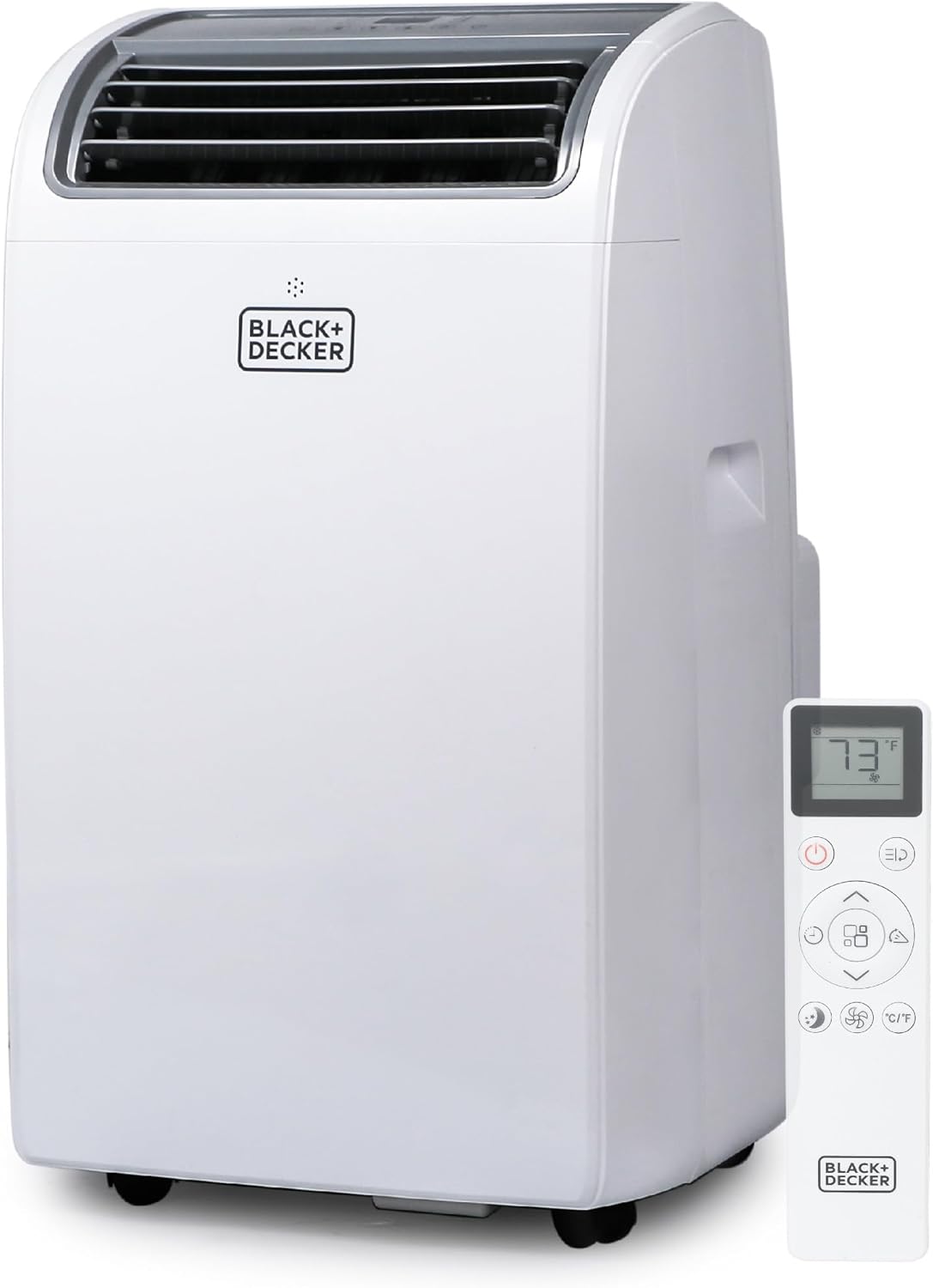
This BLACK+DECKER portable air conditioner is a mobile 3‑in‑1 unit that cools, functions as a dehumidifier, and acts as a fan for rooms up to about 700 sq ft. It uses 14,000 BTU ASHRAE (10,200 BTU SACC) capacity and ships with a window vent kit, exhaust hose and full‑function remote with a Follow Me thermostat feature for spot temperature control. Smart features include Wi‑Fi app control and compatibility with voice assistants, while the top LED panel and three power levels keep operation straightforward. Practical benefits include caster wheels and side handles for moving between rooms, a 24‑hour timer and a sleep mode for quieter overnight use, and a washable filter for simpler upkeep. Important limits are its heavy weight and relatively high noise level compared with quieter split systems, and the unit's cooling rating reflects DOE SACC values that are lower than the ASHRAE number buyers often see. Expect standard portable‑AC efficiency rather than the performance of a built‑in system and plan for venting and occasional water drainage in dehumidify mode.
Best for: Buyers who want a powerful, feature‑rich portable AC that can cool a large room and appreciate smart controls and an included installation kit for quick setup.
Less Ideal for: People who prioritize whisper‑quiet operation, the highest possible energy efficiency, or a permanently installed cooling solution should consider other options.
- High cooling capacity intended for rooms up to about 700 sq ft
- Includes complete window vent kit and exhaust hose for straightforward installation
- Wi‑Fi and voice assistant control plus a Follow Me remote for convenient temperature management
- Rolls on casters with integrated handles for reasonably easy room-to-room mobility
- Washable filter and dehumidify mode simplify maintenance and add seasonal usefulness
- Heavier and louder than split or window units, which may affect placement and night use
- Efficiency ratings are typical for portable units and lower than permanent HVAC options
Verdict: A strong, smart‑enabled portable AC that reliably cools large rooms and arrives ready to vent and use with a full installation kit.
Hisense HAP0825TWD Portable Air Conditioner

| Cooling Power | 8000 BTU DOE/SACC (10,000 ASHRAE) |
|---|---|
| Floor Area | 350 square_feet |
| Noise | 42 db |
| Refrigerant | R-32 |
| Power Source | Corded Electric |
This Hisense portable air conditioner uses a dual-hose design and inverter compressor to cool medium-large rooms more efficiently and with steadier temperatures than single-hose units. It runs in three modes—cooling, dehumidifying, and fan—and offers app, remote, and touch controls so you can set schedules or adjust settings from across the room. Inverter technology and a rotary scroll compressor reduce power draw compared with basic portable units and the manufacturer lists a noise level around 42 dB, making it reasonable for bedrooms or living rooms. The kit includes a snap-together window installation and a power cord so setup is straightforward for most users, and the unit uses R-32 refrigerant. Expect the unit to be heavier than smaller portable ACs and to need a wide window opening for the included kit, but for everyday cooling and dehumidifying in a 300–350 sq ft space it delivers steady, quieter performance with convenient controls.
Best for: Buyers who prioritize reliable, energy-conscious cooling and want a quieter, easier-to-control portable AC for bedrooms or living spaces rather than the cheapest one-off option.
Less Ideal for: People who need a very lightweight, ultra-compact cooler for frequent moves or those without a compatible window opening should consider other choices.
- Dual-hose system for faster, more consistent cooling than single-hose units
- Inverter compressor improves energy efficiency and steady temperature control
- Multiple control methods including app, remote, and touch for flexible operation
- Includes snap-together window kit and remote for easy installation and daily use
- Heavy unit compared with compact portable ACs, which may limit portability
- Requires a relatively wide window opening to use the included installation kit
Verdict: Choose this unit if you want a quieter, more energy-efficient dual-hose portable AC that reliably cools and dehumidifies medium-to-large rooms.
Choosing the Right Air Conditioner Deals: Key Factors to Consider
Cooling Capacity and Room Size
Matching a unit's cooling capacity to the specific square footage and ceiling height of the room matters because undersized units run continuously and fail to reach set temperatures, while oversized units cycle too quickly, causing humidity control issues.
Look for capacity guidance expressed in BTUs and compare that to your room measurements. Consider factors like high ceilings, strong afternoon sun, and open floor plans, which all increase required capacity. Picking the right-sized air conditioner reduces energy use and improves comfort.
Energy Efficiency Ratings
Higher efficiency ratings reduce long-term operating expenses and often justify spending a bit more up front when deals are available. Efficiency is usually expressed as EER or SEER for different unit types, and better numbers translate to lower electricity consumption for the same cooling output.
When evaluating deals, prioritize units with clear, certified efficiency ratings and consider energy-saving features like sleep modes, programmable timers, and smart thermostats. These features help maximize savings without sacrificing comfort.
Installation and Mounting Options
Installation complexity influences total cost and suitability, especially in rentals or rooms without existing hardware. Window units typically require a secure sill and support, while portable units need a nearby window kit for exhaust. Some units offer semi-permanent mounts that improve sealing and efficiency but require more work to install.
Assess the physical constraints where the unit will sit, check for required clearance around intake and exhaust vents, and confirm whether professional installation is necessary for safe operation. Easy-install options reduce immediate hassle and potential extra costs.
Noise Level and User Environment
Noise level affects usability in bedrooms, nurseries, and workspaces. A quieter unit is essential for uninterrupted sleep or concentration, while noisier units may be acceptable in garages and basements.
Compare published decibel ratings but also consider fan speed settings and compressor design. Models with multiple fan speeds and dedicated quiet modes can offer flexibility between aggressive cooling and low-noise operation.
Durability, Maintenance, and Warranty
Durable construction and clear maintenance requirements reduce long-term hassle and unexpected repair costs. Factors like filter access, drain management, and corrosion-resistant components matter for sustained performance.
Review warranty length and what it covers, and consider how easy it is to replace common wear parts. Regular filter cleaning or replacement schedules should be straightforward to keep the unit running efficiently.
Controls, Features, and Smart Integration
User controls determine how convenient the unit is to operate daily. Features such as timers, remote controls, programmable thermostats, and Wi-Fi connectivity add convenience and can improve energy management.
Smart integration that allows scheduling or remote control can reduce wasted runtime and adapt cooling to your routine. Confirm that any smart features are compatible with your home network and meet your privacy expectations.
Sizing a Unit for Different Room Types
To pick the right capacity, calculate the square footage of the room and then adjust for factors that raise cooling load, such as high ceilings, many windows, or significant afternoon sun. Bedrooms and offices usually need less capacity than living rooms or open-plan spaces.
For partitioned or connected rooms, consider whether a single larger unit can effectively cool the combined area or whether separate smaller units will provide better control and efficiency. Portable units are best for temporary needs or rooms without window access.
- Measure room length and width to get square footage.
- Add capacity for high ceilings and strong sunlight exposure.
- Account for occupants and heat-generating appliances.
Installation Tips to Maximize Efficiency
A properly sealed and leveled installation prevents air leaks that reduce efficiency. For window units, use foam sealing strips or the included side panels to close gaps. Portable units should have an exhaust kit that fits snugly in the window opening.
Ensure adequate clearance around intake and exhaust areas to avoid restricted airflow. If mounting hardware or bracing is required, use recommended supports to prevent vibration and ensure safe operation.
- Seal gaps around the installed unit to prevent warm air infiltration.
- Keep at least the manufacturer's recommended clearance on all sides.
- Level the unit slightly rearward to help condensation drain properly.
Managing Operating Costs Beyond Efficiency Ratings
Efficiency ratings are a starting point, but runtime, thermostat settings, and local electricity rates determine actual costs. Use programmable schedules to avoid cooling an empty house and raise setpoints slightly during the hottest part of the day if comfort allows.
Routine maintenance like filter cleaning and ensuring unobstructed airflow preserves the rated efficiency. Consider supplemental measures such as ceiling fans or shading to reduce load and allow a smaller unit to meet comfort needs.
- Use timers and programmable settings to limit unnecessary runtime.
- Perform simple maintenance to keep the unit running at rated efficiency.
- Combine cooling with fans or shading for lower overall energy use.
Noise Considerations for Different Uses
Manufacturers often publish decibel levels for units at different fan speeds. For bedrooms, aim for the lowest available operating noise, especially on the low or sleep setting. In living areas, slightly higher noise may be acceptable if it enables faster cooling.
Placement affects perceived noise. Units mounted near sleeping areas or workspaces can be disruptive, so plan location carefully or opt for models with dedicated quiet modes.
- Check noise ratings across fan speeds rather than a single figure.
- Prefer units with adjustable fan speeds and a low-noise mode for bedrooms.
- Mount and support the unit to minimize vibration-transmitted noise.
When to Choose Portable Vs Window Units
Portable units are useful when window mounting is impossible or when you need temporary cooling in different rooms. They are typically easier to move but can be less efficient because of ducting and exhaust losses.
Window units are generally more efficient for dedicated rooms and often deliver better cooling per installed capacity. Consider mounting constraints, sealing quality, and permanence of your cooling needs when deciding between the two.
- Use portable units for temporary or flexible cooling needs.
- Choose window units for better efficiency in a fixed location.
- Evaluate installation constraints and sealing options before deciding.
How We Chose the Best Air Conditioner Deals
We focused on practical, measurable attributes that affect real-world performance and ownership cost when selecting the seven air conditioners included here. Our evaluation prioritized energy efficiency ratings and seasonal energy efficiency performance because they directly influence operating cost. Cooling capacity relative to room size was another primary filter to ensure each pick suits a clearly defined coverage area. We also weighed installation flexibility and mounting options to reflect common home and rental situations. Reliability indicators such as warranty terms and reported build quality were considered to reduce the risk of early failures. Noise levels under typical load were assessed because sound affects usability in bedrooms and workspaces. We excluded specialty commercial HVAC units, whole-house systems requiring ductwork, and models with unclear energy documentation. The final short list balances efficiency, capacity, installation ease, durability, and noise for a broad set of home cooling needs.
Our full evaluation process is outlined in our review methodology.
FAQ
How do I know what BTU rating I need for my room?
Estimate the room square footage and consult a sizing guideline to match BTUs to area, then adjust for high ceilings, sun exposure, and typical occupancy. When in doubt, err toward a slightly larger capacity for sun-filled rooms and a smaller one for shaded rooms.
Are more efficient units always worth the extra upfront cost?
Higher efficiency typically lowers operating costs, but payback depends on runtime and local electricity rates. If you run the unit many hours daily or live in a hot climate, efficiency pays off sooner; for occasional use, savings are smaller.
Can I install a window air conditioner myself?
Many window units are designed for DIY installation and include mounting hardware and instructions. However, ensure the window sill and frame can support the weight, that the unit can be securely braced, and that sealing is adequate to prevent air leaks.
How often should I clean or replace filters?
Filter maintenance frequency depends on use and air quality but is often every 1 to 3 months for heavy use. Regular cleaning maintains airflow and efficiency and prevents ice buildup on cooling coils.
Do portable air conditioners cool as well as window units?
Portable units can provide effective cooling for individual rooms but are often less efficient than window units due to exhaust setup and potential heat transfer. They are best suited for temporary or flexible cooling needs.
Final Verdict
Prioritize the combination of correct cooling capacity and energy efficiency when evaluating air conditioner deals. Matching capacity to room size ensures effective temperature control and humidity management, while stronger efficiency ratings reduce long-term operating costs. Balance installation needs, noise tolerance, and maintenance expectations with the features offered by available deals. With those tradeoffs in mind, you can select a unit that delivers reliable comfort and manageable running costs for your specific space.