
Note: This article contains affiliate links. If you click on these links and make a purchase, we may earn a small commission at no extra cost to you. This helps support our research and content. Read our full affiliate disclosure here.
Picking the right air conditioner for a small room matters more than you might think. A unit that is too large will cycle inefficiently and waste energy, while one that is underpowered will struggle to reach a comfortable temperature. For bedrooms, home offices, and similar compact spaces you need a balance of cooling capacity, quiet operation, and sensible energy use. This guide shortlists the top air conditioners for small rooms and explains the practical tradeoffs that matter in everyday use. We evaluate cooling capacity, noise, energy efficiency, controls, and installation requirements so you can quickly identify the options that match your space and routine.
Top Picks at a Glance
| Best Overall The best all-around choice for most situations | LG 5,000 BTU Window Air Conditioner |  |
| Best Value The sweet spot between price and what you get | BLACK+DECKER Window Air Conditioner BWAC05MWTB |  |
| Best Budget The cheapest option that still gets the job done reliably | Amazon Basics 5000-BTU Window AC |  |
| Top Rated A top-rated pick with lots of positive feedback | Frigidaire FFRA051WAE 5,000 BTU |  |
| Most Popular A crowd favorite that many people choose with confidence | Midea EasyCool 5,000 BTU |  |
| Best Seller A high-volume bestseller chosen again and again | GE 5,000 BTU Window Air Conditioner |  |
LG 5,000 BTU Window Air Conditioner

| Cooling Power | 5,000 BTU |
|---|---|
| Floor Area | 150 square_feet |
| Wattage | 450 watts |
| Control Method | Remote, Touch |
| Filter Type | Washable Filter |
The LG LW5025R is a compact window air conditioner that delivers targeted cooling for small rooms, offices, or bedrooms up to roughly 150 square feet. It offers two cooling modes and two fan speeds controlled via an on-unit panel or the included remote, and its washable dust filter and EZ mount kit make installation and routine maintenance straightforward. The unit runs quietly for its class and uses R-32 refrigerant with a strong SEER rating, so it balances cooling performance with reasonable energy use. Practical benefits include simple controls, a slide-out filter for easy cleaning, and a low profile that fits typical double-hung windows. Important limitations are the modest 5,000 BTU capacity, which is not intended for larger or poorly insulated rooms, and the fixed-chassis window installation that may not suit every window type. If you need a no-frills, energy-aware window AC for a single small space, this model is a tidy, easy-to-use option.
Best for: Buyers who want a simple, energy-conscious window AC to reliably cool one small room with minimal setup and maintenance.
Less Ideal for: People who need to cool larger rooms, open-plan areas, or who require portable units that move between rooms frequently should look elsewhere.
- Compact 5,000 BTU unit suited for rooms up to about 150 sq. ft.
- Includes remote control plus easy-to-use on-unit button controls
- Washable slide-out dust filter simplifies cleaning and maintenance
- EZ mount installation kit designed for straightforward window fit
- Energy-efficient operation with R-32 refrigerant and a SEER of 14
- Limited cooling capacity not appropriate for larger or poorly insulated spaces
- Fixed window chassis installation may not work with all window types
Verdict: A compact, energy-minded window AC that reliably cools a single small room with easy installation and simple controls.
BLACK+DECKER Window Air Conditioner BWAC05MWTB

| Cooling Power | 5000 BTU |
|---|---|
| Floor Area | 150 square_feet |
| Refrigerant | R-32 |
| Control Method | Remote |
| Efficiency | 11 CEER |
This BLACK+DECKER 5,000 BTU window air conditioner is a compact, no-frills unit built for small rooms such as bedrooms, dorms, or home offices. It uses rotary compressor technology with R-32 refrigerant and delivers two cooling speeds plus two fan-only speeds controlled by simple mechanical dials and a remote. The unit includes an installation kit with accordion side panels and foam weather stripping for windows 23 to 34 inches wide and a minimum 14.5 inch height, and it features a removable washable mechanical filter and manual adjustable louvers. Practical benefits include straightforward setup, low-complexity controls that are easy to use, and decent efficiency for its class (11 CEER) which helps limit running cost for small spaces. Expect typical window AC trade-offs: limited coverage capped around 150 sq ft, a moderate noise level around 54 dB, and basic feature set without smart controls or inverter operation. For buyers seeking a simple, reliable way to cool a single small room, this model covers the essentials without extras that add cost or complexity.
Best for: Buyers who want a straightforward, low-maintenance window AC to reliably cool a single small room without paying for extras or complex features.
Less Ideal for: People who need quiet operation, precise energy savings from inverter technology, or smart/home-automation integration should consider other models.
- Designed for small rooms up to 150 sq ft, matching compact living spaces and dorms
- Simple mechanical dial controls and included remote for easy temperature adjustments
- Removable, washable filter reduces ongoing replacement costs
- Installation kit with accordion panels and weather stripping fits common double-hung windows
- 11 CEER efficiency rating provides decent energy performance for its class
- Only two cooling speeds and no inverter means less precise temperature control and efficiency compared with inverter models
- Moderate noise level around 54 dB may be noticeable in very quiet rooms
- No smart features or app connectivity for remote scheduling or monitoring
Verdict: A simple, efficient 5,000 BTU window unit that reliably cools single small rooms while keeping controls and maintenance easy.
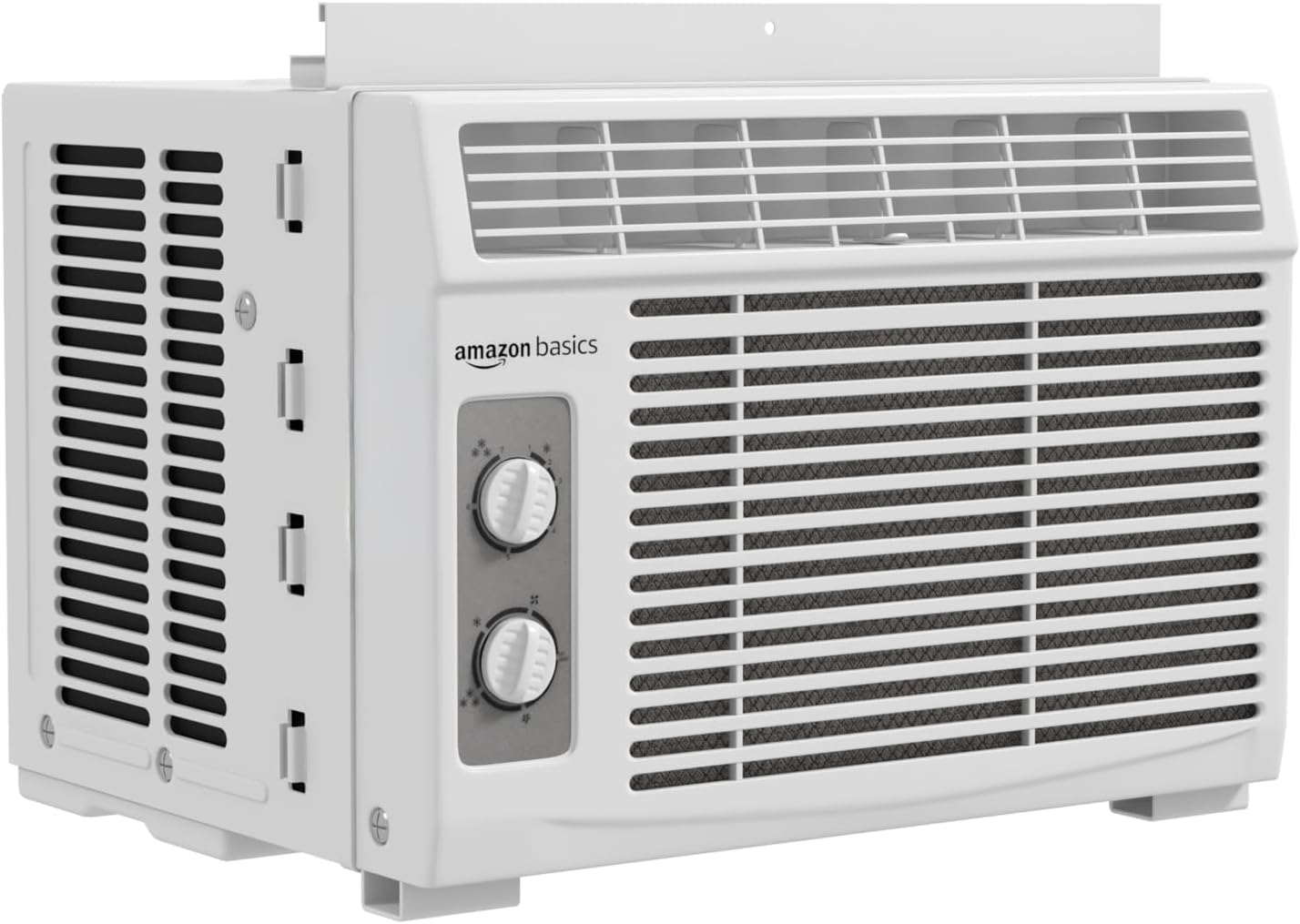
Amazon Basics 5000-BTU Window AC
| Cooling Power | 5000 british thermal units |
|---|---|
| Floor Area | 150 square_feet |
| Wattage | 450 watts |
| Noise | 56 db |
| Control Method | Touch |
This compact window air conditioner provides straightforward cooling for small rooms, dorms, or home offices with a 5000 BTU capacity rated for up to 150 square feet. It offers cooling and fan modes, seven temperature/power settings, two-speed operation, and two-way airflow so you can tailor comfort without complex controls. The removable washable pre-filter helps reduce dust and is easy to maintain, and the included adjustable window mounting kit makes installation into standard windows relatively simple. The unit runs at up to 56 dB, so it is noticeable but still suitable for sleeping or working in many cases. It does not use an inverter compressor and is a basic rotary scroll design, so it lacks some of the energy-saving features and quieter operation found in higher-end models. Expect dependable, no-frills performance and straightforward upkeep rather than premium efficiency or ultra-quiet operation.
Best for: Buyers looking for an affordable, simple-to-install window AC that reliably cools a single small room and is easy to maintain.
Less Ideal for: Those who need the quietest possible operation, the highest energy efficiency, or advanced inverter-style temperature control should consider other options.
- 5000 BTU cooling suitable for rooms up to 150 sq ft
- Removable, washable pre-filter for easy maintenance
- Adjustable window kit included for straightforward installation
- Seven temperature/power settings and two fan speeds for flexible comfort
- Operates at up to 56 dB which can be audible in very quiet rooms
- No inverter technology, so it is less efficient than inverter models
Verdict: A budget-friendly, easy-to-install window AC that effectively cools a single small room and is simple to maintain.
Frigidaire FFRA051WAE 5,000 BTU

| Cooling Power | 5000 BTU |
|---|---|
| Floor Area | 150 square_feet |
| Noise | 52 db |
| Wattage | 450 |
| Filter Type | Washable |
The Frigidaire FFRA051WAE is a compact window air conditioner built for small rooms and straightforward operation. It delivers 5,000 BTU of cooling and uses Effortless Temperature Control plus two fan speeds to maintain a steady room temperature without complicated setup. Installation is simplified by adjustable side panels and a long three-prong power cord that usually avoids an extension cable. A washable filter captures dust and is easy to remove for routine cleaning, and the unit advertises quiet operation around 52 dBA, which keeps bedrooms and living areas comfortable at night. Energy use is modest for its class, running at 450W and an efficiency rating listed as 11. Limitations include basic controls with no inverter technology or advanced smart features, and the cooling capacity is strictly suited to small spaces up to about 150 sq. ft., so it will struggle in larger or poorly insulated rooms. For buyers who want a simple, reliable window AC for small rooms, this unit offers solid performance without unnecessary bells and whistles.
Best for: Buyers who prioritize a straightforward, dependable cooling solution for a small bedroom or living area and prefer low-maintenance equipment over advanced features.
Less Ideal for: People who need high-efficiency inverter performance, smart/home integration, or cooling for larger rooms or open-plan spaces.
- Compact 5,000 BTU output suitable for small bedrooms and living rooms
- Effortless Temperature Control and two fan speeds for steady, easy operation
- Washable filter for simple, low-cost maintenance
- Adjustable side panels and long power cord make installation easier
- Relatively quiet at about 52 dBA for overnight use
- No inverter compressor or advanced smart connectivity
- Designed only for small rooms up to about 150 sq. ft., not for larger spaces
Verdict: A reliable, no-frills window AC that delivers straightforward cooling and easy maintenance for small rooms.
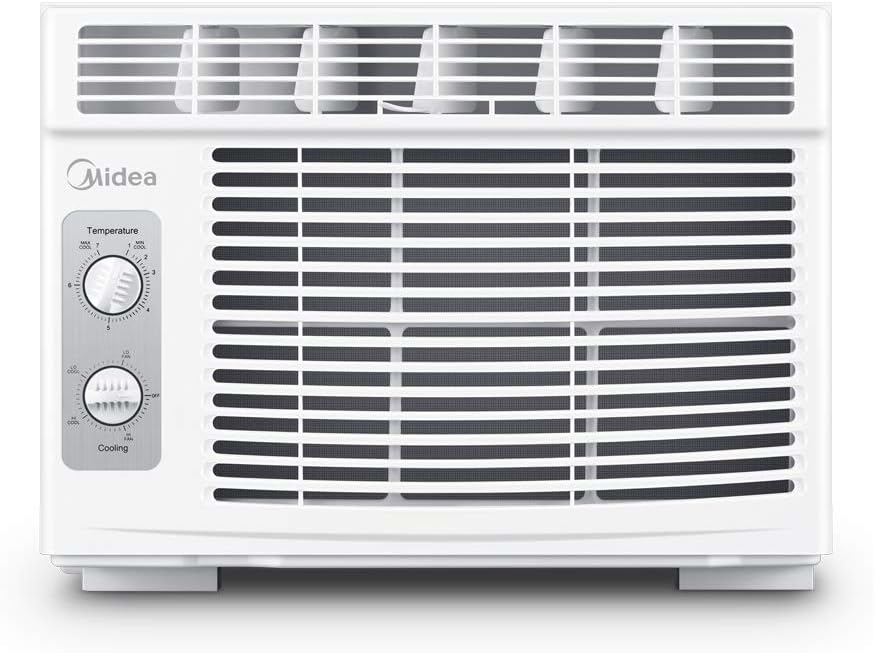
Midea EasyCool 5,000 BTU
| Cooling power | 5000 BTU |
|---|---|
| Coverage | 150 square feet |
| Control method | Push Button |
| Filter type | Washable Filter |
| Refrigerant | R-32 |
The Midea EasyCool 5,000 BTU is a straightforward window air conditioner built for small rooms and simple operation. It cools areas up to about 150 square feet using mechanical push-button controls with three power levels and multiple fan speeds, so setting it up and changing settings requires no learning curve. The unit includes a washable filter for basic dust and pet-hair protection and ships with a window bracket for easy installation in standard windows. Performance-wise it delivers adequate cooling for bedrooms, offices, or studio apartments and runs quieter than many older window units, though noise is still noticeable at higher speeds. It uses R-32 refrigerant and a rotary compressor, and its listed efficiency is modest with a CEER/SEER-equivalent of 11. Important limitations are its fixed cooling-only function, lack of a remote or smart controls, and modest energy efficiency compared with inverter models, so operating costs will be higher during heavy use. For buyers who want a no-frills, easy-to-install window AC for a single small room, this model is a sensible, proven option.
Best for: Buyers who prioritize straightforward, proven cooling for a single small room and who value easy installation and simple controls over smart features.
Less Ideal for: People who want remote or app control, higher energy savings from inverter technology, or a combined heat and cooling solution should consider other options.
- Compact window form factor cools rooms up to 150 sq. ft.
- Simple mechanical push-button controls that are easy to use
- Washable, reusable air filter for low-cost maintenance
- Includes window bracket for straightforward installation
- Cooling-only unit with no heat or smart connectivity
- Lower energy efficiency compared with inverter window models
Verdict: Choose this unit if you want an affordable, easy-to-install window AC that reliably cools a single small room without fuss.
GE 5,000 BTU Window Air Conditioner

| Cooling Power | 5000 british thermal units |
|---|---|
| Floor Area | 150 square_feet |
| Wattage | 440 watts |
| Filter Type | Washable Filter |
| SEER | 11 |
This GE 5,000 BTU window air conditioner is a straightforward cooling solution for bedrooms, dorms, and small home offices up to about 150 square feet. It uses a rotary compressor and push-button mechanical controls with two cooling modes and two fan speeds, making it simple to operate without apps or Wi-Fi. The unit claims quiet operation (roughly 52–56 dB), draws about 440 watts, and includes a washable reusable filter to reduce maintenance costs. Installation is user-friendly with an included EZ mount kit and side panels for quick DIY setup, and auto-restart restores settings after power outages. Limitations include basic mechanical controls with no remote or smart features and a modest SEER of 11, so it is best for spot cooling rather than whole-apartment use; also the noise level is low but not whisper-quiet compared with higher-end models. For buyers wanting a dependable, easy-to-install window AC that keeps a small room comfortable without technical fuss, this unit fits the bill.
Best for: Buyers who prioritize a reliable, low-complexity cooling solution for a single small room and prefer straightforward mechanical controls over smart features.
Less Ideal for: Users who want smart controls, remote operation, or higher-efficiency units for cooling multiple rooms or larger spaces.
- Compact footprint fits narrow windows and small rooms up to 150 sq ft
- Simple mechanical controls require no network setup or smartphone
- Washable reusable filter reduces ongoing filter replacement cost
- Included EZ mount installation kit and side panels make DIY install straightforward
- Auto-restart restores settings after power outages
- No remote control or Wi-Fi connectivity for remote operation
- Modest efficiency (11 SEER) and basic feature set compared with higher-end models
Verdict: A no-frills, easy-to-install window AC that reliably cools a single small room without the complexity of smart features.
Choosing the Right Air Conditioner for Small Rooms: Key Factors to Consider
Cooling Capacity and Room Size
Cooling capacity, typically expressed in BTUs, should match the square footage and ceiling height of the room. A unit rated too high will short-cycle and waste energy; a unit rated too low will run continuously and fail to maintain comfort.
Estimate room size, account for sun exposure and insulation quality, and favor models that provide a slightly conservative margin rather than oversized ratings. For small rooms, precise capacity matching is one of the most important factors to avoid noise, inefficiency, and uneven cooling.
Energy Efficiency and Operating Cost
Higher energy-efficiency ratings reduce long-term operating cost, which becomes meaningful over a cooling season. Look for published EER or SEER equivalents and compare runtime power draw at typical settings.
Efficient compressors and smart temperature control help cut electricity use. When evaluating units for small rooms, prioritize models that deliver good cooling per watt at moderate setpoints rather than peak-capacity figures that you will seldom use.
Noise Level and Acoustic Comfort
For bedrooms, nurseries, and offices, low operating noise is critical. Manufacturers report decibel ratings but these are not always measured the same way. Pay attention to noise figures for low and medium fan speeds and whether the unit offers a quiet or sleep mode.
A quieter unit improves sleep quality and productivity. Consider both the compressor and fan noise and note how the unit performs at the thermostat settings you expect to use most of the time.
Installation Type and Space Constraints
Small rooms often have limited window space or restricted wall area, so the installation footprint matters. Window-mounted units, through-the-wall models, and portable air conditioners each have different space and ventilation requirements.
Measure the available opening and clearance, check whether venting hoses or exterior grilles are acceptable, and prefer units with compact dimensions and straightforward mounting hardware when space is tight.
Controls, Programmability, and Smart Features
Modern controls and programmability let you reduce runtime and improve comfort. Features to consider include a digital thermostat, timers, sleep modes, and simple remote control. Smart or Wi-Fi controls can be convenient but add complexity.
For small-room use, prioritize accurate temperature control and easy-to-use scheduling so the unit runs only when needed and maintains stable comfort without frequent manual adjustments.
Maintenance Needs and Filter Accessibility
Regular filter cleaning and occasional condensate handling are part of owning an air conditioner. Check how easy it is to access or remove filters, whether filters are reusable, and how condensate is managed—internal evaporation, drain ports, or external collection.
Lower maintenance complexity reduces the chance of performance degradation in everyday use, which is especially valuable when the unit is in a bedroom or other space where you want low upkeep.
Sizing Your Small Room Correctly
Start by measuring floor area and ceiling height, then account for sun exposure, number of occupants, and major heat sources like electronics. Use a conservative BTU guideline tied to actual square footage rather than relying on vague room descriptors.
If your room has large windows or poor insulation, add extra capacity. For compact rooms with minimal sun and good insulation, choose a unit that meets the lower end of the recommended BTU range to avoid short cycling.
- Measure floor area and multiply by ceiling height if higher than standard
- Add 10 to 20 percent for sunny rooms or frequent occupancy
- Reduce recommended BTU slightly for shaded, well-insulated spaces
Installation Options and What Fits Best
Window units are simple and space-efficient if you have an appropriate opening. Through-the-wall installations free window space but require a sleeve and precise sizing. Portable units need an exhaust hose and a stable surface but avoid permanent modifications.
Consider how much permanent change you want to make to the room, whether you can safely support a window-mounted unit, and how the unit's depth affects usable interior space.
- Window: compact footprint, minimal permanent changes
- Wall: cleaner look, requires cutout and sleeve
- Portable: flexible placement, needs exhaust route
Managing Noise for Sleep and Work
Look for units with separate noise ratings for low and high fan speeds and a dedicated sleep mode. Even modest reductions in decibel levels make a noticeable difference in a small, enclosed space.
Placement can reduce perceived noise: mount or place units on vibration-damping pads and ensure the intake and exhaust are not directed toward seating or sleeping areas.
- Prefer models with low-speed noise figures under typical bedroom thresholds
- Use vibration pads or secure mounting to cut rattles
- Run units at lower fan speeds overnight and use thermostat control
Energy Use and Long-Term Running Costs
Small-room units still run for many hours during hot periods, so efficiency matters. Compare energy specs and consider how much runtime you expect during the day and overnight. Features like programmable timers and eco modes reduce unnecessary runtime.
Also consider whether the unit cycles on and off frequently; units that short-cycle due to oversizing can consume more power and strain components over time.
- Check the energy-efficiency metric and typical wattage at moderate settings
- Use timers and thermostats to limit unnecessary runtime
- Avoid oversized units that frequently short-cycle
Maintenance Best Practices for Longevity
Plan for seasonal filter cleaning and occasional coil maintenance to keep the unit efficient and odor-free. Easy access to filters and clear instructions for condensate handling reduce maintenance friction.
If a unit has an internal condensate evaporator, verify how it performs in humid climates; some models may require periodic draining or a condensate pump.
- Clean reusable filters every 1 to 3 months depending on use
- Inspect coils and condensate paths seasonally
- Follow manufacturer guidance for winter storage or offseason protection
How We Chose the Best Air Conditioner for Small Rooms
We narrowed candidates by real-world suitability for small rooms, focusing on measurable specs and practical features that affect comfort and cost. Primary evaluation criteria included cooling capacity relative to room size, measured noise levels in typical operating modes, and energy efficiency ratings that indicate running cost. We also assessed installation flexibility and footprint for tight spaces, plus control options and maintenance needs like filter access and condensate handling. Units that required specialized installation beyond standard window or portable setups were excluded, as were models whose cooling capacity was clearly mismatched for small rooms. We prioritized products with clear specification sheets and user-facing features that reduce daily friction. The final shortlist emphasizes balanced performance: sufficient cooling without excessive power, quiet operation for nighttime use, energy efficiency for lower ongoing cost, and straightforward installation and upkeep.
Our full evaluation process is outlined in our review methodology.
FAQ
How do I calculate the right BTU for my small room?
Measure the room's square footage and multiply by a standard BTU-per-square-foot guideline for small rooms. Adjust upward for strong sun exposure, high ceilings, or multiple occupants and downward for well-shaded, well-insulated spaces.
Are portable air conditioners a good choice for small rooms?
Portable units can work well when window or wall installations are not possible, but they need an exhaust path and typically have slightly lower efficiency. They are convenient for temporary setups and when minimal room modification is desired.
What noise level is acceptable for a bedroom?
Aim for lower fan-speed noise figures and a sleep mode; many people find continuous noise under typical bedroom thresholds comfortable. Exact decibel comfort varies, so prioritize units with clear low-speed ratings and quiet-design features.
How often should I clean or replace the filter?
For most small-room units, reusable filters should be cleaned every 1 to 3 months depending on use and air quality. Replace disposable filters as recommended by the manufacturer or when they show persistent discoloration or damage.
Can a unit be too large for a small room?
Yes. An oversized air conditioner can short-cycle, leading to poor humidity control, higher energy use, and greater wear on components. Proper sizing to the room's actual cooling load is important for efficiency and comfort.
Final Verdict
Focus on sizing, noise, and efficiency when choosing an air conditioner for a small room. Correct BTU capacity prevents short-cycling and improves humidity control, while low-noise designs and good energy efficiency make daily use more comfortable and affordable. Prioritize units that match your room's measured dimensions and installation limitations, and weigh tradeoffs between upfront convenience and long-term running cost. With those priorities in mind, you can confidently choose a small-room air conditioner that balances comfort, quiet operation, and manageable maintenance.