
Note: This article contains affiliate links. If you click on these links and make a purchase, we may earn a small commission at no extra cost to you. This helps support our research and content. Read our full affiliate disclosure here.
Sleeping and relaxing in a hot tent can ruin a trip fast, so choosing an appropriate air conditioner matters more than you might think. A tent-rated cooling unit must balance cooling capacity, portability, and power options to function reliably in the field. This guide shortlists the top air conditioners suited for tent use and explains the practical differences that matter for camping. We evaluate units based on cooling ability, power flexibility, noise, and ease of setup to help you pick the right option for your tent and trip style.
Top Picks at a Glance
| Best Overall The best all-around choice for most situations | SereneLife Portable Air Conditioner SLPAC8 |  |
| Best Quality Built to a higher standard if you want something more solid | DREO Portable Air Conditioner 515S |  |
| Best Value The sweet spot between price and what you get | Pmxloes Portable Camping Air Conditioner |  |
| Best Budget The cheapest option that still gets the job done reliably | PeakPursuit 8,000 BTU Portable AC |  |
| Top Rated A top-rated pick with lots of positive feedback | Whynter ARC-14S 14,000 BTU Portable AC |  |
| Most Popular A crowd favorite that many people choose with confidence | BLACK+DECKER Portable Air Conditioner BPACT08WT |  |
| Best Seller A high-volume bestseller chosen again and again | BLACK+DECKER Portable Air Conditioner BPACT14WT |  |
SereneLife Portable Air Conditioner SLPAC8

| Cooling Power | 8000 british thermal units |
|---|---|
| Wattage | 1000 watts |
| Power Source | Corded Electric |
| Control Method | Remote |
| Floor Area | 350 square_feet |
The SereneLife SLPAC8 is a compact portable air conditioner that combines cooling, dehumidifying, and fan modes in a single wheeled unit, intended for temporary or spot cooling where a window exhaust can be used. It delivers 8,000 BTU of cooling from a 1000 W power draw and includes a window exhaust kit and remote control for simple setup and day-to-day use. Practical benefits include the built-in dehumidifier to reduce indoor humidity and the three fan speeds for adjustable airflow; the unit also reports modest noise around 55 dB which is typical for portable units. Setup is straightforward: position near a window, attach the exhaust hose, and plug into a 120 V outlet. Limitations to expect are the modest SEER and energy efficiency compared with larger systems, and the unit is best for smaller rooms or short-term cooling rather than whole-house use. Also the capacity and required window exhaust make it more suited to locations with at least one usable window opening.
Best for: Buyers seeking a practical, moveable air conditioner for spot cooling and humidity control in small spaces who prioritize flexibility and ease of setup over permanent installation.
Less Ideal for: People needing whole-home cooling, very quiet operation, or a solution that does not require a window exhaust should consider other options.
- Combines cooling, dehumidifier, and fan modes in one portable unit
- Includes window exhaust kit and remote for easy installation and control
- 8,000 BTU cooling suitable for single rooms or temporary setups
- Built-in dehumidifier reduces moisture which helps with comfort and allergens
- Wheeled design allows moving between rooms without heavy lifting
- Lower seasonal efficiency rating compared with larger or split systems
- Requires a window for exhaust which limits placement options
- Noise level around 55 dB may be noticeable in very quiet environments
Verdict: A portable, easy-to-install 3-in-1 unit that gives balanced room cooling and dehumidifying for small spaces where temporary or flexible cooling is needed.
DREO Portable Air Conditioner 515S

| Cooling Power | 12000 BTU (ASHRAE) / 8000 BTU (SACC/DOE) |
|---|---|
| Modes | Cool / Dry (Dehumidify) / Fan |
| Controls | App, Remote, Touch, Voice |
| Power | 115 volts, 1500 watts |
| Included components | Window Mount Kit & Drain Hose, Remote Control |
The DREO 515S is a smart portable air conditioner designed to deliver focused cooling in rooms up to roughly 150 sq ft using its 12,000 BTU ASHRAE (8,000 SACC/DOE) rating. It runs in three modes—cool, fan, and dry—offers four fan speeds, and includes app, remote, touch, and voice control for convenient operation. Notable real-world features include a self-evaporating drainage-free system that reduces maintenance in low-humidity environments and a noise-optimized design rated around 45 dB that keeps operation relatively quiet for overnight use. The unit ships with a window mount kit and drain hose and uses R-32 refrigerant on a 115 V, 1500 W supply. Practical limitations are its bulky, heavy portable form factor and the need for an exhaust outlet and power; it is not battery powered and requires setup to vent properly, which limits use in truly remote or non-ventable tents. Energy efficiency is modest by modern split standards, so continuous high-power use will draw noticeable electricity.
Best for: Buyers who prioritize raw cooling performance and smart remote control for a small enclosed shelter or temporary indoor space and can provide electrical power and an exhaust path.
Less Ideal for: People seeking off-grid or truly portable tent cooling without electrical hookups or venting should look at battery, solar, or propane-powered camperspecific units instead.
- Strong ASHRAE-rated cooling for small enclosed spaces
- Smart controls including app and voice for remote adjustments
- Drainage-free self-evaporation reduces manual emptying in normal humidity
- Multiple modes (Cool/Fan/Dry) and four speeds for flexible climate control
- Relatively quiet operation around 45 dB suitable for sleeping environments
- Requires a standard 115 V outlet and exhaust venting so not portable for off-grid tent camping
- Heavier and larger than battery or propane-based tent cooling options
Verdict: If you can provide power and a vent, this unit delivers strong, quiet, app-controlled cooling for a small tent-converted shelter or temporary enclosed space.
Pmxloes Portable Camping Air Conditioner

| Cooling Power | 5200 BTU |
|---|---|
| Wattage | 400 watts |
| Noise | 45 db |
| Controller Type | Remote Control |
This compact camping air conditioner delivers 5200 BTU of cooling from a 400W GMCC-equipped compressor in a small, portable cabinet intended for tents, RVs, trucks and other tight spaces. It offers cooling, dehumidifying, fan and sleep modes plus a 24-hour timer and remote control, so you can tailor operation for daytime use or quieter night operation; the manufacturer claims it can drop temperature quickly and keeps noise in the mid 40 dB range. The unit is light enough to carry by a single person and is meant for temporary or seasonal use rather than whole-house cooling. Practical benefits include fast cooldown for small enclosures and an integrated dehumidifier to reduce muggy air, while limitations are typical for portable camping ACs: limited coverage (about 200 sq ft advertised), dependency on a corded 110V power source, and modest cooling compared with full-size units. For tent or RV use where portability and low power draw matter, it provides a useful, easy-to-move solution.
Best for: Buyers who prioritize a portable, low-power cooling solution for tents, RVs, trucks or small rooms and want fast cooldown plus dehumidification in a compact package.
Less Ideal for: People needing whole-house cooling, large-room performance, or off-grid operation without access to standard 110V power.
- 5200 BTU cooling from a GMCC compressor for rapid temperature drop in small spaces
- Multiple modes (cooling, dehumidify, fan, sleep) and 24-hour timer for flexible use
- Remote control included for convenient operation from a distance
- Low 400W power draw suitable for limited electrical setups and energy-conscious use
- Designed for small areas only, so it will not cool larger rooms effectively
- Requires a 110V corded power source, limiting use where mains power is unavailable
- Noise around mid 40 dB may be noticeable in very quiet tent or sleeping environments
Verdict: A compact, energy-conscious camping AC that gives fast cooling and dehumidification for tents and small mobile spaces.
PeakPursuit 8,000 BTU Portable AC

| Cooling Power | 8000 british thermal units |
|---|---|
| Noise | 50 db |
| Wattage | 860 |
| Capacity | 45 pints |
| Floor Area | 150 square_feet |
This PeakPursuit 8,000 BTU portable air conditioner is a compact unit designed to cool small enclosed spaces quickly while also offering fan, dehumidifier, and sleep modes. It is typically used on hard, level floors and rolled between rooms with its casters; setup includes a window installation kit and remote control for easy operation. Notable features include a 24-hour timer, quiet operation around 50 dB, and a built-in dehumidifier rated at 45 pints capacity, which helps reduce humidity in damp spaces. Practical benefits include straightforward installation, portability for moving between sleeping and living areas, and a sleep mode that lowers noise and stabilizes temperature overnight. Important limitations are the modest cooling capacity meant for small areas—its 150 sq ft coverage and 8,000 BTU rating limit performance in very hot or large spaces—and it requires proper venting to the outdoors which may be difficult in nonstandard openings like tent vents. Power consumption is typical for the class at 860 watts, so it needs reliable AC power and may not suit off-grid campsite use without an inverter and sufficient power source.
Best for: Buyers on a tight budget who need an affordable, moveable air conditioner to cool a small enclosed space or temporary sleeping area and value simple setup and quiet nighttime operation.
Less Ideal for: People who need cooling for large rooms, open-air tents, or off-grid camping without reliable AC power should look for higher-capacity or specially designed portable solutions.
- Compact and portable with casters for easy moving between rooms
- Includes remote control and 24-hour timer for convenient operation
- Quiet operation (~50 dB) suitable for bedrooms or sleeping areas
- Built-in dehumidifier helps control dampness in enclosed spaces
- Limited cooling coverage best for small rooms around 150 sq ft
- Requires standard AC power and proper venting, making tent use impractical without modifications
Verdict: A budget-friendly, portable 8,000 BTU unit that works well for cooling and dehumidifying small enclosed spaces when you have standard AC power and a venting option.
Whynter ARC-14S 14,000 BTU Portable AC

| Cooling Power | 14000 BTU |
|---|---|
| Wattage | 1300 watts |
| Noise | 51 db |
| Floor Area | 500 square_feet |
| Capacity | 71 pints |
The Whynter ARC-14S is a heavy-duty dual-hose portable air conditioner designed for large rooms up to about 500 square feet. Its 14,000 BTU cooling (SACC lower) and dual-hose design deliver stronger, more consistent cooling than single-hose units, while the built-in dehumidifier and patented auto-drain help manage moisture without frequent emptying. It offers three modes—cool, dehumidify, and fan—with full thermostat control and a remote for convenient operation. The unit includes an activated carbon filter and washable pre-filter to improve indoor air quality. Practical benefits include a high dehumidifying capacity and relatively quiet low-speed operation at around 51 dB, plus a solid accessory kit for window installation and storage. Expect a large, heavy unit that needs a proper window vent and a dedicated circuit given its 1300 W draw, and its energy efficiency is moderate rather than top-tier. Setup and mobility are straightforward for a freestanding unit of this size, but it is bulkier than compact portable ACs and consumes notable power under sustained use.
Best for: Buyers who prioritize a dependable, high-capacity portable AC for cooling and moisture control in large rooms and want a unit built for continuous, low-maintenance operation.
Less Ideal for: People who need a lightweight, highly energy-efficient, or purely budget portable AC for small rooms or occasional spot cooling should consider smaller or inverter-based alternatives.
- Dual-hose design for more consistent cooling in large rooms
- Built-in dehumidifier with auto-drain reduces maintenance
- High cooling capacity suitable for ~500 sq ft spaces
- Includes activated carbon and washable pre-filter for better air quality
- Remote and panel controls with three fan speeds for easy operation
- Relatively high power consumption compared with smaller units
- Large and heavy, requires adequate space and a proper window vent
- Not ENERGY STAR rated, so long-term operating costs may be higher
Verdict: A robust, reliability-focused portable AC that pairs strong dual-hose cooling with a high-capacity dehumidifier, making it a sensible choice for cooling and moisture control in large rooms.
BLACK+DECKER Portable Air Conditioner BPACT08WT

| Cooling Power | 9000 BTU (5,300 BTU SACC) |
|---|---|
| Wattage | 935 watts |
| Refrigerant | R-32 |
| Noise | 54 db |
| Capacity | 19.2 liters |
This BLACK+DECKER portable air conditioner is a self-contained 3-in-1 unit that provides cooling, dehumidifying, and fan modes for small rooms. It uses a 9,000 BTU (5,300 SACC) compressor and a top-mounted control panel plus a full-function remote with a Follow Me thermostat for localized temperature control. Setup uses the included window kit and exhaust hose so the unit vents through a window or wall, and rolling casters plus side handles make it easy to move between rooms. Practical benefits include a washable filter, self-evaporating operation that reduces drain maintenance, a 24-hour timer, and a sleep mode for quieter night use. Expect moderate noise around typical operating levels and standard power draw (about 935 watts), so plan outlet placement accordingly. Important limits are its portable installation requirement and need for venting—it is not a sealed tent-safe or battery-powered cooling solution—and its cooling rating is sized for small to medium indoor spaces rather than open or poorly sealed outdoor shelters.
Best for: Buyers who want a proven, easy-to-install portable AC to cool a small indoor room and who value a recognizable brand and practical features backed by solid user feedback.
Less Ideal for: People seeking a tent-ready, battery-powered, or ventless cooling solution for outdoor camping should look for products specifically designed for off-grid or tent use.
- 3-in-1 functionality: cooling, dehumidifier, and fan in one compact unit.
- Follow Me remote lets the remote act as a thermostat for more accurate spot cooling.
- Includes window installation kit and exhaust hose for straightforward venting and seasonal storage.
- Self-evaporating operation and washable filter reduce routine maintenance.
- Casters and side handles make it easy to move between rooms.
- Requires venting to a window or wall so it cannot be used in fully enclosed tents or off-grid situations without modifications.
- Moderate noise and typical household power draw may be noticeable in very quiet or low-power setups.
- Cooling capacity is for small to medium indoor rooms and may struggle in large open or poorly insulated spaces.
Verdict: A dependable, easy-to-install portable air conditioner with remote Follow Me control that is best for cooling small indoor rooms where reliable, vented cooling is needed.
BLACK+DECKER Portable Air Conditioner BPACT14WT
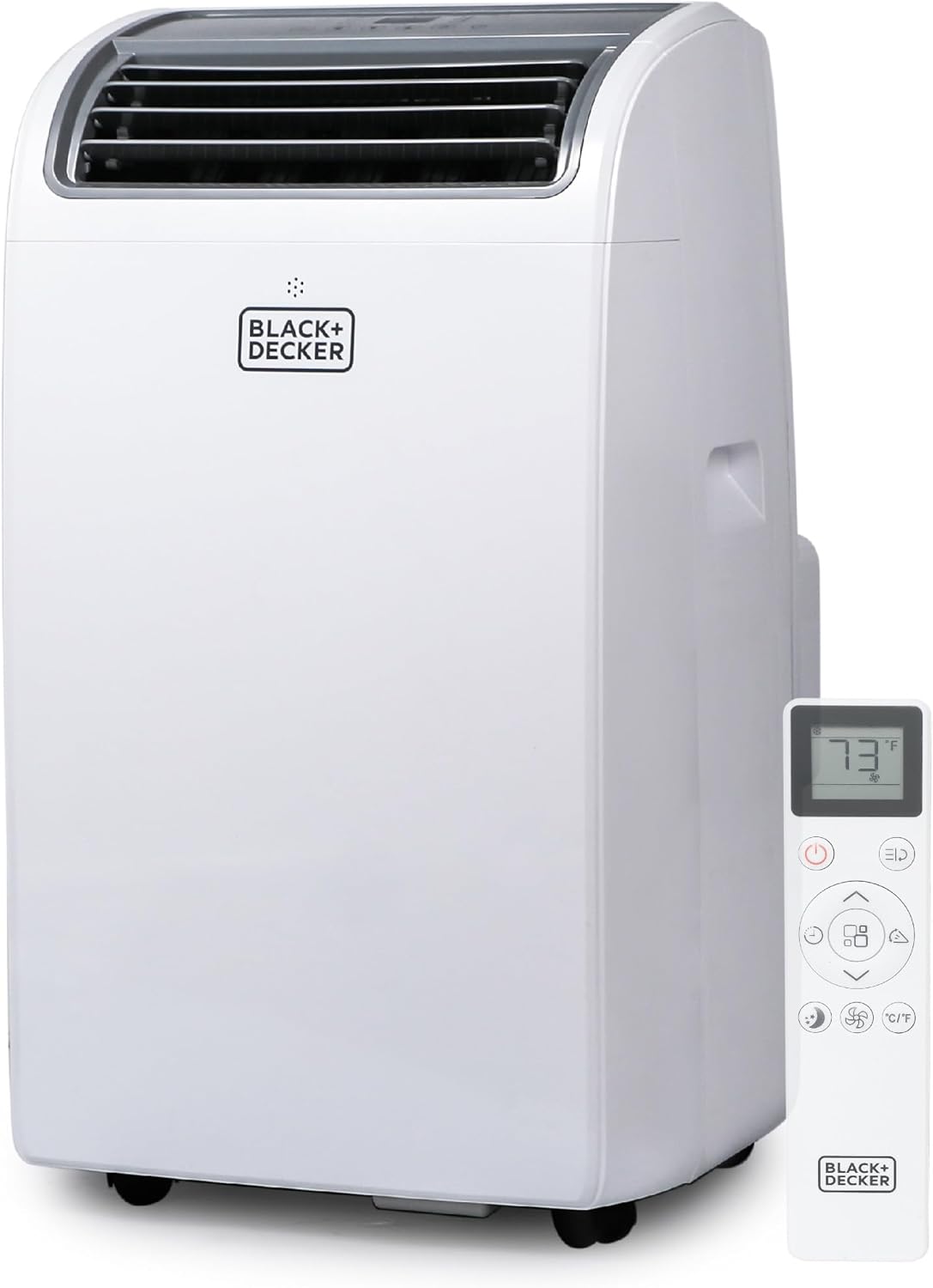
| Cooling Power | 14000 BTU ASHRAE (10,200 BTU SACC) |
|---|---|
| Refrigerant | R-32 |
| Wattage | 1365 watts |
| Control Method | Remote; Wi‑Fi app; voice assistant compatibility |
| Floor Area | 700 square_feet |
This BLACK+DECKER portable air conditioner is a mobile 3‑in‑1 unit that cools, functions as a dehumidifier, and acts as a fan for rooms up to about 700 sq ft. It uses 14,000 BTU ASHRAE (10,200 BTU SACC) capacity and ships with a window vent kit, exhaust hose and full‑function remote with a Follow Me thermostat feature for spot temperature control. Smart features include Wi‑Fi app control and compatibility with voice assistants, while the top LED panel and three power levels keep operation straightforward. Practical benefits include caster wheels and side handles for moving between rooms, a 24‑hour timer and a sleep mode for quieter overnight use, and a washable filter for simpler upkeep. Important limits are its heavy weight and relatively high noise level compared with quieter split systems, and the unit's cooling rating reflects DOE SACC values that are lower than the ASHRAE number buyers often see. Expect standard portable‑AC efficiency rather than the performance of a built‑in system and plan for venting and occasional water drainage in dehumidify mode.
Best for: Buyers who want a powerful, feature‑rich portable AC that can cool a large room and appreciate smart controls and an included installation kit for quick setup.
Less Ideal for: People who prioritize whisper‑quiet operation, the highest possible energy efficiency, or a permanently installed cooling solution should consider other options.
- High cooling capacity intended for rooms up to about 700 sq ft
- Includes complete window vent kit and exhaust hose for straightforward installation
- Wi‑Fi and voice assistant control plus a Follow Me remote for convenient temperature management
- Rolls on casters with integrated handles for reasonably easy room-to-room mobility
- Washable filter and dehumidify mode simplify maintenance and add seasonal usefulness
- Heavier and louder than split or window units, which may affect placement and night use
- Efficiency ratings are typical for portable units and lower than permanent HVAC options
Verdict: A strong, smart‑enabled portable AC that reliably cools large rooms and arrives ready to vent and use with a full installation kit.
Choosing the Right Air Conditioner for Tent: Key Factors to Consider
Cooling Capacity Relative to Tent Size
Cooling capacity determines how quickly and effectively an air conditioner can lower the temperature inside a tent. Tents have small, often oddly shaped internal volumes and typically poor insulation, so an AC with a high BTU rating designed for small spaces or variable modes will perform best.
If you undersize the unit, it will run constantly without bringing temperatures down. Oversizing can lead to short cycling, which reduces dehumidification and can cause uneven cooling. Consider the tent's floor area and peak daytime temperature when estimating needed capacity, and choose a unit that can modulate output or has low-speed operation for milder nights.
Power Source and Consumption
Power availability is often the limiting factor for tent camping. Determine whether you will have access to shore power, a portable generator, or battery power. Each option imposes constraints: generators provide ample wattage but add noise and fuel needs; batteries mandate more efficient or lower-draw units.
Check continuous and starting wattage requirements, not just nominal ratings. Look for units that offer eco or low-power modes, adjustable fan speeds, or compatibility with common inverter setups. Efficient airflow design and variable-speed compressors can significantly reduce energy draw while maintaining comfort.
Noise and Vibration
Tents amplify sound, and noisy compressors or fans will disturb sleep and conversation. Evaluate declared noise ratings and prefer models with low decibel levels at typical operating distances. Also consider vibration damping and how the unit will be mounted or supported inside the tent to avoid rattling.
Even a modest difference in noise can matter when the tent interior is just a few feet from the unit. Units with quieter fan motors, brushless designs, or insulated housings will improve comfort. If noise is a priority, look for lower-speed or variable-speed settings that let you trade some cooling power for quieter operation at night.
Portability, Size, and Weight
Portability affects how practical an air conditioner is for tent trips. Weight, overall dimensions, and whether the unit breaks down for transport influence whether you can carry it to the campsite and fit it within your vehicle or pack.
Compact units with integrated handles, removable components, or modular designs are easier to manage. Also assess how the unit will be placed inside the tent and whether it needs a stable flat surface or can be suspended. Consider storage space when the unit is not in use and the ease of cleaning and winterizing for off-season storage.
Setup, Venting, and Compatibility with Tent Openings
A good tent air conditioner should have practical setup options that do not require invasive modifications to the tent. Evaluate how the unit vents heat and condensate and whether that venting can be routed through existing tent panels, windows, or ports.
Some units require dedicated exhaust hoses or drip management, while others are designed for small enclosures and manage condensate internally. Check how straightforward the mounting and sealing steps are because poorly sealed exhausts reduce efficiency and can allow warm air back into the tent. Units that adapt to common tent openings or come with flexible venting options simplify installation.
Durability and Weather Resistance
Outdoor use exposes equipment to dust, humidity, and occasional splashes. Choose units with corrosion-resistant components, sealed electronics, and a robust housing that tolerates the rougher handling and environmental exposure typical of camping.
Look for simple serviceability and accessible filters to keep the unit operating reliably season after season. While no portable tent AC is meant to be left exposed in a storm, a design that sheds water and resists dust will require less maintenance and last longer.
Types of Cooling Solutions for Tents
There are several practical cooling approaches for tents including compact portable air conditioners, evaporative coolers, and spot coolers that direct conditioned air. Each approach has strengths and tradeoffs related to humidity, efficiency, and power needs.
Portable air conditioners provide direct cooling and dehumidification but often need a way to handle exhaust and condensate. Evaporative coolers use less energy and are lighter but increase humidity and work best in dry climates. Spot coolers focus cooling on a small area and can be efficient for sleeping spaces when you pair them with good airflow management.
- Portable ACs: Strong cooling and dehumidification, higher power draw.
- Evaporative coolers: Lower power, increases humidity, best in arid conditions.
- Spot coolers: Targeted cooling, can be efficient for single-occupant tents.
Power Planning for Remote Campsites
Plan power around the highest expected draw and include a safety margin. If you depend on a generator, account for starting surge. For battery or solar setups, calculate run time at typical operating power and consider a battery with inverter efficiency losses.
Bring power-management accessories like low-loss extension cords, rated adapters, and a reliable surge protector. Consider scheduling heavier cooling for the hottest part of the day and switching to low-power or fan-only modes overnight to conserve power.
- Match continuous amp draw to your inverter or generator capability.
- Estimate run time for battery systems before you leave camp.
- Use insulated tent positioning and shade to reduce continuous cooling needs.
Installation Tips to Maximize Efficiency
Position the unit near a tent panel that can serve as an exhaust or intake port and seal gaps to prevent warm air infiltration. Elevate the unit slightly if condensation drainage is required to avoid water pooling on tent floors.
Use reflective tarps or shade canopies to reduce direct solar heating of the tent. Improve internal airflow by adding low-power fans to distribute cool air from the unit into sleeping and living areas, which reduces the need for higher BTU capacity.
- Seal seams and vents to prevent warm-air leaks.
- Use shaded placement and ventilation to cut peak cooling load.
- Add small circulation fans to even out temperature.
Maintaining a Tent Air Conditioner in the Field
Regular maintenance keeps a unit running reliably while camping. Clean or replace filters frequently to maintain airflow, and clear dust and debris from intake and exhaust paths. Check condensate trays or pumps and empty or service them according to the manufacturer's guidance.
Carry basic spare parts and tools such as extra filters, small hose clamps, and a compact toolkit. After use, dry the unit thoroughly before storage to prevent mold and corrosion. Simple preventive steps reduce breakdown risk during trips.
- Inspect and clean filters before each trip.
- Drain condensate and dry components after use.
- Pack basic spares for common field issues.
Comfort Tradeoffs: Cooling Vs. Humidity
Understand that lowering temperature and controlling humidity are separate tasks. Traditional refrigerant-based air conditioners remove moisture while cooling, which improves overall comfort in humid climates. Evaporative coolers lower temperature by adding moisture, which can be counterproductive in already humid environments.
Select the technology that complements the local climate. In dry desert settings, evaporative cooling can be energy-efficient and comfortable. In humid woods or tropical areas, a unit that dehumidifies as it cools will typically deliver better perceived comfort.
- Refrigerant ACs remove moisture and are better for humid sites.
- Evaporative systems save energy in dry climates but increase humidity.
- Assess local humidity patterns when choosing cooling technology.
How We Chose the Best Air Conditioner for Tent
We selected units based on criteria that matter specifically to tent use rather than home or RV installations. Cooling capacity relative to small, often poorly insulated tent volumes was a primary filter. We favored units that deliver measurable cooling output while maintaining reasonable airflow distribution for compact spaces. Power flexibility was another key criterion. We prioritized air conditioners that offer multiple power options such as battery compatibility, low-voltage modes, or the ability to run off common portable generators or inverters. Noise level and fan design were evaluated because tents amplify sound; quieter operation improves sleep and general comfort. Portability, weight, and footprint were included to ensure practical transport and setup for camping. We also looked at ease of setup and venting options that work with tent openings or removable panels. Units needing specialized permanent installation were excluded. Finally, durability and basic weather tolerance were considered to avoid models that cannot withstand typical outdoor conditions.
Our full evaluation process is outlined in our review methodology.
FAQ
Can I run an air conditioner in a tent from a battery?
Often yes, but it depends on the unit's continuous and startup power draw and the battery/inverter capacity. Lower-draw units and efficient inverters can run for several hours on large battery banks, while higher-capacity units will need a generator or substantial battery system.
How do I handle exhaust and condensate inside a tent?
Plan to route exhaust through a tent zip or panel using flexible ducting and seal gaps to prevent warm-air return. For condensate, use internal trays that collect and can be emptied, or route condensate outside through a small hose. Ensure drainage does not wet sleeping areas.
Are evaporative coolers a good substitute in humid locations?
Usually not. Evaporative coolers add moisture while cooling and perform poorly in high-humidity environments. They work best in dry climates where added humidity is comfortable and helps lower temperatures efficiently.
What noise level is acceptable for tent use?
Acceptable noise varies by sleeper sensitivity, but lower decibel ratings and variable-speed operation are preferable. Aim for the quietest practical option or a unit with a nighttime mode to reduce disturbance when the tent is close to the unit.
How should I size an air conditioner for a two-person tent?
Size based on the tent's floor area and expected peak temperature rather than occupancy alone. Small tents typically need far less BTU capacity than rooms; choose a unit that can modulate output or has low-speed settings to avoid short cycling in a compact shelter.
Final Verdict
When choosing an air conditioner for tent use, prioritize the combination of adequate cooling output and practical power options. Noise, portability, and ease of setup are often decisive tradeoffs for campsite comfort and convenience. Balance BTU capacity with available power and select a solution that fits your typical climate. Focusing on efficient operation, quiet performance, and simple venting will help you pick a unit that keeps your tent comfortable without undue complexity.