
Note: This article contains affiliate links. If you click on these links and make a purchase, we may earn a small commission at no extra cost to you. This helps support our research and content. Read our full affiliate disclosure here.
If you live where humidity is as much a problem as heat, choosing the right air conditioner matters for comfort, mold prevention, and energy use. A unit that cools well but fails to remove moisture can leave rooms clammy and encourage musty smells. This guide covers seven shortlisted air conditioners optimized for humid climates, with attention to moisture removal, sensible cooling performance, energy use, and noise. Below we summarize the evaluation approach and decision factors so you can pick a model that fits your room size, ventilation, and usage pattern.
Top Picks at a Glance
| Best Overall The best all-around choice for most situations | ZAFRO Inverter Portable AC 16000 BTU |  |
| Best Quality Built to a higher standard if you want something more solid | Gasbye CoolPrime 10000 Portable AC |  |
| Best Value The sweet spot between price and what you get | Zelimon 10000 BTU Portable AC |  |
| Best Budget The cheapest option that still gets the job done reliably | IDEALHOUSE 8000 BTU Portable Air Conditioner | 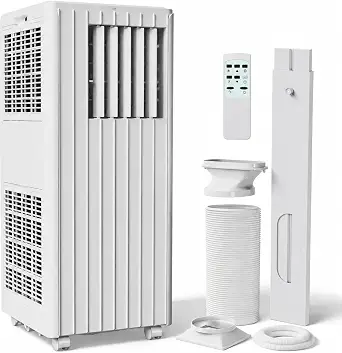 |
| Top Rated A top-rated pick with lots of positive feedback | Whynter ARC-14S 14,000 BTU Portable AC |  |
| Most Popular A crowd favorite that many people choose with confidence | BLACK+DECKER Portable Air Conditioner BPACT08WT |  |
| Best Seller A high-volume bestseller chosen again and again | BLACK+DECKER Portable Air Conditioner BPACT14WT |  |
ZAFRO Inverter Portable AC 16000 BTU

| Cooling Power | 16000 british thermal units |
|---|---|
| Floor Area | 800 square_feet |
| Noise | 42 db |
| Refrigerant | R-32 |
| Control Method | App, Remote, Touch |
The ZAFRO 16000 BTU inverter portable AC is built to deliver fast, even cooling in large spaces using a dual-hose design and a high airflow rate. It uses an inverter compressor to hold temperature precisely and reduce cycling, and an Extra Mode can push the unit to its lowest setpoint for quick relief during heat spikes. Smart features include app, touch, and remote control plus a 24-hour timer, filter reminders, and sleep mode that reduces noise to about 42 dB. The self-evaporating condensate system lets the unit run drainage-free for up to 72 hours in typical humidity levels, and a drain hose is included for very humid conditions. Energy efficiency is strong for the class with a listed SEER/CEER of 12.8, but expect a heavy, bulky cabinet and the usual portability compromises for a high-capacity unit. Installation requires routing the exhaust and using the included multi-piece window panel, so plan for a short setup and clear window access. For large rooms this model provides robust, smart-controlled cooling but takes up floor space and needs a dedicated window opening for the exhaust setup.
Best for: Buyers who prioritize strong, responsive cooling for large rooms and want smart controls and energy-efficient inverter performance to maintain steady comfort.
Less Ideal for: People who need a compact, lightweight cooler for small rooms or frequent moves between locations should consider smaller, lighter models instead.
- Dual-hose design and high airflow for faster, more even cooling in large rooms.
- Inverter compressor for stable temperature control and improved energy efficiency (SEER/CEER 12.8).
- Smart controls: app, remote, and touch with 24-hour timer and scheduling.
- Self-evaporating system provides up to 72 hours drainage-free operation in normal humidity.
- Multiple modes including Extra and Sleep for rapid cooling or quiet overnight use.
- Large and heavy for a portable unit, requiring dedicated floor space and window access.
- May need active draining in very humid environments despite the self-evaporating feature.
Verdict: Choose this unit if you need powerful, energy-efficient inverter cooling and smart remote control for reliably cooling large rooms.
Gasbye CoolPrime 10000 Portable AC

| Cooling Power | 14000 BTU (ASHRAE) / 10,500 BTU SACC |
|---|---|
| CEER / SEER | 13.6 CEER |
| Power | 1290 watts |
| Noise | 45 db |
| Floor Area | 550 square_feet |
The Gasbye CoolPrime 10000 is a full-size dual-hose portable air conditioner built around a DC inverter compressor for steady, efficient cooling in large rooms. It uses a dual-hose design to separate intake and exhaust airflow, which helps maintain neutral indoor pressure and speeds up temperature drop compared with single-hose units. The inverter compressor adjusts output between turbo and low-power modes, letting the unit deliver strong cooling when needed while reducing power draw and compressor noise during steady-state operation. Controls are handled by a backlit remote and the top display can be turned off for night use. Practical benefits include higher measured CEER efficiency, a higher realistic SACC cooling rating for sustained performance, and included window brackets and hoses sized for typical installations; the unit also has an accessible rear drain outlet for high-humidity situations. Trade-offs are its full-size footprint and substantial weight, which make it less portable than compact models, and the need to plan for proper hose routing and window bracket fitment to preserve performance.
Best for: Buyers who need a portable air conditioner that can reliably cool large rooms and want a unit focused on sustained performance, energy efficiency, and lower compressor noise.
Less Ideal for: People who prioritize frequent relocations between rooms, very compact units, or the quietest possible operation achievable with an outdoor-compressor split system should consider other options.
- Dual-hose design maintains neutral indoor pressure and speeds cooling compared with single-hose units
- Full DC inverter compressor offers adjustable output for better energy use and lower sustained noise
- High verified CEER (13.6) and SACC-based cooling rating for realistic performance in large rooms
- Includes window vent kits, dual hoses, and backlit remote for immediate installation and night-friendly use
- Large physical footprint and heavy weight reduce ease of moving between rooms
- Requires correct hose length and window bracket setup to avoid performance loss
- No multi-speed airflow options beyond two power levels
Verdict: Choose the Gasbye CoolPrime 10000 when you need a portable AC that delivers real-world, energy-efficient cooling for large rooms with lower compressor noise thanks to a full DC inverter and dual-hose design.
Zelimon 10000 BTU Portable AC

| Cooling Power | 10000 british thermal units |
|---|---|
| Refrigerant | R-32 |
| Wattage | 845 watts |
| SEER | 6.52 |
| Filter Type | Silver Ion Filter |
The Zelimon 10000 BTU portable air conditioner is a plug-in unit designed to cool medium rooms and reduce indoor humidity without permanent installation. It offers cooling, fan, dehumidifier, and sleep modes, controlled by push buttons, touch panel, or the included remote, and comes with a window installation kit and exhaust hose for no-drill setup. The unit uses R-32 refrigerant and a silver ion filter, and its 24-hour timer and adjustable humidistat help manage comfort across day and night. Practical features like built-in wheels and side handles make it easy to move between bedrooms, apartments, or home offices. Expect noticeable humidity reduction in damp rooms, though the listed SEER of 6.52 and 845-watt draw indicate moderate energy use compared with high-efficiency split systems. Noise is reported around 50 dB which is typical for portable models and may be noticeable in very quiet bedrooms. For renters or anyone needing temporary cooling and dehumidification without modifications, this unit balances functionality and convenience well.
Best for: Buyers who prioritize practical, no-permanent-install cooling and active humidity control for apartments, bedrooms, or temporary spaces and value simple setup and mobility.
Less Ideal for: People seeking the quietest possible bedroom cooling or the highest energy efficiency for long-term whole-home use should consider other solutions.
- Multi-mode operation including cooling, fan, and dehumidifier for humid climates
- No-drill window installation kit and exhaust hose for easy setup in rentals
- Included remote control and LED panel with 24-hour timer and adjustable humidistat for convenient operation
- Built-in wheels and side handles for straightforward room-to-room portability
- Moderate energy efficiency (SEER 6.52) and 845 W power draw compared with higher-efficiency options
- Noise level around 50 dB that may be noticeable in very quiet sleeping spaces
Verdict: A portable, renter-friendly 10,000 BTU unit that combines cooling and dehumidifying with easy setup and mobility for practical humidity control.
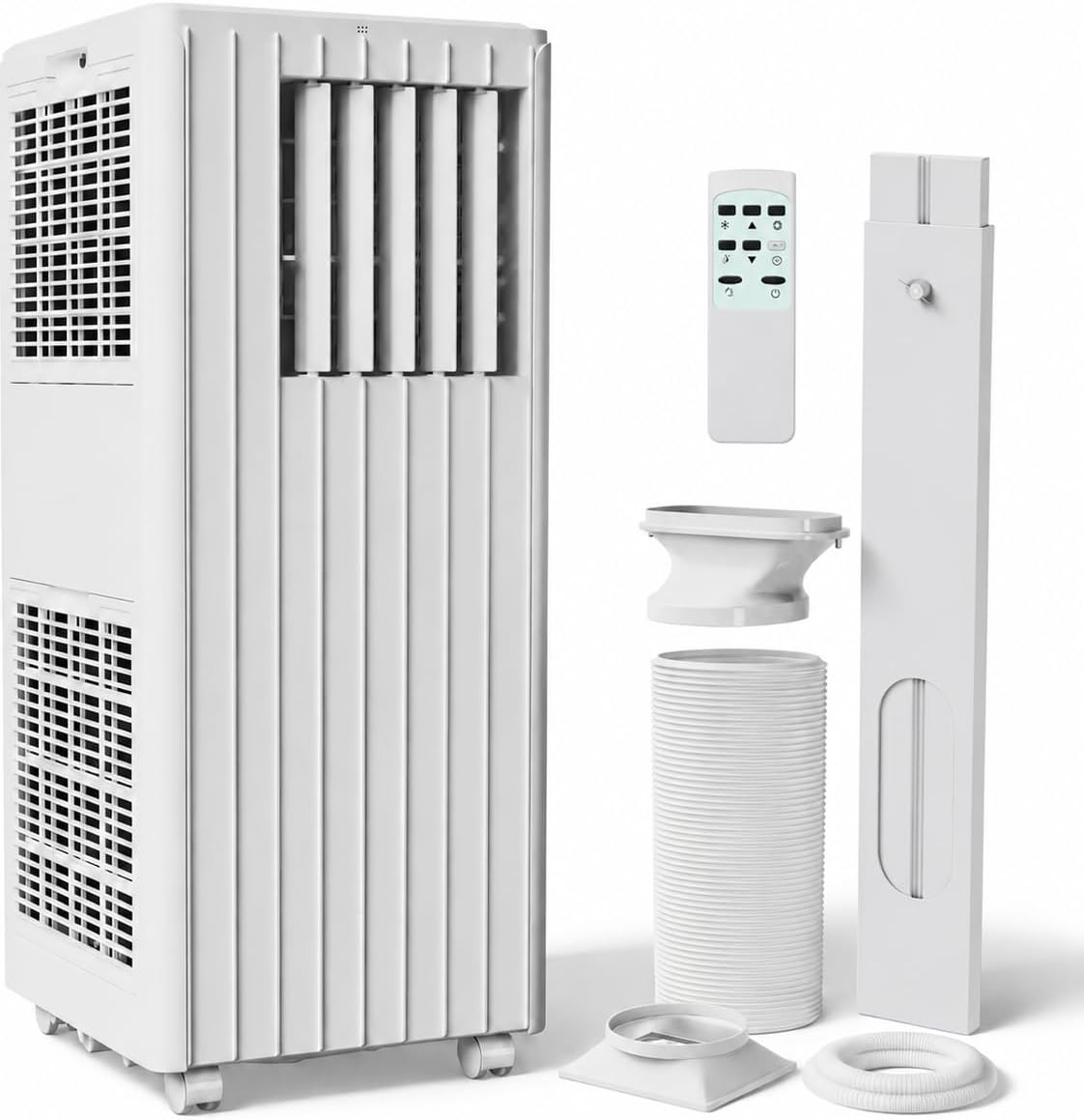
IDEALHOUSE 8000 BTU Portable Air Conditioner
| Cooling Power | 8000 british thermal units |
|---|---|
| Wattage | 699 |
| Floor Area | 350 square_feet |
| Noise | 55 db |
The IDEALHOUSE 8000 BTU portable air conditioner provides spot cooling, dehumidifying, and fan functions in a single compact unit for small to medium rooms. It is typically used in bedrooms, home offices, or apartments where window or central systems are unavailable; the included window kit and exhaust hose make tool-free installation straightforward. Notable features include an 8000 BTU cooling capacity (ASHRAE/DOE listed), a dehumidifier that can remove moisture daily, two fan speeds plus a quiet sleep mode, a 24-hour timer, and both touch and remote controls for convenience. In practice the unit cools modestly sized rooms effectively and helps with humidity by pulling moisture from the air, which is useful in humid climates where both cooling and dehumidification are needed. Trade-offs are its limited coverage compared with larger systems and typical portable AC noise and energy use; it lists 55 dB noise and about 699 watts power, so expect some sound and steady electricity draw during heavy use. The included installation kit and straightforward controls make it a practical, budget-friendly option for renters or anyone needing targeted cooling and moisture control.
Best for: Buyers seeking an affordable, all-in-one portable solution to cool and reduce humidity in a single room—particularly renters or people who need a simple, moveable unit without permanent installation.
Less Ideal for: Homes that need whole-house cooling or large open spaces should look to larger or ducted systems instead, and buyers who prioritize whisper-quiet operation may prefer quieter models or mini-splits.
- Combines cooling, dehumidifying, and fan modes in one portable unit
- Includes a full window installation kit for tool-free setup
- Quiet sleep mode and remote control for easy, low-disturbance operation
- Rated to cool rooms up to about 350 sq. ft, suitable for bedrooms and small living spaces
- Limited cooling capacity compared with larger or permanent systems
- Moderate noise level around 55 dB and notable power consumption under heavy use
Verdict: A budget-friendly portable AC that also pulls moisture from the air, making it a practical choice for renters needing targeted cooling and dehumidification in humid climates.
Whynter ARC-14S 14,000 BTU Portable AC

| Cooling Power | 14000 BTU |
|---|---|
| Wattage | 1300 watts |
| Noise | 51 db |
| Floor Area | 500 square_feet |
| Capacity | 71 pints |
The Whynter ARC-14S is a heavy-duty dual-hose portable air conditioner designed for large rooms up to about 500 square feet. Its 14,000 BTU cooling (SACC lower) and dual-hose design deliver stronger, more consistent cooling than single-hose units, while the built-in dehumidifier and patented auto-drain help manage moisture without frequent emptying. It offers three modes—cool, dehumidify, and fan—with full thermostat control and a remote for convenient operation. The unit includes an activated carbon filter and washable pre-filter to improve indoor air quality. Practical benefits include a high dehumidifying capacity and relatively quiet low-speed operation at around 51 dB, plus a solid accessory kit for window installation and storage. Expect a large, heavy unit that needs a proper window vent and a dedicated circuit given its 1300 W draw, and its energy efficiency is moderate rather than top-tier. Setup and mobility are straightforward for a freestanding unit of this size, but it is bulkier than compact portable ACs and consumes notable power under sustained use.
Best for: Buyers who prioritize a dependable, high-capacity portable AC for cooling and moisture control in large rooms and want a unit built for continuous, low-maintenance operation.
Less Ideal for: People who need a lightweight, highly energy-efficient, or purely budget portable AC for small rooms or occasional spot cooling should consider smaller or inverter-based alternatives.
- Dual-hose design for more consistent cooling in large rooms
- Built-in dehumidifier with auto-drain reduces maintenance
- High cooling capacity suitable for ~500 sq ft spaces
- Includes activated carbon and washable pre-filter for better air quality
- Remote and panel controls with three fan speeds for easy operation
- Relatively high power consumption compared with smaller units
- Large and heavy, requires adequate space and a proper window vent
- Not ENERGY STAR rated, so long-term operating costs may be higher
Verdict: A robust, reliability-focused portable AC that pairs strong dual-hose cooling with a high-capacity dehumidifier, making it a sensible choice for cooling and moisture control in large rooms.
BLACK+DECKER Portable Air Conditioner BPACT08WT

| Cooling Power | 9000 BTU (5,300 BTU SACC) |
|---|---|
| Power Source | Corded Electric (115 volts, 935 watts) |
| Refrigerant | R-32 |
| Dehumidifier Capacity | 0.45 L water collection tank |
| Timer & Modes | 24-hour timer, Sleep Mode, Remote control |
This BLACK+DECKER portable air conditioner combines cooling, dehumidifying, and fan modes in a single, wheeled unit for seasonal use in bedrooms, home offices, and similar spaces. It delivers 9,000 BTU (5,300 SACC) cooling power, uses R32 refrigerant, and includes a full-function remote with a Follow Me thermostat for localized temperature control. The unit is designed for easy installation with the included window kit and can self-evaporate moisture in many conditions while offering a 0.45 L collection tank for dehumidify mode. Practical benefits include casters and side handles for room-to-room mobility, a reusable washable filter, and a sleep mode and 24-hour timer for overnight use. Expect typical portable AC limitations: noise is noticeable at higher fan speeds, and actual cooling will vary with room layout and outside heat; it is not a permanently installed solution and requires venting. For humid climates the dehumidify function helps remove moisture, but very large or extremely damp spaces may still need a dedicated dehumidifier or larger-capacity AC for best results.
Best for: Buyers who prioritize a single, easy-to-install unit that both cools and reduces humidity in bedrooms or home offices and value social proof and risk reduction from a well-known brand.
Less Ideal for: Do not choose this unit for whole-house cooling, very large open-plan rooms, or cases where the absolute quietest operation is required.
- Combines air conditioning, dehumidifying, and fan modes in one portable unit
- Included window kit simplifies venting and seasonal installation
- Follow Me remote allows localized temperature control and convenience
- Casters and side handles make it easy to move between rooms
- Washable reusable filter reduces replacement cost and maintenance waste
- Higher noise levels at stronger fan settings can be noticeable in quiet rooms
- Cooling rating (5,300 BTU SACC) is appropriate for small to medium rooms but may struggle in very hot or poorly insulated spaces
Verdict: A convenient, mobile 3-in-1 unit that cools and reduces humidity in small to medium rooms while offering easy installation and remote control for worry-free seasonal use.
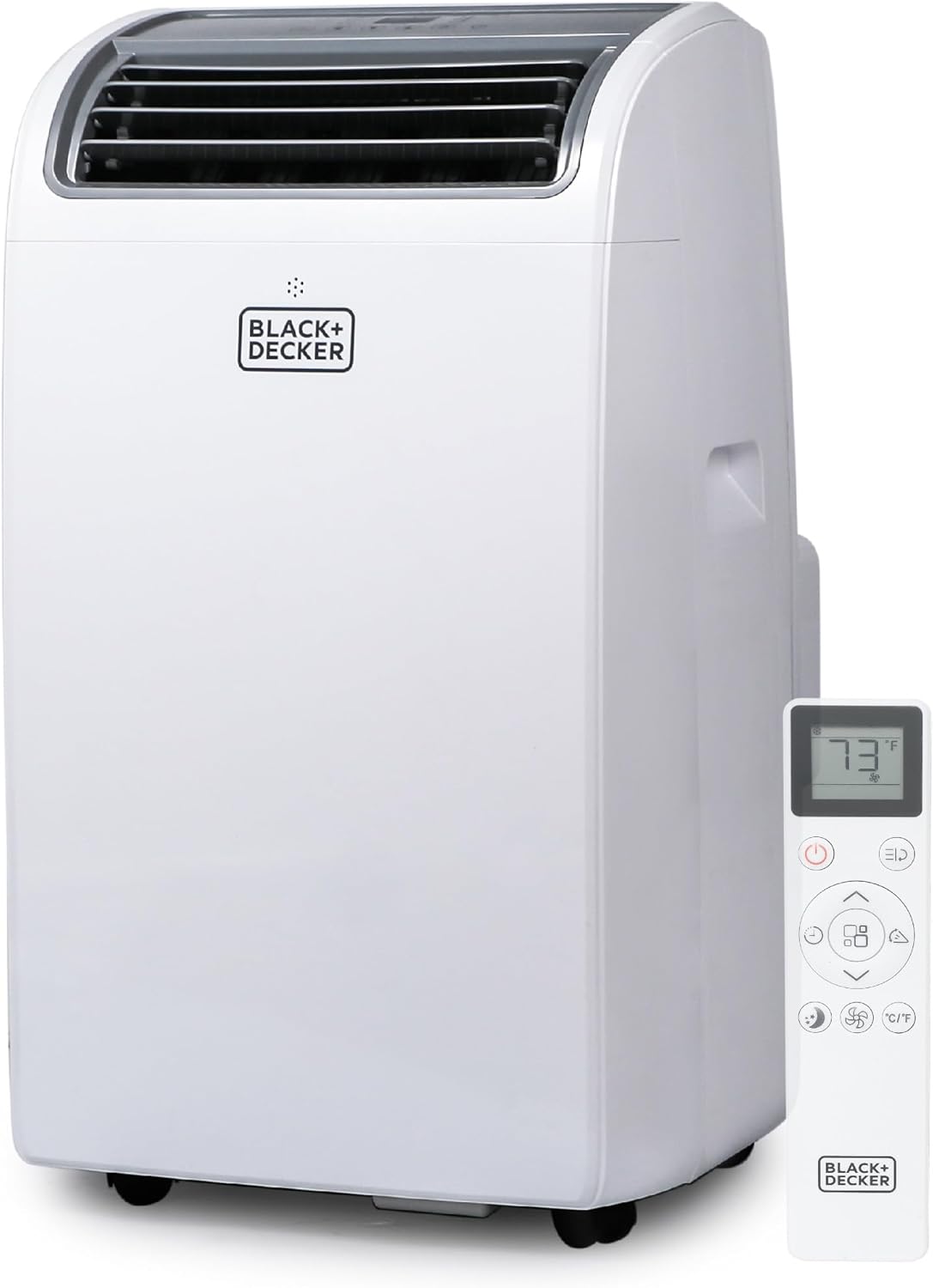
BLACK+DECKER Portable Air Conditioner BPACT14WT
| Cooling Power | 14000 BTU ASHRAE (10,200 BTU SACC) |
|---|---|
| Refrigerant | R-32 |
| Wattage | 1365 watts |
| Control Method | Remote; Wi‑Fi app; voice assistant compatibility |
| Floor Area | 700 square_feet |
This BLACK+DECKER portable air conditioner is a mobile 3‑in‑1 unit that cools, functions as a dehumidifier, and acts as a fan for rooms up to about 700 sq ft. It uses 14,000 BTU ASHRAE (10,200 BTU SACC) capacity and ships with a window vent kit, exhaust hose and full‑function remote with a Follow Me thermostat feature for spot temperature control. Smart features include Wi‑Fi app control and compatibility with voice assistants, while the top LED panel and three power levels keep operation straightforward. Practical benefits include caster wheels and side handles for moving between rooms, a 24‑hour timer and a sleep mode for quieter overnight use, and a washable filter for simpler upkeep. Important limits are its heavy weight and relatively high noise level compared with quieter split systems, and the unit's cooling rating reflects DOE SACC values that are lower than the ASHRAE number buyers often see. Expect standard portable‑AC efficiency rather than the performance of a built‑in system and plan for venting and occasional water drainage in dehumidify mode.
Best for: Buyers who want a powerful, feature‑rich portable AC that can cool a large room and appreciate smart controls and an included installation kit for quick setup.
Less Ideal for: People who prioritize whisper‑quiet operation, the highest possible energy efficiency, or a permanently installed cooling solution should consider other options.
- High cooling capacity intended for rooms up to about 700 sq ft
- Includes complete window vent kit and exhaust hose for straightforward installation
- Wi‑Fi and voice assistant control plus a Follow Me remote for convenient temperature management
- Rolls on casters with integrated handles for reasonably easy room-to-room mobility
- Washable filter and dehumidify mode simplify maintenance and add seasonal usefulness
- Heavier and louder than split or window units, which may affect placement and night use
- Efficiency ratings are typical for portable units and lower than permanent HVAC options
Verdict: A strong, smart‑enabled portable AC that reliably cools large rooms and arrives ready to vent and use with a full installation kit.
Choosing the Right Air Conditioner for Humid Climate: Key Factors to Consider
Dehumidification Capability
How much water the unit can remove per hour matters because humidity, not just temperature, defines comfort in humid climates. A higher dehumidification rate shortens drying times after showers or rainy periods and reduces the chance of mold growth.
Look for specs that list liters or pints removed per day, and understand that performance depends on room size and airflow. Continuous or dedicated dehumidify modes, adjustable humidity setpoints, and fan-speed control let you prioritize moisture removal over extra cooling when needed.
Correct Cooling Capacity
An air conditioner sized correctly for the room will run in longer cycles and remove more moisture than an oversized unit that cycles on and off. Oversized systems cool quickly but often leave humidity high because they do not run long enough to condense moisture from the air.
Calculate or confirm recommended capacity for your square footage and room height. Factor in heat sources like direct sun, appliances, or many occupants, and prioritize units with capacity or staging options that better match your actual load.
Energy Efficiency and Seasonal Performance
Energy efficiency affects operating cost and how long the system runs, which in turn influences dehumidification. A more efficient unit may run longer at lower power draw, improving moisture removal while keeping energy bills lower.
Check seasonal efficiency ratings and consider how those numbers translate to humid-weather operation. Features such as variable-speed compressors or inverter technology typically allow the system to modulate output and maintain steady humidity control with fewer start-stop cycles.
Airflow and Distribution
Proper airflow across the evaporator coil is essential for effective moisture removal. Restricted return or supply airflow reduces the coil's ability to condense water from the air and can lead to frosting or reduced capacity.
Think about placement and ducting or louvers so air circulates through the room rather than creating dead zones. Units with adjustable louvers, multi-speed fans, or better throw characteristics will spread conditioned, drier air more evenly, improving perceived comfort.
Controls and Humidity Management
User controls determine how easily you can target humidity rather than just temperature. A clear humidity setpoint, programmable schedules, or built-in hygrometer let you maintain a desired relative humidity without overcooling.
Smart or remote controls that report humidity and allow automated adjustments will reduce manual intervention. Also consider whether the unit supports modes like continuous fan, sleep, or dehumidify-only for fine-tuned daily operation.
Maintenance Needs and Durability
In humid climates, components face greater risk of corrosion, biological growth, and clogging. Easy access to filters, washable capture media, and straightforward coil cleaning reduce long-term performance loss.
Evaluate the expected filter type and replacement frequency, drain options for condensate, and whether the outdoor components have coatings to resist moisture-related wear. Lower maintenance burden preserves dehumidification capability and avoids costly service visits.
How Humidity Changes Cooling Needs
High humidity raises the apparent temperature and increases discomfort even when the air temperature is moderate. In humid climates, the sensible cooling load may be similar to drier climates, but the latent load from moisture becomes a dominant factor that affects comfort and indoor air quality.
Because of that extra latent load, choosing an air conditioner that balances sensible and latent cooling is more important than simply picking the highest BTU rating. Systems that run for longer cycles tend to remove more moisture, so design and controls that avoid short-cycling are beneficial.
- Latent load is the energy used to remove moisture, separate from sensible cooling.
- Short run cycles reduce dehumidification effectiveness.
- Steady-state operation often improves indoor humidity control.
Installation Tips for Better Moisture Control
Correct installation directly impacts both cooling and dehumidification. Position units to maximize airflow through the occupied space and ensure returns are unobstructed. For packaged or through-the-wall units, confirm that the condensate drain is properly routed and has a trap where required.
In multi-room settings, consider airflow pathways so that drier air reaches interior spaces. Poor sealing around windows, doors, and openings can flood a room with humid outdoor air and counteract any unit's dehumidification efforts.
- Verify condensate drain slope and accessibility for maintenance.
- Avoid placing units where direct sunlight hits intake grills.
- Seal gaps and improve insulation to reduce moisture infiltration.
Operation Strategies to Prioritize Dehumidification
If humidity is the primary problem, use dedicated dehumidify modes or set slightly lower fan speeds to lengthen run cycles. Lower fan speeds keep air on the coil longer, increasing moisture extraction without necessarily overcooling the room.
Run the system for short periods after activities that raise humidity, such as showers or cooking. Use temporary boosts or continuous fan modes sparingly because continuous fans can re-evaporate condensate in some designs if condensate drains are not functioning well.
- Use dehumidify mode or set a humidity target when available.
- Lower fan speeds can increase moisture removal per cycle.
- Run periodic ventilation when outdoor humidity is lower than inside.
Maintenance Checklist for Humid Environments
Regular maintenance preserves dehumidification performance. Clean or replace filters on the schedule recommended by the manufacturer, clear debris from outdoor coils, and inspect condensate drains for blockages. Address any signs of rust or biological growth promptly.
Consider annual checks that include verifying refrigerant charge and coil condition. In coastal or very humid areas, protective coatings and sacrificial anodes for outdoor components can extend service life.
- Inspect and clean filters monthly during heavy-use seasons.
- Verify condensate drain lines and pans are clear and draining.
- Schedule professional inspections for refrigerant and coil health.
When To Add Supplemental Dehumidification
Sometimes an air conditioner alone cannot keep indoor humidity within comfortable ranges, particularly in basements, bathrooms, or poorly ventilated spaces. Portable or standalone dehumidifiers can supplement an AC system to target problem areas without changing overall cooling loads.
Use a standalone dehumidifier when you need precise humidity control independently of temperature. These devices can run at times when cooling is not needed and help dry out materials after damp events, reducing mold risk.
- Assess specific problem zones before adding equipment.
- Supplemental dehumidifiers are useful for persistent local moisture.
- Balance overall energy use when running multiple systems.
How We Chose the Best Air Conditioner for Humid Climate
We selected models that demonstrate practical performance in environments where high relative humidity is common. Our editorial filters emphasized measurable moisture removal, consistent sensible cooling, and operational efficiency. We prioritized units with clear capacity ratings that match typical room sizes, reliable fan and compressor control for steady dehumidification, and user-facing controls that support humidity-targeted operation. Key evaluation criteria included dehumidification rate under typical indoor conditions, cooling capacity and sensible heat ratio, energy efficiency at real-world load points, noise levels during run and start-up, and durability features such as corrosion resistance for humid environments. We also considered installation flexibility and ease of maintenance because clogged coils or restricted airflow reduce dehumidification over time. We excluded units intended solely for dry climates, underpowered models for the listed room sizes, and designs that lack basic serviceability. The resulting picks focus on components and features that materially affect performance in humid conditions rather than cosmetic or niche extras.
Our full evaluation process is outlined in our review methodology.
FAQ
Does an air conditioner remove humidity automatically?
Most air conditioners remove moisture as part of the cooling process because warm air condenses on the cold evaporator coil. However, automatic humidity control varies by model. Units with dehumidify modes, humidity setpoints, or variable-speed compressors will manage humidity more effectively than basic on/off systems.
Will running the fan continuously help reduce humidity?
Running the fan continuously can help circulate air but may reduce net dehumidification in some designs because it can re-evaporate condensate on the coil. Use continuous fan only when its circulation benefits outweigh slightly reduced moisture removal, or when paired with a system designed to support that mode.
How should I size an air conditioner for a humid room?
Size for both sensible and latent loads. Start with the square footage guideline, then adjust for high humidity, high occupancy, direct sun, or appliances that add moisture. Oversizing tends to shorten run times and worsen humidity control, so opt for a unit that can maintain longer cycles or has capacity modulation.
Can I rely on ventilation to control humidity?
Ventilation helps when outdoor air is drier than indoor air, but in persistently humid climates outside air often has high moisture too. Use ventilation strategically during cooler, drier periods and combine it with mechanical dehumidification when outdoor humidity is high.
What maintenance matters most for dehumidification?
Keeping filters and coils clean, ensuring proper condensate drainage, and maintaining correct refrigerant charge are the biggest factors. Restricted airflow or blocked drains significantly reduce moisture removal and can lead to icing or corrosion.
Final Verdict
In humid climates, prioritize units that balance sensible cooling with strong dehumidification capability and offer controls to target indoor humidity. Size the system so it runs in longer cycles and choose features such as variable-speed operation or dedicated dehumidify modes to improve moisture removal without excessive energy use. Focus on proper installation, regular maintenance, and operational habits that support steady run times. With those tradeoffs in mind, you can select an air conditioner that keeps spaces both comfortably cool and acceptably dry.