
Note: This article contains affiliate links. If you click on these links and make a purchase, we may earn a small commission at no extra cost to you. This helps support our research and content. Read our full affiliate disclosure here.
Picking the right air conditioner with a dehumidifier matters because it affects both comfort and indoor air quality. A unit that cools well but cannot remove excess moisture will leave rooms feeling clammy and encourage mildew. Conversely, a strong dehumidifier with poor cooling performance can leave you uncomfortable during hot spells. This guide shortlists the top options for combined cooling and dehumidification. We focus on units that balance reliable temperature control, sensible moisture extraction, and practical features for everyday home use. Below you will find our top picks followed by clear evaluation criteria to help you decide which model fits your space and priorities.
Top Picks at a Glance
| Best Overall The best all-around choice for most situations | DREO Portable AC 318S |  |
| Best Quality Built to a higher standard if you want something more solid | Whynter ARC-14S 14,000 BTU Portable AC |  |
| Best Value The sweet spot between price and what you get | TOSOT Aovia Portable Air Conditioner |  |
| Best Budget The cheapest option that still gets the job done reliably | IDEALHOUSE 8000 BTU Portable Air Conditioner | 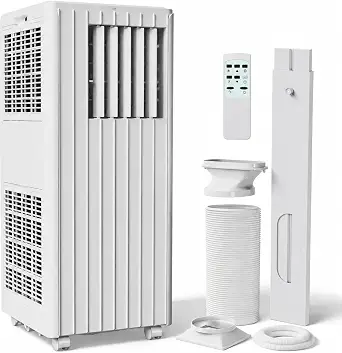 |
| Top Rated A top-rated pick with lots of positive feedback | Midea 12000 BTU Window AC with Heat |  |
| Most Popular A crowd favorite that many people choose with confidence | BLACK+DECKER Portable Air Conditioner BPACT08WT |  |
| Best Seller A high-volume bestseller chosen again and again | BLACK+DECKER Portable Air Conditioner BPACT10WT |  |
DREO Portable AC 318S

| Cooling Power | 8000 BTU (ASHRAE) |
|---|---|
| Cooling Capacity (SACC/DOE) | 5000 BTU |
| Noise | 45 db |
| Power Source | Corded Electric |
| Control Method | App, Remote, Touch, Voice |
The DREO Portable AC 318S is a compact 8000 BTU ASHRAE (5000 BTU DOE) portable air conditioner designed for bedroom and living-room use, offering cooling, dehumidify, and fan modes in one unit. It is typically set up near a window using the included mount kit and exhaust hose and controlled via touchpad, remote, the DREO app, or voice assistants. Notable features include a self-evaporating drainage-free system that reduces the need to empty water in most conditions, a large LED display, four fan speeds, and multi-method controls for convenient operation. The unit is marketed as relatively quiet at 45 dB and uses R-32 refrigerant. Practical benefits are easy installation for temporary cooling needs, built-in dehumidification that helps during muggy weather, and smart controls that let you monitor temperature and humidity remotely. Important limitations are its modest DOE cooling rating, which targets rooms up to about 100 sq ft, and its non-inverter compressor which may be less efficient than inverter models for sustained heavy cooling. For buyers seeking a balanced, feature-rich portable AC with good dehumidifying capability, this model is a sensible choice.
Best for: Buyers who want a versatile, easy-to-install portable AC that also handles humidity control and offers smart remote controls for everyday bedroom or small living-room comfort.
Less Ideal for: People needing to cool large open spaces or who prioritize the highest energy efficiency and lowest running costs over feature set should consider more powerful or inverter-equipped systems.
- 3-in-1 functionality: cool, dry (dehumidify), and fan modes in one unit
- Drainage-free self-evaporation system reduces manual water removal under typical humidity
- Multiple control options including app, remote, touch, and voice assistants
- Included window mount kit and drain hose simplify installation
- DOE cooling capacity (5000 BTU SACC) is modest, best for small rooms
- Non-inverter compressor may use more power during extended heavy cooling
Verdict: A balanced portable AC that pairs effective dehumidification with smart controls and easy installation for small-room comfort.
Whynter ARC-14S 14,000 BTU Portable AC

| Cooling Power | 14000 BTU |
|---|---|
| Wattage | 1300 watts |
| Noise | 51 db |
| Floor Area | 500 square_feet |
| Capacity | 71 pints |
The Whynter ARC-14S is a heavy-duty dual-hose portable air conditioner designed for large rooms up to about 500 square feet. Its 14,000 BTU cooling (SACC lower) and dual-hose design deliver stronger, more consistent cooling than single-hose units, while the built-in dehumidifier and patented auto-drain help manage moisture without frequent emptying. It offers three modes—cool, dehumidify, and fan—with full thermostat control and a remote for convenient operation. The unit includes an activated carbon filter and washable pre-filter to improve indoor air quality. Practical benefits include a high dehumidifying capacity and relatively quiet low-speed operation at around 51 dB, plus a solid accessory kit for window installation and storage. Expect a large, heavy unit that needs a proper window vent and a dedicated circuit given its 1300 W draw, and its energy efficiency is moderate rather than top-tier. Setup and mobility are straightforward for a freestanding unit of this size, but it is bulkier than compact portable ACs and consumes notable power under sustained use.
Best for: Buyers who prioritize a dependable, high-capacity portable AC for cooling and moisture control in large rooms and want a unit built for continuous, low-maintenance operation.
Less Ideal for: People who need a lightweight, highly energy-efficient, or purely budget portable AC for small rooms or occasional spot cooling should consider smaller or inverter-based alternatives.
- Dual-hose design for more consistent cooling in large rooms
- Built-in dehumidifier with auto-drain reduces maintenance
- High cooling capacity suitable for ~500 sq ft spaces
- Includes activated carbon and washable pre-filter for better air quality
- Remote and panel controls with three fan speeds for easy operation
- Relatively high power consumption compared with smaller units
- Large and heavy, requires adequate space and a proper window vent
- Not ENERGY STAR rated, so long-term operating costs may be higher
Verdict: A robust, reliability-focused portable AC that pairs strong dual-hose cooling with a high-capacity dehumidifier, making it a sensible choice for cooling and moisture control in large rooms.
TOSOT Aovia Portable Air Conditioner

| Cooling Power | 5200 BTU (2017 DOE) |
|---|---|
| Rated BTU | 9,000 BTU |
| Floor Area | 250 square_feet |
| Noise | 51 db |
| Wattage | 900 watts |
The TOSOT Aovia is a compact portable air conditioner designed to cool small rooms while also serving as a dehumidifier and fan. It delivers roughly 9,000 BTU (5,200 BTU DOE standard) of cooling power and is intended for spaces around 200 to 250 sq ft, with a remote and LED control panel for easy operation. Installation is straightforward using the included window kit and exhaust hose, and the unit uses an auto-evaporation system so you rarely need to empty a drain unless humidity is very high. The dehumidifier mode removes moisture at a steady rate, helping reduce clamminess in humid climates. Expect noticeable noise around 51 dB at typical operation, and the unit runs on standard 115V power without inverter technology. It is portable enough to move between rooms but is relatively heavy for a floor unit. For buyers who want a simple, multi-function unit that reduces humidity and cools without complex setup, this model is a practical, space-saving choice, though it is not as energy efficient as higher-end inverter models and may be louder than split systems.
Best for: Practical buyers who want a single, easy-to-install machine that both cools and controls humidity in small bedrooms or living areas without fussing over daily draining.
Less Ideal for: Those seeking the quietest operation, the highest energy efficiency, or a lightweight unit for frequent room-to-room moves should consider other options.
- Three functions in one unit: cooling, dehumidifying, and fan modes
- Includes installation kit and quick-adjust window panel for easy setup
- Auto-evaporation reduces the need to manually drain water in typical conditions
- Remote control and LED panel let you change settings from up to 20 feet away
- Noise level around 51 dB may be noticeable in quiet rooms
- No inverter technology so it is less energy efficient than inverter models
- Relatively heavy for a portable unit, making frequent moves more difficult
Verdict: Buy this if you need a straightforward portable unit that combines cooling and reliable dehumidifying for small rooms with minimal setup.
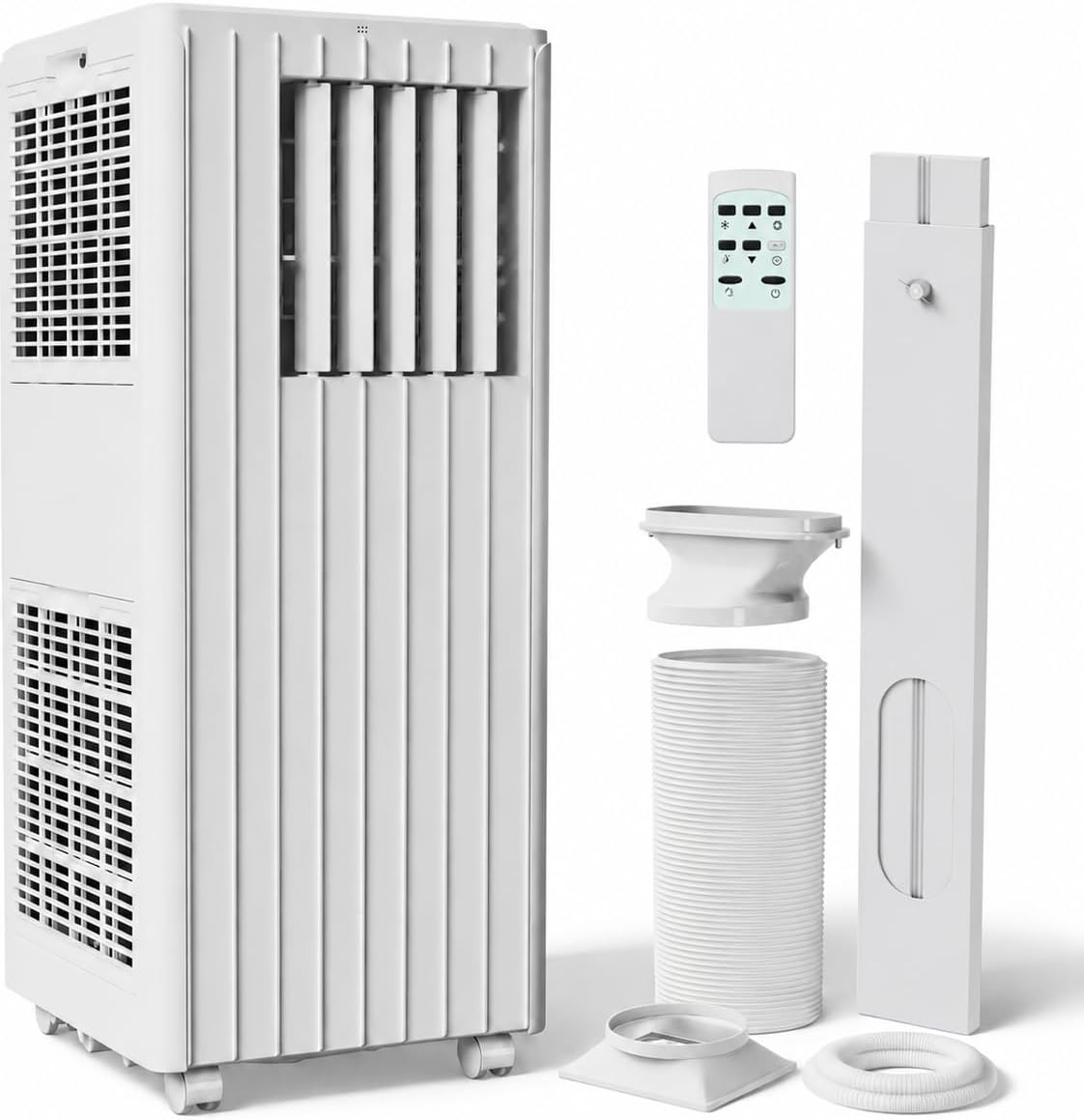
IDEALHOUSE 8000 BTU Portable Air Conditioner
| Cooling Power | 8000 BTU |
|---|---|
| Wattage | 699 W |
| Floor Area | 350 square_feet |
| Noise | 55 db |
This IDEALHOUSE 8000 BTU portable air conditioner is a compact 4-in-1 unit that provides spot cooling, dehumidification, fan-only operation, and a sleep mode for small to medium rooms. It is typically used in bedrooms, home offices, or apartments where a window-mounted or central AC is not available; the included window kit and exhaust hose make installation tool-free for most sliding or double-hung windows. Notable features include remote and touch controls, a 24-hour timer, two fan speeds, and a sleep mode that reduces noise and adjusts temperature overnight. The unit also advertises moisture removal (up to 45 pints daily) which helps in humid environments and reduces reliance on a separate dehumidifier. Practical benefits are straightforward setup, portability to move between rooms, and combined dehumidifier function that keeps indoor air more comfortable. Important limitations are modest cooling power—appropriate for single rooms up to roughly 350 square feet—and audible noise in the mid 50 dB range, so it is less suited where very quiet operation or larger-area cooling is required.
Best for: Buyers seeking an affordable, all-in-one portable unit to cool and dehumidify a single room or rental where permanent installation is not possible.
Less Ideal for: Not a good choice for those needing whole-home cooling, very quiet operation, or higher-capacity cooling for large open-plan spaces.
- Combines cooling and dehumidifying so one unit handles both tasks
- Includes full window installation kit and remote for easy, tool-free setup
- Portable design lets you move the unit between rooms seasonally
- 24-hour timer and sleep mode simplify scheduled and overnight use
- Cooling capacity is limited to single rooms up to about 350 sq ft
- Noise level around 55 dB may be noticeable in quiet bedrooms
Verdict: A budget-friendly portable AC that also dehumidifies, ideal for renters or anyone needing straightforward spot cooling and moisture control in a single room.
Midea 12000 BTU Window AC with Heat

| Cooling Power | 12000 british thermal units |
|---|---|
| Floor Area | 550 square_feet |
| Refrigerant | R-32 |
| Control Method | App, Remote, Touch, Voice |
| Seasonal Energy Efficiency Ratio (SEER) | 13.3 |
The Midea 12,000 BTU window unit blends efficient cooling, dehumidification and supplemental heat in one compact package designed for large rooms up to roughly 550 square feet. It uses variable-speed inverter technology to reach set temperatures quickly while lowering energy use, and the washable front filter plus a dry mode help control humidity without constant maintenance. Controls are flexible: onboard buttons, remote, app and voice assistant support let you adjust settings from the couch or remotely. Practical features include multiple modes (Heat, Cool, Dry, Fan, Auto), a 24-hour timer, ECO energy saver and swing louvers for directing airflow. Noise is kept low — the spec lists operation as quiet as 45 dBA — which makes it reasonable for bedrooms or home offices. Important limitations are the heat pump will not operate below about 41°F outdoor temperature and the unit requires a compatible double-hung window and adequate vertical clearance for installation. For buyers who value dependable multi-season performance and lower running costs, this unit is a solid, feature-rich option; those needing true low-temperature heating or a portable solution should look elsewhere.
Best for: Buyers who prioritize dependable year-round performance and lower operating costs and want a single window unit that cools, dehumidifies and provides supplemental heat with modern smart controls.
Less Ideal for: People who need primary heating in cold climates, or renters without compatible window openings and clearances for a mounted window unit.
- Inverter compressor for faster, more efficient cooling and up to 35% energy savings versus standard units
- Integrated dehumidifier and Dry mode to reduce indoor humidity without continuous cooling
- Multiple control options including app, remote, touch panel and voice assistants for convenient operation
- Energy Star certified with a CEER/SEER-style rating for lower annual energy consumption
- Relatively quiet operation down to about 45 dBA suitable for bedrooms and offices
- Heat pump function stops working when outdoor temperature falls below about 41°F
- Requires a double-hung window with specific opening dimensions and vertical clearance for installation
Verdict: Choose this unit if you want a reliable, energy-efficient window air conditioner that also dehumidifies and provides supplemental heat with smart remote control.
BLACK+DECKER Portable Air Conditioner BPACT08WT

| Cooling Power | 9000 BTU (5,300 BTU SACC) |
|---|---|
| Refrigerant | R-32 |
| Wattage | 935 watts |
| Filter Type | Washable filter |
| Control Method | Remote |
This BLACK+DECKER portable air conditioner combines cooling, dehumidifying, and fan modes in a single, movable unit intended for bedrooms, offices, and similar rooms. It delivers 9,000 BTU (5,300 BTU SACC) cooling capacity, uses R-32 refrigerant, and includes a window installation kit plus a full-function remote with a follow-me thermostat. Typical use is straightforward: roll it near a window, attach the exhaust hose and panel, then set the timer, fan speed, or dehumidify mode from the top panel or remote. Practical benefits include self-evaporating operation that minimizes manual draining, a reusable washable filter, casters and side handles for easy repositioning, and a compact footprint for seasonal storage. Expect moderate noise levels and single-speed compressor behavior since it is not inverter-driven, so it will cycle on and off rather than run at variable speed. It is best for spot cooling and humidity control in one room rather than whole-house cooling, and buyers should plan for venting and space for the exhaust hose when installing.
Best for: Buyers who want a straightforward, proven single-room cooling solution with built-in dehumidifying and easy setup, and who value user reviews and predictable performance when choosing a unit.
Less Ideal for: People seeking whisper-quiet, variable-speed inverter performance or whole-home cooling should look at other solutions or higher-end models.
- Three-in-one functionality: air conditioner, dehumidifier, and fan in one unit.
- Includes complete window installation kit and full-function remote with follow-me thermostat.
- Self-evaporating design and washable filter reduce maintenance hassle.
- Casters and side handles make moving and seasonal storage easier.
- Not inverter-based, so compressor runs at fixed speed and can cycle loudly compared with variable-speed units.
- Designed for single-room use up to ~400 sq. ft., not suitable for multi-room or whole-house cooling.
Verdict: A practical, easy-to-install portable AC that adds reliable spot cooling plus dehumidification for single rooms, backed by a solid track record of user satisfaction.
BLACK+DECKER Portable Air Conditioner BPACT10WT

| Cooling Power | 10000 BTU |
|---|---|
| Floor Area | 450 square_feet |
| Refrigerant | R-32 |
| Filter Type | Washable |
| Control Method | Remote |
The BLACK+DECKER BPACT10WT is a portable 10,000 BTU (5,550 DOE) unit designed to cool, dehumidify, and fan medium-sized rooms without permanent installation. It rolls on casters and includes side handles plus a window installation kit so you can vent it to double-hung or sliding windows; the full-function remote has a Follow Me thermostat for localized temperature sensing. In use it provides straightforward controls with four power levels, a washable reusable filter, and a 0.45 L internal water tank for dehumidify mode, or you can use the drain hose for continuous drain. Noise and efficiency are typical for portables of this capacity, and the unit uses R-32 refrigerant with a rotary scroll compressor. Expect practical portability and simple setup, but also the usual limitations of a portable AC: it is relatively heavy to move and less efficient than a permanent system, and performance depends on proper venting and room sealing. For buyers who want a no-permanent-install dehumidifying cooler with familiar controls and included window hardware, this is a sensible choice.
Best for: Buyers who want a straightforward, low-risk portable solution to cool and remove humidity from a single room without permanent installation and who prioritize ease of setup and familiar controls.
Less Ideal for: People seeking the quietest, most energy-efficient long-term cooling for whole-home use or those who need lightweight, frequently moved personal units.
- 3-in-1 function provides cooling, dehumidifying, and fan modes in one unit
- Includes window installation kit and exhaust hose for easy setup
- Full-function remote with Follow Me thermostat for more precise temperature control
- Washable reusable filter simplifies maintenance
- Relatively heavy for a portable unit, making frequent moves awkward
- SEER/efficiency is modest compared with permanent or inverter models
Verdict: A dependable, easy-to-install portable AC that also dehumidifies rooms up to 450 sq ft, ideal for buyers who want a low-risk, all-in-one temporary cooling solution.
Choosing the Right Air Conditioner with a Dehumidifier: Key Factors to Consider
Cooling Capacity and Room Size Match
Cooling capacity, usually expressed in BTUs, determines whether an air conditioner can maintain a comfortable temperature in your space. Picking a unit with too little capacity forces the compressor to run continuously and reduces dehumidification effectiveness. Too much capacity leads to short cycling, which cools quickly but does not run long enough to remove sufficient humidity.
Measure the room square footage and account for ceiling height, sun exposure, and occupancy to choose an appropriate capacity. For combined cooling and dehumidification, prioritize a capacity that allows steady runtime in typical conditions so both temperature and moisture targets can be met.
Dehumidification Performance
Dehumidification performance is usually given as pints or liters removed per day. This rating indicates how effectively the unit will lower indoor humidity under standard test conditions. Higher-rated units remove more moisture, which is important in climates or seasons with persistent humidity.
Consider average indoor humidity and whether the space has sources of moisture such as an attached bathroom or laundry. If humidity is the primary concern, choose a model with a stronger moisture-removal rating relative to the room size to prevent mold and musty odors.
Energy Use and Operating Cost
Running a combined air conditioner and dehumidifier can consume significant electricity, so energy efficiency matters. Look at energy efficiency ratios and any published seasonal performance metrics to estimate operating cost. Units that pair efficient compressors with smart controls or variable-speed fans typically use less energy while maintaining comfort.
Factor in local electricity rates and expected runtime during humid or hot periods. Energy-efficient models may cost more up front but reduce monthly utility bills when used regularly.
Noise Levels and Daily Comfort
Noise affects whether you can comfortably use the unit in bedrooms, living rooms, or home offices. Manufacturers often list decibel ratings at different fan speeds; lower numbers are quieter. Pay attention to both compressor and fan noise because dehumidification often requires longer runtimes, making sustained noise a real concern.
If you need a quiet environment for sleep or work, prioritize models with lower noise ratings or dedicated quiet modes that reduce fan speed while still providing dehumidification.
Controls, Automation, and Smart Features
Control features influence how easily you can maintain both temperature and humidity targets. Look for programmable thermostats, humidity setpoints, timers, and multiple fan speeds. Some units include sensors that automatically adjust fan speed or compressor activity to hold a chosen humidity level.
Smart controls and remote access can be convenient but consider reliability and whether you need those features. Simpler, reliable manual controls may be preferable in spaces where basic operation and low maintenance are the priority.
Installation, Drainage, and Maintenance
How the unit handles condensate and how it is installed matters for long-term use. Some models offer continuous drain options, internal water tanks, or automatic evaporative systems that reduce maintenance. Proper installation affects airflow and dehumidification performance, so consider mounting and drainage plans before purchase.
Routine maintenance such as filter cleaning and checking condensate paths will keep the unit working efficiently. Choose a design with accessible panels and straightforward maintenance steps if you prefer minimal upkeep.
When to Prioritize Dehumidification Over Extra Cooling
In many humid climates, reducing moisture improves perceived comfort more than dropping the temperature by a few degrees. High humidity prevents sweat from evaporating, so spaces feel warmer even when the thermostat reads a lower temperature. Choosing a unit that emphasizes moisture removal can reduce clamminess and help fabrics and finishes dry faster.
Prioritize dehumidification when you experience persistent condensation on windows, musty odors, or visible mold growth. In those cases, look for models with higher daily dehumidification ratings and steady runtime rather than models designed primarily for short, aggressive cooling bursts.
- High humidity reduces cooling effectiveness; remove moisture first when possible
- Steady runtime is better for dehumidification than short, powerful cooling cycles
- Continuous-drain options are useful where humidity is chronically high
Installation Basics and Drain Options
Combined cooling and dehumidification units need a plan for condensate management. Portable and window models often include internal tanks plus optional continuous-drain fittings. Through-the-wall and split systems may route condensate to a drain or condensate pump. Consider whether you can plumb a continuous drain or prefer to empty an internal reservoir.
Proper placement affects both cooling distribution and moisture removal. Avoid blocking intake or exhaust grills and position the unit where airflow can circulate across the room. If installation requires a professional, factor that into the overall effort and timeline.
- Internal tank: low-installation effort but requires periodic emptying
- Continuous drain: best for high-humidity areas to avoid emptying
- Condensate pump: useful when gravity drainage is not possible
Maintenance Tips to Keep Dehumidification Effective
Regular maintenance keeps both cooling and dehumidifying systems performing properly. Clean or replace air filters according to the manufacturer schedule because clogged filters reduce airflow and condensate formation. Inspect drain lines or tanks for blockages and clean panels where dust accumulates.
If the unit will be idle for seasons, drain any internal reservoirs, clean components, and store or cover the unit per instructions. Routine checks help prevent odors and microbial growth in condensate paths.
- Clean filters monthly in high-dust environments
- Flush or inspect drain lines seasonally
- Run the unit on fan mode periodically to dry internal components
Sizing for Different Room Types
Different rooms require different balances of BTU cooling and dehumidification. Bedrooms and offices benefit from quieter units with sufficient capacity to maintain comfort without short cycling. Kitchens and basements often need stronger moisture extraction due to steam and ground-level humidity, so prioritize dehumidification numbers alongside cooling capacity.
Open-plan living areas may need units with higher airflow or multiple units to avoid dead zones. Use room layout and typical occupancy patterns to decide whether a single larger unit or multiple smaller units will provide more consistent comfort and humidity control.
- Bedrooms: quieter operation, modest capacity, steady dehumidification
- Basements: strong dehumidification rating and continuous drain
- Open living areas: higher airflow and coverage
Energy and Running Cost Considerations
Estimating operating costs requires comparing energy efficiency metrics and anticipated runtime. Units with variable-speed compressors or fans adjust output to maintain setpoints while drawing less power over time. In contrast, single-speed compressors may cycle on and off more often and can be less efficient when humidity control is the priority.
To reduce long-term costs, favor models with documented efficiency ratings and controls that avoid unnecessary runtime. Using timers or humidity setpoints rather than running full blast all day will cut energy use while maintaining comfort.
- Variable-speed systems often save energy during long dehumidification cycles
- Use humidity setpoints to prevent overcooling while removing moisture
- Consider local energy prices when estimating operating expense
How We Chose the Best Air Conditioner with a Dehumidifier
We evaluated candidate air conditioners with a dehumidifier using criteria that reflect real-world home performance and ownership costs. First, we prioritized cooling efficiency by looking at seasonal energy-related metrics and sensible cooling capacity for typical room sizes. Second, moisture-removal effectiveness was assessed by rated pints-per-day dehumidification and the unit's behavior in high-humidity conditions. Third, we considered airflow and distribution features that affect how quickly a room reaches target temperature and humidity. Fourth, we looked at practical usability factors such as control options, programmability, and ease of maintenance including filter and drain access. Finally, we accounted for installation flexibility and noise levels for everyday living spaces. We excluded units that only offer nominal dehumidification as a minor feature or those that lack clear performance specs. Products without documented energy or moisture-removal ratings were not considered. The list leans toward units that demonstrably balance cooling and dehumidification for typical home scenarios.
Our full evaluation process is outlined in our review methodology.
FAQ
Can an air conditioner with a dehumidifier run continuously without damage?
Many units are designed for extended runtime, but continuous operation depends on the model and installation. Ensure condensate drainage is adequate and follow maintenance guidance. If continuous operation is needed frequently, choose a model rated for longer runtimes and check the manufacturer recommendations.
Will running the dehumidifier mode raise my energy bills significantly?
Dehumidification uses energy, but actual cost depends on unit efficiency and runtime. Models with efficient compressors and variable fan speeds typically use less energy to maintain a target humidity than older, single-speed designs. Reducing unnecessary runtime with setpoints and timers helps control costs.
Is a separate dehumidifier better than an air conditioner with built-in dehumidification?
A dedicated dehumidifier may remove more moisture per day than some combined units, especially in very damp spaces. However, a combined unit saves space and handles both cooling and moisture control. The right choice depends on how often you need dehumidification and the relative importance of cooling.
How often should I clean filters on these units?
Filter cleaning frequency depends on use and environment. In typical households, check and clean filters monthly during heavy-use seasons and at least every few months otherwise. Clean filters improve airflow, cooling efficiency, and dehumidification performance.
Can I use the unit year-round for humidity control even when I do not need cooling?
Some models offer dehumidify-only or low-temperature modes suitable for off-season humidity control. Verify that the specific unit supports dehumidify-only operation and performs adequately at lower ambient temperatures before relying on it year-round.
Final Verdict
When choosing an air conditioner with a dehumidifier, balance cooling capacity with moisture-removal capability for the spaces you use most. Prioritize steady runtime and sufficient dehumidification ratings if humidity is a primary concern, and favor quieter, energy-efficient designs for bedrooms and living areas. Consider drainage and maintenance needs as part of the decision since condensate handling affects long-term usability. Focus on the factors that matter most for your climate and room types, and select a unit that provides the best combination of cooling, moisture control, and practical controls for everyday use. That approach will deliver comfortable, drier air without unnecessary energy waste.