
Note: This article contains affiliate links. If you click on these links and make a purchase, we may earn a small commission at no extra cost to you. This helps support our research and content. Read our full affiliate disclosure here.
If you want reliably crisp fruit chips, jerky, or herb leaves, picking an air fryer that handles low-temperature dehydration matters. Not all air fryers can hold steady at the long, gentle temperatures dehydration needs, and uneven airflow can leave slices partially dried or chewy. This guide gathers the top short-listed air fryers for dehydrating, focusing on steady low-heat control, airflow design, usable capacity, and safety features that make dehydration practical at home. Below are our recommended picks and the evaluation factors we used to judge them, so you can find a model that fits your routine and kitchen space.
Top Picks at a Glance
| Best Overall The best all-around choice for most situations | Ninja Foodi DualZone DZ201 |  |
| Best Quality Built to a higher standard if you want something more solid | Breville Smart Oven Air Fryer Pro BOV900BSS |  |
| Best Value The sweet spot between price and what you get | Chefman TurboFry 7-Quart Air Fryer | 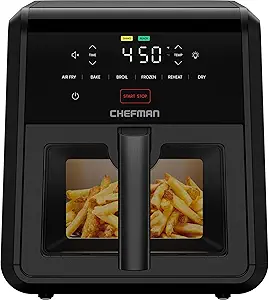 |
| Best Budget The cheapest option that still gets the job done reliably | OLIXIS 6.34-Quart Air Fryer KZ-D6QT |  |
| Top Rated A top-rated pick with lots of positive feedback | Cosori TurboBlaze 6-Quart Air Fryer |  |
| Most Popular A crowd favorite that many people choose with confidence | Ninja Air Fryer AF101 |  |
| Best Seller A high-volume bestseller chosen again and again | Cuisinart Airfryer Convection Toaster Oven TOA-70 |  |
Ninja Foodi DualZone DZ201

| Capacity | 8 quarts |
|---|---|
| Wattage | 1690 watts |
| Max Temperature Setting | 450 °F |
| Control Method | Touch |
| Air Frying Technology | DualZone Technology |
The Ninja Foodi DualZone DZ201 is a two-basket air fryer that lets you cook different foods simultaneously using separate 4‑quart baskets, each with its own fan and heater. It offers six programmable functions including air fry, air broil, roast, bake, reheat, and dehydrate, plus Smart Finish to sync cooking so both zones complete at the same time and Match Cook to copy settings across zones for full-capacity cooking. The wide temperature range up to 450°F and 1690-watt output mean it can crisp wings or roast vegetables quickly, while dishwasher-safe baskets and crisper plates make cleanup straightforward. Practical benefits include cooking mains and sides together for faster weeknight meals and the ability to run two different programs at once without flavor transfer. Limitations to consider are the unit weight and footprint relative to single-basket units and that managing two zones adds a small learning curve when timing multi-dish meals. For buyers wanting reliable, family-sized dual-zone performance, the DZ201 balances flexibility and ease of use.
Best for: Buyers who prioritize cooking complete meals quickly and want social proof of reliability will appreciate a dual-basket machine that handles mains and sides in one cycle.
Less Ideal for: Those with very limited counter space or who only cook small single-dish portions will find a compact single-basket fryer more practical.
- Two independent 4‑quart baskets let you cook different foods at once without cross-flavoring
- Smart Finish feature times both zones to finish together for synchronized meals
- Six preset cooking programs cover common tasks from air frying to dehydrating
- Dishwasher-safe baskets and nonstick crisper plates simplify cleaning
- Wide 105°F–450°F temperature range for gentle dehydration or high-heat crisping
- Larger and heavier than single-basket air fryers which may challenge small kitchens
- Operating two zones simultaneously can require practice to time components correctly
Verdict: Choose the Ninja Foodi DualZone DZ201 when you want a proven dual-basket air fryer that reliably cooks two different foods at once for faster, synchronized family meals.
Breville Smart Oven Air Fryer Pro BOV900BSS

| Wattage | 1800 watts |
|---|---|
| Temperature Range | 80-480 °F |
| Capacity | 1 cubic feet |
| Control Type | Knob Control |
| Power Source | Corded Electric |
The Breville Smart Oven Air Fryer Pro is a versatile countertop oven that combines convection baking, air frying, and dehydration in one 1-cubic-foot unit. It uses the Element iQ system with five independent heating elements and a two-speed convection fan to concentrate heat where needed, which shortens cook times and helps achieve crisp, evenly browned results. Typical use cases include roasting large items, air frying fries and wings, and dehydrating up to four trays at once with the included mesh basket and racks. The LCD display and presets make selecting functions straightforward, and the interior light helps monitor progress. Practical benefits include the ability to handle large batches, reliable temperature control across a wide 80-480°F range, and a full set of accessories for roasting, broiling, and dehydrating. Important limitations are the unit's substantial footprint and weight, which require dedicated counter space, and the 1800W power draw that may trip weak circuits or be less efficient than smaller countertop dehydrators for tiny batches.
Best for: Buyers who prioritize performance and want a single countertop appliance that can air fry, roast and dehydrate large batches with precise, fast results.
Less Ideal for: People with very limited counter space, those who only need occasional small-batch dehydration, or users who need a lightweight portable dehydrator.
- Element iQ with five heating elements for targeted, consistent heat distribution
- Super convection with two-speed fan for faster cooking and crisping
- Large interior fits a 14 lb turkey or multiple dehydrator trays for batch dehydrating
- 13 built-in cooking functions and LCD presets simplify common tasks
- Includes mesh basket and multiple racks so you can dehydrate and air fry without extra purchases
- Large, heavy countertop footprint not ideal for small kitchens
- 1800W power draw requires a dedicated, properly rated circuit
Verdict: Choose this oven if you want a high-performance, large-capacity countertop unit that air fries and dehydrates quickly and evenly.
Chefman TurboFry 7-Quart Air Fryer

| Capacity | 7 quarts |
|---|---|
| Wattage | 1750 W |
| Max Temperature | 450 °F |
| Control Method | Touch |
| Air Frying Technology | Convection |
The Chefman TurboFry is a family-sized 7-quart air fryer built around a high-powered 1750W convection system that reaches up to 450°F and promises faster, crisper results. It offers six cooking modes—Air Fry, Broil, Dehydrate, Convection Bake, Reheat, and Frozen—controlled via a touchscreen and monitored through an easy-view window and interior light so you can check progress without opening the basket. The tall, narrow design fits longer items like salmon or asparagus while saving counter space, and the nonstick basket plus removable wire rack make cleanup straightforward; the basket is dishwasher-safe. For dehydrating, the dedicated Dehydrate mode and temperature range down to 90°F let you dry fruits and herbs without guesswork, and the solid heat output helps cut run times compared with lower-powered units. Limitations include a relatively heavy unit and a slim footprint that may reduce usable basket width for wide batches, and the 7-quart capacity can be filled unevenly when stacking for dehydration. The TurboFry is a practical pick if you want an appliance that doubles as a fast everyday air fryer and a capable dehydrator.
Best for: Buyers who want a single, space-conscious countertop appliance that handles everyday air frying and occasional dehydrating reliably and with minimal fuss.
Less Ideal for: People who need a wide, flat cooking surface for large dehydrating batches or who plan heavy, frequent dehydration sessions that require multiple large trays.
- High 1750W power with 450°F max for faster crisping
- Dedicated Dehydrate mode and 90°F minimum for low-temp drying
- 7-quart basket offers family-sized capacity
- Easy-view window and interior light let you monitor without losing heat
- Dishwasher-safe basket and removable rack simplify cleanup
- Narrow footprint reduces usable width for very wide or flat batches
- Unit is relatively heavy to move around
Verdict: Choose the TurboFry if you want a powerful, family-sized air fryer that also provides a practical, built-in dehydrating mode for occasional drying tasks.
OLIXIS 6.34-Quart Air Fryer KZ-D6QT

| Capacity | 6.34 quarts |
|---|---|
| Wattage | 1700 watts |
| Max Temperature | 400 °F |
| Control Method | Touch |
| Air Frying Technology | Rapid Air Circulation |
The OLIXIS KZ-D6QT is a 6.34-quart countertop air fryer designed for family-size batches and multi-mode cooking. It uses rapid air circulation and a 1700-watt heater to reach up to 400°F, and the built-in window lets you monitor food without opening the basket. The unit offers 12 preset modes — including air fry, roast, bake, reheat, steam, and dehydrate — accessed via a touchscreen panel and programmable timer, which makes drying fruits, herbs, and small batches of jerky straightforward for home use. Practical benefits include the larger capacity for multi-serving dehydrating sessions and the high max temperature that speeds moisture removal when you need it. The polypropylene housing keeps the unit lightweight, though it also means buyers should avoid high-impact handling. Limitations include a single-chamber design, so dehydrating very large or layered trays may require multiple cycles, and polypropylene exteriors are less durable than metal-bodied appliances. For a budget-conscious shopper wanting a roomy, multi-function air fryer with a visible window and a dedicated dehydrate preset, this is a sensible choice.
Best for: Buyers on a budget who want a roomy, multi-function air fryer that can handle occasional dehydrating sessions and family-sized cooking without complexity.
Less Ideal for: Those who need professional-grade dehydrating capacity, multi-tray commercial drying, or a heavy-duty metal-bodied appliance for long-term rugged use should look elsewhere.
- Large 6.34-quart capacity suitable for family-sized batches or multiple servings
- See-through window for monitoring without opening the basket
- 12 presets including a dehydrate function for drying fruits and herbs
- High 400°F max temperature and 1700W power for faster cooking and moisture removal
- Touch controls and programmable timer for simple, repeatable settings
- Single-chamber design limits simultaneous multi-tray dehydration of large volumes
- Polypropylene outer material is less impact-resistant than metal alternatives
Verdict: A budget-friendly, roomy air fryer with a dehydrate preset and viewing window that makes small-to-medium home dehydrating jobs easy and convenient.
Cosori TurboBlaze 6-Quart Air Fryer

| Capacity | 6 quarts |
|---|---|
| Wattage | 1725 watts |
| Temperature Range | 90°–450°F |
| Control Method | Touch |
| Included Components | Crisper plate, recipe book, manual |
The Cosori TurboBlaze 6‑Quart is a versatile countertop air fryer built to deliver quick, even results for everyday meals. It uses a 5‑level fan system and TurboBlaze airflow with temperatures from 90° to 450°F to crisp fries, roast vegetables, bake soft cookies, reheat leftovers, and dehydrate fruit. Controls are handled through an LED touchscreen with integrated touch buttons and a customizable preheat program, and the basket plus crisper plate have a PFAS‑free ceramic nonstick coating that is dishwasher safe for easier cleanup. Practical touches include automatic pause/resume when the basket is removed, multiple turbo modes and an included recipe book to get started. The unit is fairly powerful at 1725W, so it heats up fast but needs a dedicated outlet and countertop space; the basket is roomy for sharing but may be larger than necessary if you only cook single portions daily. Noise is low even at higher fan speeds, and the 2‑year manufacturer support gives extra reassurance for long term use.
Best for: A buyer who prioritizes a dependable, consistently performing appliance that crisps and reheats reliably while being easy to clean and maintain.
Less Ideal for: Users who need the smallest possible footprint or very low-power appliances for limited electrical capacity should consider a smaller, lower-watt model.
- Powerful TurboBlaze airflow and wide 90°–450°F range for flexible cooking.
- PFAS‑free ceramic nonstick basket and crisper plate that are dishwasher safe.
- LED touchscreen with customizable preheat and multiple fan speeds for precise control.
- Automatic pause/resume when the basket is removed and included recipe book for easy use.
- Relatively high wattage requires a dedicated 120V outlet and can raise kitchen heat.
- 6‑quart basket may be oversized for someone who primarily cooks single servings.
Verdict: Buy this if you want a reliable, fast‑heating 6‑quart air fryer that consistently produces crispy results and is easy to maintain.
Ninja Air Fryer AF101

| Capacity | 4 quarts |
|---|---|
| Wattage | 1550 watts |
| Max Temperature Setting | 400 °F |
| Control Method | Touch |
The Ninja AF101 is a compact 4-quart air fryer that uses rapid convection circulation and a smart processor to crisp, roast, reheat, and dehydrate with minimal oil. It is typically used for small family meals or single-serve portions like fries, wings, vegetables, and snacks, and the basket holds up to about 2 pounds of fries so you can do one-batch cooking without crowding. Controls are touch-based with a wide 105°F to 400°F temperature range, which lets you go from gentle dehydration to high-heat crisping, and the included crisper plate helps circulation for browning. Cleanup is straightforward because the aluminum basket and crisper plate have a ceramic nonstick coating and are dishwasher-safe. The 1550-watt unit heats quickly and delivers consistent results for everyday use, though the 4-quart capacity is best suited to singles or small households rather than large batches. The unit is practical and reliable for routine countertop cooking, offering useful presets and durable, easy-care parts, but it does require counter space and produces typical air-fryer noise while running.
Best for: Someone who values a dependable, easy-to-use countertop cooker for daily single-serve meals and wants consistent, repeatable results with low-maintenance cleanup.
Less Ideal for: Households that regularly cook large portions or need multiple simultaneous trays should choose a larger-capacity or multi-rack unit instead.
- Compact 4-quart capacity fits small kitchens and single-serve meals
- Four cooking functions (air fry, roast, reheat, dehydrate) for versatile use
- Wide 105°F–400°F temperature range for everything from dehydrating to high-heat crisping
- Dishwasher-safe ceramic-coated basket and crisper plate for easy cleaning
- 4-quart size limits large batch cooking and is not ideal for feeding many people at once
- Produces typical air-fryer noise and requires dedicated counter space
Verdict: A reliable, easy-to-clean 4-quart air fryer that delivers consistent single-serve cooking with versatile presets and a wide temperature range.
Cuisinart Airfryer Convection Toaster Oven TOA-70

| Output Wattage | 1800 watts |
|---|---|
| Voltage | 120 volts |
| Control Method | Touch |
| Max Temperature Setting | 450 °F |
| Capacity | 0.6 cubic feet |
The Cuisinart TOA-70 is a versatile countertop oven that pairs an 1800W heater with a top fan assembly to deliver fast, crispy results across eight cooking modes including air fry, convection bake, broil, grill, and warm. Typical use covers everything from toasting six slices and baking a 12-inch pizza to air frying several pounds of wings; included accessories are an oven rack, baking pan/drip tray, air fry basket, and a reversible grill/griddle. For low-temperature applications like dehydrating, the oven's wide temperature range (Warm–450°F) and adjustable dial let you hold gentle heat, while the internal fan promotes steady airflow for drier, crisper outcomes that mimic dehydration. Practical benefits include solid build quality, a stainless steel easy-clean interior, and programmable controls with a 60-minute timer and auto-shutoff for safety. Important limitations are the 0.6 cu. ft. capacity, which limits batch size for large dehydrating projects, and the lack of a dedicated low-temp dehydration preset or very long timer for multi-hour runs, so you may need to monitor longer drying cycles manually.
Best for: Buyers who want a sturdy, full-feature countertop oven that can double as an occasional dehydrator and who prioritize reliable, easy-to-use controls and solid build quality.
Less Ideal for: People who plan to dehydrate large quantities regularly or need a dedicated appliance with very low temperature presets and multi-hour timers should consider a purpose-built dehydrator instead.
- Multiple cooking modes including air fry and convection for versatile use
- AirAdvantage fan/heater assembly promotes even, fast airflow useful for drying foods
- Included accessories (rack, baking pan, air fry basket, reversible grill/griddle) increase flexibility for trays and airflow
- Adjustable temperature dial and 60-minute timer with auto-shutoff for simple control and safety
- Stainless steel interior that is easy to clean after sticky or sugary dehydrating jobs
- 60-minute timer may be too short for many dehydration jobs requiring several hours
- 0.6 cu. ft. interior limits how much you can dehydrate in a single load
Verdict: A reliable, well-built countertop oven that can handle occasional dehydrating tasks while serving as an all-in-one air fryer and toaster oven.
Choosing the Right Air Fryer for Dehydrating: Key Factors to Consider
Temperature Range and Stability
Dehydration needs low, steady heat over many hours. An air fryer with a minimum temperature near typical dehydration set points and tight regulation will dry food more predictably and preserve flavor and nutrients.
Look for units with digital thermostats and small temperature increments so you can dial in the exact setting you need. Wide swings or thermostats that only offer high minimums will force longer runs or produce uneven results, so temperature stability is one of the most important practical considerations when using an air fryer for dehydrating.
Airflow Design and Distribution
Even airflow prevents wet spots and shortens overall drying time. The way an air fryer moves heated air across racks affects how uniformly slices dry; models with well-placed vents and multi-directional fans tend to produce consistent results across trays.
Consider whether the unit uses top-down heating, convection circulation, or a combination, and whether it includes rack spacing options that allow air to pass freely between layers. Restricted airflow between trays or dead zones near walls will require rotating or re-stacking food more often.
Internal Capacity and Rack Configuration
Dehydrating is often a volume game since thin slices take up surface area rather than depth. A unit with multiple, flat racks or wide tray space lets you dry more per cycle and reduces overall batch time.
Assess how the interior layout accommodates uniformly sliced pieces and whether trays are removable for easy loading. Tall baskets or narrow baskets limit how many slices you can lay flat, increasing the number of batches needed.
Control Options and Timer Duration
Dehydration cycles can run for many hours, so look for precise timers, long-run settings, and reliable auto-run behavior. A timer that only goes for short intervals will force you to restart cycles and adds monitoring work.
Flexible controls such as step-down timers, continuous-run modes, or programmable presets for low-heat drying make the process easier and safer. Also consider whether the controls are easy to read and adjust without disturbing the food.
Material, Finish, and Ease of Cleaning
Food prep for dehydration involves sticky juices and sugars that can bake-on during long sessions. Interio rs with nonstick, smooth finishes and removable trays simplify cleanup and maintenance.
Dishwasher-safe racks or trays help, but also think about crevices and fan housings that are hard to reach. Models that allow easy tray removal and have straightforward surfaces will reduce the time you spend cleaning between batches.
Safety and Long-Run Reliability
Extended dry cycles place continuous load on heating elements and fans, so choose units with consistent ventilation, overheat protection, and clear operating limits for continuous use.
Consider manufacturer guidance on maximum continuous run time and features like auto-shutoff, cool-down cycles, and accessible vents. Features that reduce thermal stress on components tend to extend the usable life of the appliance when used for long dehydrating sessions.
Preparing Food for Best Dehydration Results
Slice food uniformly and thinly to encourage even moisture loss. A mandoline or sharp knife helps produce consistent thickness, which is more important than absolute thinness for uniform drying.
Pre-treatments like blanching certain vegetables or lightly dipping fruit in citrus or sugar solutions can preserve color and flavor, but avoid heavy coatings that inhibit airflow. Pat slices dry before arranging them in a single layer and leave space between pieces for air to circulate.
- Aim for consistent slice thickness across a batch.
- Arrange slices in a single layer with gaps for airflow.
- Use parchment or dehydrator racks designed for air fryers to prevent sticking.
Loading Strategies and Rack Rotation
How you load trays affects drying uniformity. Place thicker pieces nearer the edges if your unit has hotter zones, and stagger slices so airflow reaches all sides.
For multi-rack drying, plan a rotation schedule: move outer trays inward and swap top-to-bottom at intervals suggested by visible progress. This reduces the need for guesswork and yields more consistent batches.
- Check progress midway and rotate trays if one area dries faster.
- Avoid overcrowding; overlapping pieces extend drying time and cause uneven texture.
Safety Tips for Long Dehydration Cycles
Run extended cycles only on a stable surface with good ventilation around the unit. Ensure vents are unobstructed and keep flammable materials away from the appliance during long sessions.
Inspect trays and interior surfaces occasionally for signs of scorching, and follow the manufacturer guidelines on maximum continuous run time. If you notice abnormal smells or smoke, stop the cycle and allow the appliance to cool before inspecting.
- Keep at least a few inches of clearance around the unit.
- Use oven mitts and heat-safe tools when checking trays mid-cycle.
Storing and Rehydrating Dried Foods
Cool dried foods completely before storing to avoid trapping residual moisture that leads to spoilage. Use airtight containers in a cool, dark place to preserve texture and flavor.
To rehydrate, soak dried fruits or vegetables in warm water or simmer briefly depending on the recipe. Properly dried and stored foods can last months to a year, depending on moisture content and storage conditions.
- Label containers with date and contents.
- Test a sample for brittleness and moisture before long-term storage.
When to Use a Dedicated Dehydrator Instead
Air fryers are versatile but may not match a dedicated dehydrator for very large-volume projects or the lowest possible temperatures. If you plan to dry bulk quantities regularly, a dedicated unit with multi-tray airflow might save time and labor.
However, for occasional home use, snacks, and small batches, an air fryer with good low-temp control and multiple flat racks will handle most dehydration tasks effectively.
- Consider batch size and frequency before choosing a long-term solution.
- Dedicated dehydrators excel at continuous, even drying over many trays.
How We Chose the Best Air Fryer for Dehydrating
We shortlisted air fryers based on features that directly affect dehydration results and user experience. Primary evaluation criteria included temperature range and accuracy, since dehydration requires sustained low heat; airflow design and distribution, because even circulation reduces hot spots and drying time variance; usable capacity and rack layout to estimate how much food fits per batch; and program flexibility for long run times with safe auto-shutoff and cooldown behavior. We also considered practical usability factors such as ease of access for loading thin slices, interior surface finish for cleanup, and energy efficiency during extended cycles. Safety and long-run reliability were important filters: units with inadequate low-temp control, limited continuous-run capabilities, or poor ventilation were excluded. We favored models with clearly documented temperature consistency and straightforward controls that let you run long dehydration cycles without constant monitoring. Lastly, we excluded specialty dehydrators and countertop appliances not marketed or designed to run stable low-temperature drying cycles, focusing strictly on air fryers that can be used effectively for dehydrating.
Our full evaluation process is outlined in our review methodology.
FAQ
Can I use any air fryer for dehydrating?
Often you can use many air fryers, but look for models that offer low-temperature settings and stable control. Units with only high minimum temperatures or short timers will be less effective for dehydration.
What temperature should I set for fruit and herbs?
Fruit and herbs usually dry well at low temperatures, often between 125 and 135 degrees Fahrenheit. Exact times vary with thickness and moisture content, so check progress periodically.
How do I prevent uneven drying between racks?
Ensure good spacing and rotate trays during long cycles. Choosing a model with well-distributed airflow and placing slices in a single layer reduces hot spots and uneven drying.
Is it safe to run an air fryer for 8 to 12 hours?
It depends on the unit. Some air fryers support long continuous runs, while others have recommended limits. Check the appliance guidance and watch for signs of overheating or unusual odors.
Do I need to pretreat produce before dehydrating in an air fryer?
Pretreatments like blanching certain vegetables or dipping fruit in an acid solution can protect color and texture, but they are not always necessary. Avoid heavy coatings that block airflow.
Final Verdict
For home dehydration, prioritize an air fryer that maintains low temperatures steadily, moves air evenly across trays, and offers a practical interior layout for single-layer drying. Expect tradeoffs between usable capacity and countertop footprint, and factor in timer flexibility and ease of cleaning when choosing a unit. If you focus on temperature stability, airflow design, and long-run reliability, you can confidently pick an air fryer that handles most small- to medium-size dehydration projects.