
Note: This article contains affiliate links. If you click on these links and make a purchase, we may earn a small commission at no extra cost to you. This helps support our research and content. Read our full affiliate disclosure here.
If you or someone at home struggles with allergies or asthma, choosing the right air purifier can meaningfully reduce indoor triggers and improve daily comfort. A targeted purifier reduces airborne pollen, dust mite fragments, pet dander, and other fine particles that commonly provoke symptoms. This guide covers seven shortlisted air purifiers chosen for home use focused on allergy and asthma relief. We evaluate each pick on measurable factors like particle filtration efficiency, CADR or equivalent clean-air performance, noise during use, and long-term upkeep. Read on to understand how those factors affect real-world breathing comfort and which features matter most for different room sizes and routines.
Top Picks at a Glance
| Best Overall The best all-around choice for most situations | Winix 5510 Air Purifier |  |
| Best Quality Built to a higher standard if you want something more solid | Rabbit Air MinusA2 SPA-780N |  |
| Best Value The sweet spot between price and what you get | GermGuardian AC4825E Tower Air Purifier |  |
| Best Budget The cheapest option that still gets the job done reliably | VOOPNU HEPA Air Purifier DH-JH12 |  |
| Top Rated A top-rated pick with lots of positive feedback | Levoit Core 200S-P |  |
| Most Popular A crowd favorite that many people choose with confidence | Levoit Core Mini-P |  |
| Best Seller A high-volume bestseller chosen again and again | VOOPNU HEPA Air Purifier DH-JH12 |  |
Winix 5510 Air Purifier

| AHAM verified coverage | 1,882 sq ft in 1 hour |
|---|---|
| Filtration stages | 4-Stage (pre-filter, HEPA, carbon, PlasmaWave) |
| Noise (low) | 23.5 dB |
| Smart features | WiFi, Alexa, Google Home, Winix Smart App |
The Winix 5510 is a four-stage air purifier built for large rooms and frequent allergen exposure. It combines a washable pre-filter, True HEPA that captures particles down to 0.01 microns, an advanced deodorization carbon layer for odors and VOCs, and Winix PlasmaWave technology to help reduce airborne impurities. Built-in air quality sensors drive an Auto Mode that raises or lowers fan speed as needed, and an LED AQI indicator gives a quick visual read on room conditions. For nighttime use it has an automated Sleep Mode that quiets operation when the room is dark, and the unit is app-compatible for remote control and status monitoring. Practical benefits include strong particulate removal for pollen, pet dander, and smoke plus odor control that can extend HEPA life, and useful smart features for remote management. Important limitations are that ongoing costs include periodic filter replacements and the PlasmaWave feature is supplemental rather than a substitute for filtration; the unit's performance is optimized for larger, open rooms rather than small confined spaces.
Best for: Buyers who want a capable all-around purifier for allergy and asthma symptom reduction in larger living spaces and who value automatic sensing plus smart control for day-to-day convenience.
Less Ideal for: People who need an ultra-compact purifier for a single small bedroom or who want a permanently maintenance-free unit with no filter replacements.
- True HEPA filtration capturing very small particles down to 0.01 microns.
- Advanced carbon filter for odor and VOC reduction that helps protect HEPA life.
- Smart sensors with Auto Mode and visual AQI indicator for hands-off operation.
- Washable pre-filter reduces maintenance cost for large-particle capture.
- App compatibility and Alexa/Google Home support for remote control.
- Requires periodic replacement of HEPA and carbon filters, which adds ongoing cost.
- PlasmaWave is a supplemental ionizing technology and not a replacement for mechanical filtration.
Verdict: A strong all-round choice for allergy and asthma sufferers who need powerful HEPA filtration, odor control, and smart automatic operation in large rooms.
Rabbit Air MinusA2 SPA-780N

| Coverage | Up to 815 sq. ft. |
|---|---|
| Filtration stages | Six-stage HEPA and deodorization |
| Smart features | Wi‑Fi enabled with app control |
| Certification | Asthma & Allergy Friendly by AAFA |
The Rabbit Air MinusA2 SPA-780N is a heavy-duty home air purifier built around a six-stage filtration system and True HEPA performance to reduce pollen, pet dander, dust, mold spores, and odors in larger rooms. It is typically used in bedrooms, living rooms, or open-plan spaces where allergy or asthma concerns are primary; the unit can sit on the floor or be mounted on the wall to save footprint. Notable features include AAFA asthma and allergy friendly certification, Wi‑Fi connectivity with app control for remote monitoring and fan adjustments, and a versatile filter set that targets particles and odors. In practice the MinusA2 is quiet in low-to-medium fan speeds, moves a large volume of air suitable for areas up to about 815 sq ft, and its multi-stage approach gives tangible improvements in measured and felt air quality for sensitive users. Trade-offs are its larger physical presence and higher upfront cost compared with compact purifiers, and replacement filters add ongoing maintenance expense, but for buyers who need robust filtration and smart controls the MinusA2 delivers consistent, effective performance.
Best for: Buyers who prioritize measurable filtration performance and need a purifier that handles large rooms or severe allergy triggers, and who value smart controls and verified allergy certification.
Less Ideal for: People who need a small, inexpensive portable unit for single small rooms or who prefer a no-frills, low-cost purifier without Wi‑Fi features.
- Six-stage True HEPA and deodorization filtration for comprehensive particle and odor removal
- Certified asthma and allergy friendly to meet stricter sensitivity standards
- Wi‑Fi and app control for remote monitoring and fan speed adjustments
- Can be wall mounted or freestanding to fit different room layouts
- Designed to move high air volume suitable for large rooms up to the stated coverage
- Larger, heavier footprint than compact tabletop purifiers
- Higher upfront and replacement filter costs compared with budget models
Verdict: Choose the MinusA2 when you need proven, high-capacity HEPA filtration and smart control to tackle allergies and asthma in large rooms.
GermGuardian AC4825E Tower Air Purifier

| Room coverage (small) | 153 sq. ft. per 12.5 minutes |
|---|---|
| Room coverage (large) | Up to 743 sq. ft. per hour |
| Filter type | True HEPA (Filter B) |
| Speeds | 3 fan speeds |
The GermGuardian AC4825E is a compact tower purifier built around a True HEPA filter that captures particles down to 0.1 microns, with an activated carbon pre-filter for odors and an optional UV-C bulb for additional airborne reduction. It is intended for continuous use in bedrooms, living rooms, nurseries, or home offices and cycles the air in a 153 sq ft room roughly every 12.5 minutes and can cover larger spaces up to about 743 sq ft hourly. Controls are simple with three fan speeds including a quiet sleep mode for night use. Maintenance requires periodic replacement of the compatible GermGuardian Filter B HEPA cartridges and optional UV-C bulbs, which keeps performance consistent but adds recurring cost. The unit is ETL and CARB certified and is reasonably lightweight for moving between rooms, though it lacks smart connectivity or advanced sensors for automatic fan adjustments. For people prioritizing proven HEPA filtration and straightforward operation, this purifier delivers reliable particle and odor reduction in typical bedroom and living spaces.
Best for: Buyers who want a straightforward, proven HEPA purifier to reduce allergens and household odors in bedrooms and common rooms and who value simple controls and certified performance.
Less Ideal for: Those who want app control, automatic air-quality sensing, or a fully silent, ultra-compact unit for very small spaces should consider other models.
- True HEPA filter captures 99.97% of particles down to 0.1 microns
- Activated carbon pre-filter reduces common household odors and scents
- Optional UV-C light for extra airborne reduction
- Three fan speeds including a quiet sleep mode for night use
- CARB and ETL certifications indicate safety and emissions compliance
- No smart features or air-quality sensors for automatic speed control
- Requires periodic replacement filters and bulbs which are additional ongoing costs
Verdict: A reliable, certified HEPA tower purifier that effectively cuts allergens and odors with simple controls, ideal for buyers who prioritize proven filtration over smart features.
VOOPNU HEPA Air Purifier DH-JH12

| Filtration | H13 True HEPA triple-layer |
|---|---|
| Coverage (tested) | 250 ft² cleaned every 15 minutes (≈1,076 ft²/hr) |
| Noise level | 22 dB (low) |
| Speeds | 3 fan speeds |
The VOOPNU DH-JH12 is a small, user-friendly air purifier built around an H13 true HEPA triple-layer filter and 360 degree intake to capture fine particles like pollen, pet hair, and smoke. It is intended for continuous use in bedrooms, living rooms, or home offices and is rated in laboratory testing to clean 250 ft² every 15 minutes, equivalent to roughly 1,076 ft² per hour. Controls are simplified to one-tap operation with three fan speeds, a timer, and an essential oil tray if you want scent. The unit is very quiet at its lowest setting (about 22 dB), so it will not disturb sleep. Certifications including ETL, CARB, and FCC indicate it meets common safety and emissions standards. Limitations to consider are its compact footprint and consumer-positioned design: replacement filters are recommended every 3–6 months in heavier-use situations, and sustained continuous operation is suggested for best results in allergy relief. For buyers prioritizing easy setup, low noise, and HEPA-level filtration on a budget, it provides practical performance without complex controls.
Best for: Buyers wanting an affordable, no-frills HEPA purifier for allergy or asthma symptom relief who prioritize quiet operation and easy setup for bedrooms or shared living spaces.
Less Ideal for: People seeking a heavy-duty, whole-home HVAC-grade purifier or advanced smart features like app control and multi-device integration should look elsewhere.
- H13 true HEPA triple-layer filter captures 99.97% of fine particles for allergy relief
- Laboratory-tested CADR-equivalent cleaning rate (250 ft² per 15 minutes) suitable for medium rooms
- Very quiet operation down to 22 dB, suitable for bedrooms and night use
- 360° air intake helps pull pollutants from all directions and simplifies placement
- Simple one-touch controls and built-in essential oil tray for optional scenting
- Replacement filters have a recommended 3–6 month cycle under typical use and will add ongoing cost
- Performance claims are based on laboratory testing and continuous run time is recommended to maintain air quality
Verdict: A compact, budget-friendly HEPA purifier that delivers quiet, effective particle removal for bedrooms and medium living spaces where straightforward allergy relief is the priority.
Levoit Core 200S-P
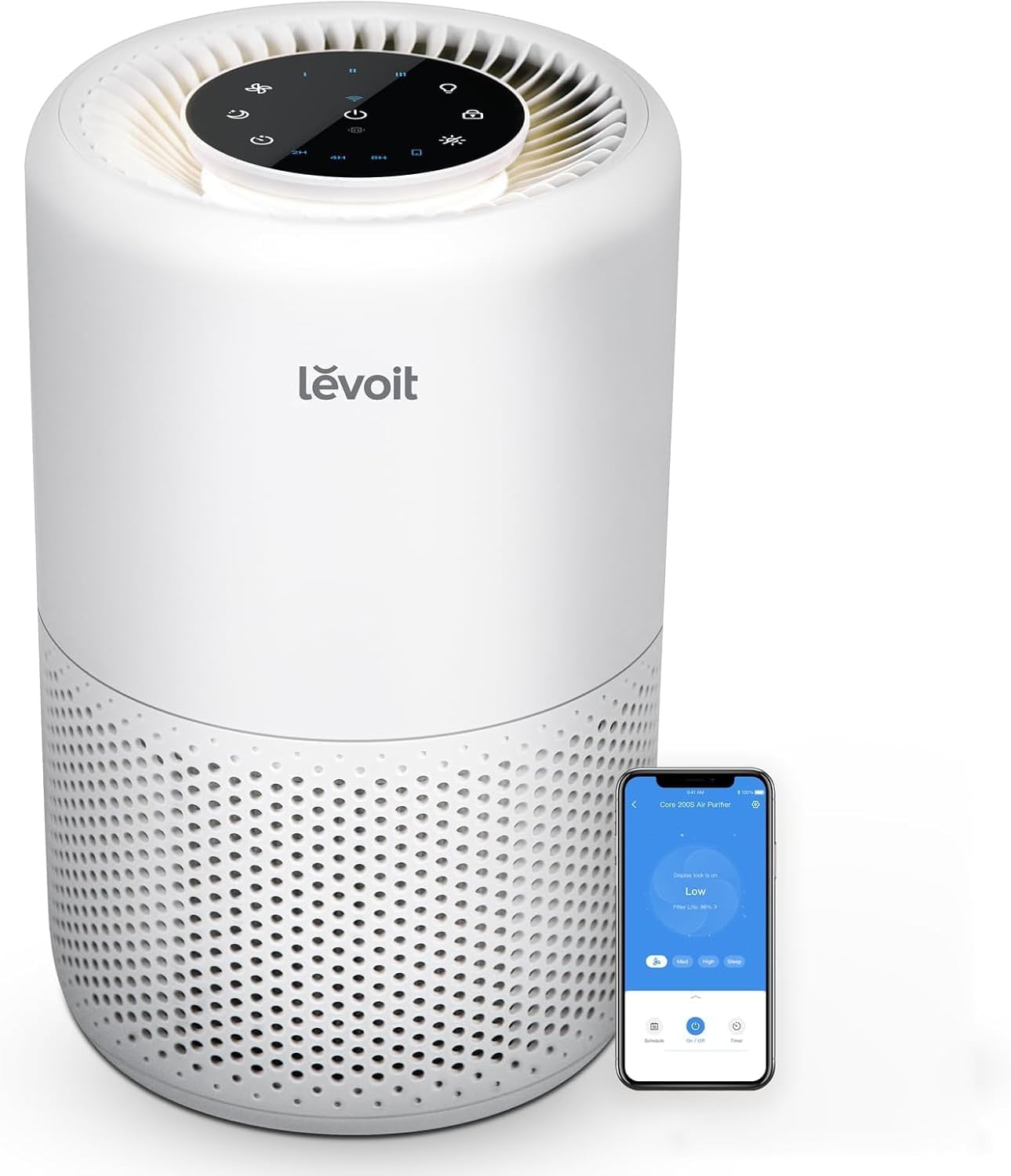
| Model | Core 200S |
|---|---|
| Coverage | 140 ft² (refreshes 4.8×/hr) |
| Filtration | 3-stage: pre-filter, activated carbon, HEPA-grade main |
| Noise level | as low as 27 dB |
The Levoit Core 200S-P is a small, smart air purifier built for bedrooms, nurseries, and other small rooms where allergies or pet dander are a concern. It pulls air in 360 degrees through a three-stage filter stack — pre-filter, activated carbon, and a HEPA-grade main filter — and the company reports it refreshes a 140 ft² room nearly five times per hour. Smart features include app-based monitoring of filter life and voice control, which make maintenance and daily use convenient. Noise can be very low in Sleep Mode, so it is suitable for overnight use, and the compact footprint is easy to move between rooms. Important limitations are its coverage ceiling and replacement filter costs; it is not intended for large open-plan living areas and will require periodic genuine filters to keep peak performance. The purifier is AHAM-verified for performance which supports its reliability claim for allergy-prone spaces.
Best for: Buyers who prioritize consistent, verifiable air cleaning in bedrooms or small living spaces and want smart monitoring and quiet operation for daily use.
Less Ideal for: People needing to purify large open-plan areas or whole-home coverage should choose a larger unit with higher room CADR and airflow capacity.
- Three-stage filtration including a HEPA-grade main filter that captures 0.1–0.3 micron particles
- AHAM-verified performance with stated CADR for small rooms
- App and voice control plus filter-life monitoring for easy maintenance
- Quiet Sleep Mode suitable for nighttime use
- Compact, lightweight design that is portable between rooms
- Designed for small rooms only and not effective as the sole purifier for large open spaces
- Requires genuine replacement filters to maintain rated performance
Verdict: A compact, AHAM-verified smart purifier that reliably reduces allergens and pet-related particles in small rooms while offering quiet, easy maintenance.
Levoit Core Mini-P
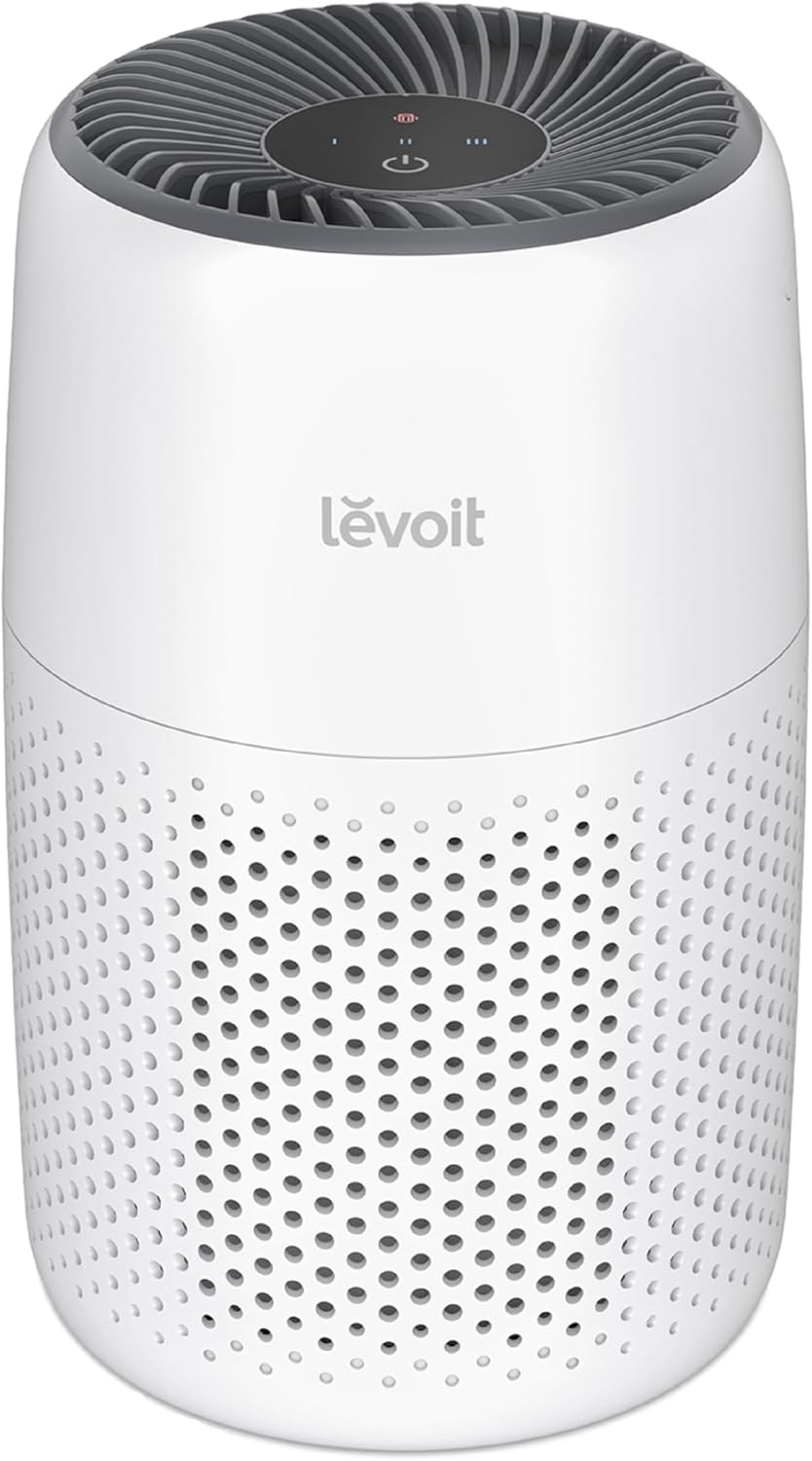
| Rated Power | 7W |
|---|---|
| Noise Level | 27-45 dB |
| AHAM Verified | Yes |
The Levoit Core Mini-P is a small, plug-in tabletop air purifier aimed at improving air quality in bedrooms, offices, and other small spaces. It uses a pre-filter and main HEPA-style filter to capture lint, pet hair, dander, dust, and smoke particles, and includes a fragrance sponge for light aromatherapy when desired. With rated power around 7W and a noise range reported near 27 to 45 dB, it runs quietly enough for sleep mode and low-interruption use. Practical features include an auto-off display and a compact form that stores the adapter inside the unit, making it easy to place on a desk or nightstand. The unit is AHAM-verified for performance, which gives measurable expectations for small-room cleaning. Limitations are its small coverage area and modest airflow compared with larger purifiers, so it is best for close-range use rather than whole-room or open-plan cleaning, and frequent filter replacements will be required in homes with heavy allergen loads.
Best for: Buyers who prioritize a quietly performing, independently verified purifier for a small bedroom, dorm, or personal office and want a compact unit they can place close to their breathing zone.
Less Ideal for: People seeking to purify large living rooms, whole apartments, or those who need high CADR airflow for heavy smoke or severe allergy sources should consider larger units instead.
- Compact, desktop-friendly footprint for use on nightstands and desks
- AHAM-verified performance gives independent validation of cleaning capability
- Quiet operation with a low-noise sleep mode suitable for bedrooms
- Simple plug-and-play setup with internal adapter storage
- Pre-filter plus main filter captures hair, pet dander, dust, and smoke particles
- Designed for small spaces only and not effective for large or open-plan rooms
- Aromatherapy feature requires careful use to avoid overfilling and potential plastic damage
Verdict: Choose the Levoit Core Mini-P when you need a quiet, AHAM-verified tabletop purifier to reduce common allergens and odors in a small bedroom or personal workspace.
VOOPNU HEPA Air Purifier DH-JH12

| Coverage | Up to 1,076 ft² |
|---|---|
| Filtration | H13 triple-layer HEPA |
| Noise level | 22 dB (low) |
| Speeds | 3 fan speeds |
This VOOPNU unit is a small, user-friendly air purifier built for continuous home use. It pulls air in through a 360 degree intake and passes it through an H13 triple-layer filtration system that the brand says captures 99.97% of airborne particles, making it suited to reduce pollen, pet dander, smoke and household odors. The control panel is simplified for one-touch operation and three fan speeds plus a timer let you balance performance and noise; the lowest setting is rated around 22 dB so it can run in a bedroom without disturbing sleep. The unit also includes an essential oil tray for light scenting and accepts factory replacement filters in standard or pet-care editions depending on needs. Because it is compact it is easy to place on a desk or shelf and VOOPNU recommends continuous operation for best results. Limitations are its small physical footprint, which implies it is intended for single rooms rather than whole-house filtration, and replacement filters are specified as the recommended option to maintain performance.
Best for: Buyers who prioritize proven filtration and quiet overnight use and who want a compact, low-effort purifier for bedrooms or individual living spaces.
Less Ideal for: Homes needing whole-house coverage or very large open-plan rooms should consider larger-capacity units instead.
- H13 true HEPA triple-layer filter captures up to 99.97% of airborne particles
- 360 degree intake improves room circulation and helps even coverage
- Very quiet operation down to about 22 dB, suitable for bedrooms
- Simple one-touch controls and timer make it easy to use without setup
- Compact size is easy to place on desks, nightstands, or small corners
- Compact design is best for single rooms and not suited to whole-house purification
- Manufacturer recommends using official replacement filters which adds ongoing cost
Verdict: A compact, quiet H13 HEPA purifier that delivers strong particle removal for bedrooms and single rooms, ideal for risk-averse buyers seeking reliable allergy relief.
Choosing the Right Air Purifier for Allergies and Asthma: Key Factors to Consider
Filtration Technology and Efficiency
Different air purifiers use distinct filtration approaches, and for allergies and asthma you want a system that reliably captures fine particles. True HEPA or equivalent filters are designed to remove at least 99.97% of particles 0.3 microns in diameter, which covers most pollen, pet dander, and many dust mite fragments. Activated carbon layers are useful for odors and some gaseous irritants but do not replace particle filtration.
When evaluating claims, look for documented test metrics such as particle removal percentages or CADR for dust and pollen. Avoid relying on marketing terms alone; confirmed filtration efficiency directly affects how much your indoor exposure to triggers will drop.
Clean-Air Delivery Rate and Room Size
CADR or stated room coverage tells you how effective a purifier will be in a specific space. A unit with a CADR rating suited to your bedroom will perform differently in a larger living area. For allergy and asthma relief, it is better to choose a purifier rated for the entire room where symptoms occur rather than a smaller unit that will be underpowered.
Factor in airflow patterns and placement: position the purifier so it can draw air from the occupied zone and avoid blocking the intake or outlet. Multiple smaller units can be useful in large, open-plan homes, but a single appropriately rated unit often provides better turnover in one room.
Noise Output and Nighttime Use
Many people with allergies run purifiers continuously, including while sleeping. Noise level is therefore a practical concern. Look for units with documented decibel levels at each fan speed or a dedicated night or sleep mode with reduced fan speed and dimmed indicators.
Consider how noise interacts with perceived effectiveness. A very quiet low-speed setting may be tolerable but might not provide sufficient air changes per hour for strong symptom control. Balance the need for lower sound levels with a unit that still delivers meaningful filtration at that setting.
Filter Lifespan and Ongoing Maintenance
Replacing filters on schedule is key to maintaining performance. Check the expected lifespan of primary HEPA and pre-filters and whether replacement filters are easy to obtain. Units with washable pre-filters can reduce the cost of ownership and help maintain peak HEPA performance.
Also evaluate how straightforward the replacement process is and whether the unit provides filter-change indicators. Complex or hard-to-access filter compartments discourage timely maintenance, which can reduce particle capture over time and increase operating costs.
Operating Cost and Energy Efficiency
Air purifiers often run for many hours daily, so energy consumption adds up. Compare wattage across fan speeds and look for energy-efficient designs that still deliver adequate CADR for your room. Some units offer timers or auto modes tied to air-quality sensors that reduce runtime when air is clean, lowering costs.
Factor in both electricity use and filter replacement frequency when estimating annual operating costs. An inexpensive unit with frequent filter changes or high power draw can cost more over its lifetime than a slightly more expensive but efficient model.
Controls, Sensors, and Usability
Practical controls and clear indicators make it easier to run a purifier effectively. Useful features include multiple fan speeds, auto mode based on particulate sensors, easy-to-read displays, and straightforward onboarding for filter replacement. Remote control or a simple app can improve convenience but is not essential for everyone.
Sensor accuracy matters for auto modes; poor sensors can cause the unit to overwork or underperform. If you rely on auto settings to maintain low allergen levels, choose a purifier with reliable, well-documented sensing and simple manual overrides for peak events.
Where to Place an Air Purifier for Best Allergy Relief
Placement influences how quickly a purifier reduces airborne allergens in the room. For bedrooms place the unit near the foot of the bed or along a side wall where air circulates around the sleeping area. In living rooms position the purifier to capture air from the main seating area rather than tucked into a corner behind furniture.
Avoid placing the intake directly against walls, curtains, or under shelving that blocks airflow. Elevating compact units a few inches off the floor can improve circulation and help capture particles that settle on lower surfaces.
- Keep at least 12 inches clearance around intakes and outlets
- Place in the room where occupants spend the most time
- Avoid obstructing airflow with curtains or furniture
Using Auto Modes and Sensors Effectively
Auto modes linked to particulate sensors can simplify operation by increasing fan speed when pollutant levels rise and lowering it when air is cleaner. For allergy sufferers, auto mode helps maintain baseline air quality without constant manual adjustments.
Check how aggressively a unit responds to transient spikes. Some sensors react to brief events like cooking and will run the fan at high speed for a long period, which is useful for rapid clean-up but may be noisy. Use manual settings for predictable nighttime quiet.
- Run auto mode during daytime while home is active
- Switch to low or night mode when sleeping
- Use manual boost after cleaning, vacuuming, or bringing in fresh pollen-laden clothing
Common Maintenance Tasks and a Basic Schedule
Routine maintenance keeps filtration working as intended. Empty or wash pre-filters monthly if the unit supports that, and check HEPA or primary filters every 3 months for heavy use or annually for light use. Replace filters according to the manufacturer's recommended interval based on runtime and indoor conditions.
Regular light vacuuming of the intake grill and ensuring the area around the purifier is free of dust buildup also helps maintain airflow and efficiency.
- Inspect pre-filter monthly and wash or vacuum as allowed
- Check HEPA filter condition every 3 to 12 months depending on use
- Keep the exterior vents free from dust and obstructions
When Multiple Purifiers Make Sense
Large or open-plan homes may require more than one purifier to achieve effective air changes in every occupied space. Instead of relying on a single oversized unit, placing multiple appropriately sized units in high-use rooms ensures more consistent allergen reduction throughout the home.
Use at least one unit in sleeping areas and one in main living spaces. For contiguous open areas, position units to encourage cross-room airflow rather than clustering them in a single spot.
- Match unit capacity to the specific room size
- Prioritize bedrooms and living rooms for multiple units
- Avoid clustering units; distribute for even coverage
Special Considerations for Asthma Management
While particle filtration is central, asthma management also benefits from reducing irritant sources such as tobacco smoke, strong odors, and volatile organic compounds. Units with an activated carbon stage help address some gaseous irritants but will not remove all VOCs. Consider combined strategies such as source control and good ventilation when safe to do so.
For children or people with severe asthma, prioritize continuous operation in sleeping areas and ensure the purifier's airflow delivers regular air changes per hour at a quiet setting that still meets filtration needs.
- Combine filtration with source control and reduced indoor triggers
- Use carbon stages for odors and some gases, but do not rely on them alone
- Maintain continuous overnight operation in bedrooms where symptoms occur
How We Chose the Best Air Purifier for Allergies and Asthma
We prioritized devices that demonstrate strong particle removal and practical usability for allergy and asthma management. Selection focused on measurable filtration performance, including true HEPA or equivalent filtration efficiency for particles down to 0.3 microns, and clean-air delivery appropriate for typical bedroom and living-room sizes. We filtered out units that lacked clear CADR or stated particle removal rates or that depend solely on ionic or ozone-producing technologies. Operational factors were weighed next: we checked documented noise outputs or quiet-mode performance for night use, assessed energy draw for continuous operation, and examined filter-change cadence and availability of replacement parts. Ease of maintenance and clear filter replacement indicators were important for long-term effectiveness. We also favored units with multiple fan speeds and simple controls so users can balance performance, noise, and energy use. Exclusions: products without verifiable filtration specifications, purifiers that rely on ozone generation, and units intended only for automotive or personal wearable use were excluded. The final list balances high particle-capture capability with practical daily use considerations for people managing allergies and asthma.
Our full evaluation process is outlined in our review methodology.
FAQ
How often should I run an air purifier for allergies and asthma?
Run the purifier continuously for the best baseline reduction of airborne allergens. If continuous operation is impractical, run it at higher settings during active hours and maintain a lower setting or night mode while sleeping.
Will an air purifier remove dust mites and mold spores?
High-efficiency particle filters capture many mold spores and the fragments associated with dust mites that circulate in the air. However, dust mites live in fabrics and bedding, so combining filtration with regular cleaning and encasements is important for full control.
Are ozone-generating purifiers safe for asthma sufferers?
Ozone generators can irritate airways and are not recommended for people with asthma or allergies. Choose purifiers with mechanical filtration and documented particle removal instead of technologies that produce ozone.
Do carbon filters help with allergy triggers?
Carbon filters reduce odors and some gaseous irritants, which can lessen irritation for sensitive individuals. They do not replace HEPA-grade particle capture for pollen, pet dander, and dust mite fragments.
Can I rely on a small personal purifier for bedroom use?
Personal purifiers can help in very small spaces but are often underpowered for typical bedrooms. Pick a unit rated for the room size to ensure enough air changes per hour for meaningful allergen reduction.
Final Verdict
Prioritize high particle-capture efficiency and appropriate room coverage when choosing an air purifier for allergies and asthma. Balance filtration performance with noise, energy use, and ease of maintenance to ensure the unit remains effective in daily life. For most households, a purifier with true HEPA-level filtration, a clear CADR or room-rating, and manageable filter upkeep will deliver the best long-term relief. Choose a model sized for the room where symptoms are worst and be consistent with placement and maintenance to get reliable results.