
Note: This article contains affiliate links. If you click on these links and make a purchase, we may earn a small commission at no extra cost to you. This helps support our research and content. Read our full affiliate disclosure here.
Basement bedrooms present a unique set of air-quality challenges: higher humidity, lingering musty odors, and limited ventilation. Choosing the right air purifier for a basement bedroom matters because it can reduce allergens, neutralize odors, and maintain comfortable noise levels for sleep. This guide shortlists seven top options that are suited to below-grade sleeping spaces and evaluates each against practical criteria buyers care about. Expect focused coverage of filtration performance, airflow capacity for smaller low-ceiling rooms, humidity interactions, and operational noise, plus real-world considerations for placement and maintenance.
Top Picks at a Glance
| Best Overall The best all-around choice for most situations | WINIX 5510 Air Purifier |  |
| Best Quality Built to a higher standard if you want something more solid | Coway Mighty AP-1512HH |  |
| Best Value The sweet spot between price and what you get | Levoit Core 200S-P |  |
| Best Budget The cheapest option that still gets the job done reliably | FULMINARE H13 HEPA Air Purifier |  |
| Top Rated A top-rated pick with lots of positive feedback | ECOSELF HAP609 Air Purifier |  |
| Most Popular A crowd favorite that many people choose with confidence | Levoit Core 300-P |  |
| Best Seller A high-volume bestseller chosen again and again | VOOPNU H13 HEPA Air Purifier DH-JH12 |  |
WINIX 5510 Air Purifier

| Model number | 5510 |
|---|---|
| AHAM verified coverage | 1,882 sq ft in 1 hr |
| Filtration stages | 4‑Stage |
| Smart features | WiFi / Alexa / Google Home |
| Noise (lowest speed) | 23.5 dB |
The WINIX 5510 is a four‑stage air purifier built to clean large rooms quickly using a True HEPA filter, carbon odor filter, washable pre‑filter, and Winix PlasmaWave technology. It is typically placed in living areas, basements, or bedrooms where continuous monitoring and automatic adjustment are useful; built‑in sensors feed an AQI indicator and Auto Mode to ramp fan speed as air quality worsens. The unit is Wi‑Fi enabled and works with the Winix Smart App and voice assistants for remote control and scheduling, and Sleep Mode lowers noise and power use in dark rooms. Practical benefits include high reported coverage and CADR performance for fast air turnover, effective odor and VOC reduction from the carbon stage, and an easy washable pre‑filter to catch larger debris. Limitations are typical for this class: filters require periodic replacement and the unit still consumes noticeable power on higher speeds, and smart features add complexity for buyers who prefer a simple plug‑and‑play purifier.
Best for: Buyers who want a capable, app‑enabled purifier that can handle larger basement or bedroom spaces and who value automatic sensing and odor control for daily use.
Less Ideal for: Those who need an ultra‑compact, ultra‑quiet unit for very small rooms or who want a completely non‑connected, no‑app device.
- True HEPA filtration captures very small particles down to 0.01 microns
- Advanced carbon filter reduces household odors and some VOCs
- Smart sensors with AQI indicator and Auto Mode adjust fan speed automatically
- Winix Smart App and voice assistant support for remote control and scheduling
- Washable fine mesh pre‑filter extends primary filter life
- Replacement HEPA and carbon filters are required over time
- Higher fan speeds increase power use and noise compared with lowest setting
Verdict: A smart, high‑coverage HEPA purifier that reliably handles basement or bedroom air quality with automatic sensing and strong odor control.
Coway Mighty AP-1512HH

| Coverage | Up to 1,748 sq. ft. in 60 minutes |
|---|---|
| Filtration stages | Pre-filter, deodorization, bipolar ionizer, HEPA |
| HEPA effectiveness | 99.97% of 0.3μm particles |
| Indicators | Air quality LED and filter indicator |
The Coway Mighty AP-1512HH is a four-stage HEPA air purifier built to handle medium to large rooms and persistent indoor pollutants. It combines a washable pre-filter, deodorization layer, bipolar ionizer, and a true HEPA filter that captures 99.97% of 0.3 micron particles, while an activated carbon stage helps reduce odors and VOCs. The unit continuously monitors air quality and adjusts fan speed in Auto Mode, and the colored LED AQI ring and filter indicator make it easy to see when air is clean or when maintenance is needed. In practice the purifier is relatively quiet on low and has an Eco mode that pauses the fan when air is already clean to save energy. Filter life is reasonable and replacement alerts simplify upkeep, but the unit is best positioned centrally in the room for the rated coverage and will need occasional pre-filter cleaning. For basement bedrooms the strong particle and gas removal plus automatic sensing make it effective at reducing dust, pet dander, smoke and odors, though its performance depends on room layout and keeping doors/windows closed during operation.
Best for: Buyers who prioritize measurable performance and automatic air-quality control for sleeping spaces like basement bedrooms and want a unit that actively reduces particles, smoke, and common odors without constant manual adjustments.
Less Ideal for: People who need a tiny travel unit or who plan to move the purifier frequently between very small rooms, and users who want integrated smart-home connectivity or app control.
- True HEPA filtration removes 99.97% of 0.3 micron particles
- Four-stage system includes activated carbon for odors and VOC reduction
- Auto Mode and real-time air quality LED make monitoring hands-free
- Washable pre-filter and filter indicator simplify maintenance
- Quiet operation on low and an Eco mode to reduce power use
- Needs central placement in the room to reach the claimed coverage effectively
- Replacement filters and periodic pre-filter cleaning add ongoing costs and chores
Verdict: Choose the Coway Mighty AP-1512HH if you want a high-performance, automatically adjusting HEPA purifier that tackles particles, smoke, and odors in a basement bedroom with minimal fuss.
Levoit Core 200S-P
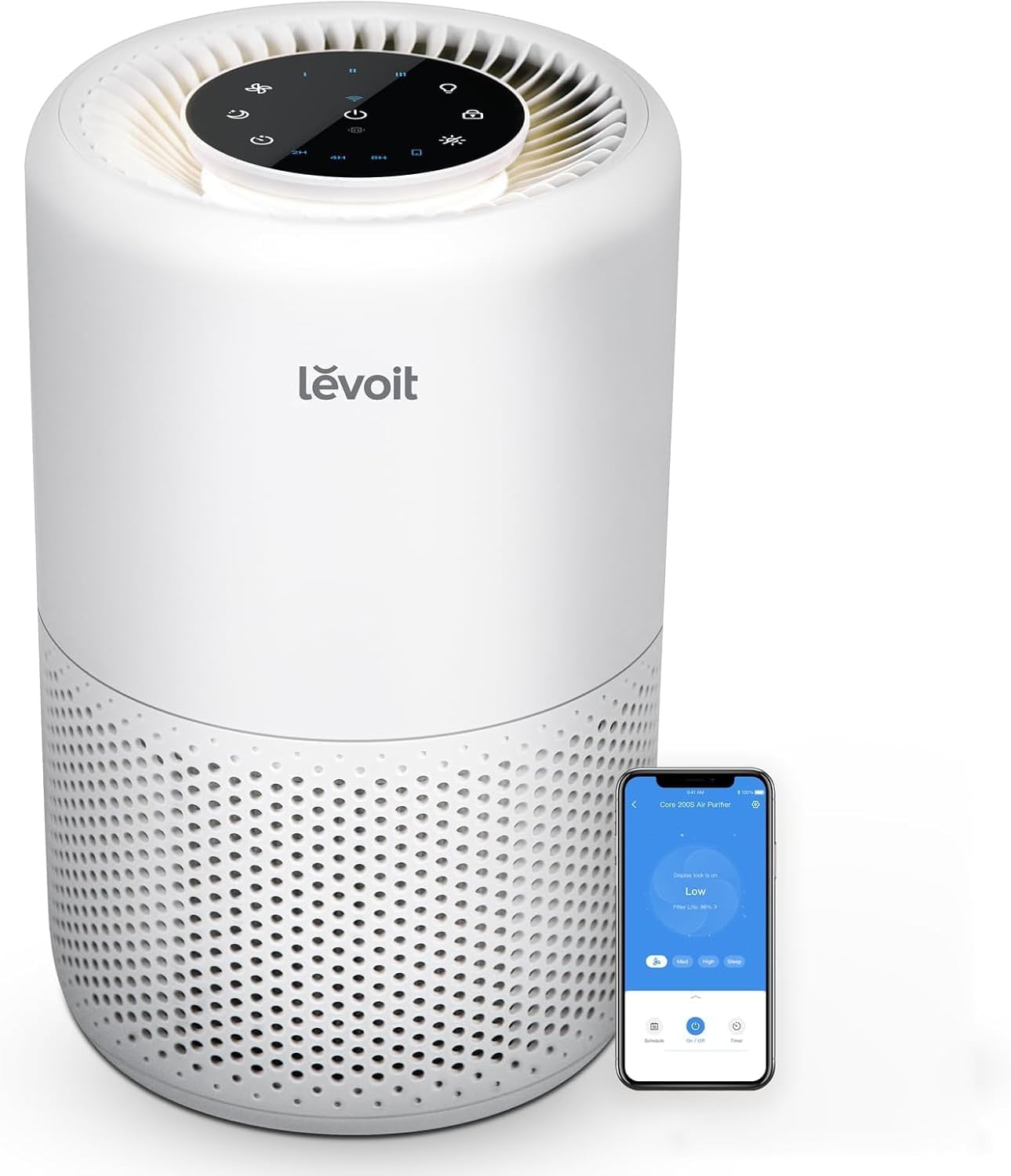
| Room coverage | 140 ft² refreshes 4.8×/hour |
|---|---|
| Filtration | 3-in-1 (Pre-filter, Activated Carbon, HEPA-grade Main) |
| Noise level | As low as 27 dB |
| Model | Core 200S |
The Levoit Core 200S-P is a compact smart air purifier intended for bedrooms, basements, and small living spaces where pets or persistent odors are a concern. It uses a 3-in-1 filter pack—nylon pre-filter, activated carbon layer, and a HEPA-grade main filter—to capture large particles, absorb odors and remove 99.97% of particulates down to 0.1–0.3 microns. The unit draws air in 360 degrees and its rated cleaning rate refreshes the air in a 140 sq ft room multiple times per hour, making it suitable for continuous overnight use. Smart and voice controls plus an app option let you monitor filter life and set schedules or modes remotely, while a sleep mode and display-off button keep noise low for night use with sound as quiet as 27 dB. Practical limitations are its room-size focus and lightweight motor, so it is not intended for large open basements or whole-house circulation, and replacement filters are required to maintain performance. For straightforward, app-enabled air cleaning in a small bedroom or den, it offers an effective, low-noise solution.
Best for: Buyers who want a quiet, app-enabled purifier that reliably cleans the air in a small bedroom, nursery, or finished basement room and value remote control and filter-life monitoring.
Less Ideal for: People needing to purify large open basements, whole floors, or multiple joined rooms should choose a higher-capacity unit instead.
- Three-stage filtration including HEPA-grade main filter that removes 99.97% of 0.1–0.3 micron particles
- 360° air intake and rated refresh rate for effective cleaning in ~140 sq ft rooms
- Smart app and voice control with filter life monitoring for convenient scheduling and remote control
- Very quiet sleep mode and display-off option suitable for overnight use
- Not designed for large rooms or whole-basement coverage due to compact airflow capacity
- Requires periodic replacement filters to sustain rated performance
Verdict: A quiet, app-controlled purifier that delivers HEPA-grade cleaning for small bedrooms or finished basement rooms where low noise and pet-odor control matter.
FULMINARE H13 HEPA Air Purifier

| Filter type | H13 HEPA |
|---|---|
| Recommended room size | Up to 215 ft² / 20 m² |
| Noise level (low) | Around 24 dB |
| Timers | 2, 4, 8, 10, 12 hours |
The FULMINARE H13 is a compact bedroom air purifier that uses an H13 true HEPA filter and a 360° air outlet to refresh air in rooms up to about 215 square feet. It is typically placed on a nightstand or small table and left running continuously or on a selectable timer; a low-noise sleep mode claims operation near 24 dB for minimal disturbance at night. The unit includes an independent night light and five timer settings (2, 4, 8, 10, 12 hours), and the filter is user-replaceable, with replacements sold separately. Practical benefits include straightforward placement, simple controls, and quiet overnight performance that suits light sleepers and nurseries. Limitations are its coverage cap—it is sized for single rooms rather than whole basements or open plans—and replacement filters are required approximately every three months under typical use, which adds ongoing cost. The plug-in power design means it must remain near an outlet and does not run on batteries.
Best for: Buyers looking for an affordable, no-frills bedroom or small basement-bedroom air purifier that prioritizes quiet overnight operation and simple setup.
Less Ideal for: Those who need whole-basement coverage or want a battery-powered, portable unit for moving between large spaces should consider larger or different designs.
- H13 true HEPA filter for particle removal
- 360° air outlet and dual-channel design for even room circulation
- Very low noise in sleep mode suitable for bedrooms
- Built-in night light and multiple timers for convenience
- Designed for rooms up to about 215 ft² so not suited to large or multiroom spaces
- Requires periodic filter replacements sold separately
Verdict: A budget-friendly bedroom air purifier that delivers quiet overnight HEPA filtration and simple timer/night-light convenience for single rooms.
ECOSELF HAP609 Air Purifier

| Model | HAP609 |
|---|---|
| Noise level | 20 dB (Sleep Mode) |
| Timer | 1–24 hours |
| Air quality indicator | PM2.5 display with color ring |
The ECOSELF HAP609 is a small, straightforward HEPA air purifier intended to scrub dust, smoke, pollen, and pet dander from single rooms such as a basement bedroom. It draws air through a 360° intake to maximize circulation, and a visible PM2.5 display plus a colored ring give immediate feedback on indoor air quality. Auto mode uses the built-in sensor to ramp fan speed when particles rise and then return to a low setting, which pairs well with the 1–24 hour timer for hands-off operation. The unit also offers a dedicated sleep mode that turns off lights and drops noise to about 20 dB, making it suitable for light sleepers. Practical limits are its compact size and room coverage: this model targets bedroom-scale spaces rather than large open basements, and replacement filters will be required over time. Controls and features are simple, so you get reliable automatic purification without a steep learning curve or unnecessary extras.
Best for: Buyers who prioritize reliable, automatic air cleaning for a bedroom or small basement room and want a unit that runs quietly at night without frequent manual adjustments.
Less Ideal for: People who need high-capacity purification for a large, open basement or whole-house coverage should consider larger, higher-CADR units instead.
- 360° air intake for more even room circulation
- Built-in PM2.5 sensor with color ring for real-time air quality feedback
- Auto mode and timer enable hands-off operation
- Sleep mode reduces noise to about 20 dB and turns off indicator lights
- Designed for single-room use so not suitable for large open areas
- Requires periodic filter replacements to maintain performance
Verdict: A quiet, sensor-driven bedroom purifier that reliably keeps small rooms clean with minimal user intervention.
Levoit Core 300-P

| Filter Type | 3 in 1 Filtration |
|---|---|
| Floor Area | 1073 square_feet |
| Noise Level | 24 db |
| Particle Retention Size | 0.3 micron |
| Wattage | 56 watts |
The Levoit Core 300-P is a small, user-friendly air purifier built around a 3-stage HEPA-grade filter and a 56W motor to pull air through the unit efficiently. It is typically placed in bedrooms, basements, or home offices to reduce dust, pollen, pet dander, smoke and common odors; the AHAM-verified CADR and stated coverage make it suitable for single rooms rather than whole houses. Controls are touch-based and include a near-silent Sleep Mode that drops noise to about 24 dB, plus a timer and a filter check indicator for basic maintenance reminders. Practical benefits include strong particle capture down to 0.3 micron at 99.97% efficiency, portability between rooms, and safety certifications like ETL and CARB. Limitations are that it lacks smart connectivity or an Auto Mode on this model, so fan speed must be adjusted manually, and real-world CADR depends on using genuine Levoit replacement filters as recommended. Expect routine filter replacements every 6 to 8 months under typical use.
Best for: Buyers who prioritize proven, quiet particulate removal in a bedroom or basement and want a compact, easy-to-use purifier with strong third-party performance verification.
Less Ideal for: Households needing whole-home purification, smart/home-automation integration, or automatic sensor-driven fan control should consider larger or smart-enabled models instead.
- True HEPA-grade 3-stage filtration capturing 99.97% of 0.1–0.3 µm particles
- AHAM-verified CADR for measurable room cleaning performance
- Very quiet Sleep Mode around 24 dB for overnight use
- Portable, compact footprint that is easy to move between rooms
- Certified safe for home use (ETL, CARB) and includes a pre-installed filter
- No built-in Auto Mode or smart connectivity on this Core 300-P model
- Requires periodic replacement filters and performs best with official Levoit filters
Verdict: Choose the Core 300-P when you want a compact, AHAM-verified HEPA purifier that quietly removes fine particles in a single bedroom or basement room.
VOOPNU H13 HEPA Air Purifier DH-JH12

| Filtration | H13 True HEPA triple-layer |
|---|---|
| Coverage (claimed) | Up to 1,076 ft² |
| Noise level | As low as 22 dB |
| Speeds | 3 fan speeds |
| Model number | DH-JH12 |
This VOOPNU DH-JH12 is a small, easy-to-use air purifier built around an H13 true HEPA triple-layer filter and a 360 degree intake that the brand says can cover up to 1,076 sq ft. Controls are simplified to one-tap operation with three fan speeds, a timer, and a built-in essential oil tray if you want light fragrance while running the unit. It is marketed for quiet use, with noise levels as low as 22 dB on the lowest setting, which makes it reasonable for bedrooms or finished basements where low noise matters. The purifier is certified to a range of safety and emissions standards and uses a compact footprint that fits on a desk or corner shelf. Expect regular filter replacements every few months for sustained performance and continuous run time for best results in spaces with persistent dust or odors. The unit's small size helps placement but also means airflow and real-world coverage will depend on room layout and continuous use rather than short bursts.
Best for: Buyers who prioritize a low-noise, easy-to-use purifier for a bedroom or finished basement and prefer a straightforward, safety-certified unit they can run continuously for steady air cleaning.
Less Ideal for: People who need very high airflow or fastest clearance for large, open basements or heavily smoky environments should choose a larger, higher-CADR purifier instead.
- H13 true HEPA filtration captures 99.97% of airborne particles according to product claims
- 360° air intake improves air capture from multiple directions
- Very quiet operation down to 22 dB suitable for sleep or quiet basement use
- Compact footprint allows flexible placement on desks, shelves, or corners
- Simplified controls and timer make it easy to run continuously
- Manufacturer coverage figures are laboratory tested and actual performance will vary with room layout and obstacles
- Small physical size suggests lower raw airflow compared with larger, higher-CADR units
- Filter replacements are required every few months to maintain peak performance
Verdict: A compact, quiet H13 HEPA purifier that is a practical, low-noise choice for bedroom or finished basement use when steady, continuous cleaning is the priority.
Choosing the Right Air Purifier for Basement Bedroom: Key Factors to Consider
Filtration Efficiency
Basement bedrooms often contain fine particulates from dust, mold spores, and airborne VOCs from damp building materials. A purifier with true HEPA-level filtration captures very small particles, which directly reduces allergy triggers and visible dust accumulation. Some units include activated carbon or other adsorbents to reduce odors and volatile organic compounds, which are common in enclosed, damp basements.
Higher filtration efficiency matters because it shortens the time required to reduce pollutant levels in a closed room. When evaluating options, consider the filter type, stated particle capture size, and whether the unit combines particulate filtration with gas-phase adsorption for odor control.
Clean Air Delivery Rate and Room Coverage
CADR indicates how quickly a purifier can clean the air in a room of a given size. Basements are often smaller but may have lower ceilings or unusual layouts, so matching CADR to the actual cubic footage and expected pollutant load is important. A unit with insufficient airflow will run constantly without noticeably improving air quality.
Aim for a CADR that clears the room air multiple times per hour. If you spend long periods sleeping in the basement bedroom with the door closed, prioritize devices sized to the closed-room volume rather than open-plan coverage figures.
Noise Levels and Nighttime Operation
Sleep quality can suffer if a purifier is too loud. Noise ratings and dedicated night modes help identify models that can operate continuously without disrupting sleep. Some purifiers reduce fan speed automatically based on sensors, while others offer a very quiet low-speed setting intended for bedrooms.
Look for measured decibel ratings at the lowest setting and any independent testing or user reports about sleep disruption. Consider whether the sound is a steady white-noise that you can sleep through or a variable fan hum that wakes light sleepers.
Humidity, Moisture Resistance, and Mold Risk
Basements are prone to higher humidity and occasional dampness, which can affect both indoor air quality and the durability of an air purifier. Materials that resist corrosion and electronic controls designed to tolerate higher humidity will last longer in basement conditions. Also consider how a purifier interacts with humidity: some units can slightly dry the immediate air through airflow but are not dehumidifiers and will not solve humidity problems on their own.
If mold is a concern, prioritize purifiers that capture mold spores effectively and recommend complementary moisture-control solutions. Regular maintenance is essential because filters exposed to damp air can develop microbial growth if not changed on schedule.
Filter Lifespan and Ongoing Maintenance
Filter replacement frequency and ease have a big impact on long-term ownership cost and hassle. Basement environments with persistent dust or odor sources can shorten filter life. Check expected runtime for replacement filters, how simple the swap is, and whether prefilters are washable to extend HEPA filter life.
Maintenance also includes whether the unit has accessible components for cleaning, clear filter-replacement indicators, and widely available replacement filters. Choosing a unit with fewer hidden maintenance steps reduces the chance of neglect, which is especially important in less-frequented basement spaces.
Placement and Power Considerations
Where you place the purifier affects performance. Basements often have limited outlet locations and furniture arrangements that can block airflow. A unit with a compact footprint and directional airflow options fits better into constrained sleeping spaces.
Also consider the unit's power draw if you plan on continuous operation. Lower-energy models are cheaper to run night after night, and features like programmable timers or smart controls can help manage runtime without manual intervention.
Managing Musty Odors in Below-Grade Bedrooms
Musty smells in basement bedrooms come from moisture-related sources and trapped air. Air purifiers with a dedicated activated carbon stage or other gas-phase media can reduce these odors, but they work best when combined with source control such as improved ventilation and humidity management.
For persistent odors, prioritize units that make it easy to replace or upgrade the carbon stage. Running the purifier continuously at a modest speed helps maintain steady odor reduction without generating excessive noise.
- Use carbon or specialized odor media for VOC and smell reduction
- Combine purifier use with humidity control like a dehumidifier
- Place unit centrally but away from walls to enable full intake and exhaust
Placement Tips for Small or Low-Ceiling Rooms
Best performance requires unobstructed airflow. Place the purifier on the floor or a stable surface with intake and exhaust clear of blankets, curtains, or furniture. In a small basement bedroom, a corner placement that maintains a 12-inch clearance on at least one side strikes a good balance between space efficiency and airflow.
If the room has a bed that restricts airflow near the floor, elevate the unit a few inches to improve circulation and distribution of cleaned air.
- Keep intake and exhaust unobstructed
- Avoid placing directly under windows where humidity spikes
- Elevate slightly if bed or furniture blocks airflow
Combining an Air Purifier with Humidity Control
An air purifier does not replace a dehumidifier. High humidity exacerbates mold growth and can shorten filter life. If your basement bedroom routinely measures above recommended humidity levels, pairing a purifier with a small dehumidifier improves results and protects both the room and the purifier itself.
Use the purifier to capture spores and particulates while the dehumidifier addresses the root moisture problem. Together they reduce odors and lower the long-term maintenance burden.
- Target relative humidity between 40 and 50 percent
- Run a dehumidifier when humidity sensors indicate persistent dampness
- Empty and clean dehumidifier and purifier filters on a regular schedule
Sensor Features and Auto Modes That Matter
Smart sensors that detect particle levels and adjust fan speeds can be especially useful in basements where pollutant levels can spike when doors open or during laundry and hobby activities. Auto mode keeps the unit responsive without manual intervention.
Look for units with separate particulate and gas sensors, or at least reliable particulate sensing, since basement pollutants often involve both dust and VOCs.
- Prefer models with accurate particulate sensing
- Auto modes reduce the need to change settings overnight
- Consider units with a true night mode that dims lights and lowers sound
Energy Use and Long-Term Running Costs
Because you will often run a basement bedroom purifier for many hours each day, energy efficiency matters. Check power consumption at typical operating speeds and whether features like timer, eco mode, or scheduled operation reduce runtime without sacrificing air quality.
Lower power draw also reduces heat output, which can be beneficial in small basement rooms that already feel stuffy.
- Compare wattage at low and high speeds
- Use timers or scheduling to limit run hours if constant operation is not required
- Choose Energy Star or documented low-wattage designs when extended runtime is expected
How We Chose the Best Air Purifier for Basement Bedroom
We focused on features that directly affect indoor air quality and user comfort in below-grade sleeping spaces. Selection criteria included filtration capability against fine particulates and common basement pollutants, clean air delivery rate relative to typical basement bedroom sizes, and operational noise at night to ensure the unit can run while you sleep. We also prioritized units with moisture-tolerant designs or materials, practical filter replacement schedules, and simple controls that make continuous use realistic. Exclusions: units that are strictly decorative, not intended for continuous operation, or lack any certified particulate filtration were not considered. The final shortlist balances measurable performance specs with everyday usability factors like filter cost and ease of maintenance. These evaluation priorities align with the scoring dimensions used in our per-product scorecards.
Our full evaluation process is outlined in our review methodology.
FAQ
Will an air purifier remove mold from the walls?
An air purifier can capture airborne mold spores, reducing spread, but it will not remove mold growing on surfaces. Address surface mold with moisture control and proper cleaning; use a purifier alongside these measures to limit airborne spores.
How loud is a typical purifier when used overnight in a bedroom?
Noise varies by model and fan speed. Many bedroom-capable purifiers have a night mode in the low teens to low twenties decibels above ambient at their quietest setting, which is generally tolerable for sleep. Check tested noise figures and look for dedicated night modes.
Do I need a dehumidifier if I have an air purifier?
Often yes. An air purifier does not lower relative humidity, so if your basement is damp a dehumidifier is the effective tool to reduce moisture. Using both together is the best approach for mold prevention and odor control.
How often should I change filters in a basement bedroom?
Filter life depends on pollutant load and humidity. Basements with persistent dust or odors may need filter changes more frequently than listed runtimes. Inspect prefilters monthly and plan on replacing primary filters per manufacturer guidance or sooner if you notice decreased airflow or persistent smells.
Can I run the purifier with the bedroom door open?
Yes, but room clearance and CADR calculations assume a closed or semi-closed space. With the door open, the purifier must clean a larger volume of air, which may reduce the effective air changes per hour for the sleeping area.
Final Verdict
Choose an air purifier for a basement bedroom by prioritizing filtration that targets fine particulates and VOCs, matching CADR to the room volume, and ensuring quiet night operation. Factor in moisture resistance and plan for a paired humidity-control strategy if the basement runs damp. Consider maintenance demands and filter availability so the unit remains effective long term. By balancing these tradeoffs you can pick a unit that delivers cleaner, fresher air without disturbing sleep or requiring excessive upkeep.