
Note: This article contains affiliate links. If you click on these links and make a purchase, we may earn a small commission at no extra cost to you. This helps support our research and content. Read our full affiliate disclosure here.
If you live with persistent dust, a dedicated air purifier can make daily cleaning noticeably easier and cut airborne particles that settle on surfaces. Picking the right air purifier for a dusty room matters because not all machines handle fine dust equally, and factors like filter type, airflow capacity, and room coverage determine real-world results. This guide presents our shortlist of the top options for dusty rooms and highlights the evaluation criteria we used, including filtration efficiency and practical coverage. Read on to see which features matter most for trapping household dust and improving indoor air clarity.
Top Picks at a Glance
| Best Overall The best all-around choice for most situations | Winix 5510 Air Purifier |  |
| Best Quality Built to a higher standard if you want something more solid | Sans True HEPA Air Purifier |  |
| Best Value The sweet spot between price and what you get | FULMINARE H13 HEPA Air Purifier |  |
| Best Budget The cheapest option that still gets the job done reliably | AromaRoom AP103-A Air Purifier |  |
| Top Rated A top-rated pick with lots of positive feedback | Levoit Core 300-P Air Purifier |  |
| Most Popular A crowd favorite that many people choose with confidence | Levoit Core Mini-P |  |
| Best Seller A high-volume bestseller chosen again and again | VOOPNU DH-JH12 Air Purifier |  |
Winix 5510 Air Purifier

| Model number | 5510 |
|---|---|
| AHAM verified coverage | 1,882 sq ft in 1 hr |
| Particle capture | Down to 0.01 microns |
| Noise (low) | 23.5 dB |
| Smart features | WiFi, Alexa, Google Home, Winix Smart App |
The Winix 5510 is a tower-style air purifier built for whole-room cleaning in larger spaces, using a 4-stage system that combines a washable pre-filter, True HEPA capture, and a high-deodorization carbon layer with Winix PlasmaWave technology. It runs on Auto Mode driven by built-in smart sensors and an air quality LED so the fan speed adjusts automatically as conditions change, and Sleep Mode cuts noise when the room is dark. App support, plus Alexa and Google Home compatibility, lets you monitor and change settings remotely. Practical benefits include strong particle removal down to 0.01 microns, active VOC and odor reduction from the carbon filter, and AHAM verification for stated coverage, making it suited for dusty rooms, pet dander, and smoke. Expect low noise on the slowest setting but higher noise and energy use when the purifier ramps up in heavily polluted conditions, and replacement filters are a recurring cost. The washable mesh pre-filter helps reduce maintenance frequency, but you will need to budget for periodic HEPA and carbon replacements if used continuously in dusty environments.
Best for: Buyers who want a reliable, sensor-driven purifier for a dusty large room and prefer automated control plus smart-home monitoring to keep air quality consistently low-maintenance.
Less Ideal for: People who need an ultra-compact or travel purifier for small spaces or those unwilling to buy replacement filters over time should look elsewhere.
- 4-stage filtration with True HEPA captures very fine particles including dust and pet dander
- High-deodorization carbon filter reduces odors and common VOCs found indoors
- Smart sensors with Auto Mode and AQI LED provide hands-off speed control based on real-time air quality
- App, Alexa, and Google Home compatibility enable remote monitoring and control
- Washable pre-filter reduces dust load on main filters and lowers short-term maintenance
- Replacement HEPA and carbon filters are consumables and add ongoing cost
- Unit will run louder and use more power when auto mode responds to heavy dust or smoke
Verdict: A smart, sensor-driven purifier with True HEPA and active odor control that reliably handles dusty large rooms while offering hands-off operation.
Sans True HEPA Air Purifier

| Filtration | Pre-filter + True HEPA + Activated carbon + UV-C |
|---|---|
| Coverage | Up to 1,854 sq ft |
| Particle capture | Down to 0.1 microns |
| Noise mode | Sleep/quiet (25 dB in auto mode) |
The Sans True HEPA Air Purifier is a tower-style unit built to tackle large, dusty rooms by combining a pre-filter, medical-grade True HEPA filter, and a thick activated carbon layer with an added UV-C light stage. In practice it pulls pet hair and larger debris in the pre-filter, captures fine dust and allergens down to 0.1 microns in the HEPA stage, and uses the carbon layer to reduce cooking and smoke odors. Smart sensors drive an automatic mode that raises fan speed when air quality worsens and a low-noise sleep mode that dims lights for bedroom use. Filter replacement is straightforward thanks to an onboard indicator and simple access. The unit's strength is room coverage and multi-stage filtration, but its large capacity and high airflow mean it is physically substantial and best used in open floor plans or single very large rooms rather than small, enclosed spaces where a smaller purifier would be more efficient.
Best for: Buyers who prioritize strong, high-coverage filtration and want a single unit that can handle heavy dust, pet dander, and persistent odors in very large rooms or open-plan areas.
Less Ideal for: People with small bedrooms, offices, or apartments who need a compact, lower-airflow purifier or who prefer quieter, lower-intensity units for confined spaces.
- Medical-grade True HEPA captures very fine particles down to 0.1 microns
- Thick activated carbon layer absorbs odors, smoke, and VOCs
- Covers up to 1,854 sq ft, suitable for very large rooms or open plans
- Smart auto mode with real-time AQI sensing adjusts fan speeds for efficiency and responsiveness
- Quiet sleep mode and dimmed display for overnight use
- Large unit better suited to big spaces and may be overkill for small rooms
- UV-C stage adds complexity though specific sterilization claims are not quantified in specs
Verdict: Choose this unit if you need powerful, multi-stage filtration and single-device coverage for a very large dusty room.
FULMINARE H13 HEPA Air Purifier

| Filter type | H13 HEPA |
|---|---|
| Coverage area | Up to 215 ft² / 20 m² |
| Noise level (low) | Around 24 dB |
| Power | Plug-in (adapter included in base) |
The FULMINARE H13 is a small, portable air cleaner that uses an H13 true HEPA filter and 360-degree airflow to refresh air in rooms up to roughly 215 square feet. It is intended for everyday use in bedrooms, home offices or living rooms where dust, pet hair, smoke and odors are a concern. Controls include multiple fan speeds, a near-silent sleep mode that can run around 24 dB, and a built-in night light with independent control and five timer options. The unit's dual-channel design and 360° outlet help distribute cleaned air throughout a small space, and its compact footprint makes it easy to move between rooms. Expect routine filter replacements—packaging notes recommend swapping filters about every three months depending on use—and the unit requires plugging into power rather than battery operation. This purifier is a practical choice when you need quiet, hands-off dust and particle capture in a single-room footprint rather than whole-house coverage.
Best for: Buyers who prioritize quiet, reliable particle removal in a single bedroom or small living space and who prefer a compact, portable unit with simple controls and a night light.
Less Ideal for: Homes needing whole-house or multi-room purification or users who want battery-powered or cordless operation.
- H13 true HEPA filtration for capturing fine particles and dust
- 360° air outlet and dual-channel design to circulate cleaned air across a small room
- Very low-noise sleep mode (~24 dB) suitable for bedrooms
- Independent night light and multiple timer settings for flexible overnight use
- Intended coverage limited to around 215 sq ft so not suitable for larger open areas
- Requires periodic filter replacements (manufacturer suggests about every 3 months)
Verdict: A compact, quiet H13 HEPA purifier that reliably captures dust and particles in single rooms up to about 215 sq ft.
AromaRoom AP103-A Air Purifier
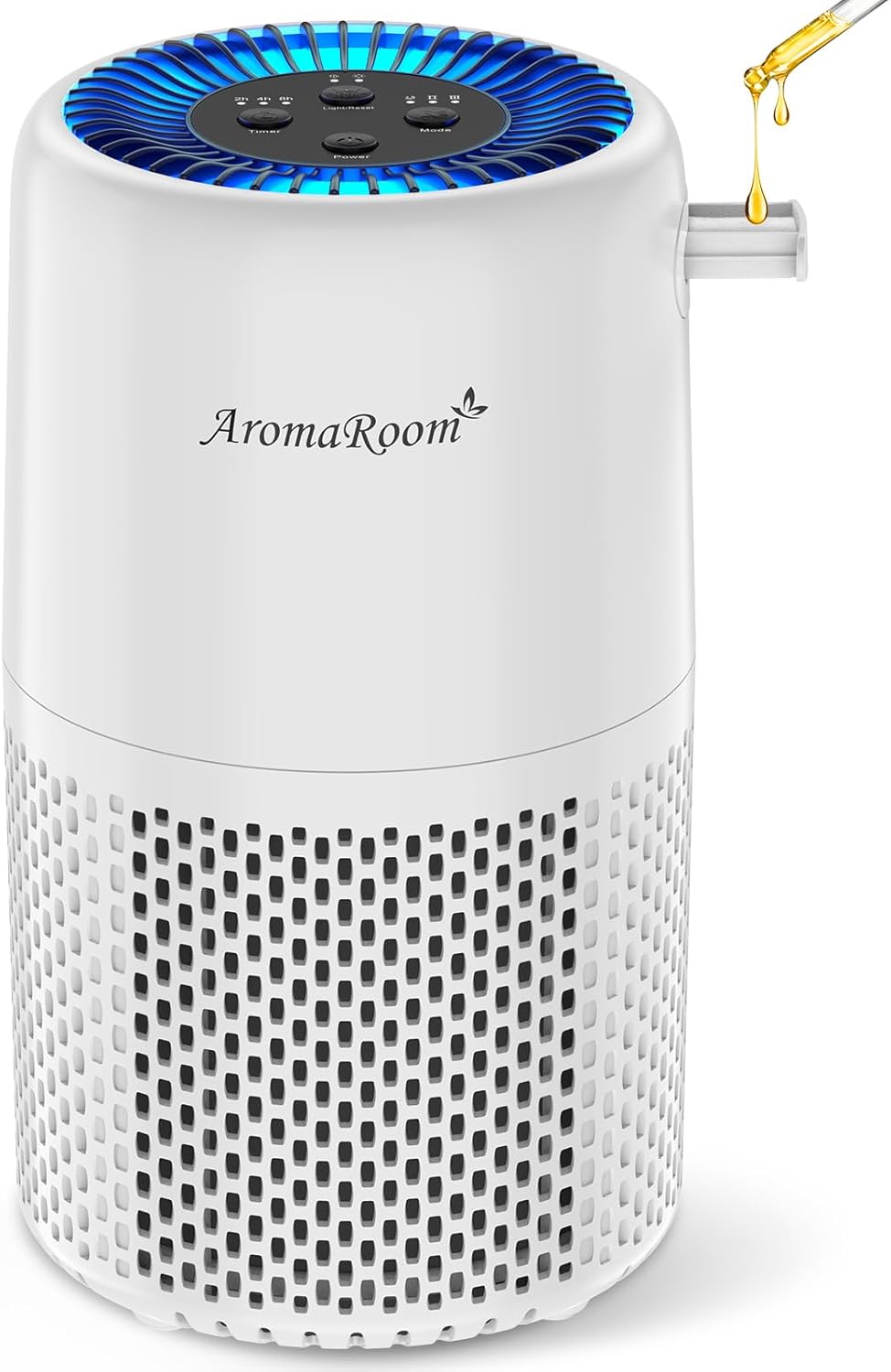
| Filtration | 3-in-1 True H13 HEPA |
|---|---|
| Coverage | Circulates air twice/hour in 323 ft² (30 m²) |
| Noise (sleep) | 22 dB |
| Timer | 2/4/8 hours |
The AromaRoom AP103-A is a small, budget-friendly air purifier designed to reduce dust, pollen, pet dander, and smoke in rooms up to about 323 sq ft by circulating the air twice per hour. It uses a 3-in-1 filtration system with a True H13 HEPA element that captures particles down to 0.1–0.3 microns, plus a smoke-targeting layer and an aroma pad if you want a light scent. Controls include sleep mode that drops noise to about 22 dB, three timers (2/4/8 hours), and straightforward fan settings, making it easy to run overnight in a bedroom. Practical benefits include quiet operation for night use, a compact footprint for desks or nightstands, and a built-in fragrance option for those who like mild aromatherapy. Important limitations are its modest coverage compared with larger purifiers and the requirement to replace the manufacturer filter every few months for best performance, which adds ongoing cost. For a dusty room on a budget, it provides effective particle filtration in a compact, user-friendly package.
Best for: Buyers who need an affordable, quiet purifier to reduce dust and pet particles in a bedroom or small living area and who prioritize low noise and simple controls over maximum coverage.
Less Ideal for: People who need high-output purification for large open-plan rooms, severe smoke or mold problems, or who want a unit sized for whole-home coverage.
- True H13 HEPA filter captures at least 99.97% of particles in the 0.1–0.3 micron range
- Quiet sleep mode with noise as low as 22 dB for overnight use
- Effective air circulation for rooms up to about 323 ft² at two air changes per hour
- Compact, lightweight design fits on nightstands and small surfaces
- Built-in fragrance pad adds optional mild aromatherapy
- Coverage and CADR are modest compared with larger, higher-output purifiers
- Requires periodic replacement of manufacturer filters every 3–6 months
- Not recommended for use in high-humidity areas like bathrooms
Verdict: A compact, low-noise HEPA purifier that delivers effective dust and particle cleanup for small rooms at a budget-friendly price.
Levoit Core 300-P Air Purifier

| Filter Type | 3 in 1 Filtration |
|---|---|
| Noise Level | 24 db |
| Wattage | 56 watts |
| Particle Retention Size | 0.3 micron |
| Floor Area | 1073 square_feet |
The Levoit Core 300-P is a small, user-friendly air purifier built around a 3-stage filtration system that includes a true HEPA-grade filter capable of capturing 99.97% of particles down to 0.1–0.3 microns. It is designed for typical rooms and can refresh air quickly thanks to a 56W motor and CADR ratings that support frequent air changes in medium-sized spaces. Controls are touch-based with a sleep mode that lowers noise to about 24 dB and dims the display for nighttime use. Practical benefits include portability, an easy-to-replace preinstalled filter, an indicator and timer functions, and certifications such as AHAM and CARB that back up performance claims. Expect effective removal of dust, pollen, pet dander, smoke, and many VOCs when used with Levoit original filters. Limitations are that smart/auto mode is not available on this variant, so fan speed must be adjusted manually, and optimal performance depends on regular filter replacements as recommended by the manufacturer.
Best for: Buyers who prioritize reliable, independently certified particle removal for bedrooms or dusty rooms and want a simple, low-noise unit that consistently cleans air when run on a set speed.
Less Ideal for: Those who need automatic, smart-managed purification across multiple rooms or a whole-house solution should consider larger or Wi-Fi enabled models instead.
- True HEPA-grade 3-stage filtration capturing ultrafine particles down to 0.1–0.3 microns.
- AHAM and CARB certifications that verify tested performance and safety.
- Very quiet sleep mode at about 24 dB for overnight use.
- Compact and portable footprint with touch controls and a built-in timer.
- Preinstalled filter and clear filter indicator simplify maintenance.
- No smart connectivity or automatic fan-speed Auto Mode on this model.
- Coverage and CADR are optimized for single rooms rather than whole-home use.
Verdict: A compact, certified HEPA purifier that reliably removes dust and fine particles in single rooms while running nearly silently.
Levoit Core Mini-P
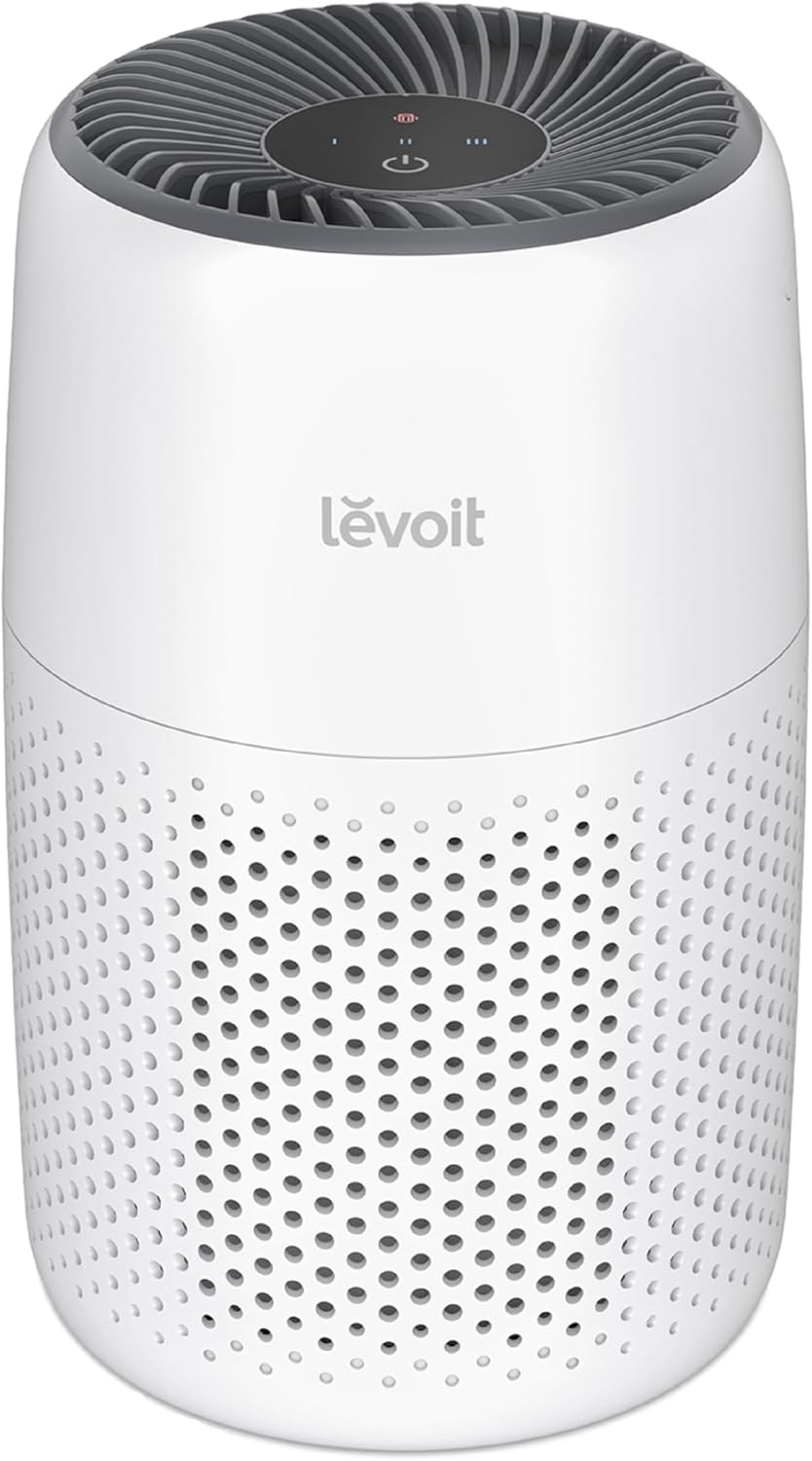
| Rated Power | 7W |
|---|---|
| Noise Level | 27-45dB |
| Adapter Input | 100-240V, 50/60 Hz |
The Levoit Core Mini-P is a small, plug-in air purifier intended for bedrooms, offices, or desktop use where space is limited. It uses a pre-filter plus a main high-efficiency filter to trap lint, hair, pet dander, fine dust and some smoke particles, and it includes a fragrance sponge for light aromatherapy. The unit runs quietly—Levoit claims noise levels from about 27 to 45 dB—so it is suitable for sleep or focused work, and the auto-off display and sleep mode reduce interruptions. Its rated power is low at 7 W, so it is energy efficient for continuous use. Practical limits are its compact coverage: this model is tuned for small areas and will not replace larger whole-room purifiers for heavily dusty rooms, and the aroma sponge requires careful dosing to avoid damage. Filter replacements are a recurring cost and the small size means shorter runtime between filter changes compared with larger units. For a balance of quiet operation, portability, and targeted small-room cleaning, the Core Mini-P performs well.
Best for: Buyers who prioritize quiet, energy-efficient air cleaning for a bedroom, dorm, or desk space and want a compact unit with proven brand reputation and lots of user feedback.
Less Ideal for: People needing to clean large, very dusty rooms or whole-apartment coverage should choose a larger-capacity purifier instead.
- Compact footprint for desks, nightstands, and small bedrooms
- Pre-filter plus main filter captures hair, pet dander, lint and fine particles
- Very low power draw (7 W) suitable for continuous use
- Quiet operation with a sleep mode and auto-off display for minimal disturbance
- Designed for small spaces so it is not effective as a primary purifier for large or very dusty rooms
- Aroma sponge needs careful dosing to avoid overflowing or damaging plastic parts
Verdict: Choose the Levoit Core Mini-P when you need a quiet, energy-efficient purifier that reliably removes dust and pet particles from small rooms or desks.
VOOPNU DH-JH12 Air Purifier

| Coverage | Up to 1,076 ft² (manufacturer claim) |
|---|---|
| Filtration | H13 True HEPA triple-layer |
| Noise level | As low as 22 dB |
| Fan speeds | 3 speeds |
| Model number | DH-JH12 |
The VOOPNU DH-JH12 is a small, easy-to-use air purifier built around an H13 true HEPA triple-layer filter and 360° intake to capture common household particles such as dust, pet dander, pollen, smoke, and odors. It is intended for continuous use in bedrooms, living rooms, or other dusty spaces and the manufacturer states laboratory-tested performance that cleans 250 ft² every 15 minutes. Controls are simple with three fan speeds, a timer, and a quiet low mode that can run around 22 dB for undisturbed sleep, plus a small aroma tray for essential oils. The unit is compact and portable, so placement on a desk or corner is straightforward, and it carries several safety and compliance certifications. Expect practical benefits in reducing airborne dust and allergens when the purifier runs for extended periods, but note the small physical footprint implies smaller internal fan and filter size than larger tower units, which may mean slower full-room turnover on the highest coverage claims. Replacement filters are recommended on a 3–6 month schedule depending on use and dust load.
Best for: Buyers who prioritize a straightforward, certified purifier that runs quietly and reliably for continuous dust and allergen reduction in bedrooms or living areas and prefer low-maintenance, easy operation.
Less Ideal for: Those needing very fast air changes for large open-plan spaces or heavy-construction dust should consider larger commercial-grade purifiers with higher airflow and CADR ratings.
- H13 true HEPA triple-layer filter captures 99.97% of common airborne particles
- 360° intake design improves airflow from all directions for more even room coverage
- Quiet low-speed operation (around 22 dB) suitable for bedrooms and nighttime use
- Simple controls, timer, and compact footprint make placement and daily use easy
- Multiple safety and regulatory certifications provide reassurance about product compliance
- Manufacturer coverage claim (up to 1,076 ft²) is optimistic for the unit's compact size and may require longer run times to achieve in very dusty rooms
- Filter replacement every few months adds ongoing maintenance cost
Verdict: A compact, certified HEPA purifier that offers quiet, easy continuous operation for reducing dust and allergens in bedrooms and small to medium rooms.
Choosing the Right Air Purifier for Dusty Room: Key Factors to Consider
Filtration Efficiency and Filter Type
Filtration efficiency determines how effectively a purifier removes fine dust and respirable particles from the air. True HEPA-class filters capture a high percentage of particles down to 0.3 microns, which covers most household dust components. Activated carbon or prefilter stages help remove larger debris and reduce odors, but the core dust-removal job is done by the particulate filter.
Filter construction, including pleat density and surface area, affects how long a filter maintains airflow before it needs replacement. A purifier with clear filter ratings and independent test data gives you a realistic expectation of dust capture performance over time.
Room Coverage and Airflow (CADR)
Room coverage and clean air delivery rate (CADR) indicate how quickly a unit can circulate and clean the air in a given space. Higher airflow means more air exchanges per hour, which reduces settled dust faster and keeps airborne particle concentrations lower. For dusty rooms, aim for a purifier rated to provide several air changes per hour at the room size you will use it in.
Consider that CADR tests typically measure smoke, pollen, and dust separately. Look for the dust CADR or the manufacturer's stated square-foot recommendation and match it to your room's dimensions to avoid underpowered equipment.
Filter Maintenance and Operating Cost
How often filters need replacing and how much replacements cost directly affects lifetime ownership expense and convenience. Prefilters that trap large particles can extend the life of the main particulate filter and are often washable. Replacement intervals vary with dust load; heavy-dust environments will require more frequent filter swaps.
Choose models with easy-to-access filters and clear maintenance indicators. Units that provide a predictable maintenance schedule help you budget for upkeep and maintain peak dust-capturing performance.
Noise Levels During Typical Use
Noise is a practical constraint because purifiers intended to run for long periods must be tolerable in living rooms, bedrooms, or home offices. Higher fan speeds increase dust removal but also raise noise. Look for models with measured sound levels at low and medium settings so you can balance speed and comfort.
If the purifier will operate in a bedroom, prioritize quieter models or those with night modes that lower fan speed while still providing reasonable filtration.
Placement, Size, and Portability
Where you place the purifier affects performance. A unit needs some clearance for intake and exhaust to avoid short-circuiting airflow. Portable and lightweight models make it easy to move the purifier between rooms based on where dust accumulates most.
Consider physical footprint if you have limited floor space or plan to place the unit on furniture. Taller, narrow units may fit into corners more easily, while larger tabletop models can offer targeted cleaning for smaller areas.
How Dust Behavior Affects Purifier Performance
Dust is a mixture of skin cells, textile fibers, pet dander, and fine mineral particles that behave differently depending on size and air movement. Larger particles settle quickly and are best captured by prefilters or by regular surface cleaning. Smaller particles stay airborne longer and are what an air purifier must capture to reduce continual settling.
Understanding this behavior helps set expectations: even a high-efficiency purifier will not instantly eliminate visible dust on surfaces. Instead, steady operation lowers the airborne particle load and reduces how quickly dust settles, which means less frequent dusting and improved indoor air quality over time.
- Smaller particles remain suspended longer and require high-efficiency particulate filters.
- Airflow patterns in the room determine how quickly particles move toward the purifier.
- Surface dust reduction is a gradual process tied to sustained air exchanges.
Placement Tips for Maximum Dust Removal
Position the purifier where it can draw air freely without obstructions. Avoid tucking it against walls or behind furniture where intakes or outlets are blocked. For general room cleaning, central placement often yields the best circulation.
If dust is concentrated in a specific zone, such as near a window or pet area, place the purifier closer to that source. In multiroom homes, moving the unit to the room where dust is worst during periods of highest activity gives noticeable short-term benefits.
- Leave several inches of clearance around intakes and outlets.
- Elevate compact units off the floor to improve intake of lighter particles.
- Avoid placing purifiers directly next to windows with incoming outdoor dust unless they are designed for that use.
Balancing Fan Speed and Noise for Daily Use
Running the purifier at high speed increases dust removal but also creates more noise. For daytime use in living areas, higher speeds may be acceptable. For night use or work-from-home situations, choose a lower fan setting that still provides useful air changes without being disruptive.
Some purifiers include automatic modes that adjust fan speed based on measured particulate levels. These modes can help manage noise and energy use while responding to spikes in dust from activities like cleaning or opening windows.
- Use higher speeds during and immediately after dust-generating activities.
- Switch to low or sleep modes overnight to maintain background filtration quietly.
- Consider models with quiet operation ratings if noise is a primary concern.
Maintaining Peak Performance in Dusty Conditions
Regular upkeep keeps a purifier effective. Clean or replace prefilters as recommended and follow the manufacturer schedule for main filter changes. In dusty rooms, check filters more often because heavy loads reduce airflow and capture efficiency.
Monitor indicator lights or manual inspections rather than waiting for poor performance. A clogged filter increases energy use and reduces the unit's ability to remove particles, so timely maintenance preserves both performance and operating cost.
- Inspect prefilters monthly in high-dust environments.
- Keep replacement filters on hand if your room regularly requires more frequent swaps.
- Wipe down exterior grilles and clear intake vents to prevent airflow restriction.
When to Use an Air Purifier Vs. Other Dust Control Strategies
Air purifiers reduce airborne particles that later settle as surface dust, but they are not a substitute for routine cleaning. Combine purifier use with consistent vacuuming, dusting with a damp cloth, and minimizing tracked-in dirt to achieve the best results.
For persistent sources of dust, such as nearby construction or heavy foot traffic, use targeted strategies like keeping windows closed when outdoor dust is high and placing doormats to reduce ingress of dirt.
- Purifiers are most effective as part of a broader cleaning routine.
- Address dust sources to lower the burden on the purifier.
- Use humidity control and ventilation strategies when appropriate to reduce dust resuspension.
How We Chose the Best Air Purifier for Dusty Room
We focused on features that directly affect a purifier's ability to reduce airborne and surface dust in everyday rooms. Primary evaluation criteria included particulate filtration efficiency for fine dust, recommended room coverage and airflow rates, filter type and maintenance ease, noise levels at typical operating speeds, and energy use during continuous operation. We also considered real-world usability factors such as control simplicity, placement flexibility, and the availability of replacement filters that match the stated filtration class. Units were excluded if they relied only on ionization without a true particulate filter or if they lacked published CADR or equivalent airflow metrics. Our short list favors devices that combine high particle-capture performance with practical operating characteristics for regular household use.
Our full evaluation process is outlined in our review methodology.
FAQ
Will an air purifier eliminate all visible dust in my room?
No. An air purifier reduces airborne particles and slows how quickly new dust settles, but visible dust on surfaces also depends on cleaning frequency, dust sources, and air movement. Expect gradual improvement rather than instant disappearance.
How often should I change filters in a dusty room?
Filter replacement frequency depends on dust load and the unit's prefilter design. In a dusty room, check prefilters monthly and expect main particulate filters to need replacement more often than in cleaner environments. Follow the manufacturer's baseline schedule and adjust based on inspections.
Can I run an air purifier 24/7 in a dusty room?
Yes. Many purifiers are designed for continuous operation and running them steadily provides the best reduction in airborne dust. Consider energy use and noise; choose a model with efficient motors and acceptable sound levels for long-term use.
Does CADR matter for dust specifically?
Yes. CADR includes a dust rating that reflects how quickly a unit removes dust particles under test conditions. Use the dust CADR or the manufacturer's room coverage guidance to size the purifier for effective dust removal in your space.
Are ionizers a good choice for dusty rooms?
Ionizers can cause particles to settle out of the air but often do not capture them in a filter and may produce byproducts. For dusty rooms, a purifier with a true particulate filter is generally a more reliable and verifiable solution.
Final Verdict
When selecting an air purifier for a dusty room, prioritize particulate filtration efficiency and a dust CADR that matches your room size. Balance fan speed, noise, and maintenance expectations to find a unit you can run regularly without undue cost or disruption. Remember that a purifier works best alongside routine cleaning and source-control measures. Focus on proven filtration, accessible maintenance, and the right coverage rating to confidently reduce dust and improve indoor air clarity.