
Note: This article contains affiliate links. If you click on these links and make a purchase, we may earn a small commission at no extra cost to you. This helps support our research and content. Read our full affiliate disclosure here.
If you work with acrylic paints, solvents, or adhesives, lingering fumes and odors can make a workspace uncomfortable and potentially unhealthy. Choosing the right air purifier for acrylic smell matters because not all units are designed to capture the volatile organic compounds and fine particles released during painting and finishing. This guide covers our shortlist of top air purifiers for acrylic smell, each chosen for real-world factors like filtration type, room coverage, and airflow performance. We evaluate units based on measurable filtration effectiveness and practical usability so you can pick a model that reduces odors, improves ventilation, and fits your studio or hobby space. Read on for the picks and the criteria we used to evaluate them before the detailed product list.
Top Picks at a Glance
| Best Overall The best all-around choice for most situations | WINIX AT40 Air Purifier |  |
| Best Quality Built to a higher standard if you want something more solid | Resiners AirPure Lite R-263E |  |
| Best Value The sweet spot between price and what you get | GermGuardian Tower AC4825E |  |
| Best Budget The cheapest option that still gets the job done reliably | VOOPNU HEPA Air Purifier DH-JH12 |  |
| Top Rated A top-rated pick with lots of positive feedback | DREO Air Purifier 338 (DR-HAP008) |  |
| Most Popular A crowd favorite that many people choose with confidence | Levoit Core 300-P Air Purifier |  |
| Best Seller A high-volume bestseller chosen again and again | Levoit Core Mini-P |  |
WINIX AT40 Air Purifier

| AHAM verified coverage | 410 sq ft (CADR-based testing) / up to 1,968 sq ft in 1 hour |
|---|---|
| Filtration stages | 4-stage 360° system (True HEPA + carbon + PlasmaWave) |
| Particle removal | Removes particles as small as 0.01 microns |
| Connectivity | Wi‑Fi with Winix Smart App |
| Included filters | Two 360° All-in-One True HEPA filter sets |
The WINIX AT40 is a smart 4-stage air purifier built to clean large spaces quickly while offering remote monitoring and automated control. It uses a 360° all-in-one True HEPA filter plus a carbon stage and Winix PlasmaWave technology to capture particles down to 0.01 microns and help reduce odors and gaseous contaminants. A built-in smart sensor and color-coded air quality display let the unit adjust fan speeds automatically in Auto Mode, and Sleep mode drops noise and power use for nighttime. The Wi‑Fi connection and Winix Smart App allow checking air quality and filter life remotely and changing settings without touching the unit. The package includes two filter sets for extended service life, which reduces the hassle and short-term cost of replacements. The main limitations are that advanced gas adsorption depends on filter condition and carbon capacity, so strong chemical sources may require more frequent filter changes or supplemental ventilation, and high-capacity performance is designed for large open areas rather than many small closed rooms.
Best for: Buyers who want a smart, low-maintenance purifier that handles large rooms and removes tiny particles and common household odors while giving remote monitoring and automated control.
Less Ideal for: People needing targeted industrial-strength VOC removal or those who must purify multiple small closed rooms where moving several smaller units would be more effective.
- 360° all-in-one True HEPA filter captures very small particles down to 0.01 microns
- Includes carbon filtration and PlasmaWave technology to assist with odors and gaseous contaminants
- Smart sensor with color-coded display and Auto Mode for hands-off operation
- Wi‑Fi and Winix Smart App let you monitor air quality and filter life remotely
- Ships with two filter sets for up to two years of filtration before replacements are needed
- Carbon adsorption capacity is finite so strong chemical odors may persist until filters are replaced
- Designed for large open rooms so performance in many small separated rooms will be reduced
Verdict: Choose the WINIX AT40 if you want a smart, high-capacity purifier that aggressively removes microscopic particles and helps reduce common household odors in very large rooms.
Resiners AirPure Lite R-263E

| Applicable space | 65-129 ft²/6-12 m² |
|---|---|
| Filter type | H13 True HEPA + pre-filter |
| TVOC removal rate | 83.59% |
| Model number | R-263E |
The Resiners AirPure Lite is a small, portable air purifier built for tabletop resin and crafting work. It uses a two-stage filtration system (pre-filter plus main H13 True HEPA filter) and a targeted design to capture fine dust and resin fumes while you mix, pour, or cure epoxy and UV resins. A real-time TVOC display and color indicators let you see volatile organic compound levels at a glance, and an auto mode adjusts fan speed based on air quality so you do not need to babysit settings. Touch controls provide three fan speeds and a timer for short sessions, and the unit's footprint and weight make it easy to move between a desk, balcony, or small studio. Expect solid performance in single-person workspaces but remember the purifier is sized for small rooms, so it will not replace a larger room system for high-volume or whole-room VOC removal. Filter replacement and airflow capacity determine long-term operating cost and effectiveness during heavy or continuous resin use.
Best for: Buyers who prioritize measurable removal of resin and solvent fumes in a focused workspace and want a compact purifier that adapts fan speed automatically during craft sessions.
Less Ideal for: People needing whole-room VOC removal or continuous heavy-duty ventilation for large workshops should choose a larger-capacity purifier or dedicated ventilation system.
- H13 True HEPA main filter for fine particle capture
- Real-time TVOC monitoring with easy color-coded display
- Auto mode that adjusts fan speed based on detected air quality
- Compact, lightweight design for desktop or small-studio placement
- Designed for small spaces so coverage is limited for larger rooms
- Does not list exact CADR or numeric airflow rates for direct performance comparison
Verdict: If you work with epoxy or UV resins at a desk, this compact unit provides targeted TVOC monitoring and HEPA filtration to keep small workspaces safer and more comfortable.
GermGuardian Tower AC4825E

| Coverage claim | 153 sq. ft. every 12.5 minutes; up to 743 sq. ft. hourly |
|---|---|
| Filter type | True HEPA with activated carbon pre-filter |
| Fan speeds | Three speeds including sleep mode |
| Optional feature | UV-C light |
| Certifications | CARB Certified, ETL Certified, Zero Ozone Verified |
The GermGuardian 22" Tower AC4825E pairs a True HEPA filter with an activated carbon pre-filter and optional UV-C light to tackle airborne particles and odors in home spaces. It is used as a continuous room air cleaner on a bedside table, in living rooms, or in workspaces, with three fan speeds including a quiet sleep setting for overnight use. The HEPA Pure filter captures a high percentage of dust, pollen, and pet dander down to 0.1 microns while the carbon layer helps reduce cooking and pet scents and some chemical odors. The unit is sized to circulate air in a 153 sq ft room every 12.5 minutes and can handle larger areas intermittently, and it accepts factory replacement filters and bulbs for straightforward maintenance. Expect steady particle removal with manageable noise on higher speeds, but the carbon stage is limited for strong solvent or industrial smells so heavy acrylic or solvent odors may require a dedicated activated-carbon system or higher carbon volume for faster elimination.
Best for: Buyers who prioritize reliable particle removal and a compact, easy-to-maintain purifier for bedrooms, studios, or small living areas and who want modest odor reduction without industrial-grade scrubbers.
Less Ideal for: People dealing with persistent, strong solvent or acrylic fumes who need rapid odor scrubbing or professional-level VOC removal should consider a purifier with a larger dedicated carbon or catalytic VOC filter.
- True HEPA filtration captures very small airborne particles down to 0.1 microns
- Activated carbon pre-filter reduces common household odors and VOC-related scents
- Compact tower design fits on tables or floors without taking much space
- Three fan speeds including a quiet sleep mode for overnight operation
- Compatible with genuine GermGuardian replacement HEPA filters and UV-C bulbs for easy upkeep
- Carbon pre-filter has limited capacity for strong solvent or heavy chemical odors
- Not optimized for very large open-plan spaces when continuous turnover is required
Verdict: A compact, easy-to-maintain HEPA tower that reliably removes particles and reduces mild household odors, making it a practical choice for optimized home air quality in bedrooms and small studios.
VOOPNU HEPA Air Purifier DH-JH12

| Filtration | H13 True HEPA triple-layer |
|---|---|
| Coverage (reported) | Up to 1,076 ft² per hour (lab-tested: 250 ft²/15 min) |
| Noise level | 22 dB (low) |
| Speeds | 3 fan speeds |
This VOOPNU DH-JH12 is a small, easy-to-use air purifier that combines a 360° intake with an H13 true HEPA multi-layer filter to capture fine particles like pollen, smoke, pet hair, and odors. It is intended for spot use in bedrooms, home offices, or corners of living spaces and features a simple control panel, three fan speeds, a timer, and an essential oil tray for light scenting. The manufacturer reports laboratory-tested coverage and a clean-air throughput capable of treating about 250 ft² every 15 minutes, which translates to about 1,076 ft² per hour under ideal conditions. Noise levels are low enough for sleep mode at around 22 dB on the lowest setting, and the unit carries multiple safety and emissions certifications. Trade-offs are its compact footprint and modest power: while fine for single rooms and removing paint or acrylic odors over time, it may need continuous operation and time to noticeably reduce strong chemical smells in large or poorly ventilated areas, and replacement filters are required on a regular schedule.
Best for: Buyers who want an affordable, compact purifier for bedrooms or small living spaces and prioritize quiet, straightforward operation over industrial-level odor removal.
Less Ideal for: People needing rapid elimination of strong fumes in large rooms, workshops, or commercial spaces should choose a higher-capacity or specialized odor-removal unit instead.
- H13 true HEPA multi-layer filtration captures 99.97% of fine particles
- 360° air intake design improves room circulation from a compact unit
- Quiet operation with a low 22 dB sleep setting
- Simple controls plus timer and essential oil tray for added convenience
- Best performance requires continuous operation to reduce persistent odors
- Compact unit may be slow to clear strong chemical smells in large or poorly ventilated spaces
Verdict: A budget-friendly, quiet HEPA purifier that works well in bedrooms and small rooms to reduce particles and mild odors when run continuously.
DREO Air Purifier 338 (DR-HAP008)

| CADR | 115 CFM |
|---|---|
| HEPA efficiency | 99.97% at 0.3 μm |
| PM monitoring | PM2.5 sensor with LED AQI (0–999) |
| Modes | Auto, Turbo, Sleep, Normal |
The DREO Air Purifier 338 is a compact, AHAM-verified HEPA purifier designed to move air quickly while reporting real-time PM2.5 levels. It uses a 3-in-1 filter (pre-filter, HEPA, activated carbon) and a 360° spiral intake driven by a BLDC motor to capture particles down to 0.3 μm and help reduce odors, which is relevant for removing fumes like acrylic smell. The unit offers Auto, Turbo, Sleep, and Normal modes plus four fan speeds so it can run quietly at night (as low as 18 dB) or ramp up when the PM2.5 sensor detects poorer air. The LED AQI display and four-color indicator make it easy to see air quality at a glance, and the aroma box gives optional scenting. Practical limitations are that performance claims depend on room size and placement for the stated coverage figures, and replacement filter costs are a recurring expense. For buyers prioritizing consistent, sensor-driven odor and particle reduction in small to medium spaces, this purifier delivers a reassuring, reliable experience.
Best for: A buyer who values dependable, sensor-driven air cleaning and wants a unit that quietly manages particles and odors in bedrooms or workspaces with minimal intervention.
Less Ideal for: Large open-plan areas where a higher-capacity commercial purifier is required or users who need multi-room portability across very large spaces.
- AHAM-verified CADR (115 CFM) for validated cleaning performance
- 3-in-1 filter with activated carbon to capture particles and reduce odors
- Built-in high-precision PM2.5 sensor with clear LED AQI readout
- Multiple modes including Auto and a very quiet Sleep mode (around 18 dB)
- Coverage and ACH claims depend on room layout and placement to achieve stated refresh rates
- Requires periodic replacement of the 3-in-1 filter which adds ongoing cost
Verdict: A reliable, sensor-driven HEPA purifier that quietly reduces particles and odors, making it a practical choice for removing acrylic fumes in small to medium rooms.
Levoit Core 300-P Air Purifier

| Filter Type | 3 in 1 Filtration |
|---|---|
| Floor Area | 1073 square_feet |
| Noise Level | 24 db |
| Particle Retention Size | 0.3 micron |
| Wattage | 56 watts |
The Levoit Core 300-P is a compact, three-stage HEPA-grade air purifier designed to clear airborne particulates, smoke, pollen, pet dander, and common odors in home spaces. It uses a 3-in-1 filter (pre-filter, HEPA-grade media, and activated carbon) driven by a 56W motor with a CADR that supports rapid air changes in medium to large rooms; the listing cites AHAM verification and specific CADR figures for smoke, dust, and pollen. Typical use is plug-and-play on a table or floor with touch controls, an adjustable fan, timer, and a near-silent Sleep Mode that lowers noise to about 24 dB and can turn display lights off for undisturbed bedrooms. Practical benefits include proven filtration down to 0.1–0.3 micron particles and a modest footprint that is easy to place near odor sources. Limitations are manual fan control only on this model (no Auto Mode) and the recommendation to use official replacement filters every 6–8 months to maintain performance, which adds ongoing cost.
Best for: Buyers who prioritize independently verified performance and quiet operation for bedrooms or work areas and who want a compact purifier they can place close to the odor source.
Less Ideal for: People who need automatic air-quality sensing and adaptive fan control or who prefer models with integrated smart connectivity and Auto Mode.
- True HEPA-grade 3-in-1 filter captures 99.97% of 0.1–0.3 μm particles
- AHAM-verified CADR and certifications provide independent performance validation
- Sleep Mode and low 24 dB noise make it suitable for bedrooms
- Compact and portable footprint lets you position it near odor sources or workstations
- Core 300-P lacks Auto Mode and requires manual fan speed adjustments
- Replacement filters are recommended every 6–8 months which incurs recurring cost
Verdict: Choose the Core 300-P when you want a compact, AHAM-verified HEPA purifier that quietly removes fine particles and household odors in bedrooms and workspaces.
Levoit Core Mini-P
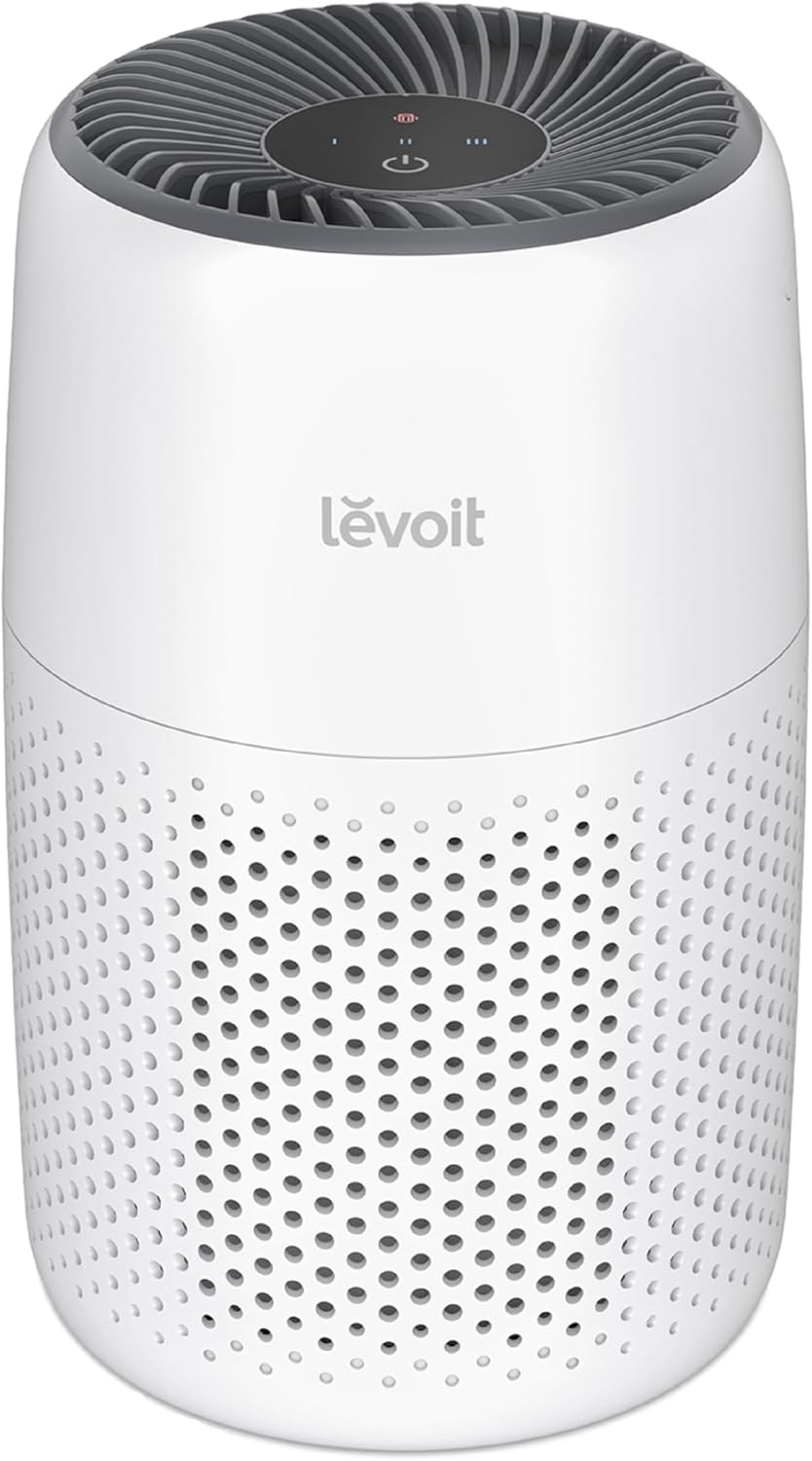
| Rated Power | 7W |
|---|---|
| Noise Level | 27–45dB |
| Dimensions | 6.5 × 6.5 × 10.4 in |
| Model number | LAP-C161-WUS |
The Levoit Core Mini-P is a desk- or bedside-sized air purifier intended for small rooms where noise and footprint matter. It uses a pre-filter plus a main high-efficiency particle filter to capture lint, pet dander, dust and smoke, and includes an aroma sponge for light fragrance. The unit is AHAM-verified for performance, draws about 7W, and offers a sleep mode and auto-off display to reduce distractions overnight. In practice it is easy to place on a nightstand or office desk, runs quietly at lower fan speeds (manufacturer noise range 27–45 dB), and the low power draw makes continuous use inexpensive. Important limitations are its small coverage—best for single rooms or personal zones—and the aromatherapy system is meant for a few drops only to avoid damaging internal parts. Filter replacement and genuine factory-quality filters are available separately, so ongoing costs and occasional maintenance should be expected.
Best for: Buyers who prioritize a reliable, low-noise purifier for a bedroom, home office, or small studio and want predictable, independently verified performance.
Less Ideal for: People needing fast purification for large rooms, open-plan living areas, or whole-home coverage should consider larger-capacity units instead.
- Compact footprint suitable for bedside or desktop use
- AHAM-verified performance for predictable air cleaning
- Low power draw (about 7W) and quiet operation at low speeds
- Two-stage filtration captures pet dander, dust, smoke and larger airborne particles
- Small coverage area not intended for whole-home purification
- Aromatherapy pad accepts only a few drops and can be damaged by overfilling
Verdict: A compact, AHAM-verified purifier that quietly improves air in small rooms, making it a cautious, low-risk choice for bedrooms and desktops.
Choosing the Right Air Purifier for Acrylic Smell: Key Factors to Consider
Filtration Media and VOC Adsorption
Not all air purifiers remove the same contaminants. For acrylic smell you need both particle filtration and gas-phase adsorption. A true HEPA filter will capture airborne pigment particles and aerosolized droplets, while an activated carbon or other adsorbent layer is necessary to trap volatile organic compounds that cause paint odors.
The size, type, and amount of activated carbon or specialized sorbents directly affect how well a unit reduces smell intensity. Larger beds of carbon, impregnated media, or multi-layer adsorbents perform longer and faster than thin carbon sheets. When evaluating models, consider whether the unit specifies VOC or chemical adsorption performance rather than only particle removal.
Room Size and CADR
Air changes per hour and CADR ratings tell you whether a purifier can circulate and clean the air in your workspace quickly enough. A hobby table in a small room has different needs than a larger studio with multiple work areas. Choose a unit with CADR and recommended room coverage that match or exceed your space so fumes are diluted and removed during active painting.
Underpowered purifiers will slowly reduce odors but may not keep up during a painting session. Look for clear manufacturer guidance on room square footage and target air changes per hour for workshop use.
Airflow, Placement, and Ventilation Strategy
Where you place the purifier and how strong its airflow is determine real-world effectiveness. A high CADR but poor placement can leave dead zones where fumes linger. Position units to pull air across the painting area and exhaust toward an open doorway or window to support room ventilation.
Adjustable fan speeds let you step up circulation while you paint and run quieter settings afterward. Consider whether the purifier can be operated continuously during a session without producing disruptive drafts or noise.
Noise and Comfort During Use
Noise matters if you paint for long periods or record while working. Higher fan speeds generally reduce odors faster but increase noise. Check the manufacturer noise ratings at typical operating speeds and choose a model that balances odor removal with acceptable sound levels for your workflow.
Some units offer turbo modes for short bursts and very low settings for all-day background use. If you share your workspace or work in a home environment, prioritize quieter models or those with effective low-speed performance.
Filter Life, Cost, and Ease of Maintenance
Filters that combine particle capture and carbon adsorption are consumables. Replace schedules vary widely based on use intensity and how much particulate and VOC load the unit handles. Consider the expected filter life, replacement cost, and how easy the unit is to service.
Accessible filter bays, clear replacement indicators, and widely available filter cartridges reduce the hassle of upkeep. If you paint frequently, budget for more frequent carbon replacement or choose units with replaceable carbon inserts to keep long-term running costs predictable.
How Activated Carbon Works Against Paint Odors
Activated carbon reduces paint odors through adsorption, a process where VOC molecules adhere to the porous carbon surface. The effectiveness depends on surface area, pore structure, and any chemical treatment applied to the media to target specific compounds found in paints and solvents.
Not all carbon is equal. Powdered or granular carbon beds typically offer more surface area than thin carbon sheets, and impregnated carbons are formulated to capture particular chemical families. For artists, units with substantial carbon volume or replaceable carbon canisters provide more consistent odor control during heavy use.
- Adsorption capacity declines as the carbon becomes saturated, requiring timely replacement.
- Larger carbon beds and multiple layers extend effective lifetime and speed of odor removal.
- Carbon works best in combination with particle filtration to remove aerosolized paint and dust.
Setting Up a Purifier in a Painting Workspace
Place the purifier so it draws air from the painting area toward the intake and exhausts toward a less used part of the room or an open doorway. Avoid blocking intake or exhaust grilles with furniture or supplies. For bench-top projects, position the unit a few feet from the work surface and slightly elevated if possible.
If you have a larger studio, consider multiple smaller units instead of one central purifier to avoid dead zones. Run a higher fan speed during active painting and a low continuous speed afterward to maintain air quality without excessive noise.
- Aim for at least 4 to 6 air changes per hour during active painting where fumes are heaviest.
- Keep the purifier away from walls to ensure unobstructed airflow.
- Use timers or smart plugs if you want the purifier to run pre- or post-session automatically.
When to Use Temporary Venting Alongside a Purifier
Local exhaust ventilation combined with a purifier speeds odor removal. If possible, open a window or use a small fan to push paint fumes toward an exhaust point while the purifier captures residual particles and VOCs. This hybrid approach reduces the burden on a single device and can lower the needed runtime for carbon media.
Temporary venting is especially useful for heavier solvent use or when spraying. However, outdoor venting may not be feasible in all situations, so a purifier with strong VOC adsorption capacity remains important for indoor work.
- Use directional fans to create a clear airflow path from work area to exhaust.
- Purge the room with fresh air after intense sessions, then run the purifier to polish remaining odors.
- Be mindful of outdoor air quality when opening windows, especially in urban settings.
Maintenance Tips to Keep Odor Control Consistent
Track filter replacement intervals based on hours of use and odor levels rather than calendar dates alone. Heavy painting sessions will saturate carbon faster and may also load particle filters with paint dust, reducing airflow.
Inspect prefilters and washable panels regularly; clogged prefilters reduce both airflow and VOC contact time with carbon, diminishing odor removal. Clean or replace parts per the manufacturer guidance to keep the unit operating at rated performance.
- Run units on a higher setting briefly after painting to push fresh air through the filters.
- Store replacement carbon cartridges in sealed containers to preserve adsorption capacity before use.
- Keep cleaning supplies and paint rags stored properly to reduce background odor load in the workspace.
How We Chose the Best Air Purifier for Acrylic Smell
We focused on features that specifically affect removal of paint-related odors and airborne particles common with acrylics. Key evaluation dimensions included filtration media and chemical adsorption capacity, measured room coverage and CADR, airflow and fan speed control, and maintenance needs such as filter life and replacement ease. We also considered noise levels at typical operating speeds and the availability of practical controls that make it easy to run the unit during painting sessions. Excluded from consideration were units lacking activated carbon or other gas-phase adsorption methods, products intended only for very small personal devices, and any purifier designs that do not deliver measurable airflow for room-scale ventilation. We prioritized models with documented filtration stages that combine particle capture and VOC adsorption, because both are necessary to reduce acrylic-related smells. The aim was to recommend options that balance odor control, airflow capacity, and day-to-day usability for hobbyists and small studio users.
Our full evaluation process is outlined in our review methodology.
FAQ
Can an air purifier eliminate strong acrylic solvent fumes completely?
Air purifiers with sufficient activated carbon can significantly reduce solvent odors but may not remove every trace immediately. Effectiveness depends on the purifier's carbon volume, airflow rate, and how saturated the media is. For very strong fumes, combine purifying with ventilation for best results.
How often should I replace carbon filters if I paint weekly?
Replacement frequency depends on session length and the amount of solvent used. For regular weekly painting, expect to check or replace carbon inserts more often than a unit used only for general household odors. Monitor odor persistence and follow the manufacturer guidance on filter life as a baseline.
Is a HEPA filter necessary for controlling paint fumes?
HEPA filters remove fine particulate and aerosolized paint droplets but do not capture gases and VOCs. For paint fumes, combine HEPA-grade particle filtration with an activated carbon or other gas-phase adsorbent to address both particles and odor-causing compounds.
Will running the purifier on high speed damage the unit or filters?
Using higher fan speeds increases airflow and can help clear odors faster but may accelerate particle loading on filters and shorten carbon life. Most units are designed for intermittent high-speed use. Check the maintenance schedule and consider alternating speeds to balance removal performance and filter longevity.
Are there safety considerations when using purifiers around wet paint?
Avoid placing a purifier so its intake pulls heavily from a very close, wet surface where it could ingest paint droplets. Keep units a safe distance from active painting to prevent filter clogging and follow electrical safety guidelines if solvents are present. Proper placement prevents premature filter saturation and maintains steady performance.
Final Verdict
When choosing an air purifier for acrylic smell, prioritize a model that combines a true particle filter with a substantial activated carbon or gas-phase adsorbent. Match the unit's CADR and recommended room coverage to your studio size to ensure sufficient air changes during painting sessions. Balance higher fan speeds for rapid odor removal with acceptable noise and maintenance demands. Choose a purifier that is easy to service and offers clear filter-life indicators so you can maintain adsorption performance over time. Focusing on filtration type, airflow capacity, and upkeep will give you the most reliable odor control and a more comfortable workspace.