
Note: This article contains affiliate links. If you click on these links and make a purchase, we may earn a small commission at no extra cost to you. This helps support our research and content. Read our full affiliate disclosure here.
If you or someone in your home reacts to pollen, dust, or mold spores, the right air purifier can noticeably reduce symptoms and improve indoor air quality. An air purifier for allergies and mold focuses on trapping fine particles and controlling spore circulation so you spend less time managing symptoms and more time enjoying clean air. This guide lists seven shortlisted options that represent the most effective approaches for allergen and mold control across common room sizes. We evaluated each option on measurable performance criteria like filtration efficiency, room coverage, and ease of maintenance. Read on to see what matters and which features match your space and needs.
Top Picks at a Glance
| Best Overall The best all-around choice for most situations | Coway Mighty AP-1512HH |  |
| Best Quality Built to a higher standard if you want something more solid | BLUEAIR Blue Signature Air Purifier |  |
| Best Value The sweet spot between price and what you get | Afloia KILO Air Purifier |  |
| Best Budget The cheapest option that still gets the job done reliably | AromaRoom AP103-A Air Purifier |  |
| Top Rated A top-rated pick with lots of positive feedback | Levoit Core 300-P |  |
| Most Popular A crowd favorite that many people choose with confidence | Levoit Core 200S-P |  |
| Best Seller A high-volume bestseller chosen again and again | VOOPNU H13 HEPA Air Purifier DH-JH12 |  |
Coway Mighty AP-1512HH

| Coverage | Up to 1,748 sq. ft. in 60 minutes |
|---|---|
| Filtration stages | Pre-filter, Deodorization, Bipolar Device, HEPA |
| HEPA effectiveness | 99.97% of 0.3 μm particles |
| Modes | Auto, Eco, Timer |
| Filter lifespan | Up to 1 Year |
The Coway Mighty AP-1512HH is a tabletop HEPA air purifier built for continuous home use in medium to large spaces. It pulls air through a washable pre-filter, activated carbon/deodorization stage, a bipolar ionizer, and a True HEPA filter that the manufacturer cites as capturing 99.97% of 0.3 micron particles. The unit runs in Auto mode using its pollution sensor to raise or lower fan speed and shows air quality on a colored LED so you can see changes at a glance. Practical benefits include quiet low-speed operation for bedrooms, an Eco mode that pauses the fan when air is clean, and filter indicators that remind you when maintenance is needed. It is straightforward to use and effective against common allergens, smoke, and household odors, and the washable pre-filter lowers ongoing filter costs. The main compromises are its physical footprint for smaller nightstands and that replacement filters and the bipolar device are consumables you must replace periodically; performance will also vary with room layout and pollutant load. For allergy-focused use, its HEPA stage and stable auto sensing make it a reliable daily performer.
Best for: Buyers seeking a dependable, low-maintenance purifier that automatically responds to changing indoor air and reduces common allergens, odors, and smoke in living rooms, bedrooms, or open-plan areas.
Less Ideal for: People who need a tiny, ultra-portable purifier for tight spaces or those who want a permanently maintenance-free unit with no filter replacements.
- True HEPA filtration rated to capture 99.97% of 0.3 μm particles
- Multi-stage system including washable pre-filter and activated carbon for odors and VOCs
- Auto and Eco modes with real-time air quality sensor reduce manual adjustments and save energy
- Filter indicator and washable pre-filter simplify maintenance and lower running costs
- Replacement filters and bipolar device require periodic purchase and replacement
- May be larger than ideal for very small bedside tables or compact spaces
Verdict: A reliable, sensor-driven HEPA purifier that automatically maintains cleaner air in medium to large rooms, making it a top pick for allergy-conscious households.
BLUEAIR Blue Signature Air Purifier

| Room coverage (1 hour) | Up to 3,385 sq ft |
|---|---|
| Particle capture | 99.97% down to 0.1 microns |
| Noise level | 23–55 dB |
| Filter lifetime | Up to 1 year |
The Blueair Blue Signature is built to clear large rooms quickly using Blueair's HEPASilent seven-stage filtration and odor-reduction tech, making it practical for open floor plans, living rooms, and basements. It monitors air quality with onboard sensors and an easy-to-read color indicator, then automatically adjusts fan speed in Auto Mode; the companion app provides remote control, scheduling, and filter lifetime tracking. The unit is unusually quiet for its performance range, operating as low as 23 dB on low while still delivering high airflow capable of cleaning thousands of square feet per hour. Filters are designed for up to a year of use under typical conditions, and the modular pre-filter options let you change the look to suit décor. Trade-offs to consider are the premium size and price compared with smaller room purifiers and the need to replace specialized filters rather than generic pleated ones. For those tackling heavy dust, pet dander, smoke, or persistent allergens in large spaces, this model focuses on measurable performance and convenient smart controls.
Best for: Buyers who prioritize measurable, high-capacity purification for allergy triggers and smoke in large, open homes and want smart, low-touch operation.
Less Ideal for: People who only need to clean a single small bedroom or who want the lowest-cost, compact purifier solution.
- High clean-air delivery able to cycle very large rooms quickly
- Seven-stage HEPASilent filtration captures fine particles and reduces odors and VOCs
- Smart sensors with Auto Mode and real-time air quality display for hands-off operation
- Very quiet on low settings, suitable for bedrooms and living areas
- App control and filter lifetime tracking simplify monitoring and maintenance
- Larger footprint and higher cost than small-room purifiers
- Uses proprietary filters that must be replaced with manufacturer-compatible cartridges
Verdict: If you need powerful, app-controlled allergy and odor removal across very large rooms, the Blueair Blue Signature delivers top-tier performance and quiet operation.
Afloia KILO Air Purifier
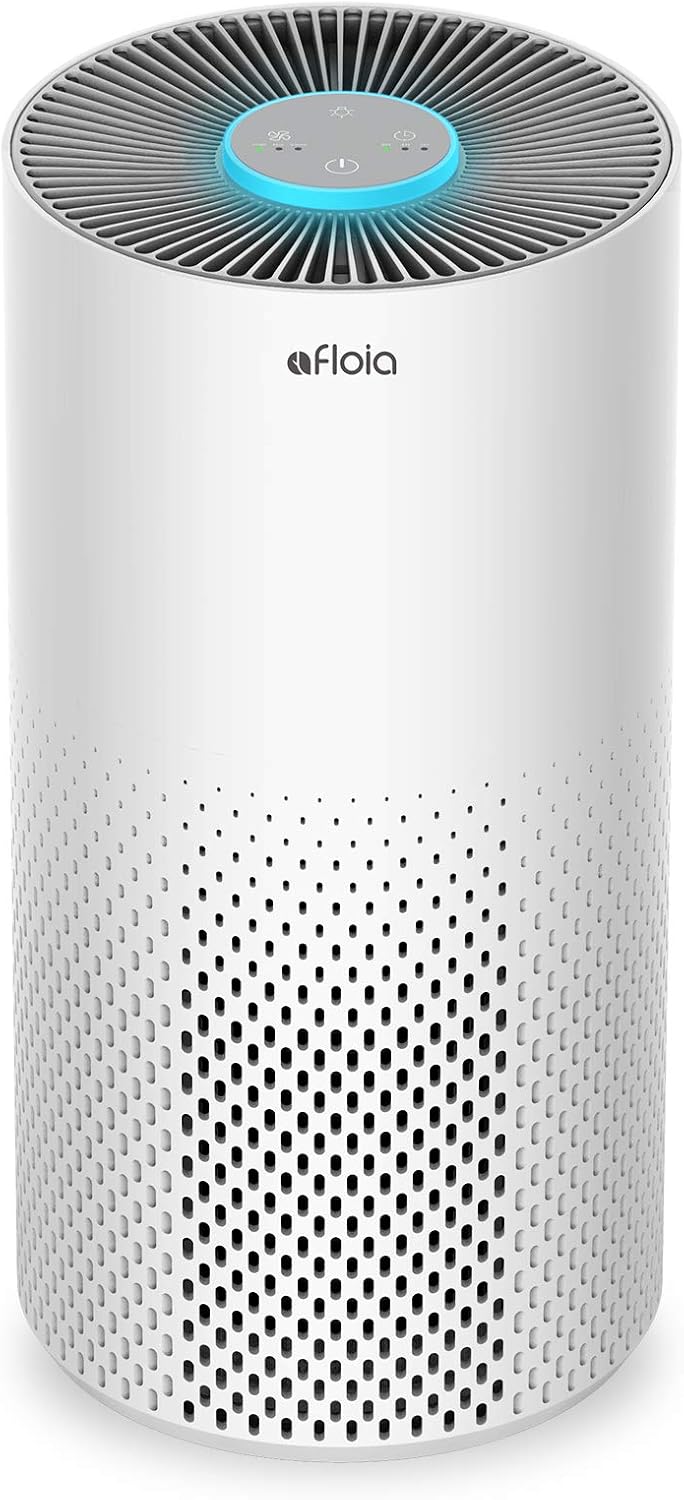
| Noise Level | 22 db |
|---|---|
| Particle Retention Size | 0.3 micron |
| Wattage | 23 watts |
| Floor Area | 60.84 square_feet |
The Afloia KILO is a tower-style air purifier that uses a 4-stage filtration system including a washable pre-filter and activated carbon layer to capture dust, pet hair, odors and fine particles down to 0.3 microns. It is designed for continuous home use with adjustable fan speeds, a timer (2/4/8/16 hours), and an ultra-quiet 22 dB sleep mode that keeps operation unobtrusive in bedrooms. The washable pre-filter simplifies maintenance for households with pets, while replacement filter options let you target allergies or antibacterial needs every 4 to 6 months. Practical extras include a 7-color night light that can dim automatically and simple touch/button controls. Limitations are its modest stated floor-area coverage figures versus marketing claims and reliance on regular filter replacements for best allergen capture, so expect ongoing maintenance costs and occasional filter shopping. For daily bedroom or living-room use it balances performance, low noise, and easy upkeep in a small footprint.
Best for: Buyers who want a low-noise, easy-to-maintain purifier for bedrooms or living areas and prioritize straightforward operation and reduced daily upkeep.
Less Ideal for: Homes that need whole-house treatment or continuous high-CADR performance for very large open-floor plans should consider a larger, higher-capacity unit instead.
- Multi-stage filtration with washable pre-filter reduces visible dust and pet hair buildup
- Very quiet 22 dB sleep mode suitable for overnight use
- Timer and multiple fan speeds let you tailor runtime and airflow
- Activated carbon layer helps reduce household odors
- Requires periodic replacement filters for peak HEPA performance
- Coverage claims vary by metric so larger open layouts may need multiple units
Verdict: A quiet, compact purifier with washable pre-filter and flexible timers that delivers practical allergen and odor reduction for bedrooms and medium rooms.
AromaRoom AP103-A Air Purifier
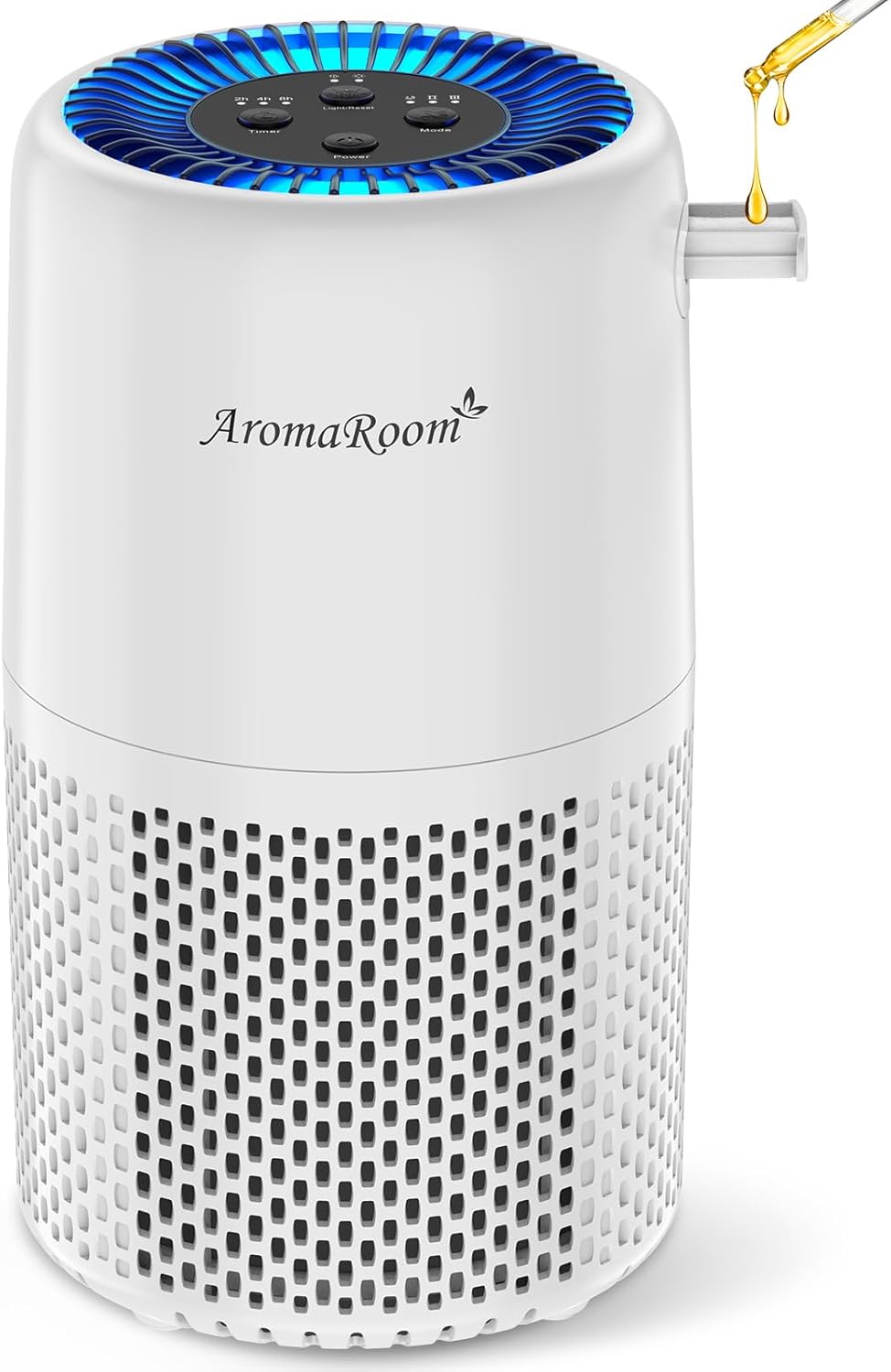
| Filter type | True H13 HEPA 3-in-1 |
|---|---|
| Coverage | Up to 323 ft² (30 m²) |
| Noise level (sleep) | 22 dB |
| Timer | 2/4/8 hours |
The AromaRoom AP103-A is a small, budget-friendly air purifier aimed at bedrooms and medium living spaces where allergy and smoke particles are a concern. It uses a True H13 HEPA 3-in-1 filter that the brand says captures 99.97% of particles down to 0.1–0.3 microns, and a dedicated smoke-removal layer helps with wildfire or cooking smoke. The unit circulates room air roughly twice per hour in a 323 ft² (30 m²) space, and offers quiet sleep operation down to about 22 dB plus three timer settings for 2/4/8 hours. A fragrance pad adds optional aromatherapy. For everyday allergy relief the purifier provides targeted particle removal in smaller rooms and is easy to move and run continuously because of its low noise and compact footprint. Expect ongoing costs for replacement filters every 3–6 months and limited raw airflow compared with larger, higher-CADR machines, so it is best used in single rooms rather than whole-house situations.
Best for: Buyers wanting an affordable, low-noise purifier for a bedroom or medium room who prioritize particle filtration and a compact footprint over whole-home capacity.
Less Ideal for: People who need high CADR whole-house air cleaning or who plan to purify large open-plan spaces should choose a larger, more powerful unit instead.
- True H13 HEPA 3-in-1 filter rated to capture 99.97% of particles in the 0.1–0.3 µm range
- Quiet sleep mode with noise as low as 22 dB for nighttime use
- Rated to circulate air twice per hour in rooms up to about 323 ft²
- Includes fragrance pad for optional aromatherapy
- Simple controls with 2/4/8 hour timer settings
- Replacement filters are recommended every 3–6 months, adding to operating cost
- Compact design limits airflow compared with larger purifiers, so coverage is best for single rooms
Verdict: A compact, budget-friendly HEPA purifier that quietly removes allergy and smoke particles in single rooms while adding optional aromatherapy.
Levoit Core 300-P

| Filter Type | 3 in 1 Filtration |
|---|---|
| Floor Area | 1073 square_feet |
| Noise Level | 24 db |
| Particle Retention Size | 0.3 micron |
| Wattage | 56 watts |
The Levoit Core 300-P is a small, reliable HEPA air purifier intended for bedrooms and living rooms where allergies, pet dander, smoke, and odors are concerns. It uses a 3-in-1 original filter and a 56W motor to deliver AHAM-verified CADR performance that refreshes air in a typical 222 ft² room multiple times per hour and can cover larger open areas at a lower exchange rate. Controls are simple touch buttons and a sleep mode drops noise to about 24 dB for undisturbed nighttime use while retaining HEPA-grade filtration. The unit is portable and ENERGY-efficient for continuous use, and indicator lights include a timer and check-filter reminder to simplify upkeep. Limitations are that it lacks smart/auto mode on this model so fan speed must be set manually, and optimal CADR figures rely on using genuine Levoit replacement filters and on replacing them every 6–8 months as recommended.
Best for: Buyers who prioritize consistent, independently verified filtration and a quiet, easy-to-use unit for bedrooms or family rooms where allergies, pets, or smoke are a concern.
Less Ideal for: People who need a smart, automated purifier with auto-adjusting fan speeds or those who want a completely hands-off Wi-Fi connected unit.
- AHAM-verified CADR and certified performance for smoke, dust, and pollen
- True HEPA-grade 3-in-1 filter removes 99.97% of 0.1–0.3 μm particles
- Very quiet Sleep Mode at approximately 24 dB for night use
- Compact, portable design with simple touch controls and timer
- No smart connectivity or Auto Mode on this Core 300-P model
- Best performance requires using official replacement filters and regular changes
Verdict: Choose the Core 300-P when you want a compact, AHAM-verified HEPA purifier that quietly delivers dependable filtration for allergy and smoke-prone rooms.
Levoit Core 200S-P
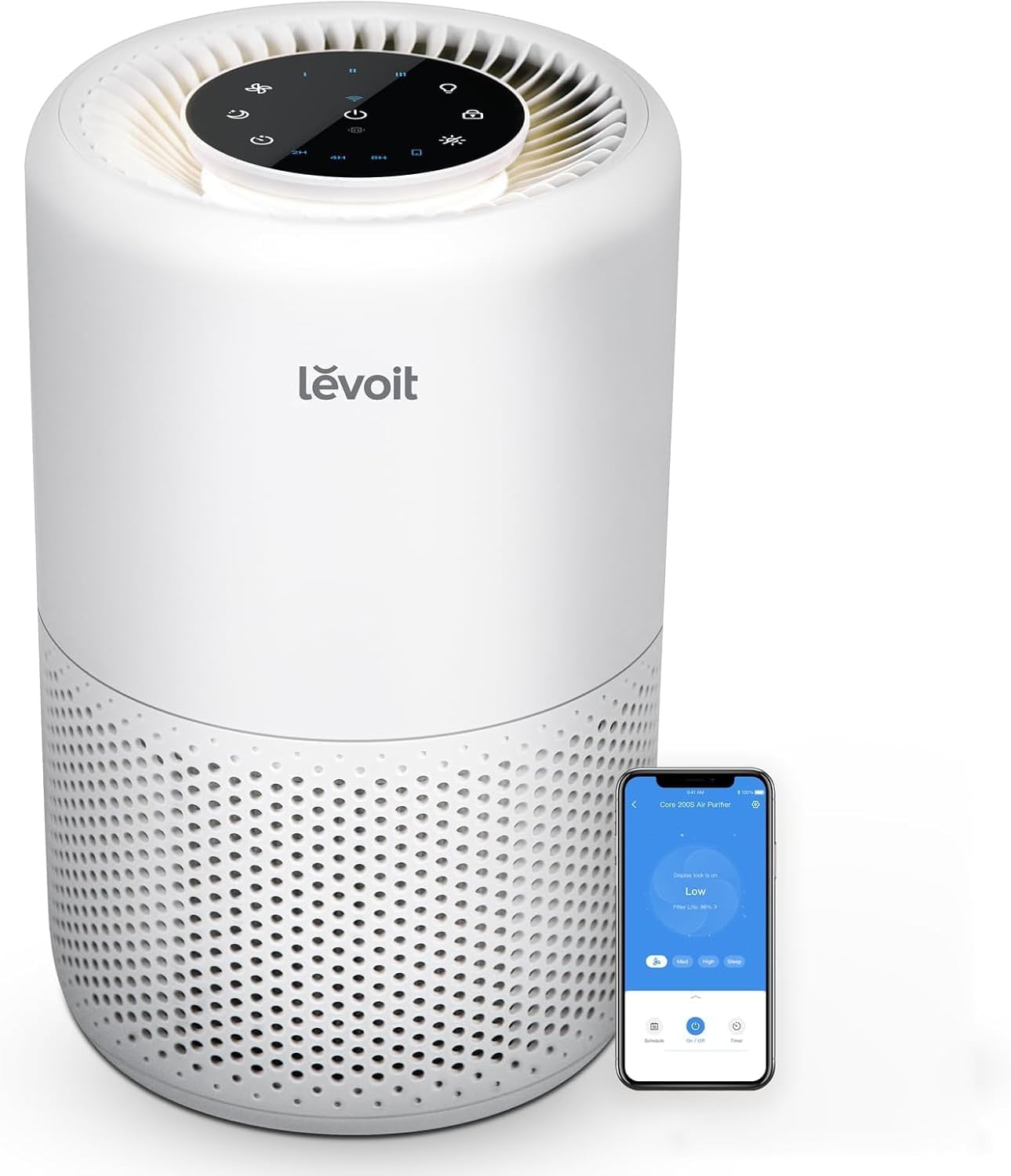
| Room coverage | Approx. 140 ft² |
|---|---|
| Filtration stages | 3-stage (pre-filter, activated carbon, HEPA-grade main filter) |
| Particle removal | 99.97% at 0.1–0.3 microns |
| Noise level | As low as 27 dB |
The Levoit Core 200S-P is a small-room air purifier that combines a three-stage filtration stack with smart controls to tackle common indoor pollutants. It pulls air through a nylon pre-filter and activated carbon layer before a HEPA-grade main filter that captures 99.97% of particles down to 0.1–0.3 microns, which addresses pollen, dust, pet dander, and many smoke particles. The unit uses 360-degree intake and a motor sized to refresh the air in a roughly 140 ft² room multiple times per hour, making it suitable for bedrooms, nurseries, and offices. Smart features include app monitoring for filter life, and voice control and a sleep mode that drops noise to about 27 dB for overnight use. The compact, lightweight design is easy to move, and the display-off button helps during sleep. Limitations are its coverage area and airflow rate—it is not intended for large open-plan living spaces—so buyers should match the Core 200S-P to smaller rooms for best results.
Best for: Buyers who want a proven, quiet purifier with smart controls for bedrooms or small living spaces and who value independent verification and strong social proof.
Less Ideal for: Those needing to clean air in large open-plan areas or whole-house coverage should consider higher-capacity units instead.
- Three-stage filtration including a HEPA-grade main filter that captures 99.97% of 0.1–0.3 micron particles
- Activated carbon layer for reducing odors and fumes
- Smart app and voice controls with filter-life monitoring
- Very quiet operation down to about 27 dB with a sleep mode
- Designed for small rooms only and won’t refresh air quickly in large or open spaces
- Replacement filters are required to maintain AHAM-verified performance
Verdict: A quiet, AHAM-verified purifier with smart controls that is a reliable choice for allergy-prone sleepers and small rooms.
VOOPNU H13 HEPA Air Purifier DH-JH12

| Coverage | Up to 1,076 ft² |
|---|---|
| Filtration | H13 True HEPA triple-layer |
| Noise level | Down to 22 dB |
| Speeds | 3 fan speeds |
The VOOPNU DH-JH12 is a compact tower air purifier built around an H13 True HEPA triple-layer filter and 360 degree intake to capture fine particles, pet hair, pollen, smoke, and common household odors. It is meant for continuous use in bedrooms, living rooms, or home offices and is laboratory tested to clean roughly 250 sq ft every 15 minutes. Controls are simple with three fan speeds, a timer and a quiet night mode that can reach around 22 dB, and a small essential oil tray lets you add scent if desired. The unit is certified to several safety and emissions standards and offers a washable pre-filter option on some SKUs and a recommended replacement cycle of roughly 3 to 6 months for primary filters. Limitations include a compact footprint that implies a modest CADR compared with larger whole-house units and ongoing filter replacement costs, and the manufacturer recommends continuous operation for best results which affects energy use over time.
Best for: Buyers who prioritize proven particle removal and low-noise operation and prefer a straightforward, easy-to-use purifier that can run continuously in living spaces to reduce allergens and common indoor pollutants.
Less Ideal for: People looking to clean very large open-plan homes or seeking a whole-house HVAC-integrated solution should consider higher-CADR or ducted systems instead.
- H13 True HEPA filtration captures 99.97% of fine airborne particles for allergy-relevant pollutants
- 360 degree intake improves room-wide air circulation from a small footprint
- Very quiet operation down to about 22 dB suitable for bedrooms and sleep
- Simple controls and timer make it easy to run continuously without fuss
- Built-in essential oil tray for optional scenting without extra accessories
- Manufacturer recommends continuous use for best performance which increases running time and energy use
- Filter replacements are periodic (recommended 3–6 months) which adds ongoing cost
Verdict: A compact, low-noise HEPA purifier that gives risk-averse buyers a simple, effective way to reduce allergy triggers in bedrooms and living spaces.
Choosing the Right Air Purifier for Allergies and Mold: Key Factors to Consider
Filtration Media and Particle Capture
Filter construction determines what the purifier actually removes from the air. For allergies and mold, a true HEPA or HEPA-equivalent filter is essential because it captures fine particles down to 0.3 microns and smaller, including many mold spores, pollen, and dust mite fragments.
Beyond the HEPA stage, look for prefilters that trap large debris and activated carbon layers that adsorb odors and volatile organic compounds. A multi-stage approach extends HEPA life and increases overall effectiveness. Check manufacturer specifications for particle removal rates rather than marketing phrases to understand real-world capability.
Room Coverage and CADR
Air changes per hour and CADR ratings indicate how quickly a purifier can clean the air in a specific room size. For allergy and mold control, you want a unit that can perform multiple air changes per hour at the size of the room where you spend the most time, such as a bedroom or living room.
Undersizing a purifier means allergens and spores linger longer and symptoms persist. Oversizing is unnecessary but ensures faster cleanup and more headroom for running at lower, quieter speeds. Use CADR or manufacturer coverage guidance as a baseline and aim for at least two to four air changes per hour for symptomatic relief.
Airflow Design and Placement
How air moves through and out of the unit affects its real-world effectiveness. Top-discharge or 360-degree intake designs can offer more even circulation in open rooms, while directional outflow can be useful for targeted cleaning in a defined area like a bedroom.
Consider furniture layout and typical occupancy when planning placement. Avoid confining a purifier against walls or behind large objects. Units with multiple fan speeds give flexibility to increase airflow during high pollen times and reduce it for quiet, lower-power operation at night.
Maintenance, Filter Life, and Cost of Upkeep
An effective purifier loses effectiveness if filters are not replaced or cleaned on schedule. Check expected filter life in months or hours and whether replacement filters are easy to buy and install. Indicators for filter status help you avoid guessing and ensure continuous protection.
Also consider washable prefilters that reduce the frequency of HEPA replacement. Factor maintenance efforts into your choice: complex disassembly or hard-to-find parts will reduce real-world uptime and increase long-term operating costs.
Noise Performance and Usability
Noise matters when a purifier runs continuously in bedrooms, nurseries, or home offices. Fans that are loud at the speeds needed to achieve proper air changes will likely be turned down, reducing effectiveness. Look for measured decibel ratings at common fan speeds and designs that use smooth airflow paths to minimize whine or turbulence noise.
Additional usability features like sleep mode, programmable timers, and simple controls improve the daily experience and make it easier to run the unit consistently when protection is needed most.
How HEPA Filters Work Against Mold and Allergens
HEPA filters capture particles through a combination of interception, impaction, and diffusion. Larger particles like pollen and some mold fragments are intercepted, while smaller particles collide with fibers or diffuse into them. This physical trapping reduces airborne load without chemicals or ionization.
Understanding the mechanics helps set realistic expectations: HEPA filtration reduces airborne concentrations but does not eliminate mold that is growing on surfaces. A purifier limits spore circulation, which reduces exposure and secondary spread, but surface cleanup and humidity control remain important.
- Intercepts large particles like pollen and dust
- Impacts and diffuses very small particles and spores
- Does not remove mold growing on surfaces
Managing Indoor Humidity With an Air Purifier
Air purifiers do not control humidity directly. Because mold growth depends heavily on moisture, pairing a purifier with humidity management is important in musty or damp environments. Use a dehumidifier or improve ventilation to keep relative humidity below levels that promote mold growth.
If you live in a humid climate, prioritize purifiers that can work continuously and combine them with HVAC adjustments or a standalone dehumidifier to address the root cause rather than just airborne spores.
- Aim for indoor relative humidity below 50 percent to limit mold
- Purifiers reduce airborne spores but not surface mold
- Combine filtration with dehumidification for best results
Placement Tips for Best Performance
Place the unit where occupants spend the most time and where airflow is not obstructed. Centered locations in living rooms or near a bedroom bed are often more effective than tucked corners. Keep a few feet of clearance on intake and exhaust sides.
For open-plan homes, one larger unit may be better than multiple small units if it provides the needed CADR. In contrast, bedrooms and nurseries benefit from a dedicated unit sized for that room to ensure nighttime protection.
- Give at least 2 to 3 feet of clearance around intakes and exhausts
- Position near sleeping or sitting areas for targeted protection
- Use multiple units only when needed to cover separate zones
Filter Replacement and Maintenance Best Practices
Follow the manufacturer-recommended replacement intervals but also monitor filter indicators and visible dust accumulation. In high-allergy seasons or after a period of high indoor contamination, filters may need earlier replacement.
Clean prefilters regularly if washable, and vacuum surrounding areas to reduce load on the purifier. Proper maintenance keeps CADR closer to rated levels and preserves motor life.
- Check filters monthly for heavy loading during peak seasons
- Clean or replace prefilters to extend HEPA life
- Use filter indicators as a guide, not the sole maintenance strategy
When to Run Your Purifier and Typical Schedules
Continuous operation at lower speeds often provides better real-world protection than intermittent high-speed bursts. Running the unit overnight in bedrooms or continuously during high-pollen days keeps airborne concentrations lower.
If energy is a concern, use programmable timers or smart controls to increase speed during peak times and lower it otherwise. Prioritize use in rooms with the highest exposure risk or where symptomatic household members spend time.
- Run continuously at low to medium speed for steady protection
- Increase fan speed during high pollen or cleaning activities
- Use timers or smart schedules to balance energy and performance
How We Chose the Best Air Purifier for Allergies and Mold
We prioritized measurable performance and practical maintenance factors that matter when you are choosing an air purifier specifically for allergies and mold. Key evaluation criteria included high-efficiency particle filtration capable of capturing submicron particles, CADR or coverage ratings that match common room sizes, and filter media that targets both airborne allergens and mold spores. We also weighed airflow design and fan-speed control because these determine how quickly a unit can cycle the air in a room. Operational considerations were another filter: easy filter replacement, clear status indicators, and reasonable maintenance frequency reduce the chance that a purifier performs poorly due to neglect. Noise levels at typical fan speeds were checked to ensure daytime and nighttime usability. Energy consumption and runtime features matter for continuous operation in bedrooms or living areas. We excluded units that lacked HEPA-grade filtration or any specification for mold or particulate removal, as well as designs that could reintroduce contaminants through poor sealing. The shortlist represents products that balance verified filtration performance, practical coverage, manageable upkeep, and noise and energy characteristics suitable for everyday use.
Our full evaluation process is outlined in our review methodology.
FAQ
Can an air purifier remove mold spores from the air?
Yes, purifiers with true HEPA filtration capture a large percentage of airborne mold spores, reducing the number circulating in your home. They do not, however, eliminate mold that is actively growing on surfaces.
How often should I replace filters when targeting allergies and mold?
Filter replacement depends on usage and environmental load but often ranges from 6 to 12 months for HEPA filters. Check prefilters more frequently and replace sooner during heavy allergy seasons or after indoor contamination events.
Is activated carbon necessary for allergy and mold control?
Activated carbon helps remove odors and some volatile compounds but does not capture particles like spores. Carbon is useful if musty smells or VOCs accompany mold issues, but HEPA filtration remains primary for particle removal.
Will running an air purifier prevent mold from growing?
Running a purifier lowers airborne spore counts and reduces spread but does not address moisture that enables mold growth. Controlling humidity and fixing leaks are necessary to prevent mold colonies from forming.
Are quieter units less effective at removing spores?
Quieter units can be effective if they are sized correctly for the room and run continuously. Noise is often a function of fan speed; running a properly sized unit at a lower, quieter speed still provides meaningful air changes over time.
Final Verdict
Prioritize a unit with true HEPA filtration and a CADR or coverage rating that matches the room where you need the most protection. Consider airflow design, ease of filter maintenance, and noise performance because these practical factors determine whether the purifier will be used consistently and effectively. Remember that filtration reduces airborne spores and allergens but works best alongside humidity control and surface cleaning to address mold at its source. Choose an appropriately sized purifier, maintain filters on schedule, and balance runtime and fan speed to keep airborne triggers low.