
Note: This article contains affiliate links. If you click on these links and make a purchase, we may earn a small commission at no extra cost to you. This helps support our research and content. Read our full affiliate disclosure here.
If you or someone in your home has asthma, the right air purifier can reduce airborne triggers and make daily life more comfortable. Asthma symptoms often respond to changes in indoor particle levels, so choosing a unit with proven filtration and suitable room coverage matters. This guide shortlists the top air purifiers suited for asthma, focusing on HEPA-grade filtration, gas and allergen control, and low operational noise. Below you will find our top picks and a clear explanation of the criteria we used to evaluate them, so you can pick a unit that fits your space and symptom profile.
Top Picks at a Glance
| Best Overall The best all-around choice for most situations | Winix 5510 Air Purifier |  |
| Best Quality Built to a higher standard if you want something more solid | IQAir HealthPro Plus XE |  |
| Best Value The sweet spot between price and what you get | GermGuardian AC4825E 22" Tower |  |
| Best Budget The cheapest option that still gets the job done reliably | FULMINARE H13 Air Purifier |  |
| Top Rated A top-rated pick with lots of positive feedback | Levoit Core 300-P |  |
| Most Popular A crowd favorite that many people choose with confidence | Levoit Core Mini-P |  |
| Best Seller A high-volume bestseller chosen again and again | VOOPNU HEPA Air Purifier DH-JH12 |  |
Winix 5510 Air Purifier

| CADR (Dust/Pollen/Smoke) | 252 / 247 / 253 |
|---|---|
| Coverage | Up to 1,882 sq ft in 1 hour |
| Filtration stages | 4-Stage |
| Noise (low) | 23.5 dB |
| Smart features | WiFi / Alexa / Google Home |
The Winix 5510 is a four-stage tower air purifier designed to remove very small airborne particles and manage odors in larger rooms. It combines a washable pre-filter, True HEPA that captures down to 0.01 microns, and a high-deodorization carbon filter to cut pet smells, smoke, and VOCs, while Winix's PlasmaWave technology provides an additional ionizing-style cleaning layer. Built-in air quality sensors drive an Auto Mode that ramps fan speed as needed, and a light-sensitive Sleep Mode keeps operation very quiet at night; the unit is also AHAM verified and UL certified. Smart features include WiFi connectivity with the Winix Smart App and voice control support for hands-off monitoring. Expect solid coverage for living rooms and open-plan spaces, low noise on the slowest setting, and straightforward filter-replacement alerts, but you will need occasional filter purchases and the plasma feature may not be necessary for everyone looking strictly for mechanical filtration.
Best for: Buyers who want a feature-rich, smart air purifier that cleans large living spaces and balances strong filtration with quiet nighttime operation.
Less Ideal for: Those seeking a no-frills, lowest-cost purifier for a single small bedroom or buyers who avoid any active ionizing technologies.
- Four-stage system with True HEPA for capturing very small particles
- High-deodorization carbon filter helps reduce odors and VOCs
- Smart sensors with Auto Mode adjust fan speed based on real-time air quality
- WiFi and app control plus voice assistant support for remote monitoring
- Sleep Mode offers very quiet operation for nighttime use
- Requires periodic replacement filters which add to lifetime cost
- PlasmaWave adds an active component some buyers may prefer to disable
Verdict: A smart, four-stage purifier built for large rooms that pairs strong HEPA and carbon filtration with quiet, automated operation.
IQAir HealthPro Plus XE

| Coverage | Up to 1125 sq. ft. |
|---|---|
| Filtration | HyperHEPA to 0.003 microns (99.5%) |
| App Integration | AirVisual WiFi control |
| Sensor-based Operation | Advanced particle sensor with 3 smart modes |
The IQAir HealthPro Plus XE is a purpose-built air purifier that prioritizes particle removal and steady performance in large rooms. It uses IQAir's HyperHEPA filtration to capture ultrafine particles down to 0.003 microns and is rated for coverage up to 1,125 square feet, making it suitable for living rooms, open-plan areas, or small clinics. The unit includes an advanced particle sensor and three smart modes so it can run automatically based on measured PM2.5 levels, and WiFi integration with the AirVisual app lets you monitor and control settings remotely. The redesigned fan system is notably more energy efficient than prior models, which helps during continuous operation. Practical considerations: the HealthPro Plus XE is a sizable, premium device intended for sustained, whole-room purification rather than spot cleaning, and replacement filters and the initial unit cost are higher than typical consumer purifiers. It excels where medical-grade particle capture and reliable sensor-driven automation are primary priorities.
Best for: Buyers who prioritize maximum particulate removal and reliable, sensor-driven performance in large living spaces or rooms where asthma triggers are a concern.
Less Ideal for: People seeking a compact, low-cost or portable spot cleaner for single small rooms should consider smaller, simpler models instead.
- HyperHEPA filtration captures ultrafine particles down to 0.003 microns for superior particle removal
- Rated coverage up to 1,125 sq ft suitable for large rooms and open spaces
- Smart particle sensor with three automatic modes adapts fan speed to real-time air quality
- WiFi and AirVisual app integration enables remote monitoring and control
- Redesigned fan system improves energy efficiency for long run times
- Premium purchase price and higher ongoing filter replacement costs
- Large physical footprint makes it less suitable for small rooms or tight spaces
Verdict: Choose the HealthPro Plus XE when medical-grade ultrafine particle removal and automated, whole-room protection are the top priorities for asthma management.
GermGuardian AC4825E 22" Tower

| Model number | AC4825E |
|---|---|
| Room coverage claim | 153 sq. ft. (12.5 min per circulation); up to 743 sq. ft. hourly |
| Filter type | True HEPA with activated carbon pre-filter |
| Fan speeds | 3 speeds with sleep mode |
| Certifications | CARB Certified, ETL Certified, Zero Ozone Verified |
The GermGuardian AC4825E is a compact tower purifier that uses a True HEPA filter, activated carbon pre-filter, and optional UV-C light to remove airborne particles, odors, and some microbes. It is typically placed in bedrooms, living rooms, or offices and is rated to circulate air in a 153 sq ft room every 12.5 minutes and handle larger spaces up to 743 sq ft hourly. Three fan speeds including a quiet sleep mode let you balance noise and cleaning power, while replacement filters and bulbs are available as factory-quality parts for straightforward maintenance. The unit is CARB and ETL certified and designed for continuous home use; the carbon pre-filter helps reduce cooking and pet scents, and the HEPA element captures very fine particles down to about 0.1 microns from air passing through the media. Limitations include the modest physical footprint and single-direction tower airflow compared with some larger designs, and the optional UV-C adds complexity and ongoing bulb replacement requirements for germ reduction rather than being purely filter-based.
Best for: Buyers who prioritize measurable allergen removal and low-maintenance operation for bedrooms or living spaces and want a certified, compact purifier that balances noise and performance.
Less Ideal for: Those who need whole-house ventilation or rapid mixing in very large, open-floor plans should consider larger or multi-directional airflow systems instead.
- True HEPA filtration captures very small particles down to 0.1 microns from air that passes through the filter
- Activated carbon pre-filter reduces common household odors and VOC-related scents
- Three fan speeds including a quiet sleep mode let you trade off noise and cleaning rate
- Compatible with factory replacement HEPA filters, carbon filters, and UV-C bulbs for straightforward maintenance
- UV-C sanitizer is optional and requires periodic bulb replacement to maintain effectiveness
- Air circulation is from a single tower outlet which may be slower to mix air in irregularly shaped rooms
Verdict: A compact, certified HEPA tower that reliably reduces allergens and household odors for bedrooms and living areas, making it a practical choice for asthma symptom management.
FULMINARE H13 Air Purifier

| Filter type | H13 HEPA |
|---|---|
| Coverage area | Up to 215 ft² / 20 m² |
| Noise level | Around 24 dB (sleep mode) |
The FULMINARE H13 is a small, portable air cleaner built around an H13 true HEPA filter and a 360 degree outlet that refreshes air in rooms up to roughly 215 square feet. It is typically placed on a bedside table or desk and runs continuously or on one of five timer settings; a dedicated sleep mode drops noise to about 24 dB for overnight use. The unit also includes an independent night light which makes it suitable for bedrooms or nurseries. Practical benefits include straightforward plug-in operation, easy placement thanks to a compact footprint, and a multi-stage filtration implied by the H13 classification that captures fine particles relevant to asthma triggers like dust and pet dander. Expect regular filter changes—manufacturer guidance suggests around three months under typical use—and modest coverage that is best for single rooms rather than whole-house purification. There is no battery option and the unit relies on a built-in plug, so placement is limited by outlet location. Overall it is a simple, quiet option for improving bedroom air in smaller spaces when used with routine filter maintenance.
Best for: Buyers on a tight budget who need a quiet, easy-to-use bedroom purifier to reduce airborne particles and pet dander in a single-room setting.
Less Ideal for: Households seeking whole-home coverage or portable, battery-powered purification should consider larger or differently powered units instead.
- H13 true HEPA filtration for capturing fine particles and common asthma triggers
- 360° air outlet with dual-channel design for even room circulation
- Very low noise in sleep mode (~24 dB) suitable for bedrooms
- Multiple timer settings and an independent night light for overnight comfort
- Recommended filter replacement about every three months adds ongoing cost
- Designed for rooms up to ~215 sq ft so not suitable for large open areas
- Requires wall outlet placement since it uses a plug-in adapter
Verdict: An affordable, quiet bedroom air purifier with H13 HEPA filtration that’s a practical single-room choice for reducing common asthma triggers.
Levoit Core 300-P

| Filter Type | 3 in 1 Filtration |
|---|---|
| Floor Area | 1073 square_feet |
| Noise Level | 24 db |
| Wattage | 56 watts |
| Particle Retention Size | 0.3 micron |
The Levoit Core 300-P is a small, reliable air purifier intended for bedrooms and medium rooms that need consistent particle removal. It uses a 3-in-1 filtration stack with a HEPA-grade filter rated to capture 99.97% of particles in the 0.1–0.3 micron range and a motor that delivers a CADR suitable for frequent air changes in typical living spaces. Controls are touch-based with sleep mode that drops noise to about 24 dB and the display can be turned off for undisturbed nights. Practical benefits include a compact footprint, AHAM verification for measured cleaning performance, and CARB/ETL safety listings that matter for long-term home use. Limitations are that this model requires manual fan speed control rather than true auto mode, and Levoit recommends using official replacement filters to maintain CADR and longevity. For allergy or asthma-oriented use the Core 300-P provides strong particle filtration in a quiet package but you will need to plan on periodic filter replacements and manual speed adjustments for best results.
Best for: Buyers who prioritize consistent, proven particle removal and quiet overnight operation will appreciate this unit for bedroom or small-to-medium room air cleaning.
Less Ideal for: People who want fully automatic operation or a purifier for very large open-plan homes should consider models with auto-sensing or higher capacity instead.
- HEPA-grade 3-in-1 filter captures 99.97% of 0.1–0.3 micron particles for effective allergen and smoke removal
- AHAM verified CADR ratings with measurable coverage for smoke, dust, and pollen
- Very quiet Sleep Mode at about 24 dB suitable for bedrooms
- Compact, portable design fits on bedside tables or desks and is easy to move between rooms
- Safety certifications (CARB, ETL) and touch controls with a display-off option for night use
- No automatic sensing/Auto Mode on this model so fan speed must be adjusted manually
- Performance depends on using official Levoit replacement filters to match test results
Verdict: A compact, AHAM-verified HEPA-grade purifier that delivers quiet, reliable particle removal ideal for asthma and allergy relief in bedrooms and medium rooms.
Levoit Core Mini-P
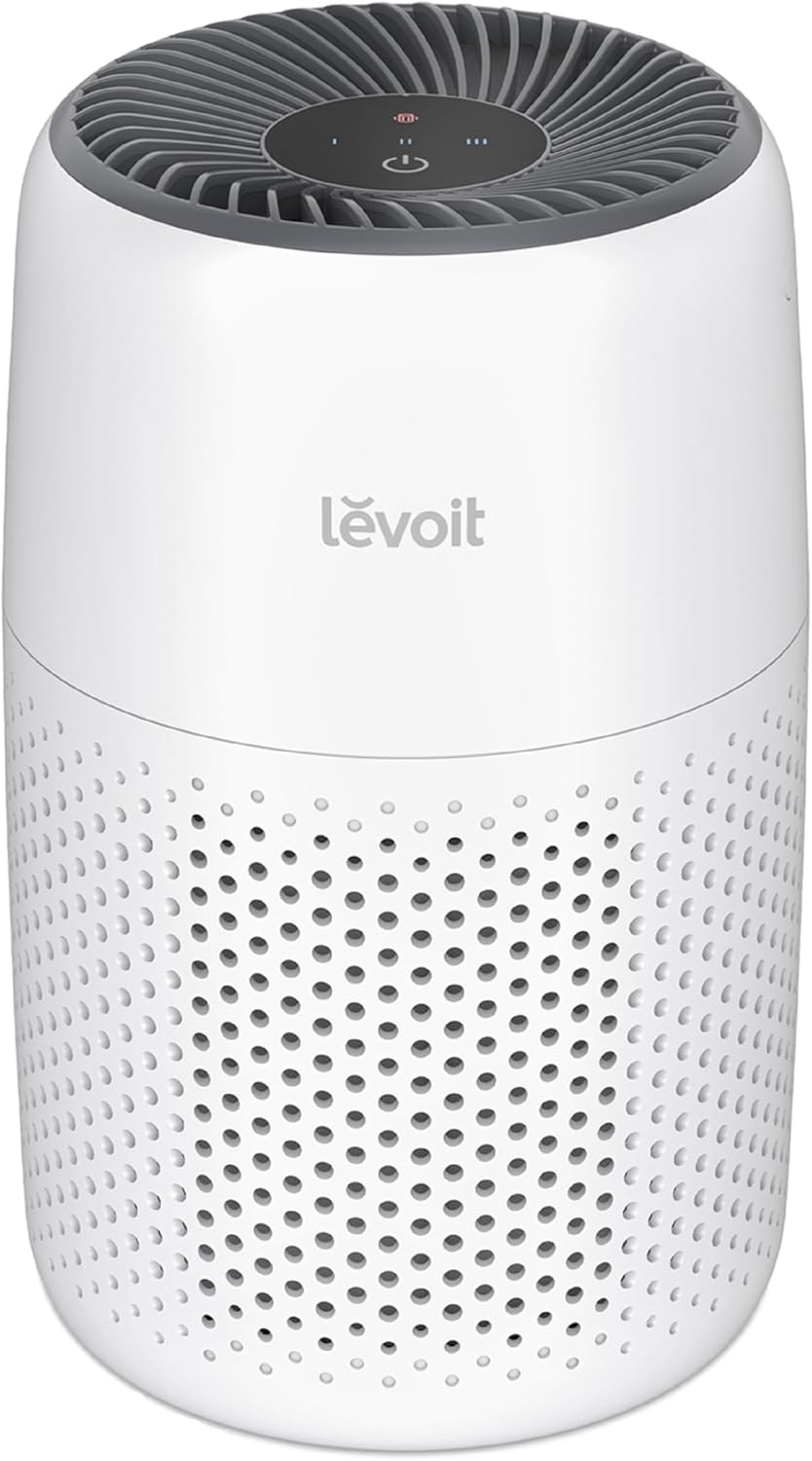
| Rated Power | 7W |
|---|---|
| Noise Level | 27-45dB |
| Adapter Input | 100-240V, 50/60 Hz |
The Levoit Core Mini-P is a small desktop air purifier built for personal spaces like bedrooms, dorms, and offices where compact size matters. It uses a pre-filter and main filter to capture lint, pet dander, smoke and fine particles and includes an aromatherapy sponge for mild fragrance control. The unit is very quiet at lower fan speeds and offers a sleep mode and auto-off display so it stays unobtrusive overnight. With a 7W rated power draw and AHAM-verified cleaning performance, it is energy efficient and suitable for continuous operation in small areas. Limitations are its coverage area and filter size, which make it unsuitable as a whole-room solution for larger living rooms or open-plan spaces and mean filters will need periodic replacement under heavy use. For people who want a low-noise, space-saving purifier for a bedroom or work desk, it balances performance and convenience well.
Best for: Buyers who prioritize proven performance and social proof and need a quiet, space-saving purifier for a bedroom, dorm, or personal workspace.
Less Ideal for: People seeking fast cleaning for large or open-plan rooms or those who want a single unit to cover an entire living area should look at larger-capacity purifiers instead.
- AHAM-verified air cleaning performance for reliable particle removal
- Very low power consumption (7W) for continuous, energy-efficient use
- Quiet operation with a dedicated sleep mode for nighttime use
- Compact, portable design that fits on desks and bedside tables
- Designed for small rooms only, not effective for large open areas
- Small filter capacity requires more frequent replacements under heavy pollutant loads
Verdict: A compact, AHAM-verified purifier that delivers quiet, energy-efficient particle removal for small personal spaces.
VOOPNU HEPA Air Purifier DH-JH12

| Filter type | H13 True HEPA |
|---|---|
| Coverage | Up to 1,076 ft² (lab-tested) |
| Noise level | As low as 22 dB |
| Speeds | 3 fan speeds |
| Recommended filter cycle | 3-6 Month |
The VOOPNU DH-JH12 is a small, user-friendly air purifier built around an H13 true HEPA multi-layer filter and 360 degree intake to capture airborne particles like pollen, pet hair, smoke, and odors. It is intended for continuous use in living rooms, bedrooms, or home offices where you want steady particle reduction; laboratory-tested coverage claims roughly 250 sq ft cleaned every 15 minutes and up to 1,076 sq ft per hour. Controls are simple, with three fan speeds, a timer, and an essential oil tray if you want scent, while the lowest fan setting runs very quietly at about 22 dB. The unit carries multiple safety and performance certifications and uses a replaceable filter with a recommended 3–6 month replacement cycle in typical conditions. Trade-offs include its compact footprint, which limits raw airflow compared with larger, high-CADR machines, and reliance on regular filter changes for best performance. For someone seeking an out-of-the-box, low-effort purifier for allergy or asthma symptom management in a small to medium area, this model is an easy-to-run option.
Best for: Buyers who prioritize a low-effort, certified purifier for allergy or asthma symptom relief in small to medium rooms and want an appliance that is quiet and easy to run continuously.
Less Ideal for: People needing to clean very large open-plan spaces or those who want the highest possible CADR from a single, heavy-duty unit should consider larger purifiers instead.
- H13 true HEPA multi-layer filtration captures 99.97% of airborne particles
- 360° intake design and lab-tested coverage (250 sq ft per 15 minutes) for efficient room turnover
- Very quiet operation down to about 22 dB suitable for bedrooms
- Simple controls with three speeds, timer, and an essential oil tray
- Multiple safety and performance certifications including ETL, CARB, FCC, and DOE
- Compact design means lower raw airflow than larger, high-CADR purifiers for big open spaces
- Filter replacement recommended every 3–6 months, adding ongoing maintenance cost
- Coverage claims are lab-tested and real-world performance depends on room layout and pollutant load
Verdict: A compact, quietly running H13 HEPA purifier with simple controls and certifications that makes continuous use easy for asthma and allergy symptom management in small to medium rooms.
Choosing the Right Air Purifier for Asthma: Key Factors to Consider
Filtration Efficiency and Filter Type
Filtration efficiency determines how well a unit removes the tiny particles that can trigger asthma attacks. Look for true HEPA filters rated to capture 99.97% of particles down to 0.3 microns; this captures many common allergens and combustion-related fine particles.
Also consider whether the purifier includes a prefilter to extend HEPA life and whether filter construction minimizes bypass and leakage. Filter lifespan and clear replacement indicators matter because clogged or old filters reduce effectiveness and can actually worsen air quality.
Gas-Phase Filtration for Odors and VOCs
Many asthma triggers are not particles but gases such as volatile organic compounds from cleaning products, paint, or cooking. Activated carbon or another gas-phase medium reduces odors and certain VOCs that can irritate airways.
Evaluate the volume and quality of activated carbon used and whether the manufacturer specifies removal of particular gases. For homes with smokers, heavy cooking, or recent renovations, stronger gas-phase filtration becomes more important.
Room Size and CADR Rating
An air purifier must be sized appropriately for the room to be effective. CADR ratings and manufacturer room coverage estimates indicate how quickly a unit can clean a given volume of air.
Target a purifier that can cycle your room air at least 4 to 5 times per hour for noticeable improvement. In open-plan areas or higher ceilings, choose a unit with higher CADR or plan multiple units for effective coverage.
Noise and Continuous Use
People with asthma benefit most when purifiers run continuously, especially overnight. Noise levels affect whether a unit will actually stay on at night or in living spaces.
Check low-speed decibel ratings and whether the unit has a quiet or sleep mode. Lower noise at equivalent airflow often indicates better fan and housing design, which makes consistent operation more likely.
Maintenance, Filter Cost, and Indicator Systems
Ongoing costs and ease of upkeep influence long-term effectiveness. Replaceable filters vary widely in price and expected life depending on usage and indoor conditions.
Choose units with accessible filters, clear replacement intervals, and helpful indicators. Consider whether replacement filters are easy to source and if the purifier allows you to clean prefilters to extend HEPA life, which reduces total ownership costs.
Operational Controls and Smart Features
Controls that promote proper use increase a purifier's real-world benefit. Features such as auto mode tied to air quality sensors, programmable schedules, and child locks can keep the unit running optimally without constant manual adjustments.
Smart connectivity and app alerts are convenient for some buyers but are not required to achieve good air quality. Prioritize reliable sensors and simple, easy-to-understand controls if you prefer low-maintenance operation.
Why HEPA Matters for Asthma
HEPA-class filtration captures the fine particulates most associated with asthma symptoms, including dust, pet dander, pollen, and many combustion-derived particles. For people with asthma, reducing particulate load inside the home can decrease the frequency and severity of flare-ups tied to airborne irritation.
Not all filters labeled HEPA perform equally, so look for a true HEPA rating and tight filter sealing within the machine. Complementary technologies like prefilters and electrostatic stages can help extend HEPA life but should not replace mechanical filtration.
- HEPA targets particles down to 0.3 microns at high efficiency
- Tight seals prevent dirty air bypass around filters
- Prefilters and washable screens reduce larger dust accumulation
Placement and Multiple Units
Where you place a purifier affects its effectiveness. Central locations or near known sources of pollution, like the kitchen or pet areas, deliver the most benefit. Avoid blocking air inlets and allow space around the unit for unrestricted airflow.
For larger homes or open-plan layouts, a single unit may not create uniform air cleaning. In those cases, consider placing smaller units in sleeping areas and living spaces to ensure continuous protection where occupants spend the most time.
- Keep at least 12 inches clearance from walls
- Place near pollution sources for targeted protection
- Consider one unit per frequently used room for consistent coverage
Running Costs and Practical Habits
Expect ongoing costs for filter replacements and electricity. Running a purifier continuously on a mid-speed setting commonly balances filtration performance and energy use. Check filter longevity estimates but plan replacements sooner if your home has pets or high particulate loads.
Simple habits extend filter life and performance: vacuum regularly, control indoor humidity, and limit indoor smoking and strong chemical use. These steps reduce the strain on your purifier and help maintain cleaner indoor air overall.
- Replace filters on schedule and use genuine replacements if required
- Run units continuously at low or auto mode for best results
- Combine purifier use with source control like ventilation and cleaning
Sensor Accuracy and Auto Modes
Built-in air quality sensors that detect particles and VOCs can automate fan speeds and keep operation efficient. However, sensor placement and calibration vary by model, so treat auto modes as helpful but not infallible.
If a unit's sensor is near a local source, such as a kitchen, it may run at higher speeds more frequently. For bedroom use, consider units with separate bedroom or sleep settings to prevent unnecessary noise increases overnight.
- Prefer sensors that report both particulate and gas-phase readings if available
- Use auto mode for convenience but verify actual noise and speed behavior
- Manual override gives control when sensors behave inconsistently
Addressing VOCs and Odors
Many asthma triggers come from gases rather than particles. Activated carbon and specialty adsorbents can reduce common household VOCs and odors that irritate airways. The effectiveness depends on the amount and quality of carbon and whether the media targets specific compounds.
For intermittent strong sources like painting or heavy cooking, source control and ventilation are more effective than relying on a purifier alone. Use gas-phase filtration as a complement to mechanical particle removal.
- Look for substantial activated carbon content for gas removal
- Know that carbon media become saturated and need replacement
- Combine ventilation with purifier use for major VOC events
How We Chose the Best Air Purifier for Asthma
We selected units that target airborne triggers most relevant to asthma sufferers and that perform consistently in real-world home settings. Our editorial filters prioritized true HEPA filtration performance, the ability to remove fine particles down to 0.3 microns, and documented effectiveness against common indoor allergens and particulate irritants. We also evaluated CADR or manufacturer-stated room coverage so each pick matches realistic room sizes, and we considered low-noise operation because sustained use—especially overnight—is essential for people with respiratory sensitivity. Additional criteria included ease of filter replacement and maintenance, availability of activated carbon or gas-phase filtration for odors and volatile compounds, and intuitive controls or auto modes that encourage continuous use. Units that lacked a HEPA-class filter, offered only ionization without particle capture, or had unclear performance specs were excluded. We favored products that balance measurable filtration with practical features that support daily use by people with asthma.
Our full evaluation process is outlined in our review methodology.
FAQ
How big should an air purifier be for a bedroom?
Choose a purifier with CADR and room coverage rated for your bedroom size so it can cycle the air multiple times per hour. For best results, select a model that can handle slightly more area than the room's square footage to ensure consistent cleaning.
Do ionizers help people with asthma?
Ionizers can reduce airborne particles by charging them, but many do not capture those particles on a filter and can produce byproducts. For asthma, mechanical HEPA capture is a more reliable method, and units that rely primarily on ionization without filtration were not prioritized.
How often should filters be replaced?
Replacement frequency depends on usage and indoor pollutant levels but commonly ranges from 6 to 12 months for HEPA filters. Homes with pets or heavy particulate loads may need replacements sooner, and prefilters can often be cleaned to extend HEPA life.
Will an air purifier remove mold spores?
Yes, true HEPA filtration removes many mold spores and can reduce airborne mold counts. However, purifiers do not address the underlying moisture source that allows mold to grow, so control of humidity and remediation of visible mold are still required.
Should I run the purifier all the time?
Continuous operation often delivers the best reduction in triggers, especially in bedrooms and high-use areas. Running at a low speed or using an accurate auto mode balances air cleaning with noise and energy use.
Final Verdict
Prioritize a purifier that pairs true HEPA filtration with appropriate room coverage and low noise if you or a household member has asthma. Gas-phase filtration is a valuable secondary feature when odors or VOCs are a concern, but mechanical particle removal remains the foundation of reducing airborne triggers. Balance ongoing costs, filter replacement intervals, and whether a unit encourages continuous use through quiet operation and helpful controls. Focus on measurable filtration performance and practical features to choose a unit that will consistently improve indoor air quality and reduce symptom triggers.