
Note: This article contains affiliate links. If you click on these links and make a purchase, we may earn a small commission at no extra cost to you. This helps support our research and content. Read our full affiliate disclosure here.
If you live with cats and sensitive lungs, picking the right air purifier can make daily life noticeably easier. An effective unit reduces airborne dander, neutralizes pet-related odors, and lowers triggers that cause sneezing, itchy eyes, or congestion. This guide rounds up seven shortlisted air purifiers for cat allergies that are suited to typical home rooms and pet-owner routines. We focus on measurable performance factors like true HEPA filtration, CADR or equivalent airflow capacity, filter maintenance, and practical fit for different room sizes. Read on to see the evaluation criteria used and the top options that match common household needs.
Top Picks at a Glance
| Best Overall The best all-around choice for most situations | Winix 9800 Air Purifier |  |
| Best Quality Built to a higher standard if you want something more solid | Coway Mighty AP-1512HH |  |
| Best Value The sweet spot between price and what you get | MOOKA B-D02L Air Purifier |  |
| Best Budget The cheapest option that still gets the job done reliably | FULMINARE H13 HEPA Air Purifier |  |
| Top Rated A top-rated pick with lots of positive feedback | FreAire VisionAir HAP606 |  |
| Most Popular A crowd favorite that many people choose with confidence | Levoit Core 300-P |  |
| Best Seller A high-volume bestseller chosen again and again | Levoit Vital 200S-P |  |
Winix 9800 Air Purifier

| Filter Type | HEPA |
|---|---|
| Floor Area | 500 square_feet |
| Noise Level | 26.2 db |
| Wattage | 95 watts |
| Controller Type | Amazon Alexa, Android, Button Control, iOS |
The Winix 9800 is a connected 4-stage air purifier built for larger rooms and continuous home use. It uses a washable pre-filter, activated carbon, and a True HEPA stage plus PlasmaWave to remove allergens, odors, and ultrafine particles while the dual smart sensors and auto mode adjust fan speed based on real-time air quality. The WiFi and Winix Smart App let you monitor air quality and control the unit remotely, and an LED indicator and sleep mode give clear feedback and quiet overnight operation. Practical benefits include strong particle capture that helps with pet dander and smoke, odor reduction from the carbon stage, and lower user maintenance because the pre-filter is washable. Trade-offs are its footprint and weight relative to smaller bedroom purifiers, and replacement HEPA/carbon filters will be an ongoing cost if you run it continuously in high-allergen homes.
Best for: Buyers who want a robust, smartphone-controlled purifier for living rooms or open-plan spaces and value strong allergen and odor removal without constant manual adjustment.
Less Ideal for: People seeking a tiny, ultra-portable bedroom unit or those unwilling to budget for regular filter replacements should consider other options.
- True HEPA filtration captures very small airborne allergens and particulates
- Activated carbon stage reduces odors and volatile organic compounds
- WiFi and mobile app allow remote monitoring and control
- Auto mode with dual sensors provides hands-off adjustment to changing air quality
- Sleep mode and low-noise operation make nighttime use comfortable
- Larger and heavier than compact bedroom purifiers
- Requires periodic replacement HEPA and carbon filters for best performance
Verdict: Choose the Winix 9800 when you need a smart, high-capacity purifier that effectively tackles pet dander and household odors in large rooms.
Coway Mighty AP-1512HH

| Coverage | Up to 1,748 sq. ft. in 60 minutes |
|---|---|
| Filtration stages | Pre-filter, Deodorization filter, Bipolar ionizer, True HEPA |
| HEPA effectiveness | 99.97% of 0.3μm particles |
| Auto & Eco modes | Yes |
The Coway Mighty AP-1512HH is a four-stage air purifier built for continuous home use, combining a washable pre-filter, deodorization filter, bipolar ionizer, and a True HEPA filter to capture fine particles and reduce odors. It is designed to cycle and clean the air in spaces up to roughly 1,748 sq ft in 60 minutes, and its auto mode adjusts fan speed based on a built-in pollution sensor so the unit runs faster during poor air quality events and quieter when the air is clean. The bright LED air quality indicator provides immediate feedback and can be turned off for nighttime use, and the filter indicator tracks when the HEPA or pre-filter need replacement or cleaning. Practical benefits include strong capture of pet dander and pollen, straightforward maintenance thanks to the washable pre-filter, and multiple fan modes including an eco setting for lower power use. Limitations are that replacement filters are required periodically and the unit's coverage claim depends on room layout and pollutant levels, so expect variable performance in complex open-plan homes.
Best for: Someone who prioritizes measurable performance and continuous air cleaning to reduce cat dander and airborne allergens in shared living spaces and bedrooms.
Less Ideal for: People seeking a near-silent bedroom-only unit for very small rooms or those who want an air purifier with integrated smart-home app controls and remote management.
- True HEPA filtration captures 99.97% of 0.3 μm particles for effective allergen removal
- Auto mode with real-time pollution sensor adjusts fan speed automatically
- Washable pre-filter reduces maintenance cost and prolongs HEPA life
- Air quality LED gives instant visual feedback and can be disabled for sleep
- Replacement HEPA and deodorization filters must be purchased periodically
- Coverage and removal rates will vary with room layout and pollutant concentration
Verdict: Choose the Coway Mighty AP-1512HH if you want a performance-focused HEPA purifier that automatically responds to poor air and effectively reduces cat allergens across medium to large spaces.
MOOKA B-D02L Air Purifier
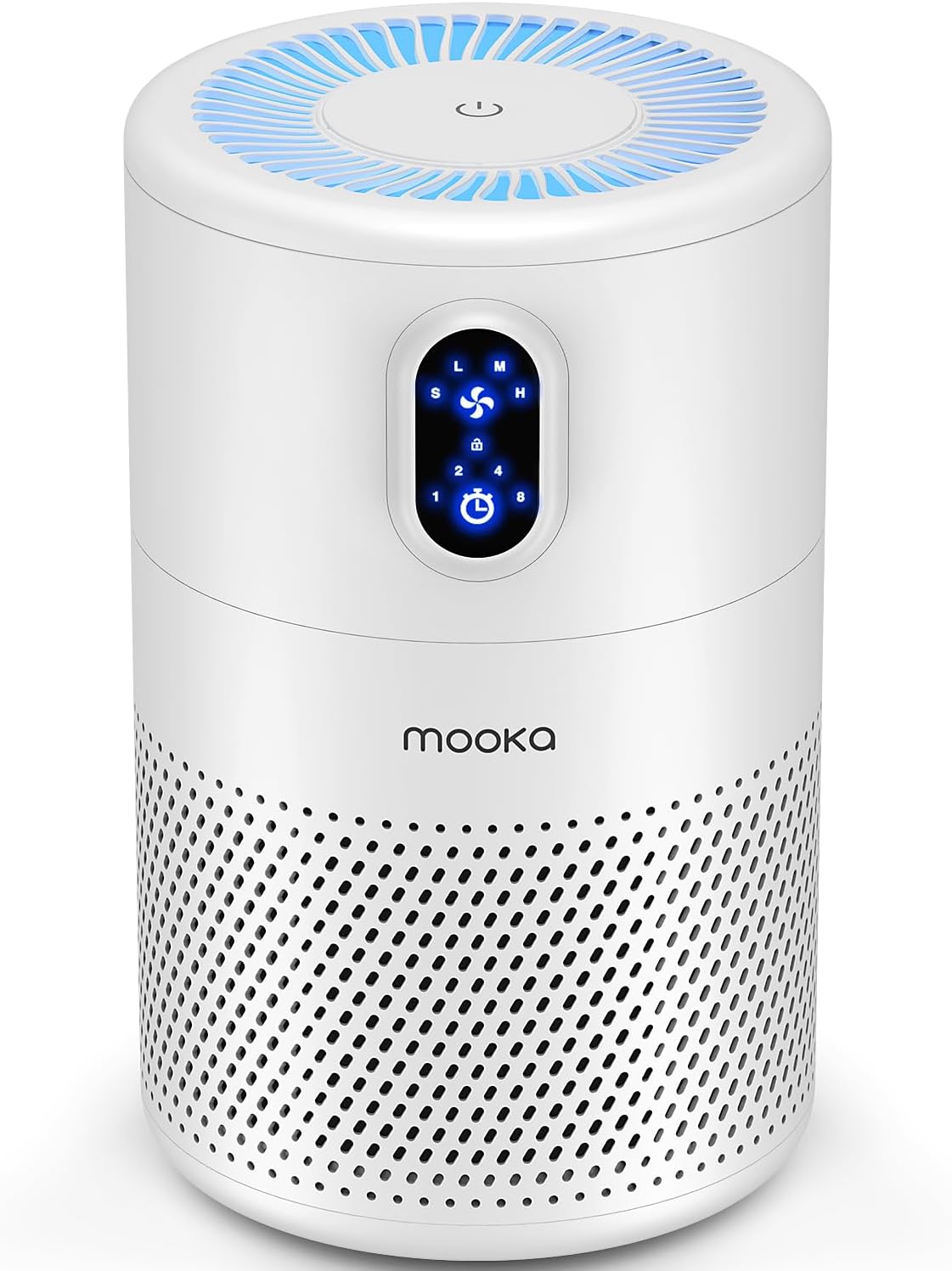
| Filter type | H13 HEPA + activated carbon + pre-filter |
|---|---|
| Coverage | Up to 1076 sq ft |
| Fan modes | 4 speeds (Sleep/Low/Med/High) |
| Timer | 1/2/4/8 hours |
The MOOKA B-D02L is a space-efficient air purifier built around an H13 true HEPA filter plus activated carbon and a pre-filter to capture pet hair, dander, pollen, smoke, and particles down to 0.3 microns. It is intended for use in bedrooms, living rooms, offices and larger open spaces — the manufacturer rates it for up to 1076 sq ft with lower air-change rates at that extreme and faster cycling in smaller rooms. Controls include four fan speeds (Sleep/Low/Med/High), four timer settings, a child lock, and a soft night light that can be turned off. The unit emphasizes quiet, energy-saving operation thanks to a brushless motor and claims noise levels as low as 20 dB on low, which makes it suitable for sleep or study. Filters are user-replaceable and should be changed every 3 to 6 months depending on use. Trade-offs are that real-world performance depends on room size and placement and that replacement filters are an ongoing cost, so expect modest maintenance if you run it continuously for pet-allergy control.
Best for: Buyers who prioritize reliable particle filtration for pet dander and want a quiet, easy-to-use purifier that can run overnight or in family spaces to reduce allergy triggers.
Less Ideal for: People seeking a maintenance-free solution or those who need guaranteed high air-change rates in very large or oddly shaped homes without using multiple units.
- H13 true HEPA plus activated carbon and pre-filter for capturing pet dander, hair, smoke, and 0.3 micron particles
- Rated to cover very large areas up to 1076 sq ft (with higher air-change rates in smaller rooms)
- Ultra-quiet brushless motor with a very low noise mode suitable for sleep or study
- Multiple timers, four fan speeds, and child lock increase usability and safety in family rooms
- Effectiveness and stated coverage depend heavily on room layout and placement rather than the single coverage figure
- Requires periodic filter replacements every 3 to 6 months, adding ongoing cost
Verdict: A quiet, HEPA-based purifier tuned for families with pets that balances strong particle filtration and low-noise operation for everyday allergy relief.
FULMINARE H13 HEPA Air Purifier

| Filter type | H13 HEPA |
|---|---|
| Recommended room size | 215 ft² / 20 m² |
| Noise level (low) | ~24 dB |
| Power | Plug-in (no battery) |
The FULMINARE H13 HEPA air purifier is a small, portable unit made for everyday bedroom or office use where quiet operation matters. It pulls air through an H13-grade HEPA filter to capture fine particles such as pet dander, smoke, and common allergens, and the 360° outlet with dual-channel design is intended to refresh air in rooms up to about 215 sq ft roughly five times per hour. Controls include a near-silent sleep mode that drops noise into the mid-20 dB range plus an independent night light and five timer settings for hands-off operation. The unit is plug-in only and uses a replaceable filter that the manufacturer recommends changing about every three months with a model-specific replacement. Practical benefits are straightforward: effective particle capture for small spaces, very low noise for light sleepers, and a small footprint that is easy to move. Limitations are also clear — it is sized for single rooms rather than whole-home use and requires periodic filter purchases and correct filter unpacking before use.
Best for: Buyers prioritizing low-cost allergy relief in a single bedroom or small living area who want a quiet, easy-to-use purifier that handles pet dander and light smoke exposure.
Less Ideal for: People seeking whole-home air cleaning or high-capacity coverage for large open-plan spaces should consider larger units instead.
- H13 HEPA filter captures fine particles and pet dander
- 360° air outlet with dual-channel design for even circulation in small rooms
- Very quiet sleep mode suitable for bedrooms
- Independent night light and multiple timer settings for convenience
- Effective coverage limited to roughly 215 sq ft so not suitable for larger spaces
- Requires regular filter replacements and filter must be unwrapped before use
Verdict: A compact, budget-friendly HEPA purifier that quietly reduces cat dander and other fine particles in a single bedroom or small living space.
FreAire VisionAir HAP606

| Coverage | Up to 1800 sq ft |
|---|---|
| Filtration | 3-stage H13 HEPA |
| Noise level (Sleep) | 20 dB |
| Real-time monitoring | PM2.5 & AQI display |
The FreAire VisionAir HAP606 is a HEPA air purifier built to continuously monitor air quality and remove airborne particles in large rooms. It uses a 3-stage H13 HEPA filtration system combined with a 360 degree intake and a high-efficiency airflow design to circulate and refresh air in spaces up to 1800 square feet multiple times per hour. The unit shows real-time PM2.5 and AQI values with a color-coded indicator, and an auto mode adjusts fan speed based on measured pollution levels, which simplifies daily use. Practical conveniences include a whisper-quiet sleep mode at around 20 dB, a child lock, and a timer for hands-off operation. For households with pets and allergy sufferers the H13 filter captures fine dander and particles down to 0.3 microns, while the replaceable factory filters are sold for consistent performance. Limitations include a relatively tall tower footprint for small tables and the need to buy replacement filters periodically to maintain factory-quality filtration.
Best for: Buyers who prioritize dependable, factory-quality filtration and want a straightforward, low-maintenance purifier that monitors air continuously for pet dander and allergens in large living spaces.
Less Ideal for: People looking for a super-compact tabletop unit for tiny rooms or those who want a filter-free or maintenance-free air cleaner.
- H13 3-stage HEPA filtration captures 99.97% of particles down to 0.3 microns
- Real-time PM2.5 digital display and color-coded AQI for instant feedback
- 360° intake and strong airflow designed to refresh large rooms up to 1800 sq ft
- Very quiet sleep mode at about 20 dB and child lock for overnight use
- Requires periodic replacement filters to sustain listed performance
- Tower height may limit placement on small surfaces or crowded shelves
Verdict: Choose the VisionAir HAP606 if you want a reliable, factory-quality HEPA purifier that actively monitors and clears pet allergens in large rooms.
Levoit Core 300-P

| Power Source | Corded Electric |
|---|---|
| Filter Type | 3 in 1 Filtration |
| Noise Level | 24 db |
| Wattage | 56 watts |
| Particle Retention Size | 0.3 micron |
The Levoit Core 300-P is a small, user-friendly air purifier built around a 3-stage True HEPA filter and a 56W motor that moves air quickly for its size. It is typically placed in bedrooms, living rooms, or near pet areas to reduce airborne allergens like pollen, dust, smoke, and pet dander; the listing states 99.97% filtration for 0.1–0.3 μm particles and AHAM-verified CADR figures that support regular air changes in medium rooms. Controls are touch-based with a near-silent Sleep Mode that drops noise to about 24 dB and an option to turn display lights off for nighttime use. Practical benefits include portable footprint, certified safety listings, and clear filter-replacement reminders, plus compatibility with Levoit replacement filters for best performance. Limitations are that it lacks smart Auto Mode on this specific Core 300-P variant and requires manual fan-speed adjustments, and optimal coverage assumes genuine Levoit filters and periodic replacements every 6–8 months.
Best for: Buyers who prioritize proven, certified filtration and want a compact purifier that reliably cuts airborne cat allergens in bedrooms or medium rooms with quiet nighttime operation.
Less Ideal for: People who need built-in smart control or automatic sensor-driven fan adjustments or those wanting an ultra-large-room purifier for whole-home coverage.
- True HEPA-grade filtration capturing 99.97% of 0.1–0.3 μm particles including pet dander
- AHAM-verified CADR and certifications (CARB, ETL) for tested performance and safety
- Very quiet Sleep Mode at around 24 dB with option to turn off display lights for undisturbed sleep
- Compact and portable design that fits on nightstands or near pet areas
- No Auto Mode or smart connectivity on this Core 300-P model so fan speed must be adjusted manually
- Best performance depends on using official Levoit replacement filters and regular changes
Verdict: Choose the Core 300-P when you want a compact, AHAM-verified HEPA purifier that quietly and reliably reduces airborne cat allergens in bedrooms and medium rooms.
Levoit Vital 200S-P

| Filter Type | 3-Stage Filter |
|---|---|
| Floor Area | 1875 square_feet |
| Noise Level | 27 db |
| Particle Retention Size | 0.1 micrometer |
| Power Source | Corded Electric |
The Levoit Vital 200S-P is a Wi‑Fi–enabled air purifier built to clean large rooms quickly while targeting common household allergens like pet hair, dander, dust, pollen, and smoke. It uses a three-stage filter stack (washable prefilter plus HEPA-style and activated carbon stages) and an extra U-shaped inlet to help capture pet hair and odors without frequent clogs. App control and an onboard air quality monitor let you track performance and switch modes remotely, and AHAM-verified CADR figures indicate strong real-world cleaning for dust, pollen, and smoke. At its lowest fan setting it is quiet enough for bedrooms, but the unit draws modest power on higher speeds and is physically substantial, so it sits best on the floor. Replacement filter options for pets, smoke, or toxins let you tune the machine to specific needs, though ongoing filter replacement is a regular maintenance cost. For buyers who want a proven, smart purifier that handles cat allergens and odors in larger spaces, this model offers a reassuring combination of performance and convenience.
Best for: Buyers who prioritize reliable, tested allergy reduction and want a smart, whole-room purifier that handles cat dander and household odors with minimal guesswork.
Less Ideal for: People seeking a very small, ultra-portable bedroom unit or those unwilling to budget for periodic replacement filters.
- AHAM-verified CADR ratings for smoke, dust, and pollen show strong whole-room cleaning performance
- Three-stage filtration with washable prefilter plus HEPA-style and activated carbon stages targets pet dander, hair, and odors
- Includes app control and built-in air quality monitor for remote management and real-time feedback
- Multiple specialized replacement filters (pet allergy, toxin, smoke) let you tailor filtration to household needs
- Physically sizeable and heavier than compact bedroom purifiers, so it is less portable
- Higher fan speeds increase power draw and noise compared with its lowest sleep setting
Verdict: A smart, AHAM-verified purifier that gives risk-averse buyers dependable, whole-room removal of cat allergens and odors with configurable replacement filters.
Choosing the Right Air Purifier for Cat Allergies: Key Factors to Consider
Filtration Technology
Look for true HEPA filtration because it captures very small particles like pet dander and many allergy triggers in the 0.3 micron range. Some units layer a pre-filter ahead of HEPA media to catch hair and large debris, which helps preserve the HEPA element and extend its useful life.
Avoid relying on unproven or single-method technologies that do not provide clear particulate removal ratings. Activated carbon layers are useful for helping with pet odors but do not replace particulate filtration. When a product lists multiple stages, check that a genuine HEPA-rated stage is included and that the manufacturer specifies removal efficiency.
Room Size and Air Changes Per Hour
An air purifier's effectiveness depends on matching its airflow to the room it will serve. Look at CADR or the manufacturer's stated room coverage, but focus on how many air changes per hour (ACH) the unit delivers for your room size. For allergy relief, one to two ACH may help general air quality, while three or more ACH gives more aggressive clearance of pet dander in frequently used rooms.
Oversizing a purifier for a small room wastes energy, while an undersized unit will not reduce allergen concentrations meaningfully. Verify that the purifier can maintain higher fan speeds without excessive noise if you need faster clearing during peak allergen times.
Filter Maintenance and Replacement
Routine maintenance affects both performance and long-term cost. Pre-filters that are washable or inexpensive to replace catch hair and prolong HEPA life. Check the expected lifetime of the HEPA cartridge under typical pet-owner conditions; heavy shedding households will shorten intervals between changes.
Also factor in the ease of finding and replacing filters. Simple snap-in designs reduce service time, and clear filter-replacement indicators help you avoid running the unit with a clogged filter, which lowers effectiveness and can stress the motor.
Noise and Daily Use Comfort
You will likely run an air purifier for many hours, including during sleep. Noise performance matters because high fan settings clear air faster but may be disruptive. Look for measured noise ratings for low, medium, and high fan speeds and consider units with quiet sleep modes or night settings.
Some purifiers use variable-speed brushless motors that are more efficient and quieter over time. If you plan to put a unit in a bedroom, prioritize models with a proven low-noise setting that still delivers at least one air change per hour for the room.
Operating Cost and Energy Use
Continuous operation adds to energy consumption, so pay attention to wattage at typical fan speeds. Energy-efficient motors and programmable timers can lower long-term operating costs. While initial purchase and filter costs matter, the ongoing energy draw and replacement filter frequency determine the real yearly cost of ownership.
Some models offer eco or auto modes that adapt fan speed to measured particle levels, which can reduce runtime on high settings while maintaining acceptable air quality. When budgeting, estimate annual filter replacements and energy costs under your expected run schedule.
How HEPA Works Against Pet Dander
True HEPA filters capture particles through a combination of interception, impaction, and diffusion. Pet dander tends to attach to tiny skin flakes and can remain airborne for long periods, so removing a high percentage of these small particles is essential for allergy relief.
In practice, the HEPA stage does the heavy lifting for allergen removal while pre-filters collect hair and larger debris. Activated carbon stages help with odors but will not significantly reduce dander counts on their own.
- HEPA targets particles down to 0.3 microns and smaller via diffusion
- Pre-filters reduce large hair buildup and protect the HEPA media
- Carbon layers reduce volatile odor compounds but not particulate allergens
Placement Tips for Maximum Allergen Reduction
Place the purifier where people and pets spend the most time, such as living rooms or bedrooms. Avoid cornering a unit tightly against walls or furniture, because restricted intake reduces effective airflow and lowers particle removal rates.
For multi-room homes, use one appropriately sized purifier per main living space instead of relying on a single oversized unit in one room. When airflow is obstructed by curtains or cabinetry, reposition the purifier to a more open area for consistent circulation.
- Keep 12 to 18 inches clearance around intake and exhaust
- Position near pet resting areas during high-shedding periods
- Consider doorways or open-plan layouts when estimating room coverage
Managing Odors Vs Allergens
Odor control and allergen removal are related but separate goals. Activated carbon or other adsorption stages reduce volatile odor compounds and some ammonia from litter boxes, improving perceived air quality. However, these stages do not substitute for particulate filtration aimed at dander.
If pet odor is a major concern, choose a purifier that combines strong particulate filtration with a substantial carbon layer. Keep in mind that carbon beds saturate over time and will need replacement or regeneration depending on the design.
- Use carbon stages for odors, HEPA for dander
- Replace carbon filters on the recommended schedule for best results
- Combine purifiers with good litter-room ventilation to reduce odor load
Keeping a Home Ready for Guests with Allergies
If you host visitors with known cat allergies, run the purifier on higher speeds for several hours before their arrival to lower airborne allergen levels. Focus on rooms they will use and consider temporarily removing soft textiles that trap dander, such as throw blankets or unwashed cushions.
While purifiers reduce airborne particles, they do not remove allergens embedded in fabrics and carpeting. Vacuuming with a machine that has a sealed HEPA exhaust and washing linens frequently complements an air purifier's work.
- Run purifiers on high for at least 1-2 hours before arrival
- Wash guest linens and vacuum seating in advance
- Keep pet access limited in guest rooms when possible
Using Smart Features and Auto Modes
Many modern purifiers include auto modes that ramp fan speeds based on particle sensors. These can maintain lower noise and energy use while increasing airflow when dander levels spike. Rely on these features for day-to-day convenience but verify sensor responsiveness in reviews or documentation.
Scheduling and integration with other smart-home systems can be helpful for routine operation. Use timers to run the unit on higher cycles during peak shedding times and revert to quiet operation overnight.
- Auto modes balance noise and performance via sensors
- Timers let you target high-shedding periods
- Remote control or app features improve day-to-day convenience
How We Chose the Best Air Purifier for Cat Allergies
We selected units that address the specific challenges of cat allergies rather than general-purpose air cleaning. Our process prioritized measurable filtration and real-world usability. Key evaluation criteria included true HEPA filtration effectiveness against pet dander and allergen-sized particles, airflow capacity and room coverage based on manufacturer CADR or equivalent ratings, and filter life plus replacement ease and cost. We also assessed noise levels at typical fan settings to ensure the purifier is tolerable in living rooms and bedrooms, and considered energy usage for continuous operation. We excluded units that rely solely on ionic or ozone-generating technologies because those approaches do not reliably remove dander and can introduce other indoor air concerns. We also filtered out appliances lacking clear filtration specifications or verifiable airflow data. The remaining candidates were judged on how well they remove allergen-sized particles, suit common room sizes, and fit into everyday pet-owner maintenance cycles.
Our full evaluation process is outlined in our review methodology.
FAQ
How often should I run an air purifier for cat allergies?
Run the purifier continuously for best control of airborne dander, especially in rooms where the cat spends time. If continuous operation is not practical, run higher fan speeds for several hours during peak shedding and use lower settings at night.
Will an air purifier remove cat hair from furniture?
Air purifiers reduce airborne hair and dander but cannot remove hair embedded in upholstery or carpets. Regular vacuuming with a sealed HEPA vacuum and washing fabrics are necessary to address settled hair and trapped allergens.
Are carbon filters necessary if my main concern is allergies?
Carbon filters help with odors and some volatile compounds but do not significantly reduce particulate allergens. For allergy relief, prioritize a true HEPA stage and treat carbon as a secondary feature for odor management.
Can I use an air purifier in the same room as the litter box?
Placing a purifier near a litter box can help reduce airborne ammonia and dust if the unit has a carbon stage, but ensure the purifier is not obstructed. Also maintain good litter area ventilation and regular cleaning to lower odor and dust loads.
How do I know when to replace the HEPA filter?
Replace HEPA filters according to the manufacturer's stated interval or when the unit shows a filter-replacement indicator. In homes with heavy shedding, expect shorter intervals. A noticeable drop in airflow or increased dust on surfaces can also signal it is time to change the filter.
Final Verdict
When choosing an air purifier for cat allergies, prioritize a true HEPA filtration stage and a unit sized to provide sufficient air changes for the rooms you use most. Balance filtration performance with practical concerns like noise, filter replacement frequency, and energy use so the purifier will be used consistently. Expect tradeoffs: higher-capacity units clear air faster but may be louder or cost more to operate. Focus on units with washable pre-filters, clear maintenance indicators, and verified room coverage for confident, long-term allergy relief.