
Note: This article contains affiliate links. If you click on these links and make a purchase, we may earn a small commission at no extra cost to you. This helps support our research and content. Read our full affiliate disclosure here.
If litter dust or tracked-in fine particulates from your cat's litter box are affecting indoor air quality, picking the right air purifier makes a measurable difference. You want a unit that captures very fine dust, handles pet dander and odors, and moves enough air for the room where the litter box sits. This guide shortlists the top air purifiers for cat litter dust and explains the factors that matter, including filtration efficiency, clean air delivery rate, and noise. Read on for focused criteria and practical buying guidance before the product list.
Top Picks at a Glance
| Best Overall The best all-around choice for most situations | WINIX 5510 Air Purifier |  |
| Best Quality Built to a higher standard if you want something more solid | Coway Mighty AP-1512HH |  |
| Best Value The sweet spot between price and what you get | MOOKA B-D02L Air Purifier |  |
| Best Budget The cheapest option that still gets the job done reliably | VOOPNU HEPA Air Purifier DH-JH12 |  |
| Top Rated A top-rated pick with lots of positive feedback | FreAire VisionAir HAP606 |  |
| Most Popular A crowd favorite that many people choose with confidence | Levoit Core 300-P Air Purifier |  |
| Best Seller A high-volume bestseller chosen again and again | Levoit Vital 200S-P Air Purifier |  |
WINIX 5510 Air Purifier

| Max room coverage | 1,882 sq ft in 1 hr |
|---|---|
| Filtration stages | 4‑Stage |
| Particle capture | 0.01 microns |
| Smart features | WiFi / Alexa / Google Home |
The WINIX 5510 is a large‑room tower purifier that combines a True HEPA filter, advanced carbon odor control, a washable prefilter, and Winix PlasmaWave to remove fine particles and reduce household smells. It is typically placed in living rooms or near litter areas to capture pet dander, dust and smoke; smart sensors and an AQI indicator monitor air quality and Auto Mode adjusts fan speed automatically. The unit is app‑compatible for remote monitoring and supports Sleep Mode that quiets the fan when the room is dark. Practical benefits include strong CADR‑class performance for fast room turnover and a washable prefilter that traps hair and large debris before they reach the HEPA. Limitations to consider are routine filter replacements for the HEPA and carbon stages and that PlasmaWave is an add‑on technology that some users prefer to disable; the unit size also requires a dedicated floor spot in medium to large rooms. For homes with cats it handles litter dust and odors effectively when run regularly, but expect moderate operating noise at higher fan speeds and ongoing filter costs.
Best for: Buyers who want a reliable, easy‑to‑manage purifier that removes fine pet dust and household odors in living spaces and prefer smart features and automatic operation.
Less Ideal for: People seeking an ultra‑compact bedroom unit or a completely silent purifier at high airflow should consider smaller or quieter models instead.
- True HEPA filtration captures very small particles down to 0.01 microns for pet dander and fine litter dust.
- Advanced carbon filter reduces odors and VOCs common around litter boxes and kitchens.
- Smart sensors with Auto Mode and an AQI light make maintenance and operation mostly automatic.
- Washable fine mesh prefilter catches hair and large debris to extend HEPA life.
- App and voice support let you monitor air quality and control the purifier remotely.
- Ongoing expense and periodic downtime for HEPA and carbon filter replacements.
- At higher fan speeds the unit produces noticeable noise compared with low‑speed Sleep Mode.
Verdict: A strong, smart large‑room purifier built to cut cat litter dust and odors while automating fan speed and air quality monitoring.
Coway Mighty AP-1512HH

| Coverage (claimed) | Up to 1,748 sq. ft. per 60 minutes |
|---|---|
| Filtration stages | Pre-filter, Deodorization, Bipolar Device, HEPA |
| HEPA effectiveness | 99.97% of 0.3 micron particles |
| Model number | AP-1512HH |
The Coway Mighty AP-1512HH is a countertop/room air purifier built around a four-stage filtration system (washable pre-filter, deodorization filter, bipolar ionizer, and a True HEPA filter) and a built-in air quality sensor that adjusts fan speed automatically. It is intended for continuous use in living rooms, bedrooms, or home offices and claims to clean up to roughly 1,748 sq ft in 60 minutes under ideal conditions. In practice the washable pre-filter captures larger cat litter dust and hair, the HEPA element removes fine dust and allergens down to 0.3 microns, and the deodorization stage helps reduce litter odors and VOCs. Auto and Eco modes let the unit run quietly at night or ramp up when sensors detect poor air, and the filter indicator makes maintenance straightforward. Limitations are typical for standalone purifiers: coverage claims assume open layouts and real-world results vary by room layout and source concentration, and replacement filters are required roughly annually to maintain peak performance.
Best for: Buyers who prioritize strong particulate removal and real-time automatic control to reduce cat litter dust and household allergens in living spaces.
Less Ideal for: Those who need purifier coverage for multiple large, closed rooms at once or who prefer an integrated smart-home app experience rather than local controls.
- True HEPA filtration removes 99.97% of 0.3 micron particles for effective capture of fine litter dust and allergens
- Washable pre-filter traps larger hair and debris to extend main filter life
- Auto mode with air quality sensor adjusts fan speed for hands-off operation
- Deodorization filter and bipolar ionizer help reduce odors and certain VOCs
- Clear filter indicator and timer simplify maintenance and scheduling
- Coverage and time-to-clean depend on room layout and source strength so results can vary
- Requires periodic replacement of HEPA/deodorization filters to sustain performance
Verdict: Choose the Coway Mighty AP-1512HH when you want a proven, sensor-driven HEPA purifier that effectively tackles fine cat litter dust and odors in medium to large rooms.
MOOKA B-D02L Air Purifier
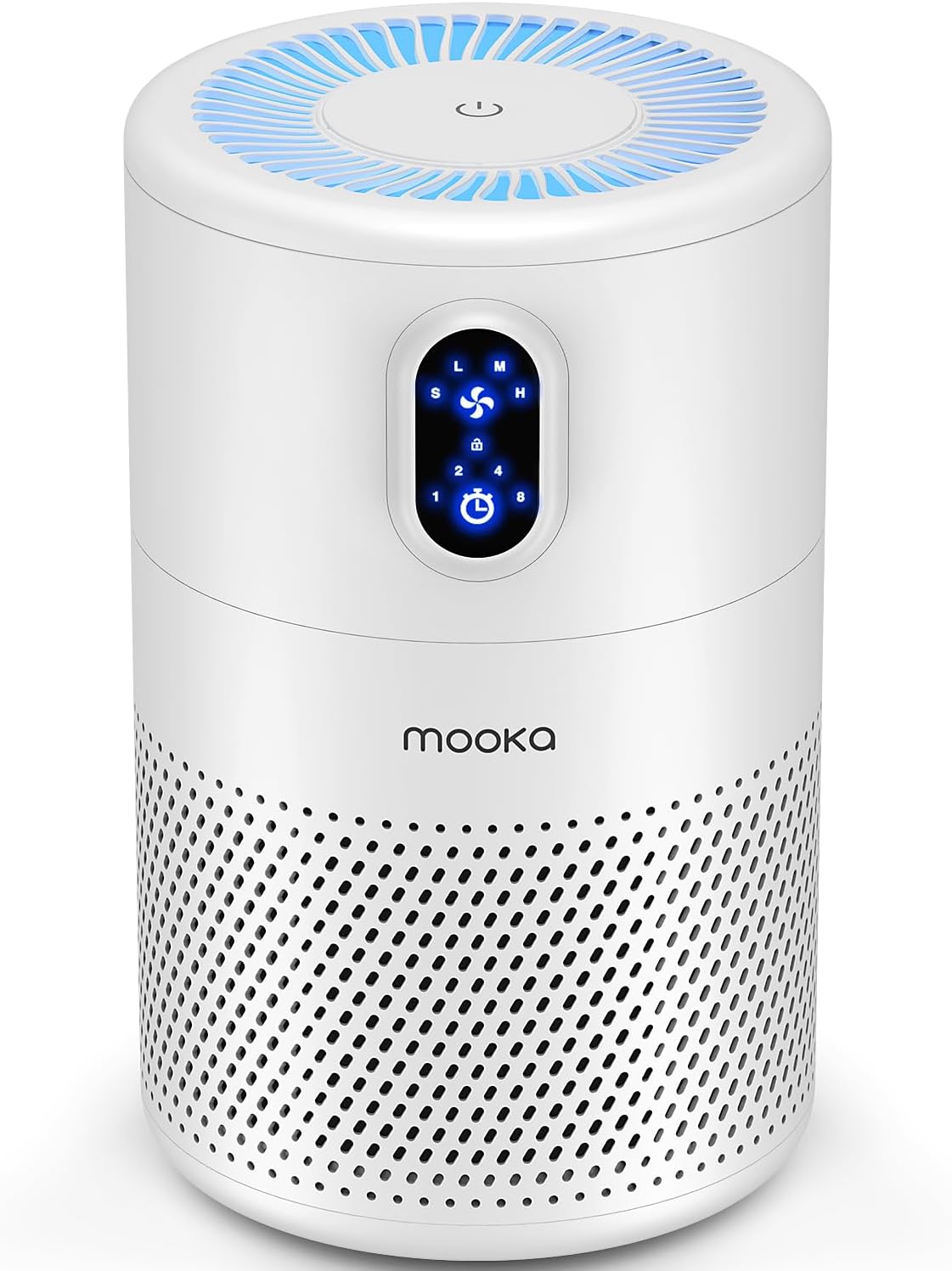
| Effective Area | 1076 sq ft |
|---|---|
| Filter Type | H13 True HEPA + Activated Carbon |
| Fan Modes | Sleep/Low/Med/High |
| Timer Settings | 1H/2H/4H/8H |
The MOOKA B-D02L is a small, countertop-style air purifier built around a three-stage filtration stack: pre-filter, H13 true HEPA, and activated carbon. It is intended for use in bedrooms, living rooms, offices, and other indoor spaces and the manufacturer rates it for coverage up to 1076 sq ft with lower ACH at the top end and faster air changes in smaller rooms. Controls include four fan speeds (Sleep/Low/Med/High), four timer settings, a soft night light that can be turned off, and a child lock for accidental presses. The unit emphasizes quiet, energy-efficient operation with a brushless motor and claims a low noise floor around 20 dB on the lowest setting. Filters are user-replaceable and should be swapped every 3 to 6 months depending on use. Practical strengths are its true HEPA filtration and activated carbon for odors; limitations are that the quoted coverage reflects a wide range (one air change per hour at the high end) so expect slower clearing in very large open spaces and you'll need periodic replacement filters to maintain performance.
Best for: Buyers who prioritize reliable particle removal and low-noise operation for improving indoor air where cats live, and who want a straightforward, easy-to-use purifier with basic controls.
Less Ideal for: Homes that need to rapidly clean very large open floor plans or whole-house coverage should consider higher-capacity units or multiple purifiers instead.
- H13 true HEPA filter captures particles down to 0.3 microns for dust, pollen, and pet dander.
- Activated carbon layer reduces common odors and smoke, helpful for litter box smells.
- Multiple fan speeds, timers, and child lock make it flexible and safe for bedroom use.
- Very quiet low-speed operation for overnight use and energy-efficient brushless motor.
- Coverage claims span a very large area but only deliver faster air changes in smaller rooms, so performance in open large rooms may be limited.
- Requires filter replacements every 3 to 6 months depending on conditions.
Verdict: A quiet, practical HEPA purifier that handles litter dust and pet odors well in bedrooms and small to medium rooms where low noise and simple controls matter.
VOOPNU HEPA Air Purifier DH-JH12

| Coverage (claimed) | Up to 1,076 ft² per hour (250 ft² every 15 minutes) |
|---|---|
| Filter type | H13 True HEPA triple-layer |
| Noise level | As low as 22 dB |
| Speeds | 3 fan speeds |
| Model | DH-JH12 |
This VOOPNU DH-JH12 is a small, user-friendly air purifier built to run continuously in living areas. It uses an H13 true HEPA triple-layer filter and 360° surround intake to capture fine particles, and the vendor claims it can clean roughly 250 ft² every 15 minutes (about 1,076 ft² per hour). Controls are simple—a basic panel with three fan speeds, a timer, and a low-noise mode that can drop to about 22 dB for undisturbed sleep. The unit includes an essential oil tray for light scenting and has multiple safety and performance certifications. Practical strengths here are the compact footprint and quiet operation, which make it easy to place near litter boxes or in bedrooms without being obtrusive. Expect regular filter replacements on the brand schedule to maintain performance, and note the modest physical size means the airflow rate may be lower than much larger room purifiers despite the claimed coverage; for heavy dust loads you may need to run it on higher speed more often. Setup is plug-and-play, and the washable prefilter option on some variants can cut recurring filter costs.
Best for: Buyers looking for an affordable, compact purifier to reduce airborne litter dust and light pet allergens in small to medium rooms who prefer a quiet, easy-to-use unit.
Less Ideal for: Homes with multiple large rooms, very heavy litter dust or severe allergies that require a high-CADR commercial-grade purifier should consider more powerful, larger-capacity models instead.
- H13 true HEPA filtration captures 99.97% of fine particles including dust and pollen
- 360° air intake for even room circulation
- Very quiet operation down to ~22 dB suitable for bedrooms
- Compact size fits near litter areas or on small surfaces
- Simple controls and timer make continuous use easy
- Small physical size may limit peak airflow compared with larger purifiers
- Filter maintenance and periodic replacements are required to sustain performance
Verdict: A budget-friendly, quiet HEPA purifier that fits near litter areas to reduce airborne cat litter dust in small to medium rooms.
FreAire VisionAir HAP606

| Coverage | up to 1800 sq ft |
|---|---|
| Filter type | 3-stage H13 HEPA |
| Noise level (sleep) | 20 dB |
| Air changes | 4 times per hour |
The FreAire VisionAir HAP606 is a home air purifier that combines continuous PM2.5/AQI monitoring with a three-stage H13 HEPA filter and 360 degree intake to tackle airborne particles in large rooms. It is typically placed in living areas or bedrooms where pets and litter dust are concerns, and it runs automatically using its auto mode or at one of four fan speeds; a quiet 20 dB sleep mode makes overnight use unobtrusive. The unit reports real-time PM2.5 readings on a color-coded display so you can see when particle levels fall, and the high-efficiency filter is designed to capture particles down to 0.3 microns, which helps reduce fine litter dust and dander. Practical benefits include fast room turnover thanks to the claimed four air changes per hour in large spaces, simple controls with child lock and timer, and ETL/FCC/CARB certifications. Important limitations are that replacement filters are recommended to be genuine FreAire parts for best performance and that size and CADR specifics beyond the stated coverage are not listed on the unit itself, so expect to match placement and replacement cadence to your home conditions.
Best for: Buyers who prioritize dependable particle removal and want constant, easy-to-read feedback on indoor PM levels for homes with cats and litter areas.
Less Ideal for: Customers seeking explicit CADR figures or industrial-strength machines for very large open-plan spaces should consider higher-capacity commercial units instead.
- Real-time PM2.5 and color-coded AQI display for instant feedback on air quality
- H13 3-stage HEPA filtration rated to capture 99.97% of particles down to 0.3 micron
- 360 degree intake and claimed 4 air changes per hour for rapid room turnover
- Very quiet sleep mode (around 20 dB) suitable for bedrooms or night use
- Manufacturer emphasizes using official replacement filters which may limit third-party options
- Detailed CADR numbers and some performance metrics are not provided in the listing
Verdict: Choose the VisionAir HAP606 when you want a quiet, monitor-equipped HEPA purifier that actively tracks PM2.5 and reduces fine litter dust in large home rooms.
Levoit Core 300-P Air Purifier

| Filter Type | 3 in 1 Filtration |
|---|---|
| Floor Area | 1073 square_feet |
| Noise Level | 24 db |
| Particle Retention Size | 0.3 micron |
| Wattage | 56 watts |
The Levoit Core 300-P is a small, quiet air purifier built around a three-stage True HEPA-grade filter that captures 0.1–0.3 micron particles and claims 99.97% efficiency for fine particulates. It uses a 56W motor and delivers strong CADR numbers for smoke, dust, and pollen, so it refreshes air in a typical bedroom several times per hour. Controls are touch-based with a sleep mode that drops noise to about 24 dB and the display can be turned off for overnight use. Practical benefits include genuine Levoit replacement filters for consistent performance, a compact portable footprint for moving between rooms, and certifications from AHAM, CARB, and ETL for peace of mind. Limitations are that this model requires manual fan speed selection (no Auto Mode) and is optimized for smaller spaces rather than whole-home coverage, so you may need multiple units or higher-capacity purifiers for very large rooms or open-plan areas.
Best for: Buyers who prioritize proven filtration and third-party certification and want a compact, quiet purifier for bedrooms or small living spaces where litter dust and pet dander are a concern.
Less Ideal for: People who need whole-house coverage, automatic air-quality-driven operation, or integrated smart features should consider larger or Auto Mode–equipped models instead.
- True HEPA-grade 3-stage filter captures ultrafine particles down to 0.1–0.3 μm
- AHAM verified CADR and other safety certifications provide independent performance assurance
- Very quiet sleep mode (about 24 dB) suitable for bedrooms
- Compact and portable design makes it easy to move between rooms
- Includes a pre-installed genuine Levoit filter for ready use
- No Auto Mode or smart connectivity on this model so fan speed must be set manually
- Rated coverage and CADR are best for small to medium rooms, not large open areas
Verdict: Choose the Core 300-P if you want a compact, AHAM-verified HEPA purifier that quietly removes fine litter dust and pet dander in bedrooms and small rooms.
Levoit Vital 200S-P Air Purifier

| Floor Area | 1875 square_feet |
|---|---|
| Noise Level | 27 db |
| Filter Type | 3-Stage Filter |
| Particle Retention Size | 0.1 micrometer |
| Power Source | Corded Electric |
The Levoit Vital 200S-P is a smart air purifier built for whole-room cleaning in homes with pets and allergy concerns. It uses a three-stage filter (pre-filter, activated carbon layer, HEPA-class capture) and an enlarged U-shaped inlet to trap pet hair and litter dust while the unit circulates air across large spaces. App control and an onboard air quality monitor make it easy to schedule runs and check conditions, while AHAM verification and CADR numbers for smoke, dust, and pollen show it is engineered for measurable performance. The purifier runs quietly in sleep mode at around 27 dB, so it can operate in bedrooms without noticeable noise. Practical limits include periodic filter replacement and the need to position the unit with clear airflow for best results; it is large compared with small desktop units, so it is intended as a central room unit rather than a portable spot-solution. For routine removal of cat litter dust and pet dander in living rooms or open-plan areas, the Vital 200S-P delivers strong filtration backed by verified CADR figures.
Best for: Buyers who prioritize verified, reliable air cleaning for pet households and want a low-noise, easy-to-manage central unit to cut litter dust and dander across living rooms or bedrooms.
Less Ideal for: People who need a tiny, ultra-portable purifier for a single desk or those unwilling to perform occasional filter maintenance should consider smaller or maintenance-free alternatives.
- AHAM-verified performance with strong CADR for dust and smoke.
- Three-stage filtration including washable pre-filter and activated carbon for odors.
- Smart app control and built-in air quality monitor for automated operation.
- Very quiet sleep mode around 27 dB suitable for bedrooms.
- Requires regular filter replacements to maintain performance.
- Physically larger footprint than compact travel purifiers, so needs floor space.
Verdict: A verified, quiet whole-room purifier that reliably reduces cat litter dust and pet dander for risk-averse buyers who want measurable performance.
Choosing the Right Air Purifier for Cat Litter Dust: Key Factors to Consider
Filtration Efficiency and Filter Type
High filtration efficiency matters because cat litter dust includes very fine particles that can stay airborne for long periods. Look for true HEPA filters or filters rated to capture particles down to 0.3 microns or smaller. A multi-stage filter stack that places a prefilter before the HEPA element helps trap larger grit and extends the life of the fine-particle media.
Consider whether the filter media is sealed within the unit so all air passes through the HEPA stage rather than bypassing it. Some units advertise enhanced particulate capture technology; prioritize measurable HEPA-equivalent ratings over vague marketing claims.
Airflow Capacity and Room Coverage
A purifier's ability to lower dust concentration depends on how much clean air it supplies, usually expressed as CADR or recommended room size. Choose a model whose CADR or coverage exceeds the square footage where the litter box is located. Running a unit that is too small will leave dust levels higher even if its filter media is excellent.
Also think about placement: a higher-capacity unit can sit farther from the litter box and still reduce dust spread through the room, while a smaller unit will need to be close and may still struggle to capture light airborne dust moving with air currents.
Noise and Daily Use Comfort
Because litter boxes are often placed in living areas, bathrooms, or bedrooms, the daily noise level of a purifier affects whether you will keep it running consistently. Check operating decibel levels at low and high fan speeds. Some purifiers advertise quiet night modes that substantially reduce noise while still circulating some air.
If you plan to run a purifier 24/7, favor models that maintain reasonable airflow at lower noise levels and avoid units that force high noise for effective filtration.
Odor Control and Gas-Phase Filtration
Litter boxes can release ammonia and other volatile compounds that are unpleasant even when dust is controlled. Units with dedicated activated carbon or gas-phase filtration help adsorb odors and VOCs. Consider the amount and type of carbon media and whether the unit uses replaceable odor cartridges.
Remember that carbon capacity is finite and will saturate; assess how often cartridges need replacement and whether replacements are easy to obtain.
Filter Maintenance and Running Costs
Ongoing maintenance affects long-term value. Filters that are easy to replace and reasonably priced reduce the friction of keeping the purifier effective. Look for clear filter life indicators, accessible filter bays, and prefilters that are washable to catch larger particles and extend the life of expensive HEPA and carbon elements.
Also factor in the frequency of filter changes based on your household's dust load and whether replacement filters are readily available.
Placement, Size, and Portability
Where you place the purifier influences its effectiveness against litter dust. A compact, portable unit can be positioned close to the litter box to capture dust at the source, while a larger tower model may be better for whole-room coverage. Consider footprint, weight, and whether the unit's intake or exhaust layout fits your intended location.
Also think about whether you will move the purifier between rooms. Lightweight units with handles or casters make repositioning easier and let you concentrate filtration where needed most during high-dust periods.
Where to Place an Air Purifier for Best Dust Capture
Positioning is key when the goal is to trap litter dust before it spreads. Place the purifier so its intake faces the litter box or the most common dust flow path. Avoid tucking the unit into a corner where airflow is restricted.
If you have a small bathroom or laundry area housing the box, elevate a compact purifier slightly so intake is not blocked by low cabinetry. In open living spaces, place the unit between the litter box and the main seating area to intercept dust traveling on air currents.
- Keep at least a few feet of clearance around intakes and exhausts.
- Avoid placing the purifier directly against walls or under furniture.
- Use a portable unit if you move the litter box occasionally or need temporary coverage.
Operating Tips to Reduce Litter Dust
Running the purifier continuously at a moderate fan speed often yields better results than intermittent high-speed blasts. Continuous operation maintains lower average dust concentrations and prevents peaks after scooping or changing litter.
Combine purifier use with simple litter box habits to minimize dust generation: scoop daily, use a covered scooper box or mat to trap tracked grit, and avoid shaking litter bags indoors. Empty and refill slowly to reduce airborne clouds.
- Start the purifier a few minutes before scooping to establish airflow.
- Run the unit on higher speed for 15–30 minutes after any dusty task, then return to quiet mode.
Managing Odors Alongside Dust
While HEPA filters capture particulates, they do not remove gases or ammonia responsible for litter box smell. If odors are a concern, choose a purifier with a dedicated activated carbon stage sized for sustained adsorption.
Keep in mind that carbon media becomes saturated and needs replacement. Use odor-control settings sparingly to extend cartridge life and rely on regular litter maintenance as the primary odor management strategy.
- Look for replaceable carbon canisters and clear guidance on expected service life.
- Consider combining a purifier with localized odor control like frequent litter changes and washable mats.
Sizing a Purifier to Your Room and Routine
Match the purifier's CADR or recommended room size to the square footage where the litter box sits. For larger rooms, favor units with higher CADR ratings or plan to run a smaller unit at higher speeds more often.
If you use multiple litter boxes in different rooms, portable purifiers that you can move between locations are often more cost-effective than one oversized unit placed far from the source.
- Measure the room and check the unit's stated coverage for a realistic match.
- Account for open floorplans by choosing a higher-capacity purifier or additional local units.
Maintaining Filters and Monitoring Performance
Regularly inspect prefilters and HEPA media for visible dust accumulation. Replace or clean according to manufacturer guidance to preserve capture efficiency. A clogged filter reduces airflow and diminishes the purifier's ability to remove dust.
Use any built-in filter indicators rather than arbitrary schedules, and keep spare filters on hand if your household generates a lot of litter dust.
- Clean washable prefilters every few weeks in high-dust homes.
- Track replacement filter part numbers and availability before committing to a model.
How We Chose the Best Air Purifier for Cat Litter Dust
We prioritized features that directly reduce airborne litter dust and its common companions, like pet dander and odor. Every candidate had to offer a true HEPA or equivalent high-efficiency particulate filter rated to capture submicron particles, because high capture efficiency for small dust is the primary determinant of effectiveness. We also assessed airflow capacity using CADR or stated room coverage so a purifier can exchange a living space's air frequently enough to lower dust concentration. Noise performance was evaluated since litter boxes are often in bedrooms, bathrooms, or shared living spaces where low sound levels matter. Odor control and activated carbon capacity were considered for ammonia and litter smells. Filter maintenance cost and ease of replacement were checked to ensure long-term usability. Units were excluded if they relied solely on ionizers without HEPA-class particulate filtration, lacked clear airflow/coverage specs, or had insufficient filter changeability. The result is a short, practical list of purifiers that meet the core requirements for trapping litter dust, managing pet-related particles, and fitting typical household rooms.
Our full evaluation process is outlined in our review methodology.
FAQ
Will an air purifier remove fine dust from clumping cat litter?
Yes, units with true HEPA filters are designed to capture fine dust created by clumping litter. The purifier's effectiveness depends on its filtration efficiency and how much air it moves through the filter. Place the unit close to the litter box and ensure the purifier's coverage matches the room size for best results.
How often should I change filters if I run a purifier for litter dust?
Filter change frequency depends on dust load and filter type. Prefilters generally need more frequent cleaning, while HEPA and carbon elements may last several months to a year. Monitor filter indicators and inspect media regularly; heavy dust or odor presence usually signals earlier replacement.
Can I rely on an ionizer or electrostatic purifier alone for litter dust?
Ionizers and electrostatic units can reduce airborne particles but often do not match the consistent capture of true HEPA filtration. For dependable removal of very fine litter dust, choose a purifier with sealed HEPA-class filtration rather than relying solely on ionization.
Do I need a purifier with strong odor control for the litter box area?
If ammonia or persistent litter odors are an issue, a unit with a dedicated activated carbon stage will help. Odor media capacity matters, and you should expect to replace carbon cartridges periodically as they become saturated.
Is it better to run a purifier continuously or only after scooping litter?
Continuous operation at a moderate fan speed typically maintains lower average dust levels than intermittent bursts. Running higher speeds briefly after scooping helps clear any immediate dust cloud, then returning to a quiet continuous setting balances noise and performance.
Where should I place the purifier relative to the litter box?
Place the purifier with its intake facing the litter box or along the main path of airborne dust. Maintain clearance around the unit to avoid obstructing airflow and consider a portable unit if you need to move it between rooms.
Final Verdict
When choosing an air purifier for cat litter dust, prioritize true HEPA-class filtration and a clean air delivery rate that matches the room where the litter box is located. Balance noise and runtime so you can keep the unit running consistently, and add adequate carbon filtration if odors are a concern. Focus on units with accessible, affordable replacement filters and a clear plan for placement. With the right match of filtration efficiency, airflow capacity, and maintenance, you can substantially reduce airborne litter dust and improve indoor comfort.