
Note: This article contains affiliate links. If you click on these links and make a purchase, we may earn a small commission at no extra cost to you. This helps support our research and content. Read our full affiliate disclosure here.
If cat urine odor is a persistent problem in your home, the right air purifier can cut airborne ammonia, reduce lingering smells, and improve overall indoor air quality. You need a unit that traps particles, reduces volatile organic compounds, and can handle the size of the room where odor is strongest. This guide looks at seven shortlisted air purifiers selected for dealing with cat urine odor across common living spaces. We summarize how each model performs on filtration, coverage, ease of upkeep, and noise so you can pick the option that best fits your room and cleaning habits. Read on for the evaluation criteria and practical tips for using an air purifier to control pet-related smells.
Top Picks at a Glance
| Best Overall The best all-around choice for most situations | Winix 5510 Air Purifier |  |
| Best Quality Built to a higher standard if you want something more solid | Coway Mighty AP-1512HH |  |
| Best Value The sweet spot between price and what you get | MOOKA B-D02L Air Purifier |  |
| Best Budget The cheapest option that still gets the job done reliably | Honeyuan H13 HEPA Air Purifier |  |
| Top Rated A top-rated pick with lots of positive feedback | DREO Air Purifier 338 |  |
| Most Popular A crowd favorite that many people choose with confidence | Levoit Core 300-P Air Purifier |  |
| Best Seller A high-volume bestseller chosen again and again | Levoit Vital 100 Air Purifier |  |
Winix 5510 Air Purifier

| Max room coverage | 1,882 ft² in 1 hr |
|---|---|
| Filtration stages | 4-Stage |
| Noise (low) | 23.5 dB |
| App compatibility | Winix Smart App |
| AHAM verified | Yes |
The Winix 5510 is a four-stage air purifier built for large rooms and persistent indoor odors like pet urine. It combines a washable pre-filter, True HEPA that captures particles down to 0.01 microns, and an advanced carbon deodorization layer to reduce VOCs and smells, while Winix's PlasmaWave technology adds an extra air-cleaning process. Smart sensors and an AQI LED let the unit change fan speed automatically and its light-activated Sleep Mode mutes operation at night. App, Wi-Fi, and voice assistant support let you monitor air quality and run the unit remotely. In real use the 5510 moves a lot of air for its footprint and handles smoke, dust, and pet dander alongside odors; the washable pre-filter helps extend the HEPA life but will still require periodic filter replacement. It is relatively quiet on low speed but can be noticeable at higher fan settings, and effective odor removal depends on keeping the carbon filter fresh and on addressing the odor source itself rather than relying solely on the purifier.
Best for: Buyers who need a capable, connected purifier for large rooms that prioritizes both particle removal and active odor control from pets and household sources.
Less Ideal for: People looking for a completely silent unit for bedroom use all night or those expecting instant elimination of strong, entrenched odors without addressing the source first.
- True HEPA filtration that captures very fine particles down to 0.01 microns
- Dedicated advanced carbon filter for VOC and odor reduction
- Smart sensors with Auto Mode and AQI indicator for hands-off operation
- Washable pre-filter extends main filter life and reduces maintenance cost
- Wi‑Fi and Winix Smart App plus voice assistant compatibility for remote control
- Odor-removal effectiveness depends on regular replacement of the carbon filter
- Higher fan speeds are noticeably louder than Sleep Mode
Verdict: Choose the Winix 5510 if you want a smart, high-CADR purifier that combines True HEPA and a strong carbon stage to cut cat urine smells and airborne allergens in large rooms.
Coway Mighty AP-1512HH

| Coverage | Up to 1,748 sq. ft. in 60 minutes |
|---|---|
| Filtration | Pre-filter, Deodorization (Activated Carbon), Bipolar Device, HEPA |
| HEPA effectiveness | 99.97% of 0.3 μm particles |
| Filter lifespan | Up to 1 Year |
| Model number | AP-1512HH |
The Coway Mighty AP-1512HH is a room air purifier built around a four-stage filtration system that combines a washable pre-filter, deodorization (activated carbon) media, a bipolar ionizer, and a HEPA filter to capture particles and reduce odors. It is typically placed in living rooms, bedrooms, or near litter-box areas to cycle room air and reduce pollen, pet dander, smoke, VOCs, and common household odors including urine smells. The unit monitors air quality continuously and adjusts fan speed in Auto mode, and an LED indicator communicates current air cleanliness. Practical benefits include strong particle removal at the HEPA level, a dedicated deodorization stage for VOCs and odors, washable pre-filter to prolong filter life, and filter-life indicators that simplify maintenance. Trade-offs are that peak performance depends on correct placement and periodic replacement of consumable filters, and the bipolar ionizer may concern buyers who prefer purely mechanical filtration. The unit is best for buyers who want an actively sensing purifier with proven filtration and odor-reduction stages for regular household use.
Best for: Buyers focused on strong day‑to‑day performance who need an actively sensing purifier to reduce pet allergens and persistent household odors in shared living spaces.
Less Ideal for: People who need a portable travel solution or those who want a purifier that operates solely with passive mechanical filtration and no ionization feature.
- Four-stage filtration including HEPA and activated carbon for particle capture and odor reduction
- Air quality sensor with Auto mode that adjusts fan speed based on real-time readings
- Washable pre-filter extends life of main filters and reduces running costs
- Filter indicator and timer make maintenance and scheduled use straightforward
- Requires periodic replacement of HEPA and carbon filters to maintain odor control
- Bipolar ionizer adds charged particles which some users may prefer to avoid
Verdict: Choose the Coway Mighty AP-1512HH when you want a proven HEPA purifier with dedicated deodorization and smart Auto sensing to tackle cat urine odor and everyday pet smells.
MOOKA B-D02L Air Purifier
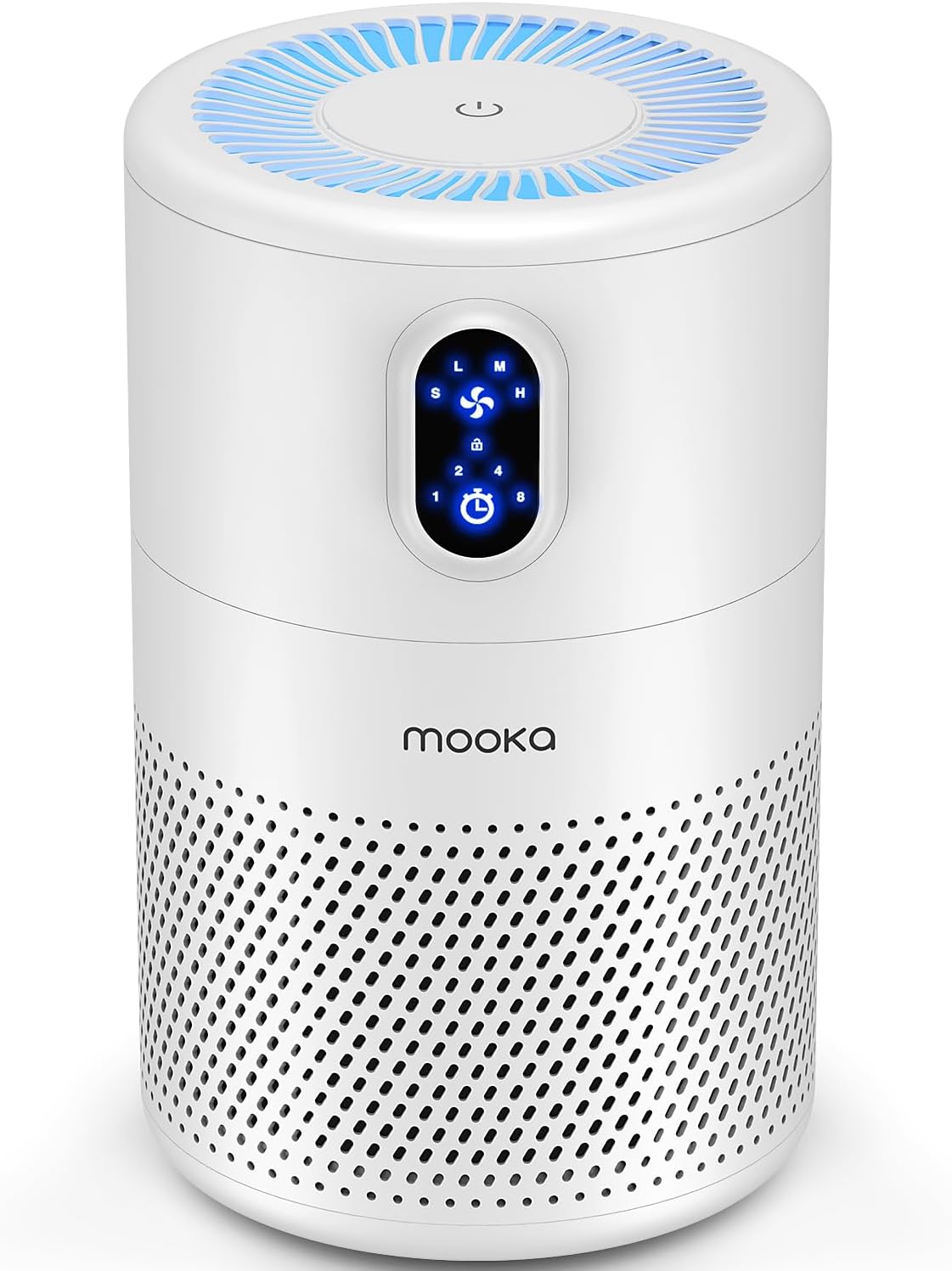
| Effective Area | 1076 sq ft |
|---|---|
| Filter Type | H13 True HEPA + Activated Carbon |
| Fan Modes | Sleep/Low/Med/High |
| Timer Options | 1H/2H/4H/8H |
The MOOKA B-D02L is a portable air purifier built around an H13 true HEPA filter plus an activated carbon stage, intended to tackle smoke, dust, pet dander and household odors across large rooms. It pulls air through a prefilter, HEPA element and carbon layer, and offers four fan speeds, a quiet sleep mode, and 1/2/4/8 hour timer settings for scheduled use. The unit is engineered for low noise and low power draw thanks to a brushless motor, and includes a child lock and a soft night light that can be disabled. Filter life is listed at about 3 to 6 months depending on conditions, and replacement filters are available specifically for this model. Practical buyers will appreciate the simple controls and energy-efficient continuous operation, but expect periodic filter replacements and modest footprint that may limit placement options in very small or cluttered spaces. The purifier is CARB certified for safety in California and is best used in bedrooms, living rooms, or areas where pet odors and particulates are a main concern.
Best for: Buyers who prioritize reliable, energy-efficient odor and particle removal in living spaces and want a simple, quiet unit they can set-and-forget.
Less Ideal for: If you need smart controls, real-time air-quality feedback, or a purifier sized specifically for very small rooms or vehicles, consider other models with those capabilities.
- H13 true HEPA plus activated carbon capture fine particles and common odors
- Covers large areas up to 1076 sq ft with stated air change rates for smaller rooms
- Very quiet low-speed operation for sleep or work environments
- Multiple timers, four fan speeds and a child lock for flexible, safe use
- Replacement filter recommended every 3–6 months which adds ongoing cost
- Lacks advanced features like app control or air quality sensors
Verdict: A straightforward, quiet HEPA-plus-carbon purifier that reliably reduces pet odors and particulates across large rooms for buyers who want efficient, no-frills performance.
Honeyuan H13 HEPA Air Purifier

| Filtration | H13 True HEPA, 3-stage |
|---|---|
| Airflow | 90–120 m³/h |
| Coverage claim | refreshed air in 30 minutes for 1095 sqft |
| Noise level | as low as 24 dB |
The Honeyuan H13 HEPA Air Purifier is a small, portable unit designed to clean air in bedrooms and living spaces using a 3-stage filtration system topped by an H13 True HEPA filter. It pulls air in from all sides and claims to refresh a large room quickly with a CADR-like airflow of 90–120 m³/h, while three fan speeds, sleep mode, and nine timer settings let you tune run time and noise for overnight use. The LCD touch display and filter-replacement reminder make operation straightforward, and the included composite filter handles common household particles, pet dander, and odors that contribute to cat urine smell. Practical downsides are its compact footprint limits strong odor removal in very large or badly soiled rooms, and replacement filters are sold separately by part number. The unit is UL, CE, FCC and CARB compliant and uses a DC motor that accepts 100–240 V, which eases installation and safe use in typical homes.
Best for: Buyers on a tight budget who need an affordable, easy-to-use purifier for bedrooms or small-to-medium rooms that reduces pet dander and common household odors.
Less Ideal for: People dealing with intense or long-term cat urine contamination, large open-plan spaces, or those who need professional-grade odor neutralization should consider higher-CADR or specialized odor control systems instead.
- H13 True HEPA 3-stage filter captures fine particles and pet dander.
- 360° air intake promotes even room circulation from a compact unit.
- Multiple fan speeds, sleep mode, and 9 timers for flexible quiet operation.
- LCD touch display with filter-replacement reminder simplifies use.
- UL, CE, FCC and CARB compliant and runs on wide voltage range (100–240 V).
- Compact size may struggle with heavy or long-standing cat urine odors in large rooms.
- Replacement filter is a separate purchase and requires the specified part number.
Verdict: A budget-friendly, compact HEPA purifier that gives buyers an easy, low-noise way to reduce pet dander and everyday odors in bedrooms and small-to-medium rooms.
DREO Air Purifier 338

| CADR (AHAM Verified) | 115 CFM |
|---|---|
| Filtration | Pre-filter + HEPA + Activated carbon |
| Coverage (1 ACH) | 856 square_feet |
| PM2.5 Sensor | High-precision with LED AQI display |
| Noise Level | As low as 18 dB |
The DREO Air Purifier 338 is a room purifier built around a 3-in-1 filter (pre-filter, true HEPA, activated carbon) and an AHAM-verified CADR of 115 CFM that supports fast air turnover for medium rooms. It uses a 360° spiral intake and TurboPure airflow to boost intake efficiency, while a high-precision PM2.5 sensor and color LED AQI display provide continuous feedback so the unit can run in Auto and adjust fan speeds as needed. Practical controls include Auto, Turbo, Sleep, and Normal modes plus four fan speeds, and HyperSilent motor tech keeps noise down to as low as 18 dB for night use. The activated carbon layer and sizable airflow make it effective at reducing smoke and odors, and the aroma box offers optional scenting. Trade-offs are typical for its size: filtration is strong for particles and many odors but persistent or very strong ammonia-based pet urine may need larger-capacity units or spot cleaning alongside the purifier, and replacement filters are a recurring cost. For everyday odor reduction and continuous monitoring in bedrooms or living spaces the 338 is a dependable, quiet choice.
Best for: Buyers who prioritize dependable, validated air cleaning and want a quiet, automated purifier that monitors air quality and reduces common household odors in bedrooms or living spaces.
Less Ideal for: Homes that need to eliminate very strong or long-standing pet urine sources without addressing the source directly should consider higher-capacity or specialty odor treatment solutions instead.
- AHAM-verified CADR 115 CFM for validated air cleaning performance
- 3-in-1 filter with activated carbon to capture particles and help reduce common odors
- Real-time PM2.5 sensor with LED AQI display for automatic adjustment
- Very quiet operation down to 18 dB suitable for bedroom use
- Multiple modes including Auto and Sleep for hands-off operation
- May struggle to fully eliminate strong ammonia-based cat urine odors on its own
- Replacement HEPA/activated carbon filters required periodically
Verdict: Choose the DREO 338 when you want a reliable, AHAM-verified, quiet purifier that actively monitors air quality and helps reduce everyday pet odors in bedrooms and living rooms.
Levoit Core 300-P Air Purifier

| Filter Type | 3 in 1 Filtration |
|---|---|
| Floor Area | 1073 square_feet |
| Noise Level | 24 db |
| Particle Retention Size | 0.3 micron |
| Wattage | 56 watts |
The Levoit Core 300-P is a small-room air purifier that combines a pre-filter, true HEPA filtration and an activated carbon layer to capture 0.1–0.3 micron particles and reduce odors. It is most often used in bedrooms, living rooms, or offices where pet dander, smoke, pollen and household smells are a concern. Key features include AHAM verification with CADR figures for smoke, dust and pollen, a 56W motor that supports fast air turnover in medium rooms, a low-noise Sleep Mode down to about 24 dB, and a simple touch control panel with timer and filter indicator. In practice the activated carbon portion helps with short-term organic odors like pet smells and mild urine odor, while the HEPA stage removes airborne allergens and fine particulates. Limitations are that it lacks Auto Mode or smart connectivity on this specific SKU, so you must manually adjust fan speed, and carbon capacity is finite so strong or persistent chemical odors will need larger units or dedicated odor-focused systems and more frequent filter replacement. The unit is portable and energy efficient for consistent daily use in occupied rooms.
Best for: Buyers who want a proven, highly rated purifier for bedrooms or small living spaces that removes allergens and helps reduce pet odors and smoke while running quietly and reliably.
Less Ideal for: Homes needing whole-house odor removal or continuous heavy chemical and urine remediation should consider larger-capacity or specialized odor units instead.
- True HEPA-grade filtration capturing 0.1–0.3 micron particles for allergy and smoke removal
- Integrated activated carbon layer to reduce common household and pet odors
- AHAM verified CADR values for measurable cleaning performance
- Very quiet Sleep Mode around 24 dB for night use
- No Auto Mode or Wi‑Fi smart controls on this model so fan speeds must be set manually
- Carbon section will saturate with heavy odors and requires timely filter replacement
Verdict: A compact, AHAM-verified HEPA purifier that quietly removes allergens and helps control pet odors in bedrooms and small rooms.
Levoit Vital 100 Air Purifier

| CADR | 105 CFM |
|---|---|
| Coverage | Cleans up to 788 sq ft/hr |
| Filtration | 3-stage (pre-filter, particle filter, activated carbon) |
| Noise level | As low as 24 dB |
| Timer | 2 / 4 / 8 hours |
The Levoit Vital 100 is a compact tabletop air purifier built around a three-stage filtration system: a washable pre-filter, an efficient particle filter, and an activated carbon layer for odors and VOCs. It is typically placed in bedrooms, living rooms, or kitchens where space is limited and noise matters, and it runs quietly—down to about 24 dB—so it can operate overnight. The unit claims a 105 CFM CADR and is rated to refresh air in a room up to about 788 sq ft once per hour, which makes it effective at reducing airborne dust, pollen, pet dander, smoke, and cooking smells. Practical touches include a timer (2/4/8 hours), a filter-check indicator, and a rear carry handle for moving between rooms. Limitations are that long-term odor removal depends on the carbon filter capacity and timely replacement, and Levoit recommends using genuine replacement filters rather than generic alternatives to maintain performance.
Best for: Buyers who prioritize a proven, quiet purifier with documented cleaning performance and prefer straightforward, low-risk operation in bedrooms or living spaces.
Less Ideal for: People needing an industrial-strength odor solution for large or heavily soiled areas should consider larger commercial units or targeted odor remediation methods instead.
- Three-stage filtration including activated carbon for odors and VOCs
- AHAM-verified CADR figure for measured cleaning performance
- Very quiet operation suitable for bedrooms
- Washable pre-filter reduces hair buildup and extends main filter life
- Timer and filter-check indicator add convenience
- Effectiveness against strong, embedded cat urine odor will depend on carbon filter saturation and replacement frequency
Verdict: A quiet, AHAM-verified compact purifier with carbon filtration that gives risk-averse buyers a reliable, user-friendly option for reducing pet odors in typical home rooms.
Choosing the Right Air Purifier for Cat Urine Odor: Key Factors to Consider
Type of Filtration
An air purifier that addresses cat urine odor needs both particle filtration and gas-phase adsorption. HEPA or true HEPA filters capture dander and urine-related aerosolized particles, which reduces one component of odor transport. However, particles alone do not eliminate the gaseous compounds in fresh urine.
Activated carbon, catalytic media, or specialized VOC adsorbents are required to capture ammonia and other odorous gases. When evaluating models, check the specification for the amount and type of carbon or gas media and whether the manufacturer lists specific gases or VOCs targeted. Units with a dedicated gas-stage are generally more effective at quickly reducing fresh urine smells.
Room Size and CADR
Match an air purifier's rated room coverage or CADR to the space where the odor is concentrated. A unit undersized for the room will cycle stale air slowly and have limited impact on odor levels. Look for CADR numbers or manufacturer coverage guidance and plan for slightly higher capacity in rooms where odor sources are frequent or strong.
Consider how the purifier will be positioned relative to the odor source. Placing the unit in the room with the litter box or the known accident area and ensuring unobstructed airflow will improve effectiveness even if the same model is rated for a slightly smaller space.
Activated Carbon Quantity and Quality
Not all carbon filters are created equal. Performance depends on the volume of carbon, its surface area, and whether it is impregnated or combined with catalytic coatings to target ammonia. Thicker carbon beds and specialized gas media tend to provide longer and stronger odor adsorption.
Manufacturers that specify carbon weight or describe layered gas stages give a better sense of expected odor control. If the unit's carbon section is shallow or only a light coating, expect weaker performance for persistent urine odors and quicker saturation.
Noise Levels and Fan Speeds
Because dealing with pet odors often requires running an air purifier long-term or at night, noise matters. Look for models that offer multiple fan speeds and low-noise or sleep modes that still provide meaningful air changes per hour.
Evaluate noise specifications alongside airflow. Some quiet modes have very low CADR, so confirm the low setting still moves enough air for your room. A balance between tolerable sound and adequate circulation will determine how consistently you can run the unit.
Maintenance and Filter Replacement
Effective odor control requires maintaining the purifier's gas and particle media. Check expected filter life, replacement frequency, and whether replacement filters are easy to access and change. Filter cost and availability are practical considerations for long-term use.
Also consider whether prefilters are washable, which can extend the life of primary filters by trapping hair and large debris. Clear filter-change indicators and straightforward filter ordering information reduce the friction of upkeep, which helps ensure the purifier is kept in optimal condition.
How Air Purifiers Reduce Cat Urine Smell
Air purifiers remove odor through two main mechanisms: capturing particles that carry odor and adsorbing gaseous compounds that produce smell. For cat urine specifically, the gaseous fraction often contains ammonia and small VOCs that typical particle filters cannot remove.
A multi-stage purifier pairs a high-efficiency particle filter with a gas adsorption stage. The particle filter reduces dander and aerosolized material, while the adsorption stage traps odorous molecules on porous media. Over time the gas media will saturate and require replacement to maintain performance.
- Particle filtration reduces transfer of odor-laden dust and dander
- Activated carbon or catalytic media adsorb ammonia and VOCs
- Saturation of gas media reduces odor control until filters are replaced
Placement and Setup Tips for Better Odor Control
Position the purifier near the source of the odor, such as the room with the litter box or where accidents occur most often. Keep at least a foot of clearance around intake and exhaust to avoid restricting airflow.
If the room is large or has multiple odor zones, run the purifier closer to the strong source rather than centrally. For long hallways or open-plan spaces, consider running two units or a higher-capacity model to ensure adequate air changes.
Run the purifier continuously for best results. Short, intermittent use reduces effectiveness because gas adsorption relies on repeated air passes to capture low-concentration compounds.
- Place unit near odor source with unobstructed intake
- Ensure clearance from walls and furniture
- Continuous operation improves cumulative odor removal
Complementary Cleaning Practices
An air purifier helps but does not replace cleaning. Regularly clean or replace soiled litter, wash fabrics exposed to accidents, and treat urine stains at the source. Removing the source reduces the load on the purifier and makes odor removal faster.
Use enzymatic cleaners on affected surfaces to neutralize urine compounds rather than just masking them. Deep-cleaning rugs and upholstery where accidents occurred will prevent persistent off-gassing that undermines purifier performance.
Combine source removal with air cleaning for the best results. Addressing both the airborne and surface reservoirs of odor gives the quickest path to a fresher-smelling home.
- Clean litter boxes frequently and replace litter as recommended
- Treat stains with enzymatic cleaners to neutralize odors
- Wash or dry-clean fabrics that have trapped urine compounds
When to Replace Filters and Media
Filter replacement intervals depend on usage, local air quality, and the severity of odor issues. Heavy or continual exposure to pet odors will shorten the useful life of activated carbon and gas media compared with models used only for dust or pollen.
Watch for reduced airflow, persistent smell despite continuous operation, or the manufacturer's filter-life indicator as signs it is time to change filters. Consider stocking replacement gas-stage filters if you expect ongoing incidents so you can swap them promptly.
If a model uses replaceable carbon sachets or modular media, follow the recommended schedule and inspect media visually for discoloration or saturation when accessible.
- High odor load shortens gas media life
- Use airflow and odor persistence as practical indicators
- Keep replacement filters on hand for continuous control
Managing Expectations: What Purifiers Can and Cannot Do
Air purifiers significantly reduce airborne odor and can lessen the perception of smell in many rooms, but they do not remove urine already soaked deep into porous materials on their own. Embedded odor in carpet padding, mattresses, and some upholstery may require targeted cleaning or replacement.
Purifiers are most effective when used alongside source control and cleaning. For ongoing marking behavior or frequent accidents, address the behavioral or medical causes with your veterinarian or animal behaviorist while using an appropriate air purifier to manage the environment.
- Purifiers reduce airborne odor but cannot extract deeply embedded urine from porous materials
- Combine with cleaning and behavioral solutions for persistent problems
- Expect periodic maintenance to keep odor adsorption effective
How We Chose the Best Air Purifier for Cat Urine Odor
We prioritized devices designed to address both particulate and gaseous odor sources because cat urine creates ammonia and other volatile compounds in addition to odor-carrying particles. Selection focused on measurable filtration technology, rated room coverage, and real-world usability factors that affect long-term odor control. Key evaluation criteria included certified particle filtration performance, presence and type of activated carbon or other gas-phase adsorption media, clean air delivery rate (CADR) relative to stated room size, and maintenance needs such as filter life and replacement ease. We also considered noise at common fan settings and fan speed flexibility since continuous or overnight operation is often necessary for persistent odors. We excluded units lacking a true multi-stage approach to odorous gases (for example, particle-only filters without any gas adsorption) and devices with no published airflow or coverage data. The final choices represent a balance of filtration capability, practical coverage for typical rooms where cat odor occurs, manageable operating noise, and straightforward filter maintenance.
Our full evaluation process is outlined in our review methodology.
FAQ
Will an air purifier remove fresh cat urine smell immediately?
An air purifier with a dedicated gas adsorption stage can begin reducing airborne odor quickly, often within hours, but complete elimination depends on odor intensity and whether the source is still present. Fresh, localized odors respond faster than smells coming from embedded sources.
Is activated carbon necessary for cat urine odor control?
Yes. While particle filtration reduces dander and carrier particles, activated carbon or another gas-phase adsorbent is necessary to capture ammonia and many volatile compounds responsible for urine smell.
How often should I run the purifier to control odor?
For persistent odors run the purifier continuously or at least during daytime and overnight. Continuous operation ensures repeated air changes and maintains lower steady-state concentrations of odorous gases.
Can I rely on an air purifier instead of cleaning up accidents?
No. Purifiers help reduce airborne smell but do not replace cleaning. Treating the source with appropriate cleaners and removing soiled material is essential for long-term odor control.
How do I know when the carbon media is spent?
Signs include a return or persistence of odor despite running the unit, a noticeable reduction in odor adsorption speed, or manufacturer's filter-life indicators. In heavy-use situations, expect to replace gas media more frequently than particle filters.
Final Verdict
When selecting an air purifier for cat urine odor, prioritize models that combine true particle filtration with a substantial gas adsorption stage and a CADR appropriate for the room. Balance noise and fan settings so you can run the unit consistently, and factor in filter replacement logistics and costs for ongoing use. Remember that purifiers work best as part of an approach that includes prompt source cleaning and behavioral or medical steps to reduce future accidents. Focus on filtration type, carbon/media capacity, and coverage to choose confidently for lasting odor reduction.