
Note: This article contains affiliate links. If you click on these links and make a purchase, we may earn a small commission at no extra cost to you. This helps support our research and content. Read our full affiliate disclosure here.
If your kitchen regularly fills with lingering smells from frying, grilling, or heavy spices, an air purifier designed for cooking odors can make a meaningful difference in daily comfort. The right unit reduces visible haze, neutralizes greasy odors, and helps stop smells from migrating through the rest of the home. This guide covers seven shortlisted air purifiers selected specifically for kitchens and cooking-related smells. We evaluate each model on filtration capability, room coverage, and practical factors like noise and maintenance so you can pick the unit that fits your routine and space. Read on to find the purifier that balances odor control with everyday convenience.
Top Picks at a Glance
| Best Overall The best all-around choice for most situations | WINIX 5510 Air Purifier |  |
| Best Quality Built to a higher standard if you want something more solid | Coway Airmega 400 |  |
| Best Value The sweet spot between price and what you get | GermGuardian AC4825E 22" Tower |  |
| Best Budget The cheapest option that still gets the job done reliably | FULMINARE H13 HEPA Air Purifier |  |
| Top Rated A top-rated pick with lots of positive feedback | Levoit Core 300-P |  |
| Most Popular A crowd favorite that many people choose with confidence | Levoit Core Mini-P |  |
| Best Seller A high-volume bestseller chosen again and again | VOOPNU HEPA Air Purifier DH-JH12 |  |
WINIX 5510 Air Purifier

| Item model number | 5510 |
|---|---|
| AHAM verified coverage | 1,882 sq ft in 1 hour |
| Noise (lowest speed) | 23.5 dB |
| Filtration stages | 4-Stage |
| App compatibility | Winix Smart App / WiFi |
The WINIX 5510 is a four-stage tower air purifier built to handle large rooms and persistent indoor odors. It combines a washable pre-filter, True HEPA stage that captures down to 0.01 microns, and an advanced deodorization carbon filter to reduce cooking smells, smoke, and VOCs, plus Winix's PlasmaWave technology for additional airborne impurity control. Built-in air quality sensors and an AQI LED let the unit run in Auto Mode, adjusting fan speed as conditions change, and a light-sensitive Sleep Mode keeps operation quiet at night. The unit is Wi‑Fi enabled and works with the Winix Smart App and voice assistants for remote monitoring and control. Practical benefits include fast coverage for open-plan kitchens or adjacent living areas, visible air quality feedback, and washable pre-filtering to extend filter life. Important limitations are that replacement filters are required over time and the PlasmaWave feature is an additive technology rather than a substitute for filtration, so strong or layered odors may need repeated cycles or higher fan speeds to clear fully.
Best for: Home cooks and households who want a single-unit solution to reduce cooking smells and airborne particles in large or open-plan spaces while keeping control and monitoring simple.
Less Ideal for: People needing an ultra-compact bedroom-only purifier or those who expect instant elimination of very strong, persistent odors without running the unit at higher speeds for extended periods.
- Four-stage filtration including True HEPA for submicron particles
- Activated carbon deodorization filter targeted at VOCs and cooking odors
- Smart sensors with Auto Mode and AQI indicator for hands-off operation
- Wi‑Fi and Winix Smart App compatibility for remote control and scheduling
- Washable pre-filter helps capture large particles and prolongs main filter life
- Requires periodic replacement filters to maintain performance
- PlasmaWave is supplemental and not a replacement for mechanical filtration
Verdict: Choose the WINIX 5510 when you want a smart, large-room purifier with HEPA plus activated carbon that actively reduces cooking odors and monitors air quality.
Coway Airmega 400
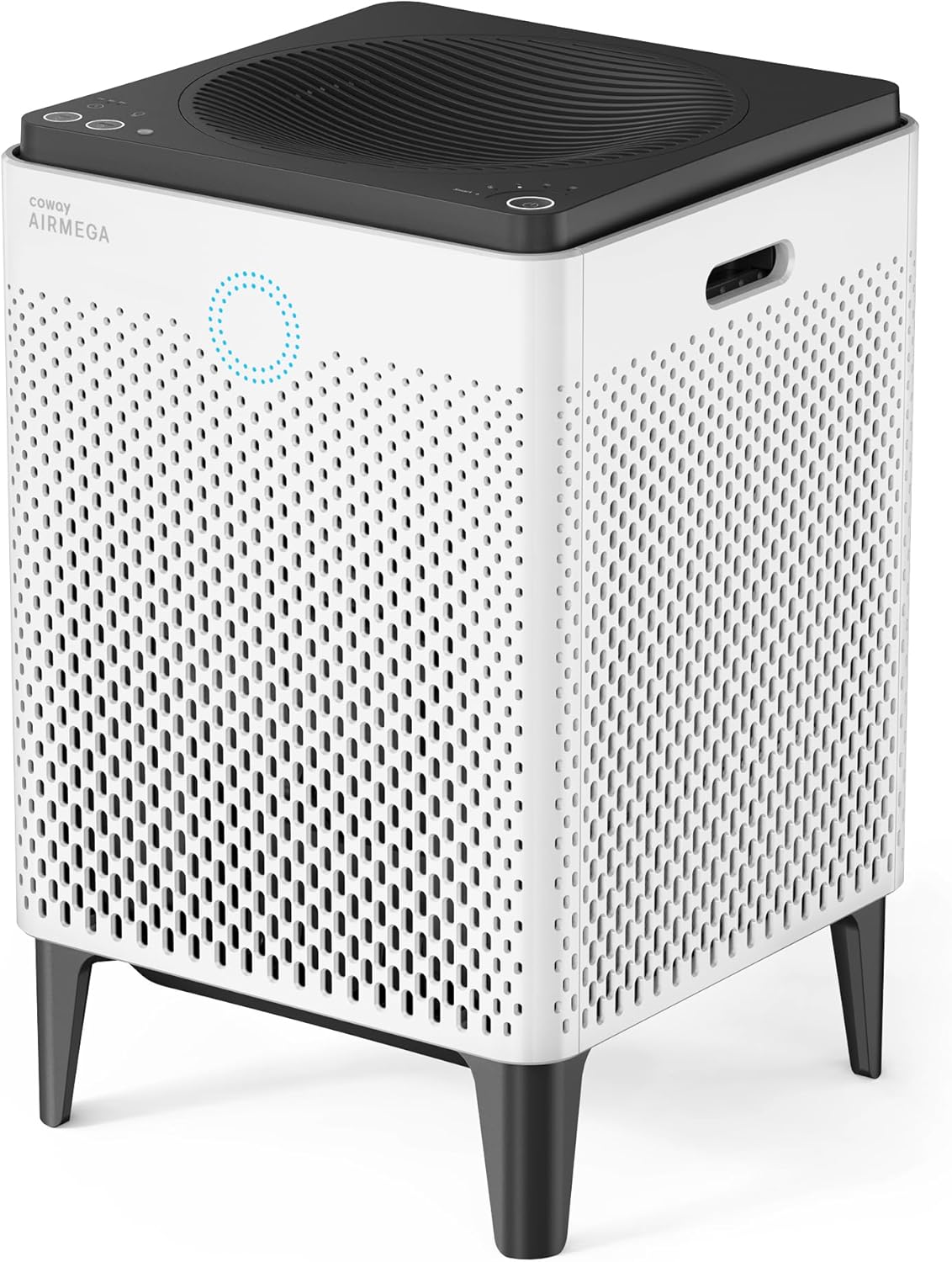
| Floor Area | 3120 square_feet |
|---|---|
| Filter Type | HEPA Filter, Active Carbon Filter, Pre-Filter |
| Particle Retention Size | 0.3 micron |
| Wattage | 66 watts |
| Special Features | Air Quality Monitor, Eco Mode, Filter Life Indicator, Smart Mode, Timer |
The Coway Airmega 400 is a high-capacity air purifier built for large open kitchens and adjoining living areas where cooking odors and airborne particles are a concern. It uses a three-stage HyperCaptive filtration system — pre-filter, activated carbon, and HEPA — to capture 99.97% of 0.3 micron particles while the activated carbon stage targets VOCs and odors from cooking. Smart Mode and an onboard air quality monitor automatically adjust fan speed based on detected pollution, and Eco and Sleep modes reduce noise and power when air remains clean. The unit is Energy Star certified and rated to cover up to 3,120 square feet in an hour, making it practical for homes with large kitchen footprints or open-plan layouts. It is relatively quiet at its low setting but is a substantial, heavier appliance and uses up to 66 watts at peak. Filter replacement and the larger footprint should be expected for continuous heavy-use odor control, but the strong carbon stage and high CADR make it an effective choice for tackling persistent cooking smells and smoke in big spaces.
Best for: Buyers who prioritize fast, high-capacity odor and particle removal in large or open-plan kitchen spaces and want an automatic, hands-off purifier that adapts to changing air quality.
Less Ideal for: Small kitchens, countertop use, or buyers needing a highly portable or compact unit for a single small room should consider smaller, more portable purifiers instead.
- High coverage for large or open kitchens up to 3,120 sq ft in 60 minutes
- Three-stage filtration including activated carbon for VOCs and cooking odors
- Smart Mode with real-time air quality monitoring adjusts performance automatically
- Energy Star certified and designed with Eco and Sleep modes to cut power and noise
- Large and relatively heavy compared with smaller kitchen purifiers
- Higher upfront size and likely higher filter-replacement cost for continuous heavy use
Verdict: For serious kitchen odor control in large or open-plan homes, the Airmega 400 delivers powerful carbon plus HEPA filtration and automatic AQI-driven performance.
GermGuardian AC4825E 22" Tower

| Coverage | 153 sq. ft. (every 12.5 minutes); up to 743 sq. ft. (hourly) |
|---|---|
| Filter type | True HEPA with activated carbon pre-filter |
| Speeds | Three fan speeds with sleep mode |
| Optional feature | UV-C light |
The GermGuardian AC4825E is a compact tower purifier built to reduce common airborne particles and household odors in living spaces. It uses a True HEPA filter to capture 99.97% of allergens down to 0.1 microns, pairs an activated carbon pre-filter to reduce cooking and pet smells, and offers an optional UV-C sanitizer for extra germ control. Three fan speeds including a quiet sleep mode let you run it overnight or boost circulation during and after cooking. The unit is sized to circulate the air of a 153 sq. ft. room every 12.5 minutes and can handle larger spaces up to 743 sq. ft. on a slower cycle, making it flexible for kitchens adjacent to dining areas or open-plan living rooms. Filters and UV bulbs are replaceable with genuine GermGuardian parts, which simplifies maintenance but adds recurring cost. Noise at higher speeds is noticeable compared with ultra-quiet models, and the tower form factor is best placed off counters to avoid splatter in busy kitchens. For routine odor reduction after cooking and general allergen control, it is a practical, proven choice.
Best for: Buyers who want a reliable, compact purifier that combines HEPA filtration and carbon odor reduction for everyday cooking smells and allergen control in kitchens or nearby living areas.
Less Ideal for: People seeking an ultra-quiet purifier for bedroom-only use or those who need a dedicated countertop unit specifically designed to withstand kitchen splatter and grease.
- True HEPA filter captures 99.97% of particles down to 0.1 microns
- Activated carbon pre-filter reduces cooking and pet odors
- Optional UV-C light adds an extra level of airborne germ reduction
- Three fan speeds including a quiet sleep mode for overnight use
- Covers small rooms quickly and can circulate air in larger rooms on a slower cycle
- Higher fan speeds produce noticeable noise compared with very quiet models
- Requires periodic replacement filters and UV bulbs which are additional ongoing costs
Verdict: A practical tower purifier that pairs HEPA filtration with a carbon pre-filter and UV-C option to cut cooking odors and everyday allergens in small to medium home spaces.
FULMINARE H13 HEPA Air Purifier

| Filter type | H13 HEPA |
|---|---|
| Coverage area | Up to 215 ft² / 20 m² |
| Noise level (low) | Around 24 dB |
| Timers | 2-4-8-10-12 hours |
The FULMINARE H13 is a small, budget-oriented air purifier designed for bedrooms and other small rooms where cooking odors, pet dander, and smoke are occasional problems. It uses an H13 true HEPA filter and a 360° air outlet with dual-channel circulation to refresh air up to five times per hour in spaces around 215 ft², which helps reduce lingering kitchen smells when placed near the source or in an adjoining room. Controls include multiple fan speeds, a near-silent sleep mode (reported around 24 dB), a built-in night light, and five timer settings for set-and-forget use. Practical benefits are straightforward: effective particle capture for particulates and improved perceived air freshness, quiet overnight performance, and portability so you can move it to the kitchen after cooking. Limitations are its small-room coverage—it is not suited to large open-plan kitchens or heavy, long-lasting cooking odors—and replacement filters will be needed regularly to keep performance up. The unit requires a plug-in adapter stored under the base and the filter must be unwrapped before use.
Best for: Buyers seeking an inexpensive, easy-to-use purifier to reduce cooking smells and airborne particles in small kitchens, dining nooks, or nearby bedrooms where quiet operation matters.
Less Ideal for: People who need rapid odor removal in large, open kitchens or who want a purifier that covers whole-floor spaces should look at higher-capacity units instead.
- H13 true HEPA filtration for particle and dander capture
- 360° dual-channel outlet provides even room circulation
- Very quiet sleep mode suitable for bedrooms
- Portable and easy to place where odors originate
- Built-in night light and multiple timers for convenience
- Coverage is limited to small rooms (around 215 ft²), so it cannot handle large kitchens or open floor plans
- No battery operation—requires the plug-in adapter stored in the base
Verdict: A low-cost, quiet HEPA purifier that makes a practical short-term solution for reducing cooking odors and particulates in small rooms.
Levoit Core 300-P

| Filter Type | 3 in 1 Filtration |
|---|---|
| Floor Area | 1073 square_feet |
| Noise Level | 24 db |
| Particle Retention Size | 0.3 micron |
| Wattage | 56 watts |
The Levoit Core 300-P is a compact True HEPA air purifier built to clear smoke, dust, pollen, pet dander, and common household odors in living rooms, kitchens, and bedrooms. It uses a three-stage filtration system with a pre-filter, HEPA-grade filter and activated carbon to capture 0.1–0.3 μm particles and reduce odors and VOCs, driven by a 56W motor that provides strong airflow and AHAM-verified CADR performance. Controls are simple touch buttons with a sleep mode that drops noise to around 24 dB and an option to turn the display lights off for nighttime use. Practical benefits include fast room turnover in medium spaces, a portable footprint that moves between rooms, and certified safety listings for home use. Limitations are manual fan speed control only (no auto mode on this model) and the recommendation to use official replacement filters every 6–8 months, which adds ongoing cost; it also lacks smart connectivity found on some newer units. For someone prioritizing reliable filtration and quiet night operation, this model delivers dependable, easy-to-use odor and particle removal.
Best for: Buyers who want a dependable, quietly operating purifier that reliably reduces cooking smells and fine particles in medium to large rooms and value independent certification over smart features.
Less Ideal for: People who need automatic air-quality sensing or app control, or those who want a whole-home integrated solution rather than a portable room unit.
- True HEPA-grade three-stage filter that removes 99.97% of 0.1–0.3 μm particles
- Activated carbon stage targets odors and VOCs common when cooking
- AHAM-verified CADR and certifications provide independent performance validation
- Quiet Sleep Mode with display-off option for undisturbed nighttime use
- No automatic fan-speed or smart connectivity on this model
- Requires official replacement filters every 6–8 months, adding recurring cost
Verdict: A reliable, AHAM-verified HEPA purifier that quietly tackles cooking odors and fine particles in living spaces without fuss.
Levoit Core Mini-P
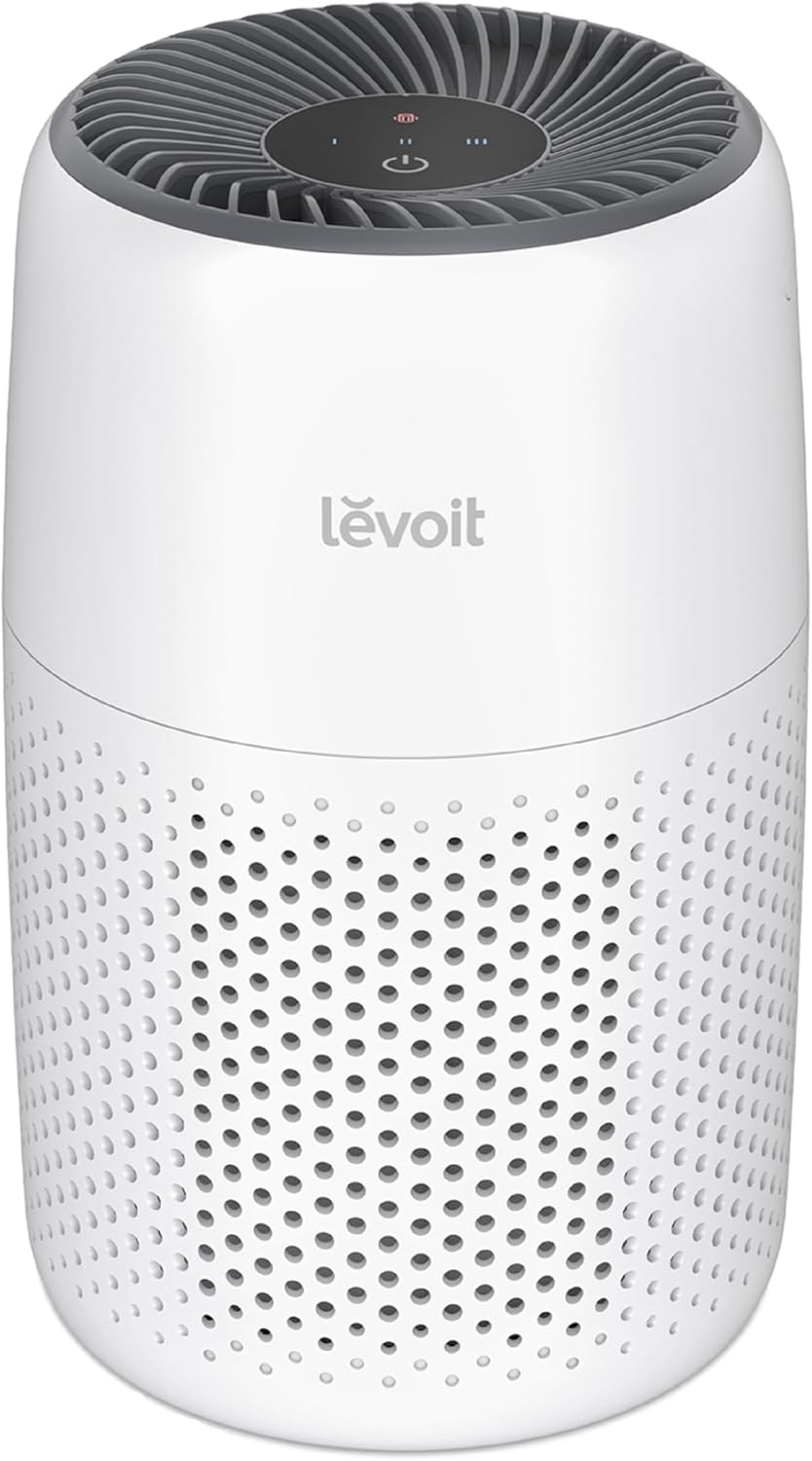
| Rated Power | 7W |
|---|---|
| Noise Level | 27-45dB |
| AHAM Verification | Yes |
The Levoit Core Mini-P is a small, AHAM-verified tabletop purifier intended for personal spaces like kitchens, bedrooms, and desks. It uses a pre-filter plus a main high-efficiency filter to trap lint, pet hair, fine particles and smoke, and the unit also includes a fragrance sponge for light aromatherapy. Rated noise levels (about 27 to 45 dB) and a sleep mode make it unobtrusive during evening use, and the built-in adapter storage keeps the cord tidy on countertops. With a rated power of 7W it is energy efficient and suitable for continuous operation in small rooms where cooking odors or smoke are occasional problems. Limitations are its compact coverage: it is best for localized odor reduction rather than cleaning the air of a whole kitchen or open-plan living area, and the fragrance sponge requires careful dosing to avoid overflow. Filter replacements and the small capacity mean ongoing maintenance compared with larger units, but the Core Mini-P delivers quiet, effective particle removal for close-range odor and smoke control.
Best for: Buyers who want a proven, compact purifier to reduce cooking odors and smoke in a single room or near a cooking area and who prioritize quiet, low-power operation.
Less Ideal for: Households that need whole-kitchen or open-plan odor removal or a unit sized to treat large volumes of air should consider a larger purifier with greater CADR.
- AHAM-verified performance for reliable small-room air cleaning
- Quiet operation with sleep mode for nighttime or low-distraction use
- Compact tabletop size with built-in adapter storage for easy placement
- Includes fragrance sponge for optional aromatherapy
- Small coverage area unsuitable for cleaning large or open kitchens
- Requires periodic filter replacements and careful use of oils to avoid damage
Verdict: A compact, AHAM-verified purifier that quietly tackles localized cooking odors and smoke at low power, making it a smart choice for countertop or small-room use.
VOOPNU HEPA Air Purifier DH-JH12

| Model | DH-JH12 |
|---|---|
| Filtration | H13 True HEPA triple-layer |
| Coverage (claimed) | Up to 1,076 ft² |
| Noise level | 22 dB (low) |
The VOOPNU DH-JH12 is a small, easy-to-use air purifier built around an H13 true HEPA triple-layer filter and 360 degree intake that the brand says captures 99.97% of airborne particles. It is meant for continuous operation and is suited to living rooms, kitchens, or bedrooms where odors, pet dander, pollen, and smoke are concerns. The unit offers three fan speeds, a timer, a washable pre-filter option in some bundles, and an essential oil tray if you want light scenting while it runs. Its manufacturer-stated coverage is up to 1,076 ft² with a lab claim of cleaning 250 ft² every 15 minutes, and the purifier is certified to a range of safety and emissions standards. Practical advantages are its quiet low-speed operation down to 22 dB and simple controls that make it low-friction for daily use. Buyers should note its compact footprint implies modest airflow compared with larger tower models, and replacement filters are part of ongoing ownership cost and maintenance to keep odor removal effective over time.
Best for: A cautious buyer who wants a certified, easy-to-operate purifier to reduce cooking odors and airborne particles in medium rooms without complicated setup or constant monitoring.
Less Ideal for: Not the best choice for those needing industrial-strength ventilation for very large open-plan kitchens or heavy, persistent odors where commercial-grade machines are required.
- H13 true HEPA triple-layer filtration captures fine particles and allergens
- 360 degree intake for more uniform room air circulation
- Quiet operation down to 22 dB for use during sleep or while cooking nearby
- Simple control panel and timer make daily use straightforward
- Essential oil tray adds optional light fragrance while running
- Compact unit means lower maximum airflow than larger purifiers for very large open kitchens
- Effectiveness against strong, persistent cooking odors depends on running the unit continuously and fresh filters
Verdict: Choose the VOOPNU DH-JH12 if you want a compact, certified HEPA purifier that quietly reduces cooking odors and airborne particles in medium-sized rooms with minimal fuss.
Choosing the Right Air Purifier for Cooking Odors: Key Factors to Consider
Type and Amount of Odor Media
Activated carbon is the primary material that adsorbs cooking odors, volatile organic compounds, and smoke by trapping odor molecules on its porous surface. The amount, pore size distribution, and whether the carbon is impregnated with additional chemicals determine how effectively it removes greasy, sulfurous, or smoky smells common to kitchen cooking.
When evaluating air purifiers for cooking odors, look for units with thick carbon layers or multi-stage odor cartridges. Thin or lightly coated carbon layers will struggle with heavy or persistent kitchen smells and will saturate faster, increasing replacement frequency and ongoing cost.
Particle Filtration Efficiency
Cooking produces ultrafine particles from oil mists, smoke, and char that contribute to visible haze and can carry odor compounds. A true HEPA or equivalent high-efficiency particulate filter captures these tiny aerosols, reducing visible smoke and removing carriers that hold odor molecules.
Good particulate filtration also protects the purifier's odor media from rapid fouling by grease-laden particles, prolonging overall performance. Check stated HEPA class and any independent test data where available.
Room Size and Airflow (CADR)
An air purifier must move enough air to meaningfully change kitchen air between cooking events. CADR or manufacturer-recommended room coverage gives a practical sense of how quickly a unit can reduce odors after a particularly smelly meal.
Kitchens often have open floor plans and higher activity, so choose a purifier whose coverage exceeds the actual kitchen footprint, or plan to run the unit at higher speeds for short bursts while cooking to maintain air quality.
Noise and Run Modes
Cooking sessions are intermittent and may require higher fan speeds to rapidly clear odors. High airflow often means more fan noise, which can be distracting if you spend time in an adjacent living area or like to chat while cooking.
Look for purifiers with multiple speed settings, quiet or sleep modes for background operation, and a turbo or boost mode for immediate post-cook clearing. Consider how often you will run boost mode versus low steady-state operation when balancing noise acceptance against odor control needs.
Maintenance and Filter Replacement
Regular maintenance affects running cost and long-term performance. Filters that are easy to access and replace reduce the hassle of upkeep, while clear filter life indicators prevent running saturated media that no longer removes odors.
Also consider the long-term availability and cost of replacement carbon and HEPA filters. Units with proprietary or uncommon cartridges may be more expensive to maintain, so factor replacement cadence and cost into total ownership.
Placement and Installation Considerations
Where you place an air purifier in relation to your cooktop, range hood, and room layout influences how well it intercepts odors. Placing a purifier upwind of typical cooking fumes and away from direct splatter will keep filters cleaner and improve efficiency.
Consider whether the unit is freestanding or wall-mountable, the length of any power cord, and whether you need a tabletop model for small kitchens. Think about airflow patterns in open-plan homes because odors can migrate quickly into living spaces.
How Cooking Odors Differ From Other Household Smells
Cooking odors often combine particulate smoke, oil aerosols, and volatile organic compounds in a way that is distinct from pet or bathroom smells. Grease and oil droplets can carry odor compounds that resist light filtration, so successful removal typically requires both particulate capture and dedicated odor adsorption.
This mix means a purifier effective against general odors may underperform in a kitchen unless it has sufficient carbon-based media and a HEPA stage to trap carriers. Understanding that combination helps explain why some filters that work well elsewhere fall short near a busy cooktop.
- Cooking odors include particulate and gaseous components.
- Oil-laden particles can foul filters faster than dry aerosols.
- Targeted odor media plus HEPA gives the best kitchen results.
Practical Placement Tips for Kitchens
Position the purifier where it can intercept rising smoke and aerosol plumes without being exposed to direct splatter or heat. A unit set on a counter or island a few feet from the cooktop, or on the floor near the kitchen perimeter, will often perform better than one tucked under cabinets or behind obstacles.
If you have an effective range hood, place the purifier so it complements the hood by catching odors that escape into the room. Avoid locations directly next to a steam source or an open window that could dilute its intake and reduce efficiency.
- Keep the intake unobstructed and away from grease splatter.
- Use short high-speed bursts while cooking for rapid clearing.
- Avoid placing the unit where it will draw in steam or direct heat.
When to Run Your Purifier and What Settings Work Best
For kitchens, run the purifier on a low steady setting during normal use and switch to a higher boost setting during and immediately after cooking. This approach balances quiet background filtration with the higher airflow needed to clear odors quickly after a particularly smelly meal.
Running a purifier for 15 to 30 minutes after cooking usually suffices to remove transient odors, but heavily smoky events may require longer or repeated boosts. Using timer functions or smart scheduling can automate this process so you do not need to remember to increase and decrease fan speeds.
- Low steady mode for background air quality.
- Boost mode during and after cooking for fast clearing.
- Use timers or automation to manage post-cook cycles.
Cleaning and Protecting Filters in Kitchen Environments
Grease and oil can accumulate on pre-filters and outer surfaces, so inspect and clean pre-filters frequently according to the manufacturer's guidance. Wiping accessible surfaces and pre-filters will prolong the life of inner HEPA and carbon stages.
Avoid using harsh chemicals or soaking internal filters in liquids unless specified. If your purifier has washable pre-filters, make a habit of rinsing and drying them weekly under heavy cooking conditions to keep airflow steady and minimize odor breakthrough.
- Clean or wash pre-filters regularly to reduce grease buildup.
- Replace inner filters when indicators show reduced performance.
- Avoid exposing units to direct spatters or open flames.
Smart Features and Controls That Help in the Kitchen
Automatic air-sensing modes can be helpful if they accurately detect odors or particulate spikes from cooking. Some units adjust fan speeds based on particle sensors, which is useful for smoke or char events but less reliable for purely gaseous odors unless a VOC sensor is present.
Remote control, app scheduling, and voice assistant integrations add convenience for adjusting settings mid-cook without touching controls with greasy hands. Choose features that match how you cook and how much automation you want.
- Particle sensors help with smoke detection; VOC sensors detect gaseous odors.
- Remote and app controls reduce the need to touch the unit during cooking.
- Look for clear filter-life indicators to avoid running saturated filters.
How We Chose the Best Air Purifier for Cooking Odors
We prioritized measurable filtration features and real-world kitchen fit when selecting these air purifiers for cooking odors. Key evaluation criteria included the presence and quality of activated carbon or odor-targeting media, HEPA or particulate filtration efficiency to capture smoke and grease aerosols, and stated room coverage expressed as recommended square footage. We also weighed airflow and clean air delivery rate (CADR) where available to judge how quickly a unit can cycle kitchen air after cooking. Practical usability factors shaped the shortlist as well: noise at typical running speeds, ease of filter replacement, and accessible controls for intermittent cooking-related bursts. Durability and straightforward maintenance were important because kitchen environments expose units to grease and humidity. We excluded units that lack dedicated odor-adsorbing media or that are clearly undersized for an average kitchen. Final selections emphasize balanced performance across odor removal, particulate capture, and daily convenience.
Our full evaluation process is outlined in our review methodology.
FAQ
Can an air purifier remove grease smells from frying?
Often it can reduce grease-related odors, but effectiveness depends on the purifier's activated carbon capacity and whether a HEPA stage is present to capture oil aerosols. Strong or prolonged frying may require repeated high-speed cycles and more frequent filter changes.
Do I need a purifier if I have a range hood?
A range hood is the first line of defense because it captures fumes at the source, but a purifier can help with residual smells that escape into the room or in kitchens without ducted ventilation. Use both together for best results.
How often should I replace filters in a kitchen setting?
Replacement frequency depends on cooking frequency and the amount of oil and smoke produced. In heavy-use kitchens, pre-filters may need cleaning or replacement monthly and inner carbon or HEPA filters every 6 to 12 months, depending on manufacturer guidance and observed performance.
Will a purifier remove gas stove odors or natural gas leaks?
Air purifiers target particulates and many VOCs but are not a substitute for gas leak detection. If you smell a gas leak, follow safety protocols and contact appropriate emergency services or a qualified technician rather than relying on a purifier.
Are VOC sensors useful for cooking odors?
VOC sensors can detect certain gaseous compounds emitted during cooking and help the unit switch to higher fan speeds when needed. They are a useful complement to particle sensors, especially for non-smoky but strong cooking smells.
Final Verdict
Prioritize units that combine substantive activated carbon media with reliable particulate filtration and sufficient airflow for your kitchen size. Expect tradeoffs between noise and rapid odor removal, and factor filter replacement frequency into ongoing cost estimates. By matching coverage, odor adsorption capacity, and maintenance needs to your cooking habits, you can select an air purifier that meaningfully reduces lingering smells and keeps kitchen air comfortable.