
Note: This article contains affiliate links. If you click on these links and make a purchase, we may earn a small commission at no extra cost to you. This helps support our research and content. Read our full affiliate disclosure here.
Dust builds up fast in homes and can aggravate allergies, worsen indoor air quality, and leave deposits on surfaces. Picking the right air purifier for dust removal matters because not all units capture the same particle sizes or cover the same room areas. This guide presents seven shortlisted air purifiers chosen for their ability to remove dust and common allergens, with attention to filtration efficiency, room coverage, and ongoing maintenance. Read on to see how we evaluated each option and which features matter most for dust control in living rooms, bedrooms, and open-plan spaces.
Top Picks at a Glance
| Best Overall The best all-around choice for most situations | Coway Mighty AP-1512HH |  |
| Best Quality Built to a higher standard if you want something more solid | Winix 5510 Air Purifier |  |
| Best Value The sweet spot between price and what you get | MOOKA KJ190H Air Purifier |  |
| Best Budget The cheapest option that still gets the job done reliably | VOOPNU H13 HEPA Air Purifier DH-JH12 |  |
| Top Rated A top-rated pick with lots of positive feedback | DREO Air Purifier 338 |  |
| Most Popular A crowd favorite that many people choose with confidence | Levoit Core 300-P Air Purifier |  |
| Best Seller A high-volume bestseller chosen again and again | Levoit Core 200S-P |  |
Coway Mighty AP-1512HH

| Coverage | Up to 1,748 sq. ft. in 60 minutes |
|---|---|
| HEPA effectiveness | 99.97% of 0.3μm particles |
| Filtration stages | Washable pre-filter, deodorization filter, Bipolar device, HEPA |
| Air quality indicator | Built-in pollution sensor with LED |
The Coway Mighty AP-1512HH is a compact HEPA air purifier built for continuous home use and strong particulate removal. It pulls air through a washable pre-filter, deodorization stage and a true HEPA filter rated to capture 99.97% of 0.3 micron particles, which makes it effective against dust, pollen and pet dander. An onboard pollution sensor and colored LED give a clear, minute-by-minute air quality readout while Auto mode adjusts fan speed to match conditions, and Eco mode reduces power when air is clean. The unit is practical for bedrooms and living rooms since the pre-filter is washable and a filter indicator reminds you when replacements are needed. It can cover large rooms quickly but is a freestanding tabletop unit and will need regular filter changes to maintain peak performance. Noise at higher fan speeds is noticeable compared with whisper-quiet models, and its design is focused on air cleaning rather than integrated smart-home control.
Best for: Buyers who want a dependable, sensor-driven purifier that prioritizes particle and dust removal in medium to large rooms and prefer a straightforward, appliance-style device.
Less Ideal for: Users looking for whisper-quiet operation for noise-sensitive bedrooms or those who require app control and smart-home integration.
- True HEPA filtration captures 99.97% of 0.3 micron particles for effective dust removal
- Auto mode with real-time air quality sensor adjusts fan speed automatically
- Washable pre-filter reduces larger debris and cuts maintenance cost
- Filter indicator and timer make upkeep and scheduled use straightforward
- Higher fan speeds produce noticeable noise compared with ultra-quiet competitors
- No built-in Wi-Fi or smart-home integration for remote control
Verdict: Choose the Coway Mighty AP-1512HH when you need a practical, sensor-driven HEPA purifier that reliably removes dust and allergens from medium to large rooms.
Winix 5510 Air Purifier

| Model | 5510 |
|---|---|
| Filtration | 4-Stage (Pre-filter, True HEPA, Carbon, PlasmaWave) |
| AHAM Verified Coverage | 1,882 sq ft/hr |
| Noise (low speed) | 23.5 dB |
| Smart features | WiFi, Winix Smart App, Alexa/Google |
The Winix 5510 uses a four-stage filtration system—washable pre-filter, True HEPA filter, advanced carbon odor filter, and PlasmaWave technology—to remove fine particles, allergens, smoke, and common household odors. It is built for large rooms and is AHAM verified for fast coverage; built-in smart sensors and an LED air quality indicator let the unit run in Auto Mode and adjust fan speeds without intervention. The purifier is also app-compatible for remote monitoring and supports automated Sleep Mode that drops noise levels when the room darkens. Practical benefits include strong particle removal down to submicron sizes, reduced VOCs from the carbon stage, and lower maintenance effort thanks to a washable pre-filter and filter replacement indicator. Expect near-silent operation on low speeds but noticeably louder airflow on higher fan settings needed for rapid cleaning. Replacement HEPA and carbon filters are required over time, and PlasmaWave adds active ionization-style cleaning that some buyers may prefer to disable if they avoid active technologies.
Best for: Buyers who prioritize fast, high-performance particle removal in large rooms and want smart monitoring and automatic adjustment to keep air quality low-maintenance.
Less Ideal for: People who need an ultra-quiet unit at all times for very small bedrooms or those who prefer strictly passive filtration without active PlasmaWave technology.
- Four-stage filtration including True HEPA for submicron particle capture
- Advanced odor-control carbon filter to reduce VOCs and smells
- Smart sensors with Auto Mode and LED air quality indicator for hands-off operation
- Winix Smart App compatibility for remote control and monitoring
- Washable pre-filter and filter replacement indicator simplify upkeep
- Higher fan speeds can be noticeably loud compared with lowest setting
- Requires periodic replacement HEPA/carbon filters to maintain performance
Verdict: Choose the Winix 5510 if you need a smart, high-performance HEPA purifier that quickly clears dust and odors from large rooms.
MOOKA KJ190H Air Purifier

| Item model number | KJ190H |
|---|---|
| HEPA Filter | H13 HEPA |
| Pre Filter | Washable |
| Filter Lifespan | 6-12 months |
The MOOKA KJ190H is a home air purifier built to remove dust, pet dander, smoke, and odors in medium to large open spaces using a three-stage system with an H13 True HEPA and activated carbon layer plus a washable pre-filter. It is typically used running 24/7 in living rooms or bedrooms where continuous particle removal and low noise matter; the built-in PM2.5 sensor and auto mode let the fan speed adjust automatically to changing air quality. Notable features include a wide dual-side and front air intake for better capture of pet hair, a digital AQI display, timer options, sleep mode rated at about 20 dB, and an aroma pad for light scenting. The washable pre-filter reduces replacement frequency and helps extend HEPA life, while the filter reminder flags service after about 2000 hours. Trade-offs are that large coverage claims should be matched to room layout for best results and replacement HEPA cartridges are still required periodically despite the reusable pre-filter.
Best for: Buyers who prioritize steady dust and pet dander removal with low operating noise and want a unit that adapts fan speed automatically to changing air quality.
Less Ideal for: People needing an industrial-grade solution for extremely large or heavily polluted spaces should look at higher-capacity commercial units instead.
- H13 True HEPA plus activated carbon removes fine dust, pet dander, and odors
- Washable pre-filter lowers consumable costs and extends HEPA life
- Built-in PM2.5 sensor with auto mode adapts fan speed to current air quality
- Very quiet sleep mode (~20 dB) suitable for bedrooms and light sleepers
- Coverage figures depend on room layout and placement, so actual large-room performance can vary
- HEPA filter still needs regular replacement despite washable pre-filter
Verdict: A practical, quiet H13 HEPA purifier with a washable pre-filter and smart auto mode that makes ongoing dust and pet-dander maintenance simpler and cheaper.
VOOPNU H13 HEPA Air Purifier DH-JH12

| Coverage | Up to 1,076 ft² |
|---|---|
| Filtration | H13 True HEPA |
| Noise level | 22 dB (low) |
The VOOPNU DH-JH12 is a small, easy-to-use air purifier built around an H13 True HEPA multi-layer filter and 360 degree intake to capture fine particles, pollen, pet hair, smoke, and odors. Controls are simplified to one-tap operation with three fan speeds and a timer, so it is straightforward to run continuously or only when needed. Laboratory-style CADR claims state it cleans 250 ft² every 15 minutes, covering roughly 1,076 ft² per hour, and it operates quietly down to about 22 dB for bedroom or office use. The unit also includes an essential oil tray and a washable pre-filter on some configurations, and it carries a range of safety and emissions certifications. Practical limits are its compact physical size and lightweight construction, which make it easy to move but suggest less raw airflow than larger tower purifiers; replacement filters and recommended continuous operation add ongoing maintenance needs. For dust-heavy rooms you may need to run higher fan speeds or pair it with regular cleaning to get the fastest results.
Best for: Buyers on a budget who want an affordable, plug-and-play purifier for bedrooms, home offices, or medium rooms where dust, pollen, and pet dander are the main concerns.
Less Ideal for: Large open-plan homes or heavily dusty workshops where a higher-capacity commercial or larger tower purifier is required.
- H13 True HEPA filtration captures 99.97% of fine airborne particles
- 360° surround intake improves room-wide air circulation
- Quiet operation down to 22 dB suitable for bedrooms
- Simple one-touch controls with three speeds and timer
- Certified to DOE, ETL, FCC, CARB, CE and ROHS standards
- Compact form means lower absolute airflow than larger purifiers for very large or heavily dusty spaces
- Continuous use recommended for best results, increasing filter replacement frequency
Verdict: A budget-friendly, quiet HEPA purifier that delivers effective dust and allergen removal for bedrooms and medium rooms.
DREO Air Purifier 338

| CADR | 115 CFM |
|---|---|
| Coverage (single ACH) | 856 square_feet |
| Filtration | Pre-filter + HEPA + Activated carbon |
| PM2.5 sensor | High-precision with LED AQI display |
| Noise | 18 dB (lowest setting) |
The DREO Air Purifier 338 is a room-focused HEPA purifier designed to remove dust, pollen, smoke, and PM2.5 particles using a 3-in-1 filter (pre-filter, HEPA, activated carbon) and a 360° spiral airflow intake. It is AHAM verified with a 115 CFM CADR and claims fast circulation for typical bedrooms and living spaces, while the PM2.5 sensor and four-color LED AQI display let you watch air quality change in real time. Operation offers Auto, Turbo, Sleep, and Normal modes with four fan speeds so it can ramp up when dust or smoke appears and run quietly at night as low as 18 dB. The unit also includes an aroma box for scent pads and an energy-efficient design certified to use about 125 kWh per year. Practical limits are its room coverage claims versus ACH assumptions and the cost and periodic replacement of the multi-stage filter; buyers should size the unit to their space for the advertised performance. For everyday dust reduction in bedrooms and medium rooms, it is a dependable, quiet option with clear air-quality feedback.
Best for: Buyers who prioritize a reliable, validated air-cleaning appliance that monitors particulate levels and runs quietly for daily dust and allergen control in bedrooms and common rooms.
Less Ideal for: Large open-plan homes or whole-house purification needs where higher CADR or multiple units would be necessary.
- AHAM verified CADR of 115 CFM for validated particle removal performance
- 3-in-1 filter captures up to 99.97% of particles down to 0.3 μm including dust and PM2.5
- Real-time PM2.5 sensor with LED AQI display provides immediate feedback on air quality
- Multiple modes and four fan speeds including an 18 dB sleep setting for quiet overnight use
- Filter replacements are required periodically which adds ongoing cost
- Coverage claims depend on air change assumptions so performance varies by room layout
Verdict: Choose the DREO 338 if you want a quietly operating, AHAM-verified HEPA purifier with real-time particle monitoring for dependable dust and PM2.5 removal in bedrooms and medium rooms.
Levoit Core 300-P Air Purifier

| Floor Area | 1073 square_feet |
|---|---|
| Noise Level | 24 db |
| Particle Retention Size | 0.3 micron |
| Wattage | 56 watts |
| Filter Type | 3 in 1 Filtration |
The Levoit Core 300-P is a small, user-friendly air purifier built around a three-stage filter that captures 99.97% of particles down to 0.1–0.3 microns, which makes it effective against dust, pollen, pet dander, smoke, and some VOCs. It uses a 56W motor with a CADR rated for fast cleaning in typical bedroom or office spaces and offers a very quiet Sleep Mode at about 24 dB for overnight use. Controls are touch-based and the unit includes a timer and a filter check indicator, while certification from AHAM, CARB, and ETL speaks to verified performance and safety. In practice this model is portable and straightforward to set up: place it in an open area, run on a medium or high fan to clear dust quickly, and switch to Sleep Mode at night to maintain background cleaning. Limitations include manual-only fan control on this model (no Auto Mode) and the need to replace factory filters every 6–8 months for best results, which adds ongoing cost. The Core 300-P is a solid choice when you want proven HEPA-level dust removal in a compact, quiet package.
Best for: Buyers who prioritize proven filtration performance and quiet overnight operation and who want a compact, easy-to-use purifier with independent certification and strong social proof.
Less Ideal for: People who need automatic air-quality sensing, smart/home integration, or a purifier sized for very large open-plan homes should consider other options.
- HEPA-grade 3-in-1 filter captures 99.97% of 0.1–0.3 micron particles for effective dust and allergen removal
- AHAM verified CADR and multiple safety certifications provide independently tested performance and compliance
- Very quiet Sleep Mode (~24 dB) suitable for bedrooms and overnight operation
- Compact and portable design is easy to place in small to medium rooms and move between spaces
- Touch controls with timer and filter indicator make daily use simple and low-friction
- Does not include Auto Mode or smart connectivity on this model, so fan speed must be adjusted manually
- Replacement filter schedule (6–8 months) creates recurring maintenance cost
Verdict: Choose the Core 300-P when you want a compact, AHAM-verified HEPA purifier that reliably removes dust and allergens while running nearly silently at night.
Levoit Core 200S-P
| Model | Core 200S |
|---|---|
| Filtration | 3-stage (pre-filter, activated carbon, HEPA-grade) |
| AHAM Verified Area | 140 ft² |
| Noise level | As low as 27 dB |
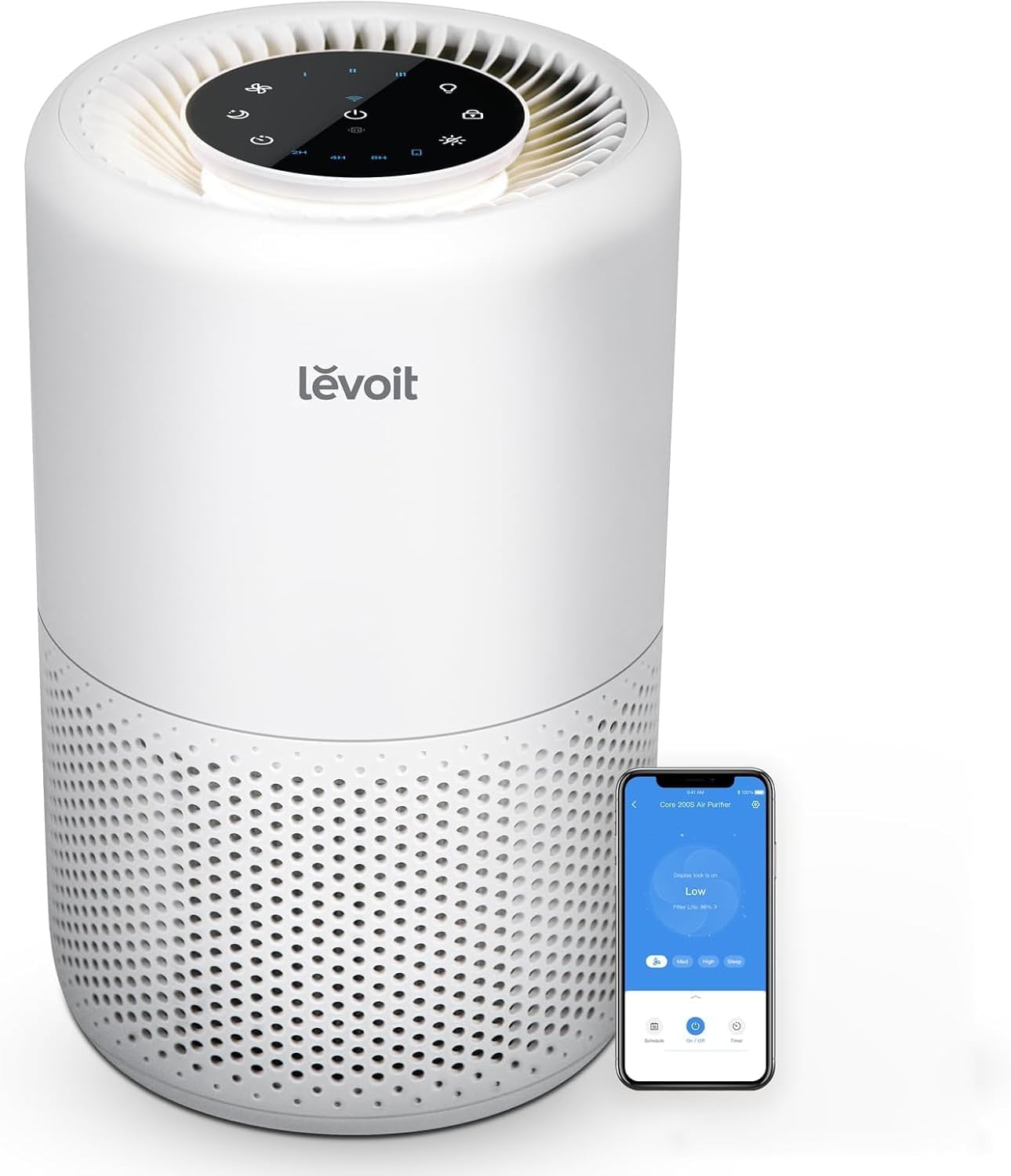
The Levoit Core 200S-P is a small-room air purifier designed to reduce dust, pollen, pet dander, smoke, and common household odors using a three-stage filtration stack and 360 degree air intake. It uses a nylon pre-filter and activated carbon stage to catch larger particles and absorb smells while a high-efficiency main filter captures particles down to 0.1–0.3 microns at 99.97% efficiency, making it effective for dust removal in bedrooms, nurseries, and apartments. The unit is AHAM-verified for room turnover and can refresh air in roughly a 140 ft² room multiple times per hour, and it supports smart and voice controls plus a sleep mode that runs quietly at about 27 dB for overnight use. Practical benefits include easy placement thanks to its compact footprint, simple filter replacement tracking via the app, and a low-noise profile for continuous operation. Limitations are its small coverage area, so larger rooms will require multiple units or a more powerful model, and ongoing cost of replacement filters if run continuously.
Best for: Buyers who prioritize reliable, tested dust removal in bedrooms or small living spaces and want a quiet, smart-capable purifier they can run overnight.
Less Ideal for: People needing whole-room or whole-apartment coverage or the fastest clearance in large open-plan living areas should consider higher-capacity units instead.
- Three-stage filtration including a HEPA-grade main filter that captures 99.97% of 0.1–0.3 micron particles
- AHAM-verified performance suitable for refreshing air in rooms around 140 ft²
- Smart and voice control with app-based filter life monitoring
- Very quiet operation down to approximately 27 dB for night use
- Designed for small rooms so single unit is insufficient for larger open spaces
- Requires periodic replacement filters, adding to long-term operating cost
Verdict: A compact, AHAM-verified purifier that quietly and reliably removes dust and fine particles in small rooms while offering smart controls.
Choosing the Right Air Purifier for Dust Removal: Key Factors to Consider
Filtration Technology
The type of filter determines what fraction of airborne dust an air purifier will remove. True HEPA filters capture at least 99.97% of particles down to 0.3 microns, which covers most common indoor dust, pet dander, and some pollen. Activated carbon is useful for odors and some volatile compounds but does not remove particulates.
When evaluating technology, consider whether the unit uses pre-filters to trap larger particles and prolong the life of the HEPA element. Multi-stage systems tend to perform better over time because each stage targets a different contaminant class, reducing load on the main particulate filter.
Room Size and CADR Ratings
Clean Air Delivery Rate, or CADR, links a purifier's airflow and filtration efficiency to a room size it can effectively service. Higher CADR numbers indicate faster removal of dust in a given space. Match the CADR to your actual room square footage and ceiling height; manufacturers often provide recommended room sizes based on standard ceiling heights.
Undersizing a purifier will result in slow dust removal and more runtime to reach acceptable air quality. Oversizing primarily increases upfront cost and may increase noise at higher fan speeds, so balance capacity with typical room usage.
Noise and Daytime Vs Nighttime Use
Airflow and fan speed dictate noise output. A unit that performs well at its highest setting may be too loud for bedroom or study use, so check rated decibel levels and whether the purifier has a low-noise or night mode.
Consider how often the purifier will run at higher speeds. Continuous low-to-medium operation often gives the best balance of dust reduction and tolerable sound. Some purifiers reduce fan speed automatically based on sensors; this can help maintain quiet operation while still addressing peaks in dust or activity.
Maintenance Requirements and Filter Costs
Regular maintenance keeps a purifier effective at catching dust. This includes replacing HEPA and carbon filters on the schedule recommended by the manufacturer and cleaning pre-filters. Filter replacement intervals vary widely depending on use patterns and indoor dust loads.
Factor filter replacement cost and availability into your long-term budget. Units with washable pre-filters can lower consumable costs, but the core particulate filter typically needs periodic replacement. Ease of access to the filters and clear replacement indicators improve ownership experience.
Siting and Airflow Placement
Where you place the purifier affects how quickly it reduces dust. Place units away from obstructions and allow clearance around intake and outlet vents for proper circulation. In open-plan homes, place the purifier centrally in the area you want cleaned, or use multiple smaller units for zonal coverage.
Avoid putting purifiers directly against walls, inside cabinets, or behind furniture, as restricted airflow reduces effective CADR. For bedrooms, place the unit near typical dust sources such as windows, vents, or upholstered furniture for best results.
Energy Use and Runtime Patterns
A purifier that runs continuously will accumulate energy costs over time. Check wattage at various fan speeds, and whether the unit has an efficient eco or automatic mode that scales fan speed to measured air quality.
If you plan to run the purifier 24/7, choose an energy-efficient model or look for Energy Star-style performance cues. Short bursts at high speed clear heavy dust quickly but increase power draw, while continuous low-speed operation is more energy efficient for background dust control.
How Dust Moves Indoors
Dust is a mix of skin cells, fibers, pollen, and fine mineral particles that stays suspended for long periods or settles onto surfaces. Everyday activities like walking, vacuuming, and laundry disturb settled dust and reintroduce particles into the air. Understanding the dynamics helps you decide how powerful a purifier you need and where to place it.
- Heavy foot traffic and pets increase airborne dust.
- Ventilation and HVAC filtering change how dust redistributes.
- Activities like making beds or changing clothes release bursts of particles.
Sizing a Purifier to Your Room
Calculate the square footage of the treatment area and compare it to the purifier's CADR and recommended room size. If you have higher ceilings, adjust your effective room volume upward when matching capacity. For open-plan rooms, either choose a higher-capacity unit or use multiple purifiers in different zones.
- Match CADR to room area and ceiling height.
- Consider multiple units for large or multi-zone spaces.
- Place near sources of dust for quicker results.
Placement Tips to Maximize Dust Removal
For best performance, give the purifier several feet of clearance on the intake and outlet sides. Position the unit where airflow will move through the occupied breathing zone rather than exhaust toward a wall. Nighttime placement should prioritize a quiet setting and proximity to the sleeper without blocking airflow.
- Keep intake and outlet unobstructed.
- Avoid enclosed spaces like closets.
- Position near high dust sources like windows or pet areas.
Maintenance Routines That Keep Dust Under Control
Establish a routine for checking pre-filters weekly and replacing primary filters per manufacturer guidance. Vacuum around the purifier and clean coarse pre-filters to maintain airflow and prolong HEPA life. Track filter replacement dates and sign up for reminders if possible; neglected filters reduce effectiveness and may increase noise due to restricted airflow.
- Clean pre-filters regularly to preserve CADR.
- Inspect seals and gaskets when replacing filters.
- Record replacement dates to avoid missed intervals.
When to Use Higher Fan Speeds
Use high fan speeds for short periods after activities that raise dust levels, such as cleaning, moving furniture, or when guests are present. High-speed operation accelerates particle clearance but increases noise and energy use. For sustained background control, lower continuous speeds are usually adequate and more comfortable for living spaces.
- Run high speed during and shortly after dusty tasks.
- Return to low or auto mode for background cleanup.
- Use timers or smart scheduling to limit runtime on high speeds.
How We Chose the Best Air Purifier for Dust Removal
We prioritized devices that are engineered specifically to reduce airborne dust and related allergens rather than general-purpose units. Our selection filters focused on measurable performance characteristics and practical ownership considerations relevant to home use. Evaluation criteria included verified particle filtration (ability to capture PM10 and PM2.5), clean air delivery rate relative to recommended room sizes, and filter type and lifespan because these directly affect dust removal and recurring costs. We also assessed noise levels at typical fan speeds, since living spaces and bedrooms require quiet operation, and ease of maintenance, covering filter replacement accessibility and routine cleaning. Energy efficiency and warranty/support terms were considered to reflect total cost of ownership and reliability. We excluded units that rely primarily on ozone generation, solely decorative air treatments, or designs without replaceable mechanical filters. We also omitted specialty industrial purifiers that are impractical for residential settings. The final list balances filtration effectiveness, room suitability, and day-to-day usability for homeowners focused on dust control.
Our full evaluation process is outlined in our review methodology.
FAQ
How often should I run an air purifier to reduce dust effectively?
Running a purifier continuously on a low-to-medium setting is most effective for background dust control. Use higher speeds for short bursts after dust-generating activities. Runtime depends on room size and purifier capacity, but continuous operation prevents accumulation.
Will a HEPA filter remove all household dust?
HEPA filters capture the vast majority of airborne particulates down to 0.3 microns, which covers most household dust. Very large settled debris and heavier particles that quickly fall to surfaces require cleaning in addition to air filtration.
Can I use an air purifier in the same room as a humidifier or fan?
Yes. Humidifiers and fans change air movement and humidity, which can affect particle suspension. Keep airflow patterns in mind so the purifier's intake is not bypassed, and avoid placing the purifier where mist from a humidifier will deposit on the filter.
How do I know when to replace the filter?
Replace filters according to the manufacturer's recommended intervals or when indicated by a replacement light. Visual checks of pre-filters and a noticeable drop in airflow or increase in noise are cues that service is needed. Heavy dust environments shorten filter life.
Is it better to have one large purifier or several small ones?
A single properly sized purifier can handle a defined room efficiently, but multiple smaller units can provide zonal coverage in larger or multi-use homes. Multiple units reduce the need to move a single unit between rooms and can be more effective at maintaining even air quality.
Final Verdict
When choosing an air purifier for dust removal, prioritize filtration efficiency, the unit's CADR relative to your room, and realistic maintenance expectations. Noise performance and filter replacement cost are practical tradeoffs to weigh against raw capacity. Focus on matching a purifier to the spaces you occupy most, plan for regular filter upkeep, and use intermittent high-speed runs for dusty activities. Doing so will deliver measurable reductions in airborne dust and improve everyday indoor air comfort.