
Note: This article contains affiliate links. If you click on these links and make a purchase, we may earn a small commission at no extra cost to you. This helps support our research and content. Read our full affiliate disclosure here.
When airborne germs are a concern you need an air cleaner that focuses on removing biological particles and limiting cross-contamination. An air purifier for germs helps reduce aerosolized bacteria, viruses, and mold spores so indoor spaces feel safer and fresher. We shortlisted seven options that prioritize high-efficiency filtration, reliable airflow, and practical maintenance so you can pick a unit that fits your room size and lifestyle. This guide explains the key performance and usability factors we considered, how each shortlisted purifier meets those needs, and the tradeoffs to expect between noise, coverage, and upkeep. Read on to find the best fit for your home or shared spaces.
Top Picks at a Glance
| Best Overall The best all-around choice for most situations | WINIX 5510 Air Purifier |  |
| Best Quality Built to a higher standard if you want something more solid | Coway Mighty AP-1512HH |  |
| Best Value The sweet spot between price and what you get | Afloia KILO Air Purifier |  |
| Best Budget The cheapest option that still gets the job done reliably | VOOPNU H13 HEPA Air Purifier DH-JH12 |  |
| Top Rated A top-rated pick with lots of positive feedback | Jafanda JF260 Air Purifier |  |
| Most Popular A crowd favorite that many people choose with confidence | Levoit Core 300-P Air Purifier |  |
| Best Seller A high-volume bestseller chosen again and again | Levoit Vital 200S-P |  |
WINIX 5510 Air Purifier

| Model number | 5510 |
|---|---|
| AHAM verified coverage | 1,882 sq ft in 1 hr |
| Filtration stages | 4-Stage |
| Smart features | WiFi / Alexa / Google Home |
| Noise (low speed) | 23.5 dB |
The WINIX 5510 is a smart, large-room air purifier intended to remove fine particles, odors, and common household pollutants. It uses a 4-stage system — washable pre-filter, True HEPA that captures down to 0.01 microns, and an advanced carbon filter for VOCs and smells — plus Winix's PlasmaWave technology for additional airborne pollutant reduction. Built-in air-quality sensors and an AQI LED let the unit run in Auto Mode, adjusting fan speeds as needed, while Sleep Mode dims lights and reduces noise overnight. The unit is Wi‑Fi enabled and works with the Winix Smart App and voice assistants for remote monitoring and control. Practical benefits include AHAM verification for coverage up to roughly 1,882 sq ft per hour and a filter replacement indicator to simplify maintenance. Expect very quiet operation on low fan speeds but higher noise when the purifier ramps up in polluted air, and routine replacement of HEPA/carbon filters is required to maintain performance.
Best for: Buyers who want a powerful, app-connected purifier that handles large rooms and emphasizes measurable particle and odor removal while offering automated, low-effort operation.
Less Ideal for: People looking for an ultra-compact or travel solution, or those who need a completely silent unit at maximum cleaning power.
- True HEPA filtration rated to capture particles down to 0.01 microns
- Advanced carbon filter reduces household odors and VOCs
- Smart sensors with Auto Mode and AQI indicator for hands-off operation
- Wi‑Fi and Winix Smart App support plus voice assistant compatibility
- Washable pre-filter and filter replacement indicator simplify upkeep
- PlasmaWave is not a substitute for filtration and some users may prefer non-ionic technologies
- Noise increases noticeably on higher fan speeds during heavy contamination
- Requires periodic HEPA and carbon filter replacements to sustain performance
Verdict: If you need an automated, app-controlled purifier that delivers strong HEPA filtration and active odor control for very large rooms, the WINIX 5510 is a top practical choice.
Coway Mighty AP-1512HH

| Coverage | Up to 1,748 sq. ft. in 60 minutes |
|---|---|
| HEPA efficiency | 99.97% of 0.3μm particles |
| Filtration stages | Pre-filter, deodorization, bipolar device, HEPA |
| Filter lifespan | Up to 1 year |
The Coway Mighty AP-1512HH is a tabletop air purifier built to continuously monitor and clean indoor air in medium to large spaces. It pulls air through a washable pre-filter, deodorization/activated carbon layer, and a true HEPA stage that captures 99.97% of 0.3 micron particles, while a bipolar ionizer helps reduce airborne contaminants and odors. The unit uses an onboard pollution sensor and colored LED air-quality indicator to drive an Auto mode that adjusts fan speed as conditions change, plus an Eco mode that stops the fan when air is clean to save energy. Practical benefits include clear filter-change alerts, a timer, and quiet low-speed operation suitable for bedrooms. Limitations are that replacement filters and the bipolar device add ongoing maintenance and that peak coverage claims apply under ideal test conditions, so real-world performance depends on room layout and pollutant loads.
Best for: Buyers focused on measurable performance who want a sensor-driven purifier that adapts fan speed to changing air quality and delivers strong particulate removal in living rooms or home offices.
Less Ideal for: People who need a no-maintenance, filter-free solution or who require validated whole-house HVAC integration should consider other approaches.
- True HEPA filtration that captures 99.97% of 0.3 μm particles
- Integrated air-quality sensor with Auto mode for hands-off operation
- Washable pre-filter and clear filter-replacement indicator make maintenance straightforward
- Multiple fan modes including quiet low-speed and Eco mode for energy savings and sleep-friendly use
- Bipolar ionizer and custom filter effectiveness are measured in lab conditions and may vary in real homes
- Replacement filters and custom filter options create recurring costs
Verdict: Choose the Coway Mighty AP-1512HH if you want a sensor-driven, high-efficiency HEPA purifier that actively adjusts to air quality for strong germ and particle removal in medium to large rooms.
Afloia KILO Air Purifier
| Power Source | ac |
|---|---|
| Noise Level | 22 db |
| Particle Retention Size | 0.3 micron |
| Wattage | 23 watts |
| Contaminant Filtration Capability | Dust, Odors, Pet Dander, Pet Hair, Pollen, Wildfire Smoke |
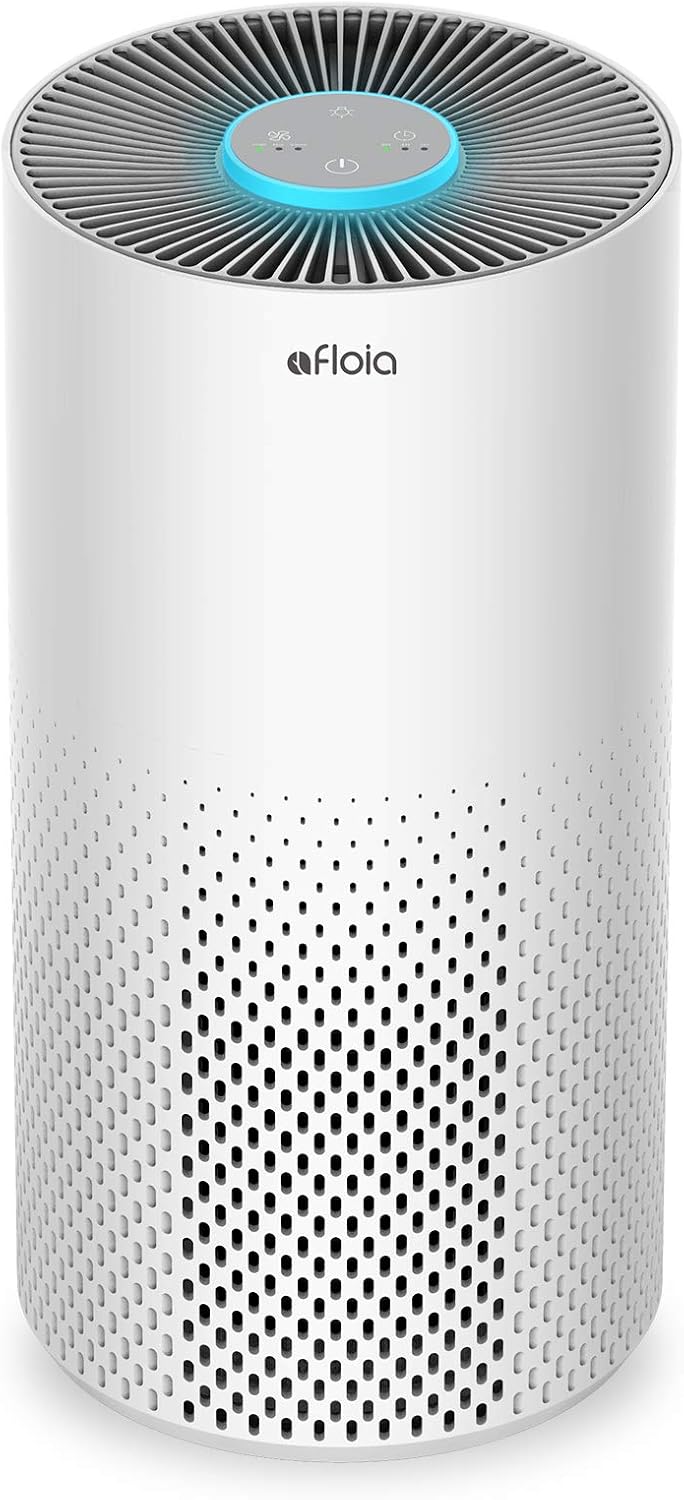
The Afloia KILO is a compact tabletop air purifier designed for everyday home use, combining a washable pre-filter with layered filtration to reduce dust, pet hair, pollen, odors and fine particles down to 0.3 micron. It is typically placed in bedrooms, living rooms or offices where low noise and simple controls matter; touch and button controls let you switch fan speeds, set 2/4/8/16-hour timers and run an ultra-quiet 22 dB sleep mode for nighttime use. The unit advertises four air changes per hour for medium rooms and includes a seven-color night light that dims automatically, which helps in shared spaces or children's rooms. Maintenance is straightforward thanks to the removable washable pre-filter and accessible replacement filter options tailored to pets or antibacterial needs. Important limitations are its modest clean-air delivery relative to larger room-sized purifiers and the need to replace specialty filters every few months for peak germ and allergy performance; buyers seeking whole-house coverage or medical-grade sterilization should look at higher-capacity units or additional technologies.
Best for: Practical buyers who want an easy-to-use, low-noise purifier for bedrooms or living rooms and value washable components and simple scheduled operation.
Less Ideal for: People who need whole-house coverage, clinical-grade germ elimination, or high CADR performance for very large open spaces should choose a larger or specialized system.
- Multi-stage filtration with washable pre-filter reduces hair, dust and larger particles
- Very quiet 22 dB sleep mode suitable for bedrooms
- Adjustable timers and multiple fan speeds for scheduled, low-effort use
- Seven-color night light that auto-dims for ambient lighting and comfort
- Not a medical-grade or whole-house purifier; limited to single-room coverage
- Replacement filters should be changed every 4–6 months for best performance
Verdict: Choose the Afloia KILO if you want a quiet, easy-to-maintain room purifier with washable pre-filter and customizable timers for everyday home use.
VOOPNU H13 HEPA Air Purifier DH-JH12

| Filter type | H13 True HEPA |
|---|---|
| Coverage | Up to 1,076 ft² (claim) |
| Noise level | 22 dB (low setting) |
| Speeds | 3 fan speeds |
The VOOPNU DH-JH12 is a small, easy-to-use air purifier built around an H13 true HEPA triple-layer filter and 360 degree intake to capture fine particles such as pollen, pet dander, and smoke. It is intended for continuous use in bedrooms, living rooms, or home offices and the maker claims it can clean about 250 ft² every 15 minutes. Controls are simple—a basic panel with three fan speeds, a timer and a built-in essential oil tray for light scenting. Noise is very low at the quietest setting (about 22 dB), so it is suitable for nighttime use. Certifications listed (ETL, CARB, DOE, FCC, CE, ROHS) suggest the unit meets common safety and emissions standards. Practical limitations are its small footprint and implied reliance on filter replacements every few months; buyers should plan on periodic filter purchases and expect better performance in single rooms rather than whole-home coverage despite the headline area figure. For germ reduction, the H13 HEPA will remove airborne particles effectively but the unit does not list UV or active antimicrobial features.
Best for: Buyers wanting an affordable, low-noise HEPA purifier for single rooms who prioritize straightforward operation and certified filtration over advanced sterilization features.
Less Ideal for: People seeking whole-house germ-killing systems or built-in antimicrobial technologies should consider larger units with active sterilization features instead.
- H13 true HEPA triple-layer filtration captures 99.97% of fine airborne particles
- 360° intake design for even room circulation
- Very quiet operation down to about 22 dB, suitable for bedrooms
- Simple controls and a compact footprint make placement and use easy
- Multiple safety and emissions certifications provide independent compliance reassurance
- No listed UV or antimicrobial module specifically targeted at killing germs
- Replacement filter needs and schedules add ongoing cost
- Manufacturer coverage claims are lab-based and may be optimistic for real-world multiroom use
Verdict: A compact, budget-friendly H13 HEPA purifier that delivers quiet, certified particle filtration for single rooms where simple, continuous air cleaning is the priority.
Jafanda JF260 Air Purifier

| Filtration System | True HEPA & Activated Carbon |
|---|---|
| CADR | 153 CFM |
| Coverage | Up to 1190 ft² (1 ACH) |
| Noise Level | As low as 23 dB |
| Fan Speeds | 5 levels + Auto |
The Jafanda JF260 is a tower-style air purifier intended for large rooms that combines a True HEPA filter with a hefty activated carbon layer and a PM2.5 sensor. It runs on five fan speeds plus an Auto mode that adjusts airflow based on measured particle levels, and a sleep mode that drops noise to the low 20 dB range for nighttime use. The unit advertises a CADR of 153 CFM and coverage estimates for 1190 ft² at one air change per hour, so it is sized to circulate air in open-plan living spaces or large bedrooms. Practical benefits include strong particulate capture down to submicron sizes and odor reduction from the activated carbon, straightforward status feedback via the PM2.5 display, and quiet operation for bedrooms or nurseries. Limitations to note are that smart app or voice control is not listed for this model, filter replacement cadence will be an ongoing cost, and coverage figures assume ideal placement and room layout so real-world performance depends on where it sits and room airflow.
Best for: Buyers who prioritize consistent, measurable particle removal in larger rooms and want a straightforward, sensor-driven purifier that runs quietly at night.
Less Ideal for: Those who need integrated smart-home controls or compact purifiers for small bedrooms and desks should consider other models.
- True HEPA filtration plus 300 g activated carbon for both particles and common odors
- PM2.5 sensor and Auto mode that adjusts fan speed to measured air quality
- Quiet sleep mode with noise levels as low as 23 dB
- CADR rating (153 CFM) and published room coverage guidance for large spaces
- No built-in smart app or voice assistant control for remote operation
- Filter replacement is required periodically which adds operating cost
Verdict: Choose the Jafanda JF260 when you want a quiet, sensor-driven HEPA purifier sized to handle large rooms and reduce airborne germs and particulates.
Levoit Core 300-P Air Purifier

| Power Source | Corded Electric |
|---|---|
| Filter Type | 3 in 1 Filtration |
| Noise Level | 24 db |
| Wattage | 56 watts |
| Particle Retention Size | 0.3 micron |
The Levoit Core 300-P is a small, user-friendly air purifier built around a three-stage filter that captures 99.97% of particles down to 0.1–0.3 microns, making it effective against pollen, dust, pet dander and smoke. It uses a 56W motor with a CADR suited for rooms up to the stated coverage and includes touch controls, a timer, and a near-silent Sleep Mode rated at about 24 dB for overnight use. The unit is AHAM verified and carries CARB and ETL certifications, which supports its performance and safety claims. Practical benefits include genuine Levoit replacement filters for consistent filtration, a compact portable design that is easy to move between rooms, and straightforward maintenance with a filter-change indicator. Limitations are that this Core 300-P model does not include smart connectivity or an automatic auto mode, so fan speed must be adjusted manually, and optimal CADR/coverage numbers apply when using official Levoit filters rather than third-party replacements.
Best for: Buyers who rely on third-party validation and want a proven, certified purifier for bedrooms or living spaces that runs quietly and is simple to operate and maintain.
Less Ideal for: Users who need Wi‑Fi control, app automation, or an auto-adjusting purifier that senses and responds to air quality without manual input should consider a smart model instead.
- HEPA-grade three-stage filter removes 99.97% of 0.1–0.3 μm particles
- AHAM verified with CADR figures and multiple safety certifications
- Very quiet Sleep Mode (~24 dB) suitable for bedrooms
- Compact and portable design that is easy to move and place
- Includes a pre-installed filter and a filter-change indicator for simple maintenance
- No smart connectivity or automatic auto mode — fan speeds are manual
- Coverage and CADR are based on official Levoit filters and may not apply with third-party replacements
Verdict: A compact, AHAM-verified HEPA purifier that delivers quiet, reliable particle filtration for bedrooms and small living areas.
Levoit Vital 200S-P

| Filter Type | 3-Stage Filter |
|---|---|
| Floor Area | 1875 square_feet |
| Noise Level | 27 db |
| Particle Retention Size | 0.1 micrometer |
| Wattage | 51 |
The Levoit Vital 200S-P is a smart air purifier built to handle large rooms and allergy or pet-related airborne contaminants. It uses a 3-stage filtration system with a washable pre-filter plus activated carbon and HEPA-class filtration to remove particles down to 0.1 micrometer, and AHAM-verified CADR ratings support rapid whole-room cleaning. It connects to an app for remote control and offers a built-in air quality monitor and sleep mode that runs quietly at about 27 dB, making it suitable for bedrooms and living areas. The unit is effective at reducing dust, pet hair and dander, smoke and odors, and the manufacturer offers specialized replacement filters for smoke, toxins, or pet allergies. Practical limitations include its physical footprint and weight relative to travel-size purifiers and the need to replace specialty filters over time, which adds ongoing cost. For buyers focused on dependable air cleaning backed by independent verification and simple smart controls, this model provides a strong mix of performance and quiet operation.
Best for: Buyers who prioritize proven, reliable room-wide air cleaning and quiet overnight operation and want simple smart controls and verified performance for allergy and pet-related contaminants.
Less Ideal for: People needing an ultra-compact or battery-powered purifier for travel or very small rooms should consider smaller portable models instead.
- AHAM-verified with strong CADR ratings for smoke, dust, and pollen
- 3-stage filtration captures particles down to 0.1 micrometer including pet dander and smoke
- Quiet sleep mode rated around 27 dB for overnight use
- App control and built-in air quality monitor for hands-off management
- Larger and heavier than compact travel purifiers, so less portable
- Requires periodic replacement of specialty filters, adding to operating cost
Verdict: Choose the Vital 200S-P if you want an AHAM-verified, smart air purifier that quietly delivers fast whole-room cleaning for allergies, pets, smoke, and germs.
Choosing the Right Air Purifier for Germs: Key Factors to Consider
Filtration Efficiency and Particle Size
High filtration efficiency directly affects how well a purifier removes airborne germs. Look for true mechanical filters that capture particles down to 0.1 to 0.3 microns, since many bacteria and respiratory aerosols fall into that range.
A filter's rated efficiency at submicron sizes and whether the system uses a sealed airflow path both influence real-world performance. Supplemental technologies can help, but a proven mechanical filter is the primary barrier against aerosolized pathogens.
Room Coverage and Air Changes Per Hour
Coverage determines how quickly an air purifier can reduce particulate concentration in a space. Consider the unit's recommended square footage and its CADR or equivalent air flow metric to estimate air changes per hour for your room.
Higher air-change rates reduce airborne load faster, which is important in shared spaces or rooms where people gather. A slightly overspecified unit for your room size gives more margin during higher-occupancy periods.
Noise Levels During Normal Operation
A purifier that runs loudly will likely be turned down or off, negating its benefit. Check decibel ratings at common fan speeds to understand what operation will sound like in living rooms, bedrooms, or home offices.
Balance the need for high airflow with acceptable noise. Some units deliver strong filtration while staying quiet on mid-range settings, which is useful for round-the-clock use.
Filter Longevity and Replacement Costs
How often filters need replacing affects both long-term cost and the unit's sustained performance. Longer-lasting primary filters reduce maintenance frequency but may cost more upfront.
Also consider how easy it is to access and change filters, whether pre-filters are washable, and whether replacement indicators are provided. Poor access or hard-to-find parts creates friction that reduces effective usage over time.
Safety and Emissions
Devices that generate ozone or other reactive byproducts can create health concerns when used continuously. Prefer purifiers designed to avoid producing harmful emissions and that use sealed filtration paths.
Look for safety features like filter seals, child locks, and stable housings. Units that combine active sanitizing technologies should provide emission data or certifications to verify safe operation in occupied rooms.
Energy Consumption and Continuous Use
Air purifiers often run continuously, so energy use matters for operating cost and environmental impact. Evaluate typical wattage at common fan speeds and whether the unit has eco modes or scheduling.
Lower energy draw is particularly important for larger units or when multiple purifiers are used throughout a home. Energy-efficient fans and motors reduce running cost without sacrificing steady air cleaning capability.
How Filtration Types Affect Germ Control
Not all filtration technologies work the same against biological contaminants. Mechanical HEPA-type filters trap particles by interception and diffusion, which makes them broadly effective against aerosols that carry bacteria and viruses. Activated carbon layers help with odors and some volatile chemicals but do not substitute for particle capture.
Some systems add ultraviolet or photocatalytic stages to inactivate organisms that pass through filters. Those stages can add protection but perform best when paired with a reliable mechanical filter. When evaluating technologies, prefer designs that provide independent performance data for the particle filtration stage.
- Mechanical filtration captures and removes particles from the air stream.
- Adsorbent media handle gases and odors but not particles.
- Active inactivation stages can help but do not replace trapping particles.
Sizing a Purifier for Bedrooms, Living Rooms, and Open Areas
Match the purifier's recommended coverage and CADR to your room layout. Bedrooms typically need less coverage than open-plan living areas. Measure the room's square footage and ceiling height to calculate volume, then choose a unit rated for that or slightly larger.
For rooms with frequent occupancy or poor ventilation, choose a higher air-change rate. In open-concept homes, a single large unit may not circulate air effectively through partitions, so multiple smaller units or strategic placement is often better.
- Calculate room volume for more accurate sizing.
- Aim for higher air changes in high-use or poorly ventilated rooms.
- Consider multiple units for complex floor plans.
Placement and Maintenance Best Practices
Place purifiers away from walls and large obstructions to allow free airflow in and out of the cabinet. Position the intake where it can draw room air from common breathing zones and the outlet so clean air mixes into the occupied space.
Regular maintenance keeps performance consistent. Clean washable pre-filters to preserve main filter life, follow manufacturer intervals for primary filter replacement, and check seals occasionally. Keep the unit powered on at recommended settings when rooms are occupied to maintain low particulate levels.
- Leave several inches of clearance around intakes and outlets.
- Use washable pre-filters where available to lower maintenance cost.
- Adhere to replacement intervals to ensure filtration efficiency.
Noise Management Strategies for Continuous Use
If you need round-the-clock filtration, manage noise by selecting units with a quiet night or sleep mode and by using mid-range settings that strike a balance between airflow and sound. In bedrooms, place units farther from the bed or use white-noise masking if necessary.
Consider scheduling higher fan speeds for peak occupancy and reduced settings overnight. Fans with well-damped designs tend to generate less tonal noise, which users perceive as less intrusive even at higher decibel levels.
- Use sleep or eco modes for nighttime operation.
- Schedule higher speeds during active periods and lower speeds when quiet is needed.
- Place units strategically to distance noise from resting areas.
Interpreting CADR, ACH, and Manufacturer Claims
CADR and ACH are useful metrics for comparing units, but understand what each measures. CADR quantifies clean air delivery for specific particle sizes and is good for relative comparisons. ACH estimates how many times the air in a room is exchanged per hour and depends on room volume.
Look for transparent testing methods and third-party certifications where available. Be wary of ambiguous claims that lack supporting specifications. Use CADR and ACH together with filter efficiency specifications to form a complete picture of expected performance.
- CADR helps compare clean air output for common particle sizes.
- ACH indicates how quickly a unit can exchange room air volume.
- Combine metrics with filter efficiency for best assessment.
How We Chose the Best Air Purifier for Germs
We evaluated units that emphasize germ reduction through measurable filtration performance, focusing on objective specifications and real-world usability. Key filters included certified filtration efficiency, recommended room coverage, and air exchange rates measured as CADR or equivalent. We prioritized true mechanical filters rated to capture submicron particles and included consideration of validated supplemental technologies that target biological contaminants. Practical factors governed selection as well. We assessed noise output at common fan speeds, the frequency and ease of filter replacement, and energy use during typical operation. Durability and build quality were considered through materials and design that affect long-term performance. Safety features such as sealed filter chambers and absence of harmful byproducts were required. We excluded devices that rely solely on ionization without a true mechanical filter, units with unproven or unsafe emissions, and purifiers sized for very small, single-use niches. The final list balances laboratory-grade filtration specifications with everyday factors like maintenance, noise, and coverage so readers get options that work both on paper and in daily use.
Our full evaluation process is outlined in our review methodology.
FAQ
Will an air purifier remove airborne viruses and bacteria?
Mechanical high-efficiency filters capture many bacteria and virus-containing aerosols, reducing airborne concentration. Purifiers are most effective as part of layered controls including ventilation and surface hygiene rather than a sole infection-prevention measure.
How often should I replace filters to maintain germ control?
Replacement frequency depends on usage and environmental load but typically ranges from every 6 to 12 months for main filters. Check pre-filters more often; washable pre-filters should be cleaned regularly to extend primary filter life.
Are ultraviolet or ionizing features necessary for germ reduction?
UV and similar active stages can inactivate organisms that pass through the device, but they are not a substitute for a sealed mechanical filter. Some active technologies may produce byproducts, so choose units with verified safe-emission data if these features are important.
How loud will a purifier be when running at effective speeds?
Noise varies by model and fan speed. Effective cleaning often requires moderate to high airflow which can be audible. Look for decibel ratings and user-oriented quiet modes if low sound is a priority for bedrooms or workspaces.
Can I use an air purifier continuously in occupied rooms?
Yes. Many purifiers are designed for continuous operation and are most effective when left on. To minimize cost and noise, use eco modes, schedule variable fan speeds, or choose energy-efficient models rated for continuous use.
Final Verdict
Prioritize units that combine true high-efficiency mechanical filtration with adequate room coverage and reasonable noise levels. Pay attention to CADR and ACH relative to your room volume, and choose designs with easy access to filters and clear replacement schedules to sustain germ-reduction performance. Accept tradeoffs between continuous airflow and noise or energy use by selecting models with adjustable speeds and efficient motors. With the right balance of filtration efficiency, coverage, and maintenance practicality, you can pick an air purifier that meaningfully lowers airborne germ load in your spaces.