
Note: This article contains affiliate links. If you click on these links and make a purchase, we may earn a small commission at no extra cost to you. This helps support our research and content. Read our full affiliate disclosure here.
If you spend a lot of time indoors, the right air purifier for home can noticeably reduce allergens, dust, and odors and help you breathe easier. Choosing a unit that fits your room size, filtration needs, and noise tolerance matters because a mismatched purifier either underperforms or wastes energy and space. This guide shortlists seven top options across common household use cases and explains the tradeoffs you should expect. We evaluate filtration capability, room coverage, noise, and upkeep so you can pick a model that fits your living area and lifestyle.
Top Picks at a Glance
| Best Overall The best all-around choice for most situations | Winix 5510 Air Purifier |  |
| Best Quality Built to a higher standard if you want something more solid | IQAir HealthPro Plus XE |  |
| Best Value The sweet spot between price and what you get | GermGuardian AC4825E 22" Tower |  |
| Best Budget The cheapest option that still gets the job done reliably | FULMINARE H13 HEPA Air Purifier |  |
| Top Rated A top-rated pick with lots of positive feedback | Levoit Core 300-P |  |
| Most Popular A crowd favorite that many people choose with confidence | Levoit Core 200S-P |  |
| Best Seller A high-volume bestseller chosen again and again | VOOPNU H13 HEPA Air Purifier DH-JH12 |  |
Winix 5510 Air Purifier

| AHAM Verified Coverage | 1,882 sq ft in 1 hr |
|---|---|
| Particle Capture | Down to 0.01 microns |
| Filtration | 4‑stage (True HEPA + carbon + washable pre-filter + PlasmaWave) |
| Noise | 23.5 dB (lowest speed) |
| Smart Features | WiFi, Winix Smart App, Alexa/Google Home |
The Winix 5510 is a four-stage air purifier built to clean large home spaces quickly using a True HEPA filter, advanced carbon odor control, and a washable pre-filter. It targets allergens, smoke, pet dander, and VOCs and claims to capture particles down to 0.01 microns while its PlasmaWave technology works as an additional air-treatment stage. Built-in smart sensors feed an LED air quality indicator and let the unit automatically adjust fan speed in Auto Mode, and a light-sensitive Sleep Mode drops noise and power use when the room is dark. Wi‑Fi and Winix Smart App compatibility add remote monitoring and control plus voice integration with popular assistants. Practical benefits include strong CADR-class performance for large rooms, an easy-to-clean pre-filter that prolongs main filter life, and a visible AQI readout so you can see changes in air quality. Limitations to note are the ongoing cost of replacement filters and the added complexity of app and smart features for buyers who prefer a simple plug-and-play purifier.
Best for: Buyers who want a high‑performance, feature-rich purifier for larger rooms and value automated air-quality response plus app control to monitor and manage indoor air.
Less Ideal for: Those seeking the simplest, lowest-maintenance purifier with no smart features or buyers on a strict tight budget for ongoing filter replacements.
- True HEPA four-stage filtration for fine particles and allergens
- Activated carbon layer for odor and VOC reduction
- Smart sensors with Auto Mode and visible air quality indicator
- Wi‑Fi and Winix Smart App for remote control and voice assistant integration
- Washable pre-filter to trap large particles and extend filter life
- Requires periodic paid replacement filters to maintain performance
- Advanced features add setup and app management compared with basic models
Verdict: Choose the Winix 5510 if you want a smart, high‑capacity home purifier that combines True HEPA filtration with automatic sensing and app control for large rooms.
IQAir HealthPro Plus XE

| Maximum Coverage | Up to 1125 sq. ft. |
|---|---|
| Filtration | Filters 99.5% particles ≥ 0.003 microns |
| AirVisual App Integration | Yes |
| Sensor-based Operation | Yes |
The IQAir HealthPro Plus XE is a top-tier air purifier built to deliver medical-grade filtration in large spaces. It uses IQAir's HyperHEPA system to capture ultrafine particles down to 0.003 microns, making it effective against smoke, allergens, bacteria, and many ultrafine pollutants, and it is rated for coverage up to about 1125 sq ft. The unit includes an improved, energy-efficient fan system and multiple fan speeds, plus an advanced particle sensor and three smart modes that let the purifier run automatically based on real-time PM2.5 readings. WiFi and AirVisual app integration let you monitor air quality and control the unit remotely. In real-world use the HealthPro XE is aimed at performance: it moves a lot of air quietly for the class, filters ultrafine particles that many competitor HEPA units miss, and its long filter lifetimes reduce maintenance frequency. The main trade-offs are size and cost since the unit is substantial and positioned at the premium end, and replacement cartridges for high-performance filtration are an ongoing expense.
Best for: Buyers who prioritize the highest practical filtration performance for large living spaces and want real-time sensor-driven control and app monitoring to maintain cleaner indoor air.
Less Ideal for: People seeking a compact, budget-oriented purifier for small rooms or those who do not want to budget for premium replacement filters should consider simpler alternatives.
- HyperHEPA filtration certified to capture down to 0.003 microns for ultrafine particle removal
- Rated coverage for large rooms up to 1125 sq ft
- Advanced particle sensor with three automatic smart modes for sensor-based operation
- Redesigned fan system that is up to three times more energy efficient than previous models
- WiFi and AirVisual app integration for remote monitoring and control
- Premium price and larger physical footprint compared with typical consumer purifiers
- Ongoing cost for replacement filters and gas cartridges
Verdict: Choose the HealthPro Plus XE when you need best-in-class ultrafine particle filtration and smart, energy-efficient performance for large rooms.
GermGuardian AC4825E 22" Tower

| Model number | AC4825E |
|---|---|
| Room coverage | 153 sq. ft. (full circulation every 12.5 min); up to 743 sq. ft. hourly |
| Filter type | True HEPA with activated carbon pre-filter |
| Speeds | 3 fan speeds |
The GermGuardian AC4825E is a compact tower purifier that uses a True HEPA filter plus an activated carbon pre-filter and optional UV-C light to capture airborne particles and reduce odors. It is typically placed in bedrooms, offices, or living areas where it circulates air for rooms up to about 153 sq ft every 12.5 minutes and can service larger open spaces intermittently. Three fan speeds, including a quiet sleep mode, let you balance filtration vs noise for night or daytime use. The carbon pre-filter helps with cooking and pet smells while the HEPA media captures fine dust, pollen, and pet dander down to 0.1 microns from air passing through the filter. Maintenance is straightforward with replaceable GermGuardian Filter B cartridges and UV-C bulbs. Limitations include basic controls without smart connectivity and performance tied to regular filter replacement, so ongoing filter cost and upkeep affect long-term value. The unit is a proven, simple option for improving household air where straightforward HEPA filtration and odor reduction are the priorities.
Best for: Buyers who want a no-frills, well-tested HEPA purifier to reduce allergens and household odors in bedrooms, offices, or living rooms and value simple controls and proven filtration.
Less Ideal for: Users who need smart home integration, whole-house HVAC integration, or a purifier sized specifically for continuous filtration of very large open-plan spaces.
- True HEPA filter captures most allergens and fine particles down to 0.1 microns from air passing through the media.
- Activated carbon pre-filter reduces common household odors like cooking and pet smells.
- Optional UV-C light provides an additional sanitizer option.
- Three fan speeds including a quiet sleep mode let you trade filtration intensity for lower noise.
- Compatible with readily available GermGuardian replacement filters and bulbs for straightforward maintenance.
- No Wi‑Fi or app connectivity for remote control or scheduling.
- Effectiveness depends on regular filter and bulb replacements, adding ongoing maintenance cost.
Verdict: A compact, reliable HEPA tower purifier that delivers effective allergen capture and odor reduction with simple controls, ideal for pragmatic home users who prioritize proven filtration.
FULMINARE H13 HEPA Air Purifier

| Filter type | H13 HEPA |
|---|---|
| Coverage area | Up to 215 sq ft / 20 m² |
| Noise level | ~24 dB (low) |
| Power | Plug-in (no battery) |
The FULMINARE H13 is a small, plug-in air purifier designed for single rooms such as bedrooms or offices. It uses an H13 HEPA filter and 360° air outlet with dual-channel circulation to refresh the air up to five times per hour in spaces up to about 215 sq ft. Controls include multiple fan speeds, a near-silent sleep mode (around 24 dB on low), a soft night light, and five timer options for hands-off use. Practical benefits are straightforward: it removes common household particles like pet hair, smoke, and odors while staying quiet enough for sleeping and offering a calming night light for children. The unit is portable and simple to place anywhere with its plug-in power; filter replacements are user-replaceable and marketed separately. Important limitations are room-size scope and runtime expectations—this is built for small rooms rather than whole-home coverage, and buyers should budget for periodic filter replacements and confirm they remove the filter packaging before use.
Best for: Buyers seeking an affordable, compact purifier for a single bedroom or office who prioritize quiet operation and simple plug-and-play use.
Less Ideal for: People who need whole-house or large open-area air cleaning or who want integrated smart home controls and long runtime without replacement filters.
- H13 true HEPA filtration for fine particles
- 360° outlet with dual-channel circulation for even room coverage
- Very quiet sleep mode suitable for light sleepers
- Built-in night light and multiple timer settings for convenience
- Portable plug-in design is easy to place and move between rooms
- Designed for rooms up to about 215 sq ft so not suitable for larger open areas
- Requires periodic filter replacements sold separately
Verdict: A budget-friendly, quiet bedroom air purifier with H13 HEPA filtration and simple timers that works well for single-room use.
Levoit Core 300-P

| Power Source | Corded Electric |
|---|---|
| Filter Type | 3 in 1 Filtration |
| Floor Area | 1073 square_feet |
| Noise Level | 24 db |
| Wattage | 56 watts |
The Levoit Core 300-P is a small, user-friendly air purifier built around a 3-stage HEPA-grade filter and a 56W motor that delivers proven CADR performance for smoke, dust, and pollen. It is typically used in bedrooms, living rooms, or home offices where quiet operation and steady particle removal matter; Sleep Mode drops noise to about 24 dB and the display can be turned off for overnight use. The unit is AHAM verified and CARB/ETL certified, which supports its claimed coverage and performance, and the filter is rated to capture 99.97% of particles down to 0.1–0.3 microns. Practical benefits include straightforward touch controls, a timer function, and a portable footprint that is easy to move between rooms. Limitations are that it lacks smart auto mode on this variant, so fan speed must be adjusted manually, and best performance depends on using Levoit original replacement filters and replacing them every 6–8 months. For buyers who prioritize dependable, quiet air cleaning in typical home spaces, the Core 300-P is a sensible, no-nonsense choice.
Best for: Buyers who want a reliable, quietly operating air purifier for bedrooms or living spaces and value certified, repeatable particle removal over advanced connectivity features.
Less Ideal for: Users who need built-in smart controls, automatic air-sensing/auto mode, or coverage for very large open-plan areas should consider other models.
- AHAM verified and CARB/ETL certified for validated performance and safety
- High-efficiency HEPA-grade 3-stage filter capturing 99.97% of 0.1–0.3 μm particles
- Quiet Sleep Mode around 24 dB suitable for bedrooms
- Compact and portable design that is easy to move between rooms
- Simple touch controls with timer and check-filter indicator for maintenance reminders
- Does not include an auto mode or smart connectivity on this model, requiring manual fan speed control
- Optimal performance requires using Levoit original replacement filters
Verdict: A compact, certification-backed purifier that delivers quiet, dependable HEPA-grade filtration for home rooms where reliability matters.
Levoit Core 200S-P
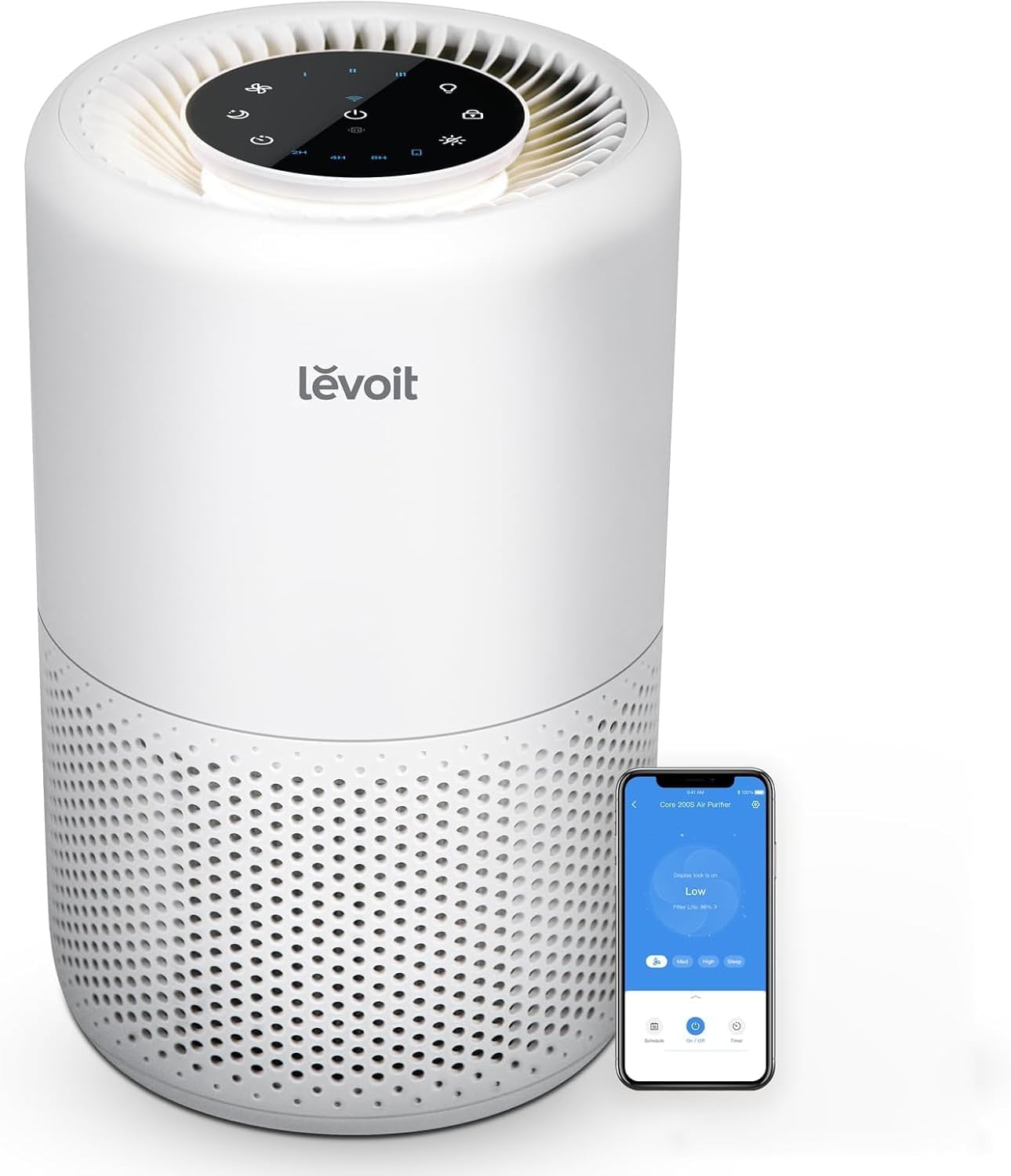
| Model | Core 200S |
|---|---|
| Filters | 3-in-1 (pre-filter, activated carbon, HEPA-grade) |
| Recommended room size | 140 ft² refresh rate 4.8×/hr |
| Noise level | As low as 27 dB |
The Levoit Core 200S-P is a compact smart air purifier built for bedrooms, nurseries, and small apartments where pets or seasonal allergies are a concern. It pulls air in through a 360° intake and passes it through a nylon pre-filter, activated carbon layer for odors, and a HEPA-grade main filter that captures particles down to 0.1–0.3 microns. The unit is AHAM-verified for room refresh rate and is rated to refresh the air in a 140 ft² room nearly five times per hour, which makes it effective for daily removal of dust, pollen, dander, smoke, and light odors. Smart and voice controls plus an app that monitors filter life make upkeep straightforward, and sleep mode and a 27 dB low-noise setting let it run at night without disturbance. The compact footprint and lighter weight make it easy to move between rooms, but its coverage is limited to small spaces so larger rooms will need a higher-capacity model or multiple units. Filter replacements are required for peak performance and genuine Levoit filters are recommended by the manufacturer.
Best for: Buyers who rely on proven performance and user feedback and need a compact, smart purifier for small rooms or pet owners who want straightforward monitoring and quiet overnight operation.
Less Ideal for: People needing to clean large living rooms or whole-home coverage should look at higher-capacity models or multiple units rather than this single compact purifier.
- Three-stage filtration (pre-filter, activated carbon, HEPA-grade main filter) handles particles, pet dander, and common odors.
- AHAM-verified performance with a stated refresh rate for a 140 ft² room, giving predictable cleaning for small spaces.
- Smart app and voice control with filter-life monitoring simplify maintenance and remote operation.
- Quiet sleep mode down to 27 dB makes it suitable for bedrooms and nurseries.
- Designed for small rooms only, so not suitable as a lone purifier for larger open-plan spaces.
- Requires periodic filter replacements to maintain rated performance.
Verdict: A compact, AHAM-verified smart purifier that reliably cleans small rooms and simplifies upkeep for buyers seeking proven, low-noise pet and allergy relief.
VOOPNU H13 HEPA Air Purifier DH-JH12

| Coverage (claimed) | Up to 1,076 ft² per hour |
|---|---|
| Filtration | H13 True HEPA multi-layer |
| Noise level | As low as 22 dB |
| Speeds | 3 fan speeds |
| Timer | Yes |
The VOOPNU DH-JH12 is a small, user-friendly air purifier built for everyday home use. It draws air in through a 360° intake and passes it through an H13 true HEPA multi-layer filter to capture common indoor pollutants like pet hair, pollen, smoke, and odors. The unit is simple to operate from a straightforward control panel and offers three fan speeds, a timer, and an essential oil tray for light scenting. Lab-tested coverage claims cleaning 250 ft² every 15 minutes (up to 1,076 ft² per hour), which makes it suitable for bedrooms, living rooms, or home offices. It runs quietly—advertised as low as 22 dB on its lowest setting—so it is unobtrusive during sleep. Filters are replaceable on a recommended 3–6 month cycle depending on use, and the purifier carries several safety and performance certifications. The most important limitations are its small physical footprint and the need to run it continuously for best results, plus filter replacement cost over time; buyers should match placement and run time to room size for reliable performance.
Best for: Buyers who prioritize reliable, easy-to-use air cleaning for bedrooms or common rooms and want a certified, low-noise purifier they can set and forget.
Less Ideal for: Large open-plan homes or whole-house needs where a single compact unit cannot provide continuous coverage across multiple rooms.
- H13 true HEPA multi-layer filtration captures 99.97% of common airborne particles
- 360° intake design supports even room circulation
- Very quiet operation down to 22 dB for nighttime use
- Compact footprint that fits on desks, nightstands, or small corners
- Simple controls with timer and optional essential oil tray for light scenting
- Recommended continuous use for optimal results increases runtime and filter consumption
- Filter replacements are required every few months which adds ongoing cost
Verdict: A compact, certified H13 HEPA purifier that delivers quiet, dependable air cleaning for bedrooms and small living spaces.
Choosing the Right Air Purifier for Home: Key Factors to Consider
Filtration Technology
The core mechanism determines what pollutants the unit removes. True HEPA filters capture at least 99.97% of particles down to 0.3 microns, which covers pollen, pet dander, and many fine dust particles. Look for a verified HEPA designation rather than marketing terms that sound similar.
Many models add an activated carbon stage to adsorb odors and certain gases. If household smells, kitchen smoke, or volatile organic compounds (VOCs) are a concern, a significant carbon bed or dedicated gas-phase filter improves performance. Some units include washable prefilters to catch large debris and extend primary filter life.
Room Size and CADR
Match the purifier to the space you intend to clean. Clean Air Delivery Rate, or CADR, gives a realistic measure of how quickly a unit will reduce smoke, dust, and pollen in a room. A higher CADR and an explicit recommended square footage rating mean faster and more effective cleaning.
Consider where you spend the most time. A unit sized for a living room should cover that area at 2 to 4 air changes per hour for noticeable improvement. For bedrooms, lower fan speeds and quieter operation at an appropriate coverage level are more important than sheer maximum CADR.
Noise and Daily Use
Noise matters because purifiers often run continuously. Check measured decibel levels for low and high fan speeds rather than subjective descriptors like "quiet."
If you plan to run the purifier at night, prioritize models with low-noise sleep modes and consistent fan curves so fan speed does not spike unexpectedly. For daytime living areas, higher fan speeds and temporarily louder operation may be acceptable when rapid clearing is needed.
Operating Costs and Filter Replacement
Long-term costs often exceed the initial purchase price. Replacement filter frequency and unit energy draw determine ongoing expense. Filter life varies with pollutant load; homes with pets or heavy cooking will replace filters more often.
Identify whether the unit uses proprietary multi-stage cartridges or separate prefilter/HEPA/carbon modules. Modular designs let you replace only the exhausted element, which can reduce cost. Also consider energy efficiency ratings or low-power modes if the purifier will run constantly.
Placement, Installation, and Maintenance
Proper placement affects performance. A purifier needs clearance on intake and exhaust sides to create a steady airflow loop. Avoid hiding a unit in a corner or behind furniture where it will recirculate the same air.
Maintenance is not just filter swaps. Check access for cleaning prefilters, whether the unit has washables, and how straightforward the filter change process is. Easy-to-access controls and clear filter life indicators reduce the chance of running with diminished performance.
Sizing Your Purifier to Different Rooms
Start by measuring the square footage of the room and check the purifier's recommended coverage and CADR ratings. Multiply the room area by the desired air changes per hour to estimate the minimum CADR you need for effective cleaning.
For living rooms and open-plan spaces, choose a unit rated for slightly larger coverage than the measured area since airflow patterns and open doorways reduce effective cleaning. Bedrooms usually need lower CADR but better noise control for overnight use.
- Small bedrooms: aim for 2–3 air changes per hour at sleep noise levels.
- Living and family rooms: target 3–5 air changes per hour for active use.
- Open-plan areas: size up to compensate for airflow losses between zones.
Dealing with Pets, Smoke, and Allergies
Different pollutant sources require different strengths. Pet owners should prioritize strong particle filtration and accessible prefilters to capture fur and large dander before it clogs the HEPA media. A larger surface-area HEPA filter extends the time between full replacements.
If smoke or cooking odors are common, look for a unit with a substantial activated carbon stage or gas-phase media. Allergy sufferers benefit from consistent, continuous operation and high CADR relative to room size so pollen and dust are constantly reduced.
- Pets: emphasize prefilters plus HEPA surface area.
- Smoke/odors: require effective activated carbon or gas filters.
- Allergies: consistent operation and appropriate CADR are key.
Placement Tips to Maximize Performance
Place the purifier where it can draw air unobstructed from the occupied zone. A central location in the room often yields the best circulation. Keep at least a few feet of clearance from walls and furniture on the intake and exhaust sides to avoid short-circuiting airflow.
For multi-room coverage, a single large purifier can work if it has sufficient CADR, but multiple smaller units positioned in key living areas typically outperform one centralized device for whole-home coverage.
- Avoid corners and tight enclosures.
- Keep clear space on intake and exhaust sides.
- Use multiple units for distributed coverage when necessary.
Energy Use and Running Costs
Because air purifiers often run continuously, energy draw affects monthly operating costs. Look for units with efficient brushless motors and multiple fan speeds, including low-power continuous modes. Unattended high-speed operation will increase energy consumption and filter loading.
Consider programmable timers or air-quality sensors that adjust fan speed automatically. Smart features can reduce wasted runtime, but confirm that automatic modes maintain adequate air changes for your needs rather than cycling off too aggressively.
- Prefer units with low-power continuous modes for overnight use.
- Sensors can save energy but should be tested against manual settings.
- Estimate annual filter replacements when budgeting total cost.
Maintenance and Filter Replacement Best Practices
Follow the manufacturer's recommended replacement intervals but adjust for your environment. Homes with pets, smokers, or heavy cooking may need more frequent filter changes. Regularly clean washable prefilters and vacuum around intake grills to reduce dust buildup.
Keep spare filters on hand if replacements have long lead times. Note whether filters are modular or combined so you understand whether every replacement includes multiple media types or only one exhausted layer.
- Clean prefilters monthly or as they visibly load.
- Inspect HEPA and carbon stages every 3 to 12 months depending on use.
- Record replacement dates to keep track of filter life.
How We Chose the Best Air Purifier for Home
We prioritized practical, measurable attributes that determine how well an air purifier performs in real homes. Primary evaluation criteria included real-room coverage based on Clean Air Delivery Rate (CADR) and recommended square footage, true HEPA filtration effectiveness for particle removal, and activated carbon or equivalent adsorption capacity for common household odors and VOCs. We also considered noise output at typical fan speeds, energy efficiency during continuous operation, and the cost and availability of replacement filters for realistic upkeep budgeting. Products were excluded if they lacked verifiable filtration specifications, relied solely on ionization without HEPA-class filtration, or failed to provide clear room-size guidance. Our selections favor units with documented particle and gas-handling capability and transparent maintenance intervals. The scoring labels below reflect these priorities so readers can compare ability to clean air, suitability for room sizes, ongoing costs, and daily usability at a glance.
Our full evaluation process is outlined in our review methodology.
FAQ
How big of an air purifier do I need for my living room?
Choose a unit with a CADR and recommended square footage that match or exceed your living room area for 2 to 4 air changes per hour. If the room is part of an open plan, size up to account for airflow losses.
Do air purifiers help with odors and chemicals?
Odors and many VOCs require gas-phase filtration such as activated carbon. Standard HEPA filters remove particles but not gases, so pick a model with sufficient carbon media if smells or chemical odors are important.
Are quieter purifiers less effective?
Not necessarily. Quieter modes reduce fan speed and cleaning rate, so a quieter purifier designed for lower noise will still clean effectively if it has adequate CADR for the room. For rapid clearing, higher fan speeds are typically needed.
How often should I replace filters?
Replacement frequency depends on usage and pollutant load. Prefilters may need monthly cleaning while HEPA and carbon stages typically last several months to a year. Check indicators and visually inspect filters to set a realistic schedule.
Can I run an air purifier all day?
Yes. Continuous operation is often recommended for consistent air quality. Use a low-power continuous mode or a model with efficient energy use to keep operating costs reasonable.
Final Verdict
Prioritize filtration capability and correct sizing when choosing an air purifier for home. Match true HEPA filtration and adequate carbon media to the specific pollutants you face, and make sure CADR and room coverage align with the spaces where you spend the most time. Expect tradeoffs between noise, speed, and running costs; focus on a unit that balances continuous low-noise operation with sufficient cleaning capacity for your room size. With those priorities in mind, you can select a purifier that delivers clearer air and predictable upkeep without overbuying.