
Note: This article contains affiliate links. If you click on these links and make a purchase, we may earn a small commission at no extra cost to you. This helps support our research and content. Read our full affiliate disclosure here.
If you rely on a central HVAC system to move conditioned air through your home, integrating the right air purifier for HVAC makes a major difference in whole-house air quality and allergy control. The wrong unit can restrict airflow, hum with vibration, or fail to capture fine particles that matter most for health. This guide shortlists the top picks that work with ducted HVAC setups and explains the tradeoffs you should expect. Below we cover shortlisted products selected for compatibility, filtration efficiency, and ease of service, and we explain the evaluation criteria used to assemble the list.
Top Picks at a Glance
| Best Overall The best all-around choice for most situations | Medify Air MA-50 V3.0 |  |
| Best Quality Built to a higher standard if you want something more solid | Austin Air HealthMate Plus B450 |  |
| Best Value The sweet spot between price and what you get | MOOKA B-D02L Air Purifier |  |
| Best Budget The cheapest option that still gets the job done reliably | VOOPNU DH-JHD07 Air Purifier |  |
| Top Rated A top-rated pick with lots of positive feedback | FreAire VisionAir HAP606 |  |
| Most Popular A crowd favorite that many people choose with confidence | Levoit Vital 200S-P Air Purifier |  |
| Best Seller A high-volume bestseller chosen again and again | Levoit Core 300-P |  |
Medify Air MA-50 V3.0

| Filter Class | HEPA H13 |
|---|---|
| Wattage | 70 watts |
| Noise Level | 56 db |
| Particle Retention Size | 0.1 micrometer |
| Included Components | Air purifier machine, True HEPA H13 filter |
The Medify Air MA-50 V3.0 is a floor-standing HEPA H13 purifier built to move large volumes of air for big rooms and open-plan spaces. It uses a True HEPA H13 filter to capture particles down to 0.1 microns and advertises CADR performance that can refresh up to 2,640 sq ft per hour, making it suitable where fast clearing of smoke, pollen, pet dander, and odors is needed. The unit offers four fan speeds, a sleep mode that dims lights and lowers noise, a touch control panel with timer and child lock, and a filter-replacement indicator for straightforward daily use. It runs on standard AC power and is ETL, CARB, and Energy Star certified, and Medify backs it with a lifetime warranty. Trade-offs are typical for a high-flow purifier: the highest fan setting is noticeably louder and filter replacements are a recurring cost with the recommended 3-4 month lifespan, so operating at high speeds continuously will raise running expenses. For large spaces where fast, effective particle removal is the priority, the MA-50 delivers reliable performance and simple controls.
Best for: Buyers who need a robust, room-scale purifier to clear smoke, allergens, and odors quickly in large rooms, open-plan homes, or shared indoor spaces and who prioritize performance over running-cost minimization.
Less Ideal for: Those seeking a near-silent bedroom-only purifier, a compact travel unit, or buyers who prefer minimal ongoing filter expenses should consider smaller or lower-flow alternatives.
- High CADR and stated coverage up to 2,640 sq ft per hour for fast air turnover in large spaces
- True HEPA H13 filtration that captures particles down to 0.1 microns
- Simple touch controls with timer, sleep mode, and child lock for easy everyday operation
- Certifications (ETL, CARB, Energy Star) and a USA-registered lifetime warranty for peace of mind
- Higher fan speeds produce noticeable noise compared with quiet residential units
- Replacement HEPA filters have a 3-4 month recommended lifespan, creating ongoing maintenance costs
Verdict: Choose the MA-50 V3.0 when you need high-flow, certified HEPA H13 filtration to rapidly clean large indoor spaces.
Austin Air HealthMate Plus B450

| Filter stages | 4-stage (pre-filters, activated carbon/zeolite, medical-grade HEPA) |
|---|---|
| HEPA area | 60 sq. ft. medical-grade HEPA |
| Carbon volume | Over 780 cubic inches activated carbon/zeolite |
| Recommended coverage | Up to 1,500 square feet |
The Austin Air HealthMate Plus B450 is a heavy-duty room purifier built for sustained, wide-area performance. It pulls air through a 360-degree perforated steel housing into a four-stage filter pack that includes coarse and medium pre-filters, over 780 cubic inches of activated carbon and zeolite for gas and odor removal, and 60 sq. ft. of medical-grade HEPA for particle capture. Typical use is continuous operation in large living areas, open floor plans, or mechanical rooms where smoke, VOCs, pet dander, and fine particles are a concern. Notable practical benefits are the unit's long-lived filter design (up to five years), robust metal construction, and a motor rated for continuous high-RPM use that supports steady airflow across a broad intake surface. The trade-offs are size and weight relative to consumer table-top purifiers and the focus on single-room coverage rather than integration with HVAC ducts; it is designed as a high-capacity standalone appliance, not an in-duct whole-house solution.
Best for: Buyers who prioritize sustained, high-capacity particulate and gas removal for large rooms and want a rugged, low-maintenance standalone purifier focused on long-term performance.
Less Ideal for: People seeking a compact, lightweight travel or bedside unit or those who need an in-duct HVAC whole-house solution should look elsewhere.
- Medical-grade HEPA removes 99.97% of particles 0.3 microns and captures many particles down to 0.1 microns
- Large activated carbon and zeolite bed targets VOCs, formaldehyde, smoke, and odors
- Filters are designed to last up to five years, reducing maintenance frequency
- 360-degree steel intake and high-efficiency continuous-duty motor provide steady airflow for large rooms
- Bulky and heavy compared with portable tabletop purifiers, limiting placement options
- Not designed for direct integration into HVAC ductwork or whole-house installation
Verdict: Choose the HealthMate Plus when you need a durable, standalone purifier that combines medical-grade HEPA with a very large carbon/zeolite bed for long-lasting, high-capacity removal of particles, smoke, and VOCs in large rooms.
MOOKA B-D02L Air Purifier
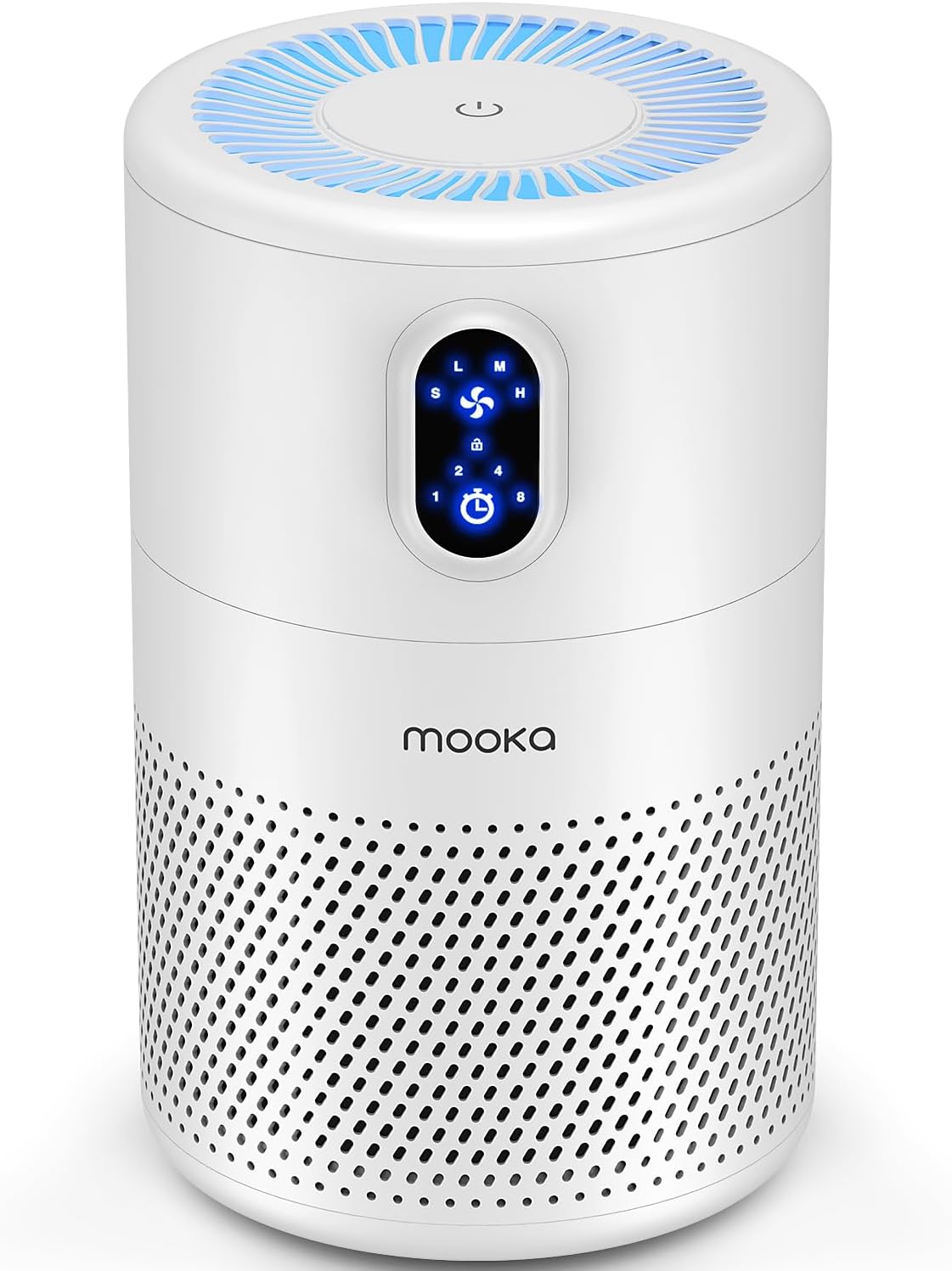
| Effective Area | 1076 sq ft |
|---|---|
| Filter Type | H13 True HEPA + activated carbon |
| Fan Modes | Sleep/Low/Med/High |
| Timer Options | 1H/2H/4H/8H |
The MOOKA B-D02L is a compact tower purifier built around an H13 true HEPA filter, a pre-filter, and activated carbon to capture pet hair, dust, pollen, smoke and odors as small as 0.3 microns. It is intended for whole-room use with a stated coverage up to 1076 sq ft and provides multiple fan speeds plus a sleep mode so you can balance cleaning speed against noise and energy use. Controls include a 1/2/4/8-hour timer, a child lock, a filter-replacement reminder and a switchable soft night light, and the brushless motor claims very low noise on the lowest setting. Practical users will appreciate the washable pre-filter option and easily replaceable HEPA cartridge that the company recommends changing every 3 to 6 months depending on conditions. The unit is small and energy-efficient, but buyers should note that the quoted coverage and air-change figures assume ideal placement and do not replace whole-home HVAC filtration; for HVAC-focused setups this works best as a supplemental room purifier near return vents or high-activity areas.
Best for: Buyers who want a practical, energy-conscious room purifier to supplement HVAC filtration and reduce airborne particles and odors in high-use rooms or near return vents.
Less Ideal for: Those seeking a dedicated whole-home HVAC filter replacement or centralized system solution should look at inline or whole-house filtration options instead.
- H13 true HEPA plus activated carbon and pre-filter capture particles, smoke and odors
- Coverage rated up to 1076 sq ft with specified air-change rates for smaller rooms
- Multiple fan speeds, quiet sleep mode and low-noise brushless motor for night use
- Timers, child lock and filter-replacement reminder increase convenience and safety
- Washable pre-filter and accessible replacement HEPA cartridge make upkeep straightforward
- Coverage claims may overstate real-world whole-home performance and are best for single-room use
- Replacement HEPA filter needs periodic purchase and service interval depends on environment
Verdict: A compact, low-noise HEPA room purifier that is an efficient, practical supplement to HVAC filtration for reducing particles and odors in individual rooms.
VOOPNU DH-JHD07 Air Purifier

| Model | DH-JHD07 |
|---|---|
| Filtration | 3-stage |
| Noise level (sleep) | 24 dB |
| Fan speeds | 5 |
| Coverage context | Small rooms/bedrooms |
The VOOPNU DH-JHD07 is a small-room air purifier that uses multi-stage filtration and a 360° intake to capture pet hair, dander, dust, and common allergens in bedrooms, offices, or dorms. It offers five fan speeds, a timer, and a near-silent sleep mode that drops noise to around 24 dB for overnight use. The unit's compact footprint and all-around intake make placement flexible on a bedside table or desk, and the included filter setup simplifies routine maintenance. Practical benefits include adjustable airflow to match air quality needs and the quiet operation that keeps it unobtrusive in living spaces. Expect modest coverage appropriate for personal rooms rather than whole-house HVAC integration, and note the product is lightweight and designed for portability rather than high CADR performance of larger purifiers. Replacement filters and run time scheduling are useful, but buyers seeking high-capacity purification for connected HVAC systems should consider more powerful, HVAC-focused solutions.
Best for: Buyers on a tight budget who need a compact, quiet purifier for a bedroom, dorm, or office and prioritize low noise and simple controls over whole-house performance.
Less Ideal for: Homes looking to improve air for an entire HVAC-served floor or larger open-plan areas should choose a higher-capacity, HVAC-compatible purifier instead.
- Three-stage filtration captures pet hair, dander, dust and common allergens.
- 360° intake design enables flexible placement and consistent air draw.
- Very quiet sleep mode at about 24 dB for undisturbed overnight use.
- Five speed settings and a timer provide useful control for different situations.
- Designed for small personal rooms so it is not suitable as a whole-house or inline HVAC purifier.
- Lightweight, lower-capacity unit that will not match CADR of larger, high-output models.
Verdict: A budget-friendly, ultra-quiet small-room purifier that delivers straightforward filtration and easy placement for bedrooms or offices.
FreAire VisionAir HAP606

| Model | HAP606 |
|---|---|
| Filter | 3-layer H13 HEPA |
| Noise (Sleep) | 20 dB |
| Coverage claim | Up to 1800 sq ft; 4 air changes/hour |
The FreAire VisionAir HAP606 is a tower-style air purifier that uses a 3-stage H13 HEPA system and 360° intake to pull air from all sides and report real-time PM2.5 and AQI readings on a color display. It is intended for continuous use in living spaces and can cycle air in large areas frequently thanks to a claimed CADR that lets it refresh air up to four times per hour in rooms as large as 1800 sq ft. Controls include auto mode, a child lock, a timer, and a whisper-quiet sleep mode around 20 dB for nighttime use. In practice the digital AQI readout and auto mode make it easy to monitor and leave running without fiddling, and the 3-layer filter captures typical particulates like pet dander, dust, and smoke down to 0.3 microns. The unit is relatively compact and light, which helps when placing it near HVAC returns or living areas, but buyers should plan on using FreAire replacement filters to maintain designed performance. Certifications and multi-year support increase confidence for long-term ownership, though stated room coverage is generous and actual results will depend on room layout and placement near HVAC intakes.
Best for: Buyers who prioritize dependable, continuously monitored air cleaning for large living spaces and want simple automatic operation without frequent adjustments.
Less Ideal for: People who need a true whole-house HVAC-integrated air handler solution rather than a standalone room purifier should look at in-duct or dedicated HVAC filtration options.
- H13 HEPA 3-stage filtration capturing 99.97% of particles down to 0.3 μm
- Real-time PM2.5 and color-coded AQI display for easy air-quality monitoring
- 360° intake and high airflow for rapid room air circulation
- Very quiet sleep mode (~20 dB) and child-lock/timer features
- ETL, FCC, EPA, and CARB certifications with multi-year support and warranty
- Manufacturer recommends using official replacement filters for reliable performance
- Claimed coverage figures are high and will vary with room layout and HVAC interaction
Verdict: If you want a compact, quietly running HEPA purifier with live PM2.5/AQI monitoring for large rooms and reliable factory-backed support, the VisionAir HAP606 is a strong standalone option.
Levoit Vital 200S-P Air Purifier

| Floor Area | 1875 square_feet |
|---|---|
| Filter Type | 3-Stage Filter |
| Particle Retention Size | 0.1 micrometer |
| Noise Level | 27 db |
| Power Source | Corded Electric |
The Levoit Vital 200S-P is a smart air purifier built for whole-room cleaning in large spaces and open floor plans. It uses a three-stage filtration system (washable pre-filter, middle filter, and activated carbon) to capture particles down to 0.1 micrometer and reduce dust, pollen, pet dander, odors, and smoke. It is AHAM-verified with high CADR numbers, and the unit covers up to 1875 sq ft in one hour, making it suitable for living rooms, basements, and large bedrooms. Controlled via onboard buttons or the app, the purifier reports air quality and offers a quiet sleep mode that operates near 27 dB for overnight use. Practical benefits include the washable pre-filter to catch larger hair and reduce replacement frequency and a U-shaped inlet design intended to reduce clogging from pet hair. Trade-offs are that it is a relatively heavy, freestanding unit and requires periodic replacement of the middle/activated carbon filter for VOC and odor performance to remain optimal. For HVAC-focused setups it works as a room-level supplement rather than an inline HVAC filter replacement.
Best for: Buyers who prioritize independently verified performance and want a smart, whole-room purifier that visibly reduces allergens and pet-related particles in larger spaces.
Less Ideal for: Homes looking for an inline HVAC or duct-mounted solution should consider purpose-built HVAC filters instead, and buyers needing a very lightweight portable unit may prefer smaller models.
- AHAM-verified CADR ratings suitable for large rooms up to 1875 sq ft
- Three-stage filtration with washable pre-filter and activated carbon for odors and smoke
- Smart app control plus onboard buttons and an air quality monitor for real-time feedback
- Quiet sleep mode around 27 dB for overnight operation
- Unit is relatively heavy and bulky for moving between rooms
- Middle and activated carbon filters need periodic replacement to maintain VOC and odor removal
Verdict: If you want an AHAM-verified, app-controlled purifier that handles large rooms and pet concerns, the Vital 200S-P delivers measurable whole-room cleaning backed by solid CADR performance.
Levoit Core 300-P

| Power Source | Corded Electric |
|---|---|
| Filter Type | 3 in 1 Filtration |
| Floor Area | 1073 square_feet |
| Noise Level | 24 db |
| Wattage | 56 watts |
The Levoit Core 300-P is a small, user-friendly air purifier built around a three-stage original filter that captures 99.97% of particles down to 0.1–0.3 microns. It is typically used in bedrooms, living rooms, or near HVAC returns to reduce dust, pollen, pet dander, smoke, and odors. The unit runs on a 56W motor and delivers a CADR suited to refresh typical rooms quickly while offering a near-silent Sleep Mode at about 24 dB. Controls are touch-based and include a timer and a filter check indicator, and the purifier is AHAM verified and CARB compliant for reliable performance and safety. Because it lacks smart Auto Mode on this model, fan speeds are adjusted manually, which is simple but means it will not respond automatically to changing air quality. Filters should be replaced every 6 to 8 months for best results and Levoit recommends using official replacement filters for certified performance. For buyers who prioritize proven filtration, low noise, and straightforward operation, this is a dependable compact choice; if you need automated, app-controlled HVAC integration you should consider a model with smart features instead.
Best for: Someone who values quiet, proven filtration and straightforward, reliable operation for rooms or in-line with an HVAC return without needing app control or automatic sensing.
Less Ideal for: Buyers who want automatic air-quality sensing, smart-home integration, or a purifier that adjusts fan speed without manual input should look at models with Auto Mode and connectivity.
- True HEPA-grade three-stage filter capturing 99.97% of 0.1–0.3 μm particles
- AHAM verified CADR with clear performance numbers for smoke, dust, and pollen
- Very low noise in Sleep Mode (~24 dB) suitable for bedrooms
- Simple touch controls with timer and filter indicator for easy operation
- Safety certifications including CARB and ETL for home use
- No built-in Auto Mode or smart connectivity on this model so it requires manual speed adjustments
- Replacement filters are recommended to be genuine Levoit filters which adds ongoing cost
Verdict: A quiet, AHAM-verified compact purifier that delivers reliable HEPA-grade filtration for risk-averse buyers who want straightforward, proven performance.
Choosing the Right Air Purifier for HVAC: Key Factors to Consider
Filtration Efficiency and Particle Size
How well an HVAC air purifier removes particles determines its health impact. Look for units with tested capture rates for particles in the 0.1 to 1.0 micron range if your primary concern is smoke, ultrafine pollution, or viruses. MERV or equivalent ratings give a useful baseline, but published percentage removal at specific particle sizes is the most informative.
Higher-efficiency media or HEPA-style filtration captures smaller particles but can increase resistance to airflow. Balancing filtration efficiency against your HVAC fan capacity is essential to avoid reducing system performance.
Airflow Compatibility and System CFM
An in-duct purifier adds pressure drop to your air handler. If the added resistance is too high, your furnace or air handler may struggle to maintain designed flow, reducing comfort and possibly causing equipment stress. Check published pressure drop or recommended maximum CFM restrictions and compare to your system's normal operating CFM.
For homes with older or low-capacity blowers, choose solutions designed for low pressure drop or that include a powered fan sized to the system. Proper sizing ensures the purifier cleans effectively without forcing the HVAC to run harder.
Installation Requirements and Mounting
Installation complexity varies from slip-in filter housings to bolt-on canisters that sit in-line with ductwork. Consider whether the unit requires professional HVAC access, sheet-metal modifications, or specific clearances around the air handler. Electrical needs also differ: some units draw low-voltage control power, while others require 120V service or a hardwired connection.
Think about where the purifier will be mounted relative to filters, coils, and condensate lines to maintain serviceability and avoid creating unintended moisture or airflow issues.
Ongoing Maintenance and Filter Life
Filter change frequency affects long-term cost and convenience. High-efficiency media often lasts longer for large particles but can load with fine dust faster, so check expected service intervals under typical household conditions. Easy access to filter elements, clear replacement indicators, and common filter sizes make upkeep less of a burden.
Also consider the total cost of consumables and whether filters are widely available in standard sizes. Some units use proprietary modules that can be more expensive or harder to source.
Noise and Vibration Impact
An HVAC-mounted purifier may add audible noise or vibration when the system runs. Noise becomes more noticeable on lower fan speeds or in quiet homes. Units with insulated housings, anti-vibration mounts, or low-speed fans reduce perceptible sound.
Pay attention to reported dBA at common operating speeds and look for designs that isolate the purifier from ductwork resonance to avoid rattles or hums.
Compatibility with HVAC Controls
Some air purifiers can be controlled by the HVAC system, using fan cycles or dedicated control signals for intermittent or boost operation. Verify whether the purifier integrates with your thermostat or requires external controls for scheduled cleaning. Integration affects power use and filter life because continuous high-speed operation increases loading and energy draw.
Ensure the purifier's control method matches your desired operating pattern, whether continuous filtering or periodic high-flow cleaning cycles.
Sizing an In-Duct Purifier for Whole-Home Coverage
Correct sizing starts with knowing the system's nominal CFM and the volume of conditioned space. Most manufacturers or installation guides list recommended coverage in square feet or CFM. Use your HVAC's fan CFM at typical static pressure as the baseline to confirm the purifier's rated capacity matches real-world airflow.
If a product lists CADR or equivalent airflow ratings, match those values to your system's normal operating CFM and avoid oversizing the purifier relative to your blower capability. Undersized units will not provide meaningful whole-home turnover, while oversized units with high resistance can impair system performance.
- Measure or obtain your system's typical CFM.
- Compare purifier rated airflow to your system CFM.
- Allow margin for future ductwork changes or added filters.
Where to Place the Unit in the Duct System
Placement affects performance and maintenance. Installing the purifier upstream of the return filter protects the unit from large debris but can increase filter loading. Downstream placement may ease access for servicing but can expose the purifier to colder return-air conditions and potential moisture.
Avoid placing the purifier where it interferes with condensate pans, coil access, or controls. A location with straight runs of duct on both sides promotes even airflow and reduces turbulence that can lower filtration efficiency.
- Prefer locations with straight duct runs on both sides.
- Keep clearances for filter changes and electrical access.
Electrical and Control Integration
Confirm whether the purifier needs line-voltage wiring or accepts low-voltage thermostat signals. Some designs run continuously and require dedicated power, while others operate only when the HVAC fan runs. Matching the control approach to your preferences affects energy use and filter life.
If you plan to use thermostat-controlled boost cycles, ensure the purifier supports the necessary control inputs and that your thermostat can provide those signals without additional interfaces.
- Check power requirements before installation.
- Consider programmable control for periodic high-cleaning cycles.
Maintaining Performance Over Time
Set a service schedule based on household dust load, pets, and local air quality. Regular inspection of filters and pressure drop across the unit helps sustain performance and prevents strain on the HVAC fan. Keep records of filter changes and note any changes in airflow or noise.
When replacing filters, use the correct rated media to preserve the purifier's designed capture rates. Skimping on filter efficiency can reduce effectiveness while over-specifying may increase resistance unnecessarily.
- Inspect filters every 3 months as a starting point.
- Monitor static pressure if possible to detect rising resistance.
Health Considerations and Particle Targets
Decide which airborne contaminants are most important to remove. Allergens like pollen and pet dander are relatively large and captured by moderate MERV-rated media. Fine particles from smoke, vehicle exhaust, or wildfires require higher-efficiency filtration capable of removing submicron particles.
If immunocompromised household members are present, prioritize tighter particle capture. For general home odor control, filtration alone may not be sufficient and additional source control or complementary technologies could be considered.
- Match filter efficiency to the dominant particle size you want removed.
- Consider combined strategies for odors and gases.
How We Chose the Best Air Purifier for HVAC
We focused on practical performance and compatibility for ducted HVAC installations. Primary evaluation criteria included filtration efficiency for particles down to 0.3 microns, fan and airflow compatibility to avoid reducing system CFM, filter replacement cadence and cost, HVAC mounting and electrical requirements, quiet operation under typical HVAC fan speeds, and durability for continuous duty. We looked for units whose published CADR or MERV-equivalent ratings match real-world whole-home coverage claims and that offer clear service access without specialized tools. We excluded portable room purifiers, devices intended only for single-room use, and products that require major HVAC modifications or nonstandard power supplies. We also favored units that clearly document airflow resistance and provide guidance for integration with common furnace and air-handler layouts. The selection balances filtration performance with the operational realities of central air systems rather than idealized lab figures alone.
Our full evaluation process is outlined in our review methodology.
FAQ
Will adding an in-duct air purifier reduce my HVAC airflow?
It can if the purifier creates significant pressure drop. Choose units with published pressure-loss data or low-resistance designs and confirm your blower can handle the added load. Professional sizing helps avoid reduced CFM.
How often do HVAC air purifier filters need changing?
Filter life depends on household dust, pets, and local pollution. Many systems start with visual checks every 3 months and change filters every 6 to 12 months. High-efficiency media or heavy pollution may require more frequent replacement.
Can an HVAC purifier remove odors and VOCs?
Standard particle filters primarily remove particulates, not gases or odors. Some systems pair media with activated carbon or separate gas-phase cartridges to reduce VOCs and smells. Evaluate media options if odors are a primary concern.
Is professional installation required for HVAC-mounted purifiers?
Not always, but many installations require sheet-metal work, electrical connections, or precise placement to avoid airflow issues. Professional installation ensures correct mounting, sealing, and electrical hookup when in doubt.
Will an HVAC air purifier work if my system runs intermittently?
Intermittent fan operation reduces total air turnover and lowers the purifier's effective runtime. Using fan-on settings during high-pollution periods or scheduling boost cycles improves overall filtration performance.
Final Verdict
When choosing an air purifier for HVAC use, prioritize a balance between filtration efficiency and airflow compatibility. High capture rates are only valuable if the unit can operate without harming system CFM or adding disruptive noise. Pay attention to installation needs, filter service intervals, and how the purifier will integrate with your existing controls. Focus on units that document pressure drop and rated airflow, choose media appropriate for the particles you want removed, and plan for realistic maintenance. With those priorities in mind, you can select a solution that meaningfully improves whole-home air quality without compromising HVAC performance.