
Note: This article contains affiliate links. If you click on these links and make a purchase, we may earn a small commission at no extra cost to you. This helps support our research and content. Read our full affiliate disclosure here.
Cooking adds flavor to meals and particles to the air. A dedicated air purifier for kitchen use helps remove smoke, grease aerosols, and persistent odors so your home stays comfortable and healthier. Choosing the right unit matters because kitchen pollutants differ from bedroom or living-room particles and because continuous use and easy maintenance are important in a food-prep zone. This guide covers seven shortlisted air purifiers for kitchen applications, selected for filtration efficiency, odor control, and practical features like cleanable pre-filters and easy placement. Read on to understand the factors we weighed and how each pick fits typical kitchen needs.
Top Picks at a Glance
| Best Overall The best all-around choice for most situations | Winix 5510 Air Purifier |  |
| Best Quality Built to a higher standard if you want something more solid | Coway Mighty AP-1512HH |  |
| Best Value The sweet spot between price and what you get | GermGuardian AC4825E Tower Air Purifier |  |
| Best Budget The cheapest option that still gets the job done reliably | FULMINARE H13 HEPA Air Purifier |  |
| Top Rated A top-rated pick with lots of positive feedback | DREO Air Purifier 338 (DR-HAP008) |  |
| Most Popular A crowd favorite that many people choose with confidence | Levoit Core 300-P |  |
| Best Seller A high-volume bestseller chosen again and again | Levoit Core Mini-P |  |
Winix 5510 Air Purifier

| Max room coverage (1 hr) | 1,882 sq ft |
|---|---|
| Filtration stages | 4-Stage |
| Particle capture | Down to 0.01 microns |
| Noise (lowest) | 23.5 dB |
| Smart features | WiFi, app, Alexa, Google Home |
The Winix 5510 is a four-stage air purifier designed to clean large indoor spaces quickly while also offering smart controls and quiet operation. It combines a washable pre-filter, True HEPA capture down to 0.01 microns, and an advanced deodorization carbon filter to remove allergens, smoke, and common kitchen odors, while Winix's PlasmaWave technology aims to reduce remaining airborne impurities. Built-in air quality sensors drive an Auto Mode that adjusts fan speed and a visible AQI indicator that helps you see room conditions at a glance, and Sleep Mode darkens lights and drops noise to a whisper for nighttime use. The Winix Smart App plus voice integrations let you monitor and control the unit remotely, which is handy when cooking triggers odors or smoke. Trade-offs include periodic filter replacements for sustained performance and the unit's footprint that you will need to accommodate in a kitchen layout. For busy kitchens where odor control, automated sensing, and wide coverage matter, the 5510 delivers a balanced mix of power and convenience.
Best for: Home cooks who want automated odor and particle removal across a large kitchen or open-plan living area and value smart controls that let the purifier run with minimal fuss.
Less Ideal for: People with very small kitchens who need a compact countertop unit or users who prefer a permanently maintenance-free purifier.
- Four-stage filtration with True HEPA captures very small particles and common allergens
- Advanced carbon filter reduces cooking odors and volatile organic compounds
- Smart sensors with Auto Mode and AQI indicator provide real-time, automatic adjustments
- Winix Smart App and voice assistant compatibility enable remote monitoring and control
- Very quiet Sleep Mode suitable for nighttime operation
- Requires periodic HEPA and carbon filter replacements to maintain effectiveness
- Relatively large footprint that requires counter or floor space in a kitchen
Verdict: A powerful, smart air purifier that tames kitchen odors and airborne particles across large spaces while running quietly and automatically.
Coway Mighty AP-1512HH

| Coverage | Designed to clean up to 1,748 sq. ft. in 60 minutes |
|---|---|
| HEPA efficiency | 99.97% of 0.3 μm particles |
| Filtration stages | Pre-filter, deodorization filter, Bipolar Device, HEPA Filter |
| Filter lifespan | Up to 1 Year |
The Coway Mighty AP-1512HH is a countertop/stand air purifier built for continuous home use in medium to large rooms. It draws air through a washable pre-filter, activated carbon/deodorization stage, and a True HEPA filter that captures 99.97% of 0.3 micron particles, while a bipolar ionizing device helps reduce fine particles and odors. An auto mode uses the built-in pollution sensor and colored LED to adjust fan speed in real time, and Eco and timer modes help save energy during low-use periods. Filter indicator lights and a washable pre-filter make basic maintenance straightforward, and optional custom filters are available for smoke or pet-focused tasks. The unit is relatively compact and quiet on low speeds, but 1,748 sq ft coverage claims refer to full-room turnover over 60 minutes so expect stronger fan noise on high when you need rapid clearing in kitchens with heavy smoke or cooking fumes. There is no integrated smart-home connectivity, so remote control or scheduling requires manual use or a separate smart plug.
Best for: Buyers who prioritize measurable filtration performance and automatic air-quality response for shared living spaces and kitchen-adjacent rooms will appreciate this unit.
Less Ideal for: If you need app-based remote control, voice assistant integration, or completely silent rapid purging for an open-concept kitchen, consider models with smart features or higher commercial airflow.
- Three-stage filtration with True HEPA captures 99.97% of 0.3 μm particles for reliable allergen and particulate removal
- Built-in air quality sensor and auto mode that adjust fan speed based on real-time pollution levels
- Washable pre-filter and filter indicator lights simplify maintenance and replacement timing
- Compact footprint and relatively quiet operation on low and eco modes suitable for living areas and kitchens during light use
- Optional specialized filters (smoke, pet, VOC-focused) for targeted odor and pollutant removal
- Higher fan speeds required for fast clearing of heavy cooking smoke are noticeably louder
- No built-in Wi-Fi or app control for remote scheduling or monitoring
Verdict: Choose the Coway Mighty AP-1512HH when you want proven HEPA performance and an automatic air-quality-driven purifier that handles cooking odors and smoke in medium to large kitchen-adjacent spaces.
GermGuardian AC4825E Tower Air Purifier

| Model | AC4825E |
|---|---|
| Room coverage (hourly) | Up to 743 sq. ft. per hour |
| Recommended small room coverage | 153 sq. ft. per 12.5 minutes |
| Fan speeds | 3 speeds |
The GermGuardian AC4825E is a compact tower air purifier designed to remove common household allergens and odors in living spaces and kitchens. It uses a genuine True HEPA filter to capture 99.97% of particles down to 0.1 microns, an activated carbon pre-filter for cooking and pet smells, and an optional UV-C bulb to help reduce airborne microbes. Three fan speeds including a quiet sleep mode let you balance noise and cleaning speed, and manufacturer-tested coverage figures describe fast circulation in small rooms and hourly turnover in larger rooms. The unit is compatible with replacement Filter B cartridges and GermGuardian UV bulbs, making maintenance straightforward. Trade-offs are that it is a single-appliance tower without smart controls or integrated sensors, so you must choose speeds manually and track filter replacement yourself, and its stated coverage is ideal for kitchens that share open-plan living areas rather than very large commercial kitchens.
Best for: Buyers who want a practical, easy-to-maintain purifier that reduces allergens and common cooking odors in home kitchens or open-plan living areas and prefer straightforward controls over automation.
Less Ideal for: Large commercial kitchens, heavy cooking environments, or users who need automatic air-quality sensing and app-based control should consider higher-capacity or feature-rich models.
- True HEPA filter captures most allergens and fine particles down to 0.1 microns
- Activated carbon pre-filter reduces common kitchen odors and smoke smells
- Optional UV-C light adds another layer aimed at airborne microbes
- Three fan speeds including a quiet sleep mode let you balance noise and airflow
- No smart features or air-quality sensors for automatic adjustment
- Designed for home-sized rooms rather than large or commercial kitchens
Verdict: A compact, no-frills tower purifier that reliably removes allergens and kitchen odors for home kitchens and open-plan living spaces.
FULMINARE H13 HEPA Air Purifier

| Filter type | H13 HEPA |
|---|---|
| Coverage area | Up to 215 ft² / 20 m² |
| Noise level (low) | Around 24 dB |
| Timers | 2, 4, 8, 10, 12 hours |
The FULMINARE H13 is a small, portable air purifier designed to clean air in bedrooms or other small rooms and can fit conveniently on a kitchen counter when you need quick odor and particle reduction. It uses an H13 HEPA filter and a 360 degree outlet with dual-channel airflow to refresh air up to five times per hour in areas around 215 ft², which helps reduce pet dander, smoke and cooking odors in a modest kitchen. Controls include a near-silent sleep mode that drops noise to about 24 dB, an independent soft night light, and five timer settings (2, 4, 8, 10, 12 hours) for hands-off use. The unit requires plugging into power via a bottom-mounted adapter and filters must be unwrapped and replaced periodically for best performance. Limitations include modest coverage that makes it unsuitable for large or open-plan kitchens and the need to buy replacement filters regularly; it also lacks smart connectivity or app control for remote monitoring.
Best for: Budget-minded buyers who want a compact, quiet purifier to reduce smoke, odors and particles in a small kitchen or single room without extra smart features.
Less Ideal for: People who need whole-kitchen or open-plan coverage, integrated smart home control, or a unit that handles heavy cooking pollution in large spaces.
- H13 HEPA filter captures fine particles and allergens.
- 360° outlet with dual-channel airflow to refresh room air up to 5 times/hour in rooms ~215 ft².
- Very quiet sleep mode around 24 dB suitable for overnight use.
- Independent night light and multiple timer settings for flexible, low-effort operation.
- Coverage is limited to small rooms so it may not clear air quickly in larger or open kitchens.
- No smart features or remote control for scheduling or monitoring.
- Requires periodic replacement filters and uses a plug-in adapter stored in the base.
Verdict: A compact, low-noise H13 HEPA purifier that gives budget-conscious buyers effective particle and odor reduction for a small kitchen or single room.
DREO Air Purifier 338 (DR-HAP008)

| CADR (CFM) | 115 CFM |
|---|---|
| HEPA efficiency | 99.97% at 0.3 μm |
| Coverage (single air change) | 178 sq. ft. (12.4 min refresh) |
| Air quality sensor | PM2.5 sensor with LED AQI (0–999) |
The DREO Air Purifier 338 is a compact HEPA air cleaner designed to reduce particles, smoke, dust, pollen, and odors in home spaces. It uses a 3-in-1 filter (pre-filter, True HEPA, activated carbon) to capture up to 99.97% of particles down to 0.3 microns while an AHAM-verified CADR of 115 CFM provides measurable air changes for medium rooms. A built-in PM2.5 sensor and four-color LED AQI indicator give immediate feedback, and Auto, Turbo, Sleep, and four fan speeds let the unit adjust to changing conditions. The spiral 360° intake and TurboPure design aim to speed circulation, and the HyperSilent motor keeps noise as low as 18 dB on the quietest setting, which is useful in kitchens when you want low distraction. The purifier also includes an aroma box for scent pads if you want odor masking in addition to filtration. Limitations to note: it is sized for typical kitchen and medium rooms rather than very large open-plan kitchens, and replacement filters and aroma pads are an added operating cost. For reliability-focused users the certified CADR and real-time sensing make its performance easy to verify in everyday use.
Best for: Buyers who prioritize a verifiable, consistently performing purifier with real-time air quality feedback and quiet operation for everyday kitchen use.
Less Ideal for: People needing a single unit to clean very large open-plan kitchens or whole-house coverage should consider higher-capacity commercial models or multiple units.
- AHAM-verified CADR (115 CFM) gives a verifiable cleaning rate.
- 3-in-1 filter (pre-filter, HEPA, activated carbon) removes particles and odors.
- Real-time PM2.5 sensor with LED AQI display for immediate air quality feedback.
- Multiple modes including Auto and Sleep plus very low noise (~18 dB) for night or low-distraction use.
- TurboPure 360° intake design improves circulation for faster refresh.
- Coverage claims vary by metric and the unit is best for medium rooms rather than very large open kitchen spaces.
- Requires periodic replacement filters and optional aroma pads, adding ongoing cost.
Verdict: Choose this DREO unit if you want a compact, AHAM-verified purifier with reliable measured performance and real-time sensing for everyday kitchen air cleaning.
Levoit Core 300-P

| Filter Type | 3 in 1 Filtration |
|---|---|
| Floor Area | 1073 square_feet |
| Noise Level | 24 db |
| Particle Retention Size | 0.3 micron |
| Wattage | 56 watts |
The Levoit Core 300-P is a small, user-friendly air purifier that uses a 3-stage original filter and an efficient fan to capture 99.97% of particles down to 0.3 microns, making it useful for smoke, pollen, pet dander, and household dust. It is typically placed on a countertop or floor in a kitchen-adjacent living space to reduce cooking odors and airborne particulates; the unit offers touch controls, a timer, and a near-silent Sleep Mode rated at about 24 dB for overnight use. Key practical benefits include AHAM verification and certified safety listings, reasonably fast CADR performance for its size, and compatibility with factory replacement filters recommended every 6 to 8 months. Limitations are its lack of smart/auto mode (the Core 300S-P has that feature) and the need to manually select fan speeds for changing conditions, which means it will not automatically ramp up for heavy cooking smoke; also replacement filters are required for peak performance and off-brand filters are discouraged by the manufacturer.
Best for: Buyers who prioritize proven, certified air cleaning and quiet operation and who want a compact purifier to improve air near kitchens or dining areas without needing smart automation.
Less Ideal for: People who want automatic air-quality sensing and hands-off adjustment during heavy cooking or large, open-concept kitchens should consider models with Auto Mode or higher CADR.
- HEPA-grade 3-stage filtration captures 99.97% of particles down to 0.3 microns
- AHAM verified CADR with proven performance for smoke, dust, and pollen
- Very quiet Sleep Mode around 24 dB for undisturbed nighttime operation
- Compact and portable design fits on counters or small kitchen islands
- Certified safety listings (ETL, CARB) and simple touch controls with timer
- No built-in Auto Mode or smart connectivity, requiring manual fan speed changes
- Performance depends on using official Levoit replacement filters every 6–8 months
Verdict: A compact, AHAM-verified HEPA purifier that reliably removes smoke and allergens for quiet, kitchen-adjacent spaces when you want proven performance rather than smart automation.
Levoit Core Mini-P
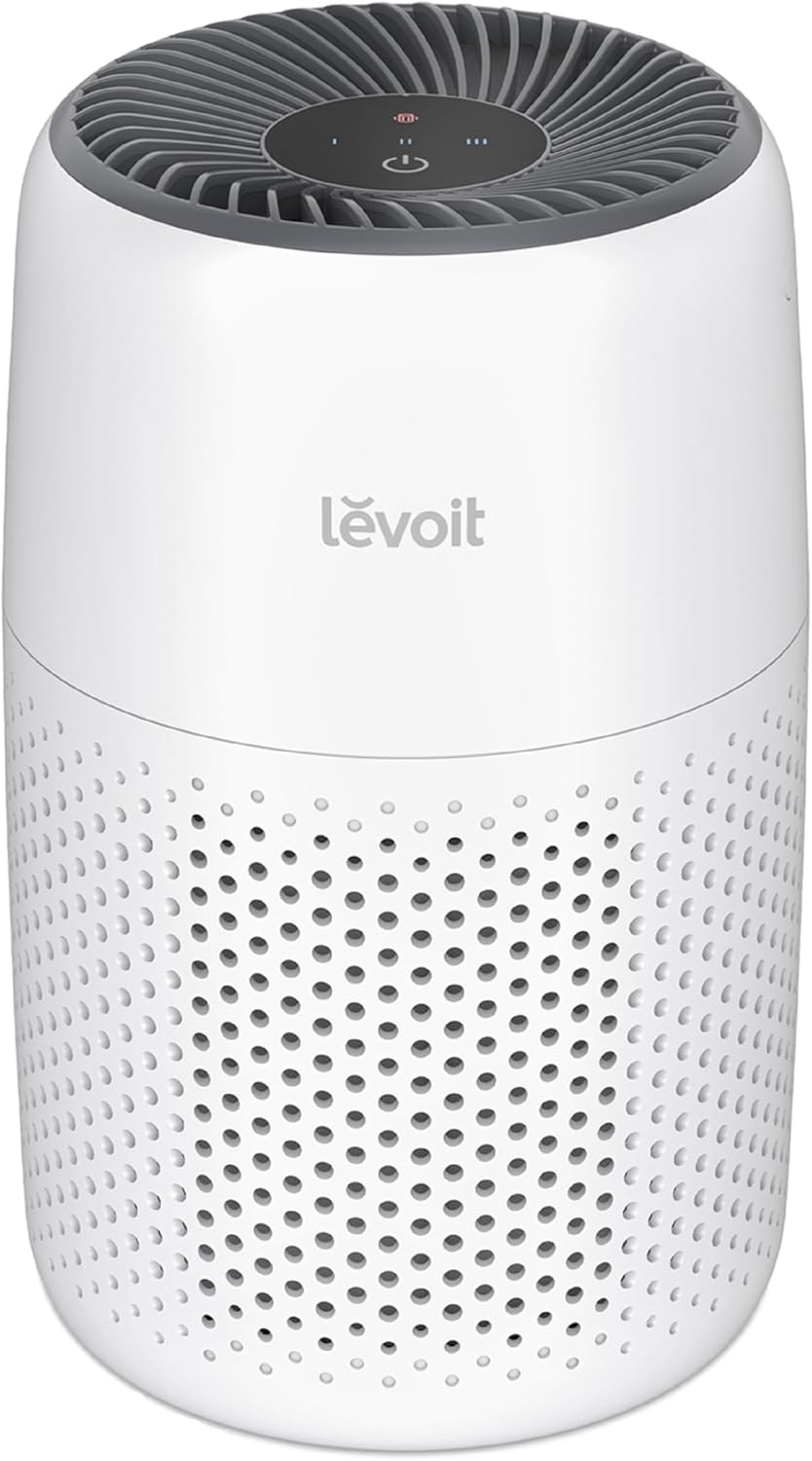
| Rated Power | 7W |
|---|---|
| Noise Level | 27-45dB |
| Adapter Input | 100-240V, 50/60Hz |
The Levoit Core Mini-P is a small, portable air purifier designed for desks, bedrooms, and other compact spaces where quick localized cleaning is useful. It uses a pre-filter and main filter to capture lint, hair, pet dander, smoke, and fine airborne particles, and includes an aromatherapy sponge for light fragrance. With a rated power of 7W and noise levels listed between 27 and 45 dB, it runs quietly enough for sleep mode or office use and has an auto-off display to limit disturbances. The unit ships with an internal adapter and supports brief aromatherapy use when only a few drops are added to the sponge. Practical benefits for kitchen use include odor reduction and capture of small smoke particles from brief cooking events, and its small footprint makes it easy to move and place on counters. Limitations are its small coverage area — it is best for spot treatment rather than replacing a whole-kitchen ventilation system — and the aromatherapy feature requires careful dosing to avoid overflow into plastic parts.
Best for: Buyers who want a fuss-free, compact purifier to reduce smells and small particles in a kitchen nook or near a cooking station and who prefer a quietly running, easy-to-use device.
Less Ideal for: Households that need whole-kitchen or open-plan air cleaning for heavy cooking, large smoke events, or grease-heavy cooking should choose a higher-capacity purifier or improved ventilation instead.
- Compact, portable design fits on counters, desks, or small kitchen islands
- Quiet operation (27–45 dB) suitable for overnight or background use
- Pre-filter plus main filter captures pet dander, lint, smoke, and fine particles
- Built-in aromatherapy sponge provides light odor masking when used sparingly
- Low power draw (7W) for continuous use without significant energy impact
- Small coverage area makes it inadequate as the sole solution for large or open kitchens
- Aromatherapy requires careful dosing to avoid damaging plastic components
Verdict: A quiet, low-power, highly portable purifier that is ideal for spot-treating odors and small particle pollution in kitchen corners and small cooking areas.
Choosing the Right Air Purifier for Kitchen: Key Factors to Consider
Filtration Efficiency for Cooking Particles
Cooking produces a wide range of airborne contaminants from coarse grease droplets to fine particulate matter under 2.5 microns. A unit with a true HEPA or equivalent particle filter and a high CADR for smoke and cooking-related aerosols will remove the smallest respirable particles that carry oils and combustion byproducts.
Assess published CADR or particle-removal metrics and prioritize units rated for smoke or fine particles. Higher filtration efficiency reduces lingering haze and helps protect household members with respiratory sensitivities.
Activated Carbon and Odor Control
Kitchen air carries volatile organic compounds and strong odors from frying, spices, and smoke. A substantial activated-carbon stage or an alternative adsorbent is required to trap gases and odors effectively. Look for purifiers that specify VOC or odor removal capacity rather than relying on particle filtration alone.
Consider the size and replace frequency of the carbon media. Units with thicker carbon beds or replaceable carbon cartridges typically perform better and are easier to service after heavy cooking periods.
Airflow Capacity and Room Coverage
A purifier's airflow determines how quickly it can cycle kitchen air and dilute pollutant concentration. Kitchens often require higher air exchanges per hour because cooking events produce short-term spikes in particles and gases. Match the unit's CADR and recommended room size to your kitchen square footage and open-plan connections to adjacent areas.
Pay attention to placement guidance because obstructions, counters, and cabinetry can reduce effective coverage. In open layouts, you may need a unit rated for a slightly larger area than the kitchen footprint alone.
Noise and Operational Modes
Noise is a practical concern in kitchens where people talk, cook, or watch content. Units should offer quiet background modes for long-run filtration and higher, temporary boost modes for active cooking or smoke events. Evaluate published decibel levels for low and high settings and consider whether a unit's boost mode is loud but short-lived or sustainable for extended cooking sessions.
Night modes are less critical in the kitchen, but low-noise operation matters for early-morning or late-night cooking when others are sleeping.
Maintenance, Filter Replacement, and Cleaning
Kitchen air tends to load up pre-filters and carbon stages faster because of grease and cooking residue. Easy-to-access pre-filters that can be vacuumed or washed extend the life of HEPA and carbon elements and reduce running costs. Check estimated filter lifespans and whether replacements are readily available.
Also consider the complexity of filter changes and whether the unit offers filter-life indicators. Simpler maintenance encourages consistent use and ensures performance remains high over time.
Placement, Size, and Safety
Countertops, islands, and floor corners are common spots for kitchen purifiers, so size and footprint matter. A compact unit is easier to tuck away without interfering with food prep, while a taller floor model may deliver higher airflow but require more clearance.
Safety features such as cool-touch housings and stable bases are important in busy kitchens. Confirm that vents are positioned to avoid blowing grease onto cabinets and that cord routing will not create trip hazards.
Where Kitchen Air Pollution Comes From
Understanding the typical sources of kitchen pollutants helps you pick the right purifier. High-heat cooking, frying, and grilling indoors create both particulate matter and gaseous compounds. Even routine tasks like boiling or toasting produce ultrafine particles that can spread into living areas.
Grease aerosols and oil mists behave differently from dust because they can coat filters and reduce performance if the unit lacks an appropriate pre-filter or a sizable carbon stage. Smoke events produce both visible soot and invisible combustion by-products, which is why both particle capture and gas adsorption matter for kitchens.
- Frying and searing: produce fine particles and strong odors
- Boiling and steaming: release aerosols and humidity
- Toasting and broiling: risk of smoke and rapid particle spikes
Best Placement and Setup Tips
Positioning a purifier affects how effectively it captures cooking emissions. Place the unit near the primary source of pollution when possible, such as beside a range or island, but avoid obstructing airflow or placing it where grease splatter could foul controls. For open-plan kitchens, a centrally located floor unit may provide better cross-room circulation.
Avoid hiding the intake behind cabinets or appliances. Ensure at least a few inches of clearance around inlets and outlets and route the power cord safely away from heat sources. If you have a range hood, run the purifier in tandem during heavy cooking to capture particles that escape the hood.
- Keep a few feet of clearance from walls and cabinetry
- Avoid placing directly above the stove where heat may affect the unit
- Use boost mode during heavy smoke events and return to low mode afterward
Managing Filters in a Grease-Prone Environment
Kitchens will often contaminate pre-filters and carbon media faster than other rooms. Choose units with washable or easily replaceable pre-filters to trap grease and extend the service life of HEPA and carbon stages. Regular vacuuming of the pre-filter keeps airflow steady and preserves capture efficiency.
Track recommended replacement intervals and look for filter-life indications. If you cook frequently at high heat, expect to change carbon filters more often. Some units allow staged replacement of carbon cartridges independently from HEPA filters, which can be more economical over time.
- Vacuum or wash pre-filters monthly with frequent cooking
- Replace carbon cartridges sooner when odors return quickly
- Check for independent filter replacement options
Ventilation Vs. Purification: When to Use Both
Air purifiers work well for particles and odors within a room, but they do not remove moisture or directly ventilate heat and steam. Combining adequate mechanical or natural ventilation with a purifier gives the best results: ventilation expels moisture and large volumes of air, while the purifier captures particulates and adsorbs gases that remain in the home.
When outdoor air is clean and available, use range hoods or open windows during heavy cooking to lower humidity and heat, then run the purifier to clear residual particles and odors. In situations where outdoor air quality is poor, rely more on filtration and recirculation.
- Use range hood or window ventilation during heavy smoke
- Run purifier after cooking to clear lingering particles
- Adjust strategy based on outdoor air quality
Energy Use and Run-Time Considerations
Kitchens often require purifiers to run for extended periods, so energy consumption matters. Look for energy-efficient fans and units with programmable schedules or occupancy sensors to reduce run time when the kitchen is idle. Low-speed continuous operation plus short boosts during cooking events is an efficient pattern.
Check whether the purifier has eco or auto modes that respond to particle sensors. These modes can decrease power draw by lowering fan speed when air is clean and increasing it when particulates spike. Energy-efficient units can run almost continuously without substantially increasing household electricity use.
- Prefer models with auto-sensing and scheduling
- Use low continuous speeds with temporary boost for cooking
- Compare power draw on typical run modes
How We Chose the Best Air Purifier for Kitchen
We focused on features and real-world performance that matter in kitchen environments. Key evaluation criteria included filtration capability for fine particles and aerosols, activated-carbon or equivalent odor removal, and sustained airflow rates appropriate for typical kitchen floor plans. We also rated noise output during cooking and cleanup, which affects whether a unit can run continuously, and maintenance needs such as filter lifespan and ease of cleaning. Practical installation and footprint were considered so the units fit on counters or nearby floor space without obstructing kitchen work. Excluded items were general-purpose small-room units that lack robust odor control or have insufficient airflow for kitchen pollutant loads. We also set aside models that require complex installation not suitable for standard residential kitchens. The final selections balance measurable filtration specs with user-facing details like replaceable versus washable pre-filters, intuitive controls, and modes that cope with peak smoke events.
Our full evaluation process is outlined in our review methodology.
FAQ
Can an air purifier remove cooking odors completely?
Air purifiers with a substantial activated-carbon stage can significantly reduce cooking odors and many VOCs, but complete elimination depends on the amount and persistence of the source. Heavy, ongoing cooking at high heat may require both ventilation and carbon filtration for best results.
How often will I need to replace filters in a kitchen?
Filter replacement frequency depends on cooking frequency and methods. Pre-filters may need cleaning monthly with heavy use, while carbon and HEPA elements might require replacement every few months to a year. Units with separate carbon cartridges often need more frequent carbon changes in grease-prone kitchens.
Is a kitchen purifier noisy during cooking?
Noise varies by model and fan speed. Most units have a high or boost setting that is louder during active smoke removal and a low background mode for continuous use. Look at published decibel ratings and pick a unit with a tolerable high mode since boost periods tend to be temporary.
Should I run the purifier while I cook or only afterward?
Running the purifier during cooking helps catch particles and odors at the source and reduces spread to adjacent rooms. Use a higher fan speed for the cooking period and switch to a lower continuous speed afterward to clear remaining particles and maintain air quality.
Can humidity from cooking affect purifier performance?
High humidity can influence particle behavior and may temporarily reduce filter efficiency if moisture condenses on filter media. Avoid placing purifiers directly over steaming pots and use ventilation to lower humidity before relying on filtration alone.
Final Verdict
For kitchen applications, prioritize a unit that combines true particle capture with substantial odor and VOC adsorption, plus the airflow to cycle kitchen air quickly. Expect tradeoffs between noise on boost modes and the speed of pollutant removal, and plan for more frequent carbon or pre-filter maintenance in grease-heavy kitchens. Choose a purifier sized for your layout, with clear filter-access and service options, so you can run it regularly and keep kitchen air noticeably fresher.