
Note: This article contains affiliate links. If you click on these links and make a purchase, we may earn a small commission at no extra cost to you. This helps support our research and content. Read our full affiliate disclosure here.
If you spend time in a wide, open-plan living area, loft, or a large family room, standard room purifiers often fall short. You need a unit designed to move more air reliably across a broad footprint while staying quiet enough for daily life. This guide shortlists the top air purifiers for large open space so you can choose a model that balances clean-air delivery, noise, and running costs. We evaluated candidates for strong airflow, real-world coverage estimates, filtration effectiveness, and practical maintenance. Read on for the key considerations that matter and the top options that fit different layout and noise priorities.
Top Picks at a Glance
| Best Overall The best all-around choice for most situations | Honeywell HPA304 HEPA Air Purifier |  |
| Best Quality Built to a higher standard if you want something more solid | BLUEAIR Blue Signature Air Purifier |  |
| Best Value The sweet spot between price and what you get | SIESEAN AP-400 Air Purifier |  |
| Best Budget The cheapest option that still gets the job done reliably | VOOPNU H13 HEPA Air Purifier DH-JH12 |  |
| Top Rated A top-rated pick with lots of positive feedback | Levoit Vital 200S-P Air Purifier |  |
| Most Popular A crowd favorite that many people choose with confidence | WINIX 5520 Air Purifier |  |
Honeywell HPA304 HEPA Air Purifier

| Filter Type | HEPA |
|---|---|
| Floor Area | 465 square_feet |
| Particle Retention Size | 0.3 micron |
| Wattage | 80 watts |
The Honeywell HPA304 is a large-room HEPA air purifier built to handle extra-large spaces by circulating and filtering air up to 4.8 times per hour in rooms up to about 465 sq ft and providing one full air change per hour in spaces up to 2,250 sq ft at the highest setting. It uses a true HEPA filter that captures particles down to 0.3 microns to reduce dust, pollen, pet dander, dust mite debris and smoke, and includes touch/button controls, a filter change indicator, timer options and a panel dimmer for nighttime use. Typical use is placing it centrally in an open living area or large bedroom and running on a medium or high speed when allergy triggers or smoke are present, then lowering speed for quieter continuous operation. The unit is corded and draws about 80 watts at runtime, and Honeywell recommends genuine replacement filters for best performance. Trade-offs are the physical footprint and weight for a large-room purifier and the need for periodic filter replacements to maintain CADR and filtration efficiency.
Best for: Buyers who want a capable, no-frills purifier that reliably reduces common allergens across large open rooms and value straightforward controls and proven HEPA filtration.
Less Ideal for: People seeking the smallest or lightest portable purifier for frequent relocation or those who want smart/home automation features built into the unit.
- True HEPA filtration captures up to 99.97% of particles 0.3 microns and larger
- Rated to circulate air frequently in extra-large rooms (up to 465 sq ft) and offers one air change/hour for very large open spaces
- Simple touch and button controls with timer and dimmer make operation straightforward
- Filter change indicator helps ensure timely maintenance for continued performance
- Large physical size and weight make placement and moving the unit less convenient
- Requires replacement filters over time to maintain stated efficiency
Verdict: A sturdy, easy-to-use true HEPA purifier that delivers strong large-room coverage for buyers who want dependable allergen reduction in open spaces.
BLUEAIR Blue Signature Air Purifier

| Room coverage (1 hour) | Up to 3,385 sq ft per hour |
|---|---|
| Recommended room size (AHAM) | ~705 sq ft for 4x per 12.5 minutes |
| Noise level | 23–55 dB |
| Filter lifetime | Up to 1 year |
The Blueair Blue Signature is built to handle large, open floor plans and heavy pollutant loads by combining a multi-stage HEPASilent filter stack with strong airflow and smart controls. It is typically placed centrally in living rooms or open-plan spaces and can cycle air for thousands of square feet quickly, with built-in sensors that drive an automatic fan response when pollution rises. Notable features include seven stages of particle and odor filtration, an app with remote controls and filter-life tracking, and a visual air-quality indicator on the unit. Practical benefits are fast whole-room cleaning rates, quiet low-speed operation for night use, and washable replaceable pre-filters that let you personalize appearance. Important limitations are its large footprint and weight compared with small-room purifiers and the need to replace the primary particle and carbon filters periodically, which adds ongoing cost; it also targets whole-space airflow rather than spot cleaning in tight corners.
Best for: Buyers who prioritize fast, whole-room air cleaning in large living areas and want smart monitoring and automated control to maintain air quality with minimal intervention.
Less Ideal for: People seeking a lightweight, highly portable unit for small rooms or targeted spot cleaning should consider smaller purifiers designed for single-room use instead.
- Designed for very large rooms with high clean-air delivery for whole-space circulation
- HEPASilent multi-stage filtration captures particles down to 0.1 microns and reduces odors and VOCs
- Smart app control, Auto Mode, and real-time air-quality indicator for low-effort monitoring and scheduling
- Whisper-quiet low-speed operation suitable for bedrooms or offices
- Interchangeable washable pre-filters let you change appearance and extend main filter life
- Primary multi-stage filters require periodic replacement, adding ongoing operating cost
- Large, furniture-style unit is heavier and less portable than compact purifiers
Verdict: Choose the Blueair Blue Signature when you need fast, quiet, app-controlled purification that reliably cleans very large open spaces.
SIESEAN AP-400 Air Purifier
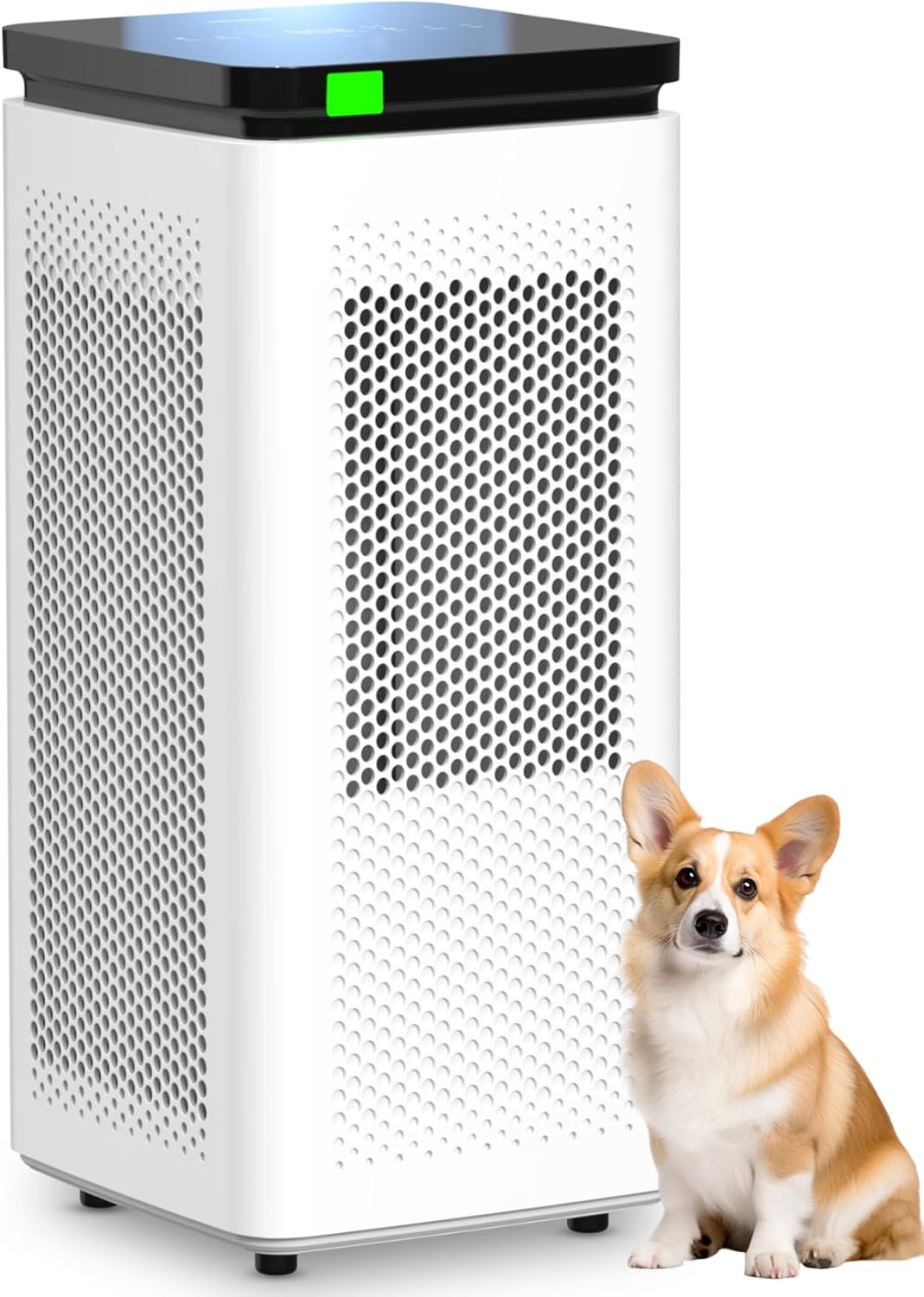
| CADR | 235 CFM |
|---|---|
| HEPA Grade | H13 True HEPA (0.1 μm, 99.97%) |
| Coverage | Up to 3500 sq ft |
| Noise (Sleep Mode) | 30 dB |
| Energy | ENERGY STAR certified |
The SIESEAN AP-400 is a large-room air purifier built to move air quickly while handling particles and odors. It pairs an H13 True HEPA element (0.1 μm, 99.97%) with activated carbon to capture dust, pollen, pet dander, smoke, VOCs and common household odors, and its dual-sided intake plus 235 CFM CADR claims faster circulation that the brand says can clean 500 sq ft in 15 minutes and cover up to 3,500 sq ft. Controls include an auto mode driven by a PM2.5 air-quality display, a timer, child lock, and a dimmable panel, and a dedicated sleep mode drops noise to about 30 dB for nighttime use. Energy Star certification and filter-replacement reminders keep running costs reasonable. The unit is designed for floor placement in living rooms, basements or open-concept spaces, and brand filters are sold separately. Expect solid real-world performance for pet owners, cooks and households that need continuous odor and smoke control, but note that replacement filters are consumables and long-term costs depend on frequency of use and filter pricing.
Best for: Buyers who want an efficient, low-noise purifier that can cycle air quickly in large open living areas and reduce smoke, pet dander and cooking odors while keeping energy use down.
Less Ideal for: People who need a compact or portable purifier for small bedrooms, desks, or travel use should look at smaller models designed for confined spaces instead.
- H13 True HEPA plus activated carbon for particle and odor removal
- 235 CFM CADR with dual-sided intake for faster room circulation
- PM2.5 display with auto mode provides real-time adjustments
- Quiet 30 dB sleep mode and dimmable panel for night use
- ENERGY STAR certified to limit daily energy draw
- Replacement filters must be purchased periodically and add to operating cost
- Large coverage claims assume optimal placement and may vary with room layout
Verdict: A strong, energy-efficient option for homeowners who need fast, quiet purification across large open rooms.
VOOPNU H13 HEPA Air Purifier DH-JH12

| Model | DH-JH12 |
|---|---|
| Filtration | H13 True HEPA triple-layer |
| Coverage (claimed) | Up to 1,076 ft² per hour |
| Noise (claimed) | 22 dB |
| Speeds | 3 speeds |
The VOOPNU DH-JH12 is a compact tower air purifier built around an H13 true HEPA triple-layer filter and 360 degree intake to capture particles like pet hair, pollen, smoke, and odors. It is intended for continuous use in larger open areas — the brand cites cleaning 250 ft² every 15 minutes and coverage up to about 1,076 ft² per hour — and offers three fan speeds, a timer, and a small essential oil tray for light scenting. The unit is quiet at low settings (claimed 22 dB) so it can run overnight without much disturbance, and its simple one-touch control panel makes operation straightforward. Practical benefits include a small footprint that fits on desks or corners while still moving a lot of air, multiple certification claims for safety, and a washable or replaceable multi-stage filter design. Limitations are typical for a compact consumer purifier: filter life requires regular replacement, performance depends on continuous operation for best results, and peak airflow and CADR figures are provided by the maker rather than independent lab reports in this listing.
Best for: Buyers who need an affordable, easy-to-use purifier that can run continuously in large open living spaces and prioritize quiet, compact equipment over industrial airflow.
Less Ideal for: Those seeking the highest possible CADR or commercial-grade airflow for very large or heavily polluted spaces should consider larger, more powerful units instead.
- H13 true HEPA triple-layer filtration capturing 99.97% of airborne particles
- 360° surround air intake for more even room circulation
- Compact footprint lets you place it on desks or in corners while still covering large areas
- Very quiet operation on low speed (claimed 22 dB) suitable for bedrooms
- Simple one-touch controls and timer for easy continuous use
- Manufacturer-stated coverage and cleaning rates are not independently verified in the listing
- Filter replacement is required on a regular schedule to maintain performance
- Small physical size may mean reduced raw airflow compared with larger commercial purifiers
Verdict: A budget-friendly, quiet HEPA tower purifier that balances compact size with claimed coverage for large open rooms.
Levoit Vital 200S-P Air Purifier

| Floor Area | 1875 square_feet |
|---|---|
| Noise Level | 27 db |
| Particle Retention Size | 0.1 micrometer |
| Wattage | 51 |
| Power Source | Corded Electric |
The Levoit Vital 200S-P is a smart air purifier built for whole-room filtration in large, open spaces and pet households. It uses a three-stage filter (pre-filter, HEPA-style middle, and activated carbon) and an enhanced U-shaped inlet to capture dust, pet hair, dander, smoke, and odors, while an onboard air quality monitor and app control let you track and adjust performance remotely. AHAM-verified CADR ratings for smoke, dust, and pollen mean it moves air quickly enough to service large rooms, and the unit runs quietly in sleep mode at about 27 dB for bedrooms or shared living areas. Practical benefits include washable pre-filter media to lower replacement cost and multiple specialty replacement filters (pet allergy, toxin absorber, smoke remover) to tailor performance. Trade-offs are typical for a large-room purifier: it is relatively heavy and takes a full footprint in a room, and optimal performance requires periodic filter replacements and appropriate placement away from walls to maintain airflow.
Best for: Buyers who prioritize reliable, verified whole-room air cleaning for large open spaces and pet households and want remote monitoring and control.
Less Ideal for: Small-room buyers seeking ultra-compact or portable purifiers or users unwilling to schedule filter replacements and occasional maintenance.
- AHAM-verified CADR ratings for smoke, dust, and pollen support fast whole-room cleaning
- Three-stage filtration with washable pre-filter and activated carbon handles particles and odors
- App control plus built-in air quality monitor for remote monitoring and adjustments
- Quiet sleep mode at about 27 dB suitable for bedrooms or quiet living areas
- Multiple specialty replacement filters available for pets, smoke, or toxins
- Unit is relatively heavy and occupies noticeable floor space
- Maintaining peak performance requires periodic replacement of non-washable filter stages
Verdict: Choose the Vital 200S-P when you need a verified, smart-capable purifier that reliably cleans large open rooms and adapts to pet or smoke problems.
WINIX 5520 Air Purifier
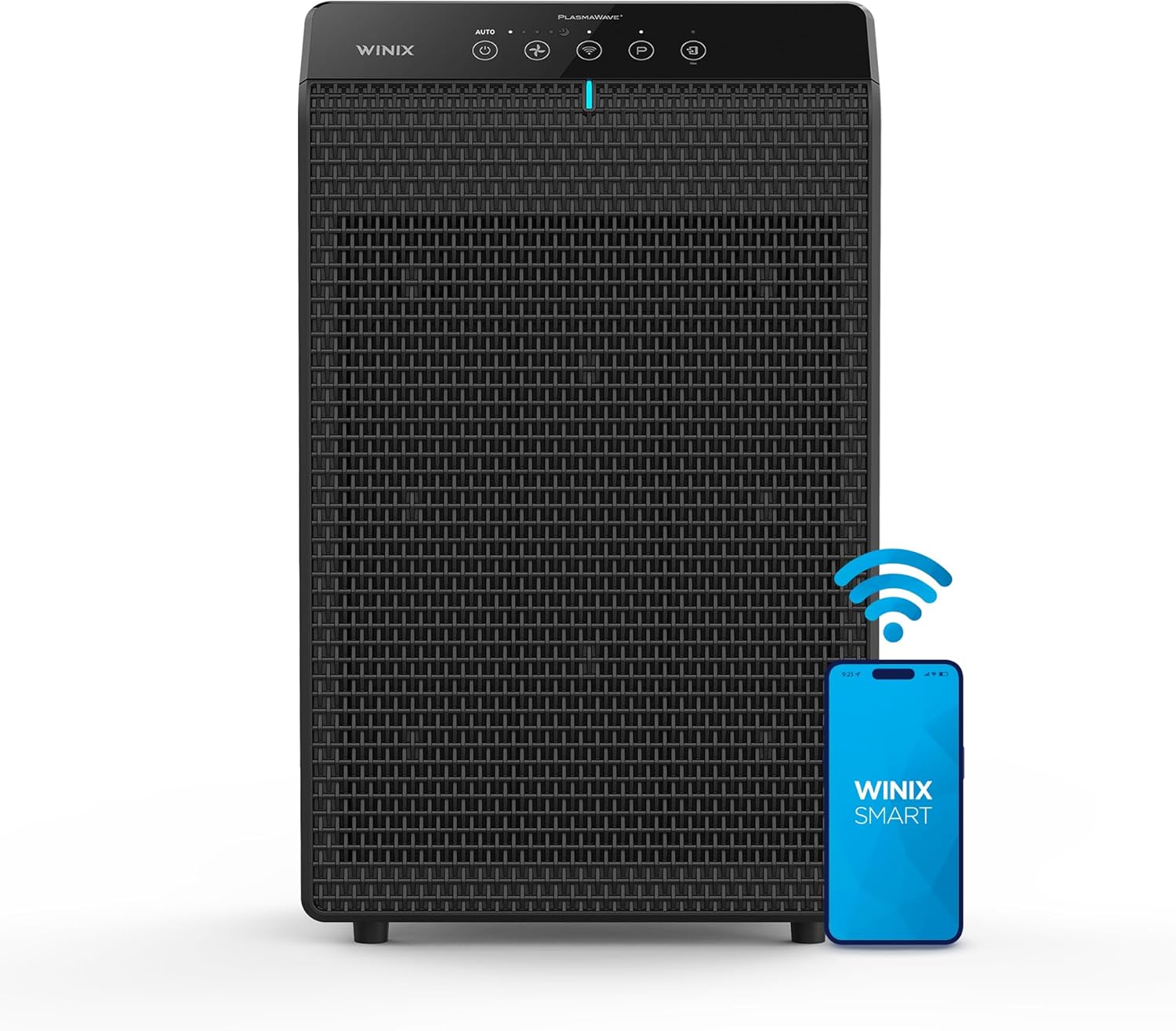
| Item model number | 5520 |
|---|---|
| AHAM verifide coverage | 392 sq ft (CADR basis) |
The WINIX 5520 is built to clean large open spaces using a 4-stage system that combines a washable pre-filter, True HEPA filtration, and an advanced carbon deodorization layer, with Winix PlasmaWave technology as an added pollutant-reduction feature. It is typically placed in living rooms, open-plan areas, or near pet zones where dust, smoke, pet dander, and cooking odors concentrate. Smart sensors continually monitor air quality and the LED indicator plus Auto Mode adjust fan speed automatically so the unit responds without manual fiddling, and Sleep Mode makes it unobtrusive at night. The washable fine mesh pre-filter reduces large-particle load on the HEPA filter, and the carbon layer targets VOCs and odors to extend filter life. Expect quiet operation on low speeds but increased noise on higher turbo settings needed for very fast circulation. Replacement filters are required periodically and the PlasmaWave feature is supplemental rather than a replacement for mechanical filtration. For large spaces the unit is AHAM verified for CADR performance, which helps set realistic expectations for coverage and exchange rates.
Best for: Buyers who prioritize verified performance and want a responsive, low-maintenance purifier for large open rooms where real-time monitoring and odor control matter.
Less Ideal for: People who need an ultra-quiet unit at maximum airflow or those looking for a permanently maintenance-free solution with no recurring filter costs.
- Four-stage filtration including True HEPA that captures ultrafine particles down to 0.01 microns
- Advanced carbon filter for reduced odors and VOCs
- Built-in air quality sensor with LED indicator and Auto Mode for hands-off operation
- Washable pre-filter helps protect and extend HEPA filter life
- Sleep Mode and low-noise operation for overnight use
- Higher fan speeds are noticeably louder when rapidly cleaning very large spaces
- Filters must be replaced periodically, adding to long-term cost
Verdict: Choose the WINIX 5520 when you need a proven, sensor-driven purifier that actively adapts to air quality and handles odors and fine particulates across large open spaces.
Choosing the Right Air Purifier for Large Open Space: Key Factors to Consider
Clean Air Delivery Rate (CADR) and Real Coverage
CADR is the primary metric that predicts how quickly a purifier can reduce airborne particles in a room. For large open spaces, look for higher CADR numbers for smoke, dust, and pollen because a single unit must move a lot more air than in a small bedroom. Higher CADR translates to faster air changes per hour and more consistent reductions in particulate levels.
Also consider the purifier's recommended coverage area and the assumed air changes per hour used to calculate that estimate. Manufacturers often quote coverage at a lower ACH; for large open spaces you should target a higher ACH depending on occupancy and pollution sources. Positioning and room airflow patterns affect effective coverage, so pick a unit with headroom above your calculated need.
Filtration Stages and Particle Capture
A multi-stage filtration system reduces a wider range of contaminants. True HEPA-class filtration or equivalent is essential for capturing fine particles like smoke and PM2.5 that travel across large rooms. Pre-filters help trap hair and large debris, extending primary filter life, while additional stages such as activated carbon target odors and gaseous pollutants.
Consider the stated particle sizes the main filter captures and whether the purifier includes specific media for odors or VOCs if you expect those issues in an open-plan living space. The combination of mechanical and adsorptive stages gives the most versatile protection.
Noise Output in Daily Use
Noise becomes more noticeable as you increase airflow to cover a big area. For living rooms or combined spaces where people watch TV or converse, look for models with low decibel levels at medium to high fan speeds, or with a night mode that maintains reasonable CADR quietly. Manufacturers sometimes list dB(A) at specific speeds; compare those figures and read real-world feedback when possible.
Also evaluate whether variable fan speed controls and scheduling let you boost airflow when needed and run quieter during downtime. A slightly larger unit running quietly can be preferable to a small unit forced to run at maximum and sounding intrusive.
Energy Use and Operating Cost
Running a purifier in a large space often means longer daily run times and higher energy consumption. Check the power draw at typical operating speeds to estimate monthly energy costs. Energy-efficient motors and certified low-power modes help reduce expense without sacrificing much performance.
Consider models with programmable timers or automatic sensors that modulate fan speed based on measured particle levels. These features often lower average power use and reduce total cost of ownership over the unit's lifetime.
Filter Life, Availability, and Replacement Cost
Filter replacement is an ongoing cost that can dominate the lifetime expense for a high-usage unit in a large space. Look for clear estimates of filter life in hours or months under typical use, and find out how easy it is to access and replace filters. Combined or modular filters may simplify maintenance but can raise replacement prices.
Also check whether compatible replacement filters are widely available and labeled with clear performance specifications. Long-lasting filters or washable pre-filters can lower waste and operating costs, but ensure washable elements do not compromise overall capture efficiency.
Placement Flexibility and Airflow Design
How a purifier distributes air matters for open spaces. Some units use 360-degree intakes and tall, upward discharge to promote mixing, while others push air directionally. Consider room layout, furniture placement, and where occupants spend time to choose a design that can be placed for optimal circulation.
A unit that performs well when placed against a wall is useful if floor space is limited. Conversely, towers or units intended for central placement can create better whole-room mixing but require cleared floor area. Think about routing power and the visual footprint as part of placement planning.
Estimating How Much Coverage You Need
Calculate your space by measuring length and width to get square footage, then factor in ceiling height for volume when contamination sources are high. For large open areas, aim for at least 4 to 6 air changes per hour for general indoor air quality and higher for smoke or heavy pollution events.
Use the unit's CADR and the desired air changes per hour to estimate the necessary capacity. If a single purifier does not reach the desired ACH, consider multiple units placed to complement airflow patterns rather than clustering one high-capacity unit in a corner.
- Measure floor area and consider ceiling height
- Target 4 to 6 ACH for routine use, more for smoke or allergens
- Use CADR to translate ACH targets into unit capacity
Placement Tips for Large Open Plans
Position purifiers to encourage cross-room airflow. Placing a unit near a central traffic area or where pollutants originate yields quicker reductions. Avoid hiding units behind large furniture which can block intake or discharge.
If you use multiple units, stagger them across the room so their intake and discharge flows promote mixing. Keep units at least a few feet from walls to prevent restricted airflow and consult manufacturer clearance guidelines if available.
- Place near pollutant sources when possible
- Allow several feet of clearance from walls and obstructions
- Use multiple units spaced across the room for even coverage
When to Rely on Multiple Units Instead of One
Very large or segmented open plans may benefit from two or more purifiers rather than a single very large unit. Multiple units reduce the distance air must travel before being filtered, improving response time and evening out flow patterns.
Using several mid-sized units also helps with noise management because you can run each at lower speeds while maintaining the combined CADR. This approach can also offer redundancy: if one unit is offline for maintenance the room still retains partial filtration.
- Multiple units improve mixing and reduce dead zones
- They can lower perceived noise by running at lower speeds
- Provide redundancy during maintenance or filter changes
Managing Odors and Gaseous Pollutants
Particulate filtration and gas-phase adsorption are different problems. For odors, cooking vapors, or VOCs in an open space, a purifier with a substantial activated carbon stage or dedicated VOC filter is important. Assess if you need continuous VOC removal or periodic heavy-duty adsorption following known events like painting or cooking.
Be aware that carbon and specialty filters saturate and require replacement based on exposure, not just time. If odors are intermittent, consider models with replaceable carbon inserts or optional boost cycles to address spikes without permanent high operating costs.
- Look for substantial activated carbon media for odors
- Carbon filters saturate based on exposure, plan replacements
- Use boost modes for episodic events to conserve filter life
Noise Management Strategies
If the open space is also a living or entertainment area, prioritize units with lower dB ratings at mid and high speeds. Check whether the unit offers a quiet mode that still provides meaningful CADR, or an automatic mode that ramps up only when sensors detect elevated particles.
Physical placement affects perceived noise. Positioning a purifier slightly away from seating areas or using multiple units at lower speeds can reduce perceived noise without sacrificing overall cleaning performance.
- Compare dB(A) figures at different speeds
- Use automatic or quiet modes for nighttime or social hours
- Place units to minimize direct airflow or noise near seating
How We Chose the Best Air Purifier for Large Open Space
We selected units that demonstrate measurable performance in large open areas and that offer practical usability for daily home environments. Evaluation emphasized measurable airflow and filtration, because large open spaces demand high clean-air delivery rates rather than slow circulation. Our filters included CADR and estimated square-foot coverage at the recommended air changes per hour, filtration stage and particle capture efficiency, measured or manufacturer-stated noise levels at common fan speeds, and typical filter life plus ease of replacement. Energy consumption and real-world runtime costs were considered to reflect ongoing operating expense in bigger spaces. We excluded small-room purifiers and any units whose performance claims lacked clear CADR or coverage data. We also filtered out designs that rely solely on one-stage filtration without HEPA-class or equivalent particle capture. The final list favors balanced designs that pair strong airflow with maintainable noise and upkeep profiles.
Our full evaluation process is outlined in our review methodology.
FAQ
How many air changes per hour should I aim for in a large open living area?
Aim for at least 4 to 6 air changes per hour for general indoor air quality. If smoke, heavy cooking, or allergy triggers are common, target higher ACH to reduce particulate levels more quickly.
Can one high-capacity purifier cover an entire open-plan space?
Sometimes, but it depends on the room layout and airflow. A single high-CADR unit can work for many open areas, but multiple units often produce more even coverage and lower noise by allowing each unit to run at lower speeds.
Do I need activated carbon if my main concern is dust and pollen?
Activated carbon mainly targets odors and gaseous pollutants. For dust and pollen, a true HEPA-class filter is the priority. Carbon is useful if you also want odor or VOC removal in the same space.
How often should I change filters when running a purifier in a large area?
Filter life depends on pollutant load and runtime. Heavy usage in a large space can shorten filter life, so check manufacturer life estimates and inspect pre-filters frequently. Expect more frequent replacements than for small-room use if the unit runs continuously.
Will running a purifier continuously in a large space dramatically increase my energy bill?
Running time and fan speed determine energy use. Energy-efficient motors and automatic modes reduce average consumption. Estimating power draw at typical speeds helps predict monthly costs and choose a unit that balances performance with energy use.
Final Verdict
When choosing an air purifier for a large open space, prioritize CADR and realistic coverage estimates first, then balance filtration stages with noise and operating cost. Consider whether one high-capacity unit will create effective circulation or if multiple strategically placed units will yield faster, quieter results. Weigh filtration efficiency, activated carbon needs, and filter-replacement logistics against energy and noise tradeoffs. That approach helps you pick a solution that maintains good air quality without creating undue noise or unexpectedly high upkeep.