
Note: This article contains affiliate links. If you click on these links and make a purchase, we may earn a small commission at no extra cost to you. This helps support our research and content. Read our full affiliate disclosure here.
If you are worried about lead dust in your home, choosing an effective air purifier matters for health and cleanup. Lead dust is a fine particulate that can linger on surfaces and in the air, so a purifier that captures small particles and circulates air across the whole room reduces exposure and helps keep settled dust from becoming airborne again. This guide shortlists the top-performing air purifiers for lead dust, focusing on filtration efficiency, room coverage, and maintenance ease. Below you will find the picks we vetted and the criteria we used so you can choose the right unit for bedrooms, living spaces, or renovation areas.
Top Picks at a Glance
| Best Overall The best all-around choice for most situations | Winix 5510 Air Purifier |  |
| Best Quality Built to a higher standard if you want something more solid | IQAir HealthPro Plus XE |  |
| Best Value The sweet spot between price and what you get | Coway Mighty AP-1512HH |  |
| Best Budget The cheapest option that still gets the job done reliably | FULMINARE H13 HEPA Air Purifier |  |
| Top Rated A top-rated pick with lots of positive feedback | PuroAir 100i HEPA Air Purifier |  |
| Most Popular A crowd favorite that many people choose with confidence | Levoit Core 300-P Air Purifier |  |
| Best Seller A high-volume bestseller chosen again and again | Levoit Vital 100 Air Purifier |  |
Winix 5510 Air Purifier

| Model | 5510 |
|---|---|
| AHAM Verified Coverage | 1,882 sq ft in 1 hr |
| Filtration | 4-Stage True HEPA + Carbon + PlasmaWave |
| Noise | 23.5 dB (lowest) |
The Winix 5510 is a 4-stage air purifier built for large rooms and sustained indoor use. It uses a washable pre-filter, True HEPA filter and an advanced carbon filter to capture fine particulates, odors and VOCs, while Winix PlasmaWave technology further reduces airborne impurities. Built-in air quality sensors drive an Auto Mode that adjusts fan speed in real time and an LED AQI indicator gives a quick view of conditions; Sleep Mode mutes the unit when the room is dark. The unit is AHAM verified and UL certified for performance and safety, and the Winix Smart App plus voice support lets you monitor and control it remotely. Practical benefits include strong particulate removal down to very small particle sizes and lower household odors, making it suitable for continuous daytime or overnight use. Limitations are typical for high-capacity purifiers: replacement filters and carbon media are ongoing costs, and a unit this powerful can be larger and less discrete than compact bedroom models.
Best for: Buyers who want a single, reliable purifier that can run continuously in larger living spaces to reduce fine dust, smoke, pet dander and household odors while offering smart controls and automated operation.
Less Ideal for: People needing a tiny, highly portable bedroom unit or those unwilling to budget for periodic replacement filters should consider smaller or simpler models instead.
- 4-stage filtration with True HEPA captures very small particles including fine dust and allergens
- Advanced carbon filter targets household odors and some VOCs
- Smart sensors with Auto Mode and AQI indicator provide automated, responsive cleaning
- Washable pre-filter extends life of main filters and reduces maintenance cost
- Winix Smart App and voice assistant support allow remote monitoring and control
- Requires periodic replacement of HEPA and carbon filters which adds ongoing cost
- Large-room performance means the unit is physically larger and less portable than small purifiers
Verdict: If you need a smart, high‑capacity purifier to reduce very fine dust and household odors across large rooms, the Winix 5510 delivers strong continuous performance and automated control.
IQAir HealthPro Plus XE

| Coverage | Up to 1125 sq. ft. |
|---|---|
| Filtration efficiency | 99.5% at 0.003 microns |
| AirVisual app integration | Yes |
| Sensor-based operation | Yes |
The IQAir HealthPro Plus XE is a premium HyperHEPA air purifier built to remove ultrafine particles and maintain clean air in large spaces. It uses IQAir's HyperHEPA filtration, which the brand certifies to capture at least 99.5% of particles down to 0.003 microns, and pairs that with a multi-speed fan and an advanced particle sensor for continuous monitoring. Typical use is in large rooms or whole open areas where persistent fine-particle sources exist; the unit is meant to run regularly or on automatic sensor-driven cycles and can be monitored and controlled via the AirVisual app. Notable features include coverage rated to about 1125 sq ft, three smart modes that adjust fan speed by detected particulate levels, and a redesigned fan system claimed to be up to three times more energy efficient than prior models. Practical benefits are very high filtration efficiency for ultrafine dust and smoke, long-lived filters, and remote monitoring. Important limitations are its large physical size and substantial weight, and the premium price and ongoing filter replacement costs associated with medical-grade filtration.
Best for: Buyers who prioritize maximum particle-removal performance in large spaces and want a sensor-driven, app-controllable system to reduce very fine dust and airborne contaminants.
Less Ideal for: People looking for a compact, low-cost portable purifier for small rooms or occasional use should consider smaller, less expensive models instead.
- HyperHEPA filtration captures ultrafine particles down to 0.003 microns for very high particulate removal.
- Rated coverage for large rooms up to 1125 sq ft suitable for open-plan spaces or whole-room treatment.
- Smart particle sensor with automatic modes adjusts operation to real-time air quality.
- Energy-efficient fan design reduces operating power compared with previous models.
- Large and heavy unit that requires a dedicated space and may be harder to move between rooms.
- High initial cost and eventual filter replacement expenses for HyperHEPA and gas pre-filters.
Verdict: Choose the HealthPro Plus XE when you need the highest practical filtration for ultrafine particles across very large rooms and want sensor-driven, app-enabled control.
Coway Mighty AP-1512HH

| Coverage | Up to 1,748 sq. ft. in 60 minutes |
|---|---|
| Filtration stages | Pre-filter, Deodorization, Bipolar Device, HEPA |
| HEPA effectiveness | 99.97% of 0.3μm particles |
| Features | Air quality indicator, Auto & Eco modes, Timer, Filter indicator |
The Coway Mighty AP-1512HH is a countertop air purifier designed to clean medium-to-large spaces quickly using a four-stage system: washable pre-filter, deodorization (carbon) filter, true HEPA filter, and bipolar ionizer. It continuously monitors indoor air quality and adjusts fan speed in Auto mode, and an LED indicator reports pollution levels so you can see when the unit is working harder. Practical touches include an Eco mode that saves power when air is clean, a timer, and a filter indicator that notifies when the HEPA or pre-filter needs attention. In real-world use it is easy to place in a living room or bedroom and leave running; the washable pre-filter reduces maintenance cost between HEPA replacements. Limitations to consider are that filter replacement and the bipolar device require periodic upkeep, and very large open-plan areas may need multiple units or longer runtimes to reach the same removal levels. For particulate concerns like lead dust this model's true HEPA filtration and measurable CADR performance make it an effective choice in appropriately sized rooms.
Best for: Buyers who prioritize reliable particulate removal and sensible running costs and want a straightforward, sensor-driven purifier for bedrooms, living rooms, or home offices where reducing airborne heavy dust makes a measurable difference.
Less Ideal for: Those needing whole-house filtration or a single unit to rapidly clean very large open areas should consider larger-capacity systems or multiple units instead.
- True HEPA filter removes 99.97% of 0.3 micron particles for effective particulate capture
- Auto mode with air quality sensor adjusts fan speed in real time
- Washable pre-filter lowers routine maintenance cost
- Carbon deodorization filter reduces odors and VOCs alongside particles
- Compact footprint and timer/Eco mode for energy-conscious use
- Requires periodic HEPA and carbon filter replacements to maintain performance
- Single unit may not be sufficient for very large or open-plan spaces
Verdict: Choose the Coway Mighty AP-1512HH when you want a proven, sensor-driven HEPA purifier that reliably removes fine dust and particles in medium-sized rooms while keeping running costs reasonable.
FULMINARE H13 HEPA Air Purifier

| Filter type | H13 HEPA |
|---|---|
| Recommended room size | Up to 215 sq ft / 20 m² |
| Noise level (low) | Around 24 dB |
| Timer options | 2, 4, 8, 10, 12 hours |
The FULMINARE H13 is a small, budget-friendly air purifier meant for single rooms and bedside use. It uses an H13 true HEPA filter and 360 degree airflow to cycle the air up to five times per hour in spaces up to about 215 sq ft, making it suitable for reducing airborne particles in a bedroom or office. Controls include multiple fan speeds, a sleep mode that runs very quietly, an independent night light, and five timer settings for hands-off operation. The unit is portable and plugs in via a bottom-mounted adapter, and the replaceable filter design simplifies maintenance. Important limits are its room-size cap and modest circulation rate compared with larger machines, so expect slower clearance in bigger or heavily contaminated rooms and plan for regular filter replacement. For everyday use against common indoor particulates and occasional smoke or pet dander, this model delivers practical filtration at a low cost, but it is not a high-capacity purifier for whole-home or heavy industrial contaminants.
Best for: Buyers on a tight budget who need an affordable bedroom or small-room purifier that runs quietly at night and is simple to use and maintain.
Less Ideal for: People seeking high-capacity filtration for large rooms, whole-house use, or rapid clearance of heavy lead dust or industrial-level contaminants should look at larger, higher-CADR units instead.
- H13 true HEPA filter captures fine airborne particles
- 360° outlet and dual-channel design provide even room circulation
- Near-silent sleep mode suitable for bedrooms
- Independent night light and multiple timer settings
- Compact, portable design with easy filter replacement
- Rated for rooms up to about 215 sq ft so not suitable for large open areas
- Lower circulation rate than larger, higher-end purifiers for heavy contamination
- Requires frequent filter changes under heavy use
Verdict: An inexpensive, quiet bedroom air purifier that provides true HEPA filtration for small rooms and simple nightly use.
PuroAir 100i HEPA Air Purifier
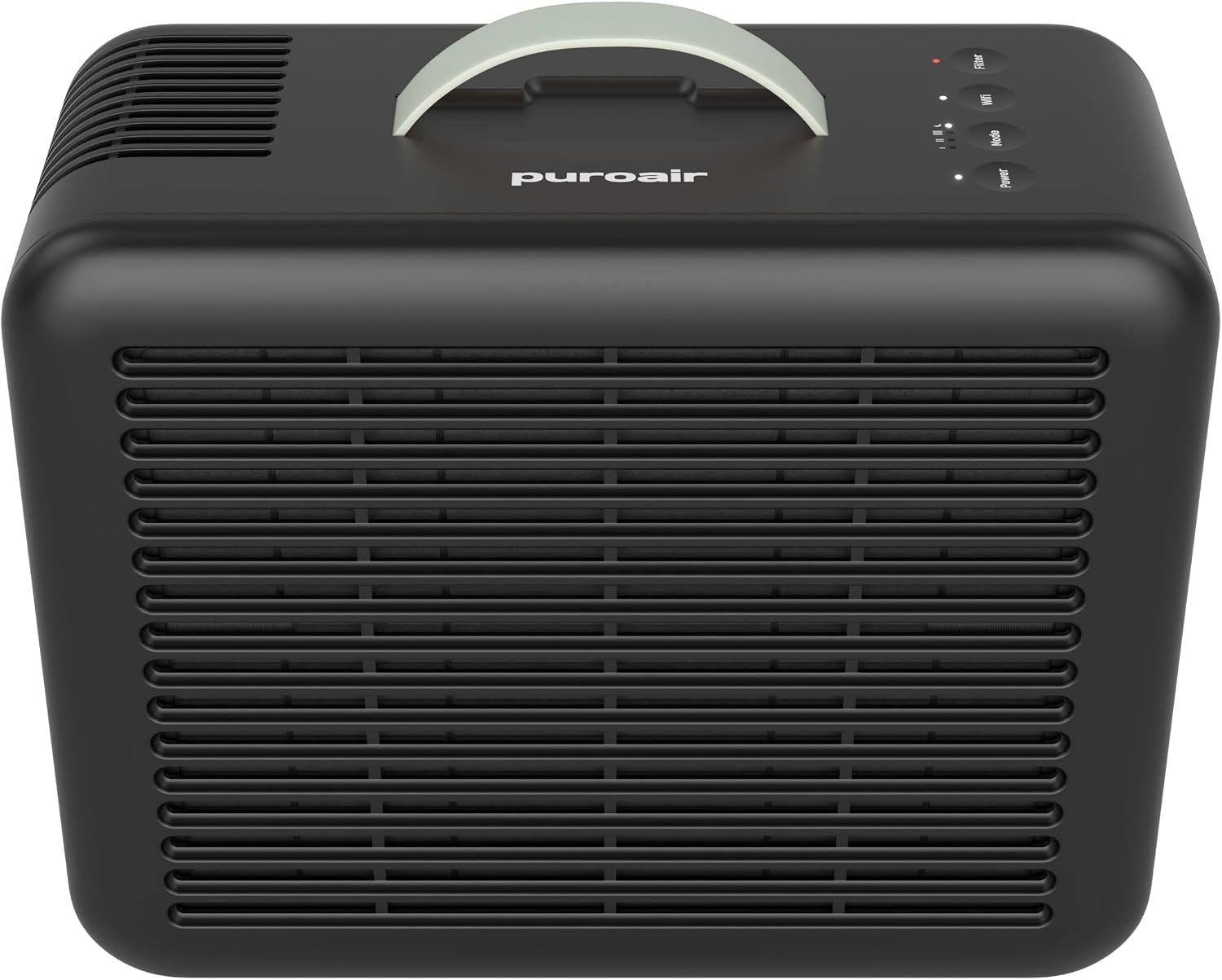
| Model | PuroAir 100i |
|---|---|
| Coverage | Up to 550 sq ft |
| Filtration | 3‑layer (Pre‑filter, True HEPA, Activated Carbon) |
| Connectivity | Wi‑Fi / App control |
The PuroAir 100i is a small, app‑controllable HEPA air purifier built for bedrooms, offices, and other small rooms up to about 550 sq ft. It uses a three‑stage filter stack with a prefilter, True HEPA layer, and activated carbon to capture fine dust, pollen, smoke and household odors while running quietly in sleep mode. The unit is portable and lightweight, so you can move it between rooms easily, and the PuroAir app lets you adjust fan speeds and run schedules from your phone. For dust control it provides steady, hour‑by‑hour air exchanges in modest spaces, and third‑party lab testing cited by the brand supports high particle removal rates. Limitations are its scope and scale: it is sized for small rooms and will take longer to reduce airborne dust in large open floor plans, and routine filter replacements are required to maintain performance. The straightforward controls, quiet operation, and focused filtration make it a practical choice where dependable day‑to‑day dust and allergen reduction is the priority.
Best for: Buyers who want a reliable, easy‑to‑use purifier for bedrooms or small living spaces and who prioritize consistent day‑to‑day removal of dust, pet dander, and smoke over covering large areas.
Less Ideal for: Homes that need whole‑house coverage or rapid clearing of heavy lead dust in large rooms should consider larger-capacity or multiple-unit solutions instead.
- Three‑stage filtration including True HEPA and activated carbon for fine particle and odor capture
- Rated to clean a single room up to roughly 550 sq ft, suitable for bedrooms and offices
- Wi‑Fi and app control for remote fan speed, scheduling, and simple monitoring
- Quiet sleep mode for overnight use
- Designed for small rooms so it is not effective as a sole purifier for large open spaces
- Requires periodic filter replacements to sustain certified filtration performance
Verdict: A compact, app‑enabled HEPA purifier that reliably reduces airborne dust and allergens in small rooms, making it a dependable choice for everyday dust control.
Levoit Core 300-P Air Purifier

| Filter Type | 3 in 1 Filtration |
|---|---|
| Floor Area | 1073 square_feet |
| Noise Level | 24 db |
| Particle Retention Size | 0.3 micron |
| Wattage | 56 watts |
The Levoit Core 300-P is a compact, plug-in air purifier built around a 3-stage filter that captures ultrafine particles down to 0.3 micron with a claimed 99.97% efficiency and a CADR suitable for single rooms. It is typically used in bedrooms, home offices, or living rooms where you want quiet continuous filtration; Sleep Mode drops noise to about 24 dB and the display can be turned off for undisturbed nights. Practical benefits include AHAM verification and CARB/ETL certifications, a touch control panel with timer options, and a relatively low 56W power draw for steady operation. The unit is portable and simple to maintain with a pre-installed original filter and recommended 6 to 8 month replacement interval. Important limitations are that it does not include Auto Mode or smart connectivity on this model, so fan speed must be set manually, and the CADR/coverage figures apply only when using Levoit original filters. For buyers focused on measurable performance and proven filtration in a room-level purifier, this unit offers a reliable, quiet option; if you need whole-house filtration or automated sensor-driven operation, consider larger or smart-enabled models instead.
Best for: Buyers who prioritize independently verified filtration performance and quiet overnight operation in single rooms and want reassurance from certifications and wide user acceptance.
Less Ideal for: People seeking whole-house air cleaning, built-in air quality sensors, or a smart-enabled purifier with automatic speed control should look at larger or connected models.
- True HEPA-grade 3-stage filtration capturing particles down to 0.3 micron with 99.97% efficiency claim
- AHAM verified and CARB/ETL certified for validated performance and safety
- Quiet Sleep Mode (around 24 dB) and display-off option for undisturbed bedrooms
- Portable, low 56W power draw suitable for continuous use
- Pre-installed original filter and clear replacement interval guidance for upkeep
- No Auto Mode or smart connectivity on this model so fan speed must be managed manually
- Coverage and CADR numbers are tied to use of Levoit original filters only
Verdict: A compact, certified HEPA room purifier that reliably removes ultrafine particles while running whisper-quiet, making it a safe, confidence-building choice for single-room air cleaning.
Levoit Vital 100 Air Purifier

| CADR | 105 CFM |
|---|---|
| Particle retention size | 0.3 micron |
| Timer | 2 / 4 / 8 hours |
| Noise level | As low as 24 dB |
The Levoit Vital 100 is a compact, user-friendly air purifier designed to run quietly in bedrooms or small living areas while capturing dust, pollen, pet hair, and odors. It uses a three-stage system: a washable pre-filter for lint and hair, a main efficient particle filter for dust and pollen, and an activated carbon layer to adsorb smells and VOCs. Practical features include a low-noise mode that can reach about 24 dB, a simple touch control panel with a 2/4/8 hour timer, and a check-filter indicator to signal maintenance. With a CADR of 105 CFM and an hourly-clean coverage claim, it is suitable for maintaining cleaner air in single rooms and for routine removal of fine particles. Limitations are that it is sized for single-room use rather than whole-home filtration and that genuine Levoit replacement filters are recommended for reliable performance, which means ongoing filter purchases. The Vital 100 is straightforward to operate and maintain, making it a sensible option for buyers prioritizing quiet, reliable particle and odor reduction in a bedroom or office.
Best for: A cautious buyer who wants a dependable, easy-to-use bedroom or home office purifier that runs quietly and simplifies maintenance.
Less Ideal for: People seeking whole-home or high-volume industrial filtration or those who need integrated smart/home automation features.
- Three-stage filtration including washable pre-filter, particle filter, and activated carbon for odors
- Quiet operation down to approximately 24 dB suitable for sleep
- Compact footprint with a rear handle for easy room-to-room placement
- Simple controls with timer and a filter-check indicator for low-maintenance use
- Intended coverage is single-room scale so not suitable for whole-house air changes
- Requires purchasing genuine replacement filters to maintain claimed performance
Verdict: Choose the Vital 100 if you want a quiet, compact purifier with three-stage filtration that reliably reduces dust and odors in a single room.
Choosing the Right Air Purifier for Lead Dust: Key Factors to Consider
Filtration Efficiency and Filter Type
The core job of any air purifier for lead dust is to trap very small particles. High-efficiency particulate air filtration is the most relevant metric because lead dust can include particles in the submicron to several-micron size range. Choose units with true HEPA filters or clearly stated filtration ratings that specify capture rates for 0.3 micron and smaller particles.
Filter media construction also matters. A densely packed mechanical filter with a well-sealed frame prevents bypass around the filter surface. If a purifier relies on electrostatic or ionic stages without a mechanical filter, its airborne particle capture will typically be much less reliable for lead dust.
Clean Air Delivery Rate and Room Coverage
Cleaning power is a combination of the filter's ability to trap particles and how much air the unit moves through that filter. Clean Air Delivery Rate or equivalent coverage guidance helps you match a purifier to your room size. For spaces where lead dust is a concern, aim for airflow that achieves multiple air changes per hour rather than minimal circulation.
Undersized units will leave areas with settled dust still contributing to airborne levels. Consider the purifier's CADR or manufacturer-specified square footage at a target air-change rate and choose a unit that provides sufficient throughput for the primary room(s) where dust exposure risk is highest.
Sealed-Design and Leakage Control
Even a high-efficiency filter is only effective if all the air passes through it. A sealed-system design minimizes leakage where contaminated air can bypass the filter assembly. Look for well-fitted filter gaskets, a secure housing, and limited intake paths that route air exclusively through the filtration media.
Design features such as filter clamps, magnetic or gasketed doors, and clear replacement instructions reduce the chance of improper reassembly that can create bypass. For lead dust concerns, prioritize units that advertise a sealed airflow path and have clear guidance for correct filter installation.
Filter Lifetime and Replacement Practicalities
Maintenance affects long-term effectiveness and ownership cost. Filters that clog quickly reduce airflow and CADR, which undermines particle removal. Consider estimated filter life under realistic use conditions and the availability of replacement filters. Filters with simple, tool-free replacement and clear change indicators reduce the risk of operating with a degraded filter.
Also think about disposal protocol for used filters in environments with lead dust. A tightly sealed used filter is safer to remove than one that sheds captured dust during handling. Units with accessible but secure filter access panels make safe replacement easier.
Noise and Daily Usability
Many people need continuous air cleaning in bedrooms or living areas. Units that are too loud at effective fan speeds will either be used at lower, less effective settings or turned off. Check noise specifications at typical fan speeds and consider models with a quiet mode designed for night use that still delivers meaningful air changes.
Controls, timers, and smart scheduling can improve usability by letting you run higher speeds during renovation or cleaning and quieter operation overnight. Simpler controls may be preferable for straightforward daily use, while advanced scheduling helps in variable-exposure situations.
Placement, Portability, and Installation
Where you put the purifier affects its ability to capture lead dust effectively. Placement in the center of the room or along typical airflow paths improves circulation through the machine. Portable units let you move cleaning power to rooms undergoing renovation or to rooms where children spend time.
Consider weight, footprint, and whether the unit needs wall clearance for intake or exhaust. Some designs perform best elevated off the floor, while others are intended to sit on the floor. Choose a size and form factor that fits your home layout and the areas that need protection.
How Filtration Works Against Lead Particles
Lead in household dust is transported as fine particles that behave like other aerosols. Mechanical filtration captures particles by interception, impaction, and diffusion. These physical mechanisms allow dense filter media to trap particles across a range of sizes, including many that carry lead.
Understanding the filtration mechanisms helps you interpret filter ratings. A true mechanical HEPA media uses randomly oriented fibers to catch particles, while layered prefilters trap larger debris and extend the main filter's life. Effective systems combine staged filtration with adequate airflow to maintain continuous removal.
- Interception and impaction catch larger particles that collide with fibers.
- Diffusion increases capture of very small particles by Brownian motion.
- Prefilters prolong HEPA life by removing hair and coarse dust first.
Safe Use and Filter Disposal with Lead Dust
Handling filters that have captured lead-laden dust requires care. When replacing a used filter, minimize shaking or tapping that could re-aerosolize trapped particles. Place the old filter in a sealed bag immediately and avoid aggressive handling.
Wear basic protective gear like gloves and a dust mask when changing filters in high-exposure situations. If you are working in a renovation zone or an area with known contamination, treat used filters as contaminated waste and follow local guidelines for disposal of hazardous household materials.
- Seal old filters in plastic before disposal.
- Change filters in a well-ventilated, outdoor-adjacent area if possible.
- Avoid vacuuming used filters or belts that could release particles back into the air.
Using Purifiers During Renovation or Remediation
Renovation activities that disturb older paint or materials can increase lead dust levels dramatically. During active work, run a purifier with maximum effective airflow near the work area and supplement with containment practices such as localized negative-pressure setups and wet cleanup.
After work is done, run continuous filtration for several days to capture residual airborne dust and then perform a careful, wet-wipe cleanup of surfaces. Purifiers are a tool in a layered strategy that includes containment, wet methods, and personal protective equipment for workers.
- Position the purifier downwind from the work area if possible to catch escaping dust.
- Combine air cleaning with HEPA-rated vacuums for surface cleanup.
- Maintain continuous operation at higher speeds during active disturbance.
Matching Unit Size to Room and Usage Patterns
Room dimensions and usage dictate the airflow and runtime needed to meaningfully reduce airborne lead particles. Larger rooms or open-plan spaces require units with higher CADR or multiple units placed strategically to create overlapping coverage.
Consider how often the room is occupied and when higher exposure risk occurs. For intermittent high-risk events, choose a unit that can run at higher speeds without excessive noise. For continuous low-level risk, a quieter unit with consistent moderate airflow may be preferable.
- Calculate room volume to estimate needed air changes per hour.
- Use multiple smaller units for zoned cleaning when single-unit coverage is impractical.
- Factor in nearby ventilation that may dilute or redistribute particles.
Maintenance Routines That Keep Filters Performing
Simple, regular maintenance preserves the purifier's effectiveness. Check prefilters monthly in dusty or renovation-affected environments and replace main filters according to the manufacturer cadence or sooner if airflow drops noticeably.
Record filter change dates and inspect seals for wear. Routine cleaning of external intakes and grilles reduces dust buildup that can impair airflow and increase operating noise over time.
- Create a maintenance log with filter change dates and observed airflow notes.
- Inspect seals and clamps during each filter change to prevent bypass.
- Keep replacement filters on hand if you anticipate frequent changes during remediation.
How We Chose the Best Air Purifier for Lead Dust
We prioritized objective, measurable features that matter for removing lead-laden particles from indoor air. Our selection filters emphasized high-efficiency filtration, verified particle capture ratings, and airflow capacity appropriate for living spaces and work zones where lead dust is a concern. We also considered real-world usability factors such as filter replacement accessibility, noise at common fan speeds, and maintenance frequency. Specifically, the evaluation focused on HEPA or HEPA-equivalent filtration efficiency for submicron particles, CADR or equivalent clean-air delivery relative to room size, sealed-system design to prevent bypass, and practical upkeep demands including filter life and replacement ease. We excluded devices that lacked verifiable filtration specifications or that relied solely on ionic or unproven technologies without a true particle-capture filter. Units intended only for outdoor, industrial, or single-use HVAC integration were not considered. The final list balances filtration effectiveness, usable airflow coverage, and owner convenience so readers can pick a unit that fits their space and maintenance tolerance.
Our full evaluation process is outlined in our review methodology.
FAQ
Can an air purifier remove lead dust from surfaces?
Air purifiers reduce airborne lead particles but do not remove settled dust from surfaces. Use wet-wipe methods and HEPA-rated vacuums for surface cleanup alongside air cleaning to lower overall exposure.
Is HEPA necessary to capture lead particles?
Yes. True mechanical HEPA filters capture a broad range of small particles that commonly carry lead dust. Lower-grade or non-mechanical technologies are less reliable for particulate removal.
How often should I change filters if I am dealing with lead dust?
Change schedules depend on exposure intensity. In renovation or remediation contexts you may need to replace prefilters monthly and main filters more frequently. Inspect airflow and visible loading to decide when to replace rather than relying solely on time.
Can I rely on just one purifier for an entire house?
One unit can help in a single room but will usually not provide sufficient air changes for an entire house. Use multiple units or strategically place one where occupants spend the most time, and supplement with targeted ventilation and cleaning.
Are ionic purifiers effective against lead dust?
Ionic or electrostatic devices may reduce some particles but they do not consistently capture lead-laden dust in a sealed filter. For reliable removal of lead particles, mechanical HEPA filtration is the preferred approach.
Final Verdict
When selecting an air purifier for lead dust, prioritize verified mechanical filtration performance, sufficient airflow for the space, and a sealed design that prevents bypass. Balance the need for high CADR during active disturbance with quieter, maintainable operation for continuous use. Focus on units that are easy to service and dispose of filters safely, and match capacity to the most critical rooms or work areas. With those tradeoffs in mind, you can choose a purifier that meaningfully reduces airborne lead exposure and supports safe cleanup practices.