
Note: This article contains affiliate links. If you click on these links and make a purchase, we may earn a small commission at no extra cost to you. This helps support our research and content. Read our full affiliate disclosure here.
If you are dealing with visible mold or persistent musty odors, the right air purifier can help reduce airborne spores and improve indoor air quality. An air purifier for mold and mildew should focus on proven filtration, appropriate room coverage, and ease of maintenance so the unit can run reliably where you need it most. This guide shortlists the top picks for controlling mold-related airborne particles and explains the evaluation criteria used to choose them. Read on to find a model that balances filtration performance, noise, and practical upkeep for your space.
Top Picks at a Glance
| Best Overall The best all-around choice for most situations | Winix 5510 Air Purifier |  |
| Best Quality Built to a higher standard if you want something more solid | Coway Airmega Mighty2 AP-1512N |  |
| Best Value The sweet spot between price and what you get | VOOPNU HEPA Air Purifier DH-JH12 |  |
| Best Budget The cheapest option that still gets the job done reliably | AromaRoom AP103-A Air Purifier |  |
| Top Rated A top-rated pick with lots of positive feedback | FreAire VisionAir HAP606 |  |
| Most Popular A crowd favorite that many people choose with confidence | Levoit Core 300-P |  |
| Best Seller A high-volume bestseller chosen again and again | Levoit Vital 100 Air Purifier |  |
Winix 5510 Air Purifier

| AHAM Verified coverage | 1,882 sq ft in 1 hour |
|---|---|
| Particle capture | 99.99% to 0.01 microns |
| Filtration stages | 4-Stage |
| Smart features | WiFi / Alexa / Google Home compatible |
The Winix 5510 is a four-stage air purifier built for large rooms, using a washable pre-filter, True HEPA filtration, and an advanced carbon filter to capture allergens, smoke, and household odors. It adds Winix PlasmaWave technology and an air quality indicator with smart sensors that drive Auto Mode to adjust fan speed as needed, and a light-activated Sleep Mode for quiet nighttime operation. The unit is Wi-Fi enabled and works with the Winix Smart App and voice assistants for remote monitoring and control, which helps when you want to track indoor air quality or schedule runs. Practical benefits include AHAM verification for tested room coverage and a CADR-class performance that cleans large spaces quickly, plus washable pre-filters to reduce replacement frequency. Limitations to consider are the need to replace the HEPA and carbon filters periodically and that advanced features like PlasmaWave add complexity some buyers may not prioritize for mold control specifically. Noise rises on higher speeds and replacement filters are an ongoing maintenance cost.
Best for: Buyers who want a high-performance, app-controlled purifier that can handle large living spaces and provide continuous monitoring without fuss.
Less Ideal for: People who need an ultra-quiet bedroom-only unit for very small rooms or who prefer a purifier with no subscription or app connectivity at all.
- Four-stage filtration including True HEPA for submicron particle capture
- Advanced carbon filter for reducing odors and VOCs
- Smart sensors plus Auto Mode adjust cleaning in real time
- Washable fine-mesh pre-filter reduces dust load on primary filters
- Winix Smart App and voice assistant compatibility for remote control
- Requires periodic HEPA and carbon filter replacements
- PlasmaWave is an extra feature that some users consider unnecessary for basic filtration
Verdict: Choose the Winix 5510 when you need a smart, high-capacity HEPA purifier that reliably clears large rooms and keeps indoor air quality visible and manageable.
Coway Airmega Mighty2 AP-1512N
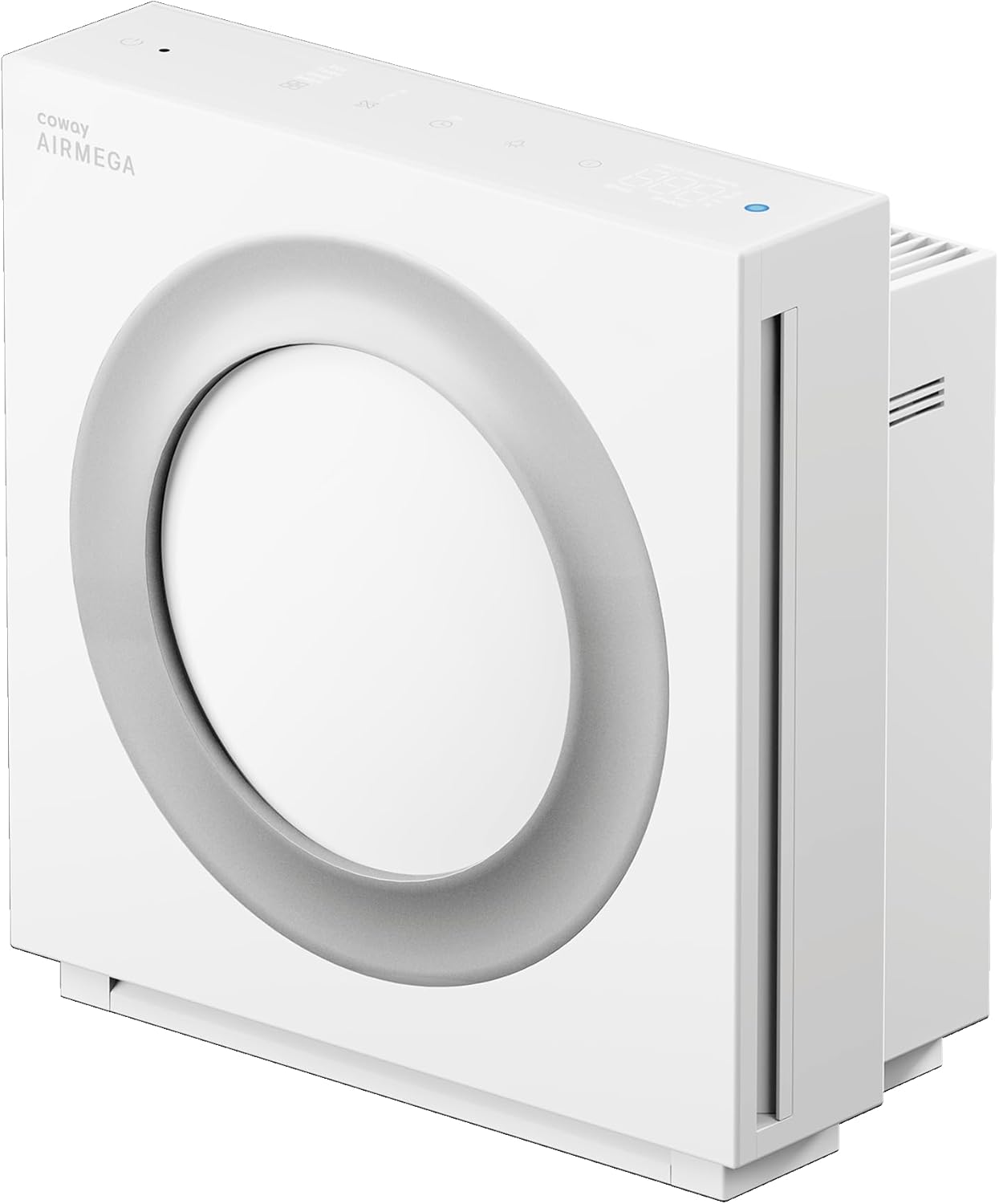
| Max coverage (1 hr) | 1,800 sq. ft. |
|---|---|
| CADR (Smoke/Dust/Pollen) | 240 / 242 / 249 |
| HEPA effectiveness | 99.97% of 0.3μm particles |
| Noise level | 19 dB – 50 dB |
| Power consumption | 56 W |
The Airmega Mighty2 AP-1512N is a room air purifier built for fast, measurable removal of particles and common indoor gases. It uses a three-stage system with a washable pre-filter and a combined HEPA plus activated carbon Max2 filter that the manufacturer and third-party labs certify to capture 99.97% of 0.3 micron particles and remove many VOCs and odors. A laser particle sensor reports PM1/2.5/10 in real time and an LED indicator plus numeric display make air quality easy to read. Smart Mode adjusts fan speed automatically and switches to Eco or Sleep for quieter, lower-energy operation; the unit can run as quiet as 19 dB and consumes up to 56 W on high. Practical touches include a slide-out washable pre-filter, on-screen filter life tracking, and hidden handles for moving the unit. Limitations: it is optimized for whole-room performance and requires periodic filter replacement for the Max2 cartridge, and lab removal rates may vary in real-world spaces with heavy mold sources or high humidity.
Best for: Buyers who prioritize fast, measurable particulate and VOC removal in living areas and want an appliance that auto-adjusts based on precise particle sensing and real-time feedback.
Less Ideal for: Homes where the primary issue is active mold growth inside building materials or very high indoor humidity that require remediation rather than air circulation and filtration.
- IEST-certified HEPA that captures 99.97% of 0.3 μm particles for reliable particulate removal
- Combined activated carbon media that targets VOCs, odors, and certain gases
- Laser sensor that measures PM1/2.5/10 and provides real-time numeric readout for precise monitoring
- Smart Mode with Eco and Sleep reduces energy use and keeps noise down to as low as 19 dB
- Washable pre-filter and on-screen filter-life indicator simplify maintenance and timing of replacements
- Max2 filter cartridge must be replaced periodically which is an ongoing cost
- Lab test results for gas and allergen reduction were achieved under controlled conditions and may differ in typical homes
Verdict: Choose the Mighty2 when you want a high-performance, sensor-driven purifier that removes fine particles and VOCs quickly across large rooms.
VOOPNU HEPA Air Purifier DH-JH12

| Coverage | Up to 1,076 ft² |
|---|---|
| Filtration | H13 True HEPA 3-stage |
| Noise level | 22 dB (low) |
| Speeds | 3 fan speeds |
The VOOPNU DH-JH12 is a small, user-friendly air purifier that uses an H13 true HEPA three-stage filter and 360 degree intake to remove airborne particles in home spaces. It is intended for continuous use and—based on the brand lab figures—can clean a 250 ft² area about every 15 minutes, supporting coverage claims up to roughly 1,076 ft². Controls are simplified to a single-panel interface with three fan speeds and a timer, and the unit includes a small essential oil tray if you want mild scenting. Noise is rated as low as 22 dB on the lowest setting, which is suitable for bedrooms. Certifications listed (DOE, ETL, FCC, CARB, CE, RoHS) indicate it meets several safety and emissions standards. Practical limitations include its very compact footprint that may restrict maximum airflow compared with larger high-CADR machines, and the product relies on regular filter replacement to maintain H13 performance. For mold and mildew concerns it can reduce airborne spores but will not address surface mold or moisture sources, so it works best as part of a broader moisture-control plan.
Best for: Buyers who prioritize a compact, easy-to-use purifier they can run continuously to lower airborne spores and particles in bedrooms or medium rooms while keeping noise minimal.
Less Ideal for: Homes with widespread mold, high indoor humidity, or very large open spaces that need high CADR airflow or dehumidification as part of mold remediation.
- H13 true HEPA filtration captures fine particles and airborne spores down to 99.97% efficiency as claimed
- 360° surround intake promotes even room air circulation from all sides
- Very quiet operation (down to 22 dB) suitable for night use
- Compact footprint makes placement flexible for bedrooms, offices, or corners
- Simple controls and timer make it easy to run continuously for steady air cleaning
- Small physical size may limit peak airflow compared with larger purifiers for very large or open-plan spaces
- Essential oil tray can introduce additional VOCs and is not a substitute for targeted mold remediation
Verdict: A compact, quiet H13 HEPA purifier for buyers wanting continuous, low-noise airborne spore reduction in bedrooms and medium rooms.
AromaRoom AP103-A Air Purifier
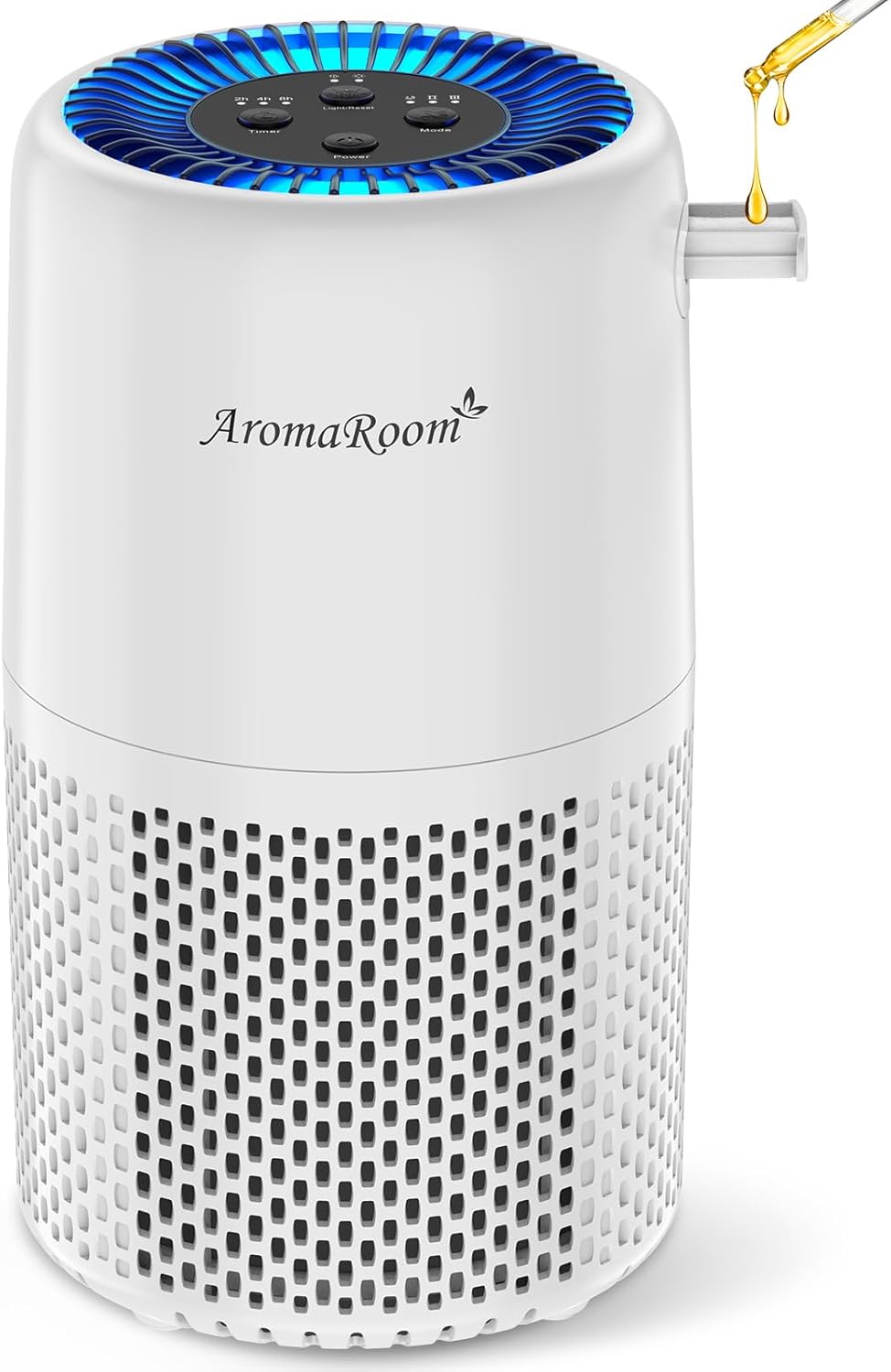
| Filtration | H13 HEPA, 3-in-1 filter |
|---|---|
| Room coverage | Up to 323 ft² |
| Noise level | 22 dB (sleep mode) |
| Timer | 2/4/8 hours |
The AromaRoom AP103-A is a small tabletop air purifier built around a True H13 HEPA filter and a three-stage cartridge designed to tackle dust, pollen, pet dander, smoke and other fine particles as small as 0.1 to 0.3 microns. It is intended for rooms up to about 323 sq ft and circulates room air roughly twice per hour, which makes it suitable for bedrooms, living rooms, and home offices. Controls include sleep mode that drops noise to around 22 dB, three timers, and an aroma pad slot so you can add essential oils. Practical benefits include effective particulate capture from the H13 filter, quiet overnight operation, and a compact footprint that fits on desks or nightstands. Important limitations are that it does not list a specific molecular VOC or gas filter for mold-related odors or spores, and replacement filters are recommended every 3 to 6 months which adds ongoing cost. It also should not be used in high-humidity areas like bathrooms. For shoppers who want a quiet, affordable HEPA purifier with aroma features, this unit performs well in small to medium rooms but is not a comprehensive standalone solution for heavy mold remediation.
Best for: Buyers on a budget who need an affordable, quiet HEPA purifier for small to medium rooms and who value low-noise overnight operation and a compact footprint.
Less Ideal for: Homes with active mold infestations, very large open spaces, or buyers who need a purifier specifically certified for VOC or gas removal should look for models with dedicated gas/charcoal stages and higher CADR ratings.
- True H13 HEPA filter captures at least 99.97% of particles 0.1–0.3 microns
- Quiet sleep mode rated around 22 dB for overnight use
- Designed to circulate air twice per hour in rooms up to ~323 ft²
- Includes aroma pad for optional fragrance
- No explicit activated carbon or dedicated gas/VOC specification for mold odors
- Replacement filters recommended every 3–6 months, creating recurring cost
Verdict: AromaRoom AP103-A is a compact, budget-friendly H13 HEPA purifier that delivers quiet particulate removal for small to medium rooms with the bonus of an aroma pad.
FreAire VisionAir HAP606

| Model | HAP606 |
|---|---|
| Filtration | 3-stage H13 HEPA |
| Noise (sleep mode) | 20 dB |
| Coverage (claimed) | Up to 1800 sq ft |
The FreAire VisionAir HAP606 is a room air purifier that combines real-time PM2.5/AQI monitoring with a 3-stage H13 HEPA filter and a 360° intake to move air quickly through the unit. It is intended for continuous use in large rooms where you want frequent air changes — FreAire advertises up to four air exchanges per hour in an 1800 sq ft space. Controls include an auto mode that responds to the built-in sensor, a low-noise sleep mode around 20 dB for bedrooms, a child lock, and a timer for scheduled operation. Practical benefits include clear numeric and color-coded air-quality feedback so you can see when filament or mold-related particulates spike, and the H13-rated filter captures 99.97% of particles down to 0.3 microns, which helps reduce airborne mold spores. Trade-offs are typical for compact tower purifiers: effectiveness depends on placement and continuous runtime for best mold control, and replacement filters are required to keep performance at factory levels. Certification coverage (ETL, FCC, EPA, CARB) and included support/warranty give added assurance for long-term reliability.
Best for: Buyers who prioritize reliable, sensor-driven air cleaning and want clear, continuous feedback on particulate levels for mold and allergy risk reduction in living areas.
Less Ideal for: People seeking an all-in-one solution for persistent structural mold growth or moisture sources should address humidity and remediation first rather than rely solely on an air purifier.
- H13 3-stage HEPA filtration rated to capture 99.97% of particles down to 0.3 μm.
- Real-time PM2.5 digital display and color-coded AQI indicator for immediate air-quality feedback.
- 360° intake and high-efficiency airflow designed for frequent air changes in large rooms.
- Very quiet sleep mode (~20 dB) suitable for overnight use in bedrooms.
- Safety features and controls including child lock, auto mode, and timer for convenient, supervised operation.
- Advertised room-coverage claims require continuous runtime and proper placement to achieve four air exchanges per hour.
- Replacement filters are proprietary, so long-term operating cost depends on buying genuine FreAire filters.
Verdict: Choose the VisionAir HAP606 if you want sensor-driven H13 HEPA filtration and quiet continuous operation to reduce airborne mold spores and monitor indoor air quality.
Levoit Core 300-P

| Power Source | Corded Electric |
|---|---|
| Filter Type | 3 in 1 Filtration |
| Floor Area | 1073 square_feet |
| Noise Level | 24 db |
| Wattage | 56 watts |
The Levoit Core 300-P is a small, power-dense air purifier that uses a 3-in-1 original filter with HEPA-grade performance to capture 0.1–0.3 micron particles and common indoor contaminants like pollen, dust, pet dander, smoke, and VOCs. It is backed by AHAM verification and runs on a 56W motor that delivers a CADR suitable for refreshing medium to large spaces; Levoit states it can cycle air several times per hour in a typical bedroom and once per hour across a much larger open area. Controls are simple touch buttons with a sleep mode that reduces noise to about 24 dB and dims the display for nighttime use. Practical benefits include portable placement, low operational noise for bedrooms, and widely available genuine replacement filters to maintain performance. Limitations are that smart Auto Mode is not included on this model, so you must adjust fan speed manually, and peak cleaning relies on using official filters as specified by the manufacturer. For mold-related uses, it filters airborne spores effectively but does not address the underlying moisture source.
Best for: Buyers who want a proven, quiet HEPA purifier with certified performance and large user adoption for bedrooms or living spaces where airborne mold spores and fine particles are a concern.
Less Ideal for: People who need automatic air-quality sensing or smart features for hands-off operation or those wanting an integrated solution for humidity control and mold prevention.
- HEPA-grade 3-in-1 filter captures particles down to 0.1–0.3 micron with 99.97% efficiency as tested
- AHAM verified CADR and certifications (CARB, ETL) that confirm measured cleaning performance
- Very quiet Sleep Mode at about 24 dB suitable for overnight use
- Compact and portable design that fits bedrooms and smaller living spaces
- Includes one original pre-installed filter and has widely available genuine replacements
- No built-in Auto Mode or smart connectivity on this model, requiring manual fan adjustments
- Effectiveness depends on using official Levoit filters and replacing them regularly
Verdict: A compact, AHAM-verified HEPA purifier that reliably removes fine particles and airborne mold spores for quiet bedroom or living-room use.
Levoit Vital 100 Air Purifier

| CADR | 105 CFM |
|---|---|
| Filtration | 3-stage (pre-filter, particle filter, activated carbon) |
| Noise level | As low as 24 dB |
| Timer | 2/4/8 hours |
The Levoit Vital 100 is a compact tabletop air purifier that uses a 3-stage filtration system—washable pre-filter, efficient particle filter, and activated carbon—to capture hair, dust, pollen, smoke and household odors. It is typically placed in bedrooms, living rooms or kitchens and runs continuously or on a 2/4/8 hour timer to keep indoor air refreshed. The unit is AHAM-verified with a 105 CFM CADR and claims to cycle air in a typical room once per hour, and a low-noise design delivers operation as quiet as 24 dB for overnight use. Practical benefits include the washable pre-filter to trap large debris and reduce replacement frequency, a carbon layer for odor and VOC control, and a simple control panel with a filter-check indicator. Limitations are that it is intended for smaller spaces despite the CADR claim, replacement filters are necessary for continued performance, and there are no smart or app features for remote control or scheduling beyond the built-in timer.
Best for: Buyers who prioritize a proven, easy-to-use purifier that runs quietly in bedrooms and living areas and who prefer straightforward, low-risk features over smart connectivity.
Less Ideal for: People who need whole-house or large-area purification, require remote app control, or want built-in air-quality sensors for automated adjustments.
- Three-stage filtration including washable pre-filter, main particle filter, and activated carbon for odors
- AHAM-verified performance with a 105 CFM CADR for reliable cleaning claims
- Very quiet operation down to about 24 dB suitable for bedrooms
- Simple controls with 2/4/8 hour timer and filter-check indicator
- No Wi-Fi or app control for remote monitoring or automation
- Relies on replacement filters for long-term performance and costs
- Best suited for small to medium rooms rather than whole-house coverage
Verdict: A quiet, AHAM-verified compact purifier with washable pre-filter and carbon odor control ideal for risk-averse buyers wanting reliable bedroom and small-room performance.
Choosing the Right Air Purifier for Mold and Mildew: Key Factors to Consider
Filtration Technology and Particulate Capture
The most important factor is whether the purifier actually captures mold spores. True HEPA filtration or equivalent mechanical capture is the standard because it traps particles down to 0.3 microns with high efficiency. Look for clear statements about particle capture efficiency and whether the device uses a multi-stage approach that combines a prefilter to catch larger debris and a HEPA stage for spores.
Mechanical filtration matters because technologies that only ionize air or produce ozone can reduce measured particles but do not reliably remove spores from the breathing zone. For mold control, choose devices that emphasize physical removal and provide documentation of their filtration performance.
Coverage Area and Airflow (CADR)
A purifier must move enough air to meaningfully reduce airborne spore counts in the intended space. Clean Air Delivery Rate or a clear square-foot rating tells you the practical coverage. A purifier with high filtration efficiency but low airflow will take much longer to lower spore concentrations in a living room or basement.
Consider where mold or mildew appears most often in your home and choose a unit rated for that room size at the runtime you expect. If you plan to run a unit continuously, lean toward models with higher CADR so they can cycle room air more frequently at quieter fan speeds.
Noise and Continuous Operation
Because mold control often requires long run times, noise is an essential usability factor. Look for measured decibel output at low and medium fan speeds so you can judge whether the unit is suitable for bedrooms, living areas, or workspaces. Some purifiers offer a quiet 'sleep' mode with reduced airflow; ensure the reduced performance still meets minimal CADR for the room.
Lower-noise operation also makes it easier to run the purifier at higher settings when needed, such as during cleaning or remediation. Energy efficiency ties into this factor because quieter, continuously running fans should also be cost-effective to operate over months.
Maintenance Requirements and Filter Cost
Filter replacement frequency and ease of access directly affect long-term effectiveness. Mold-prone environments can load prefilters and HEPA stages faster, so inspect replacement intervals and whether the unit uses washable or reusable prefilters to reduce plastic waste and cost. Check whether replacement filters are standard sizes or proprietary, as availability can influence ongoing cost and convenience.
Maintenance also includes whether the unit alerts you for filter change, how easy the cabinet is to open, and whether filter changes require tools. Simpler maintenance encourages consistent upkeep, which is critical to ensure the purifier continues to capture spores efficiently.
Odor and VOC Reduction
Mold and mildew often produce noticeable odors and release organic compounds that affect comfort. A carbon or activated-charcoal stage helps adsorb odors and many volatile organic compounds, improving perceived air quality alongside particle removal. While carbon does not capture spores, pairing it with a good HEPA stage gives a more complete remedy for the symptoms of mold.
Assess the amount of carbon media and whether it is combined with catalytic or specialized odor treatments. Larger carbon beds and replaceable cartridges typically perform better but can add to maintenance cost.
Placement Flexibility and Physical Footprint
Where you can place the purifier affects how well it treats problem areas. Taller, tower-style units may deliver 360-degree intake and disperse cleaned air more evenly, while compact models can fit on shelves or closets where mold grows. Also consider vertical clearance, floor protection if moisture is present, and whether the purifier can safely operate in basements or bathrooms where humidity is higher.
A unit that is easy to reposition and has predictable airflow patterns will be more effective at targeting mold hotspots.
How Purifiers Help With Mold and Mildew
Air purifiers reduce airborne mold spores, which lowers the chance of inhalation and reduces the pool of particles that can settle and grow. They do not remove mold from surfaces or fix moisture problems, but they can play a meaningful role in a layered approach to remediation.
Use a purifier alongside moisture control and surface cleaning. When run continuously in the affected area, a properly sized air purifier can reduce spore concentration between cleaning cycles and help improve indoor comfort for sensitive occupants.
- Purifiers target airborne spores, not surface colonies
- They are most effective when paired with humidity control
- Consistent operation between cleaning events yields the best results
Where to Place an Air Purifier for Best Mold Control
Position the purifier in or near the room where mold or mildew odors originate. For spot problems like a bathroom or a basement corner, place the unit so the intake faces the contaminated area and the exhaust circulates cleaned air toward the rest of the room.
Avoid hiding the purifier behind furniture or inside closed cabinets. If you intend to treat multiple connected rooms, position the unit centrally or use a higher-capacity model rated for the combined square footage.
- Keep at least a foot of clearance around intakes and exhausts
- Elevate small units slightly to improve air circulation
- Run continuously on low or automatic mode for steady reduction
Maintaining Performance in Humid or Musty Spaces
High humidity accelerates filter loading and can promote microbial growth inside filters if left wet. In humid rooms, choose units with washable prefilters and follow manufacturer guidance to avoid operating in standing-water conditions. Consider combining a dehumidifier with a purifier in basements or bathrooms to reduce moisture at the source.
Regularly inspect filters for visible mold or discoloration. Replace or clean prefilters more frequently in damp conditions and store replacement HEPA and carbon filters in a dry place to avoid premature degradation.
- Use washable prefilters where possible
- Inspect filters monthly in high-humidity environments
- Pair with humidity control when relative humidity exceeds 50 percent
When an Air Purifier Is Not Enough
If mold is visible on walls, ceilings, or structural materials, an air purifier alone will not resolve the problem. Surface remediation, removal of contaminated materials, and fixing leaks or ventilation issues are necessary to stop regrowth.
Use the purifier to reduce airborne exposure during and after remediation, but prioritize correcting moisture sources and cleaning or replacing affected materials for a lasting solution.
- Air cleaning complements but does not replace remediation
- Address leaks, condensation, and ventilation first
- Consider professional assessment for widespread or hidden mold
Energy Use and Long-Term Cost Considerations
Because effective mold control often requires long run times, energy efficiency matters. Look for units with energy-saving modes, programmable timers, or smart controls that can adjust fan speed based on measured air quality.
Also factor in ongoing filter replacement expenses. Larger-capacity carbon or HEPA filters will improve performance but often cost more to replace, so estimate annual operating costs before selecting a high-maintenance model.
- Estimate annual filter expense before buying
- Prefer units with automatic sensing to avoid unnecessary high-speed run times
- Check energy usage at typical settings, not just maximum listed wattage
How We Chose the Best Air Purifier for Mold and Mildew
We evaluated options that specifically address airborne mold spores and the environmental conditions that let mold proliferate. Key filters were filtration efficiency for submicron particles, verified HEPA or equivalent capture rates, and inclusion of prefilters or carbon stages to trap larger debris and odors. Coverage capability and clean air delivery rate were required to match common room sizes where mold appears, so we prioritized units with clear CADR or square-foot ratings. Continuous operation considerations included noise at typical run speeds and energy draw to ensure practical overnight and daily use. Maintenance factors were also assessed: filter replacement frequency, accessibility, and reasonable operating costs. We excluded devices that rely solely on ozone or unproven ionization as a primary mold control method. The final shortlist favors units that combine verified particle capture, sensible airflow for real rooms, and straightforward upkeep.
Our full evaluation process is outlined in our review methodology.
FAQ
Can an air purifier remove mold from walls and ceilings?
No. Air purifiers reduce airborne spores but cannot remove mold colonies on surfaces. Surface remediation and moisture correction are necessary to eliminate visible mold growth.
How often should I change filters in a mold-prone room?
Filter-change frequency depends on load and humidity, but expect more frequent changes than normal use. Inspect prefilters monthly and plan to replace HEPA or carbon stages sooner if you notice odor return or visible debris.
Are ozone-generating purifiers safe for mold control?
Ozone-generating devices are not recommended as a primary mold control method because ozone can be harmful to occupants and does not reliably remove spores from air or surfaces.
Will a purifier stop mold from coming back?
A purifier can lower airborne spore counts, which helps reduce recontamination after cleaning, but it will not stop mold from returning if moisture problems persist. Address leaks, ventilation, and humidity to prevent regrowth.
Is a dehumidifier or an air purifier more important for mold problems?
Both play different roles. A dehumidifier controls the moisture that allows mold to grow, while an air purifier reduces airborne spores. In many cases, using both together provides the most complete mitigation.
Final Verdict
Prioritize units that pair proven particulate capture with adequate airflow for the rooms you need to treat. Filtration efficiency, practical CADR coverage, manageable noise, and straightforward maintenance are the tradeoffs that matter most when targeting mold and mildew. Use an air purifier as part of a broader remediation plan that includes moisture control and surface cleaning. With the right balance of performance and upkeep, you can reduce airborne spores and improve comfort while addressing the underlying causes of mold.