
Note: This article contains affiliate links. If you click on these links and make a purchase, we may earn a small commission at no extra cost to you. This helps support our research and content. Read our full affiliate disclosure here.
If you work with monomers for crafts, resin casting, or lab projects, lingering chemical fumes are a real concern for comfort and health. Choosing the right air purifier for monomer smell helps control volatile organic compounds, airborne particulates, and nuisance odors so you can work longer with less irritation. This guide narrows the field to seven shortlisted air purifiers that are suited to dealing with solvent-like odors, focusing on filtration capability, airflow coverage, and real-world usability. Below we summarize how each unit performs against the needs of hobbyists and small workspace users, then explain the buying factors we used to select them and practical tips for day-to-day use.
Top Picks at a Glance
| Best Overall The best all-around choice for most situations | COWAY Mighty AP-1512HH |  |
| Best Quality Built to a higher standard if you want something more solid | Airpura C700 DLX |  |
| Best Value The sweet spot between price and what you get | MOOKA B-D02L Air Purifier |  |
| Best Budget The cheapest option that still gets the job done reliably | FULMINARE H13 HEPA Air Purifier |  |
| Top Rated A top-rated pick with lots of positive feedback | DREO Air Purifier 338 |  |
| Most Popular A crowd favorite that many people choose with confidence | Levoit Core 300-P |  |
| Best Seller A high-volume bestseller chosen again and again | Levoit Vital 200S-P Air Purifier |  |
COWAY Mighty AP-1512HH

| Coverage | Up to 1,748 sq. ft. in 60 minutes |
|---|---|
| Filtration stages | Pre-filter, deodorization (activated carbon), bipolar ionizer, True HEPA |
| HEPA effectiveness | 99.97% of 0.3μm particles |
| Filter lifespan | Up to 1 Year |
| Auto mode | Yes, with air-quality indicator |
The Coway Mighty AP-1512HH is a room air purifier that combines a washable pre-filter, activated carbon deodorization stage, bipolar ionizer, and a True HEPA filter to remove particles, odors, and some VOCs. It is typically used in living rooms, bedrooms, or home workshops where steady removal of dust, pollen, pet dander, smoke, and odors is needed. Notable features include an auto mode driven by a pollution sensor with a colored air-quality indicator, an eco mode that reduces fan speed when air is clean, a timer, and a filter-change indicator that tracks filter use. The activated carbon/deodorization stage and tested reduction of specific gases make it a reasonable choice for reducing monomer and solvent smells in small to medium spaces, though performance will vary with room size, source strength, and ventilation. The unit is relatively quiet on low settings and has a washable pre-filter to lower maintenance costs, but heavy or continuous chemical sources may require higher-capacity commercial ventilation or multiple units for faster reduction.
Best for: Buyers who want a proven, sensor-driven purifier for general household air cleaning and for reducing everyday chemical or monomer smells in living areas while prioritizing a balance of effectiveness, noise, and maintenance cost.
Less Ideal for: People needing rapid removal of high concentrations of industrial solvents, large workshop spaces, or continuous heavy chemical sources should consider higher-capacity ventilation or dedicated commercial solutions.
- Multi-stage filtration including True HEPA for 0.3 micron particles
- Activated carbon/deodorization filter tested to reduce various gases and odors
- Auto mode with real-time air-quality sensor and visible indicator
- Washable pre-filter reduces maintenance cost and extends filter life
- Eco and timer modes allow quieter, energy-saving operation
- Coverage and odor removal speed depend heavily on room size and ventilation
- Not specifically certified for all types of industrial solvents or high-concentration chemical sources
Verdict: A balanced, sensor-driven purifier with HEPA plus activated-carbon deodorization that is a strong household choice for cutting common monomer and solvent odors in medium-sized rooms.
Airpura C700 DLX

| CFM | 635 CFM |
|---|---|
| Coverage | Up to 2,000 sq. ft (2 air exchanges/hour) |
| HEPA efficiency | 99.97% at 0.3 microns |
The Airpura C700 DLX is a performance-focused air purifier built to tackle airborne chemicals and fine particles in large spaces. It pairs a heavy carbon filter bed with a HEPA barrier to capture VOCs and 99.97% of particles down to 0.3 microns, and its 360° airflow design supports coverage up to about 2,000 sq ft with two air exchanges per hour. The unit advertises a high CFM (listed at 635) and boosted airflow, which helps clear strong odors like monomer smells more quickly than typical home purifiers. It is relatively heavy and built as a robust standalone machine rather than a portable bedroom unit, and its size and industrial filter media mean filter replacement and initial cost are higher than consumer-grade models. Noise is reported to be low at night for its class, making it usable in occupied spaces. This is a no-nonsense purifier when chemical removal and room throughput are the priority, but buyers should expect larger footprint and maintenance commitments compared with small-room HEPA units.
Best for: Buyers who prioritize rapid removal of chemicals, VOCs, and strong odors in large open spaces and want a purpose-built, high‑throughput purifier.
Less Ideal for: Those seeking a lightweight, budget bedroom purifier or a compact unit for small rooms should consider smaller consumer models instead.
- High airflow rate (635 CFM) for fast air exchanges in large rooms
- Dedicated carbon filter bed for broad chemical and VOC adsorption
- True HEPA filtration capturing 99.97% of particles down to 0.3 microns
- 360° air distribution for even room coverage
- Reportedly quiet operation for a high‑capacity unit
- Heavy and large compared with consumer portable purifiers
- Higher upfront cost and likely higher filter replacement expense
Verdict: If you need fast, reliable removal of VOCs and strong monomer smells in large rooms, the Airpura C700 DLX delivers industrial‑grade filtration and high airflow to clear the air quickly.
MOOKA B-D02L Air Purifier
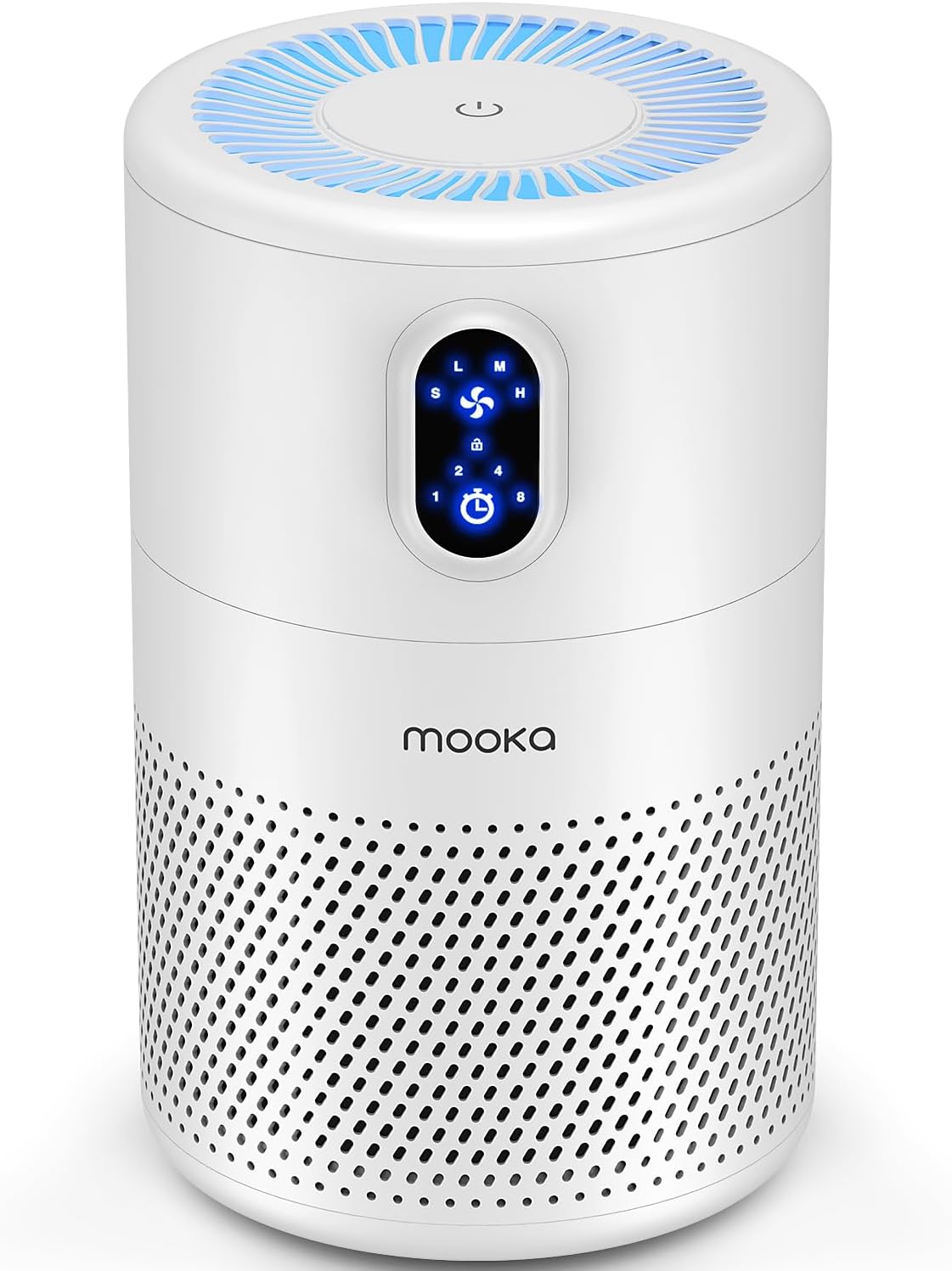
| Effective Area | 1076 sq ft |
|---|---|
| Filter Type | H13 True HEPA + activated carbon |
| Fan Modes | 4 speeds |
| Timers | 1/2/4/8 hours |
The MOOKA B-D02L is a compact tower purifier built around an H13 true HEPA filter plus pre-filter and activated carbon layer to trap pet hair, dust, smoke, odors and particles down to 0.3 microns. It is intended for living rooms, bedrooms or offices and claims coverage up to 1,076 sq ft (with faster air changes in smaller rooms). Controls include four fan speeds, four timer settings and a night light, and safety features include a child lock and a brushless motor that MUOKA rates as very quiet and energy efficient. The activated carbon stage and odor-removing filter make it useful against smells like smoke or household odors, while the washable pre-filter helps capture larger debris and extend filter life. Expect to replace the filter every 3 to 6 months depending on use. Limitations are typical for budget purifiers: actual effectiveness against strong chemical odors depends on carbon filter quantity and contact time, and real-world coverage will vary with room layout and ventilation. Setup is simple and the unit is small enough to move between rooms for targeted odor control.
Best for: Buyers who prioritize practical, moveable odor and particle control for rooms and want a quiet, energy-conscious unit they can use where odors or smoke appear.
Less Ideal for: People needing certified industrial-grade chemical vapor removal or immediate elimination of strong solvent/monomer fumes should consider dedicated activated-carbon or professional ventilation solutions instead.
- H13 true HEPA filtration captures particles down to 0.3 microns
- Activated carbon layer and odor filter for smoke and household smells
- Multiple fan speeds and timers for flexible runtime and quiet night operation
- Child lock and low-noise brushless motor improve safety and overnight use
- Carbon filter capacity not specified so strong chemical odors like monomer may require longer runtime or multiple units
- Filter replacement every 3–6 months adds recurring cost
Verdict: A compact, quiet HEPA purifier with activated carbon that offers practical, energy-efficient odor and particle control for home rooms where you need routine smell reduction.
FULMINARE H13 HEPA Air Purifier

| Filter type | H13 HEPA |
|---|---|
| Recommended room size | up to 215 sq ft / 20 m² |
| Noise level | around 24 dB (low) |
| Timers | 2, 4, 8, 10, 12 hours |
The FULMINARE H13 is a small, budget-focused air purifier that uses an H13 true HEPA filter and 360 degree airflow to refresh air in rooms up to roughly 215 sq ft. It is designed for everyday use in bedrooms, offices, or living rooms and emphasizes quiet operation with a sleep mode that can reach about 24 dB at low fan speed. The unit includes an independent night light and five timer settings for 2, 4, 8, 10, and 12 hours, and the bottom-access filter design makes replacement straightforward. In practice it removes common particulates, pet hair, smoke and odors more effectively than basic particle-only units, but its coverage and circulation rate mean it works best in a single small to medium room rather than open-plan spaces. Buyers should expect routine filter replacements and verify the filter plastic is removed before first use. For a low-cost purifier that balances quiet nighttime use with HEPA-grade filtration, it is a sensible choice with the usual limitations of compact units.
Best for: Buyers looking for an affordable, quiet HEPA purifier for a bedroom or small living space who prioritize low noise and simple timer/night-light features over whole-house coverage.
Less Ideal for: People needing fast removal in large or open-plan spaces, or users who want advanced features like app control or formaldehyde/monomer-specific adsorption without checking compatible filters.
- H13 true HEPA filter captures fine particles and common allergens
- 360 degree air outlet with dual-channel design refreshes air in rooms up to about 215 sq ft
- Very quiet low-speed operation around 24 dB suitable for light sleepers
- Independent night light and multiple timer options add bedside convenience
- Compact and portable footprint with bottom-access filter for easy replacements
- Coverage limited to single small or medium rooms, not effective for large open areas
- Requires periodic filter replacements and filter packaging must be removed before use
Verdict: A low-cost, quiet HEPA purifier that is a practical bedroom or small-room solution for reducing particulates and common odors.
DREO Air Purifier 338

| CADR (AHAM Verified) | 115 CFM |
|---|---|
| Filtration | Pre-filter + HEPA + Activated carbon |
| PM2.5 Sensor | Yes, real-time monitoring |
| Modes | Auto, Turbo, Sleep, Normal |
The DREO Air Purifier 338 is a small, feature-rich purifier designed to cut particles, odors, and PM2.5 in everyday rooms. It uses a 3-in-1 filter (pre-filter, HEPA, activated carbon) and a 360° spiral airflow intake driven by a BLDC motor to increase intake efficiency and deliver an AHAM-verified CADR of 115 CFM, which translates to frequent air refreshes in typical bedrooms and living spaces. An onboard PM2.5 sensor and a four-color AQI display report air quality in real time while Auto Mode adjusts fan speed as conditions change. The unit also offers Turbo and Sleep modes plus a scent diffuser option and an ultra-quiet low setting tested to about 18 dB for nighttime use. Practical benefits include fast particle removal, odor reduction from the activated carbon layer, simple touch controls, and ENERGY STAR-rated efficiency. Limitations are its room coverage claims that vary by ACH used and that heavy industrial or very large-area solvent odors may need higher-capacity or dedicated ventilation for fastest clearance.
Best for: Buyers who prioritize consistent, validated air cleaning and want an appliance that monitors air quality and adjusts automatically for everyday indoor pollutants and household odors.
Less Ideal for: People needing rapid clearance of strong industrial or workshop solvent smells in large open spaces should consider higher-capacity purifiers or dedicated ventilation solutions instead.
- AHAM-verified CADR of 115 CFM for validated cleaning performance
- 3-in-1 filter with activated carbon to capture particles and help reduce odors
- Real-time PM2.5 sensor with an easy-to-read AQI display
- Multiple modes including Auto, Turbo, and very quiet Sleep mode around 18 dB
- May be undersized for very large open areas or heavy industrial solvent odors
- Replacement filters and aroma pads are additional ongoing costs
Verdict: Choose the DREO 338 when you want a reliably tested, sensor-driven purifier that removes particles and reduces household odors with automatic adjustments for consistent day-to-day performance.
Levoit Core 300-P

| Filter Type | 3 in 1 Filtration |
|---|---|
| Floor Area | 1073 square_feet |
| Noise Level | 24 db |
| Wattage | 56 watts |
| Particle Retention Size | 0.3 micron |
The Levoit Core 300-P is a small, consumer-focused air purifier that uses a three-stage HEPA-grade filtration system to capture 0.1–0.3 micron particles and common contaminants like smoke, pollen, pet dander, and odors. It is typically placed in bedrooms, living rooms, or workspaces where quiet operation matters; Sleep Mode drops noise to about 24 dB while touch controls and a timer make basic operation straightforward. The unit is AHAM verified and ETL/CARB certified, which supports its claimed CADR performance for smoke, dust, and pollen and makes it a reasonable choice when indoor chemical odors or small-particle smoke are a concern. The Core 300-P runs on a 56 W motor and covers moderate rooms according to Levoit's testing, and the company recommends replacing filters every 6–8 months for best results. Limitations include the lack of smart/auto modes on this model, so it requires manual fan adjustments and may need longer run times or higher fan speeds to reduce strong chemical smells compared with an appliance that monitors air quality automatically.
Best for: A cautious buyer who values proven, independently verified cleaning performance and quiet night-time operation and wants a compact purifier for bedrooms or medium rooms.
Less Ideal for: People who want a smart, automatic purifier that actively senses VOCs/odors and adjusts fan speed or those needing a unit sized for very large open-plan spaces.
- HEPA-grade 3-stage filter captures ultrafine particles down to 0.1–0.3 μm.
- AHAM verified CADR for smoke, dust, and pollen provides independent performance validation.
- Very quiet in Sleep Mode (~24 dB), suitable for bedrooms and overnight use.
- Compact and portable footprint makes it easy to move between rooms.
- ETL and CARB certifications indicate it meets safety and California air-quality rules.
- No built-in air-quality sensor or Auto Mode on this Core 300-P model, so it requires manual fan control.
- Strong chemical or monomer odors may need extended run time or a larger activated-carbon load than the stock filter provides.
Verdict: Choose the Core 300-P if you want a compact, AHAM-verified HEPA purifier with very quiet sleep performance and proven smoke and particle removal.
Levoit Vital 200S-P Air Purifier

| Floor Area | 1875 square_feet |
|---|---|
| Filter Type | 3-Stage Filter |
| Noise Level | 27 db |
| Particle Retention Size | 0.1 micrometer |
| Wattage | 51 |
The Levoit Vital 200S-P is a whole-room air purifier intended to reduce allergens, pet dander, dust, smoke and odors in large spaces up to 1875 sq ft. It uses a three-stage filtration system with a washable pre-filter plus activated carbon to capture particles down to 0.1 micrometer and to help reduce smells and VOC-like contaminants. The unit offers smart app control alongside button controls and an air quality monitor so you can check conditions and run automated modes or a quiet sleep mode at low noise levels (27 dB). Practical benefits include fast CADR-rated cleaning for smoke, dust, and pollen, a user-replaceable filter stack, and a design that aims to keep hair and larger debris from clogging the intake. Trade-offs are that it is a larger, heavier tower unit that requires periodic filter replacements and power from an outlet, and very stubborn chemical odors in small enclosed areas may still need source removal or specialized filtration beyond standard activated carbon.
Best for: Buyers who prioritize reliable, independently tested whole-room air cleaning and want smart monitoring and quiet operation for bedrooms or living spaces.
Less Ideal for: People seeking a tiny portable unit for closets, cars, or very small rooms or those who need industrial-grade chemical vapor removal for heavy solvent use.
- AHAM-verified CADR performance for smoke, dust, and pollen supports effective whole-room cleaning
- Three-stage filtration with washable pre-filter plus activated carbon for odor and particle capture
- Smart app control and onboard air quality monitor enable hands-off automation and status checks
- Very quiet low-noise sleep mode suitable for bedrooms
- Large footprint and heavier than compact travel purifiers which may limit placement options
- Requires periodic replacement filters to maintain VOC and particulate performance
Verdict: Choose the Vital 200S-P if you want a smart, AHAM-verified whole-room purifier that quietly reduces particles and common odors in large living spaces.
Choosing the Right Air Purifier for Monomer Smell: Key Factors to Consider
VOC/Activated Carbon Capacity
Chemical odors from monomers are carried by gases and vapors that standard particulate filters cannot capture. A robust activated carbon stage, or an equivalent adsorption media, is essential because it traps volatile organic compounds through adsorption rather than mechanical filtration. Look for units that specify carbon weight or describe the media type and whether it is impregnated with catalytic additives.
Higher carbon capacity and thicker beds usually improve VOC removal but increase filter size and replacement cost. For frequent monomer use, prioritize larger or replaceable carbon modules and check whether the media is portioned to concentrate airflow through the adsorption zone for better efficiency.
HEPA or True Particle Filtration
Fine particulate matter from sanding, spraying, or polymerizing monomers can irritate the respiratory tract and reduce indoor air quality. A true HEPA filter rated to remove 99.97 percent of particles at 0.3 microns is the standard for capturing dust and aerosolized particles. While HEPA does not remove gases, it complements carbon stages by removing particulates that can carry adsorbed chemicals.
Confirm the filter is a genuine HEPA or HEPA-equivalent with clear testing standards. Consider prefilters that capture larger debris to extend HEPA life, especially in dusty or workshop environments where resins and particulates are present.
Airflow and Room Coverage (CADR / ACH)
Removing monomer fumes depends on how quickly an air purifier can cycle room air. Look for CADR values for smoke and particles or recommended room square footage and verify whether those numbers align with your workspace volume. Air changes per hour (ACH) is another useful metric: higher ACH reduces the concentration of VOCs faster after a spill or during active use.
For small studios and benchtop work, aim for a unit that can deliver at least two to four air changes per hour at your working room volume. If you work in an enclosed garage or larger shop, choose higher airflow or multiple units to avoid stagnant pockets of vapor.
Noise and Usability During Work
Many projects require concentration and fine motor control, so audible distractions matter. Noise ratings at typical operating speeds give a practical sense of whether a unit can run while you work. Look for models with variable fan speeds so you can run quieter background cycles and ramp up airflow when handling strong-smelling chemicals.
Other usability factors include control placement, filter-change indicators, and the ability to run continuously. Portability and footprint matter if you need to move the unit between a workspace and a living area.
Filter Longevity and Maintenance Costs
Filter replacement frequency and cost are ongoing expenses that affect long-term value. Carbon and HEPA modules have different lifespans depending on exposure to vapors and particulates; heavy use with monomer fumes will shorten life. Check how easily replacement filters are available and whether the design allows you to replace only the spent carbon layer or requires a full cartridge swap.
Maintenance also includes prefilter cleaning, motor access, and whether the manufacturer provides clear lifetime guidance. Factor these costs into decisions for frequent users versus occasional crafters.
How Carbon Filters Work on Monomer Fumes
Activated carbon removes monomer odors through adsorption, where gas molecules stick to the porous carbon surface. The effectiveness depends on surface area, pore structure, and contact time between the air stream and the media. Thicker carbon beds and well-directed airflow increase contact time and improve VOC capture.
Some advanced carbon media are impregnated with catalytic agents that break down certain VOCs. While these can extend performance for specific chemical families, no passive carbon filter removes every monomer at once. Regular replacement of saturated media is necessary for continued odor control.
- Adsorption, not filtration, is how carbon reduces odors
- Contact time and carbon mass are critical for VOC capture
- Catalytic additives may improve breakdown of certain solvents
- Saturated carbon loses effectiveness and must be replaced
Placement and Setup Tips for Workshop Use
Position the purifier between you and the source of fumes when possible, rather than tucked against a wall. Aim to keep the intake unobstructed and allow several feet of clearance for effective circulation. If you have a dedicated benchtop area, a compact unit placed close to the work surface can capture vapors before they disperse.
Consider using a combination of localized capture ventilation, such as a fume extractor or small hood, along with an air purifier. Local exhaust removes concentrated emissions at the source while the purifier reduces background levels in the room.
- Keep intake clear and allow 2–3 feet clearance
- Place close to the work surface for benchtop projects
- Combine with source ventilation for heavy use
- Avoid placing behind large furniture or inside enclosed cabinets
Running Strategies: Continuous Vs. Boost Modes
For ongoing light use, run the purifier continuously at a low or medium speed to maintain lower baseline VOC levels. Continuous operation prevents buildup and avoids having to spike the fan frequently. For short, high-exposure tasks, use a boost or high fan speed during and immediately after the activity to increase air changes and reduce peak concentrations.
Timed runs and programmable schedules can automate baseline and boost cycles so you do not need to manually change settings. If your workspace is shared or adjacent to living areas, plan higher airflow periods during active work and return to quieter operation afterward.
- Continuous low-speed for baseline control
- High-speed boosts during active use
- Use timers or schedules to automate cycles
- Allow a short post-work high-speed run to clear residual vapors
Measuring Effectiveness in the Real World
Practical measures of performance include sensory improvement, reduction in irritation, and objective air measurements. Portable VOC sensors and formal air-quality monitors can track reductions in total VOCs and particulates before and after deploying a purifier. Note that small consumer VOC sensors have limits and may not detect every chemical at low concentrations.
Keep records of filter change intervals and noise acceptability to judge long-term suitability. If odors persist despite using a purifier, reassess source control and ventilation rather than relying on the unit alone.
- Use VOC monitors to track changes when possible
- Log filter life for cost and maintenance planning
- Persistent odors may indicate inadequate source ventilation
- Combine objective readings with subjective comfort checks
Safety Notes and What to Avoid
Avoid devices that intentionally generate ozone as an air-cleaning method. Ozone can irritate the respiratory tract and is not a safe solution for reducing solvent odors. Also be cautious of ionizer-only devices that claim odor removal without carbon adsorption and true particulate filtration.
Rely on established filtration approaches: mechanical HEPA for particles and adsorption media for gases. Ensure the purifier you choose is safe to run unattended and has stable electrical components suitable for workshop environments.
- Do not use ozone generators or ionizer-only purifiers
- Prefer combined HEPA and carbon systems for safety and effectiveness
- Ensure stable placement and avoid obstructing airflow
- Keep replacement filters on hand if you use monomers frequently
How We Chose the Best Air Purifier for Monomer Smell
We selected units that are demonstrably suited to reducing solvent-style odors and airborne particulates common when working with monomers. Our selection filters prioritized verified multi-stage filtration that includes an activated carbon or other adsorption layer for VOCs, along with a HEPA-grade filter for particulates. We assessed published CADR or airflow figures and recommended room coverage to ensure the units can exchange air fast enough for typical workspaces and garages. Practical usability mattered: units were evaluated on noise at typical operating speeds, ease and cost of filter replacement, and control flexibility such as variable fan speeds or timers. We excluded single-stage ionizers or ozone generators due to health concerns and omitted devices with no clear specification for VOC reduction. The final shortlist balances filtration effectiveness, airflow coverage, maintenance burden, and usable noise levels to reflect what matters most to someone managing monomer fumes in a home workshop or small studio.
Our full evaluation process is outlined in our review methodology.
FAQ
Will an air purifier completely eliminate monomer smells?
Air purifiers can significantly reduce monomer odors but rarely eliminate them entirely, especially during active use. Combining a purifier with source ventilation or local exhaust gives the best results.
How often should I replace carbon filters when working with monomers?
Replacement frequency depends on use intensity and the carbon bed size. For frequent exposure, expect shorter lifespans and check manufacturers' guidance, but plan for more frequent replacement than in normal residential use.
Are HEPA filters necessary for controlling monomer-related hazards?
HEPA filters do not remove gases, but they are important for capturing fine particulates from sanding or polymer aerosols. Use HEPA alongside carbon adsorption to address both particulates and VOCs.
Can I use a small desktop purifier for resin or monomer work?
A compact purifier can help for very localized, low-intensity work if placed close to the source, but its airflow and carbon capacity may be insufficient for larger or prolonged tasks. Evaluate the unit's room coverage and carbon media before relying on it.
Is it safe to run an air purifier continuously in a workshop?
Most air purifiers are designed for continuous operation, but check the unit's ratings and ensure adequate clearance and proper electrical installation. Continuous low-speed operation is often recommended to keep background VOC levels down.
Final Verdict
When choosing an air purifier for monomer smell, prioritize a strong adsorption stage for VOCs paired with true HEPA filtration for particulates. Balance airflow capacity against your workspace volume so the unit can deliver meaningful air changes, and weigh noise and ongoing filter costs against how often you will use it. For heavy or frequent use, pair a purifier with source ventilation to protect air quality and extend filter life. With those tradeoffs in mind, select a unit that matches your room size and operational habits to reduce fumes effectively and keep your workspace comfortable.