
Note: This article contains affiliate links. If you click on these links and make a purchase, we may earn a small commission at no extra cost to you. This helps support our research and content. Read our full affiliate disclosure here.
Bringing a newborn home makes indoor air quality an immediate priority. Babies breathe faster and are more vulnerable to airborne irritants, so choosing the right air purifier for newborns can reduce allergens, pet dander, and fine particles that aggravate breathing. This guide covers seven shortlisted air purifiers built for nursery use. We evaluated options for filtration performance, sound output, and day-to-day usability so you can pick a unit that keeps nursery air cleaner while remaining safe and quiet. Read on to see which features matter most and which types of nursery setups each purifier suits best.
Top Picks at a Glance
| Best Overall The best all-around choice for most situations | WINIX 5510 Air Purifier |  |
| Best Quality Built to a higher standard if you want something more solid | Coway Mighty AP-1512HH |  |
| Best Value The sweet spot between price and what you get | GoveeLife Smart Mini Air Purifier H7126 |  |
| Best Budget The cheapest option that still gets the job done reliably | FULMINARE H13 True HEPA Air Purifier |  |
| Top Rated A top-rated pick with lots of positive feedback | Levoit Core 300-P |  |
| Most Popular A crowd favorite that many people choose with confidence | Levoit Core Mini-P |  |
| Best Seller A high-volume bestseller chosen again and again | VOOPNU H13 HEPA Air Purifier DH-JH12 |  |
WINIX 5510 Air Purifier

| CADR (Dust/Pollen/Smoke) | 252 / 247 / 253 |
|---|---|
| Coverage (1 hr) | 1,882 ft² |
| Filtration stages | 4-Stage |
| Noise (lowest speed) | 23.5 dB |
| App support | Winix Smart App, Alexa, Google Home |
The Winix 5510 is a tower-style air purifier intended to clean large rooms quickly using a 4-stage system that combines a washable pre-filter, True HEPA filtration, an advanced deodorization carbon filter, and Winix PlasmaWave technology. It is typically used in living rooms or nurseries where continuous air cleaning and quiet operation are priorities. Smart sensors feed the unit's auto mode so fan speeds adjust automatically as air quality changes, and an LED air quality indicator makes room status easy to read. App compatibility with the Winix Smart App plus voice support for smart home platforms lets you monitor and control the purifier remotely. Practical benefits include strong particle capture down to 0.01 microns, targeted odor and VOC reduction from the carbon stage, and an automated sleep mode that reduces noise when the room is dark. Important limitations are that PlasmaWave is an add-on air-cleaning technology rather than a replacement for mechanical filtration, and regular filter replacements are required to maintain performance on large spaces.
Best for: Parents seeking a dependable, largely hands-off purifier for a newborn’s room who prioritize consistent automated cleaning, quiet night operation, and remote monitoring.
Less Ideal for: People who need an ultra-compact unit for very small spaces or who want a purifier that never requires filter changes.
- 4-stage filtration including True HEPA for very small particle capture
- Advanced carbon filter for odor and VOC reduction
- Auto mode with smart sensors and visible air quality indicator
- Winix Smart App and voice assistant compatibility for remote control
- Automatic sleep mode for quieter, energy-efficient night operation
- Requires periodic replacement filters to sustain AHAM-verified performance
Verdict: A feature-rich, smart-capable purifier that quietly and automatically cleans large nursery spaces with proven HEPA and carbon filtration.
Coway Mighty AP-1512HH

| Coverage | Up to 1,748 sq. ft. in 60 minutes |
|---|---|
| Filtration stages | Pre-filter, Carbon, Bipolar Device, HEPA |
| HEPA effectiveness | 99.97% of 0.3μm particles |
| Model number | AP-1512HH |
The Coway Mighty AP-1512HH is a countertop air purifier built for continuous home use and fast particulate removal in medium to large spaces. It pulls air through a washable pre-filter, deodorization stage with activated carbon, a bipolar ionizer, and a true HEPA layer rated to capture 99.97% of 0.3 micron particles, which helps reduce pollen, pet dander, smoke and other airborne irritants. An auto mode adjusts fan speed based on a built-in pollution sensor while an LED air quality indicator shows real-time conditions, and filter alerts remind you when maintenance is needed. Its washable pre-filter and replaceable HEPA/carbon cartridges make upkeep straightforward, and Eco/timer modes let you limit runtime or noise during sleep. The unit is optimized for continuous operation across large rooms but is not designed as a portable solution for many separate rooms; higher fan speeds can be noticeable and replacement filters are an ongoing cost. For parents of newborns the emphasis on HEPA filtration and active air-quality monitoring provides reliable particle removal and clear feedback on indoor air conditions.
Best for: Caregivers who prioritize consistent particulate removal and real-time air-quality feedback for a nursery or main living area and want a proven HEPA-based solution.
Less Ideal for: People needing a lightweight, battery-free portable purifier to move between many rooms frequently or those who want an ultra-quiet unit at all fan speeds.
- True HEPA filtration capturing 99.97% of 0.3 micron particles for effective allergen and particle removal.
- Multi-stage system including washable pre-filter and activated carbon to reduce odors and VOCs.
- Auto mode with real-time pollution sensor and LED air quality indicator for hands-off operation.
- Eco and timer functions plus filter-change indicator simplify maintenance and lower operating time/noise.
- Replacement HEPA/carbon filters are consumable and add to long-term operating cost.
- At higher fan speeds the unit can be noticeably louder than on low or eco settings.
- Designed for cleaning a single medium/large space rather than frequently moving between rooms.
Verdict: A reliable HEPA-centered purifier with real-time air-quality sensing that delivers strong particulate removal for a newborn's nursery or main living space.
GoveeLife Smart Mini Air Purifier H7126

| Model | H7126 |
|---|---|
| Coverage | 376 sqft per hour |
| Noise level | 24 dB (sleep mode) |
| Connectivity | Wi-Fi (2.4 GHz) & Bluetooth |
The GoveeLife Smart Mini Air Purifier H7126 is a compact HEPA air cleaner designed for bedroom or nursery use with smart controls and a quiet sleep mode. It pulls air through a 3-in-1 filter and a dual-channel 360° intake to clean spaces up to about 376 square feet once per hour, and you can control fan speeds, timers, and modes from the GoveeLife app or with Alexa and IFTTT. The unit runs as low as 24 dB in sleep mode, making it unobtrusive overnight, and an aromatherapy pad lets you add a light scent when desired. Auto mode can ramp fan speed if paired with GoveeLife's separate air quality monitor, and the app provides filter change reminders and scheduling for routine operation. Trade-offs are its reliance on 2.4 GHz Wi-Fi only and the small physical size, which limits coverage compared with larger home units and means filters will need replacing every few months with regular use. For a nursery, its quiet operation, app scheduling, and true HEPA filtration make it a practical choice for continuous background air cleaning.
Best for: Parents who prioritize quiet, scheduled background air cleaning and smart control in a nursery or small bedroom and want a compact, easy-to-manage purifier.
Less Ideal for: Homes needing whole-house or large-room coverage or buyers who require 5 GHz Wi-Fi connectivity and larger CADR performance.
- True HEPA 3-in-1 filter for particle removal including pet dander and pollen
- App and Alexa control plus scheduling and filter reminders for hands-off operation
- Very quiet sleep mode at about 24 dB suitable for overnight use
- Dual-channel 360° intake and Energy Star certified design for efficient small-room circulation
- Built-in aromatherapy pad for optional light fragrance
- Covers smaller rooms only compared with larger purifiers so not ideal as a whole-home solution
- Requires 2.4 GHz Wi-Fi and will not connect to 5 GHz networks
Verdict: A nursery-ready compact purifier that delivers true HEPA filtration, whisper-quiet overnight operation, and app scheduling for parents who want reliable, low-effort air cleaning.
FULMINARE H13 True HEPA Air Purifier

| Filter type | H13 HEPA |
|---|---|
| Recommended room coverage | Up to 215 ft² / 20 m² |
| Noise level (low) | Around 24 dB |
| Timers | 2-4-8-10-12 hours |
The FULMINARE H13 is a compact bedroom air purifier built around an H13 HEPA filter and 360° airflow that the maker says refreshes air up to five times per hour in rooms around 215 ft². Setup is simple: remove the filter packaging, plug the unit into the included adapter, and place it on a bedside table or nursery shelf. Controls include a near-silent sleep mode that the brand lists at about 24 dB, five timer options, and an independent soft night light that can be useful for newborn rooms. The dual-channel design and cylindrical outlet aim to keep circulation even from a small footprint, and the unit is portable enough to move between rooms. Expect regular filter changes; the manufacturer recommends replacing the filter roughly every three months under typical use. The purifier is straightforward and focused on basic particulate removal and quiet overnight operation, but it does not include smart features, app control, or explicit gas/odor-targeting technology, so users wanting connected controls or advanced VOC removal should consider other models.
Best for: Parents or caregivers who need a quiet, easy-to-use purifier for a nursery or small bedroom and prioritize simple particulate filtration and low noise over connected features.
Less Ideal for: Families who need app control, advanced odor or VOC removal, or larger-room coverage should look at more feature-rich or higher-capacity models.
- H13 True HEPA filtration for particles including pet hair and smoke
- 360° outlet and dual-channel design for consistent circulation in small rooms
- Very quiet sleep mode suitable for light sleepers and nurseries
- Independent night light and multiple timer settings for overnight use
- No smart/home connectivity or app control
- Filter replacements are required frequently (manufacturer recommends about every 3 months)
Verdict: A quiet, no-frills HEPA purifier that fits nursery use for buyers focused on low noise and simple particulate cleaning.
Levoit Core 300-P

| Filter Type | 3 in 1 Filtration |
|---|---|
| Floor Area | 1073 square_feet |
| Noise Level | 24 db |
| Particle Retention Size | 0.3 micron |
| Wattage | 56 watts |
The Levoit Core 300-P is a small, straightforward air purifier built around a 3-stage HEPA filtration system that captures 0.1–0.3 micron particles with 99.97% efficiency and targets common household contaminants like pollen, dust, pet dander, smoke, and VOCs. It is typically used in bedrooms, nurseries, or home offices where quiet continuous operation matters; Sleep Mode reduces noise to about 24 dB and the display can be turned off to avoid disturbing sleeping infants. The unit is AHAM verified and CARB and ETL certified, and its 56W motor with a CADR in the product details provides meaningful air changes for small to medium rooms. Controls are touch-based and the purifier includes a timer and a filter check indicator, but it lacks smart Auto Mode on this model so fan speed is adjusted manually. Filters are intended to be replaced every 6 to 8 months and Levoit recommends using their genuine replacements for best results. For parents prioritizing reliable, quiet filtration in a nursery, this model delivers solid performance with minimal fuss, though you must manage fan speeds yourself and plan for periodic filter replacements.
Best for: Caregivers who want a dependable, low-noise purifier for a nursery or bedroom and value tested filtration and simple, reliable operation.
Less Ideal for: Households that want app control, automatic monitoring, or whole-house coverage should consider models with smart Auto Mode or higher room capacity.
- True HEPA-grade 3-stage filter captures 99.97% of 0.1–0.3 μm particles
- Very quiet Sleep Mode at about 24 dB suitable for bedrooms and nurseries
- AHAM verified and ETL/CARB certified for tested performance and safety
- Compact, portable design that fits on a nightstand or small table
- Touch controls with timer and filter check indicator for simple operation
- No Auto Mode or smart connectivity on this Core 300-P model so fan speed must be set manually
- Replacement filters are recommended to be OEM for best performance which adds ongoing cost
Verdict: Choose the Core 300-P when you need quiet, certified HEPA-grade filtration you can rely on for a newborn's room without complicated setup.
Levoit Core Mini-P
| Rated Power | 7W |
|---|---|
| Noise Level | 27-45dB |
| Adapter Input | 100-240V, 50/60Hz |
| Particle Retention Size | 0.3 micron |
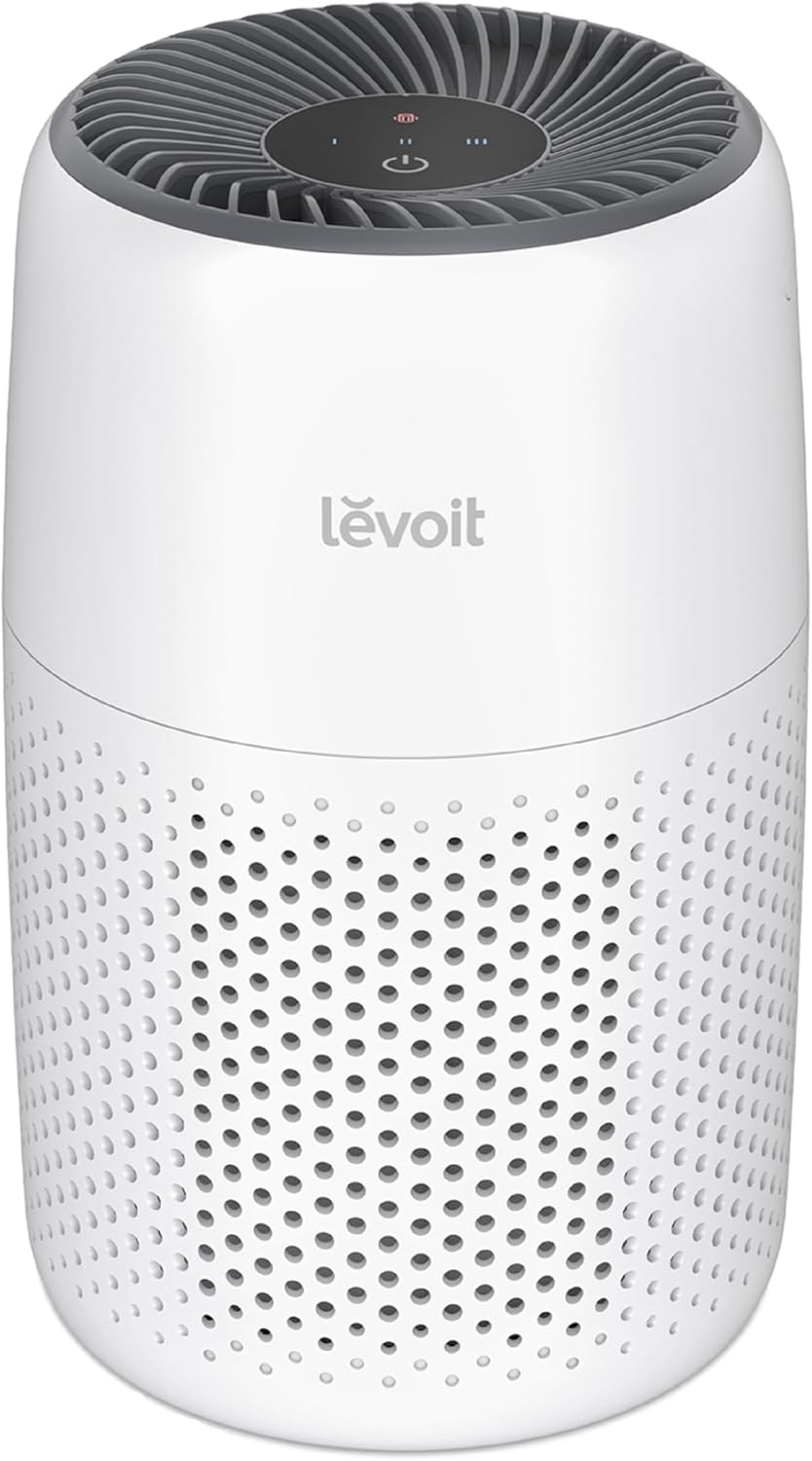
The Levoit Core Mini-P is a small, plug-in air purifier intended for bedrooms, nurseries, and workspaces where space is limited. It pulls air through a pre-filter and a main HEPA-style filter to capture lint, pet dander, dust and smoke particles, and it includes a fragrance sponge for light aromatherapy. The unit is quiet enough for sleep mode and offers an auto-off display so lights and noise are minimized overnight. With rated power around 7W and a low noise range listed at 27 to 45 dB, it runs efficiently and can stay on continuously without using much energy. Practical benefits include simple setup, compact footprint for leaving on a bedside table, and an odor-reduction option for transient smells. Limitations are its small coverage area: this model is meant for close-range or single-room use rather than whole-home purification, and the aromatherapy pad requires careful dosing to avoid damaging internal parts.
Best for: Parents or caregivers who prioritize a quiet, low-energy purifier for a newborn's room or other small spaces and value proven performance backed by strong customer feedback.
Less Ideal for: Homes needing whole-room or multi-room purification or buyers who want high CADR performance for large open layouts should consider larger units instead.
- Compact footprint fits on a nightstand or desk
- Quiet sleep mode suitable for overnight use
- Includes pre-filter and main filter to remove pet dander, dust, and smoke
- Low power draw around 7W for continuous operation
- Simple setup with auto-off display to reduce disturbances
- Small coverage area not suitable for larger rooms
- Aromatherapy sponge can damage plastic if overfilled
Verdict: A quiet, energy-efficient tabletop purifier that delivers trusted small-room filtration ideal for a newborn's bedroom.
VOOPNU H13 HEPA Air Purifier DH-JH12

| Filtration | H13 True HEPA triple-layer |
|---|---|
| Coverage claim | Up to 1,076 ft² |
| Tested rate | 250 ft² every 15 minutes |
| Noise level | As low as 22 dB |
| Speeds | 3 fan speeds |
This VOOPNU DH-JH12 is a small, user-friendly air purifier built around an H13 True HEPA triple-layer filter and a 360 degree intake to capture fine particles and common household pollutants. It is intended for straightforward everyday use: set it on a table or floor, choose one of three fan speeds, and let it run continuously to reduce pet hair, pollen, smoke and odors across medium to large rooms. Notable features include laboratory-tested coverage claims (250 ft² cleaned every 15 minutes), an essential oil tray for light scenting, and a very quiet low setting rated around 22 dB that is suitable for sleep. The control panel is simplified for easy operation and maintenance, and the unit has multiple safety and regulatory certifications. Limitations to consider are the compact plastic footprint that prioritizes portability over heavy-duty commercial airflow, and the recommendation to run the unit continuously for best results which affects energy use and filter replacement cadence. For families with a newborn, its quiet operation and HEPA filtration deliver practical air-cleaning without complex setup.
Best for: Parents who prioritize a fuss-free, certified HEPA solution that runs quietly in bedrooms and common rooms and who want straightforward operation and maintenance.
Less Ideal for: Homes seeking industrial-strength airflow for very large open-plan spaces or users who need smart home connectivity and advanced air-quality automation.
- H13 True HEPA triple-layer filter captures 99.97% of fine particles
- 360° intake design and lab-tested coverage of 250 ft² every 15 minutes
- Very quiet operation down to about 22 dB for use during sleep
- Simple control panel that is easy to operate and maintain
- Multiple certifications (DOE, ETL, FCC, CARB, CE, ROHS) for safety and performance
- Small consumer-sized housing may not provide the strongest continuous airflow compared with larger commercial units
- Manufacturer recommends continuous operation for best results, which increases filter usage and energy draw
Verdict: A quiet, certified H13 HEPA purifier that gives new parents a simple, low-noise way to reduce airborne particles in bedrooms and living areas.
Choosing the Right Air Purifier for Newborns: Key Factors to Consider
Filtration Type and Particle Capture
The core job of an air purifier for newborns is to remove airborne particles that can irritate a baby's developing lungs. True HEPA filters capture at least 99.97% of particles 0.3 microns in size and are effective against pollen, dust, and many respiratory irritants. Some units add pre-filters for large debris and activated carbon stages to reduce odors and volatile organic compounds.
When choosing, look for clear, testable filtration ratings rather than marketing terms. Consider whether the purifier lists CADR or particle-size performance; higher-rated particulate capture is especially important if allergies or wildfire smoke are concerns.
Noise Output at Low Speeds
Newborns sleep frequently and are sensitive to ambient noise, so a nursery purifier should be unobtrusive. Manufacturers often publish decibel ratings for different fan speeds. Quiet low-speed operation preserves sleep while still circulating air, and a true sleep or night mode that reduces LED indicators is valuable.
Be aware that some purifiers are loud on higher settings yet acceptably quiet on the lowest setting. If the nursery is small, a lower fan speed can still provide meaningful air exchange while keeping noise minimal.
Coverage Area and Placement
Match the purifier's rated room coverage to your nursery size and layout. Manufacturers typically state the recommended square footage for effective filtration. A unit sized for a medium room may not clear particulates quickly in an open-plan nursery adjoining other spaces.
Placement affects performance. Position the purifier so intake and exhaust are unobstructed and not directly blowing on the crib. For larger nurseries, consider units designed for higher airflow or plan to supplement with more than one purifier in connected rooms.
Maintenance, Filter Availability, and Cost
Regular filter replacement is essential to maintain performance. Check how often filters need replacing, whether filters are readily available, and how easy replacements are to install. Some designs use washable pre-filters that extend the life of primary filters and reduce operating cost.
Also consider how clearly the unit indicates filter life. Simple LED indicators or runtime counters remove guesswork. Ease of access without tools reduces the chance of accidental damage when changing filters.
Safety Features and Emissions
For a newborn's nursery, safety goes beyond electrical certifications. Avoid purifiers that intentionally produce ozone or rely on unshielded ionization that can emit byproducts. Confirm the unit meets relevant safety standards and that materials near the air path are non-toxic and enclosed.
Look for stable housings that cannot be easily tipped, cord management that reduces tripping hazards, and controls that can be locked or recessed so curious hands cannot change settings.
Operational Convenience and Controls
Nursery use benefits from straightforward controls and features that support nighttime routines. Useful conveniences include a dedicated night mode, adjustable timers, and a low-light or disabled display option. Remote control or app connectivity can be helpful but should not be required for basic operation.
Consider how the unit behaves after power interruptions and whether settings persist. A purifier that returns to a quiet, sleep-friendly state automatically reduces fuss during overnight outages or routine electrical resets.
How Much Filtration Does a Newborn Really Need?
Newborns are more vulnerable to airborne particles because their lungs and immune systems are still developing. The objective is not to create sterile air but to consistently lower particulate load and common indoor irritants to reduce risk of coughs and sleep disturbances. For most nurseries, a purifier that provides continuous low-level filtration with a true HEPA stage will meaningfully reduce particle counts over time.
If you face elevated pollution or household smoke, look for higher CADR or units rated for larger rooms so the device can run at a moderate speed without becoming noisy. In typical urban or suburban homes, maintaining steady low-speed operation overnight is generally the best balance between noise and air cleaning.
- Continuous low-speed operation often beats intermittent high-power bursts.
- HEPA-stage filtration should be prioritized over novelty technologies.
- Higher CADR is useful for smoke or heavy particulate events.
Noise Management Strategies for the Nursery
Even quiet fans produce sound; what matters is consistency. A subtle, steady background hum is often less disruptive than intermittent spikes. Choose a purifier with verified low-decibel operation on its lowest setting and a soft-start feature if possible.
Complement the purifier choice with nursery acoustics control. Soft furnishings, rugs, and curtains absorb sound and make low-level purifier noise less noticeable. If you prefer near-silence, select a unit rated for the nursery size so it can operate effectively without running at higher, louder speeds.
- Check published decibel levels for low and medium fan speeds.
- Use room textiles to dampen noise.
- Position device away from the crib to reduce perceived sound intensity.
Safe Placement and Childproofing Tips
Place purifiers on stable surfaces out of reach of children. If floor placement is necessary, select units with low center of gravity or wall-mount designs that keep them secure. Route cords so they are not accessible from the crib and avoid placing the purifier where siblings or pets can easily knock it over.
Disable or cover display lights when the baby is sleeping and choose models with lockable buttons or recessed controls. Regularly inspect intake grills to ensure there are no small objects or dust buildup that could affect airflow.
- Keep purifiers at least a foot away from walls and large furniture.
- Use cord clips or runs behind furniture to prevent access.
- Turn off bright LED indicators or enable night mode during sleep.
When to Run the Purifier at Higher Speeds
There are times when a nursery needs rapid particulate clearing, such as after cleaning, illness in the home, cooking odors that drift in, or nearby outdoor smoke events. In those cases, temporarily increasing fan speed for an hour or two will accelerate air exchanges and reduce contaminant levels more quickly.
After the event, return the purifier to a quiet, continuous mode. Frequent high-speed operation is noisier and will shorten filter life, so use boost settings judiciously.
- Use boost mode for short periods after known contamination events.
- Monitor filter indicators after heavy use and replace as needed.
- Avoid permanently running at maximum fan speed overnight.
Extras That Matter: Timers, Night Modes, and Indicators
Small convenience features make daily life easier. Timers let you schedule higher-speed runs during waking hours and quiet modes for sleep. A night mode typically dims displays and locks fan speed to the lowest setting, which helps maintain restful sleep.
Clear filter life indicators prevent guesswork and support timely maintenance. If you want remote monitoring, app controls can show air quality trends and filter status, but ensure the basic manual controls remain simple and accessible.
- Prefer units with persistent settings after power loss.
- Look for explicit filter life or replacement alerts.
- App features are useful but not essential for nursery safety.
How We Chose the Best Air Purifier for Newborns
We selected nursery-friendly air purifiers using criteria focused on real-world newborn care needs. First, filtration capability was central: we prioritized true HEPA or equivalent particulate capture specifications and multi-stage filtration that address particles down to submicron sizes. Noise performance was treated as a separate filter because even low-level hum can disrupt infant sleep. We checked published decibel ratings and low-speed behavior to favor units with verified quiet modes. Safety and materials were another core filter. We excluded designs with open ionizers or unshielded UV systems that require close handling. Usability measures included simple controls, reliable night modes, and easy filter replacement without tools. Energy efficiency and runtime were considered for continuous operation in a nursery setting. Finally, we screened for practical features such as timer functions, night lights that can be disabled, and coverage area ratings appropriate for common nursery sizes. Units that lacked clear filtration specs, excessive noise at low speeds, or proprietary filters with limited availability were excluded.
Our full evaluation process is outlined in our review methodology.
FAQ
How loud should an air purifier be in a nursery?
Aim for the lowest fan speed to be under typical sleeping-room noise levels and, if possible, check published decibel numbers. A steady low hum is usually less disruptive than variable or pulsing sound.
Is HEPA filtration necessary for newborns?
True HEPA filtration provides reliable particulate capture and is generally the most practical technology for reducing allergens, dust, and many respiratory irritants in a nursery environment.
Can I run the air purifier 24/7 for my newborn?
Yes. Continuous low-speed operation is recommended for consistent air quality. Make sure to follow the manufacturer's maintenance schedule to keep filters effective.
Should I worry about ozone or ionizers near a baby?
You should avoid devices that intentionally generate ozone or emit byproducts. Choose purifiers that list safe emissions and do not rely on unshielded ionization as a primary cleaning method.
How often do filters need replacement in nursery use?
Replacement frequency depends on usage, air quality, and filter type. Expect more frequent changes if you run higher speeds regularly or if the home has pets or persistent pollutants. Look for units with clear life indicators.
Final Verdict
When choosing an air purifier for newborns, prioritize true particulate filtration, quiet low-speed operation, and safety-conscious features. Match the unit's coverage to your nursery size and favor designs with easy filter access and clear maintenance indicators. Expect tradeoffs between maximum cleaning speed and noise or filter longevity; for everyday nursery use, steady low-level filtration with occasional short boosts offers the best balance. Choose a purifier that fits your room and routines, keep it well maintained, and place it safely to support healthier air for your baby.