
Note: This article contains affiliate links. If you click on these links and make a purchase, we may earn a small commission at no extra cost to you. This helps support our research and content. Read our full affiliate disclosure here.
Office air quality affects focus, comfort, and health. A purpose-built air purifier for offices reduces airborne particles, pollen, and common office odors so you and colleagues can breathe easier during long workdays. The right unit balances strong filtration with low noise and manageable upkeep so it fits into open-plan areas, private offices, or conference rooms without disrupting work. This guide covers our top shortlisted air purifiers for offices, chosen for their filtration efficiency, low operational noise, and real-world usability. Below you will find practical evaluation criteria and detailed guidance to help you pick the best option for your workspace size and priorities.
Top Picks at a Glance
| Best Overall The best all-around choice for most situations | GermGuardian AC4825E Tower Air Purifier |  |
| Best Quality Built to a higher standard if you want something more solid | Coway Mighty AP-1512HH |  |
| Best Value The sweet spot between price and what you get | MOOKA PR1 Air Purifier |  |
| Best Budget The cheapest option that still gets the job done reliably | FULMINARE H13 HEPA Air Purifier |  |
| Top Rated A top-rated pick with lots of positive feedback | Levoit Core 200S-P |  |
| Most Popular A crowd favorite that many people choose with confidence | Levoit Core 300-P Air Purifier |  |
| Best Seller A high-volume bestseller chosen again and again | VOOPNU H13 HEPA Air Purifier DH-JH12 |  |
GermGuardian AC4825E Tower Air Purifier

| Model | AC4825E |
|---|---|
| Coverage rate | 153 sq. ft. every 12.5 minutes; up to 743 sq. ft. per hour |
| Filter type | True HEPA with activated carbon pre-filter |
| Fan speeds | Three speeds including sleep mode |
| Optional feature | UV-C light |
The GermGuardian AC4825E is a compact tower purifier built to clear airborne allergens, pet dander, dust, and common odors in small to large rooms. It uses a genuine True HEPA filter to capture particles down to 0.1 microns, pairs that with an activated carbon pre-filter for scent and VOC reduction, and offers an optional UV-C lamp for extra germ control. Three fan speeds including a quiet sleep mode make it easy to run continuously in an office setting without becoming a distraction, and its reported airflow covers a 153 sq ft room every 12.5 minutes and up to 743 sq ft hourly. Maintenance is straightforward with replaceable GermGuardian Filter B cartridges and compatible UV bulbs and carbon filters. Trade-offs to expect are the single-direction tower design which limits placement flexibility compared with 360-degree units, and the UV-C feature adds complexity and future bulb replacement costs. For everyday office use it provides reliable filtration and low-noise operation, but buyers wanting advanced smart controls or full-room rapid circulation might look elsewhere.
Best for: An office buyer who wants a dependable, low-noise purifier that removes allergens and odors from personal offices or shared workspaces without complex smart features.
Less Ideal for: Large open-plan offices needing rapid whole-room circulation or users who require Wi-Fi, app control, or multi-directional intake for even coverage.
- True HEPA filter captures 99.97% of particles down to 0.1 microns for effective allergen removal
- Activated carbon pre-filter reduces cooking, pet, and general household odors
- Three fan speeds including quiet sleep mode suitable for office environments
- Covers small rooms quickly and can circulate air in larger spaces on an hourly basis
- Uses replaceable factory-quality filters and compatible UV-C bulbs for straightforward maintenance
- Tower design provides directional intake and may not distribute airflow as evenly as 360-degree units
- Optional UV-C bulb requires periodic replacement and adds ongoing maintenance cost
Verdict: A quiet, reliable HEPA tower purifier that removes allergens and odors in personal and small office spaces with easy factory-filter replacements.
Coway Mighty AP-1512HH

| Coverage | Up to 1,748 sq. ft. (60 minutes) |
|---|---|
| Filtration | Washable pre-filter + deodorization + HEPA + bipolar device |
| HEPA effectiveness | 99.97% of 0.3 μm particles |
| Modes | Auto, Eco, Timer |
| Model number | AP-1512HH |
The Coway Mighty AP-1512HH is a compact tower air purifier built for steady, long-term air cleaning in offices and medium open spaces. It pulls air through a washable pre-filter, activated carbon/deodorization stage and a true HEPA filter that captures 99.97% of 0.3 micron particles, while a built-in bipolar ionizer helps reduce odors and gases. An auto mode uses the pollution sensor and color-coded air quality indicator to raise or lower fan speed without user intervention, and an eco mode reduces fan run time when air is clean to save energy. Practical touches include a filter replacement indicator, timer, and a washable pre-filter that cuts maintenance cost. The unit delivers relatively quiet operation at lower speeds and is easy to place on a desk or floor; however its claimed coverage (up to 1,748 sq ft in 60 minutes) is best interpreted as whole-room turnover rather than continuous clean-air delivery for very large open-plan offices, and replacement filters are an ongoing cost. Setup is simple and there are no complicated apps or network requirements, so it fits shared workspaces where reliability and straightforward operation matter.
Best for: Buyers prioritizing reliable, proven particle removal and automatic air-quality response for private offices, meeting rooms, or medium shared spaces who want simple dependable operation without network setup.
Less Ideal for: Large open-plan offices that need continuous high CADR across a wide floorplate or centralized HVAC-integrated solutions should consider higher-capacity commercial units instead.
- True HEPA filtration capturing 99.97% of 0.3 μm particles.
- Auto mode with real-time pollution sensor and visible air quality indicator.
- Four-stage system including washable pre-filter reduces maintenance cost.
- Quiet at low speeds with Eco mode to reduce runtime and energy use.
- Coverage claims are for a single-pass 60-minute turnover and may not reflect continuous CADR in very large open-plan offices.
- Replacement filters and custom filter options add recurring expense.
Verdict: A dependable, sensor-driven HEPA purifier that delivers strong particle removal and low-noise operation for private offices and medium workspaces.
MOOKA PR1 Air Purifier

| Model | PR1 |
|---|---|
| Filter type | True H13 HEPA |
| Noise level (sleep) | 26 dB |
| Fan modes | 6 modes (Sleep/ I/ II/ III/ Auto/ Pet) |
The MOOKA PR1 is a large-room air purifier built around a True H13 HEPA filter and a multi-stage system that also includes an activated carbon layer and a washable pre-filter, so it targets smoke, pollen, pet dander, and odors. Typical use is continuous operation in living spaces or offices where larger coverage and automatic control matter: the unit has a PM2.5 sensor with an AQI display and an Auto mode that adjusts fan speed based on detected air quality. It offers six fan modes including a quiet 26 dB sleep setting, a dedicated Pet mode for faster removal of hair and pet smells, a child lock, timer and an aroma pad for scenting. Practical benefits include a wide air inlet design for faster throughput and a washable pre-filter to lower replacement frequency, plus filter-change reminders and common safety certifications. Important limitations are that true coverage claims depend on room layout and placement, replacement H13 filters are recommended every 3–6 months, and the unit requires periodic cleaning to keep the sensor accurate.
Best for: Buyers who want a practical, low-maintenance purifier for shared office spaces or larger private offices where automatic air-quality sensing and quiet operation are priorities.
Less Ideal for: People needing verified medical-grade or specialized allergen certification for clinical use, or those who require ultra-compact units for very small desks.
- True H13 HEPA filtration plus activated carbon for particles and odors
- PM2.5 sensor with real-time AQI display and Auto mode for hands-off operation
- Washable pre-filter reduces frequency of full filter replacements
- Multiple fan modes including a very quiet 26 dB sleep setting and a Pet mode for pet households
- Filter replacement reminder, timer and child lock for convenient office use
- Replacement H13 filters are consumable and recommended every 3–6 months
- Coverage claims (up to 2200 sq ft) will vary with room layout and placement
Verdict: A sensible choice for office environments that need wide-coverage HEPA cleaning with automatic AQI sensing and quiet, low-maintenance operation.
FULMINARE H13 HEPA Air Purifier

| Filter type | H13 HEPA |
|---|---|
| Recommended coverage | 215 ft² / 20 m² |
| Noise (low) | ~24 dB |
| Power | Plug-in (no battery) |
The FULMINARE H13 HEPA air purifier is a compact unit intended to quietly clean air in small rooms and offices. It pulls air through an H13-grade HEPA filter and uses dual-channel circulation with a 360° outlet to refresh air up to five times per hour in spaces around 215 sq ft, which makes it suitable for single offices or meeting rooms. Controls include multiple fan speeds, a near-silent sleep mode (about 24 dB), an independent night light, and five programmable timer options. The plug-in design means no battery changes and the filter is removable for replacement; the manufacturer recommends swapping filters roughly every three months with the listed replacement part. Practical benefits include low noise for focused work, small footprint for desktop or corner placement, and the night light for soft illumination. Limitations are its coverage cap—it is not appropriate for larger open-plan offices—and ongoing filter replacement adds running cost over time.
Best for: Buyers seeking an affordable, quiet air purifier for a single private office or small meeting room who prioritize low noise and compact placement over whole-office coverage.
Less Ideal for: Teams, open-plan offices, or larger conference rooms that need higher CADR or coverage across multiple connected spaces.
- H13 True HEPA filtration captures fine particles and allergens
- Dual-channel 360° outlet for faster air circulation in small rooms
- Very low noise in sleep mode for undisturbed work or meetings
- Built-in night light and multiple timers add useful convenience features
- Compact, portable design fits on a desk or in a small office corner
- Rated coverage limited to about 215 sq ft, not for larger office spaces
- Requires periodic filter replacements which increase long-term cost
Verdict: A budget-friendly, quiet H13 HEPA purifier that is a solid choice for one-person offices and small meeting rooms.
Levoit Core 200S-P
| Model | Core 200S |
|---|---|
| Coverage | 140 ft² (4.8 ACH) |
| Filtration | 3-stage (Pre-filter, Activated Carbon, HEPA-grade) |
| Noise level | 27 dB (Sleep Mode) |
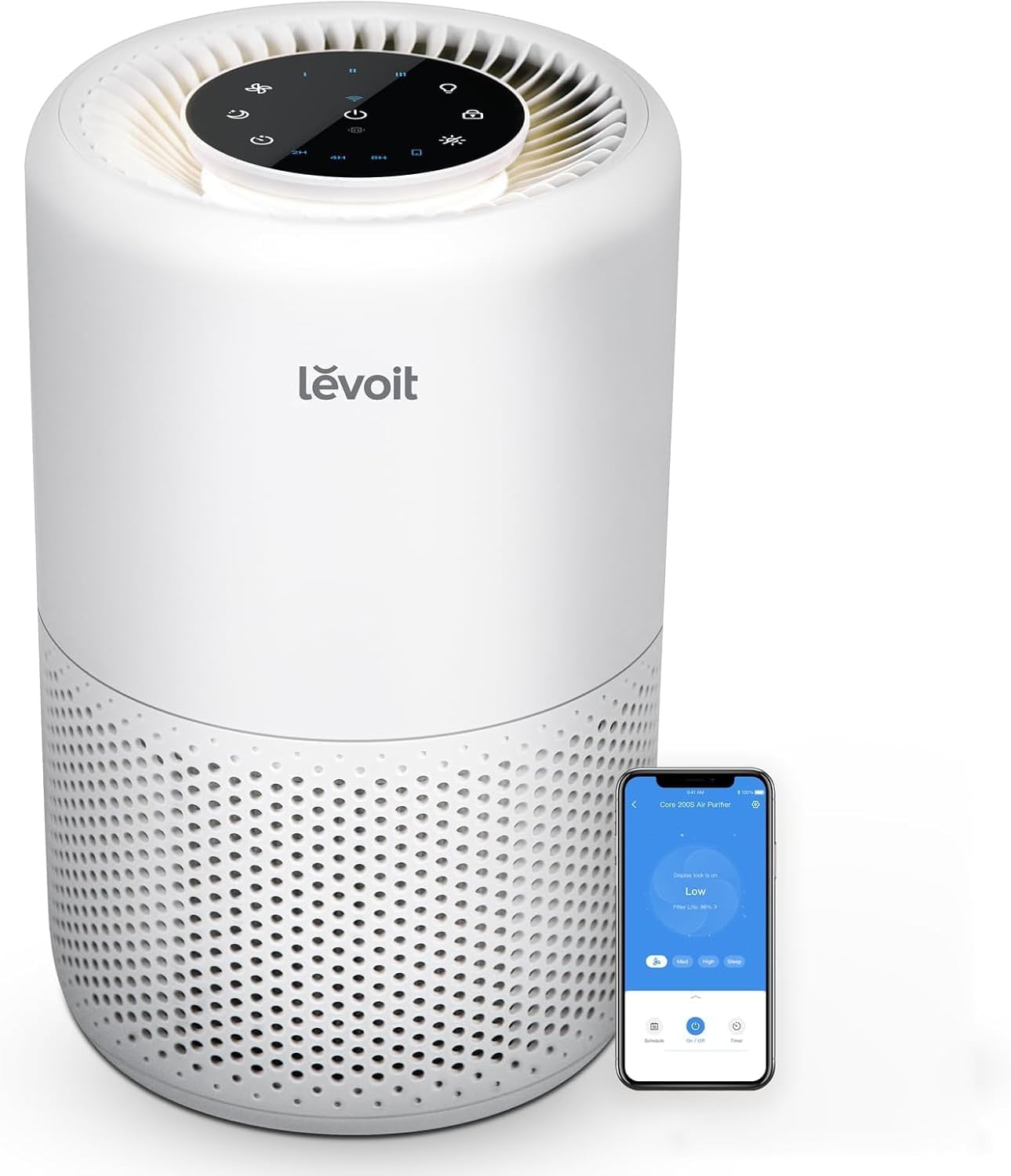
The Levoit Core 200S-P is a small, smart air purifier built for everyday room use and offices that need continuous, unobtrusive filtration. It pulls air through a 360 degree intake and a three-stage filter stack — pre-filter, activated carbon, and a HEPA-grade main filter — to capture large particles, odors, and 0.1–0.3 micron particulates. The unit is AHAM-verified and rated to refresh the air in a 140 ft² room about 4.8 times per hour, making it suitable for private offices, dorm rooms, or meeting rooms. Smart and voice control let you schedule runs and monitor filter life from the app, and a low-noise Sleep Mode (down to 27 dB) keeps it quiet during focused work or meetings. Its compact, lightweight design is easy to move between rooms, but the smaller coverage means multiple units are needed for larger open-plan offices. Filter replacements and app dependence are normal ownership costs to plan for. For a reliability-focused office setup, the Core 200S-P balances verified performance, quiet operation, and smart monitoring in a compact package.
Best for: Buyers who prioritize dependable, independently verified air cleaning for small private offices and value quiet, monitored operation with easy portability.
Less Ideal for: Large open-plan offices or shared conference spaces where a single compact purifier cannot provide adequate air changes across the full area.
- AHAM-verified performance with reported 4.8 air changes per hour in a 140 ft² room
- Three-stage filtration including HEPA-grade main filter that removes 99.97% of 0.1–0.3 micron particles
- Smart app and voice control with filter-life monitoring for hands-off maintenance planning
- Very quiet Sleep Mode at around 27 dB suitable for office work or meetings
- Coverage limited to small rooms, requiring multiple units for larger office spaces
- Ongoing cost and dependence on replacement filters and app features
Verdict: A reliable, AHAM-verified compact purifier that delivers quiet, monitored HEPA-grade filtration for small office rooms.
Levoit Core 300-P Air Purifier

| Filter Type | 3 in 1 Filtration |
|---|---|
| Floor Area | 1073 square_feet |
| Noise Level | 24 db |
| Particle Retention Size | 0.3 micron |
| Wattage | 56 watts |
The Levoit Core 300-P is a small, portable HEPA air purifier built to clean indoor air in bedrooms, home offices, and similar enclosed spaces. It uses a 3-in-1 original filter (preinstalled) and a 56W motor to deliver AHAM-verified CADR numbers that translate to fast clearing of smoke, dust, and pollen in typical offices up to a few hundred square feet. Controls are touch-based and include a near-silent Sleep Mode that drops noise to about 24 dB and turns the display lights off for nighttime or low-distraction use. The unit is CARB compliant, ETL listed, and AHAM verified, and Levoit specifies the filter retains particles down to 0.1–0.3μm with 99.97% efficiency when using genuine filters. Practical strengths are its quiet operation, compact footprint, and straightforward manual speed control; limitations include no Auto Mode on this P model (manual fan speed only) and a recommendation to use factory replacement filters every 6–8 months to maintain CADR performance. For an office setting it provides reliable, certified filtration without complex setup or smart features.
Best for: Office buyers who want a proven, independently verified air cleaner that runs quietly and fits into small workspaces where simple, reliable filtration matters more than smart automation.
Less Ideal for: Users who need automatic air-quality sensing, app control, or whole-floor coverage should consider larger or smart-enabled models instead.
- AHAM-verified CADR for smoke, dust, and pollen, so cleaning claims are independently tested
- H13-grade filtration performance with 99.97% capture of 0.1–0.3μm particles when using original filters
- Very quiet Sleep Mode (around 24 dB) suitable for low-noise office environments
- Compact and portable design that fits on a desk or small floor area
- No Auto Mode on this Core 300-P model so fan speed must be adjusted manually
- Best performance depends on using genuine Levoit replacement filters rather than third-party options
Verdict: A compact, AHAM-verified purifier that quietly delivers proven HEPA filtration for small offices where reliable, low-distraction air cleaning is the priority.
VOOPNU H13 HEPA Air Purifier DH-JH12

| Coverage (claimed) | Up to 1,076 ft² per hour (250 ft² per 15 minutes) |
|---|---|
| Filtration | H13 triple-layer HEPA + activated carbon |
| Noise level | As low as 22 dB |
| Speeds | 3 fan speeds + timer |
| Certifications | DOE, ETL, FCC, CARB, CE, ROHS |
The VOOPNU H13 HEPA Air Purifier is a compact desktop unit built to remove common indoor pollutants using a 3-stage H13 filtration and 360 degree intake. It is typically placed on a desk, shelf, or in a corner of an office to run continuously and cycle air quietly; the manufacturer claims laboratory-tested coverage that equates to roughly 250 sq ft every 15 minutes. Controls are simple and the unit includes a timer, three fan speeds, and an essential oil tray for light scenting. Practical benefits include very low operating noise down to 22 dB for undisturbed work, a small footprint that fits tight office spaces, and a washable or replaceable filter ecosystem with PET-care options for homes with animals. Limitations are conventional for compact purifiers: it relies on prolonged continuous operation to maintain air quality, replacement filters are recommended to preserve performance, and its true clean-air effectiveness depends on room layout and continuous runtime rather than one-off use.
Best for: A cautious buyer who prioritizes low-noise, easy-to-use air cleaning for individual office desks or small meeting rooms and wants a straightforward, certified purifier with replaceable filters.
Less Ideal for: Large open-plan offices or whole-floor filtration needs where a higher-CADR commercial unit is required; not suited for buyers who expect instant room-wide clearing from a small desktop unit.
- H13 triple-layer filtration captures fine particles and allergens
- 360° air intake for more even room circulation
- Very quiet operation down to 22 dB suitable for offices
- Compact footprint fits on desks or small shelves
- Simple controls with timer and three speed settings
- Best performance requires continuous long-term use and regular filter replacement
- Stated coverage figures are lab-based and real-world results vary
Verdict: Choose this compact, very quiet H13 HEPA purifier if you want simple, low-noise continuous air cleaning for a single office workspace.
Choosing the Right Air Purifier for Offices: Key Factors to Consider
Filtration Type and Efficiency
High-efficiency particulate filtration is essential because offices concentrate fine particles from occupants, HVAC cycling, and outdoor infiltration. A true HEPA-level filter or equivalent captures the bulk of PM2.5 and common allergens, which directly reduces respiratory irritants and perceived dust.
Consider whether the unit also includes activated carbon or other media for VOC and odor control, since paper, cleaning products, and kitchens near offices can introduce smells and gaseous contaminants. Filter testing ratings and particle capture percentages give a clearer picture than vague marketing claims.
Noise Output and Acoustic Comfort
Noise matters in offices where concentration and conversation are priorities. Look for published sound levels for each fan speed and compare them against typical office benchmarks to ensure the purifier can run in low-noise mode during meetings or focused work.
Also evaluate how noise scales with fan speed. Units with a quiet low setting and an effective high setting for rapid air cleaning let you run quietly most of the day and boost circulation when the room is empty.
Room Coverage and CADR
Clean Air Delivery Rate, or CADR, indicates how quickly a unit can circulate and filter air for a given room size. Match CADR ratings to the square footage and ceiling height of your office space so the purifier achieves recommended air changes per hour.
Undersized devices will run continuously without adequately reducing particle loads, while oversized units may be wasteful. Factor in open-plan areas or adjoining rooms that reduce effective coverage and choose units rated for slightly larger spaces when in doubt.
Maintenance Frequency and Filter Costs
Filter replacements and routine upkeep drive the long-term cost and inconvenience of owning an office air purifier. Understand expected filter life in months under typical office use, and whether prefilters are washable to extend service intervals.
Easy access to replacement filters, clear indicator lights, and affordable consumables make it simpler to keep devices operating at peak efficiency. Consider remote teams or shared facilities where centralized maintenance schedules can ensure filters are changed before performance degrades.
Control Options and Automation
Controls determine how seamlessly the purifier fits into daily office routines. Units with simple physical controls work well in small offices, while programmable timers, air-quality sensors that auto-adjust fan speed, and app or network integration help automate operation in larger or managed spaces.
Automation reduces the chance a unit is left off and ensures higher performance during busy periods. Evaluate the reliability of sensors and whether manual overrides are available for specific situations like meetings or events.
Placement, Size, and Aesthetics
Where the purifier will sit affects both performance and acceptance. Compact desktop units are useful for private offices or cubicles, while tower or console models better serve open-plan rooms. Ensure the unit's footprint and weight suit your intended location and that the intake and exhaust clearances are maintained for proper airflow.
Aesthetics and finish matter in visible office areas. A discreet, professional-looking design increases the chance the unit remains in active use and reduces objections from colleagues or facilities managers.
Sizing Units to Office Layouts
Determine the typical room dimensions and expected occupancy. For single private offices, a compact unit rated for the room's square footage is usually sufficient. For open-plan areas, calculate combined volume and aim for multiple units or a larger model to achieve better air turnover.
Consider airflow patterns when placing units. Position purifiers where they can draw air from the breathing zone and avoid obstructing intake or exhaust vents. In long rooms, spacing several units at intervals prevents stagnant pockets of air.
- Measure square footage and ceiling height to estimate room volume
- Aim for 4 to 6 air changes per hour for higher-risk or heavily occupied spaces
- Place units away from walls and obstructions for optimal flow
Managing Noise Without Sacrificing Performance
Choose units with measured decibel ratings for low and high modes, and test them in situ where possible. White noise from a purifier can be tolerable if consistent, but sharp fluctuations in fan speed are more disruptive.
Use scheduling and occupancy sensors to run higher fan speeds during off-hours for rapid air turnover, then revert to whisper modes during meetings and peak focus times.
- Prefer units with low-speed modes below typical office ambient noise
- Use timers or sensors to avoid high-speed running during meetings
- Consider acoustic placement like carpeting or soft furnishings to dampen overall sound
Energy Use and Continuous Operation
Offices often run purifiers for long stretches or continuously. Check wattage during typical settings and whether the unit has energy-saving modes. Lower-power fans or sleep modes can substantially reduce operational costs when continuous filtration is needed.
Review whether the purifier supports scheduled operation or sensor-driven cycles to prevent unnecessary high-power running when the room is unoccupied.
- Compare energy draw at typical operating speeds
- Use built-in timers or building automation to limit run time when unoccupied
- Balance energy savings with required air-change targets
Dealing With Odors and VOCs in Office Spaces
Offices host sources of volatile organic compounds such as cleaning agents, printers, and kitchen areas. If odors or VOCs are a concern, choose units that include activated carbon or specialized adsorbent media in addition to particulate filtration.
Note that carbon filters saturate over time and require timely replacement to remain effective. For persistent gaseous contamination, consider systems designed specifically for VOC mitigation or increased ventilation alongside filtration.
- Check for activated carbon or proprietary VOC media
- Monitor odor reduction over time and replace media as recommended
- Combine filtration with ventilation for the best results
Placement and Shared Maintenance in Multi-User Offices
In multi-user environments, establish a clear placement and maintenance plan. Centralized responsibility for filter changes and cleaning keeps performance consistent and prevents units from being neglected.
Label units with maintenance dates and consider staggered replacement schedules so not all filters need service at once. For shared offices, locate units where staff can report issues easily and where access for filter changes is safe and straightforward.
- Create a maintenance log for each unit
- Assign a single point of contact for filter replacement
- Ensure safe access for changing filters in elevated or tight spaces
How We Chose the Best Air Purifier for Offices
We prioritized specifications and real-world usability metrics that matter for office environments. Primary filters included particle filtration efficiency for PM2.5 and HEPA-grade capture, verified clean air delivery rate relative to typical office room sizes, and the ability to remove common office VOCs and odors. Operational factors were critical. We filtered for units with measured idle and active noise levels suitable for occupied workspaces, multiple fan speeds including whisper modes, and convenient controls or automation for unattended operation. Maintenance burden was assessed by filter lifespan, ease of replacement, and availability of washable prefilters. Practical installation and placement were considered next: footprint and weight for desktop versus floor placement, cord length and outlet access, and whether the unit supports continuous 24/7 operation. We excluded units designed only for very small personal spaces or industrial-grade systems that require specialized installation. Final selections reflect a balance of filtration performance, acoustic comfort, energy efficiency, and upkeep simplicity.
Our full evaluation process is outlined in our review methodology.
FAQ
How large an air purifier do I need for my office?
Match the purifier's recommended coverage or CADR to your office square footage and ceiling height. For open-plan areas, consider multiple units to ensure even coverage and achieve desired air changes per hour.
Will an air purifier reduce COVID-19 risk in the office?
Air purifiers with high-efficiency particle filtration can lower airborne particle concentrations, which may reduce transmission risk when combined with other measures. They should be used alongside ventilation, masking where appropriate, and surface cleaning.
How often should I replace filters in an office purifier?
Replacement intervals depend on usage, occupancy, and pollution levels. Typical schedules range from three to twelve months, with prefilters often washable. Use indicator lights and check filters regularly for visible loading.
Can I run a purifier 24/7 in an office?
Yes. Many units are designed for continuous operation but check manufacturer guidance for recommended duty cycles and maintenance. Running at a low-speed continuous setting is often an effective balance of performance and energy use.
Do purifiers remove odors from kitchen areas near offices?
Units with activated carbon or specialty adsorbents reduce many common odors, but heavily odorous environments or strong VOC sources may require targeted ventilation or higher-capacity adsorption systems.
Final Verdict
Prioritize filtration efficiency, acoustic comfort, and coverage when choosing an air purifier for offices. Balance a unit's CADR and filter media against expected occupancy and room volume to ensure effective air changes without constant high-speed operation. Consider maintenance burden and automation features to keep units running properly with minimal oversight. Choose a purifier that matches your office layout and noise tolerance so you get steady air cleaning that supports productivity and occupant comfort.