
Note: This article contains affiliate links. If you click on these links and make a purchase, we may earn a small commission at no extra cost to you. This helps support our research and content. Read our full affiliate disclosure here.
If seasonal allergies or year-round pollen sensitivity affect your home, picking the right air purifier can make daily life more comfortable. An effective unit captures airborne pollen before it settles on surfaces, lowers allergen exposure during sleep and work, and helps reduce symptoms such as sneezing and eye irritation. This guide focuses on the top shortlisted air purifiers for pollen removal across common home room sizes and use cases. We evaluated options that deliver high particle-capture efficiency, appropriate room coverage, and practical day-to-day usability. Read on to explore the top picks and the criteria we used to evaluate them.
Top Picks at a Glance
| Best Overall The best all-around choice for most situations | WINIX 5510 Air Purifier |  |
| Best Quality Built to a higher standard if you want something more solid | Medify MA-50 Air Purifier V3.0 |  |
| Best Value The sweet spot between price and what you get | MOOKA B-D02L Air Purifier |  |
| Best Budget The cheapest option that still gets the job done reliably | FULMINARE H13 HEPA Air Purifier |  |
| Top Rated A top-rated pick with lots of positive feedback | Levoit Core 300-P Air Purifier |  |
| Most Popular A crowd favorite that many people choose with confidence | Levoit Vital 100 Air Purifier |  |
| Best Seller A high-volume bestseller chosen again and again | VOOPNU H13 HEPA Air Purifier DH-JH12 |  |
WINIX 5510 Air Purifier

| Item model number | 5510 |
|---|---|
| AHAM Verified coverage | 1,882 sq ft in 1 hr |
| True HEPA particle size | 0.01 microns |
| Noise (lowest speed) | 23.5 dB |
| Smart features | WiFi / Alexa / Google Home |
The WINIX 5510 is a four-stage air purifier built to remove very small airborne particles and control household odors in large rooms. It uses a washable pre-filter, True HEPA filtration that captures particles down to 0.01 microns, and an advanced carbon filter to reduce VOCs and smells from cooking, pets, and smoke. Built-in air quality sensors drive an Auto Mode that ramps fan speed as needed, and an LED air quality indicator gives a quick visual readout. The unit also supports the Winix Smart App plus voice assistants for remote monitoring and control, and a light-activated Sleep Mode drops noise to nearly silent levels for nighttime use. Winix includes PlasmaWave technology intended to further reduce airborne impurities, and the purifier is AHAM verified and UL certified. Expect periodic filter replacements and a fairly sizable footprint for placement in larger open areas; performance is strongest in well-ventilated rooms where the CADR and coverage ratings can be realized.
Best for: Buyers who want a balanced, all-purpose purifier for large living spaces that combines strong particle capture, odor control, and smart controls for hands-off operation.
Less Ideal for: People who need a compact, portable bedroom-only unit or who prefer a no-smartphone, low-maintenance purifier with minimal filter changes.
- Multi-stage filtration including True HEPA for very fine particles down to 0.01 microns
- Carbon odor-control filter reduces VOCs and household smells
- Smart sensors with Auto Mode and LED air quality indicator for hands-off operation
- Winix Smart App and voice assistant compatibility for remote control and monitoring
- Sleep Mode that becomes ultra-quiet when the room is dark for nighttime use
- Requires regular replacement of HEPA and carbon filters to maintain peak performance
- Relatively large footprint compared with bedroom-focused purifiers
Verdict: A strong all-round purifier for large rooms that pairs high-efficiency HEPA filtration and odor control with smart sensors and app control, making it a top choice for pollen and allergy relief.
Medify MA-50 Air Purifier V3.0

| Filter Class | HEPA H13 |
|---|---|
| Particle Retention Size | 0.1 micrometer |
| Wattage | 70 watts |
| Noise Level | 56 db |
| Floor Area | 250 |
The Medify MA-50 V3.0 is a performance-focused air purifier built for large rooms and whole-floor coverage, using a True HEPA H13 filter that captures particles as small as 0.1 microns. It is typically placed in living rooms, open-plan spaces, or classrooms and run at higher fan speeds to cycle the air quickly — the maker rates it to clean roughly 2,640 sq ft in one hour. The unit offers four fan speeds, a sleep mode that dims lights and lowers sound, a programmable timer, child lock, and a filter replacement indicator for straightforward day-to-day use. Practically, the strong CADR and H13 filtration make it very effective at reducing pollen, dust, pet dander, smoke, and fine particulate pollution, which is useful during high-pollen seasons. Trade-offs are its size and top noise at maximum fan speed, and filters need routine replacement every few months under heavy use. For buyers prioritizing rapid, high-volume particle removal, the MA-50 is a capable, no-nonsense choice.
Best for: Buyers who prioritize fast, high-volume particle removal in large rooms and want a purifier that targets fine allergens like pollen and smoke.
Less Ideal for: People looking for a compact, ultra-quiet bedroom-only unit or those who want minimal ongoing filter maintenance.
- True HEPA H13 filter captures particles down to 0.1 microns for strong pollen and allergen removal
- High coverage rate (rated to clean 2,640 sq ft per hour) suitable for large rooms and open spaces
- Multiple fan speeds plus sleep mode and programmable timer for flexible operation
- Certified by CARB, ETL, and AHAM and includes a lifetime warranty registration
- Can be loud at the highest fan speed, which may be noticeable in quieter environments
- Replacement filters are consumable and listed lifespan requires changing every few months under heavy use
Verdict: Choose the MA-50 V3.0 when you need powerful, H13-grade filtration that removes fine pollen and particles across very large rooms quickly.
MOOKA B-D02L Air Purifier
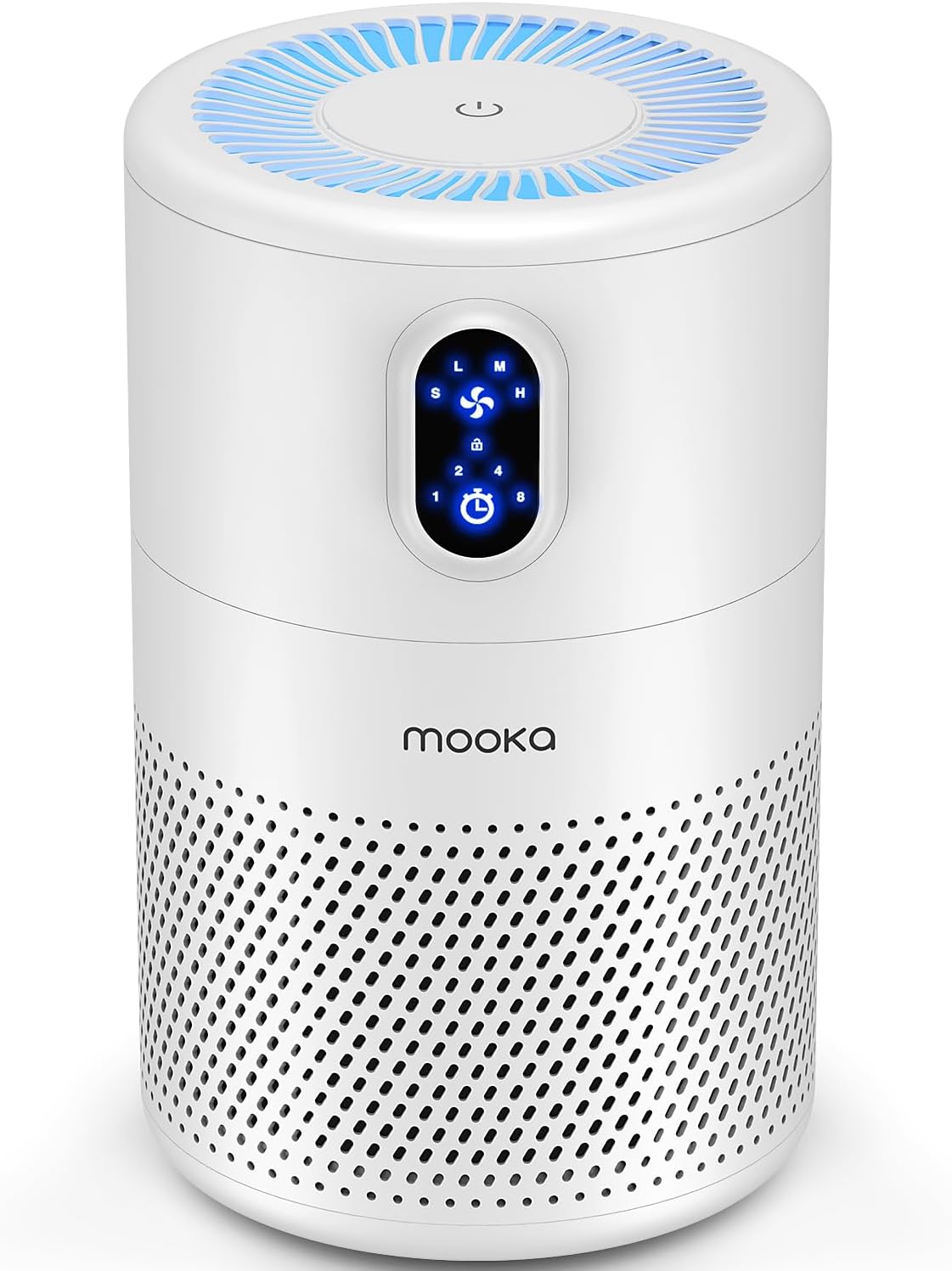
| Effective Area | 1076 sq ft |
|---|---|
| HEPA Filter | H13 HEPA |
| Filter Lifespan | 3-6 months |
| Timer Settings | 1/2/4/8 H |
The MOOKA B-D02L is a tower-style air purifier built around an H13 true HEPA filter, pre-filter and activated carbon stage to capture pollen, pet dander, smoke, odors and particles down to 0.3 microns. It is typically used in bedrooms, living rooms or home offices where continuous background filtration is needed; the unit offers four fan speeds, four timer settings (1/2/4/8 hours), a child lock and a soft night light that can be turned off. The blower runs quietly thanks to a brushless motor and claims a very low noise level on sleep mode, and the device is designed to be energy efficient for long runtimes. Filter replacement is recommended every 3 to 6 months depending on use, and the manufacturer supplies replacement filter options. Practical limitations are its compact physical footprint which may limit placement options and the need to buy replacement filters regularly, but for seasonal pollen and everyday allergens it provides focused filtration and simple controls without complex setup or apps.
Best for: Buyers who want a straightforward, reliable purifier to reduce pollen and airborne allergens across a living space without learning complex features or using smartphone controls.
Less Ideal for: People who need integrated smart-home features, remote app control, or who prefer a model with longer filter life to reduce ongoing maintenance.
- H13 true HEPA filter plus activated carbon captures pollen, dust and common allergens.
- Coverage advertised up to 1076 sq ft with multiple fan speeds for different room sizes.
- Very quiet operation and energy-efficient brushless motor suitable for sleep mode.
- Simple controls with timers, child lock and a night light for easy daily use.
- Requires filter replacements every 3–6 months depending on environment.
- No smart/home integration or app controls for remote management.
Verdict: A practical, no-fuss HEPA purifier that quietly and efficiently reduces pollen and common allergens across large rooms.
FULMINARE H13 HEPA Air Purifier

| Filter type | H13 HEPA |
|---|---|
| Recommended room size | 215 ft² / 20 m² |
| Noise level (low) | ~24 dB |
| Timer options | 2, 4, 8, 10, 12 hours |
The FULMINARE H13 is a small, budget-friendly purifier built around an H13 true HEPA filter and a 360° air outlet that the manufacturer says refreshes air up to five times per hour in rooms around 215 sq ft. It is easy to place on a bedside table or desk and has a near-silent low setting (about 24 dB) for use at night, plus a simple night light and multiple timer options (2, 4, 8, 10, 12 hours). Its plug-in design means you do not worry about recharging batteries, and replacement filters are available separately. For pollen and common household allergens the H13 filter will capture fine particles effectively in small rooms, but the unit's coverage and reported circulation rate limit it to single-room use rather than whole-home cleaning. Controls and features are basic rather than smart-enabled, so you should expect straightforward operation but no app, scheduling, or air-quality readout. If you want an affordable, quiet bedroom purifier that targets pollen and pet dander in a single room, this is a practical option; if you need larger coverage, advanced monitoring, or voice/Wi-Fi features, look at higher-end models instead.
Best for: Buyers seeking an affordable, simple bedroom or small-room purifier that effectively reduces pollen and common allergens without extras like app control.
Less Ideal for: People who need whole-room or whole-home coverage, integrated air-quality monitoring, or smart connectivity should consider larger or more feature-rich units.
- H13 true HEPA filter captures fine particles like pollen and pet dander
- 360° outlet and dual-channel design for even airflow in small rooms
- Very quiet low-speed operation suitable for bedrooms (around 24 dB)
- Built-in night light and multiple timer settings for overnight use
- Plug-in power avoids battery maintenance
- Coverage limited to about 215 sq ft so not suitable for larger spaces
- No smart features or air-quality sensors for automated control
Verdict: A quiet, no-frills H13 HEPA purifier that delivers effective pollen and allergen reduction in a single bedroom or small room at a budget-friendly price.
Levoit Core 300-P Air Purifier

| Filter Type | 3 in 1 Filtration |
|---|---|
| Floor Area | 1073 square_feet |
| Noise Level | 24 db |
| Particle Retention Size | 0.3 micron |
| Wattage | 56 watts |
The Levoit Core 300-P is a compact desktop or bedroom air purifier built around a three-stage filtration system that includes a HEPA-grade filter rated to capture 99.97% of 0.1–0.3 μm particles. It uses a 56W motor with a CADR suited to refresh air in medium rooms and lists AHAM verification and CARB and ETL certifications for safety and performance. Controls are touch-based with a near-silent Sleep Mode that reduces noise to about 24 dB and an option to dim or turn off the display for nighttime use. Practical benefits include strong pollen and dust capture, low operating noise for bedrooms, and a portable footprint that is easy to move between rooms. Limitations are that the unit lacks Auto Mode and smart connectivity on this model, so fan speeds must be adjusted manually, and optimal CADR/coverage is based on using genuine Levoit filters, which are recommended for best results. The manufacturer recommends filter replacement every 6 to 8 months depending on use.
Best for: Buyers who prioritize dependable, certified pollen and fine-particle removal for bedrooms or medium living spaces and want a quiet, easy-to-operate purifier.
Less Ideal for: People who need app control, automatic air-quality sensing, or whole-home centralized filtration should consider other solutions.
- HEPA-grade 3-stage filter captures fine particulates including pollen and pet dander
- AHAM verified CADR and safety certifications for reliable performance
- Very quiet Sleep Mode suitable for bedrooms at about 24 dB
- Compact and portable footprint makes it easy to move between rooms
- No Auto Mode or smart connectivity on this model so fan speeds are manual
- Best performance depends on using Levoit original replacement filters
Verdict: Choose the Core 300-P when you want a small, quietly operating, AHAM-verified purifier that reliably removes pollen and fine particles from bedrooms and medium rooms.
Levoit Vital 100 Air Purifier

| CADR | 105 CFM |
|---|---|
| Coverage | 788 ft² / hour |
| Noise level | 24 dB (low) |
The Levoit Vital 100 uses a three-stage filtration system (washable pre-filter, efficient main filter, and activated carbon) to capture pollen, dust, pet hair and common household odors, and its AHAM-verified 105 CFM CADR means it can clean typical living spaces quickly. It is compact and has a quiet sleep mode that drops to about 24 dB, plus a simple control panel, a 2/4/8 hour timer and a check-filter indicator for low-maintenance operation. The washable pre-filter helps reduce replacement frequency for larger debris while the carbon layer addresses cooking and pet smells, but only Levoit genuine filters are recommended for best performance. Practical limits include modest coverage per hour for larger open-plan areas and ongoing filter replacement costs for maintaining peak particle removal of fine allergens. For pollen sufferers looking for a compact, quiet purifier with verified airflow performance, the Vital 100 is a convenient, easy-to-use option.
Best for: Buyers who prioritize proven performance and strong social proof and want a compact, quiet purifier that handles pollen and everyday indoor allergens in bedrooms or living rooms.
Less Ideal for: Households needing whole-house or very large open-plan coverage or those seeking smart home connectivity and advanced remote controls.
- Three-stage filtration including washable pre-filter and activated carbon for odors
- AHAM-verified 105 CFM CADR for reliable air cleaning performance
- Very quiet operation down to 24 dB suitable for bedrooms
- Compact, portable design with built-in handle and timer controls
- Coverage claims are for single-hour cleans so multiple units or larger models may be needed for big open spaces
- Requires genuine Levoit replacement filters to maintain recommended performance
Verdict: A compact, AHAM-verified purifier that quietly and effectively reduces pollen and common household particles in bedrooms and medium rooms.
VOOPNU H13 HEPA Air Purifier DH-JH12

| Filtration | H13 True HEPA triple-layer |
|---|---|
| Coverage | Up to 1,076 ft² (listing lab test) |
| Noise level | Down to 22 dB |
| Speeds | 3 fan speeds |
The VOOPNU DH-JH12 is a small, easy-to-use air purifier built around an H13 True HEPA triple-layer filter and 360 degree intake that targets common indoor allergens like pollen, pet dander, smoke, and odors. It is simple to operate from a pared-down control panel, offers three fan speeds plus a timer, and includes an essential oil tray for light fragrance. Laboratory figures on the listing indicate it cleans 250 ft² in 15 minutes (roughly 1,076 ft² per hour), which makes it suitable for bedrooms, living rooms, or open-plan spaces where pollen and fine particles are a concern. The unit is quiet at low speed (down to 22 dB), so it can run overnight without disturbing sleep. Practical limitations are its reliance on replaceable filters and the recommendation to run it continuously for best results, which raises ongoing maintenance needs and energy use compared with intermittent operation. Its compact footprint makes placement flexible but also suggests it is optimized for room-level use rather than whole-house filtration.
Best for: Buyers who want a low-friction, reliably performing room air purifier to reduce pollen and airborne allergens with easy setup and quiet overnight operation.
Less Ideal for: Households seeking whole-house ventilation or those wanting a no-maintenance, filterless solution should look elsewhere.
- H13 True HEPA filtration captures 99.97% of fine particles including pollen
- 360° surround intake for even room coverage
- Laboratory-tested CADR claim suitable for cleaning mid-size rooms quickly
- Very quiet operation at low speed (about 22 dB) for night use
- Simple controls and compact design make placement and daily use straightforward
- Requires regular filter replacement and ongoing maintenance to maintain performance
- Recommended continuous operation for best results increases energy use over time
Verdict: A compact, quiet HEPA purifier that reliably reduces pollen and fine particles in rooms when run continuously and maintained regularly.
Choosing the Right Air Purifier for Pollen: Key Factors to Consider
Filtration Efficiency and Filter Type
Pollen particles range in size but are effectively captured by true HEPA filtration. Look for units that specify true HEPA or HEPA-equivalent performance with a guaranteed particle capture rating (for example 99.97% at 0.3 microns) because this determines how well the purifier removes pollen from the air rather than just masking odors.
Filter composition matters too. Pre-filters that catch large debris extend main filter life, while activated carbon layers help with volatile organic compounds and odors but do not remove pollen. Avoid designs that depend solely on ionization without mechanical HEPA filtration when your primary goal is pollen reduction.
Clean Air Delivery Rate and Room Size
CADR values for pollen or particulate matter indicate how quickly a purifier can clean a room. Choose a unit with a CADR rating appropriate for the square footage where you will use it so the purifier circulates and filters all the air multiple times per hour. A model undersized for the room will struggle to reduce pollen exposure effectively, whereas an oversized unit offers faster turnover and lower runtime on higher fan speeds.
Consider placement as well. Centrally located units with unobstructed airflow produce the best circulation. For open-plan homes you may prefer a higher CADR model, while bedrooms can often be served by a smaller, quieter purifier.
Noise Levels During Normal Use
Allergy sufferers often run purifiers overnight, so acceptable noise levels are a practical concern. Manufacturers sometimes list decibel levels at different fan speeds; lower settings should be quiet enough for sleep while still providing meaningful filtration. Look for models with distinct sleep or low-noise modes and check whether performance drops substantially at those settings.
Noise preference is subjective, so balance your tolerance with required CADR. In many cases, running a slightly higher but still tolerable speed for limited periods can clear pollen quickly before switching to quieter maintenance mode.
Filter Replacement Frequency and Maintenance
How often filters need replacement affects both ongoing cost and reliability. Pollen seasons can shorten filter life, so models with easily accessible filters and clear replacement indicators are more convenient. Some purifiers use washable pre-filters to trap large particles and prolong HEPA life, which reduces waste and operating expense.
Also consider visible maintenance cues such as filter change lights, and whether the purifier requires occasional external cleaning to avoid dust build-up that reduces airflow. Simpler maintenance routines increase the likelihood the unit will be kept in peak condition.
Airflow Design and Placement Flexibility
Effective pollen removal depends on how air moves through a room. Look for purifiers that draw air from multiple sides and deliver outflow in a way that promotes whole-room circulation rather than local spot-cleaning. Some units have directional outlets or tower designs optimized for broad coverage.
Placement flexibility matters when room layout limits where you can put a device. Slim or corner-friendly units can be easier to place near sleeping or living areas where pollen exposure is most problematic without obstructing walkways.
Energy Consumption and Runtime Costs
Purifiers often run continuously during high pollen periods, so energy efficiency impacts long-term operating cost. Compare wattage at typical operating speeds and look for models with eco modes or programmable schedules that minimize runtime while maintaining air quality. Lower power draw on a unit that still delivers adequate CADR reduces total cost of ownership and environmental impact.
If you plan to run a unit overnight every day, prioritize models that balance modest energy use with sufficient overnight circulation to keep pollen counts lower indoors.
Best Placement Strategies for Pollen Control
Positioning makes a big difference when dealing with pollen. Put the purifier in the room where occupants spend the most time, typically bedroom or living room, and avoid corners that block airflow. Elevating the unit a foot or two off the floor can improve intake of airborne particles that circulate at breathing height.
If pollen is tracked in through doors, set the purifier near entryways during high-pollen hours, then move it to the bedroom at night. In larger open plans, consider using multiple smaller purifiers placed strategically rather than relying on a single centralized device.
- Place units away from walls and furniture to ensure unobstructed intake and outflow
- Use multiple units for large or multiroom spaces to maintain consistent turnover
- Run higher speeds briefly after entering the home to clear tracked-in pollen
Using Purifiers with HVAC and Ventilation
Standalone air purifiers complement good ventilation and HVAC filtration but do not replace proper HVAC filter maintenance. If your HVAC system has a high-MERV filter, it will reduce pollen spread through ducts; a portable purifier can focus on occupied rooms for more immediate relief.
When outdoor pollen counts are high, avoid opening windows and rely on purifiers to maintain indoor air quality. Coordinate purifier runtimes with HVAC operation for quiet overnight performance and peak cleaning during active daytime use.
- Turn up HVAC filtration during pollen season and run purifiers in high-use rooms
- Keep windows closed during peak pollen hours to maximize purifier effectiveness
Maintenance Routine to Keep Performance Consistent
Regular maintenance preserves filtration efficiency. Inspect pre-filters monthly during pollen season and vacuum or wash reusable pre-filters as recommended. Replace HEPA and carbon filters according to the manufacturer interval or sooner if indicators show heavy loading.
Also wipe external grilles and ensure intake paths remain clear. A simple maintenance schedule reduces the risk of reduced airflow and helps ensure the purifier continues to capture pollen effectively.
- Check pre-filters monthly during high pollen months
- Follow replacement intervals and set calendar reminders for main filters
- Keep intake and outflow grilles free of dust and obstructions
What to Expect During Peak Pollen Season
During peak season, expect faster filter loading and possibly more frequent replacements. You may also need to run units at higher speeds for short periods to clear sudden spikes in indoor pollen, such as after coming inside with pollen on clothing.
Pair purifier use with other allergy-reduction habits like removing shoes at the door, showering after outdoor activity, and washing bedding frequently to reduce overall exposure.
- Increase runtime and check filters more often during peak months
- Combine purifier use with household habits to reduce indoor pollen sources
Balancing Noise, Power, and Performance
Find the sweet spot between fan speed, noise, and energy use. Higher speeds clear pollen faster but generate more noise and consume more power. For daytime cleaning, run a higher speed for intensive turnover, then switch to a quiet maintenance mode at night.
Many purifiers offer scheduling and sleep modes that help automate this balance so you do not have to manually adjust settings throughout the day.
- Use higher speeds for short bursts after being outdoors
- Rely on sleep or low-noise modes overnight to maintain low pollen levels with minimal disruption
How We Chose the Best Air Purifier for Pollen
We compiled our list by prioritizing features that directly affect pollen removal and everyday usability. Key evaluation criteria included: certified HEPA-level particle capture and true particulate removal efficiency, measured or specified CADR and recommended room coverage, airflow and fan speed options that balance quiet operation with effective circulation, and filtration system practicality such as filter lifespan, replacement ease, and maintenance requirements. We also considered energy consumption and available features that matter to allergy sufferers, for example programmable timers, sleep modes, and indicator alerts that help maintain optimal performance. Units were excluded if they relied primarily on electrostatic or ion-only solutions without verified particulate capture, or if claimed filtration performance lacked supporting specification data. We focused on models that offer clear, measurable pollen-handling capability and straightforward upkeep so buyers can expect consistent allergen reduction over time.
Our full evaluation process is outlined in our review methodology.
FAQ
Will an air purifier remove pollen from my bedding and furniture?
Air purifiers reduce airborne pollen, which over time can lower the amount that settles on bedding and furniture. They do not remove pollen already embedded in fabrics; washing bedding and vacuuming upholstery are necessary to clear settled pollen.
How often should I run an air purifier during pollen season?
Many people run purifiers continuously during high pollen periods for steady reduction. If continuous operation is not practical, run higher speeds during peak outdoor pollen hours and at entry points, then use a quieter mode overnight.
Does filter type matter if I have severe pollen allergies?
Yes. True HEPA filtration is the most reliable for particle removal. For severe allergies, prioritize units with certified HEPA-level filters, clear CADR ratings for particles, and easy maintenance to ensure consistent performance.
Can I rely on ionizers or UV lights to reduce pollen?
Ionizers and UV lights are occasional supplemental features but are not substitutes for mechanical HEPA filtration when pollen removal is the main goal. Ionizers may reduce some particles but often do not capture pollen in a way that prevents resettling.
Will a purifier help if I keep windows open during spring?
Open windows let outdoor pollen into the home faster than most purifiers can remove it. To get the most benefit from a purifier during high pollen season, keep windows closed and let the purifier maintain indoor air quality.
Final Verdict
When choosing an air purifier for pollen, prioritize true HEPA-level filtration, adequate CADR for the room size, and a maintenance pattern you will follow. Expect tradeoffs between noise, power use, and speed of removal; higher CADR units clear pollen faster but may run louder or draw more energy. For most households, a unit that balances verified particle capture, clear filter maintenance, and placement flexibility will deliver the best everyday relief.