
Note: This article contains affiliate links. If you click on these links and make a purchase, we may earn a small commission at no extra cost to you. This helps support our research and content. Read our full affiliate disclosure here.
If you print with resin, controlling fumes and ultra-fine particles is one of the most important safety and comfort upgrades you can make to your workspace. The right air purifier for resin printing reduces volatile organic compounds, captures ultrafine particles created during curing and sanding, and helps keep your room usable during longer print sessions. This guide presents a shortlist of the top options for resin printing setups and explains the practical tradeoffs between filtration type, room coverage, and noise. Below we cover why filtration method, airflow, and maintenance matter for resin users, and then walk through the best units selected for workshop and home lab scenarios.
Top Picks at a Glance
| Best Overall The best all-around choice for most situations | Resiners Purair Air Purifier AP01 |  |
| Best Quality Built to a higher standard if you want something more solid | Nuwave OxyPure Zero Plus |  |
| Best Value The sweet spot between price and what you get | KNKA APH4000 Air Purifier |  |
| Best Budget The cheapest option that still gets the job done reliably | ELEGOO Mini Air Purifier |  |
| Top Rated A top-rated pick with lots of positive feedback | Levoit Core 300-P |  |
| Most Popular A crowd favorite that many people choose with confidence | Levoit Core Mini-P |  |
| Best Seller A high-volume bestseller chosen again and again | VOOPNU H13 HEPA Air Purifier DH-JH12 |  |
Resiners Purair Air Purifier AP01

| Applicable space | 151-344 ft² / 14-32 m² |
|---|---|
| Filter type | H13 True HEPA + resin fumes filter |
| Coverage airflow design | 360° intake with 45° outlet |
| Filter life | Up to 2000 hours (replace every 3-6 months) |
The Resiners Purair AP01 is built specifically for epoxy and other craft resins, combining a prefilter plus an H13 HEPA/resin fumes filter with an active TVOC sensor and LED air-quality readout. In practice it sits on a workbench or desktop, monitors TVOC, temperature, and humidity in real time, and can run in auto mode to ramp fan speed when resin fumes spike. The 360-degree intake and angled outlet are intended to improve circulation in small to medium craft rooms, and the unit includes timer and three manual fan speeds plus filter-life reminders. Its resin-focused filter media and SGS-tested VOC reduction make it more effective at removing resin off-gassing than a general-purpose purifier. Limitations include a coverage target around 151–344 sq ft, so it is best for single rooms or bench areas, and filter replacements are recommended every 3–6 months which adds ongoing cost; the TVOC sensor also needs protection from long alcohol exposure to retain sensitivity. Overall it is a practical, purpose-built choice for makers who need continuous monitoring and removal of resin fumes while working at a bench.
Best for: A maker who works with epoxy, UV, or 3D resins and wants an easy-to-use purifier that monitors TVOCs and steps up protection automatically during pours and cures.
Less Ideal for: People needing whole-house air cleaning or large workshop coverage should choose a higher-capacity system designed for larger volumes and open spaces.
- Filters engineered for resin fumes with H13 HEPA plus resin-targeted media
- Real-time TVOC, temperature, and humidity display for instant feedback
- Auto mode that adjusts fan speed based on air quality
- 360-degree intake and angled outlet to promote faster local circulation
- Filter-life reminders and timer function for convenience
- Designed for single-room/bench coverage rather than whole-house purification
- Requires regular filter replacements every 3–6 months
Verdict: If you need a compact, resin-specific purifier that watches TVOC levels and ramps protection automatically at your bench, the Resiners Purair AP01 is a focused and practical choice.
Nuwave OxyPure Zero Plus

| Power Source | Corded Electric |
|---|---|
| Control Method | App |
| Floor Area | 3210 square_feet |
| Particle Retention Size | 0.09 micron |
| Wattage | 105 watts |
The Nuwave OxyPure Zero Plus is a large-area air purifier designed to move a lot of air and capture very fine particles down to 0.09 microns using a multi-stage filtration system that includes a stainless-steel pre-filter, dual Bio-Guard filters, and an ozone-emission removal filter. It is typically used in open or extra-large rooms where continuous high-capacity filtration is needed; the unit offers app control, real-time air-quality monitoring, sleep mode, a timer, and a high-power "ultimate clean" setting for maximum throughput. The washable, reusable filters and stainless-steel pre-filter eliminate recurring HEPA replacement costs and mean frequent maintenance is mainly rinsing and drying rather than purchasing cartridges. Noise can reach moderate levels at full power, and the unit is physically substantial, so it is best placed where airflow is unobstructed. For applications like resin printing, the ozone removal stage and high particle capture size make it effective at reducing fine particulate and some off-gassing byproducts when run continuously near the workspace, but it will not substitute for local source ventilation or a dedicated activated-carbon setup sized specifically for strong chemical fumes.
Best for: Someone who prioritizes high-performance, continuous particle removal in large or open resin-printing work areas and wants a low-maintenance filtration system to reduce filter spend.
Less Ideal for: Users who need a compact, ultra-quiet tabletop purifier for a small desktop or those who require a certified VOC-heavy chemical scrubber or dedicated local exhaust system for strong solvent fumes.
- Very high coverage up to 3,210 sq ft for large or open workspaces
- Captures particles down to 0.09 micron for fine particulate control
- Washable stainless-steel pre-filter and reusable Bio-Guard filters reduce replacement costs
- Includes ozone-emission removal filter to address ozone byproducts
- App control and real-time AQI plus multiple smart modes including sleep and timer
- Not a compact or quiet unit at maximum fan speeds
- Does not replace dedicated local exhaust or a purpose-built solvent fume extractor for heavy VOCs
Verdict: Choose this unit if you need a high-capacity, low-running-cost purifier to continuously remove very fine particles and reduce ozone emissions across a large resin-printing workspace.
KNKA APH4000 Air Purifier

| Model | APH4000 |
|---|---|
| AHAM Verified CADR (Smoke/Dust/PM2.5) | 226 CFM (384 m³/h) |
| Pollen CADR | 244 CFM (415 m³/h) |
| Coverage | 350 ft² (4.8 air changes/hour) to 1695 ft² (1 ACH) |
The KNKA APH4000 is a room-sized HEPA air purifier built for fast air exchange and practical control. It uses dual front-and-back cartridges with a washable pre-filter, HEPA filter, and activated carbon layer to capture dust, pet hair, odors, and fine particles, while AHAM certification and stated CADR numbers mean it can refresh air in a 350 ft² room multiple times per hour and still provide measurable cleaning at much larger room sizes. The unit offers modes tuned for pets, auto and eco behavior to save energy, and a very quiet sleep mode rated near 22–24 dB for night use, plus a real‑time AQI display and filter life indicator for low‑effort monitoring. For resin printing specifically, the strong airflow and activated carbon help reduce particulate and some VOCs, but like most consumer purifiers it will not eliminate all resin odors or all volatile compounds emitted during printing and post‑cure. Filters need periodic replacement every few months under heavy use, and the unit's airflow can make localized capture less effective unless positioned close to the printer.
Best for: Buyers who prioritize efficient, certified whole‑room cleaning and want a practical, low‑fuss purifier that can reduce particulates and some odors in a home workshop or printing area.
Less Ideal for: Users needing guaranteed elimination of all resin VOCs and solvents or those who require a dedicated fume capture hood for direct source extraction should consider specialized ventilation or capture solutions instead.
- High AHAM‑verified CADR for dust, smoke, and pollen supports quick air exchange in larger rooms
- Three‑stage filtration with washable pre-filter and activated carbon for particle capture and odor reduction
- Multiple modes including Pet, Eco, Auto, and a very quiet Sleep mode for flexible operation
- Real‑time AQI display and filter indicator simplify monitoring and maintenance
- Activated carbon and standard HEPA filters may not fully remove all resin VOCs or strong printer odors
- Optimal performance for point‑source emissions requires placing the unit very close to the printer rather than across the room
- Filters require replacement every 3–6 months with heavy use, adding ongoing cost
Verdict: A certified, high‑CADR HEPA purifier that offers strong whole‑room particulate removal and odor reduction, making it a practical choice to help control resin printing dust and some odors in home workspaces.
ELEGOO Mini Air Purifier

| Filter type | Activated carbon block |
|---|---|
| Battery capacity | 2000mAh |
| Compatibility | LCD/DLP/MSLA resin 3D printers |
| Power | Universal adapter included |
The ELEGOO Mini Air Purifier is a compact odor-control unit meant to sit near resin 3D printers and absorb volatile smells before they spread. It uses an activated carbon block to trap resin odors and vents air through a small cooling fan, and the carbon cartridge is replaceable when adsorption drops. The unit includes a 2000mAh rechargeable battery and a universal adapter so it can run untethered for long print sessions or stay plugged in during busy builds. Practical benefits include very small footprint that fits on or beside printer enclosures and simple maintenance when swapping the carbon block every few months. Limitations are its modest filtration scope—carbon only targets odors and not fine particles or VOCs that require specialized filters—and the tiny fan limits effective coverage to the immediate printer area rather than a whole room. Replacement carbon is sold separately so ongoing cost and availability matter for heavy users.
Best for: Someone looking for an inexpensive, space-saving way to cut noticeable resin smells at the source during printing sessions and who prioritizes portability and simple setup.
Less Ideal for: Users who need room-scale air cleanup or certified removal of ultrafine particles and VOCs should choose a larger purifier with HEPA and activated carbon or an extraction system instead.
- Dedicated activated carbon block for reducing resin odors
- Compact footprint fits on or next to resin printer enclosures
- Rechargeable 2000mAh battery allows cordless operation for long prints
- Includes a universal adapter for flexible power options
- No HEPA or VOC-specific filter so it will not remove ultrafine particles or all chemical vapors
- Small fan limits effective coverage to the immediate area around the printer
Verdict: A budget-friendly, portable carbon-filter purifier that noticeably reduces resin odors at the printer but is intended only for localized odor control.
Levoit Core 300-P

| Power Source | Corded Electric |
|---|---|
| Filter Type | 3 in 1 Filtration |
| Floor Area | 1073 square_feet |
| Noise Level | 24 db |
| Wattage | 56 watts |
The Levoit Core 300-P is a small, user-friendly air purifier that uses a three-stage filtration system with a HEPA-grade filter to capture ultrafine particulates down to 0.1–0.3 micron and reports 99.97% efficiency in that range. It is powered by a 56W motor and offers a CADR adequate for medium rooms, with AHAM verification and certifications that support reliable performance claims. Typical use is straightforward: place it in a bedroom, workshop corner, or small office, set one of the manual fan speeds, and let it run continuously to lower airborne dust, smoke, pollen, and pet dander levels. Notable features include a near-silent sleep mode that drops noise to about 24 dB, a display that can be turned off for undisturbed operation, and a timer and filter check indicator for easy maintenance. Limitations include the lack of automatic sensing or smart controls on this model and a recommendation to use genuine replacement filters for best results, which adds recurring cost and means performance may drop with off-brand filters.
Best for: Buyers who prioritize dependable, proven filtration performance in a compact unit and want a quiet purifier they can set and forget in a small workspace or room.
Less Ideal for: People who need automatic air-quality sensing, smart/home integration, or coverage for very large spaces should consider different models with those capabilities.
- HEPA-grade 3-in-1 filter captures ultrafine particles down to 0.1–0.3 micron with 99.97% efficiency
- AHAM verified CADR and multiple safety certifications back consistent performance
- Very quiet Sleep Mode at about 24 dB suitable for overnight use
- Compact, portable design that fits bedrooms, small workshops, or office corners
- No Auto Mode or built-in air quality sensor on this model
- Requires official replacement filters to maintain rated performance, adding ongoing cost
Verdict: If you need a compact, quietly operating purifier with proven HEPA-grade filtration for reliable removal of fine particulates in small to medium rooms, the Core 300-P is a solid choice.
Levoit Core Mini-P
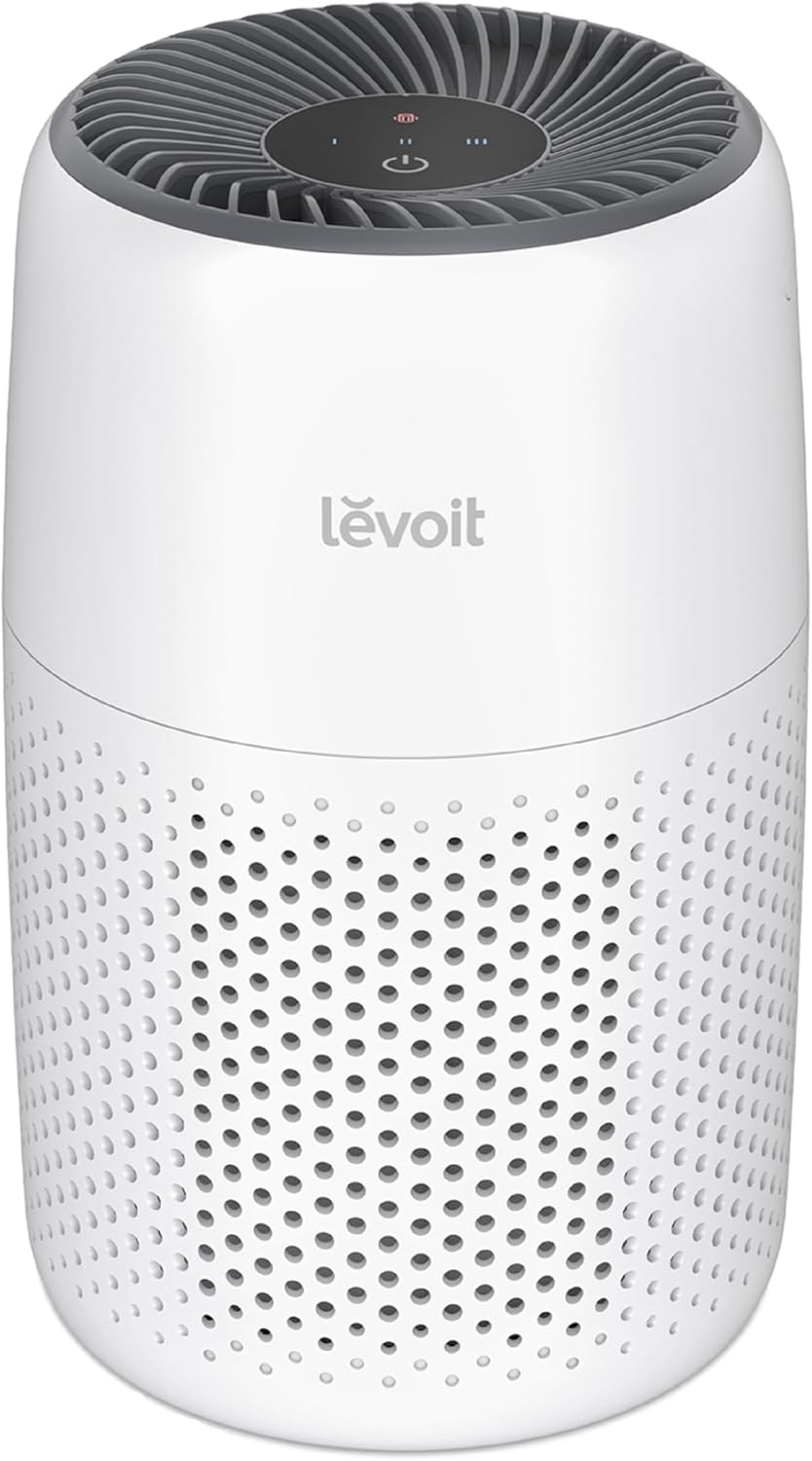
| Rated Power | 7W |
|---|---|
| Noise Level | 27-45 dB |
| Adapter Input | 100-240V, 50/60 Hz |
The Levoit Core Mini-P is a small, plug-in air purifier built for near-desk or bedside use where space is limited. It uses a pre-filter and a main HEPA-style filter to trap lint, pet dander, dust, and smoke while an activated-carbon layer helps reduce odors and fumes; the unit also accepts a few drops of essential oil for light aromatherapy. With low power draw (about 7W) and a reported noise range of roughly 27 to 45 dB, it runs quietly on sleep mode and includes an auto-off display to avoid disturbances. Practical benefits include easy placement on a desktop, simple setup, and replaceable genuine filters sold by the brand. Important limitations are its compact coverage area and modest airflow—it is tuned for single small rooms or close-range capture rather than clearing large spaces or heavy chemical vapors quickly. For work with resin printing, expect better localized reduction of dust and particulates but rely on additional ventilation or a larger purifier for higher VOC loads.
Best for: Buyers who want a reliable, compact purifier with proven user acceptance for cleaning airborne particles near their work or sleeping area and who value quiet, low-power operation.
Less Ideal for: Those needing strong VOC removal or rapid clearing of fumes from resin printing, or anyone looking to purify larger rooms without upgrading to a higher-capacity model.
- Compact footprint fits on desks and bedside tables
- Multi-stage filtration captures dust, pet dander, and smoke particles
- Very low power draw and quiet operation suitable for night use
- Simple setup with replaceable genuine filters and an aromatherapy sponge
- Limited room coverage and modest airflow not ideal for large spaces
- Not designed as a dedicated VOC/chemical scrubber for heavy fumes
Verdict: A quiet, low-power desktop purifier that effectively captures particulates at close range, making it a sensible choice for small workspaces where user-proven performance and low noise matter.
VOOPNU H13 HEPA Air Purifier DH-JH12

| Filter type | H13 True HEPA triple-layer |
|---|---|
| Coverage | Up to 1,076 ft² (laboratory tested) |
| Noise level | As low as 22 dB |
| Speeds | 3 fan speeds |
| Model number | DH-JH12 |
The VOOPNU DH-JH12 is a small, user-friendly air purifier that uses an H13 True HEPA triple-layer filter and 360° intake to capture fine particles, pet hair, pollen, smoke, and odors. It is intended for straightforward, continuous operation with a simple control panel, three fan speeds, a timer, and a quiet low setting that claims around 22 dB for overnight use. Laboratory figures and the product description state it cleans 250 ft² every 15 minutes and covers up to 1,076 ft² per hour, making it suitable for workshops or small rooms where particulate removal is a priority. The unit includes an essential oil tray for scenting and lists multiple safety and performance certifications. Practical downsides are its compact footprint which implies a smaller internal fan than larger commercial units and filter replacement on a 3–6 month cycle under typical use, so ongoing filter costs and continuous run time are considerations. For hobbyist resin printing, the purifier offers focused particle and odor reduction in enclosed spaces but expect modest airflow compared with dedicated larger CADR-rated shop units.
Best for: Someone who values straightforward, certified filtration for a small workspace or room and prefers a low-noise, easy-to-run unit for routine particle and odor reduction.
Less Ideal for: Users who need very high-volume airflow or industrial-strength odor removal for large print shops should consider larger CADR-rated units designed for heavy solvent fumes and high particulate loads.
- H13 True HEPA triple-layer filtration captures 99.97% of fine airborne particles
- 360° intake design for omnidirectional air capture in small rooms
- Quiet low-speed operation around 22 dB suitable for night use
- Simple controls and timer make continuous operation easy
- Certified to multiple safety and performance standards (ETL, CARB, FCC, DOE, CE, ROHS)
- Compact size suggests lower maximum airflow than larger workshop purifiers
- Recommended filter replacement every 3–6 months increases operating costs
Verdict: A compact, certified H13 HEPA purifier that provides quiet, easy continuous filtration for small resin-printing spaces where reliable particle and odor reduction is the priority.
Choosing the Right Air Purifier for Resin Printing: Key Factors to Consider
Filtration Stages and Media
Resin printing emits both volatile organic compounds and ultrafine particles, so a suitable purifier should combine media that address both. A multi-stage approach typically pairs a pre-filter to catch larger dust and fibers, a true HEPA or equivalent filter to capture particles down to 0.1 microns, and an activated carbon or specialized chemisorption layer to adsorb VOCs and odors.
Understanding which filter media are present matters because some HEPA-only units will remove particulate but do little for resin fumes. Check for explicit mention of high-surface-area carbon, impregnated chemisorbents, or multi-chemistry carbon blends that target common photopolymer volatiles.
CADR, Airflow, and Room Coverage
Clean air delivery rate and stated coverage area indicate how quickly a purifier can exchange and clean the air in your workspace. For resin printing, localized concentration of fumes near the printer is common, so you want a unit whose airflow is sufficient to provide multiple air changes per hour in the room where you work.
Match the unit to your workspace volume rather than just floor area. Taller ceilings or partially open rooms need higher airflow. Also consider placement: positioning the purifier to draw air away from the printer and exhaust cleaned air toward a different corner helps reduce lingering concentrations at the work surface.
Noise and Fan Speed Control
Resin printing can take hours, so continuous operation noise becomes a practical constraint. Look for purifiers that list decibel levels at different fan speeds and offer a low-noise mode or programmability. Variable fan control lets you run a quiet background setting for long prints and a higher cleanup speed while post-processing or curing when fumes spike.
Noise matters especially in shared home or office environments. Consider units with low-vibration fans and sound-dampening design if you need to keep the workspace livable during extended prints.
Maintenance, Filter Replacement, and Operating Cost
Regular filter replacement is a predictable ongoing cost and affects how effective the purifier remains over time. Check estimated filter life under normal workshop conditions and the availability of replacement media. Some carbon filters become saturated faster in heavy-fume scenarios, so factor that into operating cost projections.
Ease of accessing and replacing filters influences whether maintenance actually gets done. Units with tool-free access, clear replacement indicators, and moderate filter prices reduce friction for continued protection.
Size, Placement, and Portability
Physical footprint matters for small workshop benches and desktop printing stations. A compact unit can sit near the printer to pull fumes at the source, while a larger floor unit may be better for cleaning an entire room. Portability is useful if you frequently move between spaces or need temporary elevated airflow during post-processing.
Also consider electrical requirements and cord length so you can place the purifier where it is most effective without stretching cables or blocking walkways.
Why VOC Removal Matters for Resin Printing
Resin materials release a mix of volatile organic compounds during printing and especially during curing and sanding. These gases are responsible for strong odors and can cause irritation. Removing VOCs reduces acute discomfort and helps maintain better indoor air quality over repeated print sessions.
Targeting VOCs requires more than particle filtration. Look for units that specify activated carbon capacity or listed target gases because not all carbon filters perform equally against the specific volatiles associated with photopolymers.
- VOCs can linger longer than particulates, so continuous or post-process ventilation is beneficial.
- High-surface-area carbon or chemisorption layers accelerate gas capture compared with thin carbon pads.
- Mechanical exhaust ventilation combined with an air purifier can reduce peak concentrations faster.
Placement Tips to Maximize Effectiveness
Where you put the purifier has a big impact. For benchtop printers, place a compact purifier 1 to 3 feet from the printer and position intake between the printer and the user to intercept fumes. For room-sized units, place the purifier along airflow paths to promote cross-room circulation rather than tucked into a corner.
Avoid placing the purifier directly behind the printer exhaust if the unit's intake is on the same side as its exhaust. That setup can create short-circuiting where cleaned air recirculates and bypasses room exchange.
- Orient intake toward the printer and exhaust away from the printing zone.
- Elevate small units slightly to improve intake of rising warm air during curing.
- Keep 12 to 24 inches of clearance around the intake and exhaust for best airflow.
Combining Ventilation and Filtration
An air purifier is most effective when complemented by some form of ventilation. Opening a window or running a dedicated exhaust fan during heavy post-processing reduces the overall load on the purifier and shortens the time needed to clear fumes. In enclosed spaces without ventilation, rely on a purifier with strong VOC capacity and high airflow.
If you have the ability to duct an exhaust to the outdoors, pair it with recirculating filtration for particle control so you address both gases and particulates efficiently.
- Use ventilation during resin pours and sanding when emissions spike.
- Run the purifier on high for a period after post-processing to capture remaining particulates.
- Consider timed operation: higher speed during active work, lower overnight for background cleaning.
Filter Care and Safe Disposal
Filters that trap resin particles and adsorb VOCs should be handled carefully. Follow manufacturer guidance for removing filters and avoid shaking them, which can re-aerosolize particles. Place used filters in sealed bags before disposal if local regulations do not mandate special handling.
Document replacement dates so you maintain effective protection. Some owners find marking filters with the installation date helps them judge real-world life over time, since heavy use in small spaces often shortens expected lifespans.
- Replace or seal filters promptly after heavy post-processing sessions.
- Store replacement filters in dry, airtight packaging until use.
- Check pre-filters and clean or vacuum them regularly to extend HEPA and carbon life.
Sizing a Unit to Your Workflow
Think in terms of air changes per hour for the actual room volume you use for printing. A higher-rated CADR means faster clearing of contaminants, which is especially helpful if you frequently do long prints, batch post-processing, or work on multiple printers in one room. If your workflow includes frequent sanding or wet curing, err toward higher airflow or multiple staged cleans.
For dedicated small enclosures or printer hoods, a compact unit with targeted intake may be more effective than a larger room purifier because it intercepts contaminants at the source.
- Calculate room volume: floor area times ceiling height to match CADR recommendations.
- For high-intensity work, aim for 4 to 6 air changes per hour.
- Consider two smaller units if you split work between separate benchtop areas.
How We Chose the Best Air Purifier for Resin Printing
We focused on attributes that matter specifically to resin printing environments rather than general-purpose room air cleaning. Primary evaluation criteria included filtration capability against VOCs and ultrafine particles, measured or reported clean air delivery rates appropriate for workshop volumes, and ventilation patterns that reduce concentrated fumes near the printer. We also considered noise at typical fan speeds so the unit is tolerable during multi-hour prints and assessed filter maintenance frequency and operating cost. We excluded products that lack a dedicated activated carbon stage or that only list HEPA without specifying ultrafine particle capture, since resin emissions include both gaseous and submicron particulate components. We favored units with clear filtration stage descriptions and CADR or airflow figures sufficient for small to medium workspaces. Usability factors like filter replacement accessibility, programmable fan speeds or timers, and compact footprint were also part of the selection. Safety features such as sealed filter chambers and clear maintenance alerts were considered as well.
Our full evaluation process is outlined in our review methodology.
FAQ
Do I need a HEPA filter for resin printing?
Yes. Resin printing produces ultrafine particles during curing and sanding that HEPA-grade filters capture effectively. HEPA alone does not remove gases, so pair it with carbon or chemisorption media for VOC control.
Can a small desktop purifier protect a whole room?
A small desktop purifier can reduce local concentrations near the printer but typically cannot provide full-room air changes unless it has sufficient CADR for your room volume. For whole-room protection, match the purifier to your calculated air changes per hour.
How often should I replace the carbon filter?
Replacement intervals depend on usage intensity and VOC load. In heavy resin workshops the carbon stage may need replacing every few months, while light hobby use can stretch that to six months or more. Monitor odor return and follow manufacturer guidelines.
Are filters cleaning or washing options effective?
Pre-filters that trap large dust and fibers are often washable, but HEPA and carbon filters are typically not. Washing or attempting to regenerate these filters can damage the media and reduce effectiveness, so replace non-washable stages as recommended.
Should I run the purifier continuously during prints?
Running the purifier continuously is advisable for longer prints and during post-processing to maintain reduced concentrations. Use lower fan speeds for background cleaning and boost fan speed for active work or after sanding and curing.
Final Verdict
Prioritize units that combine effective VOC adsorption with true HEPA-level particle capture and adequate airflow for your workspace volume. Noise, maintenance ease, and filter cost are important secondary tradeoffs that determine whether a purifier remains in active use. For benchtop printing, favor placement and portability so fumes are intercepted at the source; for room-wide protection, size the purifier to deliver multiple air changes per hour. Focused attention on filtration stages and real-world airflow will give you the most reliable protection during resin printing. Choose a unit that fits your room, matches your noise tolerance, and has accessible replacement filters so you can keep respirable particulates and fumes under control over time.