
Note: This article contains affiliate links. If you click on these links and make a purchase, we may earn a small commission at no extra cost to you. This helps support our research and content. Read our full affiliate disclosure here.
If you suffer from strong allergic reactions to pollen, pet dander, or dust, a purpose-built air purifier can make a measurable difference in daily comfort. The right unit reduces airborne allergens, lowers symptom triggers overnight, and eases breathing during high-exposure periods. This guide collects seven shortlisted air purifiers for severe allergies that meet strict filtration and coverage standards. We evaluated options based on filtration efficiency, room coverage, noise level, and ongoing maintenance needs. Read on to find a model that fits the size of your living spaces and the severity of your symptoms, with clear guidance on what to prioritize.
Top Picks at a Glance
| Best Overall The best all-around choice for most situations | Winix 5510 Air Purifier |  |
| Best Quality Built to a higher standard if you want something more solid | Coway Airmega 400 |  |
| Best Value The sweet spot between price and what you get | Honeywell HPA304 HEPA Air Purifier |  |
| Best Budget The cheapest option that still gets the job done reliably | VOOPNU HEPA Air Purifier DH-JH12 |  |
| Top Rated A top-rated pick with lots of positive feedback | DREO Air Purifier 338 |  |
| Most Popular A crowd favorite that many people choose with confidence | Levoit Core 300-P |  |
| Best Seller A high-volume bestseller chosen again and again | Levoit Vital 200S-P Air Purifier |  |
Winix 5510 Air Purifier

| Filtration stages | 4-Stage |
|---|---|
| True HEPA | Captures down to 0.01 microns |
| Smart features | WiFi / Alexa / Google Home |
| AHAM verified | Coverage up to 1,882 sq ft in 1 hour |
The Winix 5510 is a 4-stage tower air purifier built to capture very small particles and reduce common indoor odors. It uses a True HEPA filter that the manufacturer says captures particles down to 0.01 microns, backed by a washable pre-filter and an advanced deodorization carbon layer to reduce VOCs, smoke and pet smells. Smart sensors feed an LED air quality indicator and let the unit run in Auto Mode, automatically adjusting fan speed, while Sleep Mode quiets operation in the dark for overnight use. The purifier also supports remote control via the Winix Smart App and integrates with voice assistants. Practical benefits include fast room coverage for larger spaces and simple maintenance with a filter replacement indicator. Expect reasonably quiet performance on low speeds but higher noise and energy use on peak fan settings when the unit ramps up to clean heavily polluted air quickly.
Best for: Buyers who want a capable all-around purifier that balances strong filtration, smart controls, and easy maintenance for large rooms and persistent indoor allergens.
Less Ideal for: People seeking the absolute quietest bedroom unit or the lowest possible running cost in continuous max-output scenarios should consider smaller or lower-power alternatives.
- 4-stage filtration including True HEPA and carbon filter for particle and odor removal
- Smart sensors with Auto Mode and LED air quality indicator for hands-off operation
- Winix Smart App and voice assistant compatibility for remote control
- Washable pre-filter and filter replacement indicator simplify upkeep
- Higher fan speeds can produce noticeable noise and increased power draw
- Claims about capture down to 0.01 microns are manufacturer-stated and may exceed standard HEPA testing scopes
Verdict: A strong, smart 4-stage purifier that balances fast large-room cleaning and convenient app control for people managing severe indoor allergies.
Coway Airmega 400
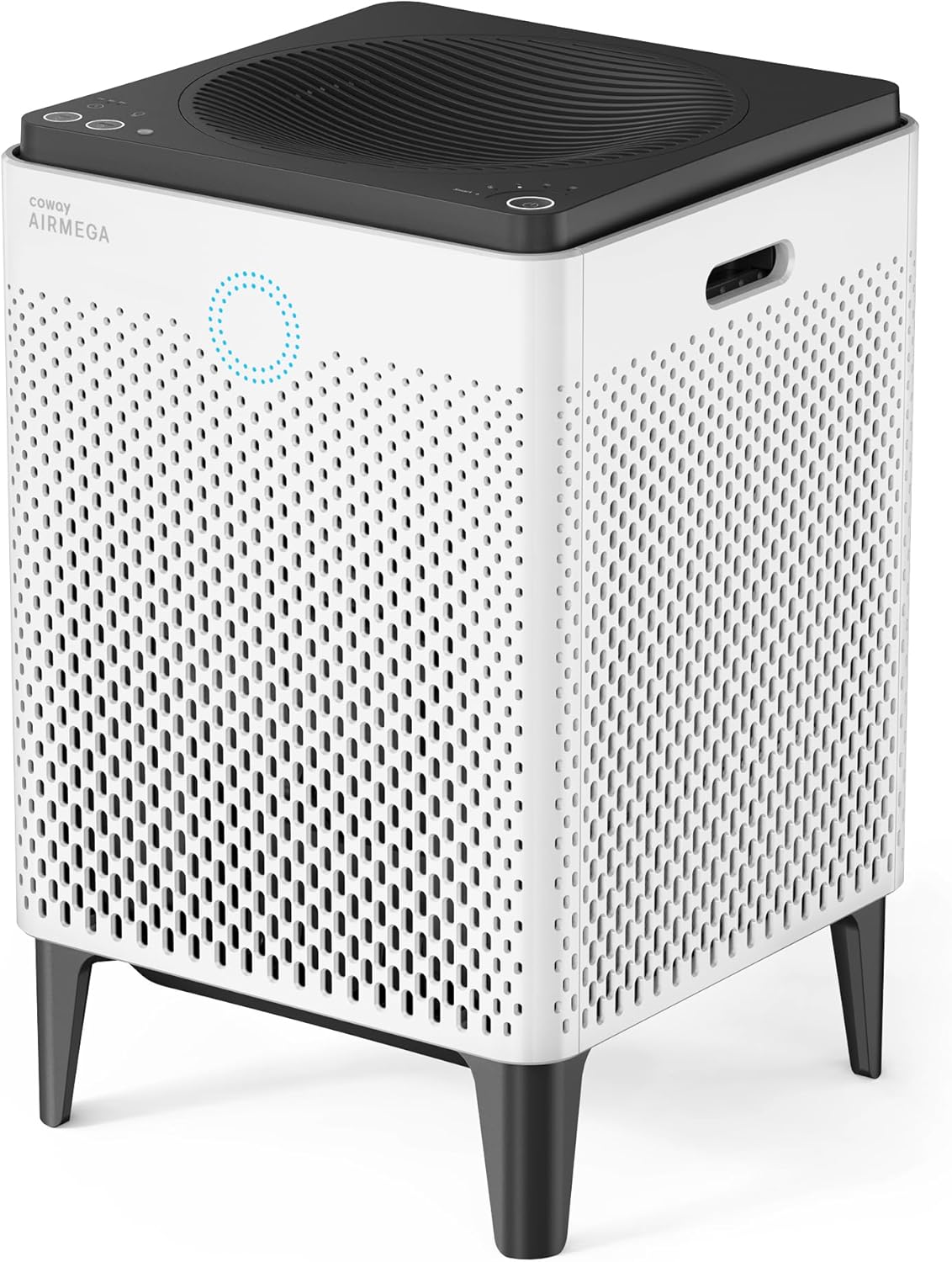
| Filter Type | HEPA, Active Carbon, Pre-Filter |
|---|---|
| Floor Area | 3120 square_feet |
| Particle Retention Size | 0.3 micron |
| Wattage | 66 watts |
| Special Features | Air Quality Monitor, Eco Mode, Smart Mode, Timer |
The Coway Airmega 400 is a large-room air purifier built to move a lot of air while capturing fine particles and many gaseous pollutants. It uses a three-stage HyperCaptive filtration system — washable pre-filter, activated carbon, and a HEPA-grade filter rated to remove 99.97% of 0.3 micron particles — and includes sensors that feed Smart, Eco, and Sleep modes to adjust fan speed automatically. In real-world use it is suited to living rooms, open-plan spaces, or whole-floor coverage where you need continuous, powerful cleaning: the unit advertises up to 3,120 sq ft cleaned in an hour and reports real-time AQI so you can see when speeds ramp up. Practical benefits are strong particle and VOC reduction, an energy-saving Eco mode that shuts the fan when air stays clean, and a low noise floor on sleep settings. Trade-offs are its large physical footprint and higher power draw compared with small-room purifiers, and replacement filters add ongoing cost for sustained heavy use.
Best for: Buyers who prioritize measurable, high-performance air cleaning for severe allergy problems in large spaces and want an automated system that adapts to changing air quality.
Less Ideal for: People needing a compact, portable, or budget entry-level purifier for a single small bedroom should consider smaller models instead.
- High coverage for large rooms (up to 3,120 sq ft per hour).
- True HEPA-grade filtration capturing 99.97% of 0.3 micron particles.
- Activated carbon stage for odor and VOC reduction.
- Automatic Smart, Eco, and Sleep modes with real-time air quality feedback.
- Large and relatively heavy unit that needs a dedicated spot in the room.
- Higher power consumption and ongoing filter replacement costs compared with compact purifiers.
Verdict: If you need factory-quality HEPA performance and automatic air-quality control to tackle severe allergies across very large rooms, the Airmega 400 delivers powerful, measurable cleaning.
Honeywell HPA304 HEPA Air Purifier

| Power Source | Corded Electric |
|---|---|
| Filter Type | HEPA |
| Floor Area | 465 square_feet |
| Particle Retention Size | 0.3 micron |
| Wattage | 80 watts |
The Honeywell HPA304 is a straightforward HEPA air purifier built for extra-large rooms and allergy relief. It uses a HEPA-class filter to capture up to 99.97% of particles 0.3 microns and larger, and Honeywell rates it to circulate air in a 465 sq ft room multiple times per hour with a Turbo Clean high setting for faster clearing. Controls are simple touch and button controls with a timer and dimmer for nighttime use, plus a filter change indicator that helps maintain performance. At 80 watts it runs with modest power draw but is relatively large and heavier than smaller units, so it is meant to stay in one spot rather than move between rooms frequently. It does not include smart connectivity or specialized gas/VOC carbon staging beyond the standard HEPA and pre-filter options, so it focuses on particle removal rather than advanced odor or chemical reduction. For buyers who want a reliable, easy-to-use purifier that emphasizes proven HEPA filtration and coverage for very large rooms, this model is a practical pick.
Best for: Buyers who prioritize dependable particle filtration and straightforward controls to reduce allergens in large spaces and want a low-maintenance, practical solution.
Less Ideal for: If you need smart integration, frequent portability between rooms, or focused VOC/odor removal, consider models tailored to those priorities instead.
- True HEPA filtration rated to capture 99.97% of particles 0.3 microns and larger
- Designed for extra-large rooms with stated coverage and multiple air changes per hour
- Simple touch/button controls with timer and filter change indicator for easy maintenance
- Modest power consumption (80 watts) for continuous operation
- No Wi-Fi or smart-home integration for remote control or scheduling
- Limited emphasis on gas/odor removal beyond particle filtration
- Relatively large and heavy compared with small-room purifiers
Verdict: A no-nonsense, high-coverage HEPA purifier that reliably reduces airborne allergens in very large rooms.
VOOPNU HEPA Air Purifier DH-JH12

| Filtration | H13 True HEPA triple-layer |
|---|---|
| Coverage | Up to 1,076 ft² (laboratory tested) |
| Noise level | 22 dB (lowest) |
| Speeds | 3 fan speeds |
The VOOPNU DH-JH12 is a small, straightforward air purifier built around an H13 True HEPA triple-layer filter and a 360 degree intake that the brand says removes 99.97% of airborne particles. It is intended for continuous use and is rated to cover roughly 1,076 sq ft (laboratory figure) with a CADR-style throughput claim that translates to cleaning 250 sq ft every 15 minutes. Controls are simple, with three fan speeds, a timer and a removable tray for essential oils if you want light scenting. Practical benefits include very quiet operation down to about 22 dB for use in bedrooms and an easy-to-place compact footprint. The unit is backed by multiple safety and emissions certifications and offers washable or replaceable filter options across the product line. Limitations to consider are that the compact chassis likely restricts sustained high airflow compared with larger, high-CADR purifiers used in severe-allergy scenarios, and filter-replacement cadence (3–6 months recommended) adds ongoing cost if you run it continuously.
Best for: Buyers who need an affordable, easy-to-use HEPA purifier for daily background filtration in bedrooms or small to medium living spaces and who prioritize quiet operation and simplicity over maximum airflow.
Less Ideal for: People with very severe allergies requiring the highest possible CADR and continuous, high-volume air exchanges for large open areas should consider larger dedicated medical-grade or high-CADR units instead.
- H13 True HEPA triple-layer filtration captures 99.97% of particles
- 360° intake design for more even room circulation
- Very quiet operation down to 22 dB suitable for bedrooms
- Simple controls and a built-in essential oil tray for scenting
- Compact form factor may deliver lower sustained airflow than larger, high-CADR models
- Recommended filter replacements every 3–6 months increase ongoing operating cost
Verdict: A budget-friendly, quiet HEPA purifier that fits small to medium rooms and daily allergy control when you want simple, low-noise operation.
DREO Air Purifier 338

| CADR | 115 CFM |
|---|---|
| Filtration | Pre-filter + HEPA + Activated carbon |
| HEPA efficiency | 99.97% of 0.3μm |
| PM2.5 sensor | High-precision, real-time |
| Energy | ENERGY STAR certified (≈125 kWh/yr) |
The DREO Air Purifier 338 is a home HEPA purifier designed to remove particles, smoke, pollen, dust, and odors using a 3-in-1 filter (pre-filter, HEPA, activated carbon) and a 360° spiral intake for faster circulation. It is AHAM verified with a CADR of 115 CFM and reports real-time PM2.5 and AQI on a color LED, which helps you see when to boost cleaning. Use it in bedrooms, living rooms, or near high-traffic areas; Auto mode adjusts fan speed based on the PM2.5 sensor while Sleep mode reduces noise and turns off display lights for nighttime. Practical benefits include fast air refresh for medium rooms, a turbo setting for strong short-term cleaning, and ENERGY STAR certified efficiency to limit electricity use. Limitations to note are that stated coverage figures vary by ACH assumptions and the unit is best for single-room use rather than whole-house filtration, and replacement filters are required to keep performance at peak levels. For allergy sufferers the real-time sensor and effective HEPA capture make it a dependable daily cleaner when maintained properly.
Best for: Buyers who prioritize consistent, validated particle removal for allergy control and want an easy-to-use room purifier that actively monitors air quality and adjusts itself.
Less Ideal for: People looking to purify multiple rooms or whole-house systems should consider larger or ducted solutions instead of a single-room unit.
- AHAM-verified CADR of 115 CFM for validated particle removal performance
- 3-in-1 filter (pre-filter, HEPA, activated carbon) captures 99.97% of 0.3µm particles and reduces odors
- Real-time PM2.5 sensor with color AQI display helps monitor indoor air quality
- Multiple modes including Auto, Turbo, and quiet Sleep mode with low noise down to 18 dB
- ENERGY STAR certified for lower annual energy use
- Coverage claims depend on air change assumptions and are most applicable to single rooms rather than entire homes
- Requires periodic filter replacements to maintain HEPA performance
Verdict: A reliable, AHAM-verified room air purifier with HEPA filtration and real-time PM2.5 monitoring that suits allergy sufferers who need consistent, validated particle removal.
Levoit Core 300-P

| Filter Type | 3 in 1 Filtration |
|---|---|
| Noise Level | 24 db |
| Wattage | 56 watts |
| Particle Retention Size | 0.3 micron |
| Contaminant Filtration Capability | Cigarette Smoke, Dust, Odors, Pet Dander, Pet Hair, Pollen, VOCs, Wildfire Smoke |
The Levoit Core 300-P is a small, user-friendly air purifier that uses a three-stage original filter with H13-grade HEPA performance to capture fine particles down to 0.3 micron and claims 99.97% filtration efficiency for pollen, dust, pet dander, smoke, and other allergens. It is intended for bedroom or home use and is powered by a 56W motor that delivers a CADR suitable for refreshing air in typical rooms; Levoit lists AHAM-verified CADR numbers for smoke, dust, and pollen. Controls are touch-based and include a near-silent Sleep Mode that drops noise to about 24 dB and a timer with preset intervals. The unit is portable and compact, making it easy to move between rooms or tuck beside furniture, and filters are user-replaceable with recommended replacement every 6 to 8 months. Limitations include the lack of an Auto Mode on this model and no smart connectivity, so fan speed must be changed manually, and optimal performance depends on using Levoit original filters rather than third-party replacements.
Best for: Buyers who prioritize proven filtration and quiet nighttime operation and who want a compact purifier backed by strong customer feedback and independent verification.
Less Ideal for: People who need smart features or automatic air-quality-driven control, or who want a purifier sized for continuous whole-house coverage rather than single rooms.
- HEPA-grade three-stage filter that captures 0.1–0.3 μm particles with 99.97% efficiency as tested
- AHAM-verified CADR ratings for smoke, dust, and pollen provide proven room-cleaning performance
- Very quiet Sleep Mode at about 24 dB suitable for bedroom use
- Compact, lightweight design makes it easy to move and place in small rooms
- Touch controls and timer function for simple operation
- No Auto Mode or air quality sensor so fan speed must be adjusted manually
- Requires genuine Levoit replacement filters for best performance
Verdict: A quiet, AHAM-verified HEPA purifier that reliably removes fine allergens in bedrooms and small to medium rooms.
Levoit Vital 200S-P Air Purifier

| Floor Area | 1875 square_feet |
|---|---|
| Filter Type | 3-Stage Filter |
| Particle Retention Size | 0.1 micrometer |
| Noise Level | 27 db |
| Wattage | 51 |
The Levoit Vital 200S-P is a smart air purifier built to tackle allergens, pet dander, smoke, and household odors in large rooms. It uses a three-stage filtration system with a washable pre-filter plus an activated carbon stage and a HEPA-grade filter that captures particles down to 0.1 micrometer, and independent AHAM testing provides CADR figures for smoke, dust, and pollen. Typical use is straightforward: place it in a living area or bedroom, use the app or onboard buttons to set sleep or manual modes, and rely on its air quality monitor to adjust operation. The unit is engineered for heavy-duty home use — 51 watts of power and an intake design aimed at reducing hair clogs — and runs quietly enough for bedrooms at its low setting. Trade-offs include its physical footprint and weight for a tabletop unit and the ongoing cost and attention of replacing or choosing specialized replacement filters for pets, smoke, or VOCs. For someone who wants verified performance and smart controls, it delivers reliable, whole-room cleaning for allergy-prone households.
Best for: Buyers seeking a proven, low-risk solution for severe allergy symptoms who prioritize independently tested performance and easy smart control in larger rooms.
Less Ideal for: People who need an ultra-compact, lightweight travel purifier or who prefer a no-maintenance filterless device.
- AHAM-verified CADR ratings for smoke, dust, and pollen ensure tested performance.
- Three-stage filtration including washable pre-filter and activated carbon reduces particulates and odors.
- App control and built-in air quality monitor make automated or remote operation easy.
- Low noise operation suitable for bedrooms at quiet settings.
- Relatively large and heavier than some compact purifiers, which may limit placement options.
- Requires periodic replacement of specialized filters for optimal performance.
Verdict: Choose the Vital 200S-P when you want independently verified, whole-room allergen removal with smart controls for a low-risk, high-confidence solution.
Choosing the Right Air Purifier for Severe Allergies: Key Factors to Consider
Filtration Efficiency and Filter Type
The core of any air purifier for severe allergies is the filtration media. True HEPA filters capture at least 99.97% of particles down to 0.3 microns and often perform even better at smaller sizes. For severe allergy sufferers, multi-stage filtration that combines a prefilter for large debris, a true HEPA stage for fine particles, and an activated carbon layer for odors and VOCs provides the most comprehensive reduction of triggers.
Higher filtration efficiency directly reduces airborne allergen counts but can increase airflow resistance. That tradeoff means the purifier must also have sufficient fan power or design to maintain an effective clean air delivery rate in real rooms.
Room Size, CADR, and Placement
Match a purifier's rated room coverage or CADR to the actual square footage and ceiling height of the room where you will use it. A unit rated for small rooms will not keep allergen levels low in a large open-plan living area. Pay attention to the CADR values for smoke, dust, and pollen if provided, since pollen and pet dander are common allergy triggers.
Placement matters: locate the unit away from obstructions and near typical sources of allergens, such as pet rest areas or bedroom sleeping zones. For whole-home effect, multiple appropriately sized units work better than one oversized unit placed in a hallway.
Noise Output and Nighttime Operation
People with severe allergies often need continuous filtration, including overnight. Noise output at low and sleep modes is therefore crucial. Look for models with documented decibel levels at different fan speeds. A quieter unit allows you to run higher filtration settings without disrupting sleep, which is important because nighttime allergen exposure can worsen morning symptoms.
Some purifiers include a dedicated sleep mode or auto mode that reduces fan speed based on sensor readings. Automated low-noise operation can maintain air quality without manual adjustments, but confirm whether the reduced speed still achieves sufficient air changes per hour for your room size.
Filter Lifespan, Replacement Cost, and Availability
Ongoing filter replacements are a primary ongoing cost. Consider both how frequently the manufacturer recommends changing filters under typical use and the current market availability of replacement filters. Long-lived filters lower total ownership cost and reduce the frequency of maintenance interruptions.
Replacement costs vary considerably between filter types and manufacturers. For severe allergy use, you may run the purifier at higher speeds, which can shorten filter life. Choosing units with widely available, reasonably priced filters or multi-pack options makes long-term upkeep simpler and more predictable.
Sensor Accuracy and Control Features
Accurate particle or air-quality sensors allow a purifier to adapt fan speed automatically, maintaining effective filtration while minimizing unnecessary noise and energy use. For severe allergies, look for devices with particle-counting sensors rather than only generic odor sensors, because particles carry most allergen material.
Control features such as programmable schedules, app-based monitoring, and filter-replacement alerts improve convenience and ensure consistent performance. However, sensor-driven automation is only useful if the sensors reliably reflect particle levels in the occupied space.
Energy Use and Long-Term Operational Cost
Continuous operation increases energy use, so consider the purifier's power draw at typical settings. Energy-efficient fans and brushless motors lower operating costs and make it practical to run the unit 24/7 when needed. Over time, small differences in wattage add up, particularly if you plan to run several units in different rooms.
Also factor in indirect costs: higher-efficiency filtration that requires more frequent filter changes may save symptoms but increase maintenance expenses. Balance upfront efficiency with predictable ongoing costs for the best long-term value.
How Clean Air Delivery Rate (CADR) Affects Real-World Results
CADR is a standardized metric that describes how quickly a purifier can remove specific particle types from a given space. Higher CADR means faster reduction of airborne pollen and dust in a room. When comparing units, consider CADR relative to your room size to estimate how many air changes per hour you will get at different fan speeds.
Remember that CADR tests assume ideal placement and unobstructed airflow. In actual rooms, furniture, doors, and airflow patterns can reduce effective performance. Expect lower real-world removal rates than laboratory CADR numbers and plan for a margin of extra capacity if you have severe symptoms.
- Match CADR to room size to estimate air changes per hour
- Prioritize pollen and dust CADR if those are your primary triggers
- Allow for reduced performance due to placement and room layout
Managing Pet Dander and High-Exposure Rooms
If pets are a major allergen source, place a dedicated purifier near the pet's main resting area and another in sleeping zones. A purifier with a good prefilter will capture larger hair and fur first, extending the life of the HEPA element.
For rooms with frequent traffic or open access to other areas, consider units with higher airflow capacity so they can keep up with continuous introduction of particulates.
- Use multiple units rather than relying on a single centralized purifier
- Clean or vacuum pet areas regularly to reduce large debris load on filters
- Select models with washable prefilters to reduce maintenance costs
Using Purifiers at Night: Sleep Modes and Timers
Many allergy sufferers need the purifier running while they sleep. Sleep modes reduce fan speed and dim lights while still providing filtration. Confirm that the lower-speed settings still deliver adequate air changes for your room size when running overnight.
Timers and schedules let you target high-exposure periods, such as morning pollen influx or evening pet activity, conserving energy while protecting sensitive times.
- Check low-speed CADR or airflow to ensure sleep mode remains effective
- Use timers to run higher speeds during known high-exposure windows
- Prefer units with programmable weekly schedules for consistent protection
Maintenance Best Practices to Keep Performance High
Regular maintenance keeps filtration working at peak efficiency. Replace HEPA and carbon filters per the manufacturer's guidance or sooner if you notice reduced airflow or persistent odors. Clean prefilters and intake grilles routinely to prevent buildup that reduces airflow.
Keep the area around the purifier clear so intake and exhaust are not blocked. Periodically check sensor ports for dust accumulation, as dirty sensors can cause erroneous auto-mode behavior.
- Follow recommended replacement intervals and monitor filter-change indicators
- Vacuum or wash washable prefilters every few weeks depending on pet and dust load
- Keep intake and exhaust at least a few inches from walls and furniture
When to Consider Additional Indoor Allergen Controls
A purifier reduces airborne particles but does not remove allergens embedded in fabrics and carpets. For severe allergies, combine purifiers with regular deep cleaning, using HEPA-equipped vacuums and washing bedding frequently in hot water.
Control humidity to limit dust mite populations and consider allergen-proof mattress and pillow covers. These measures reduce the overall allergen reservoir so purifiers can focus on airborne particles.
- Use HEPA vacuums and wash textiles frequently
- Maintain indoor humidity between 30 and 50 percent to reduce dust mites
- Consider replacing dense carpets in bedrooms if dust retention is severe
How We Chose the Best Air Purifier for Severe Allergies
We focused on products that demonstrably reduce airborne allergen loads and are practical for frequent home use. Primary filters and verified particle-capture capability were required for inclusion; units relying only on passive or ionic cleaning without HEPA-class filtration were excluded. We also prioritized models with clear rated room coverage and documented clean air delivery rate metrics so buyers can match units to real rooms. Key evaluation criteria included filtration efficiency against particles in the 0.1 to 3.0 micron range, certified CADR or equivalent performance, and coverage for typical bedroom and living-room sizes. We examined noise output at normal and sleep settings because people with severe allergies often need overnight operation. Maintenance costs and filter availability were assessed to estimate ongoing upkeep. Ease of use and control options, including preset modes and timer features, were considered since proper operation affects real-world performance. We excluded units that lack replaceable true HEPA or comparable mechanical filtration stages, those without transparent performance ratings, and models intended only for small personal use. The final selections balance proven airborne allergen removal, practical room coverage, reasonable noise profiles, and predictable maintenance demands.
Our full evaluation process is outlined in our review methodology.
FAQ
How often should I run an air purifier if I have severe allergies?
Often you will need continuous operation for best results, especially in bedrooms and high-traffic rooms. Running at a moderate speed continuously and using higher speeds during high-exposure times balances effectiveness and filter life.
Does a HEPA filter remove pet dander and pollen effectively?
Yes, true HEPA filters capture the fine particles that carry pet dander and pollen. A multi-stage system that includes a prefilter and HEPA stage works best because the prefilter catches larger debris first and extends HEPA life.
Can air purifiers help with allergy-related asthma symptoms?
Air purifiers can reduce airborne triggers that aggravate asthma, often lessening symptom frequency and severity. They are one part of asthma management and should be used alongside any medical treatment recommended by your healthcare provider.
Are ionizers or ozone generators a good option for severe allergies?
Ionizers and ozone generators are generally not recommended as primary solutions for severe allergies. Ozone can be harmful at concentrations needed for meaningful air cleaning, and many ionizers do not reliably remove particles the way mechanical HEPA filtration does.
How do I know when to replace the HEPA filter?
Replace the HEPA filter according to the manufacturer's interval or sooner if you notice reduced airflow, increased noise at the same settings, or persistent odors. Many units include filter-life indicators to simplify this decision.
Final Verdict
When choosing an air purifier for severe allergies, prioritize true HEPA-class filtration, adequate CADR for the rooms where you spend the most time, and quiet operation for overnight use. Balance filtration efficiency with filter lifespan and replacement costs so you can run the unit when needed without prohibitive upkeep. Focus on matching coverage to room size, maintaining the unit regularly, and pairing purifiers with broader allergen-reduction practices like frequent cleaning and humidity control. With those tradeoffs in mind, you can select a purifier that meaningfully reduces airborne allergens and improves daily comfort.