
Note: This article contains affiliate links. If you click on these links and make a purchase, we may earn a small commission at no extra cost to you. This helps support our research and content. Read our full affiliate disclosure here.
When someone at home is sick, the right air purifier can reduce airborne viruses, allergens, and irritating particles that prolong symptoms. You want a unit that actually moves and filters enough air for the room, runs quietly during rest, and is simple to maintain. This guide shortlists seven top air purifiers for sickness that prioritize medical-grade filtration, sensible airflow, and user-friendly upkeep. Below we explain the evaluation criteria used and walk you through the practical differences to help you pick a purifier suited to bedrooms, living rooms, or small sick rooms.
Top Picks at a Glance
| Best Overall The best all-around choice for most situations | Coway Mighty AP-1512HH |  |
| Best Quality Built to a higher standard if you want something more solid | Medify Air MA-50 V3.0 |  |
| Best Value The sweet spot between price and what you get | GermGuardian AC4825E Tower Air Purifier |  |
| Best Budget The cheapest option that still gets the job done reliably | FULMINARE H13 HEPA Air Purifier |  |
| Top Rated A top-rated pick with lots of positive feedback | Levoit Core 300-P |  |
| Most Popular A crowd favorite that many people choose with confidence | VOOPNU H13 HEPA Air Purifier DH-JH12 |  |
| Best Seller A high-volume bestseller chosen again and again | Levoit Core 200S-P |  |
Coway Mighty AP-1512HH

| Coverage | Up to 1,748 sq. ft. in 60 minutes |
|---|---|
| Filtration stages | Pre-filter, Deodorization, Bipolar Device, HEPA |
| HEPA effectiveness | 99.97% of 0.3 μm particles |
| Controls | Auto, Eco, Timer, Filter indicator |
| Included filters | 1 HEPA and custom filters |
The Coway Mighty AP-1512HH is a standalone air purifier built to scrub common indoor pollutants in medium to large rooms. It uses a four-stage system — washable pre-filter, deodorization filter, bipolar ionizer, and a true HEPA filter — to capture 99.97% of 0.3 micron particles while also reducing odors and some VOCs. The unit continuously monitors air quality and shifts fan speed in Auto mode, and the bright LED air-quality indicator provides an immediate visual readout that can be turned off for sleeping. Practical touches include a timer, filter-life indicators, and an eco mode that lowers fan speed when air is clean. The washable pre-filter reduces maintenance cost and the available custom filters let you tailor the unit for pets, smoke, or strong odors. Trade-offs are that the unit is a countertop/tower form factor that needs periodic filter replacements and it is intended for room-level use rather than whole-house integration. For illness-focused use, its HEPA filtration and real-time sensing make it effective at reducing airborne allergens and respiratory irritants in living spaces.
Best for: Buyers seeking a reliable, no-frills purifier to reduce airborne allergens, respiratory irritants, and odors in bedrooms, living rooms, or home offices while preferring automated sensing and straightforward maintenance.
Less Ideal for: People who need whole-house filtration integrated with HVAC or those who want a permanent ducted solution should consider other systems.
- True HEPA filtration captures 99.97% of 0.3 micron particles.
- Auto mode with real-time air-quality sensing adjusts fan speed automatically.
- Washable pre-filter lowers upkeep cost and is easy to clean.
- Filter indicator and timer simplify maintenance and scheduling.
- Custom filter options allow targeting smoke, pets, or VOCs.
- Requires periodic replacement of HEPA/deodorization filters to maintain performance.
- Designed for room-level coverage rather than whole-house purification.
Verdict: A dependable, sensor-driven HEPA purifier that reliably reduces airborne allergens and odors in medium to large rooms, making it a strong choice for protecting household members during illness.
Medify Air MA-50 V3.0

| Filter Class | HEPA H13 |
|---|---|
| Particle Retention Size | 0.1 micrometer |
| Wattage | 70 watts |
| Noise Level | 56 db |
| Power Source | ac |
The Medify Air MA-50 V3.0 is a performance-focused air purifier built to move a lot of air and capture very small particles with a True HEPA H13 filter. It is typically used in large living areas, open-plan homes, classrooms, or offices where rapid air changes are needed to reduce allergens, smoke, odors, and pathogens. The unit claims coverage up to 2,640 sq ft per hour and a CADR-oriented design that emphasizes fast circulation; controls include a touch panel with multiple fan speeds, sleep mode, timer, and a child lock for straightforward daily use. Practical benefits include filtration to 0.1 microns, certifications from CARB, ETL, and AHAM, and a programmable interface that makes it easy to run continuously or on schedules. Important trade-offs are its physical footprint and higher max noise at top speed, and the need to replace HEPA filters every few months under heavy use, which adds ongoing cost. For situations where strong, fast filtration is the priority, the MA-50 delivers measurable performance.
Best for: Buyers who prioritize fast, clinically capable air cleaning for large rooms or shared indoor spaces and want a purifier that emphasizes particle-removal performance over ultra-quiet operation.
Less Ideal for: Those seeking a compact, ultra-quiet bedroom-only purifier or a zero-maintenance unit that rarely needs filter changes should consider smaller or lower-maintenance alternatives.
- True HEPA H13 filtration capturing particles down to 0.1 microns
- High claimed coverage suitable for very large rooms (2,640 sq ft/hr)
- Multiple fan speeds plus sleep mode and programmable timer for flexible operation
- Certifications from CARB, ETL, and AHAM indicate tested performance
- Higher noise level at maximum fan speed compared with quieter residential models
- Replacement HEPA filters have a limited lifespan and require periodic cost and maintenance
- Large footprint may not fit small rooms or tight spaces easily
Verdict: Choose the MA-50 V3.0 when you need rapid, high-capacity HEPA H13 filtration to lower airborne particles across large rooms for sickness-focused protection.
GermGuardian AC4825E Tower Air Purifier

| Coverage | Up to 743 sq. ft. |
|---|---|
| Height | 22" |
| Filter type | True HEPA with activated carbon pre-filter |
| Speeds | 3 fan speeds |
The GermGuardian AC4825E is a compact tower air purifier that uses a True HEPA filter, activated carbon pre-filter, and optional UV-C light to capture airborne particles and reduce odors in home spaces. It runs on three fan speeds including a quiet sleep mode, and its CADR and airflow claims mean it circulates air in a small bedroom every 12.5 minutes and can service larger rooms on an hourly basis. The activated carbon layer helps reduce cooking and pet smells, while the HEPA stage captures most allergens and fine particulates down to 0.1 microns in air passing through the media. The unit is simple to place in bedrooms, offices, or basements and is compatible with several GermGuardian replacement Filter B cartridges and UV-C bulbs for routine maintenance. Limitations are its single-appliance design without smart controls and that UV-C is optional rather than integrated by default, so users seeking remote monitoring or whole-house solutions will need a different approach.
Best for: Buyers who want a straightforward, room-focused purifier that reduces allergens, odors, and airborne particles without extra connectivity or whole-house complexity.
Less Ideal for: Homes that need integrated smart controls, multi-room/whole-house purification, or specialized clinical sterilization tools.
- True HEPA filter captures 99.97% of particles as small as 0.1 microns in air passing through the filter media
- Activated carbon pre-filter reduces common household odors from cooking and pets
- Three fan speeds including a quiet sleep mode for nighttime use
- Covers small rooms quickly and can circulate air in larger rooms on an hourly basis
- No built-in smart features or remote control for scheduling or monitoring
- UV-C sanitizing is an optional add-on rather than standard in all units
Verdict: A practical, no-frills tower purifier that reliably reduces allergens and household odors in single rooms, making it a solid pick for keeping sick-room air cleaner.
FULMINARE H13 HEPA Air Purifier

| Filter type | H13 HEPA |
|---|---|
| Recommended room size | Up to 215 ft² / 20 m² |
| Noise level (low) | Around 24 dB |
| Timers | 2, 4, 8, 10, 12 hours |
The FULMINARE H13 is a small, budget-focused air purifier designed for single-room use. It uses an H13 HEPA filter to capture fine particles and pairs that filtration with a 360° outlet and dual-channel circulation that the manufacturer says refreshes air up to five times per hour in rooms up to about 215 sq ft. Controls include multiple fan speeds, a near-silent sleep mode around 24 dB, and five timer options (2, 4, 8, 10, 12 hours), plus an independent night light useful for bedrooms or nurseries. Practical benefits are straightforward: effective particle capture for allergens and some respiratory irritants, quiet overnight operation, and simple placement thanks to the compact footprint. Limitations to note are the small coverage area—it is intended for one room only—and the recurring cost and upkeep of periodic filter replacements; the unit is plug-in only and not battery powered. For someone treating sickness at home, it provides continuous particulate removal in a bedroom or patient room but will not substitute for a larger whole-house system.
Best for: Buyers on a tight budget who need an affordable, quiet bedroom purifier to reduce airborne particles during illness and improve sleep quality.
Less Ideal for: Homes needing whole-house coverage or larger rooms where higher CADR and greater airflow are required.
- H13 HEPA filter captures fine particles and allergens
- 360° air outlet with dual-channel circulation for even room coverage
- Very quiet sleep mode around 24 dB for night use
- Multiple timers and an independent night light add convenience for bedrooms
- Designed for rooms up to about 215 sq ft, not suitable for larger spaces
- Requires periodic filter replacements and is plug-in only
Verdict: A compact, affordable bedroom purifier that delivers H13 HEPA particle filtration and near-silent operation for sick-room or sleep-focused use.
Levoit Core 300-P

| Filter Type | 3 in 1 Filtration |
|---|---|
| Floor Area | 1073 square_feet |
| Noise Level | 24 db |
| Wattage | 56 watts |
| Particle Retention Size | 0.3 micron |
The Levoit Core 300-P is a small, dependable air purifier that uses a 3-stage HEPA-grade filtration system to capture fine particles such as pollen, dust, pet dander, smoke, and many airborne allergens and irritants. It is typically placed in bedrooms, living rooms, or offices and run continuously on manual fan speeds; a 56W motor and a CADR in the Levoit spec sheet deliver measurable air changes appropriate for single rooms. The unit is portable, touch-controlled, and includes a sleep mode that lowers fan speed and drops noise to around 24 dB for overnight use. Practical benefits include verified CADR performance, certifications for safety and emissions, and a filter check indicator plus timer options for simple maintenance and predictable operation. Limitations are that this Core 300-P model lacks an auto mode or smart connectivity found on other variants, so you must manually adjust fan speed rather than relying on automatic air-quality sensing, and filter replacements are required every 6 to 8 months for best performance.
Best for: Buyers who prioritize consistent, proven filtration and quiet overnight operation for bedrooms or single rooms and want a straightforward, reliable purifier without smart features.
Less Ideal for: People who want automatic air-quality sensing, app control, or whole-home coverage should consider different models with smart connectivity or higher CADR ratings.
- True HEPA-grade 3-stage filter that captures 99.97% of 0.1–0.3 μm particles
- AHAM verified CADR and certifications (AHAM, CARB, ETL) for trusted performance and safety
- Quiet Sleep Mode reduces noise to approximately 24 dB for overnight use
- Touch controls, timer, and filter check indicator simplify daily operation and upkeep
- No auto mode or air-quality sensors so fan speeds must be adjusted manually
- Coverage and CADR figures assume use with Levoit original filters and may not apply with third-party replacements
Verdict: Choose the Core 300-P when you need a compact, certified HEPA purifier that reliably cleans single rooms and runs nearly silent for better rest during sickness.
VOOPNU H13 HEPA Air Purifier DH-JH12

| Filtration | H13 True HEPA, multi-layer |
|---|---|
| Coverage | Up to 1,076 ft² (manufacturer lab test: 250 ft²/15 min) |
| Noise level | Down to 22 dB |
| Fan speeds | 3 speeds |
This VOOPNU DH-JH12 is a small, easy-to-use air purifier that relies on a 360° intake and H13 True HEPA multi-layer filtration to capture fine particles and common airborne irritants. It is designed for straightforward operation with a simple control panel, three speed settings, and a timer so you can run it continuously or on schedules; the manufacturer states a laboratory-tested cleaning rate of 250 ft² every 15 minutes. Practical features include a very quiet low setting (as low as 22 dB) and a small essential oil tray for light scenting. The unit is compact and portable, so it fits on desks or in corners, and it carries multiple certifications that indicate compliance with safety and emissions standards. Limitations to consider: the stated coverage is large for a compact chassis and likely depends on operating at higher fan speeds, which increases noise and energy use, and replacement filters are required on a multi-month cycle. For illness-related use cases, continuous operation and timely filter replacement are necessary to maintain effectiveness.
Best for: Buyers who rely on peer reviews and certifications and want an easy-to-use, quietly operating HEPA purifier to run continuously in bedrooms or living areas to reduce airborne particles during illness seasons.
Less Ideal for: People needing a silent low-power device for very small spaces where extreme portability matters, or buyers who prefer smart/Wi-Fi features and detailed air-quality controls not offered here.
- H13 True HEPA filtration captures 99.97% of fine particles according to product claims
- 360° air intake and laboratory-tested CADR-like rate of 250 ft² every 15 minutes for rapid room turnover
- Very quiet operation down to 22 dB on low for undisturbed sleep
- Simple controls with three fan speeds and a timer make setup and daily use straightforward
- Multiple safety and emissions certifications (DOE, ETL, FCC, CARB, CE, ROHS)
- Compact physical size suggests the maximum coverage figure may require high fan speeds and continuous operation
- Replacement filters are on a multi-month schedule and add ongoing maintenance cost
Verdict: A compact, certified H13 HEPA purifier that is easy to operate and quiet enough for overnight use, making it a practical pick to run continuously during sickness seasons.
Levoit Core 200S-P
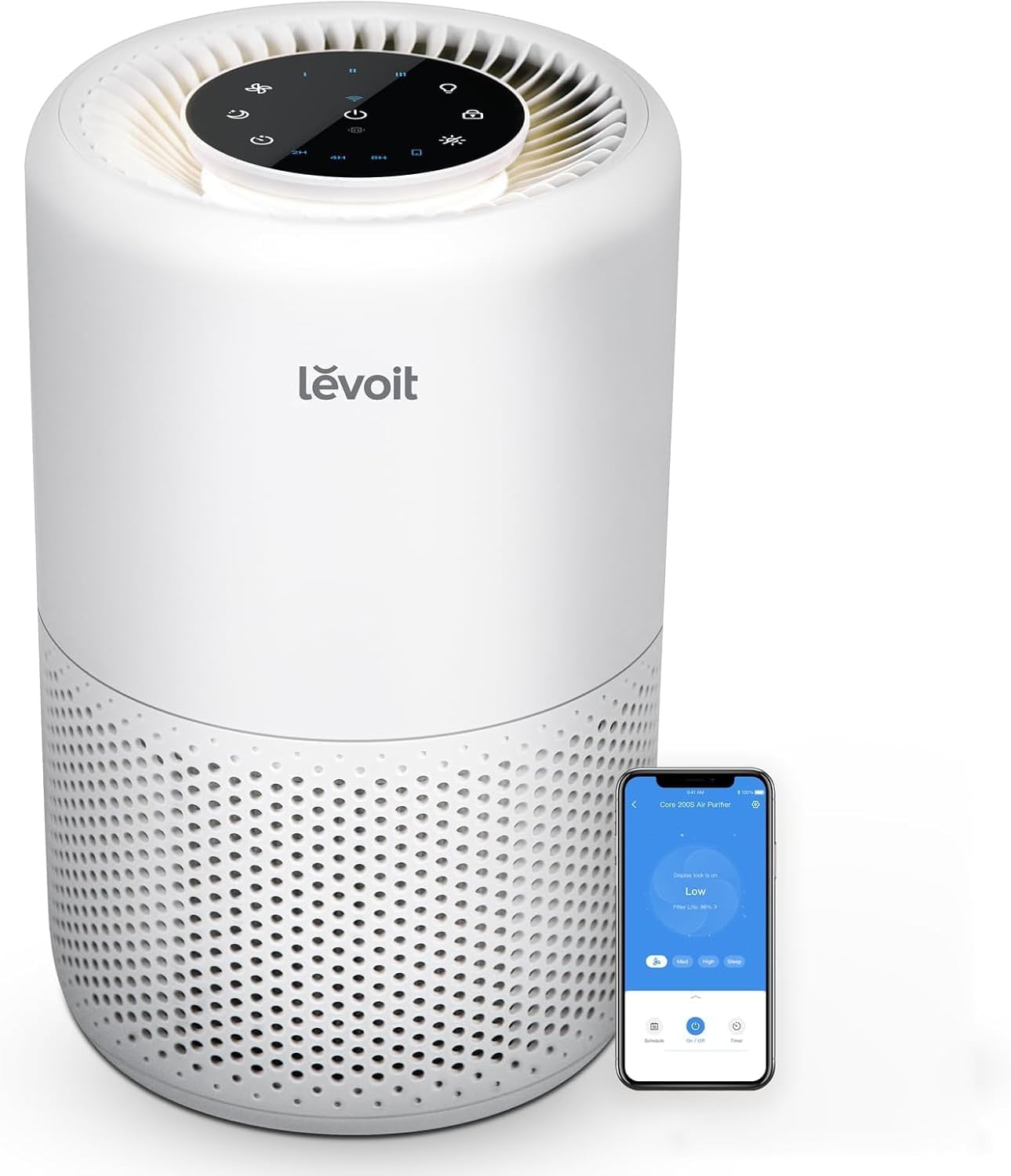
| Room coverage | 140 ft² (refreshes air 4.8 times/hour) |
|---|---|
| Filtration stages | 3-stage (pre-filter, activated carbon, HEPA-grade main) |
| Noise level | As low as 27 dB |
| Model | Core 200S |
The Levoit Core 200S-P is a compact smart air purifier built for everyday bedroom or apartment use, combining a nylon pre-filter, activated carbon layer, and a HEPA-grade main filter that removes 99.97% of particles down to 0.1–0.3 microns. It draws air in 360 degrees and the manufacturer rates it to refresh the air in a 140 ft² room nearly five times per hour, which makes it suitable for tackling pollen, dust, pet dander, smoke and common household odors. The unit supports app and voice control for remote operation and includes a Sleep Mode and Display Off button for quiet overnight use with noise as low as 27 dB. Practical benefits include lightweight, unobtrusive placement, easy filter replacement with in-app life monitoring, and measurable AHAM-verified cleaning performance. Limitations are its small- room coverage — it is not intended for whole-home filtration — and the ongoing cost of genuine replacement filters for best results.
Best for: Buyers who want a reliable, easy-to-use purifier for bedrooms, nurseries, or apartments and prioritize verified cleaning performance and quiet overnight operation.
Less Ideal for: People needing whole-house or large-room air cleaning or those who prefer a filterless or maintenance-free purifier.
- Three-stage filtration including HEPA-grade main filter that captures 0.1–0.3 micron particles
- 360° air intake and compact footprint for flexible placement in small rooms
- App and voice control plus in-app filter life monitoring for convenient remote management
- Quiet Sleep Mode with low noise down to 27 dB for overnight use
- Designed for small rooms only and cannot effectively purify large open spaces
- Requires periodic replacement of genuine filters to maintain rated performance
Verdict: A compact, AHAM-verified smart purifier that quietly delivers reliable HEPA-grade cleaning for small rooms and spaces where sickness-related particle reduction matters.
Choosing the Right Air Purifier for Sickness: Key Factors to Consider
Filtration Efficiency and Certified HEPA Performance
High-efficiency particulate filtration directly reduces airborne particles that can carry viruses and bacteria. Look for true HEPA ratings and stated capture percentages for 0.3 micron particles; higher verified capture rates indicate better removal of fine aerosols that contribute to respiratory transmission.
Filtration alone is not enough if specifications are vague. Check that the device uses a dedicated mechanical HEPA element rather than electrostatic or washable filters presented as HEPA equivalents. Certified performance and independent lab data are preferable when available because they show how the unit behaves under realistic conditions.
Clean Air Delivery and Room Coverage
An air purifier must move enough air to meaningfully lower contaminant concentrations in the room. Consider the recommended room size and CADR or equivalent airflow figures to estimate how many air changes per hour the purifier provides for your specific space.
A powerful unit in a small bedroom will cycle air frequently and reduce particle load faster, while an undersized unit will have minimal effect. If the sick room is larger than the specified rating, choose a higher-capacity unit or use multiple purifiers to achieve adequate turnover.
Noise Levels and Nighttime Comfort
Quiet operation matters when someone is resting or sleeping. Compare decibel ratings at low and medium fan speeds, and favor units that maintain good filtration while running quietly on lower settings.
Some purifiers have a 'sleep' or 'quiet' mode that reduces fan speed and display brightness. Verify that lower-noise modes still provide meaningful air changes for the room; otherwise, they may be comfortable but ineffective during long periods of rest.
Maintenance Requirements and Running Costs
Filter replacement frequency and expense determine long-term ownership costs and whether a unit remains practical during prolonged illness. Check how often primary filters and prefilters need replacement and whether replacements are easy to source.
Also consider whether filters are washable or reusable versus disposable. Washable prefilters can extend primary filter life, but mechanical HEPA elements are typically replaceable. Factor in filter cost per year based on expected runtime to estimate the total operating expense.
Ease of Use and Practical Features
A purifier that is simple to operate and maintain reduces the cognitive load on caregivers. Useful features include clear filter-change indicators, straightforward controls, timers, and multiple fan speeds.
Portability and weight matter if you need to move the unit between rooms. A compact footprint and a handle make it easier to reposition the purifier close to the sick person for targeted air cleaning.
Best Placement and Setup for Faster Air Clearing
Placement affects how quickly a purifier reduces airborne contaminants. For single-room illness scenarios, position the unit so intake and outlet are unobstructed and air can circulate across the occupied area. Placing the purifier near the sick person helps lower their immediate exposure, but avoid placing it directly against walls or behind furniture.
In shared rooms, aim for central placement or use two smaller units at opposite ends to create more uniform airflow. Avoid placing purifiers near strong drafts from windows or HVAC vents that can short-circuit airflow and reduce effectiveness.
- Keep at least several inches of clearance around intake and outlet.
- Place the unit on a stable elevated surface for better circulation if floor-level obstacles exist.
- For sleeping occupants, put the purifier near the head of the bed but not within reach to avoid accidental contact.
Operating Modes That Balance Quiet and Effectiveness
Most purifiers offer low, medium, and high fan settings plus sleep modes. High settings maximize air changes per hour and are useful when symptoms first appear or when guests are present. Low settings are better for overnight use but check that they still deliver adequate turnover.
Use timers and scheduling features to run higher speeds periodically if you want quieter conditions for extended rest. For example, run higher speed for 20 minutes every hour to reduce peak particle loads while staying comfortable between cycles.
- Use high mode for initial quick clearing after exposure or coughing events.
- Switch to low or sleep mode overnight if the low-speed CADR is sufficient for the room.
- Consider intermittent high-speed cycles to balance noise and air cleanliness.
Cleaning and Care: Keeping Performance High
Regular maintenance preserves filtration effectiveness. Clean prefilters according to the manufacturer schedule and replace primary HEPA filters at recommended intervals. Dust and hair accumulation on prefilters reduces airflow and forces the unit to work harder.
Also clean accessible air intakes and sensors. If the purifier includes an air-quality sensor, keep nearby surfaces dust-free so the sensor readings remain representative of room conditions.
- Vacuum or wash prefilters monthly if recommended.
- Note filter replacement intervals and set reminders based on actual runtime.
- Wipe down external surfaces to prevent dust reintroduction into the air stream.
When to Use Extra Measures Alongside a Purifier
An air purifier is one layer of protection. For sickness, combine filtration with ventilation and hygiene practices to reduce overall exposure. Open windows for brief ventilation when outdoor air quality allows and increase fresh airflow from mechanical systems where possible.
Encourage mask use when appropriate and isolate the sick person in a single room to limit contaminant spread. The purifier reduces aerosols in the room but does not eliminate the need for other infection-control measures.
- Short windows of cross-ventilation can lower CO2 and volatile contaminants.
- Use purifier plus local exhaust (bathroom/kitchen fans) to reduce overall room particle load.
- Pair filtration with regular surface cleaning and hand hygiene to limit multiple transmission routes.
Sizing Up Units for Bedrooms Versus Living Rooms
Bedrooms typically require lower CADR to achieve the same air changes because they are smaller. A unit sized for a bedroom can run quietly and still achieve adequate turnover. Living rooms often need higher-capacity purifiers or multiple units to cover open layouts and higher ceilings.
When choosing capacity, calculate room volume and target at least 4 to 6 air changes per hour for sickness-focused use. Higher rates reduce particle concentration faster but may increase noise and energy use.
- Measure room length, width, and height to estimate volume.
- Aim for more air changes in rooms with active coughing or multiple occupants.
- If in doubt, choose a slightly larger-rated unit rather than one that is undersized.
How We Chose the Best Air Purifier for Sickness
We focused on real-world effectiveness and usability for illness-related indoor air needs. First, we prioritized filtration performance by looking at true HEPA filtration ratings and documented particle capture down to submicron sizes, since removing aerosols and fine particles matters most when someone is contagious or experiencing respiratory symptoms. Next, we evaluated clean air delivery capability by room size and CADR-equivalent airflow to ensure a unit can cycle a sick-room volume multiple times per hour. Noise profile and low-speed performance were included because sleep and rest are critical during illness. Maintenance burden was assessed by filter life spans, replacement ease, and operating costs tied to consumables. Lastly, convenience features such as filter-change indicators, timer modes, and straightforward controls were considered for caregivers and patients. We excluded units that rely solely on ionization or ozone generation as primary mitigation strategies because those approaches are not appropriate for sickness-focused air cleaning. We also filtered out models lacking verifiable filtration specifications or ambiguous airflow ratings. The resulting selections emphasize measurable particle removal, practical room coverage, quiet operation, and manageable maintenance.
Our full evaluation process is outlined in our review methodology.
FAQ
Can an air purifier stop viral transmission in a household?
An air purifier reduces airborne particles that can carry viruses, lowering the concentration of infectious aerosols. It is a risk-reduction tool rather than a guarantee and works best combined with ventilation and hygiene practices.
How long should I run a purifier after someone recovers?
Continue running the purifier for at least 24 to 48 hours after symptoms subside to reduce lingering aerosols and residual particles. Keep maintenance in mind and replace or inspect filters if they were used heavily during illness.
Are ozone generators or ionizers appropriate for sickness scenarios?
Ozone generators are not recommended for occupied indoor spaces because ozone can irritate the respiratory tract. Rely on mechanical filtration like true HEPA rather than ionization as the primary mitigation approach.
How often should HEPA filters be replaced during extended use?
Replacement frequency depends on runtime, room pollution levels, and filter design. Under heavy use during illness, primary HEPA filters may need replacing more frequently than normal schedules; monitor airflow and follow any filter life indicators.
Will a purifier remove smells from a sick room?
Activated carbon or combined-technology units help reduce odors and volatile organic compounds. Mechanical HEPA filters do not remove gases, so choose a model with a dedicated carbon stage if odor reduction is important.
Final Verdict
When prioritizing air purifiers for sickness, focus first on proven filtration efficiency and sufficient clean-air delivery for the room. Balance those needs with noise levels and filter maintenance so the device can run continuously during rest periods without becoming a burden. Expect tradeoffs between quieter operation and higher turnover rates, and plan filter replacement costs into your long-term use. With the right capacity and a maintenance plan, an air purifier becomes a practical part of a layered approach to reducing airborne transmission and speeding recovery.