
Note: This article contains affiliate links. If you click on these links and make a purchase, we may earn a small commission at no extra cost to you. This helps support our research and content. Read our full affiliate disclosure here.
If you regularly deal with cannabis smoke indoors, the right air purifier can meaningfully cut visible haze and lingering odors. You want a unit that captures fine particulate matter, reduces volatile organic compounds and smoke smell, and fits the size and noise budget for the rooms where you spend time. This guide shortlists the top air purifiers for weed smoke and explains why each was selected. Below you will find compact picks across room sizes plus the evaluation criteria we used so you can match a purifier to your space and habits.
Top Picks at a Glance
| Best Overall The best all-around choice for most situations | Coway Mighty AP-1512HH |  |
| Best Quality Built to a higher standard if you want something more solid | Medify MA-40 Air Purifier |  |
| Best Value The sweet spot between price and what you get | GermGuardian AC4825E 22" Tower |  |
| Best Budget The cheapest option that still gets the job done reliably | Purivortex PX500 Air Purifier |  |
| Top Rated A top-rated pick with lots of positive feedback | Levoit Core 300-P Air Purifier |  |
| Most Popular A crowd favorite that many people choose with confidence | Levoit Core Mini-P |  |
| Best Seller A high-volume bestseller chosen again and again | VOOPNU HEPA Air Purifier DH-JH12 |  |
Coway Mighty AP-1512HH

| Coverage | Up to 1,748 sq. ft. in 60 minutes |
|---|---|
| Filtration | 4-stage: washable pre-filter, deodorization, bipolar device, HEPA |
| HEPA effectiveness | 99.97% of 0.3μm particles |
| Model number | AP-1512HH |
The Coway Mighty AP-1512HH is a compact, four-stage air purifier intended to clean medium to large indoor spaces. It combines a washable pre-filter, deodorization stage, bipolar ionizer, and a true HEPA filter rated to capture 99.97% of 0.3 micron particles, which helps remove smoke particles, pollen, pet dander, and many VOCs. An auto mode uses a pollution sensor and colored LED air-quality indicator to adjust fan speed automatically, while eco and timer modes help reduce runtime and energy use. The unit is straightforward to maintain with a washable pre-filter and clear filter-replacement indicator, and the coverage claim targets roughly 1,748 sq ft in 60 minutes, so it is suitable for open rooms or whole apartments when placed centrally. Limitations include the need to replace consumable filters periodically and that ionizers can produce small amounts of byproduct ozone in some conditions, so placement and ventilation matter. Noise at higher fan speeds is noticeable, though low speeds are quiet enough for bedroom use. Overall, it is a practical, feature-rich choice for managing smoke and general indoor pollutants in larger living spaces.
Best for: Buyers who want a reliable, feature-packed purifier that can handle smoke and everyday pollutants across larger living spaces with automatic sensing and straightforward upkeep.
Less Ideal for: People seeking a completely ozone-free solution or those who need a tiny, ultra-portable unit for very small rooms should consider other models.
- True HEPA filtration captures 99.97% of 0.3 micron particles for fine smoke and allergens.
- Four-stage system including washable pre-filter and deodorization stage for longer filter life and odor reduction.
- Auto mode with real-time pollution sensor and LED indicator for hands-off air quality control.
- Compact footprint with claimed rapid coverage up to 1,748 sq ft in 60 minutes for whole-room cleaning.
- Filter indicator and washable pre-filter make maintenance simple and visible.
- Replacement filters are consumable and add ongoing maintenance cost.
- Ionizer (bipolar device) may produce trace byproducts under some conditions, requiring cautious placement.
- Performance depends on placement and room airflow, so coverage claims assume ideal conditions.
Verdict: A well-rounded purifier that pairs true HEPA filtration and smart sensing to effectively reduce smoke and common indoor pollutants in medium to large spaces.
Medify MA-40 Air Purifier

| Filter Class | HEPA H13 |
|---|---|
| Coverage (1 hr) | 1,793 sq ft |
| Particle Retention Size | 0.1 micron |
| Wattage | 95 watts |
| Noise Level | 46 db |
The Medify MA-40 is a high‑capacity room air purifier built to clear smoke, odors, pollen, and fine particles from large spaces. It uses a True HEPA H13 filter and a three-speed fan with a programmable timer and sleep mode, letting you run it continuously or on a schedule; the manufacturer rates it to cover about 1,793 sq ft in an hour (CADR 406). The touch control panel, filter replacement indicator, and child lock make daily operation simple, and the unit is ETL and CARB certified. In practical use it is best placed centrally or in the room where smoke sources are concentrated; at higher fan speeds it moves a lot of air but becomes noticeably louder, while lower speeds remain reasonably quiet. Replacement filters are user-replaceable and have an advertised lifespan of roughly 3,000 hours. The MA-40 is a strong performer for persistent odors and fine particulates, though its physical footprint and audible noise at max speed are things to plan for in tight or very quiet spaces.
Best for: Buyers who prioritize fast, high-performance removal of smoke and fine particles in large living spaces and want a certified, easy-to-operate unit.
Less Ideal for: People seeking an ultra-compact or near-silent purifier for very small rooms or bedrooms should consider smaller, quieter models instead.
- High CADR and rated to clean very large rooms quickly
- True HEPA H13 filtration captures particles down to 0.1 micron
- Programmable timer, sleep mode, and child lock for flexible operation
- Touch controls and filter indicator simplify day-to-day use
- Higher fan speeds produce noticeable noise levels
- Relatively large footprint compared with small-room purifiers
Verdict: If you need a performance-first purifier that clears weed smoke and very fine particles from large rooms fast, the Medify MA-40 is a top practical choice.
GermGuardian AC4825E 22" Tower

| Coverage (small room | 153 sq. ft. per 12.5 min |
|---|---|
| Coverage (large room | up to 743 sq. ft. per hour |
| Filter type | True HEPA with activated carbon pre-filter |
| Speeds | 3 fan speeds with sleep mode |
The GermGuardian AC4825E is a compact tower purifier that combines a True HEPA filter, activated carbon pre-filter, and optional UV-C light to capture allergens, reduce odors, and lower airborne particles. It is typically placed in bedrooms, living rooms, or home offices and runs on three fan speeds including a quiet sleep mode for overnight use. The HEPA Pure filter captures 99.97% of particles down to 0.1 microns from air passing through the media, while the carbon layer helps absorb cooking smells and pet scents that commonly mask smoke odors. The unit is designed to cycle the air in a 153 sq ft room every 12.5 minutes and can reach larger spaces on a slower cycle, making it useful for regular air cleaning rather than rapid heavy-smoke clearing. Replacement GermGuardian Filter B cartridges and UV-C bulbs are available for maintenance. Buyers should note that its odor reduction relies on the carbon pre-filter and that very heavy or continuous smoke may exceed its capacity to fully neutralize strong smells quickly.
Best for: A practical buyer who wants a reliable, space-saving purifier for regular odor and allergen control in bedrooms or living areas and values proven filtration and straightforward maintenance.
Less Ideal for: People needing immediate, heavy-duty smoke removal for large open spaces or commercial grow/consumption areas should consider higher-capacity or specialized smoke filters designed for continuous heavy smoke.
- True HEPA filter captures very small particles down to 0.1 microns
- Activated carbon pre-filter reduces common household odors and pet/scents
- Optional UV-C light adds an extra layer of airborne particle reduction
- Three fan speeds including a quiet sleep mode for night use
- Certified testing mentions (CARB, ETL) and US testing by the maker
- Not optimized for rapid removal of heavy or continuous cannabis smoke in large open areas
- Odor control depends on the carbon pre-filter which will need regular replacement to remain effective
- Air change rate is modest for large rooms, slower when covering up to 743 sq ft
Verdict: Choose the AC4825E if you want a compact, tested HEPA purifier that reliably reduces allergens and moderate smoke odors in bedrooms and living rooms.
Purivortex PX500 Air Purifier

| Coverage Area | Up to 880 sq.ft |
|---|---|
| Filtration | Pre-filter, HEPA, Activated carbon |
| Particle Size | Filters down to 0.1 microns |
| Decibel | 20 dB |
The Purivortex PX500 is a compact HEPA air purifier built to remove common pollutants and light odors across medium to large rooms. It uses a three-layer filtration stack — pre-filter, HEPA, and activated carbon — and a taller 6-inch filter to capture particles down to 0.1 microns and help reduce smoke and household VOCs. Controls include four fan speeds, three timers, and four night-light modes, and the unit operates as quietly as 20 dB on low, making it suitable for bedrooms and living spaces. In testing conditions cited by the brand, the PX500 can purify up to 880 sq ft in an hour and refresh a typical 215 sq ft room in about 15 minutes, which makes it effective at reducing lingering smoke when running at higher speeds. Practical limits are that sustained heavy-smoke environments will require regular filter replacement and higher fan settings, which increases noise and filter wear, and it is designed as a single-room solution rather than whole-home HVAC integration. For buyers wanting a straightforward, science-backed purifier that balances quiet operation with strong particulate and odor reduction, the PX500 is a sensible option.
Best for: Buyers on a tight budget who want an affordable, room-level purifier that effectively cuts particulates and light smoke odors while running quietly overnight.
Less Ideal for: People needing continuous industrial-strength smoke removal for very smoky spaces or whole-home filtration should choose a more heavy-duty or HVAC-integrated system.
- Three-layer filtration with HEPA and activated carbon captures particles down to 0.1 microns and reduces light odors
- Rated to purify up to 880 sq ft in one hour for faster air turnover in larger rooms
- Very quiet operation down to 20 dB on low, suitable for bedrooms
- Multiple timers and fan speeds plus night-light modes for flexible, low-effort use
- Activated carbon capacity may be limited for heavy or continuous smoke, requiring frequent filter changes
- Single-unit design means effectiveness is limited to room-level coverage rather than whole-house purification
Verdict: A budget-friendly, quiet HEPA purifier that quickly refreshes single rooms and meaningfully reduces weed smoke and particulates when run at higher speeds.
Levoit Core 300-P Air Purifier

| Power Source | Corded Electric |
|---|---|
| Filter Type | 3 in 1 Filtration |
| Floor Area | 1073 square_feet |
| Noise Level | 24 db |
| Particle Retention Size | 0.3 micron |
The Levoit Core 300-P is a small, user-friendly air purifier built around a three-stage HEPA-grade filter and a 56W motor that moves air quickly through the unit. It is typically placed in bedrooms, living rooms, or home offices to reduce smoke, pollen, pet dander, and odors; the listing cites 99.97% filtration for 0.1–0.3 micron particulates and AHAM-verified CADR figures for smoke, dust, and pollen. Controls are touch-based with a quiet Sleep Mode that drops noise to about 24 dB and a timer and display light-off option for overnight use. Practical benefits include solid particle capture at close to room scale, portability for moving between rooms, and certifications that indicate tested performance and safety. Limits to consider are that this model lacks smart Auto Mode (Core 300S-P has that feature) so fan speed must be adjusted manually, and its listed coverage is most effective when paired with genuine Levoit replacement filters and maintained regularly.
Best for: Buyers who prioritize a dependable, tested purifier that quietly removes smoke and fine particles in bedrooms or small to medium rooms and prefer straightforward manual controls.
Less Ideal for: People who want built-in smart features, automated air-quality sensing, or whole-home purification should consider different models or higher-capacity units.
- HEPA-grade 3-in-1 filtration capturing particles down to 0.1–0.3 μm
- AHAM-verified CADR for smoke, dust, and pollen supporting reliable cleaning rates
- Very quiet Sleep Mode (~24 dB) suitable for overnight use
- Portable, compact design that is easy to move between rooms
- Touch controls with timer and display-off for undisturbed operation
- No built-in Auto Mode or smart connectivity on this model
- Best performance depends on using Levoit original replacement filters
Verdict: Choose the Core 300-P if you want a compact, AHAM-verified purifier that reliably cuts smoke and fine particles with quiet, simple operation.
Levoit Core Mini-P
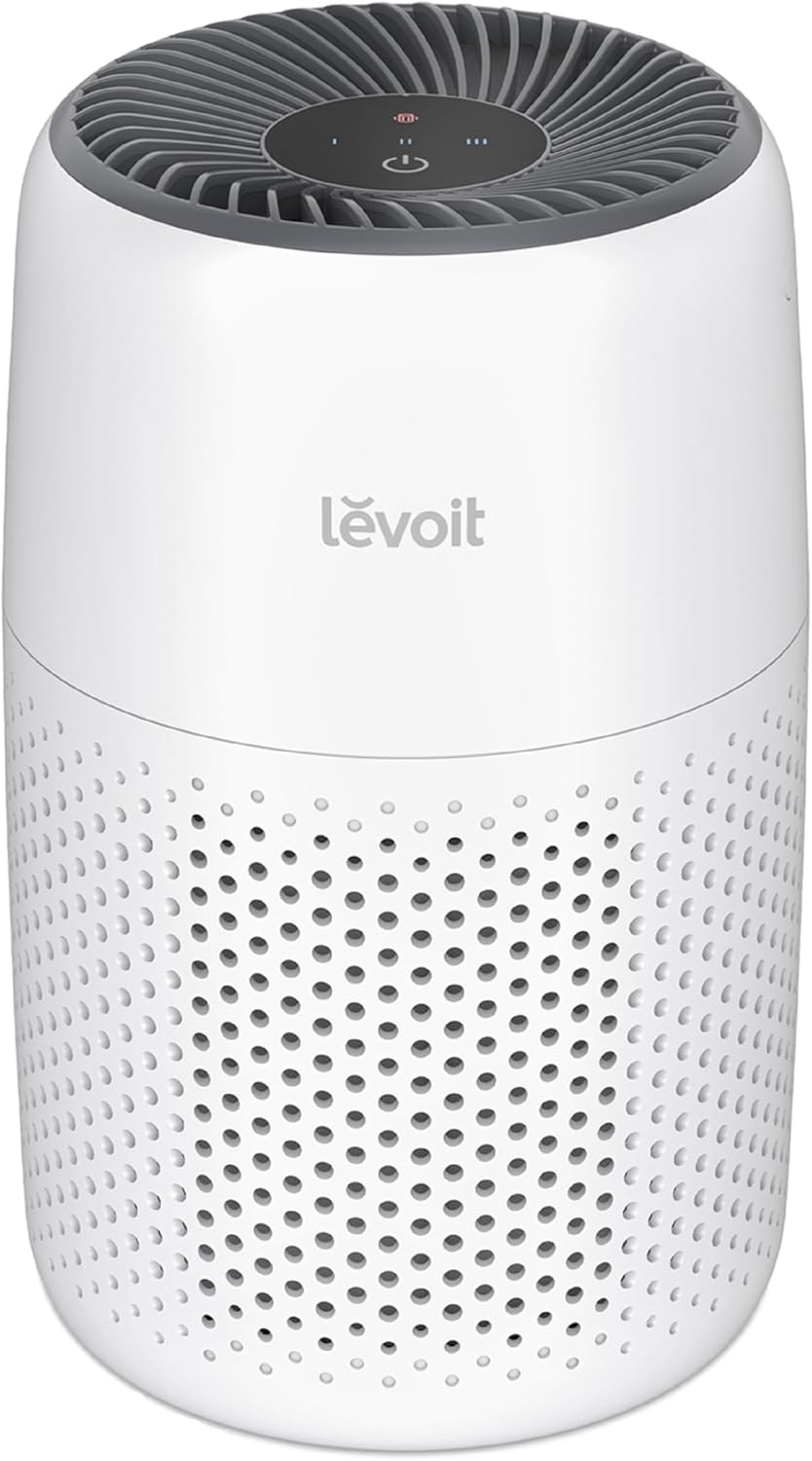
| Rated Power | 7W |
|---|---|
| Noise Level | 27-45dB |
| Adapter Input | 100-240V, 50/60 Hz |
| Particle Retention Size | 0.3 micron |
The Levoit Core Mini-P is a small, plug-in air purifier meant for bedrooms, offices, or desktops where space is limited but smoke and odor control matter. It uses a pre-filter plus a main high-efficiency filter to trap lint, hair, fine particles and smoke, and includes a small fragrance sponge for light aromatherapy. The unit runs quietly in sleep mode and has an auto-off display to reduce nighttime disturbance, while rated noise and power specs indicate low energy use. Practical benefits include genuinely portable size, simple operation, and effective particle removal in compact areas; the AHAM verification note also signals independently tested cleaning performance. Limitations are its small coverage area and modest airflow, so it will take longer to clear smoke in larger rooms and is not a whole-home solution. The fragrance sponge requires care to avoid overfilling, and replacement filters will be a recurring cost if you run the purifier continuously in smoky environments.
Best for: Buyers who want a proven, compact purifier to reduce smoke and odors in a bedroom, dorm, or small office and who prioritize independent verification and social-proof when choosing appliances.
Less Ideal for: People seeking to clear heavy or room-filling smoke quickly or to protect large open living areas should choose a higher-capacity unit instead.
- AHAM-verified air cleaning for reliable particle removal
- Compact, lightweight design for desktop or bedside use
- Quiet sleep mode and auto-off display for nighttime use
- Includes fragrance sponge for optional light aromatherapy
- Small coverage area not suited for larger rooms
- Requires periodic filter replacement when used heavily in smoky conditions
Verdict: If you need a small, AHAM-verified purifier to quietly reduce weed smoke and odors in a bedroom or small room, the Core Mini-P is a reliable, low-profile choice.
VOOPNU HEPA Air Purifier DH-JH12

| Filtration | H13 True HEPA triple-layer |
|---|---|
| Coverage | Up to 1,076 ft² (laboratory tested) |
| Noise level | 22 dB (low) |
| Speeds | 3 fan speeds |
The VOOPNU DH-JH12 is a compact air purifier that uses a 360 degree intake and H13 True HEPA triple-layer filter to capture particles and reduce odors across a reported coverage area up to about 1,076 square feet. It has a simple one-touch control panel, three fan speeds, a timer and a small essential oil tray if you want scent without affecting filtration. The unit is quiet enough for bedrooms at its lowest setting, with noise as low as 22 dB, and the manufacturer cites lab testing that it can clean 250 ft² in about 15 minutes. Certifications such as ETL, CARB and FCC back the device's electrical and emissions claims. Practical benefits include easy placement thanks to its small footprint and a washable pre-filter option on some kits, plus straightforward filter replacement cycles advertised at roughly 3 to 6 months depending on use. Limitations include modest onboard controls without advanced sensors or app connectivity and the need to run the machine continuously for best results in persistent smoke situations to achieve meaningful odor and particulate reduction.
Best for: Buyers who prioritize straightforward, certified filtration and quiet operation and want a compact purifier they can set and forget to reduce smoke and particulates in living spaces.
Less Ideal for: People seeking an air purifier with smart monitoring, app control, or automated pollutant sensing should consider a model with built-in sensors and connectivity instead.
- H13 True HEPA filtration captures fine particles down to 99.97% efficiency
- 360° intake design for more even room circulation
- Very quiet low-speed operation around 22 dB suitable for night use
- Compact footprint that fits on desks or in corners and claims wide coverage
- Simple controls and a built-in aroma tray for optional scenting
- No smart connectivity or air-quality sensor for automatic fan control
- Filter replacement frequency can be frequent in smoky environments
- Manufacturer coverage claims are based on lab testing and real-world performance varies
Verdict: A quiet, compact HEPA purifier with certified filtration that is a low-risk choice for reducing smoke and fine particles in homes.
Choosing the Right Air Purifier for Weed Smoke: Key Factors to Consider
Filtration Technology
Filtration technology determines what the purifier can remove from the air. For weed smoke you need a combination that captures fine particles produced by combustion and adsorbs the gases and odor compounds. True HEPA capture is important for particles down to 0.3 microns and below when paired with prefilters. Activated carbon or other adsorbents remove many odor-causing volatile compounds, but their effectiveness depends on the amount and quality of the media.
Different units combine layers in different ways. Look for clear specifications about the HEPA class and the quantity or thickness of activated carbon rather than vague marketing claims. Some purifiers add catalytic media or specialized gas-phase filters that target certain VOCs; these can help but vary widely in tested performance.
Room Size and Air Changes Per Hour
Room size is a primary determinant of how well a single purifier will control smoke. A unit rated for a small bedroom will be overwhelmed in a living room if its clean-air delivery rate is too low. Check the purifier's recommended coverage and CADR or equivalent clean-air flow values and match them to your typical smoking room.
For regular smoking, aim for multiple air changes per hour rather than minimal coverage. Higher airflow settings clear smoke faster, but may increase noise and filter loading. If you plan to move the unit between rooms, consider portability and whether the rated coverage is appropriate for the largest space you will use.
Noise and Daily Use
Noise matters because many people want a purifier running continuously. Higher fan speeds deliver faster cleaning but also produce more sound. Look for measured decibel ratings at common speeds or user feedback about quiet operation at low and medium settings.
Some units include night modes or automatic speed control tied to sensors to balance performance and quiet operation. If you smoke while sleeping or need background quiet, prioritize models with low noise at the speeds that still provide meaningful air changes.
Maintenance, Filter Life, and Running Cost
Maintenance impacts both cost and long-term effectiveness. HEPA and carbon filters saturate with smoke residue and will need regular replacement. Understand the expected filter life in hours or months under typical use, the cost and availability of replacement filters, and whether the unit uses modular filters or combined cartridges.
Also consider how easy it is to access and replace filters, whether the purifier has filter life indicators, and whether parts like prefilters are washable. Frequent high-speed operation will shorten filter life, so account for realistic replacement cadence when evaluating total cost of ownership.
Controls, Sensors, and Placement Flexibility
Good controls and accurate sensors make continuous use simpler. Units with auto modes that respond to particle sensors will ramp fan speeds when smoke spikes and run quieter otherwise. Verify the type of sensors used and whether the unit reports particle counts or simply a qualitative indicator.
Placement flexibility matters because purifiers need unobstructed airflow. Consider footprint, cord length, and whether the intake and exhaust orientations fit the room layout. Some designs are intended for corner placement while others benefit from central placement; pick a design that fits where you plan to use it regularly.
How Carbon Filters Work Against Smoke Odor
Activated carbon removes odor by adsorbing volatile organic compounds onto its porous surface. For weed smoke, sizable carbon volume and high-surface-area granules or pellets provide more adsorption capacity and longer useful life.
Not all carbon filters are equal. Thin or lightly loaded carbon layers trap less gas and saturate more quickly when exposed to frequent smoking. Some purifiers use replaceable carbon inserts to allow larger quantities of media without increasing machine size.
- Look for filter weight or volume figures when available
- Thicker carbon layers last longer under heavy use
- Modular carbon cartridges simplify replacements
Placement Tips to Maximize Smoke Removal
Place the purifier between the primary smoke source and the rest of the room to intercept pollutants before they spread. Avoid crowding the intake behind furniture or near walls where airflow is restricted.
If you have a dedicated smoking corner, position the unit close to that area and run at a higher setting during and shortly after smoking sessions. In open-plan layouts you may need a higher-capacity unit or multiple purifiers for even coverage.
- Keep clearances recommended by the manufacturer for intake and exhaust
- Elevate small units off the floor for better mixing in some rooms
- Use more than one unit for large, open spaces
Sensor Accuracy and When to Use Manual Controls
Many purifiers include particle sensors that trigger auto mode, but sensor placement and sensitivity vary. Sensors that sit inside the airflow path give faster response to smoke, while others positioned lower or off to the side may respond slowly.
For predictable results, run the purifier manually at a higher speed during smoking sessions and switch to auto or low when air appears clear. Relying only on auto modes can leave short smoke bursts untreated if the sensor is slow to detect them.
- Test auto mode by producing a brief visible smoke event to see how quickly the unit reacts
- Use manual boost during and for 10 to 20 minutes after smoking
- Reset or recalibrate sensors per instructions if readings seem inconsistent
Managing Filter Change Frequency
Smoke-heavy use shortens filter life, especially for carbon media. Track runtime and check visual cues such as discoloration or manufacturer filter indicators to decide when to replace filters.
Consider buying replacement filters in advance if you expect regular heavy use. Some owners extend life by using a washable prefilter to catch large particles, preserving HEPA and carbon capacity for smaller particles and gases.
- Run at moderate speeds for continuous use to balance life and performance
- Rotate filters if using multiple units to stagger replacements
- Follow disposal guidance for used filters
How We Chose the Best Air Purifier for Weed Smoke
We prioritized measurable filtration performance and real-world utility when shortlisting air purifiers for weed smoke. Key filters included HEPA-grade particle capture and activated-carbon or equivalent odor adsorption capacity, because smoke affects both particles and gases. We also evaluated clean-air delivery relative to room size, expressed as CADR or equivalent coverage figures, since an undersized unit cannot keep up with continuous smoking. Noise output at typical running speeds was weighted because many users need a machine they can run continuously without disruption. Maintenance factors were considered, including filter life, ease of replacement, and ongoing operating costs. We excluded devices that rely solely on ionization without substantial particulate and gas adsorption or that lack independently verifiable filtration specs. Final selections balanced objective performance specs with practical aspects like footprint and control options so the list includes effective and usable choices for indoor cannabis smoke.
Our full evaluation process is outlined in our review methodology.
FAQ
Can an air purifier eliminate all weed smoke odor?
Air purifiers with adequate activated-carbon capacity can significantly reduce smoke odor, but they may not remove every trace instantly. Success depends on carbon load, airflow, room size, and how long you run the unit.
Is HEPA enough to handle cannabis smoke?
HEPA efficiently captures fine particulate matter in smoke but does not adsorb gases or odor compounds. For full smoke control, pair HEPA filtration with a robust carbon or gas-phase filter.
How big of a purifier do I need for a living room?
Match the purifier's recommended coverage or CADR to your living room square footage and aim for multiple air changes per hour during active smoking. If the space is open-plan, choose a higher-capacity unit or supplement with additional purifiers.
Will running a purifier all night keep my bedroom odor-free?
Running a purifier overnight can reduce lingering odor if the unit has sufficient carbon capacity and you run it at an effective speed. Low-noise modes may slow cleaning, so consider a balance between noise and airflow for best overnight results.
Do ionizers or ozone generators help with weed smoke?
Ionizers can reduce airborne particles but usually do not address odor-causing gases effectively. Ozone generators are not recommended for occupied indoor spaces because ozone can be harmful and may not reliably neutralize smoke odor without health tradeoffs.
Final Verdict
When choosing an air purifier for weed smoke, prioritize a combination of true HEPA particle capture and substantial activated-carbon adsorption. Match the unit's coverage and clean-air delivery to the room where you smoke and plan for accelerated filter replacement under heavy use. Balance noise versus airflow depending on whether you need continuous operation or short bursts of high cleaning power. If you focus on filtration technology, realistic room coverage, and manageable maintenance, you can find a purifier that meaningfully reduces visible smoke and lingering odors and fits your daily routine.