
Note: This article contains affiliate links. If you click on these links and make a purchase, we may earn a small commission at no extra cost to you. This helps support our research and content. Read our full affiliate disclosure here.
When wildfire smoke drifts into your home, an ordinary fan or open window is not enough to keep indoor air healthy. Choosing the right air purifier for wildfire smoke can cut fine particles and reduce lingering odors so your household breathes easier during multiday or unpredictable smoke events. This guide shortlists the top options for handling fine particulate matter and volatile organic compounds that accompany smoke, and it explains the practical tradeoffs between filtration, coverage, and noise. Below you will find the top picks for different room sizes and needs, together with the evaluation criteria used to select them and the factors you should weigh before buying.
Top Picks at a Glance
| Best Overall The best all-around choice for most situations | Medify MA-40 Air Purifier |  |
| Best Quality Built to a higher standard if you want something more solid | Medify MA-50 V3.0 Air Purifier |  |
| Best Value The sweet spot between price and what you get | SIESEAN AP-400 Air Purifier |  |
| Best Budget The cheapest option that still gets the job done reliably | MOOKA B-D02L Air Purifier |  |
| Top Rated A top-rated pick with lots of positive feedback | KNKA APH4000 Air Purifier |  |
| Most Popular A crowd favorite that many people choose with confidence | Levoit Core 300-P Air Purifier |  |
| Best Seller A high-volume bestseller chosen again and again | Levoit Vital 200S-P Air Purifier |  |
Medify MA-40 Air Purifier

| Coverage | 1,793 sq ft / hour |
|---|---|
| Filter Class | HEPA H13 |
| Particle Retention | 0.1 micron |
| Wattage | 95 watts |
| Noise Level | 46 db (min) |
The Medify MA-40 is a powerful air purifier built around a True HEPA H13 filter and a high CADR that the brand rates to clean up to roughly 1,793 sq ft in an hour, making it suitable for open living areas and for tackling wildfire smoke. It uses a touch control panel with programmable timer, three main fan speeds plus a sleep mode to dim lights, and a filter replacement indicator for straightforward daily use. The H13 filter captures particles down to about 0.1 microns, which helps remove smoke and fine particulates that standard HEPA H11 units miss, and the unit is ETL and CARB certified. Practical downsides are its size and noise: it draws about 95 watts and runs louder at higher speeds (advertised up to the mid-60s dB), so placing it centrally and running it on high for rapid smoke clearance is effective but may be intrusive in quiet spaces. Filter life is typical for the category at several months under heavy use, so budget for replacements if you use it continuously during wildfire events.
Best for: Buyers who want a capable, no-nonsense purifier that can clear wildfire smoke and fine particles from large living spaces and are willing to run a more powerful unit when air quality is poor.
Less Ideal for: People who need an ultra-quiet, highly portable purifier for small bedrooms or who prefer a very compact, lightweight unit for travel.
- True HEPA H13 filtration captures particles down to 0.1 microns, effective for smoke and fine particulates
- High CADR and large coverage area for cleaning large rooms quickly
- Touch controls with timer, sleep mode, and filter indicator simplify operation
- Certified by CARB and ETL, and includes a factory H13 filter out of the box
- Relatively loud at higher fan speeds which can be distracting in quiet rooms
- Large footprint and weight make it less convenient to move between rooms
Verdict: If you need a high-capacity purifier that can actively reduce wildfire smoke and fine particles across large rooms, the Medify MA-40 delivers strong H13 filtration and high airflow to get the job done.
Medify MA-50 V3.0 Air Purifier

| Filter Class | HEPA H13 |
|---|---|
| Power Source | ac |
| Wattage | 70 watts |
| Particle Retention Size | 0.1 micrometer |
| Noise Level | 56 db |
The Medify MA-50 V3.0 is built for heavy-duty air cleaning in large spaces and is especially aimed at removing smoke and fine particles from the air. It uses a True HEPA H13 filter and a multi-speed fan to deliver a CADR that Medify reports as cleaning up to 2,640 sq ft in an hour, making it suitable for open-plan rooms, offices, or classrooms impacted by wildfire smoke. Controls are touch-based with a timer, sleep mode, and indicator lights for filter replacement, and the unit is CARB, ETL, and Energy Star certified. In use the MA-50 can run quietly on lower speeds for overnight operation while allowing high-output runs when smoke or odors spike, and replacement filters are rated for roughly 2,500 hours. The trade-offs are a relatively high power draw at maximum and a size intended for large areas rather than single small rooms, so expect greater noise and energy use at top speed and periodic filter replacements for sustained heavy smoke events.
Best for: Buyers who prioritize maximum smoke and fine-particle removal in large rooms and need a unit that can rapidly reduce airborne contaminants during wildfire events.
Less Ideal for: People who need a compact, ultra-quiet purifier for a single small bedroom or who want a very low-power device for constant background use.
- True HEPA H13 filtration rated to capture particles down to 0.1 microns
- Very high reported coverage and CADR suitable for cleaning large open areas quickly
- Touch controls with timer, sleep mode, and filter replacement indicator for convenient operation
- Certified by CARB, ETL, and Energy Star, and backed by a lifetime warranty
- Designed for very large spaces so it may be overkill for small bedrooms or offices
- Higher noise and power use at maximum fan speeds during intensive cleaning
- Filters require replacement every few months under heavy use
Verdict: Choose the MA-50 V3.0 when you need one of the most powerful HEPA H13 systems available to rapidly clear wildfire smoke from very large indoor spaces.
SIESEAN AP-400 Air Purifier
| CADR | 235 CFM |
|---|---|
| HEPA Type | H13 True HEPA (0.1 micron, 99.97%) |
| Coverage | Up to 3500 sq ft |
| Noise (Sleep Mode) | 30 dB |
| Features | PM2.5 display, Auto Mode, Child Lock, Timer |
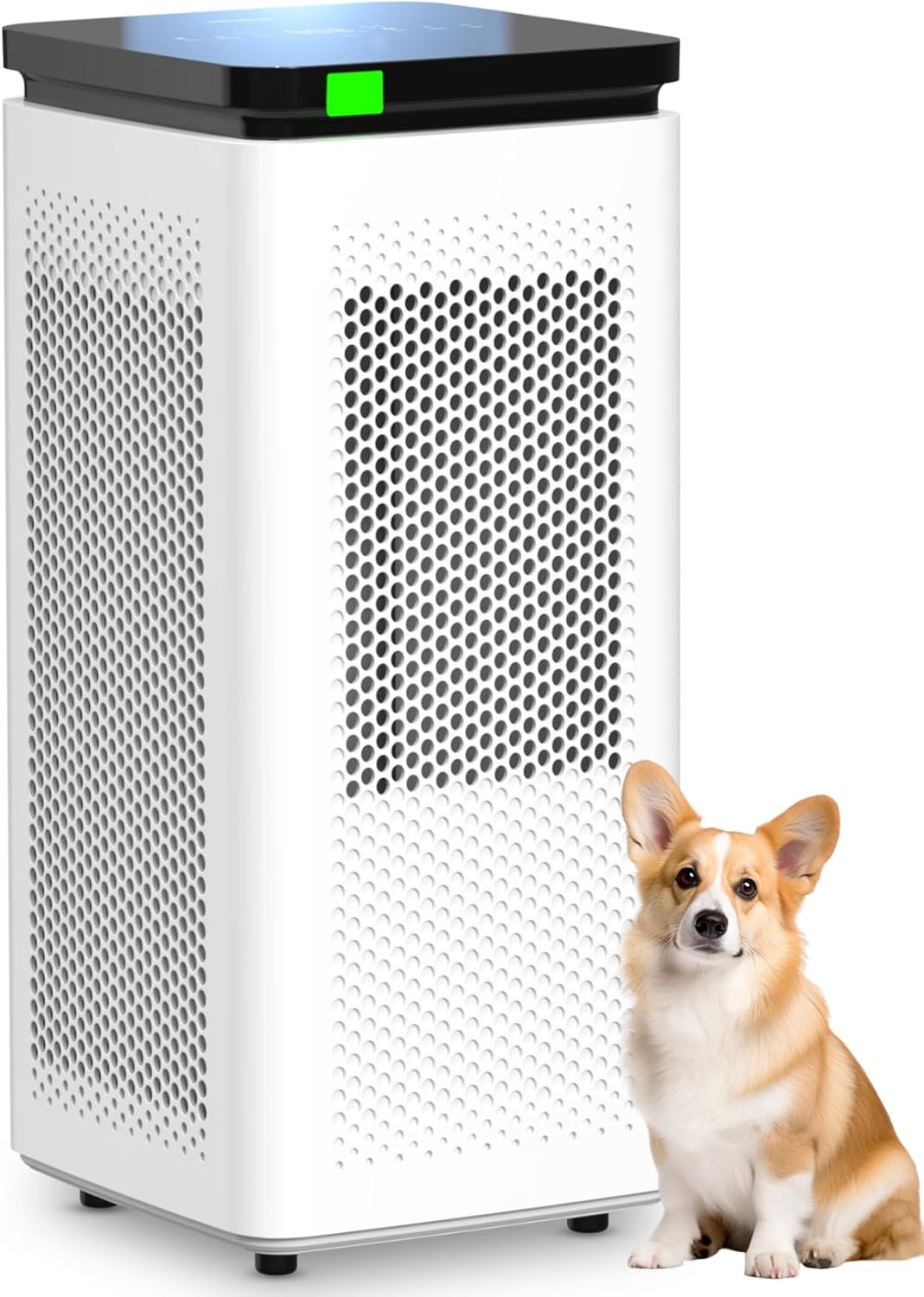
The SIESEAN AP-400 is a large-room air purifier built around an H13 True HEPA filter plus activated carbon to tackle particles and odors common with wildfire smoke. Its 235 CFM CADR and dual-sided airflow accelerate circulation so the manufacturer claims it can clean 500 sq ft in about 15 minutes and cover up to 3500 sq ft, which makes it suitable for open living areas and basements during smoke events. The unit includes a PM2.5 air quality display and an auto mode that adjusts fan speed to changing conditions, and a 30 dB sleep mode with a dimmer for overnight use. Practical touches like a filter-replacement indicator, child lock, and timer help with day-to-day ownership, and ENERGY STAR and multiple safety certifications point to efficient, tested performance. Expect regular filter replacements (every 3–4 months with heavy use) and plan for replacement-filter costs; the purifier is sizable and intended as a stationary, floor-standing unit rather than a portable closet model.
Best for: Buyers who prioritize measurable smoke removal and continuous monitoring for a whole-room solution in living spaces and basements where wildfire smoke or persistent VOCs are a concern.
Less Ideal for: People who need a lightweight, highly portable purifier for occasional single-room use or those looking to avoid recurring filter expenses.
- H13 True HEPA filter plus activated carbon captures fine particles and reduces smoke odors and VOCs.
- 235 CFM CADR with dual-sided airflow accelerates room circulation for faster clearing of smoke.
- PM2.5 air quality display and auto mode provide real-time feedback and automatic speed adjustment.
- Very quiet sleep mode (around 30 dB) and dimmable panel for comfortable overnight operation.
- ENERGY STAR certified and independently tested for safety and efficiency.
- Requires frequent filter replacement with heavy smoke exposure, which adds ongoing cost.
- Large, floor-standing design is not ideal for moving between rooms frequently.
Verdict: A powerful, certified whole-room purifier with H13 HEPA and carbon filtration that gives fast, monitored protection against wildfire smoke for large living spaces.
MOOKA B-D02L Air Purifier
| Effective Area | 1076 sq ft |
|---|---|
| Filter Type | H13 True HEPA + activated carbon |
| Fan Modes | Sleep/Low/Med/High |
| Timer | 1/2/4/8 hours |
| Noise Level | As low as 20 dB |
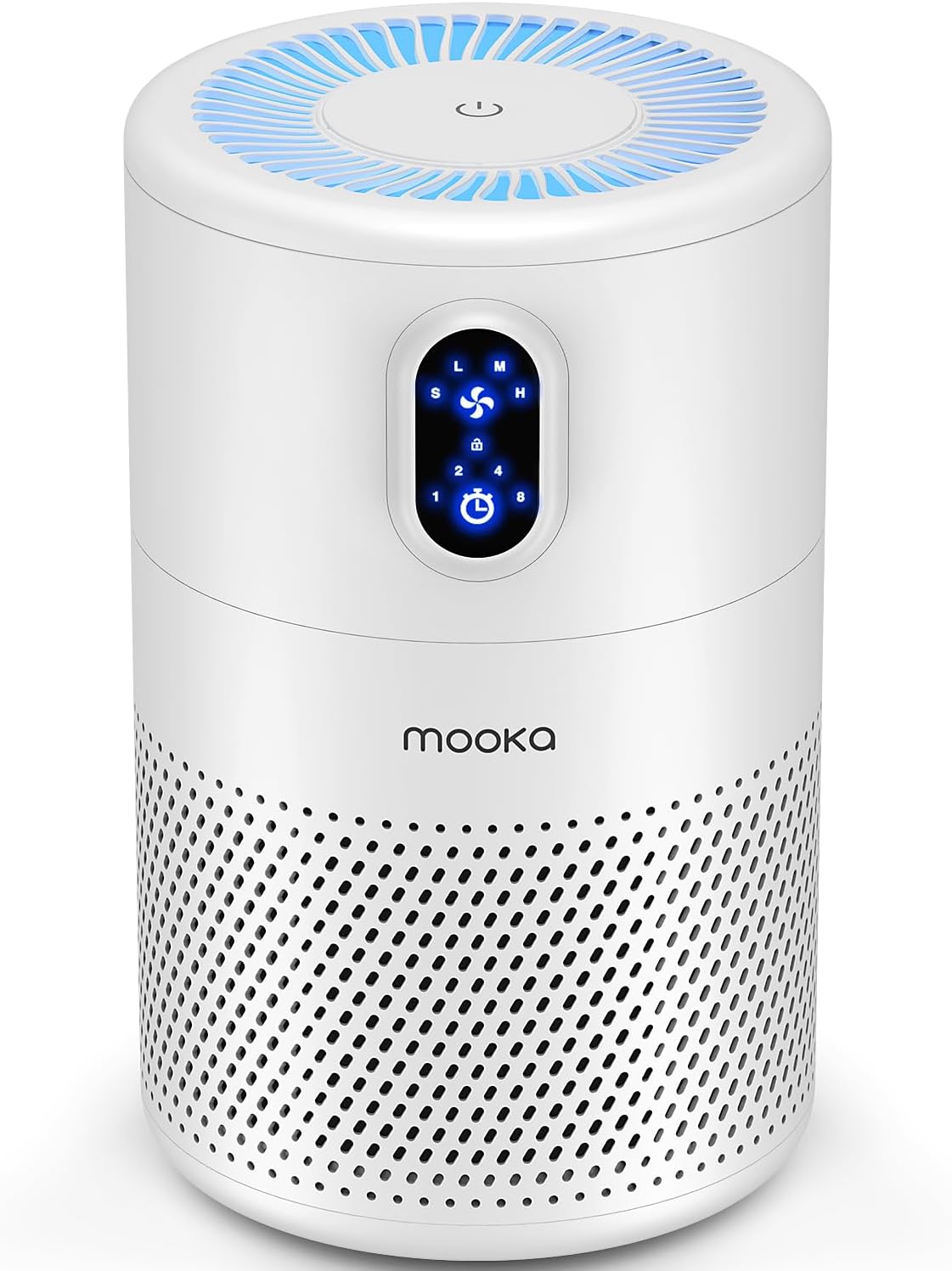
The MOOKA B-D02L is a plug-in HEPA air purifier built around an H13 true HEPA filter plus an activated carbon layer to capture particulates and reduce odors, which makes it useful during wildfire smoke episodes. Intended for whole-room use, the unit claims coverage to 1,076 sq ft with faster air changes in smaller rooms and offers four fan speeds, a 1/2/4/8 hour timer, and a child lock for unattended operation. It runs quietly on low thanks to a brushless motor and includes a soft night light that can be turned off. The washable pre-filter and replaceable HEPA cartridge (recommended every 3 to 6 months) keep maintenance simple, and the built-in filter reminder helps track replacements. On the downside, the manufacturer-specified coverage is an idealized number and real-world smoke removal depends on room layout and continuous runtime, and replacement filters are an ongoing cost. For buyers prioritizing budget, this model packs strong filtration features and low noise into a small footprint, but heavy indoor smoke may require continuous higher-speed operation and larger or multiple units for best results.
Best for: Buyers who want a low-cost, feature-ready purifier with true HEPA filtration for improving indoor air during smoke events and who prefer a quiet, simple-to-operate unit.
Less Ideal for: Homes with very large open-plan spaces or extreme smoke levels where industrial or multiple high-capacity purifiers are needed for fast clearance.
- H13 true HEPA filter captures particles down to 0.3 microns for effective smoke and pollen removal
- Activated carbon layer helps reduce smoke odor and volatile organic compounds
- Multiple fan speeds and timer settings let you balance cleaning power and noise
- Very quiet on low and energy-efficient thanks to a brushless motor
- Coverage figures are optimistic and performance will vary with room layout and door openings
- Requires periodic filter replacements, which add to lifetime cost
Verdict: A budget-friendly, quiet HEPA purifier with activated carbon that offers practical smoke and odor reduction for most rooms when run continuously at appropriate fan speeds.
KNKA APH4000 Air Purifier

| CADR (Smoke/Dust) | 226 CFM (384 m³/h) |
|---|---|
| CADR (Pollen) | 244 CFM (415 m³/h) |
| Room coverage (1‑hr) | Up to 1,695 ft² (1 full refresh/hr in largest quoted area; 4.8×/hr for 350 ft²) |
| Noise (Sleep) | 22–24 dB |
| Filter system | Washable pre-filter + HEPA + activated carbon |
The KNKA APH4000 is a large-room HEPA air purifier built around dual front-and-back filter cartridges and an AHAM-verified CADR for smoke, dust, and pollen. It moves air efficiently with dual intakes and side outlets, allowing faster circulation and multiple air-exchange rates depending on room size; KNKA quotes full refresh rates for typical living spaces and a reduced but continuous refresh for much larger rooms. The three-stage filters combine a washable pre-filter, a high-efficiency HEPA-stage, and activated carbon to capture particulates, odors, and some gases—useful during wildfire smoke events. Controls include Auto, Sleep (22–24 dB), Pet, ECO, a timer, child lock, and a real-time AQI display with color codes, which help monitor indoor smoke levels without extra devices. Filters need replacing every 3–6 months under normal use and genuine replacement parts are recommended. The unit is relatively heavy for portable moves and larger rooms will see lower per-hour filtration efficiency, so placement and fan speed matter for best results.
Best for: Buyers who prioritize dependable, certified smoke and particle removal for bedrooms and living areas and want simple automatic controls and an AQI readout to monitor indoor air quality during smoke events.
Less Ideal for: People who need lightweight, highly portable purifiers for moving between many rooms or who expect a single unit to fully clear very large open-plan homes without using multiple units.
- AHAM-verified CADR for smoke, dust, and pollen supports measurable performance during smoke events
- Dual intake and dual-outlet airflow design improves circulation and reduces clean-air delivery time
- Three-stage filtration with HEPA and activated carbon tackles particles and odors from wildfire smoke
- Multiple modes (Auto, Pet, ECO, Sleep) and AQI display simplify running and monitoring without extra sensors
- Filter replacements recommended every 3–6 months which adds ongoing cost
- Reduced per-hour purification efficiency in very large rooms means one unit may not suffice for whole-house coverage
Verdict: Choose the KNKA APH4000 when you need a certified, high‑CADR HEPA purifier with carbon filtration and easy AQI monitoring to reliably reduce wildfire smoke in bedrooms and living rooms.
Levoit Core 300-P Air Purifier

| Filter Type | 3 in 1 Filtration |
|---|---|
| Floor Area | 1073 square_feet |
| Noise Level | 24 db |
| Wattage | 56 watts |
| Particle Retention Size | 0.3 micron |
The Levoit Core 300-P is a small, user-friendly air purifier built around a three-stage HEPA-grade filter that captures 99.97% of 0.1–0.3 micron particles, making it effective against smoke, pollen, dust, and pet dander. It uses a 56W motor with a CADR suited to refresh medium rooms quickly and runs quietly in Sleep Mode at about 24 dB, which is convenient for bedrooms or home offices. Controls are touch-based and include a timer and a display-off option for night use. The unit is AHAM verified and meets CARB and ETL safety standards, and Levoit recommends using their genuine replacement filters for best performance. Trade-offs are its lack of Auto Mode on this specific Core 300-P model and the need to manually adjust fan speeds, plus replacement filters should be changed every 6–8 months to maintain efficiency. For smoky conditions, it offers strong particle removal in a compact package but requires attentive filter maintenance and manual speed management for peak performance.
Best for: Buyers who prioritize proven filtration performance and verified CADR numbers and want a quiet, compact purifier for bedrooms or medium rooms affected by smoke or allergens.
Less Ideal for: People who need a hands-off unit with automatic air-quality sensing and automatic fan adjustment or those covering very large open-plan areas without multiple units.
- HEPA-grade three-stage filter captures 99.97% of 0.1–0.3 micron particles relevant to wildfire smoke
- AHAM verified with CADR ratings for smoke, dust, and pollen for reliable performance estimates
- Very quiet Sleep Mode (~24 dB) suitable for nighttime use
- Compact and portable design fits bedrooms and smaller living spaces
- Certified to CARB and ETL safety standards
- Does not include Auto Mode on this Core 300-P model, so fan speeds must be adjusted manually
- Optimal performance depends on using genuine Levoit replacement filters and regular 6–8 month replacement
Verdict: A compact, AHAM-verified HEPA purifier that quietly and effectively removes fine smoke particles in bedrooms and medium rooms when maintained with genuine replacement filters.
Levoit Vital 200S-P Air Purifier

| Control Method | App |
|---|---|
| Filter Type | 3-Stage Filter |
| Floor Area | 1875 square_feet |
| Noise Level | 27 db |
| Particle Retention Size | 0.1 micrometer |
The Levoit Vital 200S-P is a whole-room air purifier that pairs a three-stage filter (pre-filter, activated carbon, HEPA-class) with smart app control and an onboard air quality monitor to reduce smoke, dust, pet dander, and odors in large spaces. You use it by placing it centrally in the room, selecting fan speed in the app or on the unit, and letting the unit cycle air; its CADR and AHAM verification support rapid cleaning for open living areas or bedrooms. Notable features include a washable pre-filter to catch hair and larger debris, a dedicated activated carbon stage for odors and VOCs, a low noise night mode around 27 dB for bedrooms, and Wi-Fi/app control for scheduling and remote monitoring. For wildfire smoke it offers strong particle capture down to 0.1 micrometer and high CADR numbers, while replaceable specialty filters (smoke remover or toxin absorber) let you focus on smoke or VOCs when needed. Limits: it is a large, corded unit that needs periodic filter replacements and power; in very large or multi-room homes you may need multiple units to maintain fast clearance everywhere.
Best for: Buyers who prioritize proven, lab-verified smoke and particle removal and want a low-noise, easy-to-monitor purifier with smart controls for bedrooms or living areas.
Less Ideal for: People seeking a portable, battery-powered purifier or those who need whole-house filtration from a single device should consider alternatives.
- AHAM-verified performance with high CADR suited for rapid smoke and particle reduction
- Three-stage filtration including activated carbon for odors and VOCs
- Washable pre-filter reduces hair buildup and extends filter life
- Quiet night/sleep mode around 27 dB for bedroom use
- Smart app control and built-in air quality monitor for remote scheduling and status checks
- Requires replacement filters over time which adds ongoing cost
- Corded, single-room design means whole-house coverage requires multiple units
- Not the smallest footprint for tight spaces
Verdict: Choose the Vital 200S-P when you want a quiet, AHAM-verified purifier with strong particle and smoke-handling capability plus smart monitoring for bedrooms and large rooms.
Choosing the Right Air Purifier for Wildfire Smoke: Key Factors to Consider
Filtration Stages and Particle Capture
A purifier that handles wildfire smoke should include a true HEPA or HEPA-equivalent stage that captures fine particulate matter, including PM2.5 and smaller. HEPA media is specifically rated for small particles and is the primary defense against the airborne ash and soot carried by smoke.
Multiple stages help: a pre-filter catches large debris and extends the HEPA life, while a dedicated adsorption layer (activated carbon or equivalent) captures gases and odors. Confirming the particle-size capture performance and filter type matters because some units use generic or washable filters that do not remove the smallest, most harmful smoke particles.
Activated Carbon and Odor Control
Smoke includes gases and volatile organic compounds that produce lingering odors and can irritate the eyes and throat. A substantial activated carbon bed or another sorbent stage reduces these gases, improving perceived air quality beyond just particle removal.
Look for the quantity and type of carbon, how it is contained, and whether the manufacturer rates it for smoke or odors. Thin carbon layers or only surface-coated filters often have limited effectiveness during heavy smoke; a deeper or replaceable carbon cartridge generally performs better during sustained smoke events.
Room Size and CADR Matching
Clean air delivery rate and stated room coverage help you choose a unit that can cycle and sufficiently filter the volume of your space. For wildfire smoke events, aim for a purifier that can achieve multiple air changes per hour in the rooms you occupy, especially bedrooms and living areas where people spend extended time.
Undersizing a purifier leads to slower particle reduction and less protection. Consider placement, open doorways, and whether you need more than one unit to cover larger or connected spaces effectively.
Noise and Continuous Operation Comfort
When air quality is poor for days, purifiers often run continuously. Noise performance matters for sleep and daily living. Look at measured decibel ratings at low, medium, and high fan speeds rather than just marketing phrases like 'quiet mode.'
Some units trade higher airflow for increased noise on top settings. If you need 24/7 operation in a bedroom, prioritize models that maintain useful airflow at a low noise level or use multiple smaller units so each runs at a quieter speed.
Filter Life, Availability, and Cost
Maintenance runs the long-term cost and practicality of running a purifier during recurring smoke seasons. Check expected filter life in hours or months, whether replacement filters are widely available, and how much replacement sets typically weigh on ongoing costs.
Frequent heavy smoke can shorten filter life. Choose units with accessible filter-change indicators, straightforward filter swaps, and reasonable long-term supply availability to avoid gaps in protection when a change is needed.
Controls, Monitoring, and Smart Features
Useful controls and monitoring features help you run the purifier effectively during changing smoke conditions. Built-in particle sensors with auto modes can increase fan speed when indoor particulate rises, reducing the need for manual adjustment.
Additional helpful features include timer schedules, smartphone apps for remote control, and simple indicators for filter status. However, advanced connectivity is secondary to core filtration performance; it should support, not replace, the purifier's primary cleaning abilities.
How Wildfire Smoke Affects Indoor Air
Wildfire smoke contains a mix of fine particulate matter, soot, and gaseous compounds that infiltrate homes through cracks, HVAC intakes, and open windows. Once inside, particles can remain suspended for hours and deposit on surfaces, while gases and odors linger and can worsen symptoms for people with respiratory issues.
Understanding that smoke is both particulate and gaseous explains why a two-stage approach — particle capture plus adsorption — is more effective than particle filtration alone.
- PM2.5 and smaller particles are the most concerning for health.
- Gases and VOCs cause odors and can irritate airways.
- Sealing the room and running a purifier together gives the best short-term protection.
Best Placement and Setup During Smoke Events
Position purifiers in rooms where occupants spend the most time, typically living rooms and bedrooms. Place the unit away from walls and furniture to ensure unobstructed airflow, and avoid corners where intake or exhaust might be restricted.
For whole-home strategies, combine one high-capacity unit in a central area with smaller units in bedrooms. Close exterior doors and windows and seal gaps as much as practical to reduce the influx of new smoke while the purifier runs.
- Keep intake and exhaust clear by leaving at least 6 to 12 inches of space around the device.
- Run units on higher fan settings when smoke peaks, then shift to lower, quieter settings for continuous use.
- Place bedroom purifiers near the bed but not directly blowing on sleepers to balance comfort and air turnover.
Running Times, Energy Use, and Practical Tips
Continuous operation is common during long smoke episodes, so consider the energy impact of running a purifier 24/7. Compare power consumption figures and choose models that offer efficient fan motors or eco modes that maintain reasonable airflow with lower energy draw.
Practical tips include pre-cleaning the room to remove surface dust that can load filters, scheduling filter checks after heavy smoke days, and keeping spare filters on hand if you live in a fire-prone area.
- Use higher speeds for rapid clearing, then switch to lower speeds for maintenance.
- Turn on purifiers before opening interior doors to reduce cross-room contamination.
- Unplug or switch off units during thunderstorms or electrical outages to avoid damage.
Special Considerations for Bedrooms and Children
Bedrooms require quieter operation while still providing sufficient air changes overnight. Look for purifiers that maintain useful CADR at low noise levels and that have dimmable displays or night modes to avoid sleep disruption.
When children or people with asthma are present, prioritize stronger particulate capture and reliable odor reduction. Keep track of filter replacement intervals more closely because repeated exposure to smoke can saturate filters faster than ordinary use.
- Check for child-safe designs and secure filter compartments.
- Position units where airflow will cover the sleeping area without blowing directly on occupants.
- Consider running a unit continuously during the night at a low but effective setting.
What To Do After A Smoke Event
After smoke clears, continue running purifiers for several hours to remove settled particles and lingering gases. Wipe down surfaces and launder textiles that trapped soot or odor to reduce re-suspension of particles.
Inspect filters and replace any that show visible darkening or reduced airflow. If filters were heavily loaded during the event, replace them rather than trying to extend life artificially, since saturated filters provide less protection.
- Vacuum with a HEPA-equipped vacuum to remove settled ash from floors and upholstery.
- Ventilate briefly on a low-smoke day to flush residual indoor gases, but avoid opening windows while outdoor levels are elevated.
- Store spare filters in a dry, dust-free place so replacements are ready when needed.
How We Chose the Best Air Purifier for Wildfire Smoke
We focused on the attributes that matter when coping with wildfire smoke, using a consistent editorial filter to narrow the field. First, filtration effectiveness was required to include a true HEPA or HEPA-equivalent stage capable of capturing fine particulate matter down to 0.3 microns or smaller. Second, we prioritized validated clean air delivery rate (CADR) or manufacturer-stated room coverage that matches common indoor spaces during smoke events. Third, we evaluated the presence and quality of pre-filters and activated carbon or other adsorption stages because those reduce smoke odor and gaseous compounds. Other considerations included fan speed range and airflow control, measured or stated noise levels at typical settings, and practical maintenance factors such as filter replacement frequency and cost. We also looked at build quality, ease of operation, and safety features relevant for extended use. Units that only targeted larger particles or lacked any gas/odor adsorption were excluded. The final list balances particulate removal, gas control, usable room coverage, and real-world operation to help people choose a reliable purifier for wildfire smoke.
Our full evaluation process is outlined in our review methodology.
FAQ
Can an air purifier remove all wildfire smoke from my home?
An air purifier can significantly reduce airborne smoke particles and some gases, but eliminating all smoke requires a combination of sealing the home, stopping fresh infiltration, and using appropriately sized purifiers. Multiple units or continuous operation may be necessary for larger or leakier spaces.
How often should I change filters after heavy smoke exposure?
Filter life depends on smoke intensity and run time. After heavy smoke events, expect to check filters more often and replace them sooner than under normal use. Replaceable HEPA and carbon filters showing visible darkening or reduced airflow should be changed promptly.
Do I need activated carbon if I only care about particles?
If you only care about particle removal, HEPA filtration is essential. However, activated carbon reduces smoke odors and gas-phase pollutants that HEPA does not capture. For comprehensive relief from wildfire smoke, a carbon stage is recommended in addition to HEPA.
Will running multiple smaller purifiers beat one large unit?
Using multiple smaller units can be effective if they collectively provide adequate air changes for the combined area and allow quieter operation by sharing the load. Placement across key rooms often yields better localized protection than a single centrally placed unit that cannot reach isolated spaces.
Are smart sensors and auto modes worth having for smoke events?
Smart sensors and auto modes can be helpful because they adjust fan speed when particulate levels rise, ensuring timely response without constant manual changes. They are useful but should complement verified filtration performance rather than substitute for it.
Final Verdict
Choosing the right air purifier for wildfire smoke comes down to matching reliable particle capture with effective gas and odor removal, appropriate room coverage, and acceptable noise for continuous use. Prioritize units with true HEPA filtration, a substantial activated carbon stage, and sufficient CADR for the rooms you use most. Balance upfront convenience against long-term maintenance: a quieter unit with replaceable filters and available spares will serve better across repeated smoke seasons. With these tradeoffs in mind, select a purifier sized for your critical rooms and plan for ongoing filter care to maintain protection when smoke returns.