
Note: This article contains affiliate links. If you click on these links and make a purchase, we may earn a small commission at no extra cost to you. This helps support our research and content. Read our full affiliate disclosure here.
If you live with cooking smoke, wildfire haze, or occasional tobacco odors, the right air purifier for smoke odors can make your home noticeably fresher and healthier. Choosing a unit that handles both tiny particles and volatile odor compounds matters because smoke carries fine particulate matter that impacts breathing and separate gases that cause lingering smells. This guide shortlists the top models that balance filtration performance, room coverage, noise, and upkeep. We evaluated options that suit bedrooms, living rooms, and open-plan spaces and explain the criteria used to pick them. Read on to find a purifier that matches your room size and sensitivity to smell.
Top Picks at a Glance
| Best Overall The best all-around choice for most situations | Medify MA-40 Air Purifier |  |
| Best Quality Built to a higher standard if you want something more solid | Coway Mighty AP-1512HH |  |
| Best Value The sweet spot between price and what you get | GermGuardian AC4825E 22" Tower |  |
| Best Budget The cheapest option that still gets the job done reliably | VOOPNU HEPA Air Purifier DH-JH12 |  |
| Top Rated A top-rated pick with lots of positive feedback | FreAire VisionAir HAP606 |  |
| Most Popular A crowd favorite that many people choose with confidence | Levoit Core Mini-P |  |
| Best Seller A high-volume bestseller chosen again and again | Levoit Vital 200S-P Air Purifier |  |
Medify MA-40 Air Purifier

| Power Source | Plug in |
|---|---|
| Filter Class | HEPA H13 |
| Noise Level | 46 db |
| Contaminant Filtration Capability | Dust, Odors, Pollen, cigarette_smoke, pet_dander |
The Medify MA-40 is a room air purifier built around a True HEPA H13 filter and a simple touch control panel for households dealing with smoke, odors, pollen, and pet dander. It is intended for large spaces and claims coverage up to about 1,793 sq ft per hour using a high CADR, which makes it suitable for living rooms, open-plan areas, or offices. Users get three fan speeds, a timer, sleep mode that dims panel lights, filter life and replacement indicators, and a child lock for unattended operation. The H13 filter captures particles down to 0.1 microns, so it removes many fine smoke particles and allergens more effectively than lower-grade HEPA. In use the unit is relatively quiet on low and offers straightforward maintenance since replacement filters are available and rated for roughly six months of typical runtime. Trade-offs are its physical footprint and electrical draw at higher speeds, and effectiveness depends on running the unit at adequate fan settings for the room size rather than short bursts of use.
Best for: Buyers who want a powerful, easy-to-use purifier that can run continuously in large rooms to reduce smoke, odors, and fine particles while offering simple programmable controls.
Less Ideal for: People seeking a compact, ultra-quiet bedside unit or those who need an extremely low-power option for tiny rooms should consider smaller, lower-output models instead.
- True HEPA H13 filtration that captures particles down to 0.1 micron
- High coverage/CADR suitable for large rooms (up to ~1,793 sq ft per hour)
- Touch controls with timer, sleep mode, and child lock for convenient daily use
- Filter replacement indicator and widely available replacement filters
- CARB and ETL safety certifications and a lifetime warranty on parts and services
- Unit is relatively large and requires dedicated floor space
- Noise and power use increase noticeably at higher fan speeds
Verdict: Choose the MA-40 if you need a robust, H13 HEPA purifier designed to run in large rooms to tackle smoke and persistent odors effectively.
Coway Mighty AP-1512HH

| Coverage | Up to 1,748 sq. ft. in 60 minutes |
|---|---|
| Filtration | Washable pre-filter, deodorization filter, Bipolar device, True HEPA |
| HEPA Effectiveness | 99.97% of 0.3μm particles |
| Model number | AP-1512HH |
The Coway Mighty AP-1512HH is a tabletop air purifier built for performance in medium to large spaces, using a washable pre-filter, activated carbon deodorization layer, Bipolar ionizer, and a True HEPA filter that captures 99.97% of 0.3 micron particles. It is typically placed in living rooms, bedrooms, or home offices where smoke, pet dander, and VOCs are a concern; the unit continuously monitors air quality and switches fan speeds in Auto mode to respond to pollution spikes. The activated carbon stage and lab-tested custom filters target odors and gases, making the model effective for reducing smoke smells and household fumes. Practical benefits include a clear LED air-quality indicator, an ECO mode for energy-savvy runtime, a timer, and a filter-change indicator that simplifies maintenance, while the washable pre-filter cuts ongoing filter costs. Limitations are that peak coverage claims assume ideal conditions, filter replacements are required roughly annually depending on use, and the integrated ionizing function may be a consideration for buyers sensitive to ionizers or who prefer purely mechanical filtration.
Best for: Buyers who prioritize measurable filtration performance against smoke and indoor pollutants and want a responsive unit with automatic fan control for medium-to-large rooms.
Less Ideal for: Those needing whole-house HVAC integration or silent operation in very small bedrooms should consider other solutions.
- Four-stage system with True HEPA plus activated carbon that targets smoke, odors, and particulates
- Auto and Eco modes with real-time air quality sensing for responsive, efficient operation
- Washable pre-filter reduces dust load and lowers replacement frequency
- Filter indicator and timer make upkeep and scheduled use straightforward
- Annual filter replacements add ongoing operating cost
- Coverage and pollutant reduction are lab-based and can vary in real-world rooms
Verdict: Choose the Coway Mighty AP-1512HH when you need a proven, responsive purifier that reduces smoke and odors in medium-to-large rooms.
GermGuardian AC4825E 22" Tower

| Room coverage | 153 sq. ft. (full cycle 12.5 min); up to 743 sq. ft. hourly |
|---|---|
| Filter type | True HEPA with activated carbon pre-filter |
| Fan speeds | 3 speeds with sleep mode |
| Model number | AC4825E |
The GermGuardian AC4825E is a compact tower purifier built to capture common allergens and reduce household odors and smoke particles. It uses a genuine True HEPA filter to trap 99.97% of particles down to 0.1 microns, an activated carbon pre-filter to cut cooking and pet smells, and an optional UV-C bulb for additional sanitizing. Three fan speeds including a quiet sleep mode let you balance noise and cleaning speed, and the unit circulates air in a 153 sq. ft. room every 12.5 minutes and can service larger areas up to 743 sq. ft. on a slower cycle. In practice it is easy to set up and maintain with a straightforward filter replacement path using GermGuardian Filter B and compatible carbon and UV-C replacements. The main limitations are its modest coverage time for very large open-floor plans and reliance on periodic filter and bulb replacements to maintain performance, but for bedrooms, offices, and living rooms it delivers effective odor reduction and allergen capture without a large footprint.
Best for: Buyers who want a practical, no-frills purifier that reduces odors and airborne particles in bedrooms, offices, and living rooms while keeping operating choices simple.
Less Ideal for: People needing continuous rapid air cleaning for very large open living areas or industrial smoke conditions should consider higher-capacity systems.
- True HEPA filter captures fine allergens and smoke particles down to 0.1 microns.
- Activated carbon pre-filter reduces common household odors and pet scents.
- Optional UV-C light adds an extra sanitizing layer for airborne microbes.
- Three fan speeds including a quiet sleep mode for night use.
- Compact tower design fits small rooms and bedrooms without taking much floor space.
- Performance depends on timely replacement of HEPA, carbon filters, and UV-C bulb.
- Air exchange time is slower in very large or open-plan spaces compared with larger commercial units.
Verdict: A compact, easy-to-maintain tower purifier that effectively reduces smoke odors and fine particles in bedrooms and living rooms.
VOOPNU HEPA Air Purifier DH-JH12

| Coverage (manufacturer) | Up to 1,076 ft² |
|---|---|
| Filtration | H13 triple-layer (True HEPA + activated carbon) |
| Noise level | 22 dB (low) |
| Controls | 3 speeds, timer, essential oil tray |
The VOOPNU HEPA Air Purifier is a compact purifier aimed at improving air in bedrooms, dorms, or other small rooms. It uses a 360° intake and an H13 triple-layer filtration system that the manufacturer says captures 99.97% of airborne particles, and laboratory figures claim it can clean 250 ft² every 15 minutes. Controls are simple and the unit includes three fan speeds, a timer, and an essential oil tray for light scenting; rated noise can be as low as 22 dB on low. The small footprint makes it easy to place on a desk or shelf, and certifications such as ETL and CARB indicate it meets common safety and emissions standards. For smoke and odor control it benefits from the activated carbon stage in the filter, but long-term performance depends on running the unit regularly and replacing filters on the recommended cycle. The purifier is best for spot cleaning and smaller rooms rather than whole-house use, and you should plan filter replacement to maintain odor removal performance over time.
Best for: Buyers on a budget who need an unobtrusive, easy-to-use purifier for a bedroom or small living space and prioritize quiet operation and simple controls.
Less Ideal for: People seeking rapid purification for large rooms or whole-house odor control should choose a larger unit with higher CADR ratings and greater airflow capacity.
- H13 true HEPA triple-layer filtration captures fine particles
- 360° surround intake for even air circulation
- Very quiet low-speed operation (around 22 dB) suitable for bedrooms
- Compact footprint fits on desks or small surfaces and is easy to place
- Built-in essential oil tray for light scenting option
- Coverage claims target small to medium rooms so not suitable for large open areas
- Effective odor removal depends on activated carbon stage and timely filter replacements
Verdict: A compact, budget-friendly HEPA purifier that quietly improves air in bedrooms and small rooms, making it a practical choice for reducing smoke odors in confined spaces.
FreAire VisionAir HAP606

| Model | HAP606 |
|---|---|
| Filtration | 3-stage H13 HEPA + activated carbon |
| Noise level | 20 dB (sleep mode) |
| PM2.5 display | Real-time digital readout |
The FreAire VisionAir HAP606 is a portable HEPA air purifier intended for large rooms that combines a real-time PM2.5/AQI display with a 3-stage H13 filtration and 360-degree intake to reduce airborne particles and odors. In everyday use you place it centrally or near pollution sources, set auto mode or one of four fan speeds, and let it cycle room air frequently; the brand claims it refreshes air in up to 1800 sq ft four times per hour. The H13 filter captures particles down to 0.3 microns and the unit includes an activated carbon stage useful against smoke and household odors, while the digital PM2.5 readout and color-coded AQI make it easy to see when air quality improves. Practical benefits include child lock, timer, and a whisper-quiet sleep mode around 20 dB for nighttime use. Limits to consider are that the large-room coverage figures are manufacturer-stated and real-world performance will depend on room layout and pollutant sources, and replacement filters are recommended to be genuine FreAire parts for consistent results.
Best for: Buyers who prioritize reliable, easy-to-read air quality control and quiet continuous filtration for bedrooms or large living spaces where smoke and odors are a concern.
Less Ideal for: People who need verified laboratory CADR numbers for specific smoke scenarios or those seeking an industrial-grade purifier for extremely smoky environments should consider specialized units instead.
- H13 HEPA 3-stage filtration captures 99.97% of particles down to 0.3 μm
- Activated carbon stage helps reduce smoke and odor molecules
- Real-time PM2.5 and color-coded AQI display for instant feedback
- 360° air intake and high-efficiency airflow designed for frequent whole-room turnover
- Very quiet sleep mode (around 20 dB) with child lock and timer
- Manufacturer coverage claims (up to 1800 sq ft, 4x per hour) may not match every room layout or heavy smoke conditions
- Optimal performance depends on using genuine replacement filters
Verdict: Choose the VisionAir HAP606 if you want a quiet, easy-to-monitor HEPA purifier with carbon filtration that focuses on dependable day-to-day removal of smoke particles and odors in large rooms.
Levoit Core Mini-P
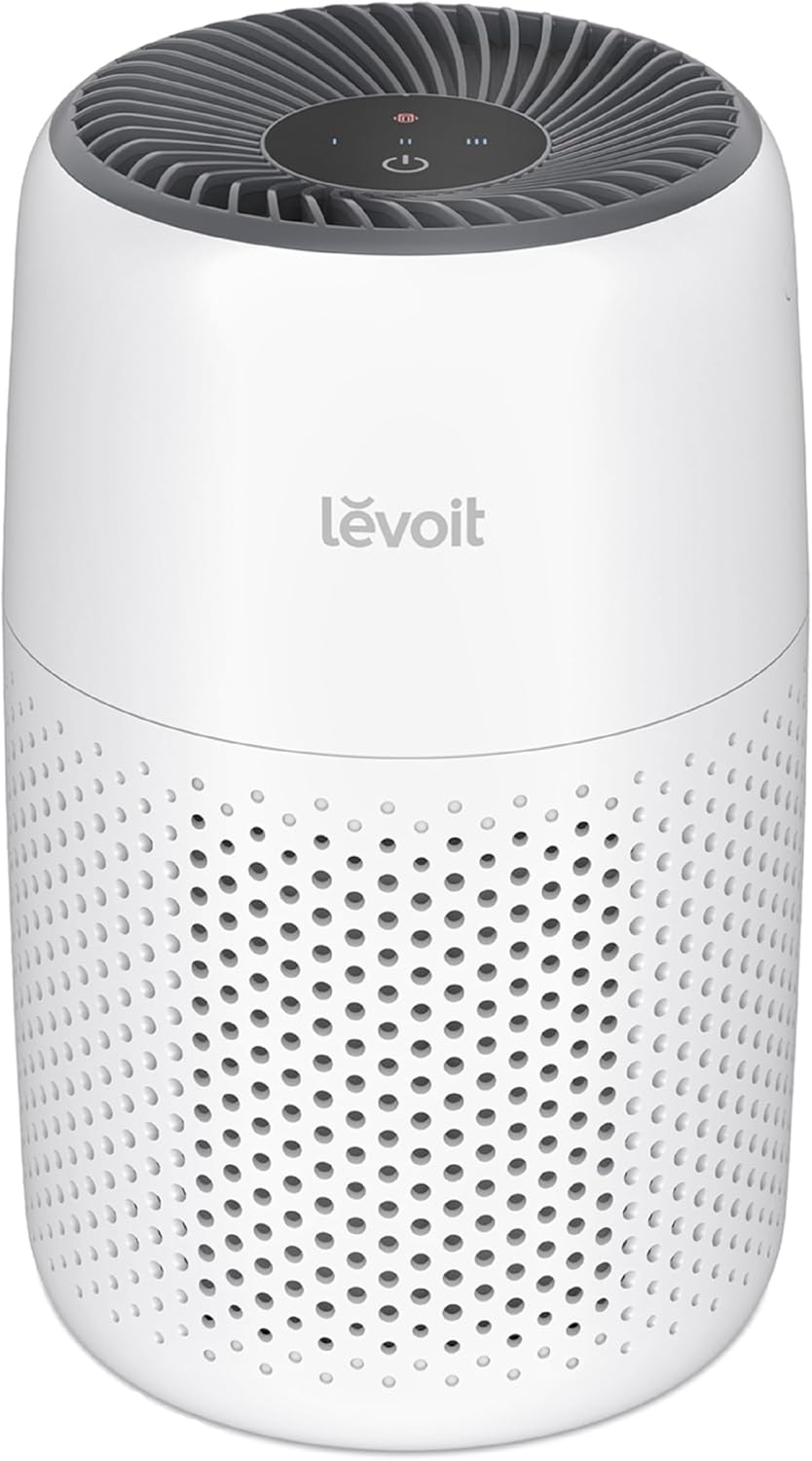
| Rated Power | 7W |
|---|---|
| Noise Level | 27–45 dB |
| Adapter Input | 100–240V, 50/60 Hz |
The Levoit Core Mini-P is a small, plug-in tabletop air purifier intended for bedrooms, dorms, or desktop use where space is limited. It uses a pre-filter and main HEPA-style filter to capture lint, hair, pet dander, fine particles and smoke, and includes a small fragrance sponge for light aromatherapy. The unit runs quietly (manufacturer noise range 27–45 dB) and offers a sleep mode and auto-off display to reduce disturbance overnight. Its low rated power (7W) makes it energy efficient for continuous use, and the internal adapter keeps the footprint tidy. Practical benefits include straightforward setup, near-silent operation, and modest odor reduction for close-range placement. Limitations are its small coverage area and compact filter size, so it will not replace a full-room purifier for living rooms or heavy indoor smoke; filter replacement frequency may be higher if used in smoky environments. The aromatherapy feature works but requires caution with oils to avoid overflow and plastic damage.
Best for: Buyers who want a highly rated, compact purifier for a bedroom, office, or near-source smoke and odor control and who value quiet, low-energy operation and social-proof confidence from many user reviews.
Less Ideal for: Those needing to clear heavy smoke or purify large living areas should choose a larger, higher-capacity purifier tailored to whole-room cleaning.
- Effective at capturing pet hair, lint, and fine airborne particles at close range
- Very quiet operation with a dedicated sleep mode for overnight use
- Low power draw suitable for continuous, desktop or bedside use
- Includes an aromatherapy sponge for light scenting without separate devices
- Small unit with limited room coverage not suited for large spaces
- Aromatherapy requires only 2–3 drops and can damage plastic if overfilled
Verdict: A quiet, energy-efficient tabletop purifier that offers reliable close-range removal of smoke, odors, and pet allergens for small rooms.
Levoit Vital 200S-P Air Purifier

| Floor Area | 1875 square_feet |
|---|---|
| Noise Level | 27 db |
| Particle Retention Size | 0.1 micrometer |
| Power Source | Corded Electric |
| Filter Type | 3-Stage Filter |
The Levoit Vital 200S-P is a smart three-stage air purifier built for whole-room cleaning in larger spaces. It uses a washable pre-filter plus an activated carbon and HEPA-style middle stage to capture particles down to 0.1 micrometer and absorb odors and volatile compounds, which makes it helpful for smoke and pet smells. The unit is AHAM verified with high CADR-style performance and runs quietly in sleep mode at about 27 dB for bedroom use while offering app control and a built-in air quality monitor for automatic adjustments. Practical benefits include washable pre-filter savings, targeted replacement filter options (pet, smoke, toxin-absorber), and reasonably low power draw. Limitations to consider are the physical footprint for smaller rooms and ongoing filter replacement costs if you switch to specialty filters for persistent wildfire or heavy-smoke situations; also some users may prefer more granular manual controls than the app provides. For buyers seeking a reliable, quiet purifier with solid smoke and odor handling and easy smart controls, this model fits well.
Best for: Buyers who prioritize dependable, independently tested smoke and odor removal with quiet operation and simple smart monitoring for bedrooms or living rooms.
Less Ideal for: People who need an ultra-compact or portable purifier for very small spaces or frequent relocation should consider smaller travel-size units instead.
- Three-stage filtration combining washable pre-filter, activated carbon, and HEPA-class particle capture for particles down to 0.1 micrometer
- AHAM-verified performance with high CADR-style results for smoke, dust, and pollen
- Built-in air quality monitor and app control for automatic adjustments and remote monitoring
- Sleep mode that operates quietly around 27 dB, suitable for bedrooms
- Replaceable specialty filters available (Pet Allergy, Smoke Remover, Toxin Absorber) for targeted odor and smoke removal
- Relatively large footprint compared with compact travel purifiers
- Specialty filters add ongoing replacement cost for heavy smoke or VOC situations
- Some users may prefer more tactile manual controls over app-driven operation
Verdict: Choose the Vital 200S-P when you want a quietly running, AHAM-verified purifier that handles smoke and odors for large rooms with smart monitoring.
Choosing the Right Air Purifier for Smoke Odors: Key Factors to Consider
Filtration Type and Efficiency
Smoke contains very small particles, often in the submicron range, so filtration type determines how effectively those particles are removed. True HEPA filters capture at least 99.97 percent of particles down to 0.3 microns and are the baseline for particle removal. Consider whether a unit uses a certified HEPA element versus a mechanical or washable filter and whether the manufacturer provides independent test data or CADR figures specific to smoke or fine particles.
Beyond the primary particle filter, check whether the system layers prefilters to catch larger debris and whether filters are sealed so air cannot bypass the media. A high-efficiency filter with proper sealing will keep circulating air cleaner for longer and reduce the frequency of secondary cleaning tasks like wiping surfaces.
Activated Carbon and Odor Media
Odor removal requires media that adsorbs or chemically transforms volatile organic compounds and gaseous smoke constituents. Activated carbon is the most common solution and varies widely in quantity, pore structure, and impregnation with chemicals that target specific gases. Look at the carbon bed depth or weight and whether the product specifies gas-removal performance or uses enhanced carbon blends for smoke and VOCs.
Some systems pair carbon with catalytic or specialized odor media that can break down certain compounds. If lingering smell is your primary concern, prioritize units with substantial, replaceable carbon stages rather than models that only claim "odor reduction" without describing the media.
Room Size and Air Changes Per Hour
An effective purifier must move enough air to provide meaningful air changes per hour (ACH) for your room. Check the rated room coverage or CADR and compare it to your room's square footage and ceiling height. A unit that is undersized for the space will have minimal impact on smoke and odors, even if its filters are high quality.
Aim for a purifier that can deliver at least 4 to 6 air changes per hour in a room where smoke exposure is frequent. For occasional smoke in larger living areas, higher CADR and stronger airflow reduce the time it takes to clear the air after an event.
Noise Levels and Operating Modes
Smoke events often require running a purifier at high speed, so noise matters. Fan design, motor quality, and speed settings influence the audible experience. Look for published decibel ratings at different fan speeds and consider whether the unit has a quiet or sleep mode for overnight use.
Also evaluate how the purifier balances noise and performance. Some models keep good filtration at moderate noise by using efficient airflow paths and motor controls; others only perform well at uncomfortably loud settings. A unit that is too loud will likely be turned off or down, negating its smoke-removal benefits.
Maintenance, Filter Replacement, and Operating Cost
Ongoing costs affect long-term satisfaction. Filter lifespan depends on smoke exposure and whether there are prefilters to trap larger particles. Check expected filter life in months or approximate hours for replacement and whether the carbon stage is replaceable separately from the HEPA element.
Also consider how easy the unit is to open for filter changes, whether filters are commonly available, and whether there are indicator lights for replacement. Higher initial performance can be undermined by expensive or hard-to-source filters, so factor total ownership cost into your decision.
Controls, Sensors, and Smart Features
Useful controls can make a big difference when managing smoke. Look for air-quality sensors that adjust fan speed automatically, timers, Wi-Fi or app control for remote operation, and manual speed settings. Sensor-driven operation helps maintain low particle counts without constant manual intervention.
However, sensors vary in accuracy and placement matters. A good implementation will include both particle and sometimes VOC sensing and let users override automatic behavior. Prioritize intuitive controls and reliable sensor feedback over flashy but impractical features.
How Smoke Differs From Other Indoor Pollutants
Smoke is a mix of solid particles and gaseous compounds, which means a single approach rarely solves both problems. Particulate matter from smoke is often very small and can penetrate deep into lungs, while the gases are responsible for odor and irritation. Understanding this distinction helps you choose a unit with both a high-efficiency particle filter and a dedicated odor removal stage.
Because smoke composition varies by source, a purifier that pairs true particle filtration with robust carbon or catalytic media will be more versatile across cooking smoke, wildfire smoke, and other smoky sources.
- Particles affect health and require mechanical filtration.
- Gaseous compounds cause smell and need adsorption or chemical treatment.
- Different smoke sources produce varying mixtures of particles and gases.
Placement and Multiple-Unit Strategies
Where you place an air purifier influences how quickly it clears smoke. Position units in the path of airflow where smoke originates or in the breathing zone where people spend the most time. Avoid placing a purifier directly against walls or behind furniture where intake or exhaust can be blocked.
For larger homes or open plans, using multiple smaller units placed strategically often outperforms a single large unit located in the wrong spot. Multiple units can create more even air circulation and reduce dead zones where smoke lingers.
- Place purifiers near the source of smoke when possible.
- Keep intake and exhaust clear of obstructions.
- Consider two smaller units for zonal coverage in large spaces.
Running Strategy During and After a Smoke Event
During active smoke generation, run the purifier at a higher fan speed to increase air changes, then lower the speed for continuous maintenance once particulate levels drop. If outdoor air is the source, keep windows and doors closed while purifying indoor air.
After a smoke event, continue running the unit for several hours to remove residual gases that adhere to surfaces. Periodic vacuuming and wiping can help remove settled particles so the purifier does not become overloaded too quickly.
- High speed while smoke is present, then drop to automatic or low for maintenance.
- Keep building envelope closed to avoid new smoke entry during cleanup.
- Combine purifier use with surface cleaning to reduce re-emission of particles.
Understanding CADR and What It Means for Smoke
Clean Air Delivery Rate, or CADR, measures how quickly a purifier reduces specified particle sizes in a standardized test. Higher CADR for smoke-sized particles indicates the unit can clear rooms faster. Use CADR alongside your room size to estimate how long the purifier will take to reduce particle concentrations.
Remember CADR is a lab metric; real-world performance depends on placement, room layout, and whether indoor sources are still active. Treat CADR as a useful comparative number rather than an absolute guarantee.
- Compare CADR to room square footage and desired air changes per hour.
- Higher CADR shortens cleanup time after smoke events.
- Consider real-world factors that can lower effective CADR like obstructions.
When to Consider Additional Ventilation or Source Control
An air purifier improves indoor air quality but is most effective when combined with source control. Eliminating the smoke source, using local exhaust for cooking, or sealing access points for outdoor smoke will reduce the purifier's workload and improve outcomes.
In prolonged or severe outdoor smoke episodes, mechanical ventilation with appropriate filtration or running purifiers in multiple rooms may be necessary. If smells persist despite proper purifier use, inspect fabrics, HVAC filters, and other surfaces that can act as secondary odor reservoirs.
- Prioritize removing or reducing the smoke source when possible.
- Use local exhaust for cooking and sealing windows during outdoor smoke.
- Check textiles and HVAC filters as potential odor reservoirs.
How We Chose the Best Air Purifier for Smoke Odors
We focused on attributes that directly affect how well a unit reduces smoke particles and associated odors in real-world home use. Key evaluation criteria included particle filtration efficiency against submicron particulate matter, activated-carbon or catalyst-based gas and odor removal capacity, room coverage and CADR or equivalent airflow rating, noise levels at typical operating speeds, and ongoing maintenance costs such as filter lifespan and replacement ease. We also considered control features that help users match performance to conditions, like multiple fan speeds, air-quality sensors, and scheduling. Units that lacked meaningful odor capture media or had insufficient airflow for their target room size were excluded. We prioritized appliances that combine measurable filtration performance with sensible day-to-day usability rather than hypothetical specs that do not translate into odor reduction. The result is a shortlist of seven air purifiers that meet those practical standards and are appropriate for different room sizes and user priorities.
Our full evaluation process is outlined in our review methodology.
FAQ
Can an air purifier remove smoke smell completely?
It often depends on the source and severity. A purifier with a substantial activated-carbon stage can significantly reduce smoke odors, but complete removal may take extended runtime and additional cleaning of surfaces that absorbed the smell.
How long should I run a purifier after a smoke event?
Run the unit at a higher setting while smoke is present and continue for several hours afterward to clear residual particulates and gases. The exact time depends on room size, purifier capacity, and how long the smoke source was active.
Are HEPA filters enough to tackle smoke?
HEPA filters are essential for removing fine particles from smoke but do not adsorb gaseous compounds responsible for odor. For smell removal, pair HEPA filtration with a dedicated carbon or gas-treatment stage.
Will running a purifier on high remove smoke faster than opening windows?
Opening windows may bring in fresh air but can also introduce outdoor smoke depending on conditions. Running a purifier on high recirculates and cleans indoor air and is usually more effective at reducing indoor smoke levels when outdoor air is smoky.
Do sensors reliably detect smoke and control fan speed?
Many sensors reliably detect particulate spikes and can ramp fan speed accordingly, but sensor accuracy varies. Look for units with proven particle-sensing systems and test automatic modes yourself to confirm responsiveness.
Final Verdict
When choosing an air purifier for smoke odors, prioritize a combination of true particle filtration and a substantial odor-removal stage. Match unit capacity to your room size and favor models with CADR or airflow ratings that provide several air changes per hour during smoke events. Balance noise and runtime so you will keep the purifier running when it matters, and plan for filter replacement costs and maintenance. The right decision depends on whether you need fast cleanup after occasional smoke or continuous control for persistent exposure. Focus on filtration type, carbon media, and room coverage to find a unit that reduces both particles and smells effectively.