
Note: This article contains affiliate links. If you click on these links and make a purchase, we may earn a small commission at no extra cost to you. This helps support our research and content. Read our full affiliate disclosure here.
When you want cleaner indoor air without spending a lot, the right air purifier can make a visible difference in dust, pet dander, and odors. For many households, a budget cap of $150 still gets models with true HEPA filtration, useful coverage for small to medium rooms, and manageable noise levels. This guide shortlists seven top picks in the under-$150 range and evaluates each against practical buyer concerns such as filtration effectiveness, room coverage, noise, and running costs. Read on to find an option that fits your living space and daily routine.
Top Picks at a Glance
| Best Overall The best all-around choice for most situations | GermGuardian AC4825E 22" Tower Air Purifier |  |
| Best Quality Built to a higher standard if you want something more solid | Coway Airmega 150 |  |
| Best Value The sweet spot between price and what you get | VOOPNU DH-JH12 Air Purifier |  |
| Best Budget The cheapest option that still gets the job done reliably | FULMINARE H13 HEPA Air Purifier |  |
| Top Rated A top-rated pick with lots of positive feedback | FreAire VisionAir HAP606 |  |
| Most Popular A crowd favorite that many people choose with confidence | Levoit Core 300-P |  |
| Best Seller A high-volume bestseller chosen again and again | Levoit Core Mini-P |  |
GermGuardian AC4825E 22" Tower Air Purifier

| Model | AC4825E |
|---|---|
| Room coverage | 153 sq. ft. (air refresh every 12.5 min); up to 743 sq. ft. hourly |
| Filter type | True HEPA with activated carbon pre-filter |
| Fan speeds | 3 speeds with sleep mode |
The GermGuardian AC4825E is a compact tower air purifier that uses a True HEPA filter plus an activated carbon pre-filter and optional UV-C light to capture allergens, pet dander, dust, pollen, and reduce common household odors. It is typically placed in bedrooms, living rooms, home offices, or basements and runs on one of three fan speeds including a quiet sleep mode for nighttime use. The unit circulates air fast enough to refresh a 153 sq ft room every 12.5 minutes and can provide hourly turnover in much larger spaces up to the stated 743 sq ft. The genuine HEPA Filter B captures particles down to 0.1 microns with an initial efficiency claim and the carbon layer helps with cooking and pet smells. Maintenance is straightforward since replacement HEPA, carbon, and UV parts are standard GermGuardian items. Expect good filtration performance for seasonal allergies and everyday odors, though the tower form and fan power mean it is not a silent or ultra-compact desktop unit and replacement filters are an ongoing cost over time.
Best for: Buyers who want an affordable, full-featured purifier that handles allergies, pet dander, and everyday odors across typical home rooms and prioritize proven HEPA performance and easy upkeep.
Less Ideal for: People who need a completely silent purifier for very small desks or those who prefer a no-maintenance filterless design should consider other options.
- True HEPA filtration captures fine allergens and pet dander
- Activated carbon pre-filter reduces common household odors
- Optional UV-C light adds an extra layer of airborne particle reduction
- Three fan speeds including a quiet sleep mode for nighttime use
- Fits standard replacement GermGuardian Filter B and UV parts for easy maintenance
- Not a fanless or ultra-quiet design on higher speeds
- Requires periodic purchase of replacement filters and UV bulb
- Tower size may be bulky for very small desks or compact spaces
Verdict: A reliable, budget-friendly HEPA tower that delivers solid allergy and odor reduction with easy-to-source replacement parts, making it a strong all-around choice under $150.
Coway Airmega 150

| Floor Area | 1035 square_feet |
|---|---|
| Filter Type | HEPA |
| Noise Level | 19.98 db |
| Wattage | 35 watts |
| Special Features | Air Quality Monitor, Filter Life Indicator, Smart Mode |
The Coway Airmega 150 is a small, performance-focused air purifier that combines a HEPA element, carbon layer, and washable prefilter in a single cartridge for easy maintenance. It is intended for home use where fast coverage matters: the manufacturer rates it to clean roughly 518 sq ft in 30 minutes and up to 1,035 sq ft in 60 minutes. The unit has a touch control panel, an air quality monitor that drives an auto mode to raise fan speed when pollutants are detected, and a filter-life indicator to remind you when maintenance is needed. Its reported particle capture meets 99.97% for 0.3 micron and the carbon layer targets VOCs and odors, which makes it useful for smoke, pollen, and pet dander. Noise and power are modest at low speeds, and the cartridge design keeps filter changes clean and straightforward. Expect routine filter replacements and modest airflow compared with larger models, so it is best when you need efficient cleaning in small to medium rooms rather than whole-house coverage.
Best for: Buyers who prioritize measurable in-room performance and fast, efficient cleaning for bedrooms or medium living spaces and who value a simple, low-fuss maintenance design.
Less Ideal for: People seeking whole-house air cleaning or higher CADR and airflow for very large open floor plans should consider larger, higher-capacity units.
- Multi-stage HyperCaptive filtration captures 99.97% of 0.3 micron particles and reduces VOCs and odors
- Cartridge design makes filter replacement cleaner and easier
- Built-in air quality monitor with auto mode adjusts fan speed in real time
- Washable prefilter reduces maintenance cost and extends filter life
- Coverage and airflow are limited compared with larger room or whole-home purifiers
- Some lab-tested gas and allergen removal claims are environment-dependent and may vary in real rooms
Verdict: A compact, performance-oriented purifier that delivers fast, measurable cleaning for bedrooms and medium rooms while keeping filter changes simple.
VOOPNU DH-JH12 Air Purifier

| Coverage | Up to 1,076 ft² |
|---|---|
| Filtration | H13 True HEPA multi-layer |
| Noise level | 22 dB (low) |
| Speeds | 3 fan speeds |
The VOOPNU DH-JH12 is a compact tower air purifier built around an H13 True HEPA multi-layer filter and 360° intake to capture dust, pollen, pet hair, smoke, and odor particles. It is simplest to use: a pared-down control panel, three fan speeds, a timer, and a small essential oil tray make it suitable for bedroom or home-office placement where quiet operation is important. Lab-tested claims show it can clean roughly 250 ft² every 15 minutes, which supports its rated coverage up to about 1,076 ft²; that makes it useful for medium rooms or open-plan areas when run continuously. The unit is notably quiet at low speed and carries multiple safety and performance certifications. Expect routine filter replacements on the manufacturer schedule and modest trade-offs common to compact purifiers: peak airflow and odor removal on the highest setting will be less powerful than larger, bulkier models, and the small footprint limits large-room rapid clearance without continuous operation.
Best for: Buyers who want a fuss-free, space-saving purifier for bedrooms, home offices, or medium open rooms and prioritize low noise and easy operation.
Less Ideal for: Those needing very fast clearing of large spaces, heavy smoke remediation, or industrial-level filtration should choose a larger unit with higher CADR.
- H13 True HEPA multi-layer filtration captures 99.97% of fine particles
- 360° air intake design for even room circulation
- Quiet operation down to about 22 dB suitable for night use
- Compact footprint that fits on desks or corners
- Simple controls plus timer and essential oil tray for added convenience
- Smaller physical size limits maximum airflow compared with larger purifiers
- Best performance requires continuous or long runtimes for full-room coverage
Verdict: A compact, quiet HEPA purifier that delivers practical, easy-to-use air cleaning for bedrooms and medium rooms under $150.
FULMINARE H13 HEPA Air Purifier

| Filter type | H13 HEPA |
|---|---|
| Recommended room size | Up to 215 sq ft / 20 m² |
| Noise level (low) | Around 24 dB |
| Timers | 2-4-8-10-12 hours |
The FULMINARE H13 is a small, budget-oriented air purifier intended to improve air quality in bedrooms and small living spaces. It uses an H13 true HEPA filter and a 360-degree outlet with dual-channel circulation to refresh air in rooms up to about 215 sq ft, making it suitable for single rooms rather than whole homes. Controls include multiple timers and a dedicated sleep mode that reduces fan noise to a reported low decibel level for overnight use, and an independent night light adds a child-friendly touch. Practical benefits are straightforward: it removes common particles such as pet hair, smoke, and odors while running quietly and occupying little floor space. Limitations include the need to replace filters regularly and a plug-in power design that requires access to an outlet, and its coverage and filtration capacity are modest compared with larger or higher-end units. For buyers prioritizing a low-cost, compact purifier for one room, this model delivers useful basic performance with few bells and whistles.
Best for: Buyers on a tight budget who need a simple, compact purifier for a single bedroom or office and value quiet overnight operation and ease of placement.
Less Ideal for: Households seeking whole-home air cleaning, higher CADR performance, or advanced smart features should consider larger or more capable units instead.
- H13 true HEPA filter for particle removal
- 360-degree air outlet and dual-channel design for even circulation
- Very quiet sleep mode suitable for bedrooms
- Compact and portable footprint that fits small rooms
- Independent night light and multiple timer settings
- Intended coverage limited to about 215 sq ft so not for larger spaces
- Requires periodic filter replacement and no battery operation
Verdict: A no-frills, budget-friendly H13 HEPA purifier that quietly improves air in single rooms and is a strong value under $150.
FreAire VisionAir HAP606

| Coverage claim | Up to 1800 sq ft |
|---|---|
| Filtration | 3-stage H13 HEPA |
| Noise level | Sleep mode 20 dB |
| AQI/PM2.5 | Real-time digital display |
The FreAire VisionAir HAP606 is a tower-style air purifier built to monitor and clean indoor air continuously. It uses a 3-stage H13 HEPA filter and 360° intake to capture particles down to 0.3 μm and reports real-time PM2.5 and AQI on a color-coded display so you can watch changes as they happen. The unit offers multiple fan speeds, an auto mode that responds to air quality, a child lock, timer, and a sleep mode that drops noise to about 20 dB for overnight use. In practice the design is easy to place in bedrooms or living areas and the 4x-per-hour circulation claim for large rooms means faster refresh when running at higher speeds. Filters are replaceable with official FreAire replacements for consistent fit and performance. Limitations include the need to replace filters periodically and that the smallest, quietest settings will reduce airflow speed, so it may take longer to clear heavy smoke or high-pollutant events compared with continuous high-power operation.
Best for: Buyers who prioritize a reliable, monitor-equipped purifier that runs quietly and provides visible air-quality feedback for bedrooms and living spaces.
Less Ideal for: People needing industrial-strength or whole-house filtration for consistently heavy smoke or very large open-plan areas should consider larger or higher-capacity units.
- H13 HEPA 3-stage filtration captures 99.97% of particles down to 0.3 μm
- Real-time PM2.5 and AQI display for immediate feedback on air quality
- 360° intake plus multiple fan speeds and auto mode for adaptable room circulation
- Very quiet sleep mode around 20 dB and child-lock safety features
- Requires periodic replacement filters to maintain performance
- Lowest fan settings reduce purification speed during heavy pollution events
Verdict: Choose the VisionAir HAP606 if you want a quiet, monitor-driven HEPA purifier that reliably tracks and improves household air quality.
Levoit Core 300-P

| Filter Type | 3 in 1 Filtration |
|---|---|
| Floor Area | 1073 square_feet |
| Noise Level | 24 db |
| Wattage | 56 watts |
| Particle Retention Size | 0.3 micron |
The Levoit Core 300-P is a small, plug-in HEPA air purifier intended to clean bedroom or living-room air. It uses a three-stage filter (pre-filter, true HEPA-grade filter, and activated carbon) driven by a 56W motor with a CADR that supports refresh rates for rooms up to about 222 sq ft several times per hour and a larger area at lower refresh. Controls are touch-based with a sleep mode that drops noise to about 24 dB and an option to turn off the display lights for night use. Practical benefits include strong particle capture for pollen, dust, pet dander, smoke and VOCs, a compact footprint that is easy to move between rooms, and AHAM and CARB certifications that back stated performance. Limitations are that the Core 300-P lacks smart connectivity and Auto Mode found on some variants, so fan speeds must be adjusted manually, and Levoit recommends using genuine replacement filters and changing them roughly every 6 to 8 months for best results.
Best for: Buyers who prioritize proven, measured air-cleaning performance and quiet night operation and who value extensive user reviews and third-party certifications when choosing a budget-friendly purifier.
Less Ideal for: People who want Wi-Fi control, automated air-quality sensing, or fully hands-off operation should consider models with smart features and Auto Mode instead.
- True HEPA-grade filtration capturing 99.97% of 0.1–0.3 μm particles
- AHAM verified CADR with stated coverage and ETL/CARB certifications
- Very quiet Sleep Mode at approximately 24 dB for overnight use
- Compact, portable design that is easy to move between rooms
- No smart connectivity or Auto Mode on this model, requiring manual fan adjustments
- Requires regular filter replacements and works best with genuine Levoit filters
Verdict: A compact, AHAM-verified HEPA purifier that delivers quiet, reliable particle removal for buyers who want proven performance without smart features.
Levoit Core Mini-P
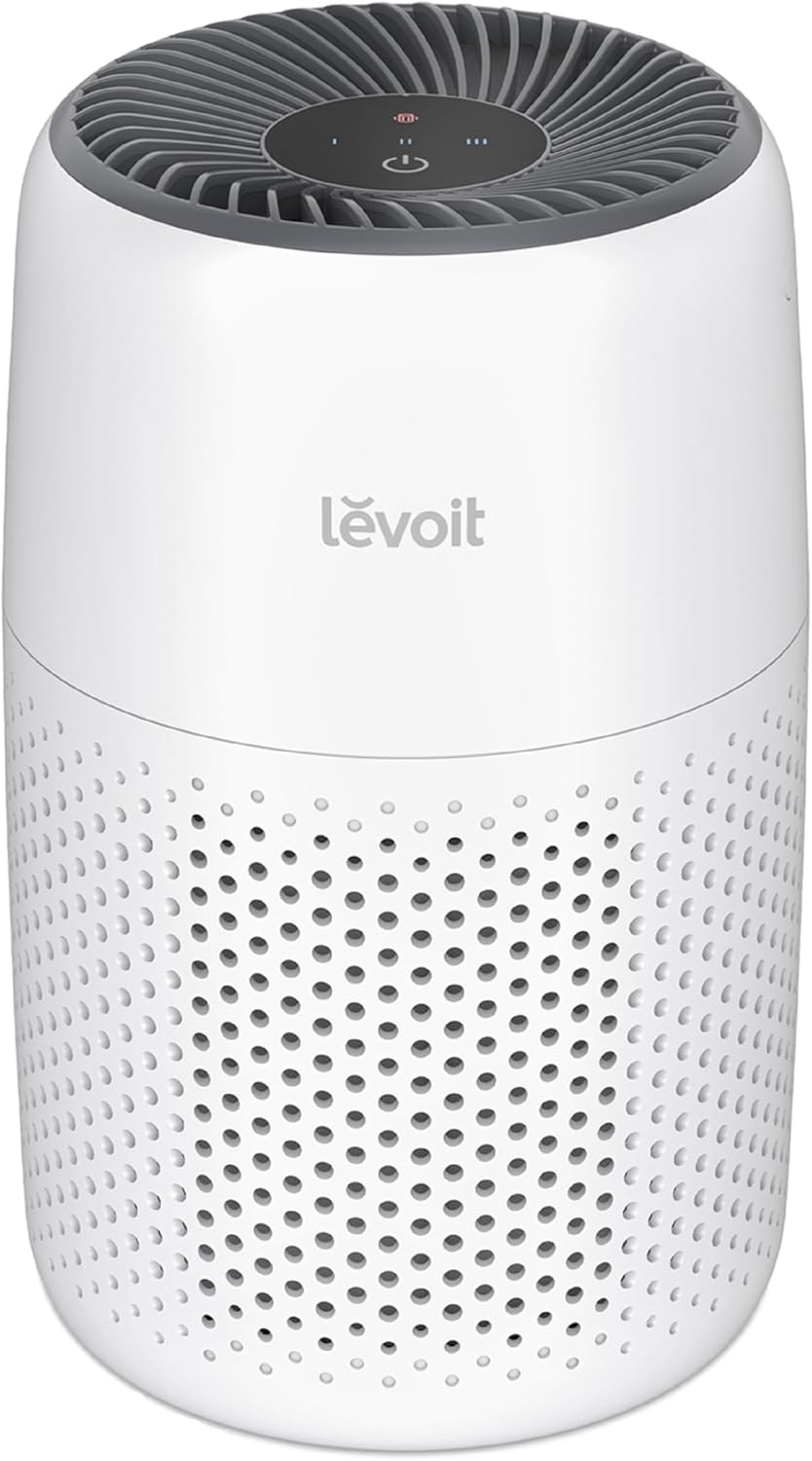
| Rated Power | 7W |
|---|---|
| Noise Level | 27-45dB |
| Adapter Input | 100-240V, 50/60 Hz |
| Dimension | 6.5 × 6.5 × 10.4 in/16.4 × 16.4 × 26.4 cm |
The Levoit Core Mini-P is a small, plug-in air purifier intended for bedrooms, offices, and desktops where space is limited. It uses a two-stage filtration system—pre-filter plus main HEPA-style filter—to capture lint, pet hair, dander, dust and smoke, and includes an aromatherapy sponge for light scenting. Setup is simple: place on a table, plug in, and choose one of the low-noise modes; the unit runs between about 27 and 45 dB so it is unobtrusive in sleep or work environments. Other handy touches are a sleep mode and an auto-off display to reduce distraction, and the internal adapter keeps the cord tidy. Expect practical benefits like noticeably reduced visible dust and fewer odors in small spaces, plus very low power draw. Limitations: it is sized for small rooms only, so it will not replace a whole-room purifier for larger living rooms, and replacement filters are required to maintain performance. Also avoid overfilling the aroma pad to prevent damage to plastic parts.
Best for: Buyers who prioritize a reliable, easy-to-use purifier for a bedroom or desk and want a low-noise, low-power unit that consistently reduces dust, pet dander, and household odors.
Less Ideal for: People seeking whole-room or multi-room purification for larger living spaces should choose a higher-capacity unit instead.
- Compact footprint for desktop or bedside use
- Two-stage filtration that captures pet dander, dust, and smoke
- Very quiet operation suitable for sleep with a low noise floor of ~27 dB
- Simple plug-and-play setup with internal adapter and auto-off display
- Effective only in small rooms or personal spaces
- Requires periodic replacement filters to retain filtering efficiency
Verdict: A dependable, whisper-quiet desktop air purifier that reliably reduces dust, pet dander, smoke, and odors in small rooms.
Choosing the Right Air Purifier: Key Factors to Consider
Filtration Type and Certification
Look for true HEPA or HEPA-equivalent filtration because these capture the smallest common allergy and smoke particles. Certifications or stated particle capture rates give you confidence that the unit will remove fine particulate matter rather than just circulating it.
Also check whether the purifier includes an activated carbon stage if odors or volatile organic compounds are a concern. A clear description of filter media and a quoted particle size rating makes it easier to compare models and anticipate actual indoor air improvements.
Room Size and CADR
Match the purifier's recommended room size or CADR figures to the space where you will use it. A unit designed for small bedrooms will struggle in an open-plan living area and will run constantly without adequately reducing particulates.
Remember manufacturers often quote idealized room sizes; plan for a margin of safety by choosing a unit rated slightly above the floor area you intend to treat to maintain performance during typical household activity.
Noise and Daily Comfort
Noise output affects where and when you can run a purifier. For bedrooms, look for low decibel ratings on lower fan speeds and a usable sleep mode. Higher speeds clean faster but may be too loud for nighttime use.
Also consider whether fan-speed steps and fan control are intuitive, and whether there are delayed or scheduled-run options to minimize disruption while keeping air quality high.
Operating Cost and Energy Use
A lower purchase price can be offset by high electricity use or frequent filter replacements. Check estimated wattage at typical fan speeds and the expected lifespan and cost of replacement filters.
If available, look for energy-saving features such as automatic mode tied to an air-quality sensor or programmable schedules that limit runtime when air is already clean, reducing total operating cost over time.
Maintenance and Filter Availability
Ease of replacing filters and the availability of affordable replacement parts matter for long-term satisfaction. Filters that require tool-free access and have clear life indicators make upkeep simpler.
Also verify that replacement filters are commonly available and clearly labeled, and consider units that allow you to independently replace stages (pre-filter, HEPA, carbon) rather than discarding combined multi-stage cartridges when only one layer is spent.
Extra Features and Controls
Features such as air-quality sensors, auto mode, timers, child locks, and simple digital displays can improve daily usability. An accurate air-quality indicator helps the unit run only as aggressively as needed.
However, extra features should not replace solid core performance. Usefulness is determined by reliability and whether the extras reduce maintenance or energy use rather than just adding complexity.
Sizing Your Purifier to the Room
Calculate the square footage of the room and compare it to the purifier's rated coverage or CADR. For consistent results, choose a model rated for a slightly larger area than the physical room to allow for furniture and air circulation losses.
Consider where the unit will sit; avoid placing it in corners or behind large furniture. Central locations with unobstructed inlet and outlet paths let the purifier move air more effectively and reduce the time needed to lower particulate levels.
- Measure floor area and ceiling height to estimate volume for more precise matching
- Prefer a model rated for at least 1.2 times your room area
- Keep 12–24 inches clearance on intake and exhaust sides when possible
Understanding Filter Lifespan and Replacement
Manufacturers typically quote filter life in months based on average indoor conditions. Heavy pollutant loads like pets, active smokers, or high dust levels will shorten that lifespan.
Look for user-replaceable pre-filters you can vacuum to extend the life of more expensive HEPA and carbon stages. Clear instructions and widely available replacements simplify long-term upkeep.
- Expect heavier use environments to require more frequent changes
- Check whether indicator lights or timer reminders are included
- Confirm replacement filter part numbers and local availability
Noise Tradeoffs: When to Use Higher Speeds
Higher fan speeds increase air exchanges and lower particulates faster, but they also produce more noise. Use high speed for short bursts, such as when cooking or after vacuuming, and return to low or auto modes for continuous overnight use.
If you plan to run the purifier in a bedroom, prioritize models with documented quiet modes or low decibel ratings at night settings to avoid disturbing sleep.
- Use turbo modes only when rapid clearing is needed
- Auto modes can reduce noise by only increasing fan speed when sensors detect particles
- Compare manufacturer decibel ratings rather than subjective descriptions
Placement and Multiple Units
A single small purifier is best for concentrated spaces like a bedroom or home office. For whole-home coverage, several well-placed units often outperform one central unit because they treat sources locally.
Place units near pollution sources when possible, such as by pet sleeping areas or kitchens, rather than attempting to place a single unit at the center of a home and expecting uniform results.
- Prioritize one unit for the room you spend most time in
- Complementary units can cover high-traffic areas and sleeping spaces
- Avoid placing units where airflow is restricted by curtains or furniture
Interpreting Air-Quality Indicators
Some purifiers include particle sensors and color-coded indicators that reflect relative air quality. These help the unit adapt fan speed automatically, which can save energy and reduce noise when levels are low.
Be aware that inexpensive sensors may lag behind real-time conditions or be overly sensitive. Use indicators as a guide rather than an absolute measurement, and combine them with your observation of odors or visible dust.
- Prefer units that clearly explain what sensors detect
- Consider models with separate indicators for particle matter and VOCs if odor removal is important
- Use indicators to time filter changes and cleaning cycles
How We Chose the Best Air Purifier
We selected entries that deliver measurable air-cleaning performance while staying under the stated price cap. Our filters prioritized measurable filtration standards like true HEPA or equivalent particle capture, effective CADR or manufacturer-stated room coverage appropriate for bedrooms and living rooms, and verified low to moderate noise output for daily use. We also considered energy efficiency and expected operating cost, build quality and ease of routine maintenance such as filter replacement accessibility, and additional features that affect usability like reliable fan-speed controls and straightforward indicators. Models that only claimed generic "air cleaning" without clear filtration specs were excluded, as were units with impractical filter replacement needs or unclear coverage claims. In short, choices needed to combine credible particle-removal specs, usable room coverage, reasonable noise and energy performance, and practical maintenance. These evaluation points informed the scoring criteria and ensured the shortlist focuses on real-world value rather than marketing alone.
Our full evaluation process is outlined in our review methodology.
FAQ
How often should I replace an air purifier filter under regular home use?
Under average conditions, HEPA filters often last 6 to 12 months, while pre-filters can be cleaned or replaced more frequently. Heavy use, pets, or smoky environments will shorten these intervals.
Will a purifier under $150 handle smoke or wildfire particles?
Many budget units with true HEPA filtration can capture particulate matter from smoke, but effectiveness depends on airflow rate and room size. For severe or prolonged smoke events, higher-capacity units or multiple purifiers may be necessary.
Can I run an air purifier 24/7?
Yes. Running continuously on low or auto mode is common and helps maintain steady air quality. Check the model's energy consumption and expected filter life to estimate operating costs.
Do carbon filters remove household odors effectively?
Activated carbon stages reduce many common odors and some VOCs, but their effectiveness depends on the carbon amount and contact time. For persistent chemical odors, look for units with a dedicated and replaceable carbon layer.
Are cheap particle sensors reliable in budget purifiers?
Lower-cost sensors can provide useful trends but may be less accurate than laboratory-grade equipment. Use them to monitor relative changes rather than as precise pollutant measurements.
Final Verdict
When choosing an air purifier under $150, prioritize credible filtration and appropriate room coverage over cosmetic features. A true HEPA stage, reasonable CADR or coverage rating, and manageable noise levels will determine day-to-day usefulness. Balance initial cost with expected filter-replacement frequency and energy use. Focus on models that are easy to maintain and that offer useful controls or auto modes so you can run them often without disruption. With those tradeoffs in mind, you can confidently pick a budget purifier that meaningfully improves indoor air quality.