
Note: This article contains affiliate links. If you click on these links and make a purchase, we may earn a small commission at no extra cost to you. This helps support our research and content. Read our full affiliate disclosure here.
When indoor air quality matters, picking the right air purifier can directly affect allergies, sleep, and general comfort. Units under $300 span compact bedroom models to larger-room purifiers, but performance varies widely in filtration, fan design, and noise. This guide shortlists seven top-performing air purifiers under $300 and explains the features that matter most. We evaluate filtration effectiveness, coverage area, noise output, and long-term upkeep to help you choose the model that matches your living space and health goals. Read on for a clear, practical breakdown before the product list.
Top Picks at a Glance
| Best Overall The best all-around choice for most situations | Winix 5510 Air Purifier |  |
| Best Quality Built to a higher standard if you want something more solid | Coway Mighty AP-1512HH |  |
| Best Value The sweet spot between price and what you get | GermGuardian AC4825E 22" Tower |  |
| Best Budget The cheapest option that still gets the job done reliably | VOOPNU Air Purifier DH-JH12 |  |
| Top Rated A top-rated pick with lots of positive feedback | ECOSELF HAP609 Air Purifier |  |
| Most Popular A crowd favorite that many people choose with confidence | Levoit Core 300-P |  |
| Best Seller A high-volume bestseller chosen again and again | Levoit Core Mini-P |  |
Winix 5510 Air Purifier

| AHAM Verified Coverage | 1,882 sq ft in 1 hour |
|---|---|
| Filtration Stages | 4-Stage |
| True HEPA Capture | Particles as small as 0.01 microns |
| Smart Features | WiFi / Alexa / Google Home |
| Noise (low speed) | 23.5 dB |
The Winix 5510 is a four-stage air purifier designed to clean large rooms quickly while offering smart controls and quiet operation. It combines a washable pre-filter, a True HEPA filter that captures particles down to 0.01 microns, an advanced deodorization carbon filter for odors and VOCs, and Winix PlasmaWave technology. Built-in sensors and an LED air quality indicator let the unit run in Auto Mode and adjust fan speed as conditions change, and the Winix Smart App plus voice integrations allow remote control and monitoring. Sleep Mode reduces noise when the room is dark, and the unit is AHAM verified and UL certified for reliable performance. Practical benefits include strong coverage for open living spaces, easy maintenance with a washable pre-filter, and automated operation that reduces the need for manual adjustments. Limitations to consider are that replacement HEPA and carbon filters are required over time and the unit occupies a moderate footprint for floor placement in living areas.
Best for: Buyers who want a powerful, automated purifier for open living rooms or larger bedrooms and value app control and quiet night operation.
Less Ideal for: People looking for a compact tabletop unit for very small rooms or those who want a permanently maintenance-free air cleaner.
- Four-stage filtration including True HEPA for submicron particles
- Advanced carbon filter to reduce household odors and some VOCs
- Smart sensors with Auto Mode and LED air quality indicator for hands-off operation
- Winix Smart App and voice assistant compatibility for remote control
- Washable pre-filter reduces large particle load and extends filter life
- Requires periodic replacement of HEPA and carbon filters to maintain performance
- Moderate floor footprint may not suit very small rooms or tight spaces
Verdict: A smart, high-coverage HEPA purifier that balances strong filtration, quiet night use, and app control for larger rooms under $300.
Coway Mighty AP-1512HH

| Coverage | Up to 1,748 sq. ft. in 60 minutes |
|---|---|
| Filtration | Washable pre-filter, deodorization, bipolar ionizer, True HEPA |
| HEPA effectiveness | 99.97% of 0.3μm particles |
| Modes | Auto, Eco, Timer |
| Filter lifespan | Up to 1 Year |
The Coway Mighty AP-1512HH is a room air purifier built around a four-stage filtration system (washable pre-filter, deodorization filter, bipolar ionizer, and True HEPA) that targets pollen, pet dander, smoke, and VOCs. It is typically used in living rooms, bedrooms, or open-plan areas where continuous monitoring and automatic fan adjustments are helpful; the unit's air quality sensor and colored LED make it easy to see changes at a glance while Auto Mode varies fan speed to match pollution levels. Practical benefits include a washable pre-filter that lowers running cost, filter change indicators that simplify maintenance, and an Eco mode that reduces fan noise and power when air is clean. The AP-1512HH is rated to move enough air to cover large rooms quickly, and Coway's custom filter options (smoke, pet, VOC-focused) let you tune performance to a specific problem. Important limitations are that replacement filters are required roughly annually under typical use, and the unit's coverage claim depends on room layout and pollutant load, so results will vary in real homes.
Best for: Buyers who prioritize measurable cleaning performance and automatic, responsive operation for medium to large living spaces and who value visible air-quality feedback.
Less Ideal for: Those who need an ultra-quiet unit for very small bedrooms where low noise at all times is the top priority or who want a permanently maintenance-free purifier with no consumable filters.
- True HEPA filtration captures 99.97% of 0.3 micron particles for effective allergen and dust removal.
- Auto mode with an onboard air quality sensor adjusts fan speed in real time for hands-off operation.
- Washable pre-filter and filter indicator reduce guesswork and help manage operating costs.
- Multiple custom filter options available for smoke, pets, and VOCs to address specific indoor pollution sources.
- Replacement filters typically need annual replacement, adding to ownership cost.
- Performance varies with room layout and pollutant concentration, so the quoted coverage is not guaranteed in every home.
Verdict: Choose the Coway Mighty AP-1512HH if you want a proven, performance-focused HEPA purifier that actively monitors air quality and adapts fan speed for fast, reliable results in medium to large rooms.
GermGuardian AC4825E 22" Tower

| Model number | AC4825E |
|---|---|
| Room coverage (single-pass) | 153 sq. ft. per 12.5 minutes |
| Room coverage (hourly) | Up to 743 sq. ft. per hour |
| Filter type | True HEPA with activated carbon pre-filter |
| Speeds | Three fan speeds |
The GermGuardian AC4825E is a compact tower purifier that uses a True HEPA filter, activated carbon pre-filter, and an optional UV-C light to remove dust, pollen, pet dander, smoke and common household odors. It is intended for everyday home use: place it in a bedroom, living room, basement or office and choose one of three fan speeds including a quiet sleep mode. The unit circulates air in a 153 sq ft room roughly every 12.5 minutes and can service larger areas on a slower cycle, so it works both for single rooms and shared spaces. The genuine HEPA filter captures very small particles (the brand cites down to 0.1 microns in initial efficiency), while the carbon layer helps cut cooking and pet smells; compatible replacement filters and bulbs are available for straightforward maintenance. Trade-offs are its straightforward, non-smart controls and basic tower design, which lacks advanced sensors or app integration, and filter replacement is an ongoing cost to maintain peak performance.
Best for: Buyers who want a proven, no-frills room purifier that reliably removes allergens and odors without fuss and prefer straightforward operation and replaceable factory filters.
Less Ideal for: If you need smart home integration, automatic air-quality tuning, or multi-room centralized purification, this basic tower model is not the best choice.
- True HEPA filtration captures very small particles for allergy relief
- Activated carbon pre-filter reduces common household odors
- Optional UV-C light adds an extra sanitizing layer
- Three fan speeds including a quiet sleep mode for night use
- No smart features or air quality sensors for automated control
- Basic user interface without advanced scheduling or remote control
Verdict: A reliable, easy-to-use HEPA tower purifier that delivers strong particle removal and odor reduction for single rooms without complicated features.
VOOPNU Air Purifier DH-JH12

| Filter Type | H13 True HEPA triple-layer |
|---|---|
| Coverage | Up to 1,076 ft² per hour (laboratory tested) |
| Noise Level | 22 dB (low) |
| Speeds | 3 fan speeds |
The VOOPNU DH-JH12 is a compact home air purifier built around an H13 true HEPA triple-layer filter and 360 degree intake to capture common indoor pollutants such as pet hair, pollen, smoke and odors. It is intended for everyday room use and claims laboratory-tested cleaning of 250 ft² every 15 minutes, covering up to about 1,076 ft² per hour; controls are simplified to one-tap operation with three fan speeds and a timer for hands-off running. Practical benefits include a very quiet low-speed mode (as low as 22 dB) for bedrooms, a washable pre-filter option in some kits and a small footprint that fits on desks or corners. The unit also offers an essential oil tray to add scent while running and carries multiple safety and emissions certifications. Be aware the manufacturer recommends continuous long-term use for best results and replacement cycles for filters are typically every 3 to 6 months depending on usage, so ongoing filter purchases are part of ownership costs. The purifier is compact and easy to place, but buyers should match coverage claims to their room layout for consistent performance.
Best for: Buyers on a budget who want a small, certified HEPA purifier that is quiet enough for bedrooms and versatile enough for living rooms or home offices.
Less Ideal for: People needing a true whole-house solution or those who prefer units with smart app control and advanced sensors for automatic air-quality regulation.
- H13 true HEPA triple-layer filtration captures 99.97% of many airborne particles
- 360° intake design and lab-tested CADR-equivalent cleaning rate for fast room turnover
- Very quiet operation down to 22 dB suitable for bedrooms
- Compact footprint that is easy to place in small rooms or on desks
- Simple one-tap control with 3 speeds, timer and aroma tray for added convenience
- Filter replacements recommended every 3–6 months increase lifetime operating cost
- Coverage claims depend on continuous use and room layout for best results
Verdict: A quiet, compact HEPA purifier that delivers strong particle removal and solid coverage for small to medium rooms while staying budget-friendly.
ECOSELF HAP609 Air Purifier

| Model number | HAP609 |
|---|---|
| Noise level (Sleep mode) | 20 dB |
| Timer | 1–24 hours |
| PM2.5 display | Yes |
The ECOSELF HAP609 is a compact HEPA air purifier aimed at improving indoor air in bedrooms and small to medium living spaces. It draws air from all directions using a 360° intake and circulates filtered air quickly, while a built-in PM2.5 sensor and color ring display show real-time air quality and drive an Auto mode that adjusts fan speed as pollution levels change. Practical features include a 1–24 hour timer and a Sleep mode that mutes lights and lowers noise to about 20 dB for overnight use. The unit's small footprint makes it easy to move between rooms and suitable for apartments or offices, and replacement filters are available from the brand. Limitations include its modest coverage relative to larger purifiers and the absence of advanced connectivity options like Wi‑Fi or app control, so it is best for users who want straightforward, reliable air cleaning rather than smart-home integration.
Best for: Buyers who prioritize a straightforward, reliable purifier that actively monitors air quality and runs silently at night will appreciate this unit for bedrooms, home offices, or apartments.
Less Ideal for: Skip this model if you need smart-home connectivity, remote control, or a unit sized for large open living areas.
- 360° air intake for more even room circulation
- PM2.5 sensor with color ring and numeric display for instant air-quality feedback
- Auto mode that adjusts fan speed based on detected pollution
- Very quiet Sleep mode with lights off and noise around 20 dB
- 1–24 hour timer for scheduled operation
- No Wi‑Fi or mobile app control for remote monitoring or scheduling
- Coverage is intended for smaller rooms and may not suit large open-plan spaces
Verdict: Choose the HAP609 when you want a quiet, reliable HEPA purifier with real-time PM2.5 sensing and automatic cleaning for bedrooms and small living spaces.
Levoit Core 300-P

| Filter Type | 3 in 1 Filtration |
|---|---|
| Noise Level | 24 db |
| Wattage | 56 watts |
| Particle Retention Size | 0.3 micron |
| Floor Area | 1073 square_feet |
The Levoit Core 300-P is a compact room air purifier that uses a 3-in-1 HEPA-grade filter to capture fine particulates, pollen, pet dander, smoke, and common household odors. It is typically placed in bedrooms, living rooms, or home offices and runs on manual fan speeds with a dedicated sleep mode that reduces noise to about 24 dB for overnight use. Notable features include AHAM verification for CADR performance, a touch control panel, a timer, and a check-filter indicator, and the unit is CARB and ETL certified for safe home operation. In practice the Core 300-P delivers effective air changes in small to medium rooms and is straightforward to maintain since replacement filters are available and user-replaceable. The purifier lacks built-in smart or auto modes, so it requires manual speed adjustments and monitoring rather than automatic pollutant sensing, and it is intended for use with Levoit original filters for best results. For buyers seeking a quiet, proven HEPA purifier under $300, the Core 300-P balances performance and simplicity but does not offer connected features or automatic air-quality control.
Best for: Buyers who prioritize proven filtration performance and quiet overnight operation and who want a simple, reliable purifier backed by strong customer feedback.
Less Ideal for: Shoppers who want smart features, automatic air-quality sensing, or fully hands-off operation should consider models with built-in Auto Mode or Wi‑Fi instead.
- H13 HEPA-grade 3-in-1 filter captures 99.97% of 0.1–0.3 μm particles
- AHAM verified CADR with stated coverage for efficient room air changes
- Very quiet Sleep Mode at about 24 dB for overnight operation
- Compact, portable design that fits bedrooms and small living spaces
- Certified (CARB, ETL) and includes filter change indicator and timer
- No auto or smart connectivity so air flow must be adjusted manually
- Performance and CADR figures apply only when using official Levoit filters
Verdict: A quietly powerful HEPA-grade purifier that delivers proven particle removal in bedrooms and small rooms without smart features.
Levoit Core Mini-P
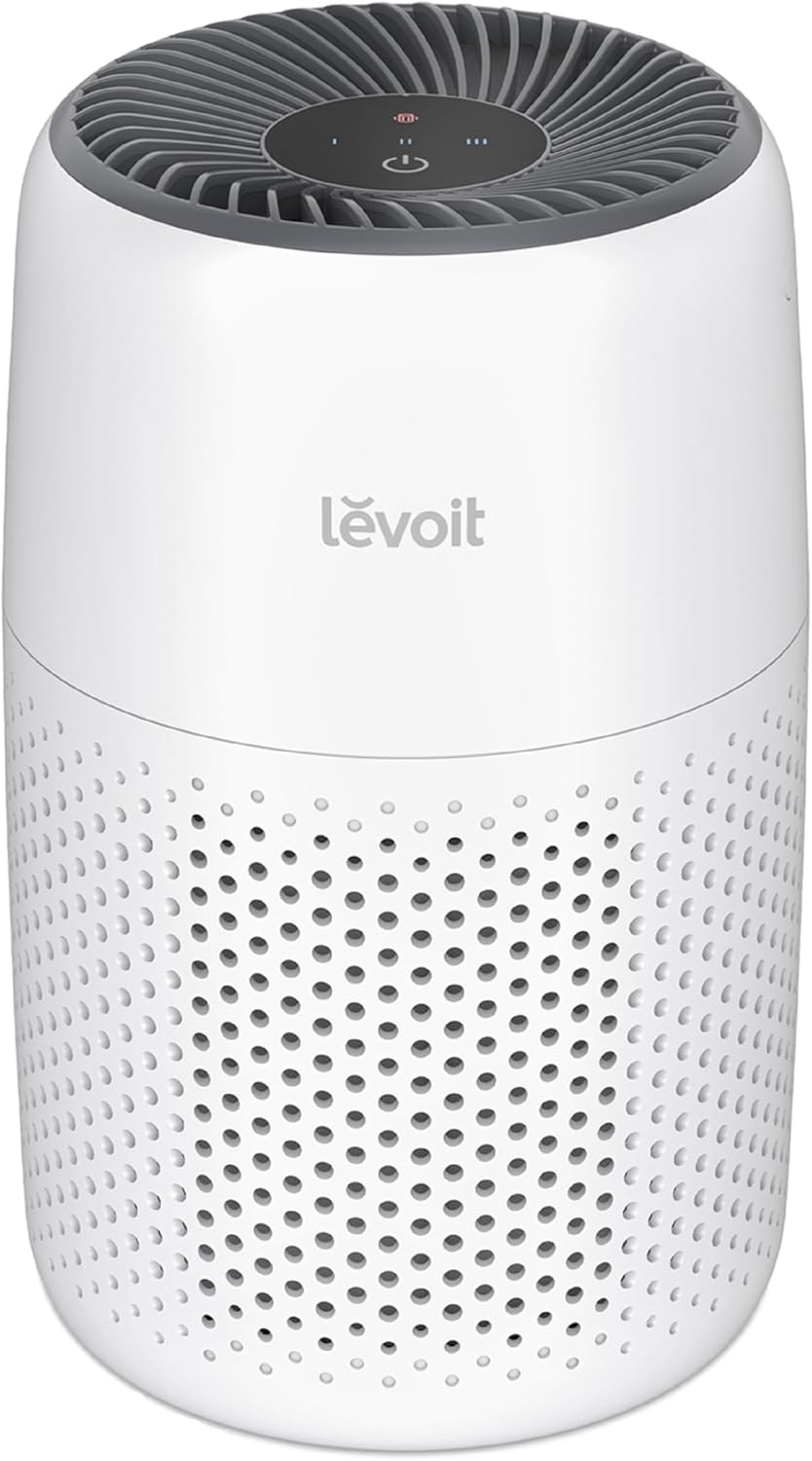
| Rated Power | 7W |
|---|---|
| Noise Level | 27-45dB |
| Dimension | 6.5 × 6.5 × 10.4 in |
| Particle Retention Size | 0.3 micron |
The Levoit Core Mini-P is a small, low-power air purifier made for desks, bedside tables, and other compact spaces. It uses a pre-filter and a main HEPA-style filter to capture lint, hair, pet dander, fine particulates and smoke, and it includes a fragrance sponge for light aromatherapy. Typical use is simple: plug it in, set one of the fan modes or sleep mode for quiet nighttime operation, and replace filters periodically. At 7W rated power and a stated noise range around 27 to 45 dB it runs quietly and is energy efficient for continuous use. The unit is AHAM-verified which gives independent validation of its cleaning performance for small rooms, and the auto-off display and compact footprint make it unobtrusive. Limitations are obvious: its small size means it is intended for close-range purification in bedrooms, offices, or kitchens rather than whole-house or large living areas, and the aroma pad requires only a couple drops of oil to avoid damage. For buyers who want a reliable, low-noise purifier for a single room, it is a practical choice under $300.
Best for: Buyers who prioritize dependable, independently verified air cleaning in a small bedroom, dorm, or home office and want a quiet, energy-efficient unit that stays out of the way.
Less Ideal for: People seeking whole-room or multi-room purification, or those who need higher CADR performance for large living areas should choose a larger-capacity purifier.
- AHAM-verified performance for trustworthy small-room air cleaning
- Quiet operation with sleep mode suitable for bedside use
- Low power draw (7W) for continuous, energy-efficient use
- Includes fragrance sponge for optional light aromatherapy
- Compact footprint that fits on desks and nightstands
- Not sized or powerful enough for large rooms or whole-home use
- Requires periodic filter replacement and careful use of essential oils to avoid damage
Verdict: A compact, AHAM-verified purifier that delivers quiet, energy-efficient air cleaning for a single bedroom or small workspace.
Choosing the Right Air Purifier: Key Factors to Consider
Filtration Type and Efficiency
The type of filter determines what pollutants the air purifier actually removes. True HEPA filters capture particles down to 0.3 microns and are the most reliable for allergens, smoke, and fine dust. Some units include prefilters for large debris and activated carbon layers for odors and VOCs, which matter if you have pets, cook frequently, or live near heavy traffic.
Knowing the filter stages helps predict ongoing maintenance and costs. Multi-stage systems usually perform better but can mean higher filter replacement expenses. Check filter lifespans and whether replacement filters are easy to source when estimating long-term ownership costs.
Room Coverage and CADR Ratings
Coverage area tells you what sized room the purifier can reasonably service. Look for models with clean air delivery rate (CADR) numbers that match the square footage of your space; a purifier underpowered for the room will run constantly and still fail to reduce particle counts effectively. Manufacturers often list recommended room sizes—use those as starting guidance and prefer units rated slightly above your room's floor area.
Also consider placement. A unit with a higher CADR can be placed farther from occupants and still improve air quality, while smaller units work best when located near the breathing zone, such as beside a bed or desk.
Noise Output at Realistic Settings
An otherwise excellent purifier is useless if it is too loud to run during sleep or work. Noise ratings are typically given for low, medium, and high fan speeds; prioritize low-speed decibel levels for bedroom use. Some purifiers advertise a 'sleep mode' with reduced fan speed and lights off—these features help maintain use at night.
Remember that perceived noise depends on distance and room acoustics. A quiet low speed in a large open area may still be audible in a small bedroom. If noise matters, compare published dB figures and look for units with progressively adjustable fan steps or truly silent low modes.
Operating Cost and Filter Replacement
Upfront price is only part of ownership cost. Filters need periodic replacement, and carbon or specialty filters often require more frequent changes. Estimate annual filter costs and factor them into the budget for the product lifetime. Energy consumption is another ongoing expense; purifiers with efficient motors and low-watt sleep modes save money if they run continuously.
Also check whether replacement filters are widely available and whether the manufacturer provides subscription options. Hard-to-find filters or proprietary high-cost replacements can turn a good initial deal into an expensive long-term commitment.
Control Features and Usability
How you control the unit affects whether it will be used consistently. Simple, intuitive controls, clear status indicators for filter life, and reliable timers make daily operation easier. Smart features like mobile apps or voice integration can add convenience but may complicate setup or require accounts and network access.
Consider physical controls and display readability if you prefer not to use apps. Also look for maintenance reminders and how easy the unit is to open for filter swaps; straightforward access reduces the chance of skipped maintenance.
Safety and Ozone Emissions
Some purifiers use ionizers or ozone-producing technology that can generate trace ozone levels. For indoor environments, avoid units that intentionally emit ozone as a primary cleaning method, since ozone can irritate airways. Verify that the unit meets safety standards and that any ionization features are low-emission or optional.
If someone in the household has respiratory sensitivities, prioritize filtration-only designs that rely on mechanical filters rather than reactive chemistries.
Sizing Your Air Purifier to Room Layout
Selecting the right capacity is about more than square footage. Think about ceiling height, open-plan layouts, and where pollutants originate. A purifier rated for a 250-square-foot bedroom may not be adequate for an open living area that includes a kitchen. Match the unit's rated coverage to the specific space where you will run it most and consider a higher CADR for open or connected rooms.
- Place units away from walls and large furniture to allow unrestricted airflow.
- If you have multiple problem areas, consider one larger unit positioned centrally rather than several undersized units.
- Use portable purifiers in the room where occupants spend the most time, such as bedrooms during sleep.
Managing Odors and VOCs
If odors or volatile organic compounds are a primary concern, prioritize models with substantial activated carbon or specialized gas-phase filtration. Carbon filters vary in capacity and must be replaced more frequently when exposed to heavy odors. Consider the typical sources of indoor VOCs in your home, such as painting, new furniture, or frequent cooking, and select a purifier with enough carbon media to handle those loads.
- Look for indications of carbon weight or dedicated VOC adsorption stages.
- Use exhaust fans and source-control measures together with purification to reduce the load on filters.
Placement Tips for Best Performance
Optimal placement improves performance more than small differences in CADR. Place the purifier where it can draw air freely and where people spend most of their time. Avoid corners, behind curtains, or tucked under desks. For bedrooms, position the unit on a nightstand or floor near the bed, ensuring intake and outlet are unobstructed.
- Keep the intake at least a foot from walls for most models.
- Avoid placing purifiers directly next to windows where outdoor pollutants may overwhelm filtration.
Maintenance That Keeps Units Effective
Regular maintenance preserves filtration efficiency. Clean prefilters monthly if washable, and replace HEPA and carbon filters according to manufacturer guidance or sooner if you notice reduced airflow or persistent odors. Reset filter indicators correctly after replacement to ensure accurate reminders.
- Record the date of each filter change to track intervals.
- Vacuum external grilles occasionally to prevent dust buildup that reduces airflow.
Energy Use and Continuous Operation
Many buyers run purifiers continuously. Choose energy-efficient models with low-watt sleep modes if you plan 24/7 operation. Look for units that balance sufficient circulation with reasonable power draw, and consider programmable timers or smart scheduling to reduce runtime during low-occupancy periods.
- Estimate monthly energy cost by checking wattage at typical fan speeds.
- Use lower fan speeds overnight when pollutant generation is low to save energy.
How We Chose the Best Air Purifier
We applied practical, buyer-focused filters to identify models that deliver the best real-world performance for the under $300 segment. First, we required true HEPA or equivalent filtration that captures fine particulates down to typical allergen sizes. Second, we prioritized verified clean air delivery rates aligned to stated coverage area so buyers get meaningful airflow for their rooms. Third, we assessed user-facing operational factors such as low-speed noise levels and control simplicity because a quiet, easy-to-use unit is more likely to be used consistently. Additional selection criteria included filter replacement availability and cost, energy draw at typical settings, and the manufacturer's stated warranty and support terms. We excluded units lacking clear filtration specifications, unverified CADR or coverage claims, or models that rely solely on ionization without particle filtration. The final shortlist balances measured filtration capability, practical coverage, quiet operation, and predictable upkeep costs.
Our full evaluation process is outlined in our review methodology.
FAQ
How often should I replace HEPA and carbon filters?
HEPA filters typically last six to twelve months depending on use and pollutant load, while carbon filters often need replacement more frequently if exposed to heavy odors. Check manufacturer guidance, monitor airflow, and replace sooner if performance declines.
Can I use an air purifier in the kitchen to remove cooking smoke?
Yes, a purifier with strong particulate CADR and a carbon layer for odors can reduce smoke and smells. However, for heavy cooking smoke, local ventilation such as range hoods is an important complement to reduce the load on the purifier.
Are quieter purifiers less effective?
Not necessarily. Noise correlates with fan speed, but some designs use efficient motors and optimized airflow to deliver good CADR at lower noise levels. Compare CADR per watt and published decibel ratings to find efficient, quiet models.
Do air purifiers remove viruses and bacteria?
High-quality HEPA filters capture many respiratory droplets and some airborne microbial particles, lowering airborne pathogen concentration. Filtration reduces exposure but does not guarantee elimination of infection risk and should be combined with other hygiene and ventilation measures.
Is ozone from ionizers a concern?
Ozone can irritate the respiratory system, so avoid purifiers that emit ozone intentionally. If an ionizer feature is present, prefer units where it is optional or rated as low-emission and ensure the device meets safety guidelines.
Final Verdict
Prioritize filtration efficiency, realistic room coverage, and noise performance when choosing an air purifier under $300. Balance upfront cost with expected filter and energy expenses to avoid surprises in long-term ownership. Focus on units with true HEPA filtration, clear CADR ratings that match your room, and manageable filter replacement routines. That approach helps you pick a dependable, quietly running purifier that improves indoor air quality without ongoing headaches.