
Note: This article contains affiliate links. If you click on these links and make a purchase, we may earn a small commission at no extra cost to you. This helps support our research and content. Read our full affiliate disclosure here.
If you want both cleaner air and a cooling breeze, an air purifier with a built-in cooling fan can simplify climate and air-quality control in a single appliance. These combination units remove particles, allergens, and odors while circulating air to lower perceived temperature and improve comfort in bedrooms, living rooms, and home offices. Choosing the right model matters because filtration capability, fan power, and noise interact differently depending on your room size and sensitivity to sound. This guide covers seven shortlisted options that represent strong choices across use cases and budgets. We evaluated each unit on filtration, airflow, noise, and maintenance to help you pick the best fit for your space. Read on for practical buying guidance and objective criteria used to assemble the list.
Top Picks at a Glance
| Best Overall The best all-around choice for most situations | Dyson Purifier Cool TP09 |  |
| Best Quality Built to a higher standard if you want something more solid | Honeywell Allergen Plus HPA6000 |  |
| Best Value The sweet spot between price and what you get | Chikit CK-019L Bladeless Tower Fan | 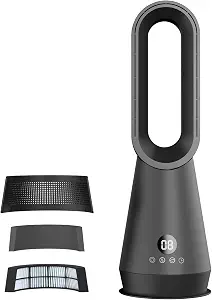 |
| Best Budget The cheapest option that still gets the job done reliably | Crane Desktop Air Purifier Fan EE-5073 |  |
| Top Rated A top-rated pick with lots of positive feedback | Dyson Purifier Hot+Cool HP1 |  |
| Most Popular A crowd favorite that many people choose with confidence | ULTTY Bladeless Tower Fan SKJ-CR021 |  |
| Best Seller A high-volume bestseller chosen again and again | DREO MC710S Tower Fan |  |
Dyson Purifier Cool TP09

| Filter Type | HEPA |
|---|---|
| Floor Area | 101 square_feet |
| Particle Retention Size | 0.3 micron |
| Controller Type | Mobile App, Remote Control |
| Power Source | Electric |
The Dyson Purifier Cool TP09 combines a HEPA filtration system with a bladeless fan to both clean and cool living spaces. It continuously monitors air quality, including formaldehyde, and uses a catalytic filter that Dyson says destroys formaldehyde rather than just trapping it. Air Multiplier circulation projects purified air across the room and you can select direct fan cooling or a backwards airflow mode that purifies without feeling the breeze. It supports remote, app, and scheduled control and features a night mode with dimmed display and quieter operation. Practical benefits include whole-room coverage for large rooms, simple maintenance with replaceable filters and on-screen filter-life alerts, and quiet operation compared with prior models. Trade-offs are the premium price and ongoing filter replacements, and its large vertical footprint may limit placement in tight spaces. The unit is best used in living rooms and open-plan areas where continuous sensing and whole-room air projection matter.
Best for: Buyers who want a high-performance purifier that also provides fan cooling and continuous formaldehyde management for large living spaces.
Less Ideal for: People on a tight budget or those needing a compact tabletop purifier for very small rooms or desks.
- Built-in formaldehyde sensor and catalytic filter that continuously destroys formaldehyde.
- HEPA filtration captures 99.97% of particles down to 0.3 microns for reliable particle removal.
- Air Multiplier fan projects purified air for whole-room coverage and offers adjustable oscillation.
- App and remote control plus programmable schedules and automatic filter-life notifications.
- Night mode and acoustic engineering reduce noise for quieter overnight operation.
- Premium price and ongoing cost of replacement filters.
- Tall vertical design requires floor space and may not fit small rooms or low shelves.
Verdict: Choose the Dyson Purifier Cool TP09 when you want a premium whole-room purifier that doubles as a powerful, quiet fan and actively removes formaldehyde.
Honeywell Allergen Plus HPA6000

| AHAM verified coverage | 398 sq. ft. (4.8 ACH) |
|---|---|
| Large-room coverage | 1928 sq. ft. at 1 ACH |
| Filtration stages | Pre-filter, HEPA, Carbon |
| Model number | HPA6000B |
The Honeywell Allergen Plus HPA6000 combines a three-stage filtration system with a Turbo360 swivel fan to deliver HEPA-filtered airflow across large spaces. It uses a cleanable pre-filter for hair and large particles, a certified HEPA filter that captures up to 99.97% of airborne allergens, and a carbon filter to reduce odors and VOCs, while an onboard air quality sensor and color-coded display adjust performance automatically. The Turbo360 fan and 360-degree circulation make it effective as both a purifier and a room circulator, and AHAM verification indicates strong performance for mid-to-large rooms. Controls include three fan speeds, sleep mode with dimmed lights, and timers for scheduled use, and the unit is designed for relatively quiet bedroom operation. Expect routine filter replacements for the HEPA and carbon stages and some bulk when moving the unit due to its size and weight, but for anyone prioritizing measurable air-exchange performance and consistent circulation this model delivers reliable, performance-focused purification with convenient monitoring features.
Best for: Buyers who prioritize measurable purification performance and strong room circulation for allergy, smoke, or odor problems and want a purifier that actively monitors and adjusts to air quality.
Less Ideal for: People seeking a lightweight travel unit or a minimalist tabletop purifier for very small rooms should consider smaller, more portable models instead.
- Certified HEPA filter captures up to 99.97% of airborne allergens
- 360° Turbo360 swivel fan provides broad air circulation across large rooms
- Built-in air quality sensor with real-time color display for automatic adjustments
- Cleanable pre-filter reduces hair and large particles to extend filter life
- Multiple fan speeds, sleep mode, and timer options for flexible operation
- Larger and heavier than compact purifiers, making it less portable
- Requires replacement HEPA and carbon filters over time
Verdict: Choose the HPA6000 when you need a high-performance HEPA purifier that also provides strong room circulation and automatic air-quality adjustments.
Chikit CK-019L Bladeless Tower Fan
| Room Type | Bedroom, Home Office, Living Room |
|---|---|
| Number of Speeds | 8 |
| Noise Level | 32 db |
| Control Method | Remote, Touch |
| Wattage | 1300 watts |
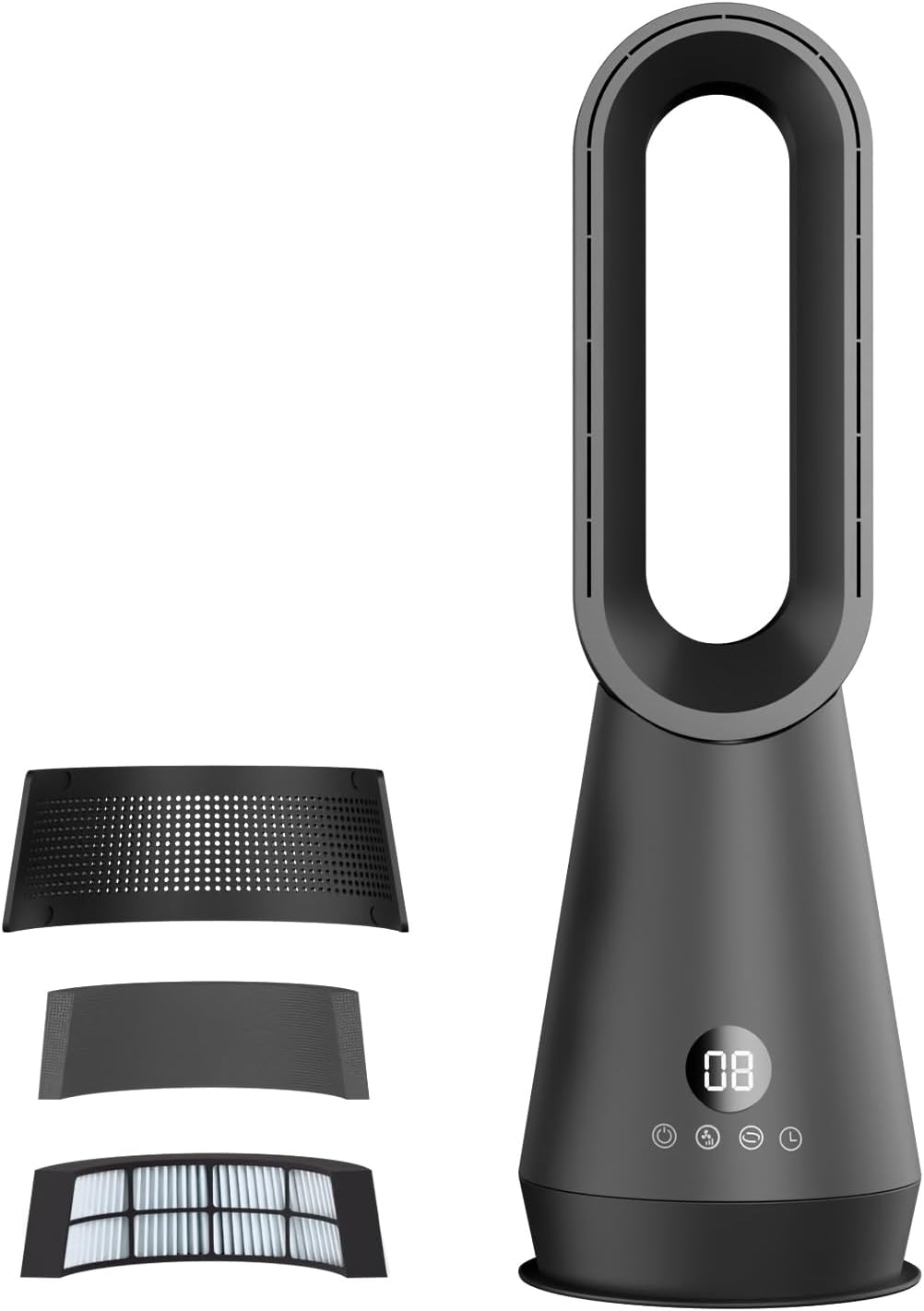
The Chikit CK-019L combines a bladeless tower fan with a dual-filtration purifier to deliver both air movement and basic particle/odor reduction for bedrooms and home offices. It circulates air across a room using 90° wide oscillation and eight speed levels that you control by touch or the included remote, and it offers a whisper-quiet sleep mode with a 9-hour timer and an auto-dimming LED. The purifier uses an H11 filter plus activated carbon in the base, which helps capture dust, pet dander, and light odors while the fan distributes the cleaned air. At under 32 dB on low settings the unit is unobtrusive for sleeping, and the bladeless housing is easy to wipe clean and safer around kids and pets. Important limits are its stated 1300-watt power rating and modest H11 filter level, which positions it for supplemental air cleaning rather than replacing a dedicated HEPA air purifier for allergy or medical needs.
Best for: Buyers who want a practical single appliance that provides steady room cooling plus basic air purification for everyday comfort in bedrooms or home offices.
Less Ideal for: People who need medical-grade allergy or smoke removal should choose a dedicated HEPA purifier instead.
- Two-in-one design pairs a tower fan with an H11 plus activated carbon filter for combined cooling and odor reduction.
- Wide 90° oscillation and 8 speed levels provide even whole-room airflow control.
- Quiet operation below 32 dB makes it suitable for bedrooms and offices.
- Remote and touch controls plus a 9-hour timer add convenient, flexible operation.
- Bladeless housing is easy to clean and safer around children and pets.
- Filter is H11 grade, so it is less effective than true HEPA for fine allergen removal.
- Listed wattage is relatively high which could mean higher energy use on top speeds.
Verdict: Choose this unit if you want a quiet, bladeless tower fan that also provides basic particle and odor filtering for everyday room cooling and comfort.
Crane Desktop Air Purifier Fan EE-5073

| Filter Type | HEPA |
|---|---|
| Floor Area | 250 square_feet |
| Particle Retention Size | 0.3 micron |
| Control Method | Touch |
| Power Source | AC/DC |
The Crane Desktop Air Purifier Fan pairs a three-speed, 90-degree-tilt fan with a HEPA-class filter to deliver both cooling airflow and particle removal for desks, nightstands, and dorm rooms. Users toggle touch/button controls to switch fan speeds while the purifier captures particles down to 0.3 micron, making it useful for dust and common allergens in small rooms. Its compact footprint and quiet operation make it suitable for bedrooms, offices, or study spaces where noise and space are concerns. The unit is powered by AC/DC and has a manual control layout, so you get simple, reliable operation without app setup or complex modes. Limitations include modest coverage—rated for roughly 250 square feet—so it is not intended to replace larger room purifiers, and the basic control scheme means no scheduling or automatic air-quality sensing. The design favors portability and simplicity over advanced features, which fits buyers looking for an affordable, multiuse small appliance that provides both cooling and basic air cleaning.
Best for: Buyers who want an inexpensive, space-saving appliance that provides both a personal cooling fan and basic HEPA filtration for small rooms and surfaces.
Less Ideal for: People who need whole-room air cleaning, advanced automation, or strong HVAC-style airflow should choose a larger, feature-rich purifier instead.
- Combines HEPA-class filtration with a fan for simultaneous cooling and particle removal
- Three fan speeds and 90-degree tilt let you direct airflow where you need it
- Compact, quiet design suits desks, bedside tables, and dorm rooms
- Simple touch/button controls and AC/DC power for straightforward setup and use
- No automatic air-quality sensor or scheduling features
- Coverage and airflow are modest compared with larger purifiers
Verdict: A budget-friendly, compact fan-plus-HEPA purifier that delivers quiet, directed airflow and basic particle filtration for small personal spaces.
Dyson Purifier Hot+Cool HP1

| Filter Type | HEPA H13 with activated carbon |
|---|---|
| Floor Area | 73 square_feet |
| Noise Level | 63 db |
| Control Method | App, Remote |
The Dyson Purifier Hot+Cool HP1 combines whole-room air purification with fan cooling and ceramic heating in a single tower unit. It uses a fully sealed HEPA H13 system plus an activated carbon layer to capture 99.97% of particles down to 0.3 microns and reduce odors and gases, while Air Multiplier technology projects strong, smooth airflow and up to 350° oscillation to move purified air around the room. Built-in sensors feed data to the LCD and the MyDyson app so the machine can run in Auto mode and adjust output as pollution levels change, and the magnetized remote stores neatly on the machine. Night mode and quiet operation make it suitable for bedrooms. The unit is app and voice compatible for remote monitoring and scheduling. Trade-offs are that it is a single-piece tower that requires periodic filter replacements and it is louder at higher fan/heater settings compared with basic standalone fans or heaters.
Best for: Buyers who prioritize dependable, factory-grade filtration and want a single appliance that purifies air while providing fan cooling or supplemental heating and remote monitoring.
Less Ideal for: People who need a very quiet, budget standalone fan or heater or who prefer devices with no ongoing filter maintenance obligations.
- Fully sealed HEPA H13 plus activated carbon for particle and gas capture
- Air Multiplier projection with wide oscillation for whole-room circulation
- App connectivity and remote control for monitoring and scheduling
- Combined purifier, fan, and heater reduces need for separate appliances
- Requires replacement HEPA and carbon filters over time
- Higher noise on maximum fan/heater settings compared with basic fans
Verdict: Choose the HP1 if you want a reliable, fully sealed HEPA purifier that also delivers strong fan airflow and remote control for whole-room cooling and air quality management.
ULTTY Bladeless Tower Fan SKJ-CR021

| Number of Speeds | 9 |
|---|---|
| Noise Level | 30 db |
| Oscillation | 90° |
| Power Source | AC |
| Control Method | Remote, Touch |
The ULTTY SKJ-CR021 is a dual-purpose bladeless tower fan and air purifier designed to circulate air while removing common airborne particles with a replaceable HEPA cartridge. In everyday use it functions like a compact tower fan: choose one of nine speeds, set the 90 degree oscillation and tilt the outlet up to 15 degrees for more precise airflow, or run a timed session up to eight hours via the included remote or the LED touch panel. The integrated HEPA-style filter runs continuously when filtration is active and is intended to be replaced every few months depending on air quality. Practical benefits include a brushless motor for quieter operation—reported noise around 30 dB—an LED night light, and a bladeless housing that is safer and easier to wipe clean than conventional fans. Trade-offs are that real-world filtration performance depends on the filter quality and room size, replacement filters are required maintenance, and the unit is sized for medium rooms rather than whole-home use. For buyers who want cooling plus basic particle filtration in one space-saving appliance, this model is a sensible option.
Best for: Buyers who prioritize a single, compact appliance that provides both a cooling breeze and basic air filtration for bedrooms or home offices and who value quiet, easy operation backed by many user reviews.
Less Ideal for: People needing high-capacity air cleaning for large rooms or those who want a pure HEPA air purifier without integrated fan airflow functionality should consider purpose-built alternatives.
- Combines fan and HEPA-style filtration for simultaneous cooling and particle reduction
- Nine-speed settings plus 90° oscillation and 15° tilt for customizable airflow
- Bladeless design is safer around children and pets and simple to clean
- Quiet brushless motor suitable for night use and bedrooms
- Includes remote control and LED touch panel for easy operation
- Filter cartridges must be replaced periodically, adding ongoing cost
- Intended for medium rooms so it may not deliver strong cooling or purification in large open spaces
Verdict: Choose this model if you want a quiet, space-saving bladeless tower fan that also provides basic HEPA-style filtration for medium rooms.
DREO MC710S Tower Fan

| Power Source | dc |
|---|---|
| Air Flow Capacity | 1558 cfm |
| Number of Speeds | 12 |
| Noise Level | 25 db |
| Motor Type | Brushless DC |
The DREO MC710S is a freestanding tower fan that doubles as an air purifier, using dual motors to separate fan and purification functions so you can run powerful airflow or quiet purification independently. In everyday use it delivers a fast 27 ft/s airflow and customizable oscillation up to 120 degrees to move air across a room, while the true HEPA plus prefilter captures particles down to 0.3 μm for allergy-prone spaces. Controls are flexible: onboard touch, remote, voice assistants, or the DREO app let you set timers, schedules, oscillation range, and monitor room air data remotely. Notable practical benefits include a brushless DC motor for quieter operation (as low as 25 dB) and a sleep mode that dims the display. The dual-motor design boosts coverage without forcing the purifier motor to work constantly, but the unit is relatively large and intended for indoor whole-room use only, and maintenance requires periodic filter replacements. For buyers who prioritize simple, quiet cooling plus built-in HEPA filtration, this model offers a sensible combined solution with smart controls.
Best for: Buyers who want a low-noise, whole-room cooling fan that also provides HEPA-grade particle filtration and easy smart control for daily bedroom or living-room use.
Less Ideal for: People who need a compact or portable personal fan for desks, outdoor use, or those who prefer a simple non-smart unit without app or voice features.
- Dual-motor design separates fan and purifier for flexible performance.
- True HEPA filter with prefilter captures particles down to 0.3 μm.
- Smart controls via app, remote, touch, and voice for convenient scheduling and monitoring.
- Brushless DC motor enables low noise operation (around 25 dB) and efficient power use.
- Large freestanding footprint may be bulky in small rooms.
- Requires periodic replacement filters to maintain purification performance.
Verdict: If you want a quiet, smart tower fan that also cleans the air for whole-room comfort, the DREO MC710S combines powerful airflow with HEPA filtration in one dependable unit.
Choosing the Right Air Purifier with Cooling Fan: Key Factors to Consider
Filtration Technology and CADR
Filtration is the primary reason to buy an air purifier, so the type of filter and its rated clean air delivery rate matter. HEPA-grade filtration removes fine particles like dust, pollen, and many allergens; activated carbon stages address odors and some volatile organics. CADR values give a standardized sense of how quickly a unit can clean a given room. Higher CADR corresponds to faster particle removal but often requires more fan power.
When assessing systems with cooling fans, consider whether the purifier maintains filtration efficiency at higher fan speeds. Some designs reduce filtration effectiveness when airflow is maximized for cooling, while better-engineered units retain filter capture at a variety of speeds.
Fan Power and Air Distribution
A built-in cooling fan should provide meaningful air movement for the room sizes you use most. Look at the unit's airflow in cubic feet per minute or equivalent manufacturer-provided figures and whether the design uses directional outlets or oscillation to spread air. Strong, well-directed flow improves perceived cooling and mixes room air so the purifier clears pollutants evenly.
Consider room layout as well. In open-plan areas, a higher-flow model or oscillating head helps distribute both cooled and cleaned air, while a compact unit can be adequate for small bedrooms if placed strategically.
Noise Performance Across Fan Speeds
Noise is a practical tradeoff between the purifier's cleaning speed and comfort. Cooling fans add another noise source compared with passive purifiers, so review sound ratings at low, medium, and high settings. Nighttime or bedroom use typically requires a near-silent low setting. Some models include a dedicated quiet or sleep mode that limits fan RPM while still running filtration, which is useful for overnight use.
Also note that perceived noise depends on pitch as well as decibel levels. Lower-frequency airflow hums can be less obtrusive than high-pitched rattles even at the same measured SPL.
Energy Use and Fan Efficiency
Running a purifier with an active fan for many hours adds to household energy use, so efficiency matters. Compare wattage at typical operating speeds and whether the unit adjusts fan power automatically based on air quality sensors. More efficient motors and aerodynamic fan blades can deliver higher airflow for less energy.
If you plan to run the device continuously, prioritize models that balance CADR and fan power with modest energy draw to limit operating cost and reduce heat added to the room.
Maintenance, Filter Lifespan, and Replacement Cost
Ongoing maintenance determines the long-term convenience and cost of ownership. Check how accessible filters are, whether they are washable pre-filters, and the expected lifetime of primary filters. Some units use multi-stage cartridges that require periodic replacement of multiple components, while others separate the pre-filter for easier cleaning.
Also review whether the model includes intuitive indicators for filter life or a built-in timer for replacements. Lower replacement frequency and easy access reduce the friction of upkeep and keep filtration operating at peak performance.
Controls, Modes, and Smart Features
User controls affect how you interact with the purifier and integrate it into daily routines. Accessible speed controls, sleep modes, timers, and simple displays make it easier to match filtration and cooling to your schedule. Some models offer auto mode that uses sensors to modulate fan speed, which can optimize both air quality and energy use.
Smart connectivity and app controls are convenient for remote adjustments, but they are not strictly necessary. When present, verify that remote features include meaningful controls for fan and filtration modes rather than only reporting data.
Sizing the Unit to Your Room
Match the purifier's recommended coverage to your actual room square footage for effective performance. Manufacturers typically state coverage based on an assumed air-change-per-hour rate; for perceptible cooling and rapid purification, aim for a unit rated for at least the room size at two air changes per hour.
Placement matters as much as rated coverage. Position the unit away from corners and obstructions to allow unobstructed intake and outlet airflow. Elevating a compact unit a few feet off the floor can improve circulation in rooms with low furniture.
- Place near the area you occupy most for immediate benefit
- Avoid tight enclosures or placing directly against walls
- Use multiple smaller units for irregular floor plans rather than one oversized unit
Balancing Cooling and Filtration Needs
Decide which function is primary for your use case. If you need stronger cooling during hot months, prioritize airflow and fan modes that give wide circulation. If allergy control is the priority, select a unit that preserves filtration efficiency even at higher fan speeds.
Many users benefit from switching modes seasonally: higher fan settings in warm months for comfort, and moderate speeds with steady filtration when airborne allergens are a concern.
- Use high airflow for short-term cooling boosts
- Keep moderate airflow for continuous filtration with tolerable noise
- Use sleep modes overnight to preserve quiet and steady cleaning
Understanding Noise Tradeoffs
Expect noise to rise as fan speed increases. Look for models that provide clear SPL ratings or user reviews that describe sound profile. A model with a low-noise sleep mode can be left running overnight without disturbing sleep.
Also consider the character of the sound. Vibration or tonal whine indicates mechanical issues, while broad-spectrum airflow noise usually becomes backgroundable more easily. Isolation feet and quality casing construction help reduce rattles and resonance.
- Check noise ratings at all speeds, not just the quiet setting
- Prefer units with multiple fan speeds and a dedicated sleep mode
- Read practical notes about sound character as well as decibel numbers
Filter Care and Replacement Logistics
Look for accessible filter panels and straightforward replacement procedures. Units that require tools to swap filters add friction and discourage timely maintenance. Washable pre-filters extend the life of primary filters and reduce waste.
Keep a sense of expected annual running hours in mind. Heavy use will shorten filter life and raise replacement frequency. Confirm whether replacement filters are widely available and whether they use common or proprietary sizes before committing.
- Prefer easily removable panels for filter changes
- Use washable pre-filters to capture larger debris
- Track expected replacement intervals relative to your run hours
Using Auto Modes and Sensors Effectively
Auto mode can simplify operation by increasing fan speed in response to detected particles or odors. Reliable sensors improve convenience, but not all sensor systems are equally responsive. Confirm that auto behavior is documented and can be overridden when you want a specific noise or fan level.
For continuous overnight use, pair auto mode with a sleep setting that retains some responsiveness but keeps sound low. In heavily polluted environments, manual higher speeds are often necessary for rapid cleaning before reverting to automated maintenance.
- Verify sensor responsiveness and whether it triggers fan ramps smoothly
- Ensure auto mode has adjustable thresholds or can be disabled
- Combine auto mode with timers to limit high-speed operation to certain periods
How We Chose the Best Air Purifier with Cooling Fan
We focused on features that directly affect performance and daily use for air purifiers that include an integrated cooling fan. Selection began with models that clearly separate filtration and airflow functions so buyers can assess each independently. We excluded single-function fans or purifiers without distinct filtration specs. The editorial filters prioritized: filtration technology and CADR ratings, fan airflow and distribution, noise levels at multiple speeds, energy use and fan efficiency, and ease and cost of filter maintenance. We also looked at additional useful features such as multi-stage filtration options, fan speed controls, programmable timers, and indicators for filter replacement or air quality. Products that lacked published filtration metrics or omitted fan airflow data were excluded. The final shortlist balances quiet models for night use, higher-airflow units for larger rooms, and compact options for small spaces. The criteria emphasize measurable specs that matter to daily performance rather than subjective design elements.
Our full evaluation process is outlined in our review methodology.
FAQ
Can an air purifier with a cooling fan actually lower room temperature?
A built-in fan helps increase air movement and can lower perceived temperature by improving airflow across your skin. However, it does not remove heat like an air conditioner. Expect improved comfort through circulation rather than substantial drops in ambient temperature.
Will running the fan reduce the purifier's filtration effectiveness?
Not necessarily. Higher fan speeds increase airflow through the filter and can improve particle capture per minute, but some units may sacrifice capture efficiency at extreme speeds. Choose models that document consistent filtration performance across multiple fan settings.
How often should I replace filters in a unit I run continuously?
Replacement intervals depend on run hours and local pollution levels, but many primary filters last several months to a year under typical continuous use. Use the unit's indicator if available and inspect pre-filters monthly for cleaning to prolong main filter life.
Are auto modes reliable for managing both air quality and cooling needs?
Auto modes are useful for balancing both functions, especially when sensors accurately represent particle and odor levels. They are not perfect, so check that auto settings allow manual override if you need immediate cooling or quieter operation.
Is it better to buy one large unit or several smaller units for an open-plan area?
Several smaller units placed in key locations often provide more even air cleaning and distributed airflow than a single oversized unit, particularly in irregular layouts. For centralized cooling-like circulation, a single high-airflow model with oscillation can suffice if positioned centrally.
Final Verdict
When choosing an air purifier with a cooling fan, prioritize measurable filtration performance and the fan characteristics that match your use case. Balance CADR and filter type against fan airflow and noise so you do not sacrifice clean air for a stronger breeze. Consider maintenance demands and energy use for continuous operation. Decide whether cooling or filtration is your main goal, then select a unit sized for your room with the right mix of modes and accessible filters. That approach will give you both better air quality and improved comfort without unnecessary tradeoffs.