
Note: This article contains affiliate links. If you click on these links and make a purchase, we may earn a small commission at no extra cost to you. This helps support our research and content. Read our full affiliate disclosure here.
Choosing an affordable air quality monitor matters because indoor pollution levels change quickly and subtle differences can affect health and comfort. If you need straightforward, trustworthy measurements without expensive extras, a budget-focused monitor can still deliver the core data that helps you act — whether that means changing ventilation, running an air cleaner, or adjusting activities. This guide shortlists seven top options for monitoring indoor air on a budget. We evaluated ease of setup, sensor accuracy, and ongoing costs so you can pick a monitor that fits small spaces and daily routines. Read on to see which features matter most and which tradeoffs are reasonable for cost-conscious buyers.
Top Picks at a Glance
| Best Overall The best all-around choice for most situations | LifeBasis Air Quality Monitor LSAM003 |  |
| Best Quality Built to a higher standard if you want something more solid | Temtop M10+ CO2 & AQ Monitor |  |
| Best Value The sweet spot between price and what you get | YNAK 16-in-1 Air Quality Monitor AK22A |  |
| Best Budget The cheapest option that still gets the job done reliably | Dienmern DM145F Air Quality Monitor |  |
| Top Rated A top-rated pick with lots of positive feedback | Temtop S1 Air Quality Monitor | 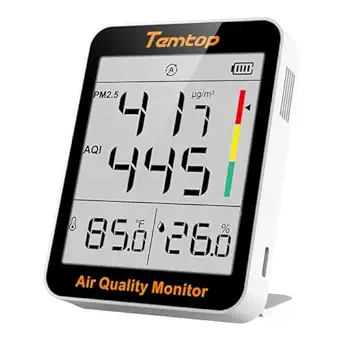 |
| Most Popular A crowd favorite that many people choose with confidence | Amazon Smart Air Quality Monitor |  |
| Best Seller A high-volume bestseller chosen again and again | GoveeLife Smart Air Quality Monitor H5106 |  |
LifeBasis Air Quality Monitor LSAM003

| Battery | 2500mAh |
|---|---|
| Charging | Type-C |
| Sensors | NDIR CO2, laser particle, semiconductor, photoelectric |
| Measured metrics | AQI, PM1.0/2.5/10, CO2, TVOC, HCHO, temperature, humidity |
This compact LifeBasis monitor continuously measures 11 indoor air metrics and displays them on a color LCD with both visual and audible alerts. It uses an NDIR CO2 sensor, laser particle sensor and other sensors to report AQI, PM1.0/2.5/10, total particles, TVOC, formaldehyde, temperature and humidity in real time, making it useful for checking air quality in living rooms, bedrooms or home offices. The colored icons simplify readings at a glance and the device beeps and flashes when levels exceed normal ranges, which helps spot problem sources quickly. A 2500mAh battery and Type-C charging make it portable for spot checks; the manufacturer rates about 11 to 12 hours of continuous use per charge. Practical limits include short runtime compared with plugged-in tabletop monitors and the usual consumer-meter accuracy ceiling versus lab instruments, so use it for routine home monitoring rather than certification. The clear display, multiple sensors and alarms deliver good everyday value for a budget-focused buyer who wants broad coverage of common indoor pollutants.
Best for: Buyers who want a single, easy-to-read device to track common indoor pollutants and respond quickly to poor conditions in living spaces without spending on professional gear.
Less Ideal for: People who need continuous, guaranteed-accurate data for certifications or scientific testing should choose a calibrated professional monitor instead.
- Measures a wide range of pollutants (AQI, PM1.0/2.5/10, CO2, TVOC, HCHO) for comprehensive indoor checks
- Color-coded LCD and audible alerts make unsafe readings easy to spot at a glance
- Uses NDIR CO2 and laser particle sensors for faster, more reliable response than basic sensors
- Portable with a 2500mAh battery and Type-C charging for spot checks around the home
- Battery life is limited to roughly half a day of continuous use, so frequent recharging or keeping it plugged in is needed for long-term monitoring
- Consumer-grade sensor accuracy can vary versus laboratory instruments, so results are best used for trends and alerts rather than formal testing
Verdict: A budget-friendly, portable monitor that gives broad, easy-to-read coverage of common indoor pollutants for everyday home use.
Temtop M10+ CO2 & AQ Monitor

| Measures | CO2, PM2.5, TVOC, AQI, Temperature, Humidity |
|---|---|
| Display | E-Ink |
| Power Source | Battery Powered |
| Connectivity | Bluetooth |
| Alarm | Audible |
The Temtop M10+ is a compact, battery-powered indoor air quality monitor intended for home and small office use. It continuously measures CO2, PM2.5, TVOC (as an index), AQI, temperature, and humidity and shows results on a low-power E-Ink screen that helps the device reach up to 60 days of battery life. You can pair it with the Temtop smartphone app to view historical trends, export data, calibrate the unit, and receive firmware updates. The audible alarm and adjustable thresholds make it useful for monitoring ventilation and spotting pollution events from cooking, cleaning, or poor airflow. Expect practical, consumer-grade readings best suited for trend spotting rather than lab-accurate concentrations; the TVOC output is an index rather than absolute mg/m3 and CO and radon are not measured. Bluetooth limits remote access compared with Wi-Fi models, but the M10+ trades that for simpler setup and long battery life.
Best for: Buyers who prioritize reliable multi-parameter trend tracking and long battery life for home or bedroom monitoring and who want app access for data logging and calibration.
Less Ideal for: Users who need lab-grade quantitative readings, CO or radon detection, or always-on remote monitoring via Wi-Fi should consider other models.
- Measures six common indoor metrics in one compact unit
- E-Ink display and efficient algorithm deliver very long battery life
- Companion app for trend viewing, calibration, data export, and OTA updates
- Adjustable audible alarm and clear visual readout make problem detection easy
- TVOC reported as an index not absolute concentration
- Does not measure carbon monoxide or radon
Verdict: A budget-friendly, battery-efficient multi-sensor monitor that delivers practical trend data and long runtime for performance-minded home users.
YNAK 16-in-1 Air Quality Monitor AK22A

| Detectable parameters | CO2, PM2.5, PM1.0, PM10, HCHO, TVOC, Temperature, Humidity, AQI |
|---|---|
| Display | 7-inch LED with three brightness settings |
| Alerts | 7 AQI alert buzzers with mute button |
| Power | USB-C charging adapter included |
This YNAK AK22A air quality monitor is a budget-friendly countertop device that tracks CO2, PM2.5, PM1.0, PM10, HCHO, TVOC, temperature, humidity, and overall AQI and presents the data on a large 7-inch display. It is typically used in living rooms, bedrooms, or home offices to spot changes in air quality and trigger its seven distinct alert buzzers when thresholds are exceeded. The unit ships with a USB-C cable and charging adapter and offers three brightness settings and a mute button for the alerts, which makes it easy to tailor for daytime or sleeping conditions. Its seller claims high-precision external sensors and realtime sampling, so you get rapid updates rather than slow averaged readings. On the downside, the listing does not provide detailed calibration or sensor lifespan information and budget monitors like this can drift over long-term use compared with lab-grade instruments. For everyday home use during wildfire season or to monitor indoor ventilation, it gives clear immediate feedback without a steep price or complicated setup.
Best for: Buyers who want an affordable, easy-to-read device to monitor household air and get fast alerts when conditions worsen, especially during wildfire season or when checking ventilation.
Less Ideal for: Users needing laboratory-grade accuracy, professional certification, or who require documented calibration and long-term sensor traceability.
- Large 7-inch display with three brightness settings for easy at-a-glance readings
- Monitors nine key parameters including CO2 and multiple PM sizes for broad coverage
- Seven configurable AQI alert buzzers with a mute option for timely notifications
- Includes USB-C charging adapter and cable for simple power and placement
- No detailed calibration procedure or long-term accuracy data provided
- Budget sensor platforms can drift over time compared with professional-grade meters
Verdict: A practical, budget-friendly monitor that gives clear, real-time readings and audible alerts to help homeowners quickly spot and respond to indoor air quality problems.
Dienmern DM145F Air Quality Monitor

| Sensors | CO2, AQI, HCHO, TVOC, temperature, humidity |
|---|---|
| Battery | 1600mAh rechargeable |
| Runtime | Up to 72 hours continuous use |
| Display | Large HD screen |
The Dienmern DM145F is a compact, budget-focused air quality monitor that gives a broad snapshot of indoor conditions. It continuously displays CO2, AQI, temperature, humidity, formaldehyde (HCHO) and TVOC readings on a large HD screen so you can glance at multiple values at once. Built-in high-precision sensors claim fast detection and the 1600mAh rechargeable battery supports up to about 72 hours of portable use between USB charges, making it easy to move between rooms, offices, and travel. For everyday home use it helps flag stuffy rooms, VOC spikes, or elevated formaldehyde levels so you can ventilate or investigate sources. The unit is straightforward to read but does not include app connectivity, data logging, or advanced calibration features, so it is best for spot checks and short-term monitoring rather than professional testing or long-term trend analysis. Given its feature set and runtime, it is a practical entry-level monitor if you want multi-parameter awareness without a large investment.
Best for: Buyers who want an affordable, straightforward way to monitor several indoor air metrics at home, in classrooms, or while traveling and prioritize easy-to-read, portable hardware over advanced connectivity.
Less Ideal for: Users who need professional-grade accuracy, continuous long-term logging, or remote monitoring and alerts should consider higher-end models with app support and calibration options.
- Measures multiple important indoor pollutants and conditions on one device (CO2, AQI, HCHO, TVOC, temperature, humidity).
- Large HD screen makes several readings easy to scan at a glance.
- 1600mAh rechargeable battery with up to 72 hours runtime enables portable use without constant charging.
- No mobile app, cloud sync, or detailed data logging for trend analysis.
- Not intended for professional-grade calibration or laboratory accuracy verification.
Verdict: An inexpensive, portable multi-parameter monitor that gives quick, actionable indoor air readings for budget-conscious users who need simple spot checks.
Temtop S1 Air Quality Monitor

| PM2.5 measuring range | 0-999 µg/m³ |
|---|---|
| Battery life | ≥20 days (Smart) ≥60 days (Eco) |
| Temperature accuracy | ±0.9°F |
| Humidity accuracy | ±5% RH |
| Display | 3.3-inch segment screen |
The Temtop S1 is a simple, battery-powered indoor air quality monitor that displays PM2.5, AQI, temperature and humidity on a small segment screen. It is designed for grab-and-go use around the house, nursery or office and can sit, stand or magnetically attach to surfaces. The S1 uses a laser particle sensor for PM2.5 readings plus a digital temperature/humidity sensor, and its two-button interface and three-color alert indicator make status easy to read at a glance. Where it shines is battery life: an Eco mode stretches standby up to 60 days so you can leave it running for extended monitoring without frequent charging. Practical limitations are its basic display and controls, which lack graphing, historical logs or app connectivity, and it does not measure CO2 or VOCs, so it is best for straightforward particulate and comfort checks rather than comprehensive indoor air diagnostics. For buyers who want a low-cost, reliable PM2.5/AQI and thermo-hygrometer that runs for weeks on a charge, the S1 is a pragmatic choice.
Best for: Buyers who prioritize straightforward, dependable particulate and comfort monitoring on a tight budget and want a low-maintenance device they can move between rooms.
Less Ideal for: Users seeking a full-featured indoor air station with CO2/VOC sensing, app connectivity, or long-term data logging should look at more advanced models.
- Laser particle sensor for PM2.5 and AQI gives fast, on-the-spot readings
- Long battery life with up to 60 days in Eco mode for low maintenance monitoring
- Compact, portable design with stand or magnetic attachment options
- Simple two-button interface and three-color alert make readings easy to interpret
- No app, Wi‑Fi, or data logging for historical trends or remote alerts
- Does not measure CO2, VOCs, or formaldehyde, limiting comprehensive indoor air assessment
Verdict: A reliable, no-frills monitor for accurate PM2.5, AQI and comfort readings with exceptional battery life for budget-conscious buyers.
Amazon Smart Air Quality Monitor

| Measured pollutants | PM2.5, VOCs, CO |
|---|---|
| Additional sensors | Humidity and temperature |
| Connectivity | Alexa app integration |
| Power | Plug-in only |
The Amazon Smart Air Quality Monitor is a compact plug-and-play sensor that tracks five indoor air metrics: particulate matter (PM2.5), volatile organic compounds (VOCs), carbon monoxide (CO), humidity, and temperature. You set it up by plugging it in and pairing with the Alexa app, where it shows an easy-to-read air quality score and provides color-coded LED feedback on the device itself. It can push real-time alerts to your phone and announce issues on Echo devices, and you can create Routines to automatically trigger compatible purifiers, dehumidifiers, or fans. The device is most useful as a room-level indicator and a smart-home trigger rather than a laboratory-grade meter; its strength is seamless Alexa integration and straightforward notifications. Limitations include no battery operation and reliance on the Alexa ecosystem for full functionality, so users who want fully standalone logging or cross-platform support may need a different monitor.
Best for: Buyers who prioritize easy smart-home integration and quick, shareable alerts about indoor air quality and who value clear social proof from ecosystem-connected devices.
Less Ideal for: Users who need standalone data logging, cross-platform compatibility, or professional-grade air-quality measurements should consider specialized monitors instead.
- Monitors five key indoor air metrics including PM2.5, VOCs, CO, humidity, and temperature.
- Simple plug-and-play setup with Alexa app integration and color-coded LED status on the device.
- Real-time alerts to phone and optional announcements on Echo devices for quick notification.
- Can automate other smart devices via Alexa Routines to respond automatically to air changes.
- Requires Alexa app and ecosystem for full feature set and notifications.
- Not intended as a professional-grade measurement device for detailed logs or calibration.
Verdict: If you want an affordable, Alexa-ready room sensor that gives clear alerts and automations for everyday indoor air quality, this is a practical choice.
GoveeLife Smart Air Quality Monitor H5106

| PM2.5 accuracy | ±15 µg/m³ (0–100 µg/m³) | ±15% (100–1000 µg/m³) |
|---|---|
| Temperature accuracy | ±0.54°F |
| Humidity accuracy | ±3% |
| Response time | 2 seconds |
| Connectivity | 2.4G Wi‑Fi, Bluetooth |
The GoveeLife H5106 is a plug‑in air quality monitor designed for home or office use that continuously tracks PM2.5, temperature, and humidity and displays readings on an LED panel. It refreshes data every two seconds for near real‑time awareness and stores up to two years of data in the app for trend review and export. The unit connects over 2.4 GHz Wi‑Fi or Bluetooth so you can check readings remotely and link the monitor to other GoveeLife devices to trigger purifiers, humidifiers, or fans automatically. The display lets you toggle clock, PM2.5, and brightness modes, and the LED ring provides a quick at‑a‑glance air quality level. Accuracy specs are reasonable for a budget monitor (PM2.5 ±15 µg/m3, temp ±0.54°F, humidity ±3%), but the sensor requires a clear intake and a constant power connection since there is no battery. If you want simple, continuous indoor monitoring with app logging and smart‑device automation on a budget, this is a practical choice; expect modest consumer‑grade accuracy rather than lab‑grade readings.
Best for: Buyers who want a low‑cost, always‑on indoor monitor that logs long‑term data and can automate other smart home air devices without requiring technical setup.
Less Ideal for: Users who need battery operation for portable or temporary monitoring or who require laboratory‑grade particulate measurements for professional assessments.
- Fast 2‑second refresh shows near real‑time changes in PM2.5, temperature, and humidity.
- Wi‑Fi and Bluetooth connectivity with app logging and two years of exportable data.
- LED display with quick mode switching and color indicator for easy at‑a‑glance status.
- Integrates with GoveeLife smart appliances to automate purifiers, humidifiers, and fans.
- Requires constant power via Type‑C cable because it has no internal battery.
- PM2.5 accuracy is consumer‑grade (±15 µg/m3) and may not match professional monitors.
Verdict: A budget friendly wired monitor that gives fast, app‑logged PM2.5, temperature, and humidity readings and can automate other GoveeLife devices.
Choosing the Right Air Quality Monitor on a Budget: Key Factors to Consider
Sensor Types and What They Measure
Different low-cost monitors use different sensors for particulate matter, volatile organic compounds, carbon dioxide, and formaldehyde. PM2.5 sensors estimate fine particles that penetrate deep into the lungs, while VOC sensors track a range of gaseous compounds from cleaning products, paints, and cooking. Knowing which pollutants matter for your household helps you choose a monitor that reports the right metrics.
Budget units may omit some sensors or use lower-cost sensor modules that trade off precision for affordability. That means readings are best used for spotting trends and spikes rather than delivering laboratory-grade concentrations. Still, consistent relative readings allow you to compare interventions like opening windows or running an air cleaner.
Accuracy Versus Trend Detection
On a budget, you should weigh absolute accuracy against the monitor's ability to reliably detect changes. Many affordable sensors can drift or be biased in absolute numbers, but they still indicate whether air quality is improving or worsening after an action.
If you need exact concentration values for medical or regulatory reasons, a low-cost consumer monitor may not suffice. For everyday residential use, prioritize devices with documented stability and calibration options that let you confirm trends over time.
Display, Alerts, and User Interface
A clear on-device display and straightforward alerts make a budget monitor genuinely useful. Look for devices that present readable numeric values and color-coded indicators so you can interpret results at a glance. Simple audible or visual alerts for rising PM or CO2 levels prevent you from needing to constantly check an app.
Companion apps are helpful but not mandatory. If you rely on the app, check that it provides historical charts, exportable logs, and easy firmware updates. Poorly designed software can negate the convenience of an otherwise capable device.
Power, Placement, and Portability
Power requirements affect where you can place the monitor. Battery-powered units offer portability for moving between rooms, while plug-in monitors often provide continuous sampling without recharge interruptions. Consider how often you will move the unit and whether you need overnight unattended monitoring.
Also think about placement rules. Monitors should sit away from direct cooking smoke, heating vents, and windows to avoid skewed short-term spikes, but close enough to living areas to reflect the air people breathe.
Maintenance and Long-Term Costs
Budget monitors are inexpensive up front, but some require filter replacements or periodic calibration that add ongoing costs. Check whether the manufacturer recommends calibration intervals or sells replaceable sensor modules. Simpler devices that need minimal maintenance usually cost less over time and reduce the chance of inaccurate readings due to neglected upkeep.
Consider whether replacement parts are readily available and whether the unit supports user calibration or only professional servicing. Low-maintenance designs are often better for buyers who want a 'set it and forget it' device.
Which Pollutants Matter Most in Homes?
Most home monitoring focuses on a few common pollutants: fine particulate matter (PM2.5), carbon dioxide as a proxy for ventilation, and volatile organic compounds produced by household products. PM2.5 comes from combustion sources such as cooking and candles, while VOCs come from paints, cleaners, and new furniture. CO2 itself is not toxic at typical indoor concentrations but is useful for judging how well a space is ventilated.
- PM2.5: Indicates combustion and infiltration from outside traffic.
- VOCs: Useful for tracking chemical sources and odors.
- CO2: Practical proxy for ventilation and occupancy.
Where to Place a Budget Monitor for Accurate Readings
Placement affects usefulness. Put the monitor in a central living area at breathing height rather than tucked on a high shelf or directly next to a window. Avoid direct sources like cooktops and smoking areas unless you specifically want to measure those events. For bedrooms, place the unit on a bedside table or dresser away from curtains and vents to capture the air you actually inhale during sleep.
- Keep 1 to 2 feet of clearance around the device.
- Avoid direct drafts, heat sources, and open windows.
- If tracking bedroom air, run overnight tests to capture sleep-period exposure.
Interpreting Readings and Responding Effectively
Numbers alone are not actions. Use trends and short-term spikes to decide whether to ventilate, run an air cleaner, or alter activities. A sudden PM2.5 spike during cooking is expected and can be reduced with local exhaust. Persistently elevated readings indicate a ventilation or filtration issue that may require longer-term solutions. Set practical thresholds for alerts based on health needs. For example, lower thresholds are appropriate for households with children, elderly residents, or those with respiratory conditions. Treat VOC spikes as prompts to identify sources and increase ventilation rather than as emergencies in most cases.
- Short spikes: Use targeted ventilation or source control.
- Sustained elevation: Consider filtration upgrades or ventilation changes.
- CO2 rises: Increase fresh air or reduce occupancy.
Using Data to Improve Indoor Air Over Time
A budget monitor can help you evaluate the effectiveness of interventions. Track baseline conditions for several days, then introduce changes like using a range hood or a portable air cleaner and compare the logged results. Over time, this empirical approach helps you prioritize improvements that give the largest air-quality gains for your household. Exportable logs or simple screenshots let you document improvements and share findings with household members so everyone understands the impact of small behavioral changes.
- Record baseline conditions for at least a week.
- Change one variable at a time to measure impact.
- Use exported data to compare long-term trends.
How We Chose the Best Air Quality Monitor on a Budget
We focused on affordable units that deliver reliable, actionable indoor air data without costly extras. Our selection filters started with models sized for typical rooms and limited to devices priced for budget-minded buyers. We then narrowed the list by key performance dimensions buyers care about: sensor fidelity for particulate matter and VOCs, clarity of the user interface, battery life or power needs, and the typical upkeep required for accurate readings. Evaluation criteria we applied include sensor accuracy over common concentration ranges, responsiveness to changes in air quality, the clarity and usability of on-device displays and companion apps, and the frequency and cost of consumables or maintenance. We also prioritized devices with straightforward setup and stable wireless connectivity. We excluded specialty or industrial-grade instruments, multi-thousand-dollar lab equipment, and units that rely on non-replaceable proprietary consumables that create hidden long-term costs. The result is a curated list of compact, economical monitors that balance initial cost with real-world usability and ongoing reliability. Each pick meets minimum standards for measurement scope and user experience appropriate for home environments.
Our full evaluation process is outlined in our review methodology.
FAQ
Can a cheap air quality monitor keep me safe from dangerous gases?
Affordable consumer monitors typically focus on PM, VOCs, and sometimes CO2. They are not substitutes for dedicated safety detectors for carbon monoxide or natural gas. If you need protection from toxic or flammable gases, use certified alarms designed for those hazards.
How accurate are low-cost PM sensors compared with lab equipment?
Low-cost PM sensors can reliably show trends and relative changes but often have measurement bias compared with lab-grade instruments. They perform well for detecting spikes and assessing interventions but are less reliable for precise, regulation-level concentration values.
Do I need to calibrate a budget air quality monitor?
Some units include a simple self-calibration routine or recommend periodic checks. Calibration helps maintain accuracy, but many consumer monitors are designed to be useful without complex servicing. Follow the manufacturer's recommended procedure for best results.
Will temperature and humidity affect readings?
Yes. Temperature and humidity can influence some sensor types, especially particulate readings at very high humidity. Many monitors compensate for environmental conditions, but placing the device in extremes of heat or moisture can still skew results.
Can a single monitor represent an entire house?
A single monitor gives a snapshot of one zone. For multi-room homes, monitor the rooms where occupants spend the most time or move the device between rooms to survey conditions. For continuous whole-house data, consider several monitors or focus on ventilation improvements.
Final Verdict
When shopping for an air quality monitor on a budget, prioritize sensors that measure the pollutants you care about, ease of use, and low ongoing maintenance. Expect tradeoffs between absolute accuracy and cost, and use readings mainly to detect trends and trigger practical actions like ventilation and filtration. Pick a unit with a clear display or reliable app, and place it where it represents breathing zones. For most households, a budget monitor that is stable and easy to operate provides the best balance of information and affordability, helping you make meaningful improvements to indoor air without unnecessary complexity.