
Note: This article contains affiliate links. If you click on these links and make a purchase, we may earn a small commission at no extra cost to you. This helps support our research and content. Read our full affiliate disclosure here.
Choosing the right manual coffee grinder matters because grind consistency and ease of use directly affect extraction and the taste of your coffee. Whether you brew with a French press, pour-over dripper, Aeropress, or an espresso-style setup, a well-designed all-purpose manual grinder gives you control over particle size without depending on electricity. This guide covers seven shortlisted manual coffee grinders that suit a broad range of brewing methods. We evaluated each pick for grind consistency, build quality, and everyday usability. Read on to find a grinder that fits your brewing habits and lifestyle, with practical notes on what to expect from each option.
Top Picks at a Glance
| Best Overall The best all-around choice for most situations | TIMEMORE C5 Pro Manual Coffee Grinder |  |
| Best Quality Built to a higher standard if you want something more solid | 1Zpresso K-Ultra Manual Grinder |  |
| Best Value The sweet spot between price and what you get | Hario Ceramic Coffee Mill MSS-1B |  |
| Best Budget The cheapest option that still gets the job done reliably | PARACITY Manual Coffee Grinder |  |
| Top Rated A top-rated pick with lots of positive feedback | TIMEMORE Chestnut C3S Pro |  |
| Most Popular A crowd favorite that many people choose with confidence | JavaPresse Manual Coffee Grinder |  |
| Best Seller A high-volume bestseller chosen again and again | CEVING Manual Coffee Grinder MCG-02 | 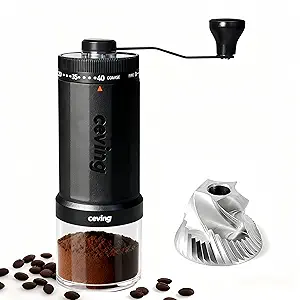 |
TIMEMORE C5 Pro Manual Coffee Grinder

| Capacity | 30 g |
|---|---|
| Burr material | Stainless steel |
| Burr size | 42 mm |
| Adjustment levels | Approx 48 levels |
The TIMEMORE C5 Pro is a precision-focused hand grinder built for daily use and travel. It grinds with a 42 mm CNC stainless steel conical burr and a double-bearing central axis that produces consistent particle size for pour over, French press, and finer settings. The adjustment ring offers roughly 48 click-stop levels with a fine 0.031 mm pitch so you can dial in repeatable coarseness, and the enlarged one-piece metal body feels sturdy while staying compact. A built-in bearing and smooth folding handle reduce wrist effort, making longer grinds easier despite being manual. The 30 g capacity suits single to small-batch doses and the included brush makes cleaning straightforward. Expect slightly slower throughput than large electric grinders and you will need some hand strength for larger doses, but for someone who values control, portability, and build quality the C5 Pro delivers precise, uniform grinds across common brew methods.
Best for: Buyers who want a durable, travel-capable grinder that gives precise, repeatable control over grind size for a range of brew methods and who value build quality over speed.
Less Ideal for: People who need to grind large daily volumes quickly or who prefer push-button convenience from an electric grinder.
- 42 mm CNC stainless steel conical burr for consistent particle size
- Fine 48-step adjustment with 0.031 mm pitch for precise grind dialing
- All-metal one-piece body and double-bearing axis for durable, stable grinding
- Folding handle and compact form make it travel- and storage-friendly
- 30 g capacity requires multiple batches for larger servings
- Manual operation is slower than electric grinders for high-volume use
Verdict: Choose the C5 Pro if you want a well-built, highly adjustable manual grinder that balances precision and portability for everyday brewing and travel.
1Zpresso K-Ultra Manual Grinder

| Burr material | Stainless steel |
|---|---|
| Burr size | 48mm |
| Adjustment | External dial, ~20 microns per click |
| Catch cup capacity | 35–40 g |
| Power source | Manual |
The 1Zpresso K-Ultra is a performance-focused hand grinder built to deliver consistent grounds across brew methods from espresso to pour-over. It uses a 48mm stainless steel conical burr and an external adjustment dial with over 100 clicks at roughly 20 microns per click, which makes dialing in fine espresso to coarser filter grinds straightforward. The magnetic catch cup holds about 35–40 g of grounds and snaps on for a faster workflow, while the foldable crank and compact aluminum body make it easy to stash in a travel case. The grinder disassembles without tools for cleaning and maintenance, and the manufacturer rates the burrs for long-term stability. Expect fast, controlled hand grinding suitable for home baristas who value repeatable results and a tactile adjustment system; be aware manual grinding requires physical effort and is slower than electric alternatives, especially at very fine espresso settings.
Best for: Home brewers who prioritize grind precision and consistency across espresso and filter methods and are willing to hand-grind for better control and portability.
Less Ideal for: People who need rapid, hands-free grinding for daily high-volume use or who prefer the convenience of electric grinders.
- Large 48mm stainless steel conical burr for consistent, even grounds across brew methods
- External adjustment dial with 100+ clicks for precise, repeatable grind settings
- Magnetic catch cup that holds 35–40 g and speeds up dosing
- Tool-free disassembly and included cleaning brush make maintenance easy
- Foldable handle and travel case improve portability and storage
- Manual operation is slower and requires physical effort compared with electric grinders
- Higher upfront cost than many basic hand grinders
Verdict: Choose the K-Ultra for repeatable, high-precision manual grinding when you want café-level control and portability in one robust hand grinder.
Hario Ceramic Coffee Mill MSS-1B

| Material Type | Ceramic |
|---|---|
| Power Source | Manual |
| Capacity | 2 cups |
The Hario Ceramic Coffee Mill is a compact hand grinder built around a ceramic milling mechanism that resists rust and reduces heat transfer during grinding. You use it by loading beans into the top hopper, turning the removable handle, and adjusting grind size with the knob for anything from coarse to finer brews; the clear grounds container makes it easy to monitor yield. Its slim profile and the ability to store the unit without the handle make it a space-saving option for kitchens or travel. Ceramic internals deliver steady, consistent grinds and are easy to clean when disassembled, though the two-cup capacity and manual operation mean it is best for single-serve or small household use rather than large batches. Expect modest grinding speed compared with electric models and more effort for very fine settings, but for someone who values a dependable, low-maintenance manual grinder the Hario delivers reliable results and durability.
Best for: Buyers who want a reliable, low-maintenance manual grinder for single cups or small household use and who prioritize compact storage and consistent grind quality.
Less Ideal for: People who routinely grind large quantities, need very high-speed grinding, or prefer hands-off electric operation should choose a larger or powered grinder instead.
- Ceramic mill resists rust and helps keep grounds cool for more consistent flavor
- Slim, removable-handle design stores easily in small kitchens or travel bags
- Transparent grounds container lets you see and measure output
- Simple disassembly makes cleaning straightforward
- Small two-cup capacity limits usefulness for brewing for larger groups
- Manual operation is slower and requires physical effort compared with electric grinders
Verdict: A compact, durable manual grinder that delivers consistent small-batch results for buyers who value space-saving design and low-maintenance performance.
PARACITY Manual Coffee Grinder

| Capacity | 1.4 pounds |
|---|---|
| Material Type | Stainless Steel |
| Power Source | Manual |
| Included jars | 2 glass jars |
This PARACITY manual coffee grinder is a budget-friendly hand mill built for everyday use and travel. It uses a ceramic burr to deliver a more uniform grind while minimizing heat buildup, and an adjustable control lets you shift from coarse for French press to fine for espresso or Turkish brews. The long stainless steel crank reduces effort during grinding and the nonslip silicone base helps keep the unit steady. Two clear glass jars are included so you can store beans or ground coffee directly, and the parts disassemble for straightforward cleaning. Because it is manual, grinding takes longer than an electric grinder and requires some physical effort for larger batches, but that also means quiet operation and no power needed. The glass components make it attractive and easy to monitor grind volume but add fragility for frequent travel. For everyday single-cup grinding or occasional use across brew styles, it delivers solid performance at a low price point.
Best for: Buyers looking for an inexpensive, no-power grinder to dial in different grind sizes for home or travel and who prioritize value over speed.
Less Ideal for: People who need fast, large-batch grinding or a travel-tough grinder that can withstand frequent drops should consider an electric or all-metal alternative.
- Ceramic burr provides consistent, low-heat grinding across grind settings
- Adjustable grind control supports multiple brew methods from French press to espresso
- Included glass jars let you grind directly into storage and monitor volume
- Long stainless steel crank reduces effort and improves leverage
- Glass jars increase fragility compared with all-metal or plastic alternatives
- Manual operation is slower and requires physical effort for larger quantities
Verdict: A low-cost, adjustable ceramic-burr hand grinder that gives versatile, good-quality grinds for single-cup and occasional use without needing power.
TIMEMORE Chestnut C3S Pro

| Capacity | 25 g |
|---|---|
| Power Source | manual |
| Item Weight | 430 g |
| Brand Name | TIMEMORE |
The TIMEMORE Chestnut C3S Pro is a durable, all-metal manual grinder designed for consistent, portable grinding. Its aluminum-alloy integrated body and metal top cover reduce the risk of cracking and improve longevity, while the upgraded S2C conical steel burrs and double-bearing central axis aim for even particle distribution and efficient cutting. A foldable crank handle and compact profile make it easy to pack for travel or store in a small kitchen, and the built-in bearing smooths the rotation so you can grind with less effort. Grind size is stepless with roughly 36 adjustment levels, letting you dial in settings from espresso-adjacent fine to coarse for French press. The 25 g capacity makes it best suited to single-serve or small-batch use, and the mostly metal construction keeps cleanup straightforward compared with mixed-material designs. Expect slightly slower throughput than electric grinders and slightly more effort for larger batches, but for buyers prioritizing reliability, precise manual adjustment, and an all-metal build, this grinder delivers consistent, long-lasting performance.
Best for: Buyers who value a durable, factory-quality manual grinder that gives precise, repeatable grind adjustment for single-serve or small-batch brewing and who prefer a long-lasting metal build over minimal weight.
Less Ideal for: People who need to grind large volumes quickly, those who prefer the speed and convenience of electric grinders, or buyers wanting larger-capacity grinders for group brewing.
- Full-metal aluminum-alloy body and metal top reduce risk of cracking and improve durability
- S2C conical steel burrs designed for consistent cuts and minimal overly fine particles
- Double-bearing central axis and built-in bearing deliver smoother, less tiring grinding
- Foldable crank handle and compact form make it highly portable and easy to store
- 25 g capacity limits usefulness for brewing for larger groups
- Manual operation is slower and requires effort compared with electric grinders
Verdict: Choose this all-metal Chestnut C3S Pro if you want a reliable, travel-friendly manual grinder built for consistent, long-term performance.
JavaPresse Manual Coffee Grinder

| Material Type | Stainless Steel |
|---|---|
| Power Source | Manual |
| Included Components | Grinder |
The JavaPresse Manual Coffee Grinder is a hand-crank conical burr grinder designed for travelers and home brewers who want control over grind size without electricity. It uses a ceramic conical burr and an 18-setting adjustable dial so you can dial in grind sizes from fine for espresso to coarse for French press, and the manual crank keeps noise very low compared with electric grinders. The stainless steel body feels durable and compact enough to slip into a bag for camping or commuting, and the removable parts make it easy to clean by hand. Practical benefits include consistent, repeatable grinds for better extraction and zero reliance on batteries or power, which is useful for trips or quiet mornings. The main limitations are the effort and time required for larger batches and the smaller capacity compared with countertop grinders, so it is best for one to two cups at a time rather than brewing for a crowd.
Best for: Buyers who want a reliable, portable manual grinder with precise grind control and value real-world user feedback when choosing gear for travel or daily single-cup brewing.
Less Ideal for: People who routinely grind large quantities or want hands-free, high-speed grinding for multiple servings should choose an electric countertop grinder instead.
- Ceramic conical burr for consistent, even grinds and long burr life
- 18 adjustable grind settings for espresso through French press
- Compact stainless steel build that is portable for travel and camping
- Very quiet manual operation with no batteries or cords
- Small capacity and manual cranking make it slow for brewing multiple cups
Verdict: A portable, low-noise manual burr grinder that gives repeatable, adjustable grinds for one to two cups and is ideal for travelers and solo brewers.
CEVING Manual Coffee Grinder MCG-02

| Capacity | 60 g |
|---|---|
| Adjustable settings | 40 |
| Burr type | Stainless steel conical burr |
The CEVING MCG-02 is a purposely portable hand grinder built to handle larger single-session batches without repeated refills. It holds up to 60 g of beans so you can grind enough for multiple cups or coarser brew methods in one pass, and the CNC stainless steel conical burrs are designed to deliver uniform particles for better extraction. The external click-ring offers 40 indexed settings, making it straightforward to switch between espresso-fine and French-press coarse grinds without disassembling the unit. In real-world use it feels solid and precise; the larger capacity reduces interruptions for two-cup or travel brewing and the metal burrs speed up grinding versus basic ceramic or blade options. Expect manual effort typical of hand mills, and the size/weight favor portability over ultra-compact pocket grinders. For buyers who prioritize consistent grind size and fewer refills while traveling or brewing at home, this grinder is a practical, risk-averse choice backed by clear settings and durable materials.
Best for: Buyers who want a dependable, low-risk manual grinder that delivers consistent, repeatable grinds and handles larger single-session batches for pour-over, French press, or travel brewing.
Less Ideal for: People who need the fastest hands-free grinding or the smallest possible travel kit should consider compact electric or ultra-mini manual grinders instead.
- Large 60 g capacity lets you grind more beans in one session
- 40 external, indexed settings make grind adjustments quick and repeatable
- CNC stainless steel conical burrs provide consistent particle size and faster grinding
- Sturdy construction suited for travel and regular home use
- Manual operation requires physical effort compared with electric grinders
- Larger footprint and weight compared with ultra-compact travel grinders
Verdict: Choose this grinder if you want a durable, well‑indexed manual mill that grinds larger batches reliably with factory‑quality stainless steel burrs.
Choosing the Right All-Purpose Manual Coffee Grinder: Key Factors to Consider
Burr Type and Material
The burr geometry and material determine how evenly beans are crushed and how long the grinding surfaces last. Conical or flat burrs can both produce uniform grounds, but steel and ceramic wear differently. Steel burrs generally last longer under heavy use and tolerate heat better, while ceramic burrs resist corrosion and can stay sharper for some users. Consider the expected frequency of use and whether you need a burr set that can be replaced when worn.
Burr condition impacts extraction more than grind speed. A high-quality burr set reduces fines and large particles, resulting in clearer flavor and more predictable brewing. When choosing a manual grinder for multiple brew methods, prioritize a burr type known for stable, repeatable particle distribution.
Adjustment Mechanism
A precise, repeatable adjustment system makes switching between coarse and fine grinds practical. Look for stepless or clearly indexed stepped settings that allow small incremental changes without slipping during use. A stable adjustment collar or numbered dial helps you return to a favored setting for a particular brew method.
Poorly designed mechanisms can drift while grinding, which is frustrating when dialing in recipes. For all-purpose grinders, the range should cover coarse settings for immersion brews through fine settings for pressurized devices. Ease of making small changes is essential when you experiment with grind size to optimize extraction.
Capacity and Portability
Capacity affects how many doses you can grind before refilling. If you brew for multiple people, a larger hopper and catch cup reduce interruptions. Portability matters if you plan to bring the grinder to work or on trips; compact designs and lightweight materials improve travel convenience.
Balance size with stability. Very small grinders can be portable but may require more hand rotations and can be harder to hold steady. Consider how often you will move the grinder and whether integrated or detachable containers suit your storage and travel habits.
Ergonomics and Hand Comfort
Manual grinding requires physical effort, so handle shape, crank length, and rotation smoothness affect user comfort. A longer crank reduces the torque needed per rotation but can increase bulk. Non-slip grips and a well-balanced center of rotation make repetitive grinding less tiring.
Try to assess how the grinder sits on a table or in your hand. Some designs clamp securely to a cup or have rubberized feet to prevent slipping. Comfort influences the likelihood you will use the grinder regularly, and it also affects consistency if you can maintain an even grinding pace.
Maintenance and Cleanability
Regular cleaning keeps oils and fines from building up and altering flavor. Grinders that disassemble easily allow routine removal of the burrs and internal parts for brushing and occasional deeper cleaning. Materials that resist staining or corrosion simplify upkeep.
Consider whether parts that contact beans are dishwasher-safe or require hand cleaning. Accessible replacement parts, like spare burrs or seals, extend the appliance life. Maintenance time and complexity are practical tradeoffs when choosing an all-purpose manual grinder.
Sturdiness and Long-Term Reliability
A grinder must withstand repeated force and occasional travel shocks. Metal housings, solid shafts, and well-mounted bearings resist looseness and wobble that can produce inconsistent grounds. Check that critical load-bearing components do not rely solely on plastic if you expect heavy use.
Reliability matters most when you depend on the grinder daily. A sturdier unit may weigh more but will likely deliver steady performance over months and years. Consider warranty support and availability of replacement components as part of long-term reliability.
How Grind Size Affects Different Brewing Methods
Grind size shapes extraction rate and flavor clarity. Coarser grinds slow extraction and are suited to immersion methods like French press, which benefit from larger particle surfaces to avoid over-extraction. Medium to medium-coarse sizes are common for pour-over drippers where consistent flow rate and particle distribution are important.
Finer grinds increase surface area and speed extraction, which is necessary for pressurized brews or rapid contact devices. When using a single manual grinder for multiple methods, expect to make frequent, small adjustments to find the sweet spot for each device.
- Coarse: French press, cold brew immersion
- Medium: pour-over, drip brewers
- Fine: espresso-style, Aeropress with short brew times
Tuning Your Grind: Practical Steps
Start with a baseline setting recommended for your brewing method and measure extraction by taste or timing. Make incremental adjustments in small steps rather than large jumps to better understand how particle size affects flavor. Keep notes of settings and outcomes to build a repeatable dialing-in process.
If sludgy or muddy flavors appear, try coarsening the grind slightly or adjusting brew time. If coffee tastes sour or under-extracted, try a finer setting or increase contact time. Consistent dose and water temperature are equally important when evaluating grind adjustments.
- Use small incremental changes to fine-tune taste
- Record settings for favorite methods and devices
- Adjust grind before changing brew variables like time or temperature
Packing and Travel Tips for Manual Grinders
When traveling, secure loose parts and empty the hopper to avoid damage and stale grounds. Use a protective pouch or wrap the grinder in clothing to protect the handle and burrs. Consider a compact model with a locking adjustment collar to prevent settings from shifting in transit.
If you expect to grind multiple doses away from home, bring a small brush and a cloth for quick cleaning. Some grinders have modular catch cups that also serve as storage for ground coffee during transit, which reduces extra gear.
- Empty and brush out grounds before packing
- Lock adjustment mechanism when available
- Choose compact designs for longer trips
Daily Cleaning Routine
A quick daily cleaning prevents stale oils from building up and altering flavor. After each use, tap out leftover grounds and brush accessible burr surfaces. Avoid using water on metal burrs unless the manufacturer explicitly allows it, and always dry parts thoroughly.
For weekly or monthly maintenance, disassemble reachable components and brush away trapped fines. Deep cleaning can be performed with a dry brush or recommended cleaning tablets when appropriate. Regular care keeps grind distribution consistent and prolongs the functional life of the grinder.
- Tap and brush after each use
- Perform deeper disassembly-based cleaning regularly
- Dry thoroughly after any contact with moisture
Evaluating Warranty and Spare Parts Availability
A clear warranty and available replacement parts reduce long-term ownership costs. Verify that burr sets or common wear items can be replaced without replacing the entire unit. Even without comparing brands, knowing that parts exist and are accessible gives confidence that the grinder will remain serviceable.
Consider how easy it is to source spare components locally or online. Grinders built with standard screw fittings and readily replaceable hardware are easier to maintain over years of regular use.
- Check for replaceable burrs and shafts
- Prefer designs with simple fasteners for repairs
- Confirm warranty covers mechanical defects
How We Chose the Best All-Purpose Manual Coffee Grinder
We focused on tools that deliver consistent, adjustable grinds across multiple brewing methods, because a grinder that only handles one brew style is not suitable for all-purpose use. Our evaluation prioritized burr geometry and material because these determine particle uniformity and longevity. We also weighed ease of adjustment and range of grind settings to ensure smooth transitions between coarse and fine targets. Build quality and ergonomics were included so the grinder performs well during regular use and travel. Finally, we considered maintenance and cleaning simplicity since routine care affects grind quality over time. We excluded electric and single-method specialty grinders that cannot offer the range or tactile control necessary for all-purpose use. Models with unclear adjustment mechanisms or questionable burr materials were also omitted. The final list balances mechanical design, adjustment precision, sturdiness, and user maintenance needs to reflect what matters most for everyday manual grinding.
Our full evaluation process is outlined in our review methodology.
FAQ
Can one manual grinder handle espresso and French press?
Often yes. Many all-purpose manual grinders offer a wide adjustment range that spans from coarse to fine. Expect some tradeoffs in speed and effort when grinding very fine or very coarse, and plan to make precise adjustments to dial in each brew style.
How often should I clean a manual coffee grinder?
You should tap out and brush the grinder after each session to remove loose grounds. Perform a deeper disassembly and cleaning every few weeks or monthly depending on use to prevent oil buildup and maintain consistent grind quality.
Are ceramic burrs better than steel for manual use?
Ceramic burrs resist corrosion and can stay sharp for certain users, but steel burrs generally withstand heavier use and heat better. The best choice depends on your volume and priorities for durability versus maintenance.
What grind setting should I start with for pour-over?
Start with a medium-coarse setting and adjust in small increments. If flow is too slow or extraction tastes bitter, coarsen the grind slightly. If the brew is sour or under-extracted, move finer and reassess brew time.
How much coffee can a typical manual grinder hold?
Capacity varies, but many manual grinders hold enough beans for one to four cups per fill. If you routinely brew for several people, choose a larger-capacity hopper or plan for multiple short grinding sessions.
Will humidity affect grind consistency?
Humidity can cause grounds to clump, which may alter apparent extraction and flow through filters. In humid conditions, grind slightly coarser or store beans in a dry container to reduce clumping and preserve consistent dosing.
Final Verdict
For all-purpose manual coffee grinders, prioritize consistent burr geometry and a reliable adjustment mechanism because those factors most directly affect extraction across different brewing methods. Balance capacity and portability with ergonomic design so the grinder fits your daily routine and any travel needs. Expect modest tradeoffs: a design optimized for wide range versatility may require more hand rotations than a single-purpose unit but will give you flexibility. Focus on durability, ease of cleaning, and the availability of replacement parts to ensure long-term performance. With these priorities in mind, you can confidently choose a manual grinder that delivers repeatable grinds and satisfies a variety of brewing approaches.