
Note: This article contains affiliate links. If you click on these links and make a purchase, we may earn a small commission at no extra cost to you. This helps support our research and content. Read our full affiliate disclosure here.
Choosing the right baseboard heater matters because it determines how evenly and efficiently a room warms, how much installation will disrupt your space, and the long-term operating cost. Whether you need reliable supplemental heat for a single room or a primary source for a finished basement, the right baseboard heater can improve comfort while minimizing noise and maintenance. This guide shortlists the top options in the category and evaluates them on real buyer concerns like heat output, energy efficiency, installation complexity, and safety features. Read on for a practical overview of what to expect from the best baseboard heaters and the criteria we used to select them.
Top Picks at a Glance
| Best Overall The best all-around choice for most situations | KING K Series Baseboard Heater 6K2412BW |  |
| Best Quality Built to a higher standard if you want something more solid | Cadet F Series 36" Baseboard Heater |  |
| Best Value The sweet spot between price and what you get | Comfort Zone CZ650B Baseboard Heater |  |
| Best Budget The cheapest option that still gets the job done reliably | Cadet F Series 2F350W Baseboard Heater |  |
| Top Rated A top-rated pick with lots of positive feedback | Stelpro Prima Baseboard Heater ASPRL1501W |  |
| Most Popular A crowd favorite that many people choose with confidence | CCC Comfort Zone CZ600 Baseboard Heater |  |
KING K Series Baseboard Heater 6K2412BW

| Heat Output | 1500 watts |
|---|---|
| Voltage | 277 volts |
| Amperage | 5.42 A |
| Power Source | Electric |
The KING K Series baseboard heater is a straightforward, rugged electric heater that delivers steady convection heat for living areas and bedrooms. It installs on the wall, can be wired at either end, and uses a crush-proof aluminum ribbon fin element to transfer heat efficiently along the full length of the unit. The heater includes a full-length safety cutout to shut power off in an overheat event, and its dent-resistant steel cover helps with durability in everyday use. Because it is a line-voltage device rated at 277/240 volts and 1500 watts, it is typically paired with a separate line-voltage thermostat (sold separately) for temperature control and is often used in zonal installations to heat individual rooms. The practical benefits are low initial cost, quiet operation, and long-lived element design, while limitations include the need for compatible wiring and a separate thermostat and the fixed heat output that may be excessive for very small rooms.
Best for: Buyers who want a no-frills, durable wall-mounted heater to create room-by-room zoning and reliable convection warmth with low maintenance.
Less Ideal for: People who need programmable or smart temperature control built into the unit or who lack compatible high-voltage wiring in the installation location.
- Crush-proof aluminum ribbon fin element for reliable, long-lasting heat transfer
- Full-length safety cutout provides overheat protection
- Quiet natural convection heating suitable for bedrooms and living areas
- Durable, dent-resistant steel cover built for everyday use
- Requires a separate line-voltage thermostat for temperature control
- Fixed 1500-watt output may be too powerful for very small rooms
Verdict: A tough, low-maintenance line-voltage baseboard heater that delivers quiet, reliable convection heat for zoned room heating.
Cadet F Series 36" Baseboard Heater

| Heat Output | 750 watts |
|---|---|
| Voltage | 240/208 Volt |
| Heating Method | Convection |
| Heating Coverage | 125 sq ft |
| Amperage | 3.13 A |
The Cadet F Series 36" baseboard heater is a simple, performance-focused electric heater designed to provide steady convection heat for a single room. It offers multi-watt operation (750/563 W) and supports 240/208 V wiring, which makes it suitable for typical residential electrical setups. The unit mounts along baseboards or low on a wall and circulates warm air quietly, making it useful in bedrooms, home offices, and other living spaces. Installation is straightforward thanks to universal wiring and pre-punched knockouts, and the heater includes a high-temperature automatic shutoff for safety. Because it is a convection-only baseboard, heat distribution is gradual rather than instantaneous like a fan-forced unit, and its fixed wattage means it is best paired with a compatible thermostat or controller for precise temperature control. The steel housing and Cadet's long-standing product line suggest durable operation and long life in normal use. For buyers seeking a low-noise, reliable source of room heat, this model performs well when sized correctly for the space.
Best for: Buyers who prioritize steady, quiet room heating and a durable, easy-to-install baseboard solution for bedrooms or home offices.
Less Ideal for: People who need rapid, high-output spot heating or built-in variable-speed fan circulation should consider fan-forced or portable heater options instead.
- Multi-watt rating usable on 240/208 V circuits for flexible installation
- Quiet convection heating suitable for bedrooms and offices
- Universal wiring and pre-punched knockouts simplify installation
- Built-in high-temperature automatic shutoff for safety
- Durable, simple design from an established heater line
- Convection-only design provides slower room heating compared with fan-forced units
- Requires an external thermostat or controller for precise temperature regulation
Verdict: Choose this Cadet 36" baseboard heater when you want quiet, reliable convection heat and straightforward installation for a single-room application.
Comfort Zone CZ650B Baseboard Heater

| Power | 1500 Watt |
|---|---|
| Heating Coverage | 500 sq. ft. |
| Voltage | 120 |
| Number of Speeds | 2 |
| Min Temperature Setting | 35 °F |
The Comfort Zone CZ650B is a corded electric baseboard convection heater designed to warm medium-sized rooms with a 1500 watt element and two heat settings. It installs as a low-profile floor-mounted unit and uses the digital adjustable thermostat and temperature display to hold a target temperature between roughly 35 and 95°F. In everyday use the heater runs quietly, making it suited for bedrooms and offices where noise matters, and the dent-proof end panels help it stay presentable over time. Safety features include a tip-over cutout, overheat protection sensor, and a stay-cool exterior, which are useful if you have pets or family traffic. Because it targets a single room it can lower whole-home heating bills when used for spot heating, but buyers should plan for hardwiring or a nearby outlet and remember it is intended as a supplemental room heater rather than whole-house heat. The unit is straightforward to operate and offers practical, reliable performance for targeted indoor heating.
Best for: Buyers who want an efficient, low-noise heater to warm individual rooms and prefer straightforward thermostat control to reduce whole-home heating use.
Less Ideal for: People seeking a primary heating source for large open areas or those who need portable, freestanding space heaters that can be moved between rooms.
- Digital thermostat with clear temperature display for precise room control
- Quiet convection operation suitable for bedrooms and offices
- Multiple safety systems including tip-over switch, overheat sensor, and stay-cool body
- Dent-proof end panels for durable, low-profile appearance
- Designed for supplemental room heating and not as a primary whole-house solution
- Requires appropriate outlet or wiring location which may limit placement flexibility
Verdict: A practical, quiet baseboard heater with a digital thermostat and built-in safety features that makes targeted room heating simple and cost effective.
Cadet F Series 2F350W Baseboard Heater

| Watts | 350/262 Watt |
|---|---|
| Volts | 240/208 Volt |
| Heating Coverage | 35 square feet |
| Heat Output | 1195 british thermal units |
| Amperage | 1.5 A |
The Cadet F Series 24-inch baseboard heater is a simple, no-frills electric convection heater intended to warm small rooms quietly. It produces 350 watts (1195 BTU at 240V) and is typically mounted along the floor to provide steady, even heat for spaces such as bedrooms or offices. The built-in thermostat and universal wiring at either end make installation and basic control straightforward for DIYers or installers replacing an existing baseboard. Its whisper-quiet operation and high-temperature safety shutoff are practical for overnight use, and the low amperage draw suits modest household circuits. Limitations include a relatively low heat output suitable for about 35 square feet, so multiple units or a higher-capacity model are required for larger rooms, and it lacks fan-forced boost heating. For buyers focused on affordability, ease of replacement, and silent convection heat in small spaces, this unit covers the basics reliably.
Best for: Practical buyers seeking an inexpensive, easy-to-install replacement baseboard heater for a small room or bedroom where quiet, steady heat matters.
Less Ideal for: People who need to heat medium or large rooms with a single unit or who want rapid, fan-boosted warming should look at higher-capacity or fan-forced heaters.
- Quiet convection heating suitable for bedrooms and quiet spaces
- Built-in thermostat for simple temperature control
- Universal wiring options at either end simplify installation
- High-temperature safety shutoff adds a safety layer
- Low wattage limits effective coverage to small rooms
- No fan-forced option for faster or more powerful heating
Verdict: A budget-friendly, quietly operating baseboard heater that reliably delivers steady convection heat for small rooms.
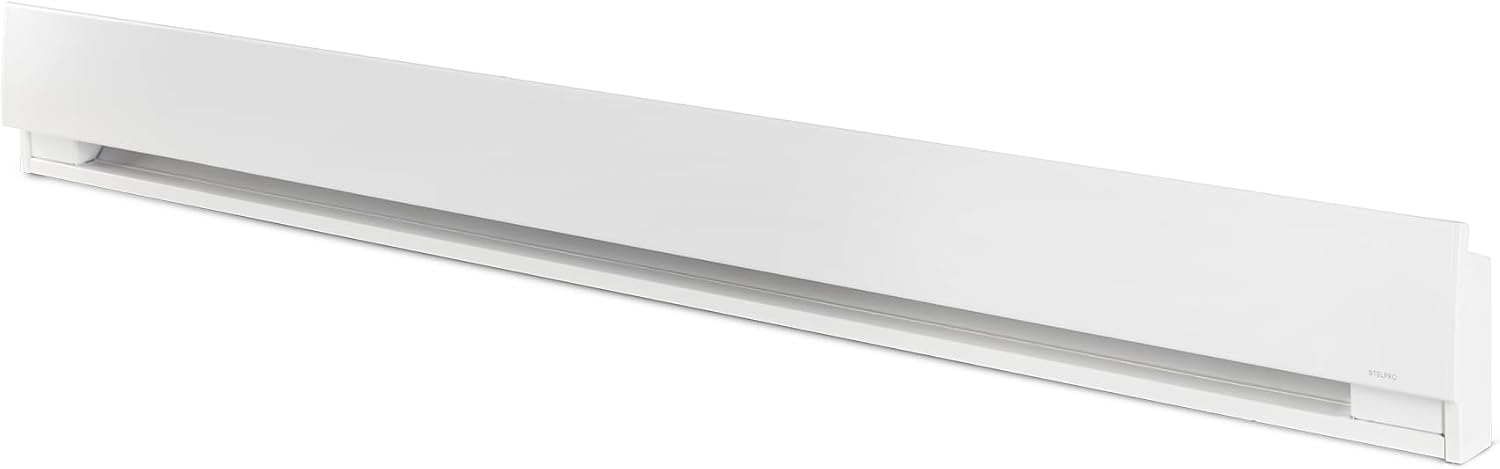
Stelpro Prima Baseboard Heater ASPRL1501W
| Heat Output | 1500 watts |
|---|---|
| Voltage | 120 volts |
| Heating Coverage | 150 sq. ft. |
| Heating Method | Convection |
The Stelpro Prima ASPRL1501W is a low-profile, hardwired electric baseboard heater built to provide steady convection warmth for bedrooms, home offices, and living areas. It installs along baseboards or under windows and connects to a wall thermostat (not included) or an optional built-in electronic thermostat, giving standard room temperature control. The heater uses a stainless steel sheathed tubular element with boxed aluminum fins for even heat distribution, while a discreet bottom air inlet and top outlet encourage good circulation without noisy fans. The housing is designed to limit access to the element and the removable front panel makes cleaning straightforward. Thermal protection with automatic reset and floating end sleeves to reduce expansion noise are practical reliability features. Expect straightforward, continuous heating rather than rapid spot heating, and plan to purchase or wire a compatible wall thermostat for full control.
Best for: Buyers who prioritize dependable, long-lasting heating for a single room and want a discreet, low-noise baseboard solution that emphasizes safety and serviceability.
Less Ideal for: People who need portable or instant supplemental heat, or who want plug-and-play heaters with built-in thermostats and no wiring work.
- 1500W output suited for rooms up to ~150 sq ft
- Stainless steel sheathed element with aluminum fins for even convection heat
- Low-profile, discreet design that installs under windows or along baseboards
- Safety features including full-length thermal protection with automatic reset and guarded housing
- Removable front panel simplifies cleaning and maintenance
- Requires a separately purchased wall thermostat unless the optional built-in thermostat is installed
- Hardwired 120V installation requires electrical work or professional installation
Verdict: Choose the Stelpro Prima when you want a reliable, quietly performing hardwired baseboard heater built for steady, long-term room heating.
CCC Comfort Zone CZ600 Baseboard Heater

| Heat Output | 5120 british thermal units |
|---|---|
| Heating Coverage | 300 sq. ft. |
| Number of Speeds | 2 |
| Voltage | 120 |
| Amperage | 12.5 A |
The Comfort Zone CZ600 is a low-profile 1,500 watt convection baseboard heater intended for medium rooms and targeted supplemental heating. It offers two heat output settings (1,500W and 750W) and a manual thermostat knob so you can dial in the comfort level without complicated controls. Installation is typical of plug-in/corded baseboard units and the slim, dent-resistant housing lets it sit unobtrusively along a wall or under a window. Notable safety features include a tip-over switch, overheat protection, and a stay-cool exterior, which reduce the chance of accidents in busy households. The unit runs quietly, making it suitable for bedrooms and living areas where noise matters. Limitations are its fixed 120V design and focus on single-room heating, so it is not a whole-house solution and will only cover the manufacturer-rated area; it also lacks digital controls or scheduling. For buyers who want a straightforward, safety-focused baseboard heater to warm one room, the CZ600 delivers reliable, no-frills performance.
Best for: Buyers who prioritize a simple, safety-focused supplemental heater for a bedroom or living room and want quiet, easy manual control backed by a solid history of user reviews.
Less Ideal for: People seeking whole-home heating, smart/digital thermostatic controls, or higher-voltage hardwired baseboard systems should look elsewhere.
- Two heat settings (1,500W and 750W) for flexible room heating
- Adjustable manual thermostat knob for simple temperature control
- Multiple built-in safety protections including tip-over switch and overheat sensor
- Low-profile, dent-resistant design that operates quietly
- Designed for single-room use and not suitable as a whole-house heating solution
- No digital controls, timers, or smart features for automated scheduling
Verdict: A straightforward, safety-oriented 1,500W baseboard heater that reliably warms a single medium-sized room without complexity.
Choosing the Right Baseboard Heater: Key Factors to Consider
Heat Output and Room Coverage
Heat output, typically expressed in watts, determines how large an area a baseboard heater can warm. Matching the unit's rated output to room size, ceiling height, and insulation quality prevents underheating or excessive cycling.
A properly sized heater runs more consistently and avoids the noise and energy waste of short-cycling. When calculating needs, factor in room orientation and window area because heat loss through glazing and exterior walls increases required output.
Thermostat Type and Temperature Control
Thermostat accuracy affects comfort and energy use. Built-in thermostats offer compact installation and straightforward control, while external thermostats or smart controls can deliver finer temperature regulation and scheduling.
Look for thermostats with tight deadband control to avoid temperature swings. If you plan to integrate the heater with a home automation system, confirm compatibility with low-voltage or digital control inputs.
Installation Complexity and Electrical Requirements
Baseboard heaters must be matched to your home's wiring capacity and circuit layout. Some units require dedicated circuits or specific amperage and voltage, which influences installation cost and feasibility.
Consider mounting needs such as wall space, clearance from floor coverings, and whether the wall surface allows straightforward anchoring. If retrofit wiring is extensive, factor labor and potential drywall repair into the decision.
Energy Efficiency And Operating Cost
Although electric baseboard heaters convert nearly all input power to heat, control precision and thermostat behavior influence real-world energy use. Models that maintain stable temperatures with minimal overshoot reduce wasted cycles and lower bills.
Insulation and user habits also drive operating cost, so pair a suitable heater size with programmable or adaptive controls where possible to reduce runtime during unoccupied periods.
Safety Features And Surface Temperatures
Safety measures such as thermal cutoff switches, temperature-limiting surfaces, and automatic shutoffs are essential for preventing overheating and fire risk. Lower outer case temperatures reduce the chance of burns if occupants contact the unit.
Also check for secure terminal covers and clearances required by code to avoid carpeting or combustible materials near the heater. Reliable safety features reduce maintenance headaches and increase peace of mind.
Durability And Maintenance
Build quality influences how long a heater performs reliably. Corrosion-resistant fins, sturdy mounting brackets, and accessible wiring compartments make maintenance simpler and extend lifespan.
Regular dusting and occasional inspection of wiring connections are typical upkeep tasks. Selecting a unit with accessible components simplifies routine checks and reduces service needs over time.
Sizing Your Baseboard Heater
To size a baseboard heater properly, start with the room's square footage and then adjust for ceiling height, insulation quality, and the number or size of exterior windows. A common approach is to calculate required watts per square foot and then select a unit or combination of units whose combined output meets that requirement.
When in doubt, lean toward slightly higher capacity for rooms with large windows or weak insulation. Oversizing modestly maintains comfort during cold snaps, but excessive oversizing can cause short cycling and reduce effectiveness.
- Measure usable floor area and ceiling height
- Account for windows, exterior walls, and drafts
- Add margin for poorly insulated or north-facing rooms
Wiring and Circuit Considerations
Before purchasing, verify the electrical circuit capacity where the heater will be installed. Many baseboard heaters require dedicated circuits and specific amperage ratings. Confirm the home panel has available space and that the wiring meets local electrical code.
If you are not comfortable with electrical work, hire a licensed electrician. Improper wiring risks tripped breakers, poor heater performance, or safety hazards. The electrician can also recommend whether a subpanel or circuit reconfiguration is necessary.
- Check voltage and amperage requirements on the specification sheet
- Plan for a dedicated circuit if required
- Confirm local code clearance and mounting height rules
Mounting, Placement, and Clearance
Placement against an exterior wall under windows is common because it combats cold drafts and promotes even heat distribution. Ensure there is the recommended clearance above and in front of the heater for optimal convection and safety.
Avoid blocking the heater with furniture, curtains, or rugs because restrictions reduce airflow and increase surface temperatures. Proper placement improves comfort and keeps the unit operating within designed temperature limits.
- Mount along exterior walls under windows when possible
- Maintain manufacturer-recommended clearances
- Keep furniture and textiles away from the unit
Controls And Zoning Strategies
Control strategy determines how effectively the heater maintains comfort and energy use. Using separate thermostats per room enables zoning, so you only heat occupied spaces. Built-in thermostats offer simplicity, while wall-mounted or smart thermostats provide scheduling and remote control.
If you have multiple units in a larger space, synchronize controls or use zoning to avoid temperature differentials. Thoughtful control selection reduces runtime and improves perceived comfort.
- Consider one thermostat per room for best control
- Use programmable schedules to cut runtime when rooms are empty
- Match thermostat type to wiring and control capabilities
Maintenance Tips For Longevity
Simple maintenance extends service life. Keep fins and intake areas free of dust and debris, and inspect electrical connections periodically for signs of wear or looseness. Follow any cleaning instructions that avoid abrasive cleaners or excessive moisture.
If the heater emits unusual smells or inconsistent heat, disconnect power and inspect for loose wiring or component issues. Prompt attention to minor problems prevents more serious failures later.
- Dust fins and vents regularly
- Check wiring connections annually
- Address unusual noises or odors immediately
How We Chose the Best Baseboard Heater
We focused on attributes that matter for safe, effective baseboard heating in typical home rooms. Key evaluation criteria included steady-state heat output and temperature control to assess whether a unit can maintain comfortable temperatures for different room sizes. Energy efficiency and thermostat accuracy were measured to judge operating cost and how well the heater avoids temperature overshoot. Installation and mounting complexity were considered so homeowners can understand labor or wiring needs. Safety features such as thermal cutouts, surface temperature limits, and compliance with common safety standards were required. Durability and build quality, including corrosion-resistant elements and robust wiring terminals, rounded out the filters. We excluded inline or portable space heaters and hydronic baseboard systems that require separate boilers or plumbing. Only electric fin-tube or convective baseboard heaters suitable for direct wall mounting were included. Products that lacked clear safety features, had inconsistent heat ratings, or were unsuitable for typical residential wiring were filtered out. The resulting shortlist reflects units that balance reliable heat delivery, reasonable installation demands, and built-in safety and control features.
Our full evaluation process is outlined in our review methodology.
FAQ
How do I determine the right wattage for my room?
Calculate required wattage from square footage, then adjust for ceiling height and insulation. Use higher wattage for poorly insulated rooms or rooms with large windows. When uncertain, add a moderate safety margin rather than undersizing.
Can I install a baseboard heater on any wall?
Install on an exterior wall if possible to counteract heat loss, and ensure required clearances from floor coverings and furniture. Avoid installing on internal partition walls where heat distribution will be less effective.
Do baseboard heaters need a dedicated circuit?
Many models require a dedicated circuit because of their amperage draw. Check the heater's electrical specs and consult a licensed electrician to confirm whether panel capacity and circuit allocation are sufficient.
Are these heaters loud during operation?
Most baseboard heaters operate quietly because they rely on convection rather than fans. You may hear minor expansion or contraction noises as the element heats and cools, but constant fan noise is uncommon.
What safety checks should I perform after installation?
Verify the unit's surface temperature is within safe limits, check that terminal covers are secure, and confirm there are no unusual odors when the unit first energizes. Also ensure recommended clearances are maintained from combustibles.
Final Verdict
Selecting the right baseboard heater comes down to matching heat output to room needs, ensuring safe and code-compliant installation, and choosing control options that limit runtime while keeping occupants comfortable. Prioritize accurate thermostat control, appropriate circuit capacity, and built-in safety features to avoid surprises after installation. With the right balance of sizing, wiring, and controls you can achieve steady, quiet warmth and reasonable operating costs for the spaces you heat.