
Note: This article contains affiliate links. If you click on these links and make a purchase, we may earn a small commission at no extra cost to you. This helps support our research and content. Read our full affiliate disclosure here.
Running a restaurant demands equipment that can withstand heavy daily use while delivering consistent results. Choosing the right blender for restaurants affects speed of service, menu consistency, and staff efficiency. In this guide we shortlist the top picks designed for commercial kitchens and evaluate them on durability, motor performance, and ease of maintenance. Below you will find the best blenders selected for restaurant use plus straightforward advice on what to prioritize for different kitchen styles and menu needs.
Top Picks at a Glance
| Best Overall The best all-around choice for most situations | WantJoin Professional Commercial Blender WZ-K90 |  |
| Best Quality Built to a higher standard if you want something more solid | Vitamix 5200 Blender | 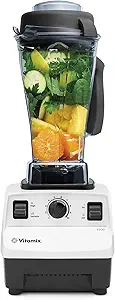 |
| Best Value The sweet spot between price and what you get | Waring Xtreme MX1100XTX |  |
| Best Budget The cheapest option that still gets the job done reliably | Hamilton Beach Power Elite 58148A |  |
| Top Rated A top-rated pick with lots of positive feedback | Ninja Professional Plus BN701 |  |
| Most Popular A crowd favorite that many people choose with confidence | Ninja Professional Blender BL610 |  |
| Best Seller A high-volume bestseller chosen again and again | VEVOR Commercial Immersion Blender HB6089 |  |
WantJoin Professional Commercial Blender WZ-K90

| Wattage | 2200 watts |
|---|---|
| Number of Speeds | 15 |
| Capacity | 2200 ml |
| Power Source | ac |
This WantJoin commercial blender is built for high-volume kitchens and loud tasks while keeping noise and splatter down with its soundproof shield. The 2200W motor and dual-direction stainless steel blades deliver fast, consistent blending up to the claimed 38,000 RPM, and the 15-speed plus pulse controls give fine control when making smoothies, sauces, nut butters, or crushing ice. The large 80 oz (2.2 L) BPA-free pitcher and tamper let you process batches for service periods, and the lid feed hole makes adding ingredients while running convenient. Practical touches include automatic self-cleaning and overheat protection to protect the motor during frequent runs. The unit is fairly large and heavy, so it suits a counter with space rather than tight prep stations, and the plastic pitcher means buyers who prefer all-metal or glass containers may look elsewhere. The sound shield reduces noise but adds bulk, so expect a trade-off between quieter operation and footprint. For restaurants and cafes that need a powerful, semi-professional blender that minimizes noise and handles frequent use, this model is a solid option.
Best for: Kitchen operators who need a high-power blender that handles frequent, batch-oriented tasks while keeping noise and mess under control.
Less Ideal for: Small prep stations with limited counter space or operators who require an all-metal or glass container for high-heat or heavy-duty commercial use.
- Powerful 2200W motor with dual-direction stainless steel blades for fast, consistent blending
- Soundproof shield and lid feed hole reduce noise and splatter during operation
- Large 80 oz (2.2 L) BPA-free pitcher and tamper support batch blending for restaurant use
- 15 speed settings plus pulse and automatic self-cleaning make it versatile and easy to maintain
- Bulky and heavy footprint due to the shield, which can be limiting on crowded countertops
- Container is plastic rather than glass or metal, which some commercial kitchens may prefer
Verdict: A high-power, shielded countertop blender that balances restaurant-grade performance with quieter operation for busy foodservice environments.
Vitamix 5200 Blender

| Wattage | 1380 watts |
|---|---|
| Number of Speeds | 10 |
| Capacity | 64 fluid ounces |
| Blade Material | Stainless Steel |
| Material | BPA-free Eastman Tritan copolyester |
The Vitamix 5200 is built for heavy, continuous blending in demanding kitchens and can handle everything from frozen fruit and nut butters to hot soups made by blade friction. It pairs a 2-horsepower (about 1380W) motor with laser-cut stainless-steel blades and a full-size 64-ounce Tritan container to produce consistent, smooth purées and frozen drinks at scale. Variable speed control plus a high-speed switch gives precise texture control while the included tamper keeps thick mixtures moving without interrupting operation. Self-cleaning is quick and saves turnaround time between batches. The unit is large and robust, so it needs a dedicated counter spot and produces typical blender noise at high speeds, and its manual controls lack programmable presets found on some commercial models. For restaurants or busy prep kitchens that prioritize raw power, durability, and consistent results, the 5200 offers proven performance though it is a single-container solution without automated programs.
Best for: Kitchen operators who need a rugged, high-power blender that delivers consistent purees and frozen drinks for high-volume prep and service.
Less Ideal for: Small cafes or venues that require quiet, compact machines with preset programs or multiple container options for varied portion sizes.
- High-performance 2-horsepower motor handles fibrous greens, ice, and nuts reliably
- Durable laser-cut stainless-steel blades for long-term, consistent cutting
- Large 64 oz BPA-free container supports batch blending and meal prep
- Variable speed knob plus a High switch enables precise texture control
- Quick self-cleaning saves time between service runs
- Manual knob controls lack programmable presets for repeatable, automated cycles
- Size and noise level may be too much for very small or quiet front-of-house spaces
Verdict: A reliable, high-power workhorse blender that delivers commercial-caliber performance for restaurant kitchens focused on consistent, high-volume blending.
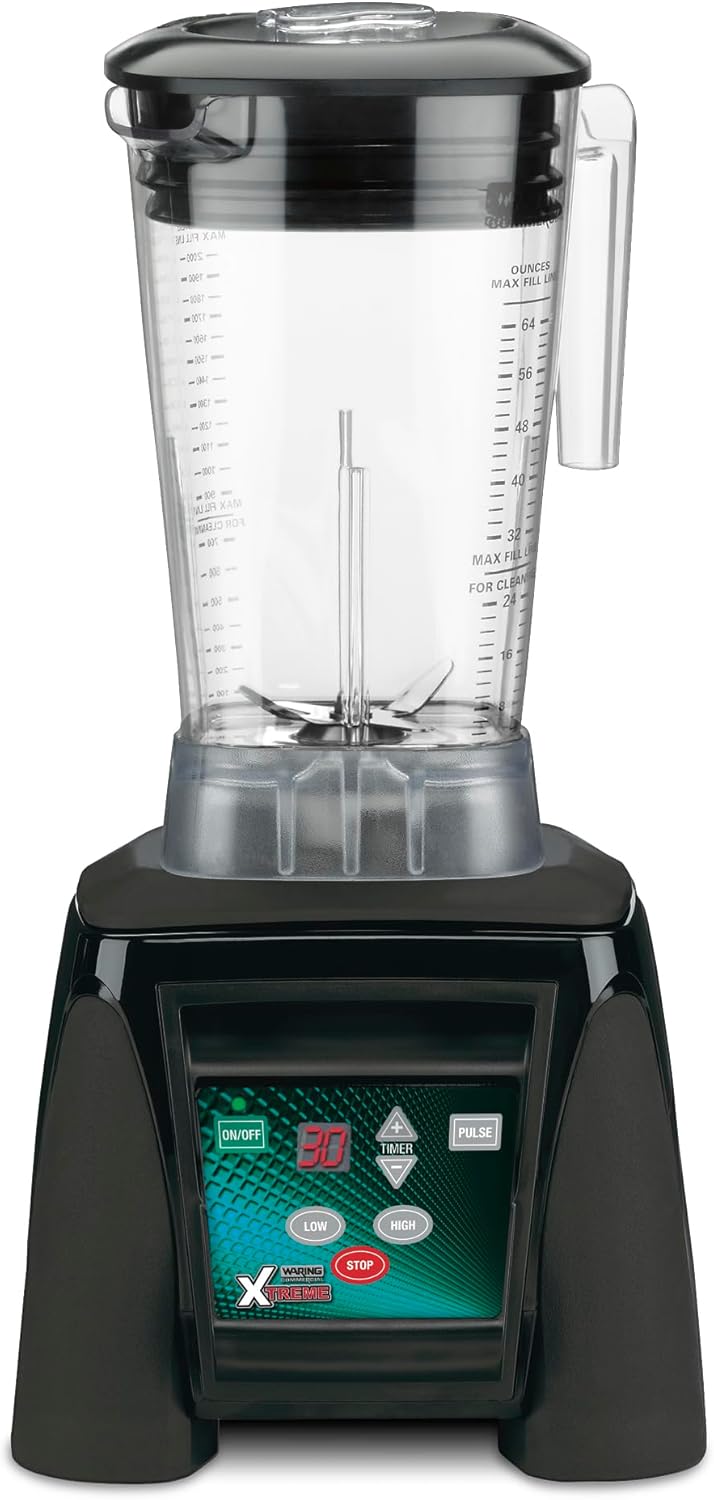
Waring Xtreme MX1100XTX
| Wattage | 1560 watts |
|---|---|
| Power source | Electric |
| Capacity | 64 fluid ounces |
| Controls type | Electronic-membrane keypad |
The Waring Xtreme MX1100XTX is a commercial countertop blender built for steady service in cafes, bars, and quick-serve kitchens where dozens of blended drinks are made daily. Its 3.5 peak-HP motor and the Raptor blade assembly handle ice, smoothies, and high-viscosity mixes while an electronic membrane keypad offers HIGH, LOW, OFF and PULSE selections plus a 30-second countdown timer for repeatable runs. The 64 oz BPA-free copolyester jar is stackable and dishwasher-safe, making batch work and cleanup simpler, and a removable stainless blade eases maintenance. Practical features include an auto shutoff and safety lock and the design supports recommended throughput of 75+ drinks per day. Limitations are a two-speed control scheme that gives less fine-grain speed modulation than variable-speed commercial models and a relatively large footprint and weight that require dedicated counter space. For operations that need reliable high-power blending with straightforward controls and easy servicing, this model delivers consistent, heavy-duty performance.
Best for: Busy cafes, smoothie bars, and restaurant kitchens that prioritize robust, repeatable blending and simple controls to maximize throughput and minimize downtime.
Less Ideal for: Operations that require fine-grain speed control for delicate emulsions or that need a compact, lightweight unit for limited counter space should consider alternatives.
- Powerful 3.5 peak-HP motor capable of handling ice, frozen fruit, and thick mixtures
- Durable 64 oz BPA-free copolyester jar that is stackable and dishwasher-safe
- Electronic membrane keypad with timer and pulse for repeatable, quick cycles
- Removable stainless steel blade and safety lock make maintenance and safe operation straightforward
- Only two speed settings limit precision compared with variable-speed commercial blenders
- Heavy and large footprint needs dedicated counter space in busy prep areas
Verdict: A workhorse commercial blender that delivers high-power, repeatable blending for high-volume restaurant and bar use.
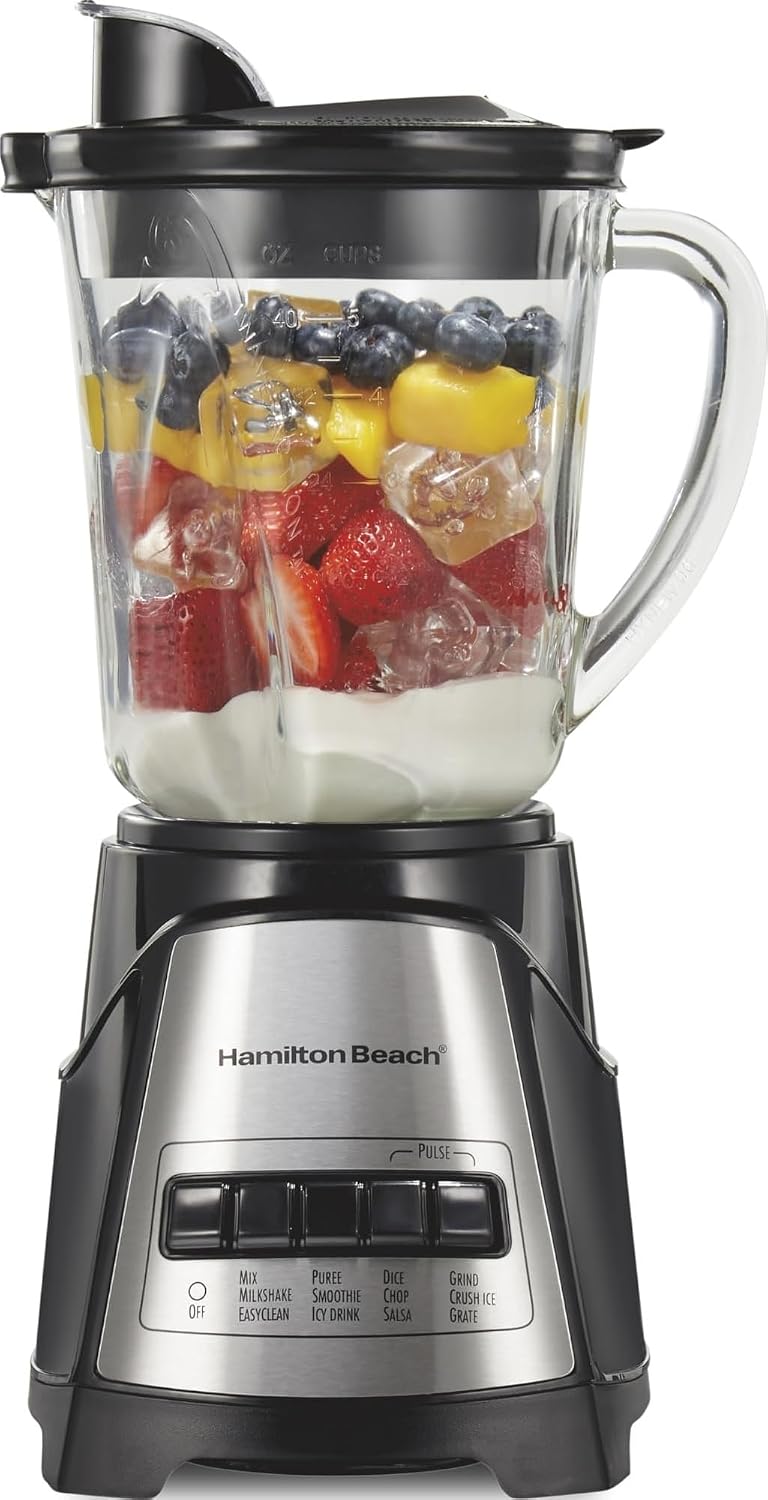
Hamilton Beach Power Elite 58148A
| Wattage | 700 watts |
|---|---|
| Capacity | 40 fluid ounces |
| Number of Speeds | 12 |
| Blade Material | Stainless Steel |
| Material | Glass |
The Hamilton Beach Power Elite is a straightforward countertop blender aimed at everyday blending tasks like smoothies, purees, and crushed ice. Its 700-watt motor and stainless steel Ice Sabre blades work with the Wave Action system to pull ingredients down into the cutting zone, which helps produce smoother results without repeated stirring. The 40-ounce glass jar and pour spout make it easy to prepare and serve blended food, and the removable blades, jar, and lid are dishwasher safe for simpler cleanup. Controls are button-based with 12 functions accessed through five buttons, so you can pick a preset for pureeing, crushing, or mixing rather than guessing speeds. For blending for elderly diets the glass jar avoids plastic contact and the power handles soft solids and frozen fruit reliably when recipes include enough liquid. The unit is not a commercial machine, so very large batches or heavy-duty processing will be slower and you should follow the guideline to keep at least 1 cup of liquid to ensure smooth blending. Overall it is a practical, easy-to-use blender for home purees and daily smoothies.
Best for: Caregivers or home cooks who want a reliable, easy-to-use blender to make small-to-medium batches of smooth purees and shakes for elderly diets, with simple controls and dishwasher-cleanable parts.
Less Ideal for: Users who need commercial capacity or who regularly process large volumes of thick, heavy mixtures should consider a higher-powered, heavy-duty blender instead.
- 700-watt motor with Wave Action system helps pull food down for smoother purees
- Removable stainless steel blades and dishwasher-safe glass jar simplify cleaning
- 12 functions accessed via simple button controls for common blending tasks
- Glass jar reduces plastic contact and has a pour spout for mess-free serving
- Not designed for very large or continuous heavy-duty batches
- Requires at least 1 cup of liquid for best blending results
Verdict: A practical, easy-to-clean 700W blender that reliably produces smooth purees and shakes for everyday elderly meal prep.
Ninja Professional Plus BN701

| Wattage | 1400 watts |
|---|---|
| Capacity | 72 fluid ounces |
| Number of Speeds | 4 |
| Other Special Features of the Product | Dishwasher Safe, Pre-Programmed, Pulse Technology |
The Ninja Professional Plus BN701 is a powerful countertop blender built to handle tough blending tasks like crushing ice, smoothies, and batch recipes. Its 1400 peak-watt motor and six-blade Total Crushing assembly turn ice and firm ingredients into smooth textures quickly, while the full-size 72 oz pitcher makes it easy to prepare hummus or dips for a crowd. Auto-iQ offers three preset programs that combine timed pulsing and blending so you can get consistent results without manual guesswork, and four manual speeds plus pulse give basic control when you need it. The pitcher and stacked blade assembly are top-rack dishwasher safe for easier cleanup after processing beans and oils, and the BPA-free plastic pitcher is marked with a 64 oz max fill to prevent overfilling. Expect a sturdy, loud machine that excels at pureeing and crushing, but note its larger footprint and weight compared with compact personal blenders, so it suits a kitchen counter rather than frequent transport or tiny storage spaces.
Best for: Buyers who prioritize powerful, reliable performance for making smooth hummus, dips, and large batches and want preset programs to simplify consistent pureeing.
Less Ideal for: Those who need a compact, lightweight blender for single servings or frequent travel should consider smaller personal models instead.
- Very strong 1400 peak-watt motor for fast pureeing and ice crushing
- Large 72 oz pitcher for making hummus or dips in family-size batches
- Total Crushing 6-blade assembly produces smooth, consistent textures
- Auto-iQ presets simplify repeatable blending programs
- Dishwasher-safe pitcher and blade assembly for easier cleanup
- Bulky and heavier than small personal blenders, takes counter space
- Plastic pitcher may retain odors over time when processing strongly scented foods
Verdict: Choose this blender if you want a high-power, full-size unit that reliably purees chickpeas and makes smooth hummus for family-sized batches.
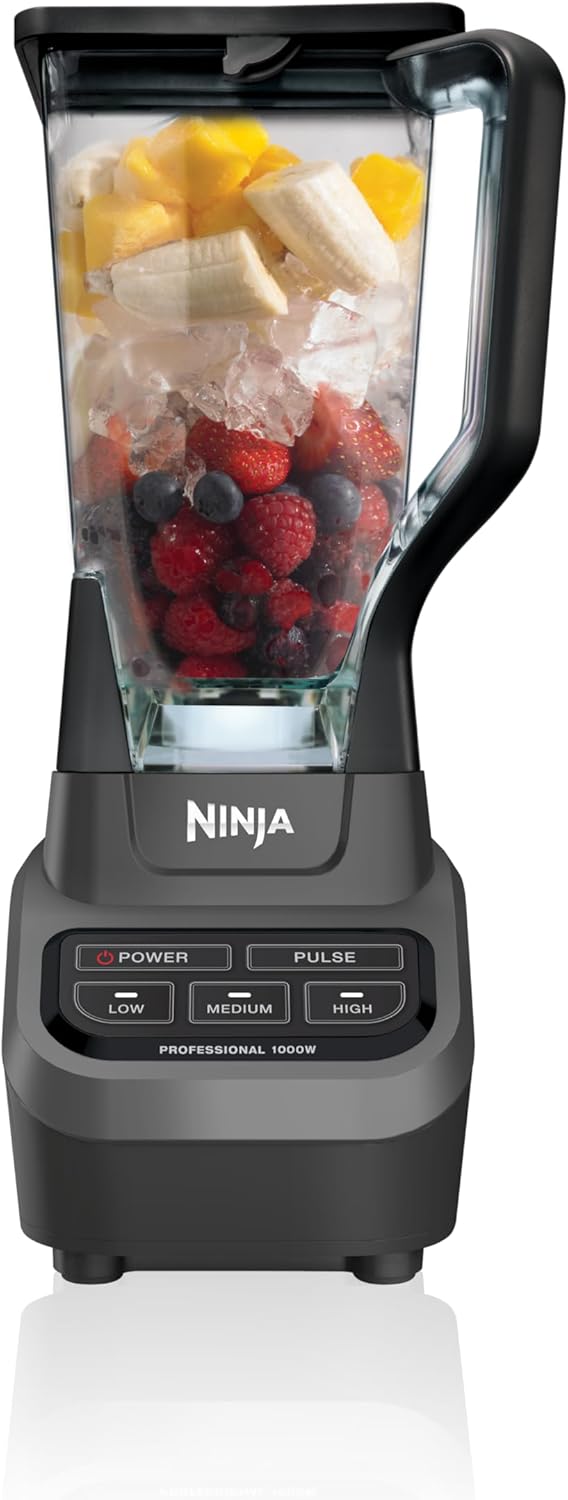
Ninja Professional Blender BL610
| Wattage | 1000 watts |
|---|---|
| Capacity | 1.8 liters |
| Number of Speeds | 4 |
| Power Source | Corded Electric |
The Ninja Professional BL610 pairs a 1000 watt motor with Total Crushing stainless steel blades to handle smoothies, frozen drinks, sauces, and ice crushing reliably. You use it like a conventional push-button blender: load the XL 72 oz pitcher with ingredients, pick one of four speeds or a preset, and let the blades reduce whole fruits, frozen fruit, and ice to a smooth consistency. The large pitcher and clear max-fill mark make it easy to prepare family batches or party-sized servings, while dishwasher-safe, BPA-free plastic parts simplify cleanup. Manual controls keep operation straightforward but limit precision compared with variable-speed dials. The blender is lightweight for a full-size unit and includes a recipe guide for quick ideas, but it lacks specialized attachments for single-serve blending or milling. For everyday kitchen tasks that require power to crush ice and blend frozen fruit into smooth textures, the BL610 is a dependable, no-fuss choice that balances performance and easy cleanup.
Best for: Buyers who prioritize reliable power and proven performance for making smoothies and frozen drinks for families or gatherings and who value simple, easy-to-clean appliances.
Less Ideal for: People who need precise speed control, compact single-serve blending, or specialized attachments for grinding or food processing should look elsewhere.
- 1000W motor and Total Crushing blades efficiently crush ice and frozen fruit
- Large 72 oz pitcher lets you make family-size batches with a 64 oz max liquid fill line
- Dishwasher-safe, BPA-free pitcher and lid make cleanup simple
- Simple push-button controls are easy to use for everyday recipes
- Manual speed settings offer less fine control than variable-speed models
- No dedicated single-serve or additional accessory attachments included
Verdict: Choose the Ninja BL610 when you want a powerful, easy-to-use countertop blender that consistently crushes ice and makes large smoothie batches.
VEVOR Commercial Immersion Blender HB6089

| Wattage | 500 watts |
|---|---|
| Voltage | 120 volts |
| Control Type | Manual, Variable Speed |
| Blade Material | Stainless Steel |
| Included Components | Whisk Attachment |
This VEVOR immersion blender is built for restaurant and food-service use where continuous, repeatable blending is required. Its 500W copper-core motor and 16-inch shaft let chefs reach deep pots and blend large batches of soups, sauces, and purees without moving pans to a countertop unit. Speed is controlled by an infinite knob (around 4,000–16,000 rpm), so you can dial in gentle emulsifying or high-speed breaking down of solids, and a one-touch continuous operation reduces hand fatigue during long runs. The detachable stainless-steel shaft and whirlwind triple-blade head simplify cleaning and maintenance, and the splash-resistant guard helps keep workstations neater. Expect a utilitarian plastic housing and a heavier weight that reflects its commercial intent, so it is less compact than domestic stick blenders and needs a stable place to hang or store. While powerful and durable for professional kitchens, it lacks advanced electronic controls or presets that some higher-end commercial brands provide.
Best for: Chefs and restaurant buyers who need a straightforward, powerful stick blender that handles large pots and continuous use and who prioritize reliable motor performance and simple controls.
Less Ideal for: Fine-dining kitchens that require programmable blending cycles, integrated timers, or fully metal-bodied industrial units for maximum durability should consider higher-spec commercial brands.
- 500W copper-core motor designed for continuous commercial use
- Long 16-inch shaft reaches deep pots and large batches
- Stepless variable speed knob for precise control from low to high RPM
- Detachable stainless-steel shaft and replaceable triple blade for easier cleaning and serviceability
- Plastic body is less rugged-feeling than all-metal commercial models
- No digital controls, presets, or integrated safety interlocks
Verdict: A no-frills, powerful immersion blender made to handle restaurant-sized pots with reliable continuous performance.
Choosing the Right Blender for Restaurants: Key Factors to Consider
Motor Power and Torque
Motor power and torque determine whether a blender can handle dense, continuous batches without bogging down. Restaurants often need to process ice, fibrous vegetables, and thick sauces repeatedly; a higher-torque motor sustains blade speed under load and reduces the chance of stalling.
Selecting an appropriately powered motor reduces cycle time and extends component life because the unit is less likely to be run at its limit. For high-volume outlets, prioritize torque over occasional peak wattage numbers; manufacturers sometimes rate wattage differently, but torque and real-world performance matter most.
Container Capacity and Throughput
Capacity affects how many servings you can produce per cycle and impacts back-of-house workflow. A larger jar lets you blend bigger batches and reduces the frequency of load-and-clean cycles, which is valuable during service peaks.
Consider the typical portion size and whether you will blend single-serve items or batch recipes. Stackable or multiple jars can increase throughput without needing a larger footprint. Also check lid design for secure pouring and any volume markings that aid consistent portioning.
Durability and Serviceability
Commercial kitchens put constant stress on equipment, so construction materials and ease of repair matter. Metal housings, sealed switches, and reinforced motor mounts resist wear better than consumer plastics. Look for replaceable parts such as blades, seals, and couplings to simplify repairs.
Serviceability also includes how easy it is to access the motor or drive assembly for maintenance. Units with user-serviceable wear parts and good documentation reduce downtime and total cost of ownership.
Ease of Cleaning
Fast, thorough cleaning keeps turnaround times short and maintains food safety. Removable blades or single-piece jars without hidden crevices make cleaning faster and more reliable. Dishwasher-safe components are helpful when available, but also consider how seals and gaskets are cleaned.
Design features that cut rinsing and scrubbing time—smooth interior surfaces, large openings, and simple lid assemblies—translate directly into labor savings over a busy service day.
Controls and Recipe Precision
Consistent menu items require repeatable control settings. A mix of variable-speed controls, pulse functions, and programmable presets helps staff reproduce textures and temperatures across shifts. Intuitive controls reduce training time and errors during rush periods.
Consider how easily staff can change speeds or engage pulses while multitasking. Presets for common tasks such as crushing ice or making smoothies can keep quality consistent even with high staff turnover.
Noise, Heat Management, and Safety
Noise contributes to staff fatigue and customer experience in open kitchens, so quieter operation is beneficial. Heat buildup from continuous operation can shorten motor life and affect food temperature; look for units designed for intermittent duty or with cooling features for sustained use.
Safety features such as interlocks, non-slip feet, and thermal cutoffs protect staff and equipment. A blender with integrated safety measures reduces risk during fast-paced service and helps meet health and safety policies.
Matching Blender Capacity to Restaurant Volume
Estimate your typical batch sizes and peak service volume before selecting capacity. A small cafe preparing single-serve beverages has different needs than a full-service restaurant producing large batches of soups or sauces.
Think through the menu: are you blending individual cocktails, large smoothie batches, or prepping sauces? Plan for a buffer above average demand to avoid bottlenecks during unexpected rushes.
- Single-serve focus: choose compact jars with fast cycle times.
- High-volume batch work: prioritize large-capacity containers and quick refill workflows.
- Multiple-station kitchens: consider extra jars for parallel processing.
Blade Design and Ingredient Handling
Blade geometry affects how ingredients are drawn into the cutting zone and how fine a texture you can achieve. Look for blades engineered for both ice crushing and pureeing vegetables if your menu is diverse.
Consider whether the blade assembly is replaceable and how easy it is to remove for sharpening or replacement. Durable stainless steel blades resist bending and corrosion under frequent use.
- 4- or 6-point blades for aggressive crushing.
- Low-profile blades that reduce cavitation for sauces.
- Sealed blade bearings to prevent food ingress.
Workflow Integration and Counter Footprint
Commercial kitchens are tight on counter space and circulation. Choose a blender that fits your work zone and allows staff to load, blend, and pour without cross-traffic delays. Measure the footprint including the jar and lid when planning placement.
Also think about electrical supply and outlet placement. High-power motors require appropriate circuit capacity and may need dedicated wiring to avoid tripping breakers during busy service times.
- Measure clearance for lifting lids and removing jars.
- Consider mounting options or under-counter storage for spare jars.
- Verify electrical specifications before purchase.
Staff Training and Standardized Recipes
Standardizing recipes and training staff on control use reduces variability. Provide quick-reference cards near the blender showing speed, duration, and sequence for common items to keep results consistent across shifts.
Routine preventive maintenance training helps staff spot wear before it causes failure. Simple tasks like checking gaskets, tightening couplings, and cleaning vent openings extend service life.
- Create laminated recipe cards for common blends.
- Schedule daily and weekly maintenance checks.
- Train multiple team members to avoid single-operator bottlenecks.
Energy Use and Operational Costs
Higher-power units use more energy but can finish cycles faster, which may reduce cumulative runtime. Evaluate energy use in the context of throughput rather than comparing idle wattage alone.
Consider the total cost impact of parts replacement and downtime. A slightly more efficient or serviceable unit can save labor and repair costs over time even if initial power draw is higher.
- Compare duty cycle ratings for expected usage.
- Factor in maintenance labor when estimating operating cost.
- Look for models with easy-to-replace wear parts.
How We Chose the Best Blender for Restaurants
Our selections focused on machines built for sustained, repeated use in commercial settings. We prioritized motor power and torque because those determine how reliably a blender handles dense batches and ice. We also measured container capacity and throughput to match typical restaurant batch sizes, and we considered construction materials and serviceability for long-term durability under heavy cycles. Noise and heat management were part of the evaluation because quieter, cooler-running units reduce kitchen fatigue and thermal stress on internal components. Ease of cleaning, blade access, and gasket design were included since fast turnaround between orders matters in busy service windows. Safety features and control precision were also weighed to prevent operator error and to enable repeatable recipes. We excluded small household-only units and any models lacking commercial-duty components. The final list emphasizes machines that balance power, capacity, and maintainability for real-world restaurant workloads.
Our full evaluation process is outlined in our review methodology.
FAQ
What motor size is appropriate for a busy restaurant?
It depends on workload. For continuous batch work and crushing ice frequently, choose a higher-torque motor rated for commercial duty. Smaller motors may work for limited, intermittent tasks but can overheat under heavy use.
How often should blender parts be replaced in a commercial kitchen?
Replacement frequency varies with volume and maintenance. Blades and gaskets may need inspection monthly under heavy use and replacement every few months to a year depending on wear. Regular inspections prevent unexpected failures.
Are commercial blenders louder than consumer units?
Often they are, because commercial motors are more powerful. Some models include noise-reduction design features, but in many kitchens noise is a tradeoff for higher performance. Consider sound in open-kitchen environments.
Can I run a commercial blender continuously during service?
Some models are rated for sustained or continuous duty, but others are designed for intermittent cycles. Check duty cycle specifications and allow time for cooling as recommended to avoid thermal overload.
What cleaning practices minimize downtime?
Use removable jars and blades that are easy to disassemble and rinse. Implement a quick-rinse protocol between orders and a deeper clean at shift end. Clear maintenance roles so cleaning is consistent and fast.
Final Verdict
For restaurant use, prioritize a blender that balances motor torque, container capacity, and straightforward serviceability. The right tradeoff depends on whether your kitchen focuses on single-serve beverages, batch sauces, or heavy ice work. Choose equipment that fits your service volume and staff workflow, and plan for routine maintenance. Focusing on power, ease of cleaning, and replaceable parts will keep service smooth and reduce costly downtime.