
Note: This article contains affiliate links. If you click on these links and make a purchase, we may earn a small commission at no extra cost to you. This helps support our research and content. Read our full affiliate disclosure here.
Picking the right budget induction rice cooker matters because rice is a daily staple and small differences in heat control change texture and reliability. A good induction cooker gives you steady, even heat and dependable results without expensive features you will not use. This guide covers seven shortlisted budget induction rice cookers that balance consistent cooking, useful capacity, and durable construction. We evaluated models for cooking performance, energy use, meal-size flexibility, and ease of cleaning to surface the most practical options for everyday home kitchens. Read on for the factors that matter and how to match a compact induction rice cooker to your routine.
Top Picks at a Glance
| Best Overall The best all-around choice for most situations | CUCKOO Induction Pressure Rice Cooker CRP-EHSS0309FG |  |
| Best Quality Built to a higher standard if you want something more solid | CUCKOO CRP-JHR1009F 10-Cup Rice Cooker |  |
| Best Value The sweet spot between price and what you get | Midea IH Rice Cooker 6-Cup |  |
| Best Budget The cheapest option that still gets the job done reliably | Aroma ARC-7606B Induction Rice Cooker |  |
| Top Rated A top-rated pick with lots of positive feedback | Zojirushi NP-HCC10XH Rice Cooker |  |
| Most Popular A crowd favorite that many people choose with confidence | TOSHIBA Induction Rice Cooker TRSH01 |  |
| Best Seller A high-volume bestseller chosen again and again | Zojirushi NW-QAC10 Induction Rice Cooker |  |
CUCKOO Induction Pressure Rice Cooker CRP-EHSS0309FG

| Capacity | 3 cups |
|---|---|
| Wattage | 850 watts |
| Power Source | Corded Electric |
| Voltage | 120 volts |
This Cuckoo induction pressure rice cooker uses IH (induction heating) and advanced fuzzy logic to cook rice more evenly and with better texture than basic electric cookers. It handles up to 3 cups uncooked (about 6 cups cooked) and offers around 16 menu options including GABA, brown, glutinous, mixed rice, and a Turbo white rice mode, so it covers everyday rice types and a few specialty settings. Practical touches include a nonstick inner pot, detachable inner cover for easier cleaning, an included spatula and measuring cup, and a self-clean or auto-clean function. At 850 watts it heats quickly and the pressure function helps shorten cooking time for firmer grains. Limitations are its small capacity for larger families and the need to hand wash some parts, which adds upkeep compared with dishwasher-safe alternatives. Its compact footprint and focused feature set make it a strong pick for kitchens that need efficient, restaurant-style rice without a large machine.
Best for: Buyers who want a compact, efficient induction rice cooker that produces restaurant-quality rice and covers a variety of rice types without taking much counter space.
Less Ideal for: Large households or anyone who regularly needs to cook rice in bulk should consider larger-capacity models instead.
- Induction heating with fuzzy logic for consistent, evenly cooked rice
- Multiple preset modes including GABA, brown, glutinous, mixed, and Turbo white rice
- Compact 3-cup uncooked capacity suitable for small households
- Pressure cooking speeds up cook times and improves texture
- Detachable inner cover and included accessories simplify routine use
- Small uncooked capacity may not suit larger families
- Some parts require hand washing rather than dishwasher cleaning
Verdict: A compact, budget-friendly induction pressure cooker that delivers better-textured rice and versatile preset modes for small households.
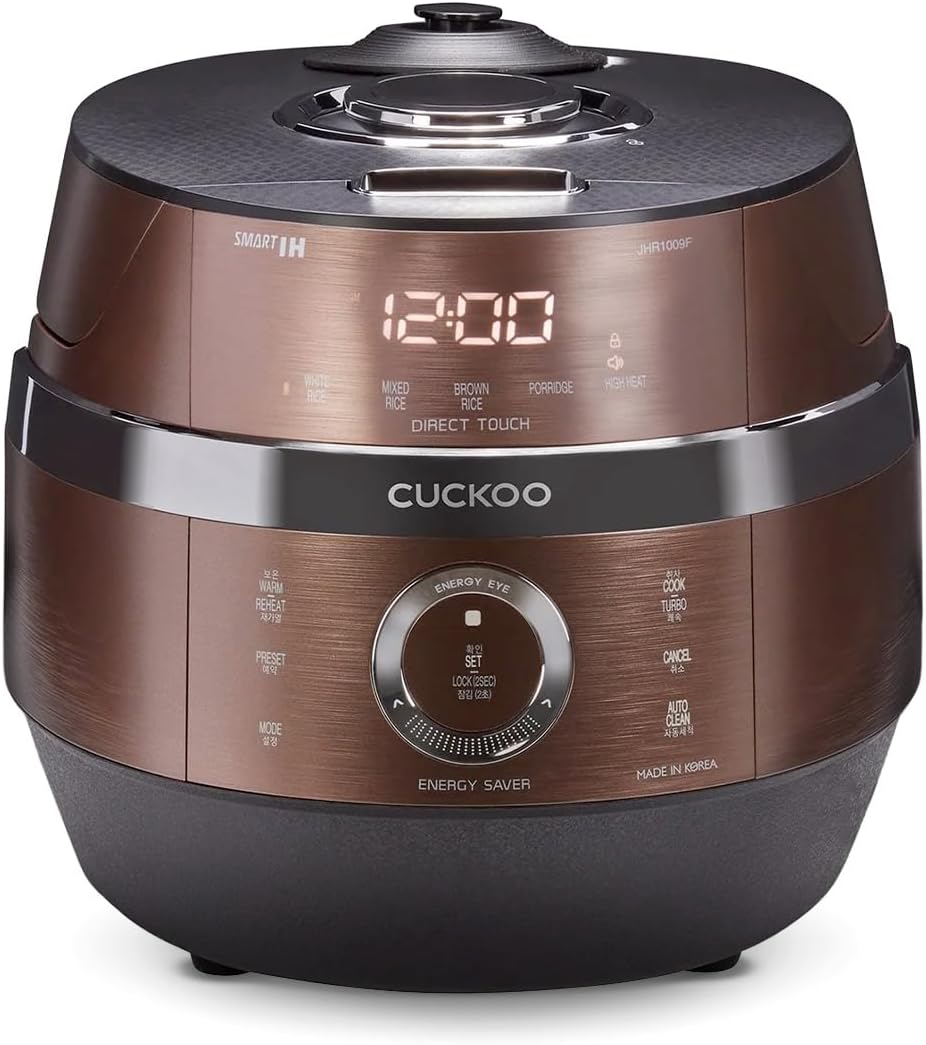
CUCKOO CRP-JHR1009F 10-Cup Rice Cooker
| Capacity | 10 cups |
|---|---|
| Power Source | Corded Electric |
| Wattage | 1000 watts |
| Other Special Features | Advanced Fuzzy Logic |
The CUCKOO CRP-JHR1009F is a performance-focused induction heating pressure rice cooker built for reliable, repeatable results. It uses induction heating and high pressure to shorten cook times and produce evenly cooked rice, and the advanced fuzzy logic adapts heat and time across 16 to 19 menu options including white rice, brown rice, GABA, and turbo white rice. The removable lid, stainless steel inner components, and included spatula and measuring cup make daily use and cleanup straightforward, while features like a condensation tray and steam sterilization add convenience. Practical benefits include faster pressure cooking, a large family-friendly capacity, and voice guidance that helps with menu selection. Downsides are its substantial footprint and weight compared with simpler models, and it requires hand washing for care. For buyers prioritizing cooking performance over minimal cost or compact size, this model delivers consistent, restaurant-style rice and flexible program choices.
Best for: Buyers who want faster, precise rice cooking and flexible program choices for family meals and prioritize cooking performance over compact size.
Less Ideal for: Those seeking a compact, lightweight, no-frills budget cooker or a unit that is fully dishwasher-friendly should consider simpler alternatives.
- Induction heating with high pressure for faster, evenly cooked rice
- Multiple preset menus (including GABA and turbo white) for versatile rice types
- Large 10-cup capacity suitable for family meals
- Stainless steel construction and detachable lid for durability and easier cleaning
- Relatively heavy and bulky compared with basic rice cookers
- Requires hand washing rather than dishwasher-safe care
Verdict: Choose this CUCKOO if you want a high-performance induction pressure cooker that delivers faster, consistent rice and versatile preset programs for family cooking.
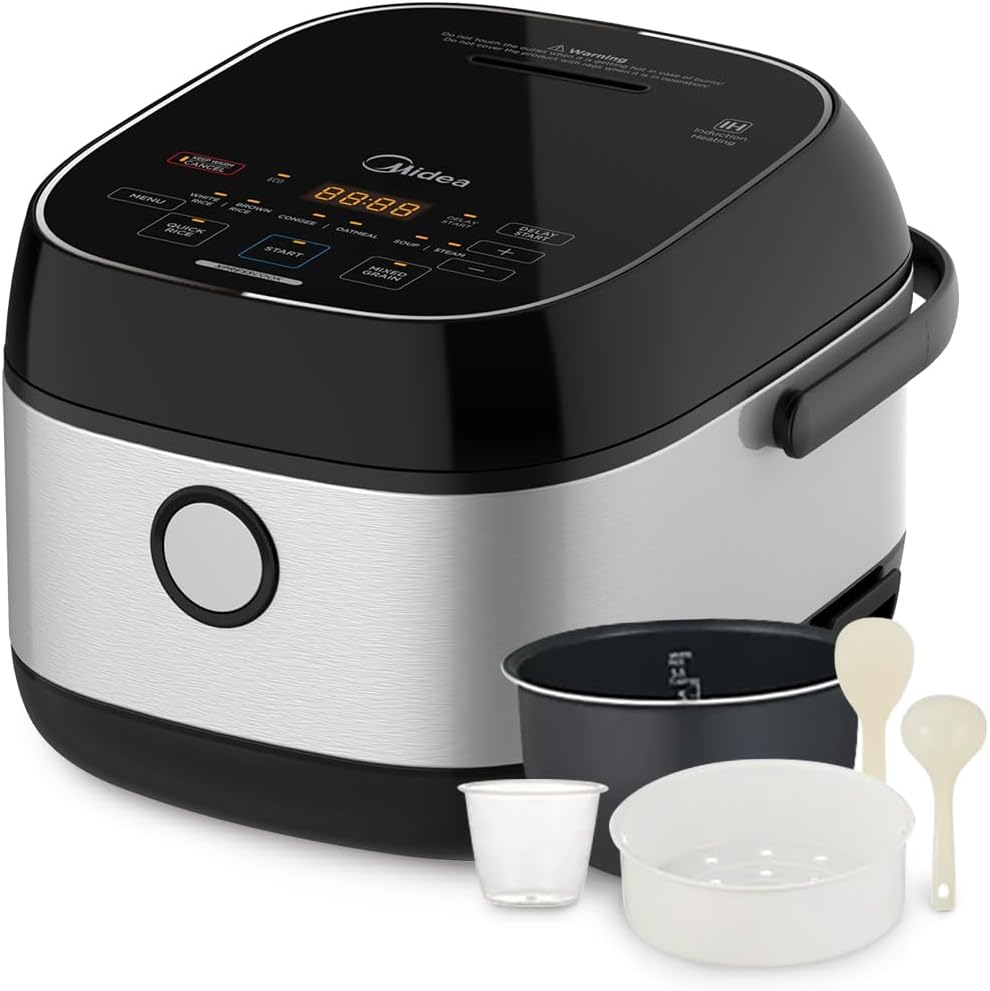
Midea IH Rice Cooker 6-Cup
| Capacity | 6 cups |
|---|---|
| Power Source | Corded Electric |
| Wattage | 220 watts |
| Voltage | 120 volts |
This Midea IH rice cooker uses induction heating combined with fuzzy logic to produce consistent, evenly cooked rice for small families. It offers eight preset menus including quick rice, white, brown, mixed grain, congee, soup, oatmeal, and steam, plus a 24-hour delay start and automatic keep-warm so you can schedule meals and serve rice still warm. The multi-layer 2.0 mm nonstick inner pot and removable inner lid make cleanup straightforward, and the steamer basket adds basic versatility for simple one-pot meals. Practical touches like a carry handle and a quick-cook option (claimed to make up to 12 cups cooked in about 25 minutes) fit a busy kitchen. Expect relatively high cooking power and reliable temperature control from the IH system, but note the unit is hand-wash recommended and the cooker is fairly compact, best suited to households of two to four. If you want a straightforward induction rice cooker with smart presets and easy maintenance, this model covers the essentials without extra complexity.
Best for: Buyers who want a reliable, no-frills induction rice cooker that delivers consistent results and flexible scheduling for small households and everyday meals.
Less Ideal for: Those who need large-capacity or heavy-duty commercial-style cooking or who require fully dishwasher-safe components should consider other options.
- Induction heating plus fuzzy logic for even, consistent cooking
- Eight preset menus covering common rice types and simple meals
- 2.0 mm multi-layer nonstick inner pot for improved heat conduction and easier cleaning
- 24-hour delay start and automatic keep-warm for flexible meal timing
- Includes steamer basket and portable handle for basic versatility and transport
- Item care recommends hand washing rather than dishwasher safe
- Designed for smaller households so not ideal for large families or heavy daily use
- Higher wattage and IH system may be more power than some budget users expect
Verdict: This Midea induction rice cooker is a practical, budget-friendly choice for small households that want reliable IH cooking and smart presets without unnecessary bells and whistles.
Aroma ARC-7606B Induction Rice Cooker

| Capacity | 3 quarts |
|---|---|
| Power Source | Corded Electric |
| Wattage | 850 watts |
| Voltage | 120 volts |
The Aroma ARC-7606B uses 360° induction heating and dual temperature sensors to cook rice and other grains more evenly than conventional bottom-heated cookers. It handles white rice, multigrain, oatmeal, porridge and soup via one-touch digital presets and keeps food warm automatically after cooking, while the included steam tray lets you steam vegetables or seafood above the cooking grain for one-pot meals. The heavy-duty 2mm iron inner pot has a durable nonstick coating for easier cleanup, and the 15-hour delay timer is useful for meal planning. In practice the induction system yields more consistent texture, though the unit is corded and weighs more than compact models, which matters if counter space or portability is a priority. Accessories include a rice cup, spatula, ladle and steam tray so you can start using it right away.
Best for: Buyers who need an affordable induction-based multicooker that makes evenly cooked rice and basic one-pot meals while offering programmable convenience and meal-timing features.
Less Ideal for: Those who want an ultra-compact, lightweight cooker for frequent travel or users seeking a fully dishwasher-safe cooker should consider other options.
- 360° induction heating with dual sensors for more even cooking
- Programmable presets for rice, multigrain, oatmeal, porridge and soup
- 15-hour delay timer and automatic keep-warm for meal planning
- Includes steam tray and serving accessories for one-pot meals
- Durable 2mm iron inner pot with nonstick coating for easier cleaning
- 3-quart capacity and heavier construction may be bulky for small counters
- Hand wash care required for best maintenance
Verdict: This cooker delivers induction-style, evenly cooked rice and useful multicooker presets at a budget-friendly price, making it a strong pick for cost-conscious buyers who want better results than a basic rice cooker.
Zojirushi NP-HCC10XH Rice Cooker

| Capacity | 5.5 cups |
|---|---|
| Wattage | 1.2 KW |
| Power Source | Corded Electric |
| Voltage | 120 volts |
The Zojirushi NP-HCC10XH uses induction heating and a triple-heater design to deliver evenly cooked rice across a wide range of settings, from white and jasmine to brown and porridge. It is typically used as a daily countertop cooker and warmer: load measured rice and water, pick a menu or quick-cook option, and rely on the automatic keep-warm or extended keep-warm functions for serving. Notable features include the thick spherical nonstick inner pan, an easy-to-read orange LCD with timer, and a stainless-steel inner lid and exterior that simplify cleanup. Practical benefits are consistent results with diverse rice types, energy-efficient IH heating, and dependable warm-holding for mealtime pacing. Important limitations are its medium 5.5-cup capacity, which is small for large families or batch cooking, and the need to hand-wash components rather than using a dishwasher.
Best for: Buyers who prioritize consistent, reliable rice cooking and want a durable induction model for everyday use in small to medium households.
Less Ideal for: People who regularly need to cook large batches or feed many guests at once should choose a larger-capacity cooker.
- Induction heating with triple heater for even, consistent cooking
- Multiple menu settings for white, jasmine, brown, porridge and quick cook
- Automatic and extended keep-warm to hold rice at serving temperature
- Durable stainless-steel inner lid and clear-coated exterior for easier cleaning
- Includes useful accessories: measuring cup, spatula, and spatula holder
- 5.5-cup capacity may be too small for large households
- Inner pan and parts require hand washing
Verdict: A dependable induction rice cooker that delivers consistent, restaurant-quality rice for small to medium households.
TOSHIBA Induction Rice Cooker TRSH01

| Capacity | 5.5 cups |
|---|---|
| Wattage | 1130 watts |
| Power Source | Corded Electric |
| Voltage | 120 volts |
| Other Special Features of the Product | Non-Stick |
This Toshiba TRSH01 uses induction heating and fuzzy-logic controls to cook rice evenly and adapt timing and temperature for different grains. It offers eight presets including Low Carb, White, Brown, Quick, Mixed Grain, Quinoa, Steam, and Oatmeal, plus a steam basket for vegetables, seafood, and soups. In daily use the IH system produces consistently fluffy rice and the low-carb mode can reduce digestible starch for diet-conscious cooks, while the 24-hour timer and auto keep-warm make meal timing flexible. The stainless steel exterior wipes clean easily and the removable steam valve simplifies maintenance, though the nonstick inner pot requires hand washing. At 1130 watts it heats quickly, and safety features like an automatic shut-off and locking lid add reassurance. Limitations include the 5.5-cup capacity that may be small for large families and a heavier countertop footprint compared with simpler electric cookers, and the inner pot is not dishwasher safe.
Best for: Buyers who want an affordable induction cooker that reliably produces restaurant-style rice and supports low-carb or specialty grain cooking while valuing safety and consistent results.
Less Ideal for: Large families who need greater batch capacity or shoppers who prefer a lightweight, dishwasher-safe pot for minimal upkeep.
- Induction heating with fuzzy-logic delivers even, well-cooked rice across grain types.
- Dedicated Low Carb program designed to reduce digestible starch for diet-focused meals.
- Eight cooking presets plus a steam basket expand use beyond plain rice to grains and steaming.
- 24-hour timer and auto keep-warm add scheduling flexibility for meal prep.
- Stainless steel exterior and removable steam parts make surface cleaning straightforward.
- 5.5-cup uncooked capacity may be too small for larger households.
- Inner nonstick pot requires hand washing and is not dishwasher safe.
- Relatively high wattage and weight make it less portable than basic rice cookers.
Verdict: Choose the Toshiba TRSH01 if you want a compact, budget-friendly induction rice cooker that delivers consistent results and a dedicated low-carb cooking option.
Zojirushi NW-QAC10 Induction Rice Cooker

| Capacity | 5.5 cups |
|---|---|
| Wattage | 1080 watts |
| Power Source | Corded Electric |
| Voltage | 120 volts |
The Zojirushi NW-QAC10 is an induction heating rice cooker designed to deliver consistently fluffy rice using high heat and fine temperature control. You pick a menu on the LCD panel—white, brown, sushi, GABA brown, steel-cut oatmeal, quinoa, congee, steam and more—and the cooker adjusts pressure and timing automatically to suit the grain. The flat-top, detachable stainless steel inner lid and double nonstick coated custom pan make cleanup easier, and included accessories like a steaming tray and self-standing spatula let you steam vegetables while rice cooks. Practical features such as water measure lines, a delay timer, automatic keep-warm, and a self-cleaning function reduce guesswork and maintenance. Expect a premium, durable machine with Japanese build quality, but note it is relatively heavy and sized for small households rather than large families. The 1080-watt induction system is efficient and fast, though buyers seeking a very compact or ultra-cheap unit may find it overbuilt for basic needs.
Best for: Buyers who prioritize consistent results and low-maintenance operation will appreciate a reliable, feature-rich induction cooker that reduces cooking guesswork for everyday meals.
Less Ideal for: Shoppers who need a very compact, ultra-lightweight, or minimal-feature budget cooker for occasional use should consider simpler models instead.
- Induction heating with precise temperature control for fluffy, evenly cooked rice
- Wide range of preset menus for different grains and dishes
- Double nonstick coated custom pan and detachable inner lid simplify cleaning
- Integrated steam function and included steaming tray add cooking versatility
- LCD controls, delay timer, and automatic keep-warm reduce user guesswork
- Relatively heavy and larger than basic budget cookers
- Higher wattage and build complexity make it less of an entry-level bargain
Verdict: Choose this Zojirushi if you want a reliable, low-hassle induction rice cooker that consistently makes high-quality rice for small households.
Choosing the Right Budget Induction Rice Cooker: Key Factors to Consider
Induction Heating Control
True induction heating delivers faster, more even heat and finer temperature control than conventional hotplate designs. For rice cookers, that means a more consistent cook across the grain bed and fewer dry spots or gummy patches.
When choosing a budget induction rice cooker, check how the unit maintains temperature during the simmer and keep-warm phases. Units with better thermal regulation produce repeatable results with different rice types, which matters if you regularly cook white, brown, or mixed grains.
Cooker Capacity and Portion Sizes
Capacity determines how practical the cooker is for your household. Small 3-cup models suit singles or two people who rarely batch-cook. Mid-size 5 to 6-cup units are the most versatile for small families. Larger capacities add flexibility but increase counter footprint and energy per cycle.
Think about whether you need space to cook extra rice for meal prep, or whether most meals are single-pot portions. Also consider the minimum fill guidance; some induction units perform poorly when underfilled, so match capacity to the smallest typical batch you will make.
Program Variety and Control Simplicity
Budget models should prioritize useful presets over a long list of rarely used modes. Essential presets include plain white rice, brown rice, and a quick-cook option. Simple, clearly labeled controls reduce the learning curve and lower the risk of operator error.
Avoid cookers that bury basic settings in complicated menus. Physical buttons or straightforward digital displays are often easier to use than multi-level touch menus on budget products.
Inner Pot Construction and Nonstick Durability
The inner pot material affects heat transfer and long-term durability. Thick, heavy pots spread heat more evenly and resist warping. A robust nonstick coating makes cleaning easier, but cheaper coatings can flake over time and contaminate food.
Look for pots with reinforced bases and at least two-coat nonstick systems when possible. Removable inner pots that sit flat on the induction base help maintain consistent contact and performance.
Energy Use and Heat-Up Time
Induction rice cookers can be more energy-efficient than conventional models because they heat the pot directly. Still, budget designs vary in power draw and how quickly they reach temperature. Faster heat-up shortens overall cook time and reduces standing energy use.
Consider how frequently you will run the cooker and whether faster cycles or lower standby consumption will save noticeable energy in your routine. Also factor in whether longer keep-warm cycles are necessary for your schedule, as extended warm time influences energy consumption.
Maintenance, Cleaning, and Replacement Parts
Ease of cleaning affects how likely you are to use the cooker regularly. Removable lids, dishwasher-safe inner pots, and simple sealing gaskets make maintenance straightforward. Budget units sometimes skimp on serviceable parts, so confirm whether common wear items like inner pots or lids are easy to replace.
Consider how parts handle prolonged exposure to steam and whether the cooker has crevices that trap starch. A design that simplifies daily cleanup will be more useful in the long run than one that looks attractive on the counter but is high maintenance.
How Induction Changes Rice Texture
Induction heating applies electromagnetic energy to the pot itself, producing rapid and uniform temperature changes. For rice, this means the water boils more evenly and the grains heat at the same rate, which helps prevent outer grains from overcooking while inner grains remain underdone.
Budget induction rice cookers can narrow the gap between everyday results and premium performance by improving temperature stability. Expect better separation and consistent bite, particularly with short- and medium-grain rices that are sensitive to uneven heat.
- More even heat reduces the need for stirring or manual intervention.
- Faster, more uniform simmer phases help with whole-grain types.
- Improved keep-warm control minimizes drying or hardening of rice.
Sizing Your Cooker for Weekly Meal Patterns
Match the cooker capacity to how often you batch cook and how many portions you need per meal. If you pack lunches for a few days, step up one size to avoid frequent repeat cycles. If you mostly cook for one or two, a compact model saves counter space and uses less energy for small batches.
Also think about storage; larger units take more space when not in use. Consider whether you will use the cooker for other tasks such as steaming vegetables or making porridges, as that can justify a larger capacity.
- 3-cup: single diners or occasional use
- 5–6-cup: small families and meal prep
- 8-cup and above: larger households or frequent batch cooking
Simple Presets That Make a Difference
The most useful presets are those you actually use often. Look for dedicated white rice, brown rice, and quick-cook modes. A steamer tray or porridge setting adds flexibility without complicating operation.
Avoid units with excessive, overlapping modes. A small set of well-implemented presets is usually better than many poorly tuned ones, especially on budget models where software calibration can be inconsistent.
- White rice and brown rice presets
- Quick-cook option for smaller batches
- Steam or porridge modes add versatility
Maintenance Tips to Extend Cooker Life
Regular cleaning after each use prevents starch buildup and protects seals and vents. Wipe the outside and the induction base contact area gently to avoid scratching the housing. Clean removable inner lids and steam vents according to the manual to prevent odors and clogged vents.
Replace nonstick inner pots if the coating shows wear. Even on budget models, treating the pot gently and avoiding metal utensils will prolong usable life and maintain cooking consistency.
- Wash inner pot and accessories after each cycle
- Dry gasket and lid parts thoroughly before storage
- Avoid abrasive cleaners that wear nonstick surfaces
When Quick-Cook Matters
Quick-cook programs are valuable if you need rice ready in tight time windows. These modes shorten soak and cook phases, often at the cost of slightly different texture. For weekday dinners or last-minute meals, a reliable quick mode is worth prioritizing.
If you mostly plan ahead and have time, standard presets usually yield better texture for whole grains and mixed rice varieties. Consider how often you will use quick-cook versus standard cycles when choosing a model.
- Quick mode is useful for weekday meals and small batches
- Standard cycles are better for whole grains and mixed rice
- Balance speed needs against desired texture
How We Chose the Best Budget Induction Rice Cooker
We focused on practical, measurable criteria that matter to people who need an induction rice cooker on a tight budget. Key evaluation dimensions included cooking consistency under induction control, where we looked for models that maintain stable temperature and produce uniform grain texture. Capacity and flex modes were assessed to ensure each cooker can handle typical household portion sizes and switch between white, brown, and mixed-grain settings. Energy efficiency and heat-up time were examined to reflect ongoing running cost and kitchen workflow. Build quality and materials were reviewed for durable inner pots and reliable lids that withstand daily use. Usability factors such as control simplicity, intuitive preset programs, and ease of cleaning were also weighed because they affect day-to-day satisfaction. We excluded premium feature sets and high-end smart integrations that push a product out of the budget category. Models that rely on conventional heating rather than true induction control were filtered out. The final list prioritizes consistent induction heating, practical capacity, straightforward operation, and components that hold up under regular use.
Our full evaluation process is outlined in our review methodology.
FAQ
Is an induction rice cooker worth it for a small household?
Often yes. Induction models provide more even heating and better temperature control, which improves texture even on smaller batches. Choose a capacity that matches your typical portion size to avoid underfilling issues.
Can I cook brown rice reliably in a budget induction cooker?
Usually. Many budget induction cookers include a brown rice preset or allow longer simmer times, which helps cook dense grains thoroughly. Look for models with consistent simmer control and a dedicated brown program for best results.
How important is the inner pot material for induction models?
Very important. A thick, flat-bottomed inner pot ensures good contact with the induction field and distributes heat evenly. A durable nonstick makes cleaning easier but check for multi-coat finishes that resist scratching.
Do induction rice cookers use much more electricity than conventional models?
Not usually. Induction tends to be more efficient because it heats the pot directly. Power draw and run time vary by model, but many budget induction units have comparable or lower energy use due to faster heat-up and shorter cycles.
Will a small induction rice cooker handle steaming or other dishes?
Often yes. Many units include a basic steam tray or presets for porridge and steaming. Capacity and steam tray size limit how much you can prepare at once, so check whether the included accessories suit the meals you plan to make.
Final Verdict
For budget shoppers, prioritize induction cooking consistency, the right capacity for your household, and straightforward controls. Those three tradeoffs have the biggest impact on daily satisfaction: consistent heat yields better texture, correct sizing reduces wasted cycles, and simple presets keep operation predictable. Choose a model that balances a durable inner pot and easy cleaning with efficient heat-up and a useful quick-cook option if you need speed. Focus on fit and everyday practicality rather than feature lists, and you will end up with a reliable induction rice cooker that performs well without costing more than necessary.