
Note: This article contains affiliate links. If you click on these links and make a purchase, we may earn a small commission at no extra cost to you. This helps support our research and content. Read our full affiliate disclosure here.
Picking the right budget manual coffee grinder matters more than you might think. The grinder determines grind uniformity, extraction control, and how much flavor you can coax from beans when brewing by hand. For home brewers and coffee travelers focused on value, a well-chosen manual grinder can deliver café-quality results without electrical power or a big outlay. This guide spotlights seven shortlisted budget manual coffee grinders that balance grind consistency, durability, and portability. We evaluated each option against practical criteria that matter when grinding by hand and explain what to expect from budget designs before the product list below.
Top Picks at a Glance
| Best Overall The best all-around choice for most situations | Hario Mini Mill Slim MSS-1B |  |
| Best Quality Built to a higher standard if you want something more solid | 1Zpresso K-Ultra Manual Grinder |  |
| Best Value The sweet spot between price and what you get | CEVING Mini Manual Coffee Grinder | 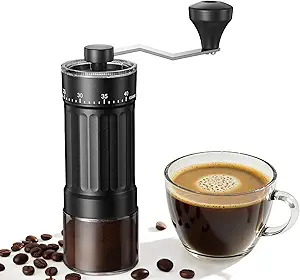 |
| Best Budget The cheapest option that still gets the job done reliably | Rsoilch Manual Coffee Grinder HS-011 |  |
| Top Rated A top-rated pick with lots of positive feedback | JavaPresse Manual Coffee Grinder |  |
| Most Popular A crowd favorite that many people choose with confidence | LHS Manual Coffee Grinder |  |
| Best Seller A high-volume bestseller chosen again and again | CEVING Manual Coffee Grinder MCG-MEGA-60 |  |
Hario Mini Mill Slim MSS-1B

| Capacity | 2 cups |
|---|---|
| Material Type | Ceramic |
| Power Source | Manual |
The Hario Mini Mill Slim is a compact manual coffee grinder that uses a ceramic burr to produce consistent grounds for drip, pour-over, and immersion brewing. It is operated by a removable hand crank and an adjustable knob that changes grind coarseness, while a transparent ground container lets you monitor dose. Its slim profile makes it easy to store or pack for travel and the disassembled parts clean easily. Because the mill is manual and modest in capacity it is best for one to two cups at a time and keeps runtime quiet and simple without electricity. The ceramic burr resists rust and holds flavor better than cheap steel, though it will require occasional recalibration and is not ideal for very fine espresso settings. Overall, this grinder delivers reliable, portable performance with straightforward controls for home brewers who want better-than-blade results on a budget.
Best for: Buyers seeking an affordable, compact manual grinder for daily single-serve or small-batch pour-over use who value portability and consistent ceramic burr performance.
Less Ideal for: Anyone who needs high-volume grinding, very fine espresso grinds, or hands-free electric convenience should consider a larger or motorized grinder instead.
- Ceramic burr for consistent, rust-resistant grinding and preserved flavor
- Slim, removable-handle design that saves storage space and is travel-friendly
- Adjustable grind knob and transparent container for visible dosing and easy calibration
- Easy to disassemble and clean
- Small capacity geared toward one to two cups rather than larger batch grinding
- Manual operation requires physical effort and is slower than electric grinders
Verdict: A compact, budget-friendly manual grinder that delivers consistent ceramic-burr grounds for single-cup and small-batch brewing.
1Zpresso K-Ultra Manual Grinder

| Burr material | Stainless steel |
|---|---|
| Burr size | 48mm |
| Adjustment | External dial, 20 microns per click |
| Capacity | 35–40 g catch cup |
| Power source | Manual |
The 1Zpresso K-Ultra is a performance-focused hand grinder that aims to deliver very consistent grounds for everything from espresso to pour-over. It uses a 48mm stainless steel conical burr and an external adjustment dial with over 100 clicks at roughly 20 microns per click, so dialing in fine to coarse settings is precise and repeatable. The magnetic catch cup holds about 35–40 g of grounds and snaps on for a faster workflow, while the foldable crank and included travel case make it easy to carry and store. The grinder disassembles tool-free for cleaning, and the burr assembly is fixed to the shaft to reduce wobble and preserve long-term stability. At its price point the K-Ultra focuses on grind quality and control rather than ultra-compact weight savings, so expect a sturdy aluminum body and a deliberate manual feel when cranking. If you want a manual grinder that prioritizes consistent, adjustable performance for espresso and filter brewing, the K-Ultra delivers a pro-level experience in a portable package.
Best for: Buyers seeking a manual grinder that prioritizes precise, repeatable grind control and real-world performance for espresso and specialty brewing.
Less Ideal for: Casual users who want the lightest, cheapest travel grinder or those who prefer electric convenience over manual effort.
- Large 48mm stainless steel conical burr for stable, consistent grind distribution
- External micro-adjustment dial with 100+ clicks for precise, repeatable settings
- Magnetic catch cup that holds 35–40 g and speeds up the workflow
- Tool-free disassembly and included cleaning brush make maintenance simple
- Foldable handle and travel case improve portability and storage
- Heavier, sturdier aluminum construction makes it less ideal for ultralight travel
- Premium features at a higher cost than basic budget grinders
Verdict: Choose the K-Ultra when you want a portable manual grinder that delivers precise, repeatable grind control and café-quality results.
CEVING Mini Manual Coffee Grinder

| Capacity | 30 g |
|---|---|
| Material Type | Ceramic |
| Power Source | manual winding |
| Adjustable Settings | 40 |
This compact CEVING grinder is built for precise, small-batch grinding on the go. It uses ceramic conical burrs and an external 40-step adjustment ring so you can dial in grind sizes from fine to coarse for espresso, pour-over, and French press. The 30 g bean hopper is sized for one or two cups, and the grinder is lightweight and simple to disassemble for cleaning without tools. Because it is hand-powered the feel is quiet and controllable, though it takes more effort and time than an electric grinder when making multiple cups. Ceramic burrs help keep heat low and deliver a consistent grind, but the small capacity and manual operation make this best for travelers, campers, or single-cup brewers rather than high-volume home use. Overall it delivers accurate, portable grinding at a budget-friendly level if you prioritize grind control and compactness over speed.
Best for: Buyers who want accurate, portable grinding for single-cup brewing or travel and prioritize grind consistency and compactness over speed.
Less Ideal for: Those who regularly make multiple cups or want a fast, hands-off electric grinder should consider higher-capacity or powered options instead.
- 40 external grind settings for precise adjustment across brew methods
- Ceramic conical burrs produce uniform grind with low heat transfer
- Compact and lightweight design suitable for travel and camping
- Detachable three-part construction simplifies cleaning and maintenance
- 30 g capacity limits use to one or two cups per grind
- Manual winding requires time and effort for multiple servings
Verdict: A budget-friendly, highly adjustable portable grinder that delivers consistent small-batch grinds for travelers and single-cup brewers.
Rsoilch Manual Coffee Grinder HS-011

| Capacity | 30 g |
|---|---|
| Included Components | Ceramic Burr, Stainless Steel Body |
| Material Type | Ceramic, Plastic |
This handheld grinder uses a ceramic conical burr and a 40-click adjustable grind to deliver consistent, uniform grounds across brew methods from espresso to French press. You crank the stainless steel handle by hand into the low-noise mechanism, which requires no power and is easy to use while camping or at home. The clear glass grounds container lets you watch the grind and helps avoid spills, and the ABS body keeps weight down for travel. The unit holds about 25 to 30 g of beans, so it is best for one to two cups at a time rather than large batches. Build materials are mostly plastic with a ceramic burr and stainless-steel elements, so it offers good grind quality for the price but will not match heavier all-metal hand mills for long-term durability. If you value portability, adjustable grind control, and a budget price, this grinder delivers a solid, quiet manual option for everyday brewing and occasional travel.
Best for: Buyers looking for an inexpensive, portable manual grinder to get fresh, adjustable grinds for one to two cups and to use while traveling or camping.
Less Ideal for: People who need to grind large volumes at once or who prefer a heavy-duty all-metal mill for long-term daily use.
- 40-step adjustable grind lets you dial in settings for espresso, pour-over, and French press
- Ceramic conical burr produces even grounds while preserving oils and aroma
- Compact, lightweight design is easy to carry for travel and camping
- Transparent glass grounds jar reduces mess and lets you monitor progress
- Small capacity (about 25–30 g) unsuitable for grinding larger batches
- Mostly plastic body may wear faster than heavier metal hand grinders
Verdict: A wallet-friendly, portable manual grinder that gives reliable, adjustable grounds for single-cup brewing and travel.
JavaPresse Manual Coffee Grinder

| Adjustable settings | 18 settings |
|---|---|
| Burr type | Ceramic conical burr |
| Power source | Manual |
| Material type | Stainless Steel |
The JavaPresse Manual Coffee Grinder is a hand-crank conical burr grinder designed for travelers and home users who want consistent grinds without electricity. You set one of 18 grind settings via an adjustable collar, then turn the ergonomic crank to grind beans into the detachable catch cup. Ceramic conical burrs deliver a uniform grind and are quieter and less prone to heat transfer than many steel alternatives, which helps preserve flavor for espresso, pour over, drip, and French press. Its stainless steel body and simple friction-fit parts make it durable for everyday use and easy to pack for camping. Expect slower throughput than an electric grinder, so it is best for single-serve or small-batch grinding rather than high-volume use, and coarse adjustment requires a little practice to hit exact settings. The lack of electric power is a strength for quiet reliability but means manual effort is required. Overall it offers precise, portable grinding on a budget with parts and construction aimed at everyday dependability.
Best for: Buyers who prioritize a dependable, low-maintenance grinder for single-serve or small-batch brewing and want a portable, quiet alternative to electric grinders.
Less Ideal for: If you frequently grind large quantities or need hands-free, high-speed grinding for a busy household, an electric grinder is a better choice.
- 18-step adjustable grind for a wide range of brew methods
- Ceramic conical burrs for consistent grind and reduced heat
- Compact, cord-free design suitable for travel and camping
- Stainless steel construction that feels durable and easy to clean
- Manual operation is slower and requires effort for larger batches
- Fine-tuning to exact settings can take practice
Verdict: A reliable, compact manual grinder that delivers consistent, low-noise grinds for single-serve and travel use.
LHS Manual Coffee Grinder

| Material Type | Stainless Steel |
|---|---|
| Power Source | manual |
| Specific Uses For Product | Coffee Grinder |
| Recommended Uses For Product | Grinding |
This LHS manual coffee grinder is a compact hand-crank mill built around a ceramic conical burr and stainless steel body, designed for simple home use or travel. You load whole beans into the top hopper, turn the crank to grind, and adjust the bottom rotor to set coarseness from fine to coarse for espresso, pour-over, drip, or French press. The ceramic burr reduces heat and preserves flavor while providing reasonably consistent particle size for a budget grinder, and the stainless components feel durable for everyday handling. It is straightforward to disassemble for rinsing and cleaning, and its small, lightweight design makes it easy to stash in a bag. Limitations are expected for the price: grinding takes longer and more elbow grease than electric models, and the grind consistency will not match higher-end burr grinders for very fine espresso. Still, for low-cost manual grinding and occasional use, it delivers good flavor retention and portability.
Best for: Buyers seeking an inexpensive, travel-friendly way to grind beans by hand who value flavor preservation and configurable grind size over speed.
Less Ideal for: People who need fast, high-volume grinding or precise, ultra-fine espresso-level consistency should choose an electric or higher-end burr grinder instead.
- Ceramic conical burr minimizes heat and helps preserve coffee flavor
- Adjustable coarseness from fine to coarse for multiple brew methods
- Stainless steel construction feels durable and portable
- Easy to disassemble and rinse for cleaning
- Manual operation requires more time and effort than electric grinders
- Grind consistency is limited compared with higher-end burr grinders
Verdict: A low-cost, portable manual grinder that preserves coffee flavor and lets you dial in coarseness for multiple brew methods.
CEVING Manual Coffee Grinder MCG-MEGA-60

| Capacity | 60 g |
|---|---|
| Grind settings | 40 external settings |
| Burr type | Ceramic conical burr |
The CEVING MCG-MEGA-60 is a hand-powered burr grinder designed for people who want larger single-session batches without relying on electricity. It holds up to 60 g of beans—about double many travel grinders—so you can grind enough for multiple cups or coarser brews like French press and cold brew in one go. The external 40-click adjustment ring makes switching grind size quick and visible, and the ceramic conical burr minimizes heat transfer to preserve oils and flavor. In use it performs as a straightforward travel or home backup grinder: it grinds evenly across the range and the larger capacity cuts down on repeated short sessions. Because it is manual, expect more effort for fine espresso-style grinds and slightly slower throughput than electric models. The unit is lightweight and compact for packing, though the manual winding power source means it is best for users who accept hand-cranking. For buyers focused on predictable, consistent results without complex setup, this grinder delivers practical value at a budget-friendly level.
Best for: Buyers who want a reliable, no-frills manual grinder that produces consistent grinds for multiple cups and values simple, visible adjustments over electronic features.
Less Ideal for: People who need fast, effortless grinding for daily espresso or who prefer fully electric, hands-off grinders.
- 60 g capacity lets you grind larger single batches without repeating sessions
- 40 external click settings provide easy, repeatable grind adjustments
- Ceramic conical burr preserves bean oils and reduces heat during grinding
- Lightweight and portable for travel, camping, or small kitchens
- Manual operation requires physical effort and is slower than electric grinders
- May be less convenient for daily users who need quick fine espresso-level grinds
Verdict: Choose this grinder if you want a budget-friendly, portable manual mill that reliably grinds larger single batches with precise, click-adjustable settings.
Choosing the Right Budget Manual Coffee Grinder: Key Factors to Consider
Burr Type and Material
The burrs are the single most important mechanical element affecting particle size distribution and longevity. Conical burrs are common in budget manual grinders because they tend to be forgiving on speed and produce a uniform grind across a range of settings. Steel burrs wear more slowly and can maintain a consistent grind for many months of regular home use, while ceramic burrs resist corrosion and heat but can chip if dropped.
When choosing a budget manual grinder, confirm whether the burrs are removable and whether replacement parts are available. That keeps the grinder serviceable beyond the unit's initial lifespan and protects any small additional investment you make.
Adjustment Range and Stepless Vs Stepped
Adjustment determines how finely you can dial in grind size for different brew methods. Stepped systems click between preset positions and make it faster to switch between a few common grinds. Stepless adjustment enables micro-tuning for espresso or pourover but can be harder to replicate consistently unless the grinder has clear indexing.
On budget models, stepped adjustments are often simpler and more repeatable for everyday pour-over and French press use. If you plan to switch frequently between extraction methods, prefer a grinder with clear stop points or an easy way to mark preferred settings.
Ergonomics and Handfeel
Manual grinding is a physical task, so crank length, handle shape, and resistance matter. A longer crank reduces the force needed per rotation but can add bulk. Comfortable handles with a secure grip reduce hand fatigue during multiple doses. Consider the diameter of the hopper and how easily beans feed into the burrs without jamming.
Also check how the grind container attaches and whether it wobbles during use. A stable, well-aligned assembly keeps grinding efficient and prevents frustration during daily use.
Capacity and Portability
Budget manual grinders vary from small travel models that hold a single brew dose to larger units that store multiple scoops. If you primarily make one or two cups at a time, a compact unit reduces weight and footprint. If you routinely prepare coffee for several people, a larger hopper and catch cup reduce the need for repeated fills.
Think about where you will use the grinder. A travel-friendly model that disassembles and packs into luggage is useful for trips, while a heavier, more robust unit may be preferable for a permanent home coffee station.
Ease of Cleaning and Maintenance
Ground coffee oils accumulate in burrs and housing and can change flavor over time. Budget manual grinders that disassemble without tools or have easily removable burrs speed cleaning and reduce buildup. Look for grinders where the catch cup, hopper, and burr housing are straightforward to access and wipe out.
Regular light cleaning maintains consistent performance. Also consider whether the grinder's finish and materials hide coffee oils or show wear quickly, and whether the manufacturer provides guidance on part replacement intervals.
Why Manual Grinders Can Beat Electric Options For Value
Manual grinders often deliver comparable grind quality for many home brew methods at a fraction of the cost of quality electric grinders. Because they eliminate a motor, manual units focus budget toward better burrs and tighter tolerances that influence extraction.
Manual models also give you control over grind speed, which reduces heat buildup and preserves bean flavor. For brewers who rarely need more than a few cups at once, the slower hand grind is an acceptable tradeoff for consistent results and lower upfront expense.
- Lower complexity means fewer parts to fail
- Better burr quality per dollar in many budget models
- Power-free operation for travel and off-grid use
Common Tradeoffs With Budget Manual Grinders
Budget designs make pragmatic choices. You may see molded plastic in noncritical parts, stepped adjustments instead of stepless, or lighter-duty bearings. These changes reduce cost but often do not prevent satisfactory daily performance.
Expect slower grind rates and potentially shorter warranty terms versus premium machines. The key is whether the grinder's core components — the burrs and adjustment mechanism — are well engineered. If those are solid, other compromises are manageable.
- Smaller hoppers require more frequent refills
- Lightweight constructions can be less stable during grinding
- Some budget burrs dull faster and may need replacement sooner
Setting Up and Calibrating a New Manual Grinder
When you first get a manual grinder, run a few test grinds and record the setting numbers that produce the results you like for each brew method. If the adjustment is stepped, mark or note the clicks. For stepless systems, count full turns from a reference point to reproduce settings.
Also clean the burrs of any factory residues and make a few blank runs to ensure beans feed consistently. Over time you will develop a small cheat sheet of settings that makes switching between pour-over, Aeropress, or French press quick and repeatable.
- Make small adjustments and test several extractions
- Keep a reference mark for favorite grind sizes
- Break in new burrs with a few doses before evaluating final performance
Maintaining Sharpness: When To Replace Burrs
Burr wear gradually increases fines and reduces consistency. You usually notice a change in flavor before visual wear is obvious. If grind distribution becomes noticeably dustier at settings that previously produced even particle sizes, burrs may be nearing the end of useful life.
In budget grinders, having removable burrs and available replacements extends the unit's service life. Routine light cleaning reduces abrasive buildup and helps burrs last longer, but plan on eventual replacement if you use the grinder frequently.
- Track extraction changes rather than relying on sight alone
- Keep spare burrs available if you grind a lot
- Regularly clear trapped grounds and oils to slow wear
Tips For Using Manual Grinders On The Go
Choose a compact model with a secure catch cup that fastens tightly for travel. Disassembling the crank and handle for packing reduces damage risk and saves space. Keep a small brush or cloth for quick field cleaning after each use.
When grinding in unfamiliar settings, brace the grinder against a stable surface and grind in steady, even strokes. This reduces wobble and improves consistency compared with hurried or uneven motion.
- Pack parts separately to avoid stress on the adjustment knob
- Carry a small travel brush to keep burrs clean
- Practice in home conditions before relying on a grinder on a trip
How We Chose the Best Budget Manual Coffee Grinder
We started by focusing on grinders that are explicitly positioned for budget-conscious buyers and that use adjustable burr systems rather than blade-style mechanisms. Key evaluation criteria included burr type and grind consistency, build materials and durability, adjustment range and precision, ease of use and speed for typical home doses, and ease of cleaning and maintenance. We excluded blade grinders and models that rely on proprietary replacement parts that are hard to source. We also filtered out grinders designed solely for decorative or novelty use rather than repeatable brewing performance. For each shortlisted grinder we confirmed it offered a reasonable grind range covering coarse to fine settings suitable for common manual brewing methods, that burrs were serviceable, and that the grinder's ergonomics supported regular use. Our selection emphasized real-world usability for daily brewing, not theoretical maximum throughput or unusual features that do not affect coffee quality.
Our full evaluation process is outlined in our review methodology.
FAQ
How fine can a budget manual coffee grinder go for espresso?
Many budget manual grinders can reach a fine espresso-like setting, but the particle distribution may not match that of pricier espresso-focused grinders. For consistent espresso you usually need very precise, repeatable adjustment and high-quality burrs, so results can vary.
Are ceramic burrs better than steel in budget grinders?
Ceramic burrs resist corrosion and retain sharpness for a long time, but they can be more brittle. Steel burrs are tougher and often preferable in budget grinders because they are less likely to chip and can handle higher-volume use.
How often should I clean a manual coffee grinder?
Light cleaning after several uses and a more thorough disassembly cleaning every few weeks is common for home use. Frequency depends on how oily your beans are and how much you grind. Regular cleaning helps maintain consistent flavor and grind performance.
Can a manual grinder handle dark, oily beans?
Yes, but oily beans are more likely to leave residues that gunk up the burrs and housing. Choose a grinder that disassembles easily for cleaning if you plan to use darker roasts frequently.
Is crank length important for comfort?
Crank length affects leverage and the force required to grind. Longer cranks reduce effort per rotation but add bulk. If you plan to grind multiple doses often, a longer crank or ergonomic handle will reduce hand fatigue.
Final Verdict
For budget-focused manual coffee grinders, prioritize burr quality, a usable adjustment range, and ease of maintenance. Those three factors determine whether a low-cost grinder will deliver repeatable, satisfying results over time. Accepting tradeoffs in materials or capacity can be fine if the core grinding mechanism is solid. Focus on the grind consistency you need for your preferred brew methods and choose a unit with removable burrs and straightforward cleaning to extend useful life.