
Note: This article contains affiliate links. If you click on these links and make a purchase, we may earn a small commission at no extra cost to you. This helps support our research and content. Read our full affiliate disclosure here.
If you want consistent deli-style cuts at home without spending a lot, a budget meat slicer can give you the control missing from knives alone. The right slicer saves time when portioning roasts, ham, or homemade charcuterie and produces even thickness for sandwiches and meal prep. This guide rounds up the top budget meat slicers we shortlisted for home cooks who want dependable blades, straightforward cleaning, and safe operation. Below you will find practical notes on what matters most and how each pick stacks up against common home-kitchen use cases.
Top Picks at a Glance
| Best Quality Built to a higher standard if you want something more solid | Cuisinart Kitchen Pro FS-75 |  |
| Best Value The sweet spot between price and what you get | Pterying 200W Meat Slicer |  |
| Best Budget The cheapest option that still gets the job done reliably | Valley Sportsman Meat Slicer 7.5" |  |
| Top Rated A top-rated pick with lots of positive feedback | SUPER DEAL Meat Slicer 7.5" |  |
| Most Popular A crowd favorite that many people choose with confidence | CUSIMAX 8.7" Meat Slicer |  |
| Best Seller A high-volume bestseller chosen again and again | OSTBA Meat Slicer SL-518 |  |
Cuisinart Kitchen Pro FS-75

| BladeLength | 7.5 inches |
|---|---|
| Operation Mode | Automatic |
| Material Type | Alloy Steel |
| Blade Material Type | Stainless Steel |
| Included Components | Slicer houseing^slicing blade |
The Cuisinart Kitchen Pro FS-75 is a compact electric slicer aimed at home use that tackles meats, firm cheeses, bread, and vegetables with a 7.5" stainless steel blade and a slice control knob that adjusts thickness from 1/32" to 1/2". It is driven by a 130-watt motor that provides steady power for deli-style slices and a die-cast aluminum and coated steel housing that feels durable for the price. The carriage, blade, and food guide are removable, which makes cleanup easier than fixed designs, and non-slip feet plus a long power cord simplify countertop placement. Because it is built for home kitchens, the motor is adequate for regular household portions but not intended for continuous commercial use, and the unit requires hand washing for components. For buyers focused on solid performance without premium cost, it delivers precise, repeatable slices and sensible construction, though users expecting restaurant-level throughput or heavy daily duty should consider higher-capacity models.
Best for: Buyers who want deli-style performance on a kitchen countertop and prioritize accurate, repeatable slices for home cooking without spending on a commercial machine.
Less Ideal for: People who need high-volume, all-day slicing for a professional kitchen or catering operation should choose a commercial-grade slicer instead.
- Adjustable slice thickness from 1/32" to 1/2" for precise cuts
- 7.5" stainless steel blade suitable for meats, cheeses, and bread
- 130-watt motor provides consistent power for home slicing tasks
- Removable blade, carriage, and food guide for easier cleaning
- Designed for home use so not suited for heavy commercial throughput
- Requires hand washing of components rather than dishwasher safe
Verdict: A compact, performance-focused home slicer that delivers precise, deli-style cuts without the cost of a commercial unit.
Pterying 200W Meat Slicer

| Motor power | 200W |
|---|---|
| Blade length | 7.5 inches |
| Materials | Cast iron body, stainless steel blades |
| Operation mode | Automatic |
The Pterying 200W Meat Slicer is a budget-friendly countertop slicer aimed at home cooks who want deli-style results without commercial bulk. It uses a 200W motor and two removable 7.5" stainless-steel blades to slice meats, cheese, bread, and vegetables; a thickness dial adjusts from very thin deli cuts up to about 12mm for thicker servings. Safety features include a dual-action child lock, a food pusher that doubles as a blade guard, and non-slip suction feet paired with an 11-pound cast iron base for stability. Most parts detach for hand washing and the unit assembles without tools, which keeps cleaning and storage straightforward. Limitations are expected for the price: hand wash only components and a compact blade limit the size of roasts you can process, and the motor power is suitable for home use but not heavy duty daily commercial workloads. For home meal prep, charcuterie, and occasional bread slicing, it delivers good value with sensible safety and cleanup design.
Best for: Buyers who want an affordable, practical slicer for home meal prep, charcuterie, and occasional bread or deli slicing and value safety and easy disassembly.
Less Ideal for: Those who need a commercial-grade slicer for heavy daily use or who regularly slice very large roasts should consider a larger, higher-powered machine.
- 200W motor with two 7.5" stainless-steel removable blades for even slicing
- Adjustable thickness dial from ultra-thin to about 12mm for versatile cuts
- Safety features including dual-action child lock and non-slip suction feet
- Detachable components for easier hand washing and tool-free assembly
- Heavy cast iron base improves stability during operation
- Hand-wash-only parts increase post-use maintenance time
- Blade size and motor limit handling of very large or continuous heavy-duty slicing
Verdict: A practical, budget-focused home slicer that delivers versatile deli-style cuts with sensible safety and easy teardown for cleaning.
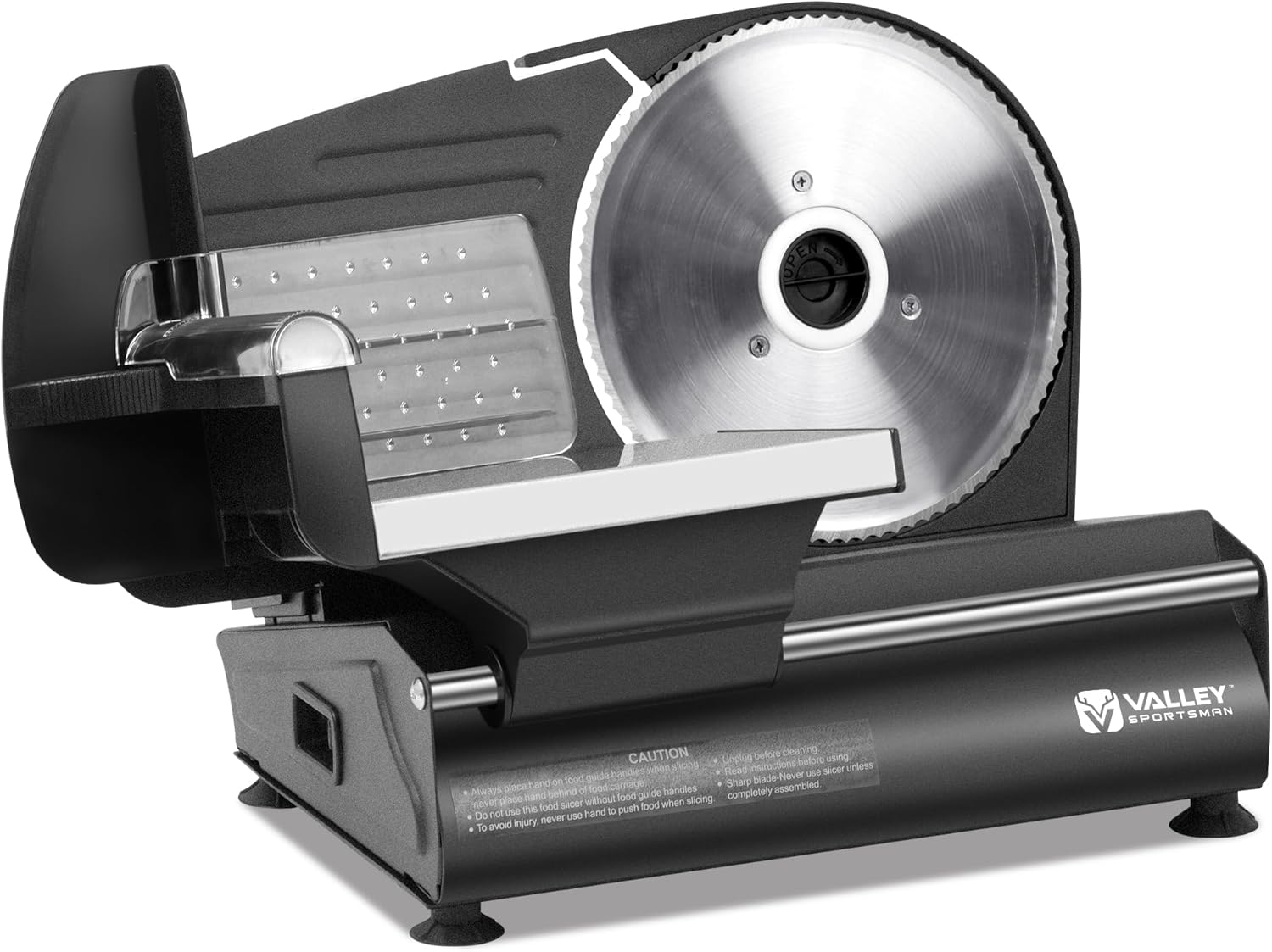
Valley Sportsman Meat Slicer 7.5"
| BladeLength | 7.5 inches |
|---|---|
| Operation Mode | Automatic |
| Material Type | Stainless Steel |
| Power | 180 W |
This compact Valley Sportsman electric meat slicer brings deli-style slicing to a budget kitchen with a 7.5-inch stainless steel blade and a 180 W motor. It is meant for countertop or tabletop use and handles sliced meats, cheeses, bread, and vegetables; the adjustable thickness control lets you go from very thin to about 0.56 inches for thicker cuts. Removable parts including the blade, carriage, and food pusher simplify cleaning and the rubberized feet add stability during operation. The unit is ETL, CE, GS and EMC listed, which covers basic safety expectations for home use. Practical limitations to expect at this price are a smaller cutting capacity compared with commercial slicers and a modest motor that is best for regular home portions rather than continuous heavy-duty processing. For a budget buyer it delivers essential slicing performance, easy cleanup, and a small footprint, provided you accept less industrial power and a compact work area.
Best for: Buyers on a tight budget who want deli-style slicing at home and need a compact, easy-to-clean machine for occasional to regular household use.
Less Ideal for: People who need a commercial-grade machine for heavy or continuous slicing sessions or who require a larger cutting capacity for big batches.
- Compact countertop design saves space and stores easily
- 7.5-inch stainless steel blade suitable for meats, cheese, bread, and vegetables
- Adjustable thickness control for paper-thin to thicker slices
- Removable blade and carriage make cleaning more straightforward
- Certified to common safety standards (ETL, CE, GS, EMC) and has rubberized feet for stability
- 180 W motor is modest and not intended for heavy continuous commercial use
- Smaller cutting capacity compared with larger, higher-end slicers
Verdict: A space-saving, budget-friendly electric slicer that brings adjustable, household deli slicing to the countertop without the cost of larger commercial units.
SUPER DEAL Meat Slicer 7.5"

| Blade length | 7.5 inches |
|---|---|
| Power | 150 watts |
| Operation mode | Automatic |
| Material type | Alloy Steel, Aluminum, Plastic, Stainless Steel |
The SUPER DEAL Meat Slicer is a budget-friendly electric slicer aimed at home cooks who want deli-style cuts without visiting a store. It uses a 7.5-inch stainless steel blade driven by a 150-watt motor to slice cold cuts, roasts, cheese, bread, and produce; thickness adjusts from very thin to about 3/5 inch so you can make prosciutto or sandwich slices. The unit includes a removable carriage, ring-guard cover, and a detachable meat-grip arm to simplify cleaning and keep food from contacting the blade housing. Built with a die-cast aluminum body and suction feet for stability, it is designed for regular kitchen use rather than heavy commercial workloads. Expect careful handling for safety and hand-wash cleaning as recommended. On the budget end you get solid slicing power and useful safety features, but construction and long-term durability will reflect its price point compared with higher-end, professional models.
Best for: Buyers who want an affordable, dependable home slicer to produce deli-style cuts and party platters without professional equipment upkeep.
Less Ideal for: Not a good fit for commercial kitchens or users who need continuous heavy-duty slicing for high-volume production.
- Adjustable slice thickness from very thin to about 3/5 inch for versatile cuts
- 7.5-inch stainless steel blade with a 150-watt motor for consistent home slicing
- Removable carriage, ring-guard cover, and meat-grip arm for easier cleaning and safer handling
- Die-cast aluminum body and suction feet add stability during use
- Designed for home and light use rather than heavy commercial throughput
- Requires hand washing and some disassembly to clean thoroughly
Verdict: A reliable, budget-minded home slicer that delivers consistent deli-style cuts with useful safety and cleaning features.
CUSIMAX 8.7" Meat Slicer

| Power | 200 watts |
|---|---|
| Blade Diameter | 8.7 inches |
| Thickness Range | 1-20mm |
| Operation Mode | Automatic |
The CUSIMAX 8.7" Meat Slicer is a compact countertop machine designed for home deli tasks like slicing cooked meats, cheese, bread and vegetables. It runs on a 200W motor and uses an 8.7-inch stainless steel blade; two removable blades and a carriage make it straightforward to swap tasks and clean, while the thickness knob adjusts slices from about 1mm up to 20mm for anything from paper-thin prosciutto to chunky sandwich cuts. Safety-minded touches include a blade guard, food pusher and non-slip feet, and the manufacturer recommends avoiding frozen or bone-in foods and limiting continuous runs. The unit is dishwasher-safe for some parts, which helps cleanup, but it is relatively heavy for a small appliance and not intended for industrial or continuous commercial use. For budget-focused home cooks who want deli-style results and easy maintenance, this slicer covers the essentials without complex controls or large footprints.
Best for: Buyers seeking an affordable, home-focused meat slicer that delivers consistent deli-style slices and is easy to clean and store, with a preference for proven customer feedback and basic safety features.
Less Ideal for: People who need a commercial-grade slicer for heavy daily use or who plan to cut frozen or bone-in meats should look at more powerful professional machines.
- Adjustable slice thickness from 1–20mm for fine to thick cuts
- 8.7-inch stainless steel blade with two removable blade options
- Removable food carriage and parts for easier cleaning
- Safety features include blade guard, food pusher and non-slip feet
- Not rated or recommended for frozen or bone-in meats and not for continuous commercial use
- Some parts still require manual cleaning despite removable components
Verdict: A budget-friendly home deli slicer that delivers adjustable, consistent slices with simple cleaning and safety features ideal for household use.
OSTBA Meat Slicer SL-518

| Blade length | 7.5 inches |
|---|---|
| Power | 150W |
| Adjustable thickness | 0-15mm |
| Operation mode | Automatic |
| Material type | Stainless Steel |
The OSTBA SL-518 is a small, budget-friendly electric meat slicer aimed at home cooks who want consistent deli-style slices. It uses a 7.5-inch stainless steel blade driven by a 150W motor and offers an adjustable thickness dial from paper-thin up to about 15mm, letting you slice meats, cheeses, bread, and vegetables for sandwiches or meal prep. The blade, food carriage, slide rod and pusher are removable, which makes cleaning easier and helps keep the unit hygienic, and a safety lock plus dual-button start reduce accidental operation. Non-slip suction feet add stability while cutting. Expect straightforward, occasional-home use performance rather than restaurant throughput: the 150W motor handles typical household quantities well but will slow with very large or frozen pieces. Some buyers may miss a full metal food tray or heavier-duty motor, but for everyday deli slicing and small batches this model delivers consistent, adjustable cuts at a low price point.
Best for: Buyers looking for an affordable, easy-to-use home deli slicer who prioritize safe operation, simple cleaning, and reliable everyday slicing for sandwiches and meal prep.
Less Ideal for: Not a good fit for users who need continuous high-volume or commercial-grade slicing, or who plan to process large frozen roasts frequently.
- Removable blade and carriage for easier cleaning and sanitation.
- Adjustable thickness control from very thin to about 15mm for versatile slicing.
- Safety lock plus dual-button start reduces accidental powering on.
- Compact footprint suitable for countertop storage.
- Stainless steel blade provides consistent, sharp cuts for deli meats and cheese.
- 150W motor is intended for household volumes and can struggle with very large or partially frozen items.
- No built-in heavy-duty metal food tray on this specific model for higher-volume catching.
- Some parts may feel plasticky compared with commercial slicers.
Verdict: A compact, safety-minded home slicer that delivers adjustable, clean slicing for everyday deli tasks at a budget-friendly price.
Choosing the Right Budget Meat Slicer: Key Factors to Consider
Blade Material and Size
Blade composition determines edge retention and resistance to corrosion. Stainless steel blades are common on budget slicers because they balance durability with corrosion resistance, but vary in hardness and sharpening needs. A larger diameter blade slices more smoothly through bulky cuts, while a smaller blade can be lighter and easier to maintain.
Blade size also affects the maximum width of meat you can process. If you routinely slice larger roasts or whole hams, choose a slicer with a blade diameter that accommodates the width you need. Consider whether the blade is removable for sharpening or replacement because that affects long-term upkeep and cost.
Motor Power and Speed Control
Motor power dictates how well a slicer handles dense or chilled items without bogging down. For home use, look for a motor spec and a design that maintains steady RPM under load rather than one that stalls or vibrates excessively.
Speed control matters for versatility. Variable speed or a moderate fixed speed helps with different foods: a slower speed works well for delicate cheeses and soft breads, while a steadier higher speed is preferable for firmer meats. Consider duty cycle guidance and whether the slicer is rated for occasional home use versus continuous commercial runs.
Ease of Cleaning and Maintenance
Meat slicers encounter raw proteins and fats, so the ability to clean thoroughly is essential for food safety. Designs that allow the blade guard and food carriage to be removed without tools make routine cleaning faster and more reliable.
Look for smooth surfaces, minimal crevices, and parts that can be wiped or rinsed easily. Also check how accessible the blade edge is for safe sharpening and whether the manufacturer provides clear maintenance instructions. Easy-to-find replacement parts and a straightforward disassembly process reduce long-term ownership hassle.
Safety Features and Stability
Effective safety measures reduce the risk of cuts and accidental operation. Important features include a solid blade guard, a secure on/off switch that is easy to reach, non-slip feet or suction bases, and a food pusher or carriage that keeps hands away from the blade.
Stable construction prevents the slicer from moving during use, which improves cut consistency and reduces accidents. Evaluate how well the carriage locks in place and whether controls are positioned to prevent inadvertent activation while adjusting thickness or loading meat.
Size, Weight, and Storage
Counter space and storage are common constraints in home kitchens. Compact machines are easier to tuck away but may limit the size of meat you can slice. Conversely, larger machines offer more capability but require dedicated space.
Weight affects stability and portability. Heavier units tend to be steadier during cutting but are harder to move for storage. Consider where you will keep the slicer and whether it needs to be light enough to lift into a cabinet or heavy enough to stay put during use.
Getting Even Slices Every Time
Consistent thickness is the main reason most people buy a slicer. Look for precise thickness adjustment that stays locked during operation and a carriage that feeds the meat smoothly past the blade. Some budget units offer micro-adjustment knobs or discrete step settings; either can work as long as the setting does not drift while slicing.
Practice with chilled, but not frozen, meat and use steady, even pressure when guiding the carriage. Softer items require a slower feed and sometimes a damp cloth around the carriage to keep them stable.
- Prefer models with a clear thickness gauge that clicks into place
- Use the food pusher or carriage lock to prevent hand contact with the blade
- Slice chilled meats for cleaner cuts and less drag on the blade
Maintaining Food Safety
Sanitation is critical when handling raw meat. After each use, disassemble any removable guards and the food carriage for cleaning with hot, soapy water. Wipe the motor housing and base with a damp cloth; do not submerge electrical components.
If your slicer has removable blades, clean and dry them thoroughly before reassembly to prevent rust. Regularly inspect seals and fasteners to ensure there are no buildup spots where bacteria could hide.
- Sanitize surfaces that contact food after every session
- Follow manufacturer guidance on blade removal and reinstallation
- Allow parts to dry completely to reduce corrosion risk
Sharpening and Blade Care
Even quality blades dull over time. Some budget slicers include a built-in sharpener, while others require manual honing. Knowing whether the blade can be removed for sharpening or whether the machine supports an onboard sharpener affects the effort needed to keep cuts clean.
Sharpening frequency depends on use. For occasional home slicing, expect to hone or sharpen a few times a year. Always follow safe procedures and keep the sharpener aligned to the blade angle to avoid uneven edges.
- Check if the unit has a removable blade for external sharpening
- Use recommended sharpening tools and follow safety steps
- Test blade sharpness on a small piece of meat before a large job
Space-Saving Setup and Storage Tips
Budget slicers often trade bulk for convenience. If counter space is limited, measure the machine's footprint and ensure you can access the carriage and blade for cleaning when the unit is stored. Consider storing the slicer on a slide-out shelf or near a sink for easier cleanup.
Use a protective cover for stored slicing equipment to limit dust and kitchen debris on exposed surfaces. If the unit is heavy, store it in a location where you will not need to move it frequently.
- Keep clearance around the carriage for safe operation
- Store blades and small removable parts in a labeled container
- Position the slicer near a prep area to reduce handling time
Common Home Use Scenarios
Budget meat slicers are best for weekly meal prep, sandwich assembly, and slicing roast for family dinners. They excel at producing uniform slices for portion control and presentation without the need for professional equipment.
For occasional holiday or party preparation, choose a model with slightly higher motor power and a sturdy carriage to manage larger volumes. For mostly cheese and deli meats, a lighter-duty unit with easy blade removal may be preferable.
- Light use: soft cheeses, deli meats, small roasts
- Moderate use: regular family meal prep and sandwich slices
- Heavy home use: larger roasts for gatherings requires sturdier motors
How We Chose the Best Budget Meat Slicer
We selected slicers that deliver reliable performance on a limited budget by focusing on criteria that directly affect everyday use. First, blade quality and material were prioritized because a sharp, well-balanced blade determines slice consistency and how long the unit stays useful between sharpenings. Second, motor power and speed control were assessed to ensure each slicer can handle common home tasks like cold roast, ham, and firm cheeses without bogging down. Third, ease of cleaning and maintenance was a gating factor, favoring designs with removable guards, accessible surfaces, and simple disassembly. Fourth, safety features were required, such as a stable base, blade guard, and clear on/off controls. Finally, build quality and usable accessories were considered to judge long-term reliability. We excluded heavy industrial or commercial machines and models with unclear safety features or poor user-accessible maintenance. Units that required costly specialty parts for common upkeep were also left out. The result is a list focused on practical home use, balancing cutting performance, user safety, and straightforward upkeep.
Our full evaluation process is outlined in our review methodology.
FAQ
How often should I sharpen a home meat slicer blade?
Sharpening frequency depends on how often you slice and the types of food. For occasional home use, sharpening a few times a year is common. Hone the blade more frequently and perform a full sharpening when you notice drag or uneven cuts.
Can I use a budget meat slicer for cheese and vegetables?
Yes. Most budget slicers handle firm cheeses and vegetables well. Softer cheeses require slower feeds or chilling first to avoid smearing, and some vegetables may need trimming to fit the carriage safely.
Is it safe to clean the blade myself?
Cleaning the blade yourself is safe if you follow precautions. Unplug the machine, use a sturdy food pusher or glove, and remove guards as instructed. Wipe from the non-cutting edge and follow any manufacturer cleaning steps.
Do budget slicers run hot during use?
Under normal home use, a properly sized slicer may feel warm but should not overheat. If the motor gets excessively hot or performance drops, stop and allow it to cool. Continuous commercial-style runs are not recommended for budget home units.
What maintenance extends the life of a budget slicer?
Regular cleaning, drying, and timely blade sharpening extend lifespan. Inspect fasteners and seals, tighten loose parts, and replace worn non-slip feet or guards. Avoid slicing frozen items, which can damage blades and the motor.
Final Verdict
Choose a budget meat slicer that prioritizes blade quality, reliable motor performance, and easy cleaning. Expect tradeoffs: smaller, lighter machines save space and cost less but may limit the size and frequency of jobs, while heavier units offer better stability and longevity. Focus on safety features and the ability to maintain and sharpen the blade without specialized tools. With those priorities, you can pick a compact, affordable slicer that handles weekly prep and occasional larger tasks with confidence.