
Note: This article contains affiliate links. If you click on these links and make a purchase, we may earn a small commission at no extra cost to you. This helps support our research and content. Read our full affiliate disclosure here.
Choosing the right built-in electric cooktop with downdraft matters when you want strong ventilation without an overhead hood. A downdraft system pulls steam and smoke away at the cooktop level, which can be crucial in kitchens with limited ceiling clearance or open layouts. You need a cooktop that balances reliable heat control, effective airflow, and straightforward maintenance. This guide covers the top six shortlisted built-in electric cooktops with downdraft, focusing on venting performance, cooktop usability, safety features, and installation considerations. Read on to see the evaluation criteria we used and the practical tradeoffs to weigh before picking the right unit for your kitchen.
Top Picks at a Glance
| Best Overall The best all-around choice for most situations | Cooksir 36-Inch Electric Cooktop |  |
| Best Quality Built to a higher standard if you want something more solid | CDV CABEH304BF Induction Cooktop |  |
| Best Value The sweet spot between price and what you get | GASLAND 31.5" Downdraft Electric Cooktop |  |
| Best Budget The cheapest option that still gets the job done reliably | Hobsir 36 Inch Electric Downdraft Cooktop |  |
| Top Rated A top-rated pick with lots of positive feedback | GASLAND 31.5" Electric Cooktop |  |
| Most Popular A crowd favorite that many people choose with confidence | Cooksir 30-Inch Electric Cooktop |  |
Cooksir 36-Inch Electric Cooktop

| Number of Heating Elements | 4 |
|---|---|
| Wattage | 7400 watts |
| Power Source | Corded Electric |
| Control Type | Touch |
| Additional Features | Adjustable Temperature, Digital Display, Hot Surface Indicator, Safety Lock, Timer |
The Cooksir 36-inch electric cooktop combines a glass-ceramic four-burner surface with a built-in downdraft vent, aiming to replace a separate overhead hood for a cleaner kitchen layout. It delivers 7400W total power across versatile cooking zones including a bridge griddle and a dual-ring burner, controlled by a touch panel with a timer, pause, child lock, and hot-surface residual-heat indicators. The downdraft is ductless and offers nine fan speeds with up to 360 CFM to pull fumes down and recirculate air, which is handy for high-heat cooking in kitchens where ducting is impractical. Installation is drop-in for a 34.25" x 19.29" cutout and the tempered glass top is easy to wipe clean. Expect the benefits of strong surface heating and space-saving ventilation, but keep in mind this is a 220–240V hard-wired unit that requires compatible wiring and careful fitment for the specified cutout. The controls and safety features make it family-friendly, while the integrated vent simplifies design for remodels or compact layouts.
Best for: Home cooks who want a space-saving built-in cooktop that combines strong surface heat with integrated downdraft ventilation and family-friendly safety controls.
Less Ideal for: Those who cannot accommodate 220–240V hard wiring or who prefer maximum odor removal and outside venting that only a ducted hood can provide.
- Integrated ductless downdraft with 9 speed settings and up to 360 CFM for effective smoke extraction without external ducting
- 7400W total power with a bridge griddle and dual-ring burner for flexible, high-heat cooking
- Touch controls with timer, pause, child lock, and residual-heat indicator for convenient and safe operation
- Tempered glass-ceramic surface that is easy to clean and provides even radiant heating
- Requires 220–240V hard-wired installation and the specified cutout, which may need professional electrical and countertop work
- Ductless recirculation may not remove odors as completely as a vented ducted hood
Verdict: Choose this cooktop if you want a powerful built-in electric surface with an integrated downdraft to save space and avoid installing an overhead hood.
CDV CABEH304BF Induction Cooktop

| Number of Heating Elements | 4 |
|---|---|
| Heating Element | Induction |
| Control Type | Touch |
| Installation Type | Drop-In |
| Wattage | 7200 watts |
This CDV CABEH304BF combines a four-zone induction surface with a built-in ductless downdraft to give a compact, performance-focused cooking station for kitchens without an overhead hood. The glass-ceramic top and touch controls make it simple to position and adjust heat quickly, and induction delivers fast boil times, precise simmering and safety benefits because the cooktop itself stays relatively cool. The integrated downdraft pulls smoke and steam down through the unit so you can install the cooktop in an island or against a backsplash where a traditional hood is impractical, though ductless systems rely on filters and recirculation rather than venting outside. At 7200 watts total the unit supports high-output cooking across multiple burners, but installation requires a drop-in cutout and planning for the recirculation path and filter access. Expect the usual induction limitations: pans must be induction-compatible and the downdraft will not match the extraction power of a dedicated external-vent hood. For buyers prioritizing compact, high-performance built-in cooking with integrated ventilation, this model is a solid option.
Best for: A buyer who wants a high-performance, built-in induction cooktop with integrated ventilation for island or compact installations and values quick heat response and precise control.
Less Ideal for: Homes that need maximum kitchen exhaust power or prefer external-vent hood systems for heavy frying and high-volume smoke situations should look elsewhere.
- Four induction cooking zones for fast, responsive heating and precise temperature control.
- 7200 watts total power suitable for high-output, multi-burner cooking.
- Integrated ductless downdraft adds ventilation without an overhead hood.
- Glass-ceramic surface with touch controls is easy to clean and offers a modern look.
- Ductless downdraft recirculates air through filters and cannot match the extraction of an external venting hood.
- Requires induction-compatible cookware to achieve full performance.
Verdict: Choose this unit if you want a powerful 30-inch built-in induction cooktop with a factory-quality downdraft for strong on-counter performance where an overhead hood is not possible.
GASLAND 31.5" Downdraft Electric Cooktop
| Number of Heating Elements | 4 |
|---|---|
| Wattage | 7400 watts |
| Voltage | 220 volts |
| Control Type | Touch |
| Additional Features | Downdraft Exhaust, Sync Element, Child Lock, Warm Setting |
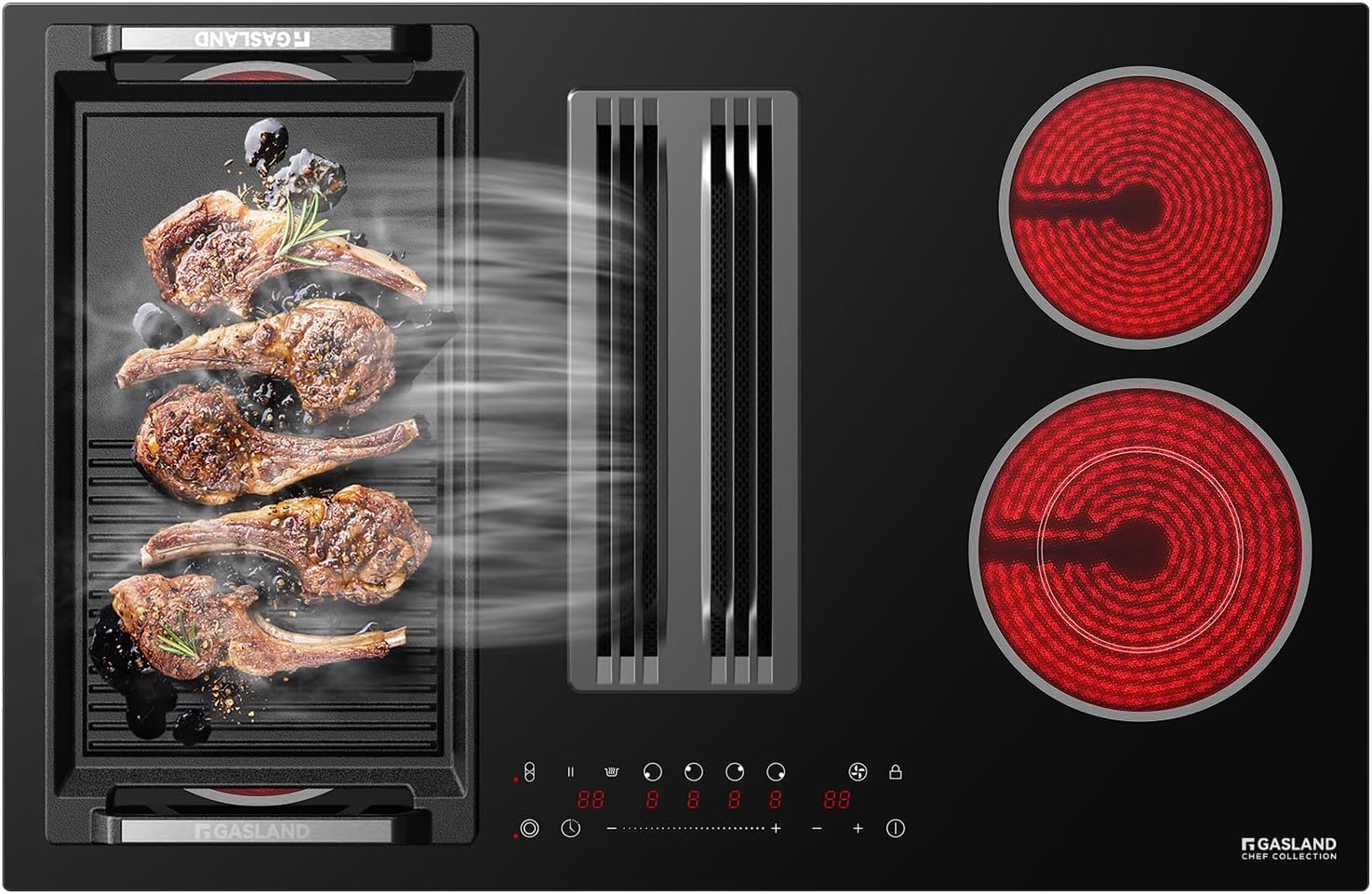
This GASLAND cooktop combines four radiant heating zones with a built-in downdraft exhaust to provide a compact, island-friendly cooking surface. It is typically installed as a drop-in unit where an overhead hood is impractical and is used for everyday stovetop tasks plus griddle-style cooking using the bridge element. Notable features include a bridge/flex zone that links two burners for long pans or griddles, a dual-ring element for better fit with different cookware sizes, a slide touch control and a 99-minute timer, and a downdraft fan rated up to about 330 CFM with washable grease filter. Practical benefits are a sleek glass-ceramic surface that wipes clean, removable drip pan and dishwasher-safe filter parts, and safety aids like child lock, hot surface warning, and auto shutoff. Limitations are the requirement for a 220V connection and that downdraft ventilation may be less powerful than a full overhead hood for very heavy smoke or high-heat commercial cooking.
Best for: Buyers who want a space-saving built-in cooktop with integrated ventilation for open-plan kitchens or islands and who prioritize a clean look and flexible cooktop zones.
Less Ideal for: Homes that need commercial-level ventilation or that cannot accommodate a 220V electrical supply should consider other options.
- Integrated downdraft with up to 330 CFM removes steam and odors without an overhead hood
- Bridge/flex element links two burners for griddles and long cookware
- Dual-ring element adapts to different pan sizes for more efficient heating
- Smooth glass-ceramic surface and removable dishwasher-safe parts simplify cleaning
- Requires a 220-volt installation which may need electrician work
- Downdraft exhaust is practical for normal home use but can be less effective than a strong overhead hood during heavy searing
Verdict: Choose this built-in cooktop if you want a sleek, island-ready electric surface with an integrated downdraft and flexible bridge zone for griddles and long cookware.
Hobsir 36 Inch Electric Downdraft Cooktop

| Number of Heating Elements | 4 |
|---|---|
| Additional Features | Downdraft Exhaust |
| Heating Element | Ceramic |
| Control Type | Digital Touch |
| Wattage | 7535 watts |
This Hobsir 36-inch cooktop combines a four-zone ceramic glass surface with a built-in ductless downdraft extractor, so you get cooking power and ventilation in one drop-in unit. It offers a mix of burners including a dual-ring zone and a long BBQ rectangular zone that can act as a griddle, and the touch controls deliver nine power levels plus timer, pause, and a child safety lock for everyday convenience. The downdraft pulls air down through a removable washable filter, avoiding the need for external ducting and making it suitable for islands or remodels where a hood is impractical. The smooth glass-ceramic surface is easy to wipe clean and works with any cookware. Expect practical benefits like flexible cooking layout and lower installation complexity, while trade-offs include the usual limitations of ductless extraction (filter changes and somewhat lower peak extraction than a ducted hood) and reliance on radiant ceramic heat instead of induction speed and efficiency.
Best for: Buyers who want a budget-friendly built-in cooktop that includes ventilation without investing in ductwork and who prioritize flexible burner layouts and easy cleaning.
Less Ideal for: Those seeking the fastest, most energy-efficient heat control or the highest-performance ducted ventilation should consider induction cooktops or dedicated ducted hoods instead.
- Integrated ductless downdraft extractor removes smoke and grease without external venting
- Four ceramic heating zones with a dual-ring burner and large BBQ/griddle zone for versatile cooking
- Smooth glass-ceramic surface cleans easily and accepts any cookware
- Touch controls with nine power levels, timer, pause, and safety lock for precise, family-friendly operation
- Ductless extractor depends on a filter that needs regular cleaning and will not match the airflow of a ducted hood
- Radiant ceramic heating is slower to change temperature and less energy-efficient than induction
Verdict: If you need an affordable built-in cooktop with built-in ductless ventilation and versatile burners for island or compact kitchen installs, this Hobsir 36-inch model is a practical all-in-one choice.
GASLAND 31.5" Electric Cooktop

| Number of Heating Elements | 4 |
|---|---|
| Additional Features | Adjustable Temperature, Downdraft Exhaust, Safety Lock, Sync Bridge Element, Timer |
| Heating Element | Radiant |
| Control Type | Touch |
| Wattage | 7400 watts |
This GASLAND 31.5" built-in electric cooktop combines a smooth glass-ceramic surface with an integrated downdraft vent so you can cook on islands or open-plan counters without a separate hood. It has four radiant heating elements including a dual-ring element and a sync bridge to join zones for large pans or griddles, and touch controls with a 99-minute timer for straightforward operation. The built-in downdraft offers three fan speeds and up to 330 CFM, and maintenance is simplified by a removable drip pan, dishwasher-safe grease filter, and vent grate. Safety features include child lock, overheat protection, hot surface warnings, and automatic shutoff, which help reduce the risk of accidents. Expect easy surface cleaning thanks to the glass-ceramic top, but note that downdraft vents can be slightly less powerful than high-end overhead hoods for heavy smoke and that installation requires planning for the 220V connection and vent components. For kitchens where a low-profile, island-friendly cooktop with integrated ventilation is the priority, this model delivers a practical, safety-minded solution.
Best for: Buyers who prioritize a reliable, integrated cooktop and ventilation solution for island or open-concept kitchens and want straightforward controls and safety features.
Less Ideal for: Those who need maximum ventilation for very heavy frying or commercial-style cooking or who cannot accommodate 220V built-in installation should consider other options.
- Integrated downdraft vent with three fan speeds and up to 330 CFM for island-friendly ventilation
- Flexible cooking zones including dual-ring element and sync bridge for oversized cookware
- Smooth glass-ceramic surface with removable drip pan and dishwasher-safe grease filter for easier cleaning
- Multiple safety features such as child lock, overheat protection, hot surface warning, and automatic shutoff
- Downdraft ventilation may not match the extraction power of a high-end overhead hood for heavy smoke
- Requires 220V wiring and planned built-in installation, which can add to setup complexity
Verdict: A dependable built-in electric cooktop with effective integrated downdraft ventilation and practical safety features for island and open-concept kitchens.
Cooksir 30-Inch Electric Cooktop
| Number of Heating Elements | 4 |
|---|---|
| Additional Features | Automatic Shut-Off, Downdraft Exhaust, Hot Surface Indicator, Safety Lock, Timer |
| Heating Element | Radiant |
| Voltage | 220 volts_of_alternating_current |
| Wattage | 7400 watts |
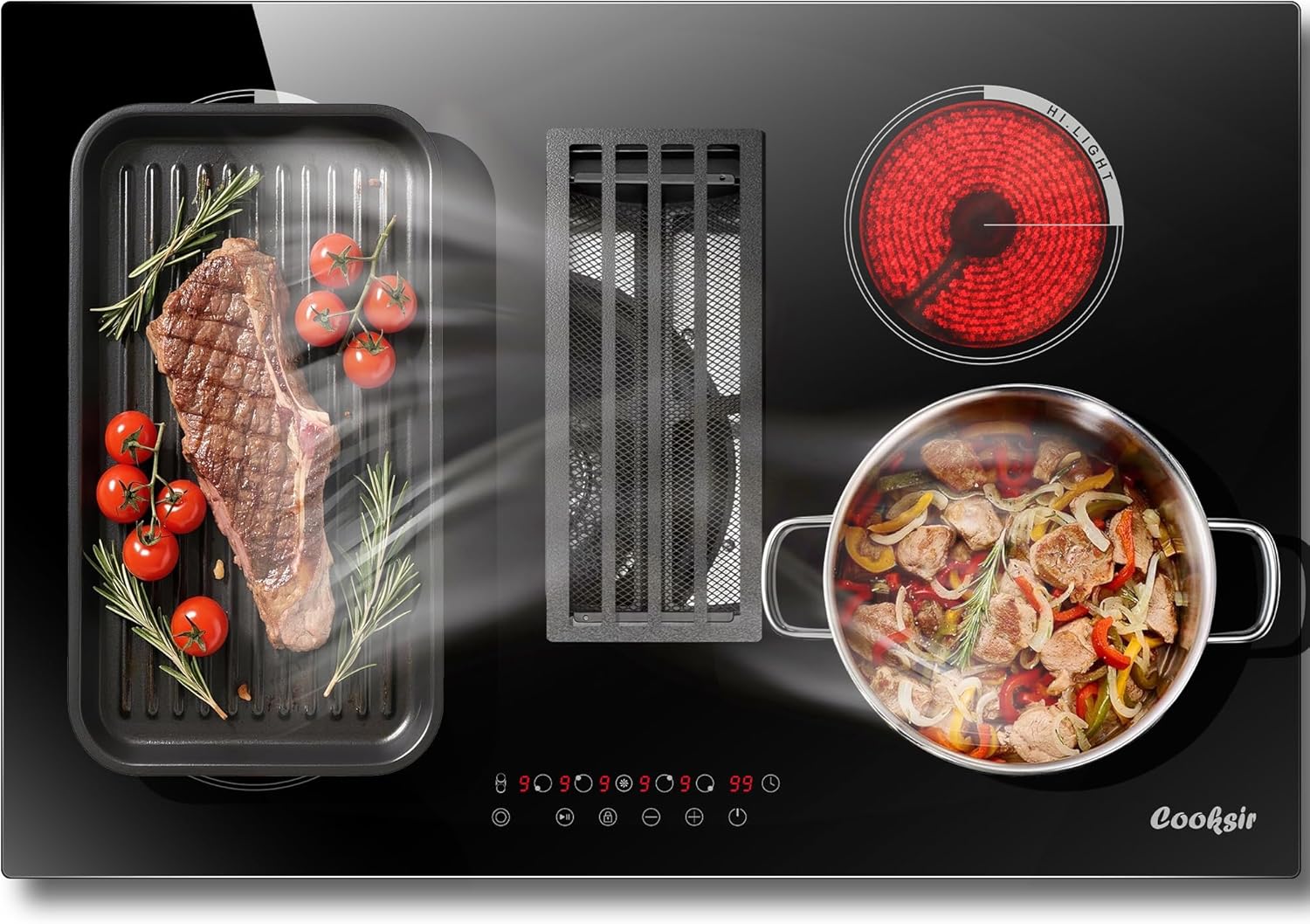
This Cooksir 30-inch cooktop combines a glass-ceramic radiant stove top with a ductless recirculating downdraft, so you get cooking surface and ventilation in one unit without running external ductwork. It installs as a drop-in built-in and is designed for 220–240V hardwired kitchens; the cooktop offers four heating elements including a dual-ring burner and a high-output bridge-style burner for large pans, and controls are touch-based for precise adjustments. The downdraft uses onboard filtration and a 135W fan to capture fumes at the cooktop rather than venting outside, which simplifies installation but means extraction performance depends on proximity and heavy frying may produce some residual smell. Safety features include a child lock, hot-surface indicators, automatic shutoff and a timer, which make everyday use straightforward. Because it is a high-power 7400W unit with tempered glass top, cleaning is easy but the unit does require compatible 220V wiring and careful cut-out sizing for proper fit. For kitchens where duct routing is difficult, the integrated downdraft is a practical space-saving solution.
Best for: Buyers who need a built-in cooktop with built-in ventilation where running ductwork is impractical and who value a compact, integrated look with safety features.
Less Ideal for: People who require the strongest possible smoke and odor removal from heavy wok or frying use or who cannot accommodate a 220–240V hardwired installation should consider externally ducted ventilation or different cooktop options.
- Integrated ductless downdraft removes the need for external ducting and saves space
- Four radiant heating zones including a dual-ring and bridge-style burner for flexible pan coverage
- Touch controls plus timer, child lock and hot-surface indicators improve safety and control
- Tempered glass ceramic surface is easy to wipe clean and looks streamlined
- Ductless recirculation vents filter and return air so extraction and odor removal are not as effective as an externally ducted hood
- Requires 220–240V hardwired installation and correct cut-out sizing for built-in fit
Verdict: Choose this unit if you want a built-in 30-inch electric cooktop with a space-saving ductless downdraft for simpler installation and integrated ventilation.
Choosing the Right Built-In Electric Cooktop with Downdraft: Key Factors to Consider
Downdraft Ventilation Capacity
Downdraft ventilation capacity determines how effectively the cooktop removes smoke, steam, and odors from the cooking zone. Higher airflow and multiple fan speeds let you match extraction to the intensity of cooking, from gentle simmering to high-heat searing. Consider whether the downdraft vents vertically through a short duct or supports recirculation with charcoal filters, since routing will affect real-world performance.
Noise matters too. A powerful fan that is excessively loud during regular cooking will be disruptive in open-plan spaces. Look for models that specify airflow in CFM and provide multiple speed settings so you can balance extraction against noise level.
Cooktop Heat Control and Zone Layout
Heating performance and the arrangement of cooking zones affect how well the cooktop fits your cooking habits. Multiple sized zones and bridgable elements make it easier to use large pots, griddles, and specialty cookware. Pay attention to wattage ratings for each zone; higher power delivers faster boil times and better high-heat responsiveness.
Even heat distribution and independent controls let you run multiple dishes at different temperatures. Induction-style electric elements will differ from radiant elements in responsiveness and efficiency, so match the element type to how you cook.
Installation and Ducting Requirements
Installation needs can make or break a downdraft cooktop decision. Built-in units vary in cutout size, clearance under the countertop, and whether they require vertical or horizontal duct runs. Some models support recirculation with filters instead of ducting, which simplifies installation but typically reduces peak airflow.
Measure cabinet space and routing options before buying. Confirm electrical service requirements and whether the downdraft fan requires a separate circuit or dedicated power connection. If you plan to install into a specific countertop material, check manufacturer guidance for clearances and reinforcement needs.
Maintenance, Cleaning, and Filter Access
Surface materials and the accessibility of filters affect daily upkeep. Smooth, sealed glass-ceramic or durable enameled surfaces are easier to wipe clean than textured finishes. Removable downdraft grates and easily accessible grease or charcoal filters make routine cleaning faster and safer.
Consider how often filters must be replaced or serviced and whether replacements are standard sizes. A design that allows quick filter removal without tools reduces downtime and keeps the ventilation working optimally.
Noise and User Comfort
Downdraft fans operate within the living space, so motor noise and vibration directly impact comfort. Look for published decibel ratings at different speeds if available. Some units include quieter low-speed modes that handle everyday cooking, reserving higher power for heavy-duty tasks.
Controls that offer soft-start or variable-speed ramps reduce abrupt noise changes. Vibration isolation and solid-mounted housings also lower transmitted sound. Balance the need for strong extraction with acceptable operating noise for your home layout.
Safety Features and Controls
Safety features limit risks from unattended or accidental operation. Useful elements include automatic shutoff timers, residual-heat indicators, child locks for controls, and overheat protection. Illuminated or tactile control surfaces improve accuracy when adjusting heat or fan speed.
Confirm that the control layout is intuitive and that critical indicators are visible from a typical standing position. Built-in safety features reduce the chance of fire hazards and make the cooktop friendlier for households with children or older adults.
Ducted Vs Recirculating Downdraft Systems
A key decision is whether the downdraft will vent to the outdoors or recirculate filtered air back into the kitchen. Ducted systems generally provide stronger and cleaner extraction because they expel grease and odors outside. However, they require a viable path for ductwork, which can be limited by cabinet and floor layouts.
- Ducted: Better peak performance, requires routing to exterior.
- Recirculating: Easier installation, uses charcoal filters, usually lower peak airflow.
- Consider local building constraints and whether existing cabinetry allows a duct run before choosing.
Electric Element Types and Cooking Style
Electric built-in cooktops can use radiant elements, smooth glass-ceramic tops, or induction-style heating. Each has tradeoffs in responsiveness, heat-up time, and cookware compatibility. Radiant elements are common and reliable but slower to change temperature compared with induction. Induction heats quickly and offers precise control but needs compatible magnetic cookware.
- Radiant/coil: Works with any cookware, moderate responsiveness.
- Glass-ceramic radiant: Sleeker surface, easier cleaning, similar heat behavior.
- Induction-compatible: Fast, efficient, precise control; cookware compatibility required.
Countertop and Cabinet Considerations
Cutout dimensions and underside clearances determine whether a cooktop will fit without cabinet modification. Some downdraft units need significant vertical space beneath the countertop for the fan assembly and filters. Before purchasing, measure the cabinet cavity depth, nearby drawers, and the location of plumbing or electrical lines that could interfere with installation.
- Confirm cutout width and depth against your cabinet.
- Account for any ventilation grille or access panel in adjacent cabinetry.
- Plan for future servicing access to the downdraft fan and filters.
Control Layouts and User Interface
Controls range from front-mounted knobs to touch-sensitive panels. Front-mounted controls are easier to reach and safer when downdraft vents are centrally placed. Touch controls look streamlined but can be harder to operate with oily or wet hands. Look for clear labeling, lock functions, and an ergonomically placed fan control to adjust ventilation quickly while cooking.
- Knobs: Tactile, reliable, easier with gloved or wet hands.
- Touch panels: Sleek, often offer precise increments and timers.
- Ensure the fan control is intuitive and reachable during active cooking.
Filter Types and Replacement Logistics
Built-in downdrafts commonly use washable metal grease filters and optional charcoal odor filters for recirculating setups. Metal filters protect the fan and ducting from grease buildup and are typically dishwasher-safe. Charcoal filters reduce odors but require periodic replacement and are not washable. Consider the cost and availability of replacement filters. Models that use standard-size filters or easy-to-source cartridges reduce long-term maintenance hassle.
- Washable grease filters reduce consumable costs.
- Charcoal filters needed for recirculation; factor replacement intervals.
- Check ease of filter removal for routine maintenance.
How We Chose the Best Built-In Electric Cooktop with Downdraft
To assemble this list we screened current built-in electric cooktops equipped with integrated downdraft ventilation and applied consistent editorial filters. We prioritized measurable ventilation performance, looking for units with documented airflow capacity and multi-speed fan control. Cooktop heat control and element responsiveness were assessed via supported power ratings and heating zone flexibility. Installation practicality was another key filter, including rough-in requirements, required cutout dimensions, and whether the downdraft requires separate ducting or supports recirculation. Durability and surface materials were evaluated for scratch and stain resistance plus ease of cleaning. Safety and convenience features such as automatic shutoff, residual-heat indicators, and control-lock functions were included as mandatory considerations. We excluded cooktops without integrated downdraft systems and units that require extensive aftermarket modifications to obtain ventilation. The final picks balance airflow efficiency, cooktop performance, installation fit, and user-oriented safety features consistent with home kitchen needs.
Our full evaluation process is outlined in our review methodology.
FAQ
Can a downdraft cooktop match the performance of an overhead hood?
A ducted downdraft can approach the effectiveness of an overhead hood for many cooking tasks, especially when ducting is short and appropriately sized. However, overhead hoods typically offer greater capture area and higher peak airflow for heavy-duty cooking.
Do downdraft systems require more maintenance than standard cooktops?
Downdraft systems add maintenance in the form of grease and charcoal filters that need cleaning or replacement. Metal filters are often washable, while charcoal filters require periodic replacement if used in recirculation mode. Regular cleaning keeps airflow optimal.
Will a downdraft fit into any countertop?
Not always. Downdraft-equipped built-in cooktops need specific cutout dimensions and clearance beneath the countertop for the fan assembly and filters. Verify cabinet depth and routing space before selecting a model to avoid retrofit complications.
Are downdraft systems noisy?
Noise varies by model and fan speed. Many cooktops offer low-speed settings that are reasonably quiet for daily cooking and higher speeds for intense tasks. Look for published decibel levels or user-oriented noise descriptions if sound is a critical concern.
Can I use the downdraft without ducting to the outside?
Some models support recirculation with charcoal filters, allowing use without external ducting. This option reduces installation complexity but usually lowers maximum extraction effectiveness compared with a properly sized ducted system.
Final Verdict
A built-in electric cooktop with downdraft is a good solution when overhead ventilation is impractical or when you prefer a streamlined, open-kitchen aesthetic. Prioritize downdraft airflow and installation compatibility first, then match heating-zone layout and surface durability to your cooking habits. Balance noise level and filter maintenance against extraction needs to find the best fit for your space. Focus on units that clearly document airflow, provide flexible installation options, and offer accessible filters and safety indicators. That approach will help you pick a cooktop that delivers dependable ventilation and dependable cooking performance for years to come.