
Note: This article contains affiliate links. If you click on these links and make a purchase, we may earn a small commission at no extra cost to you. This helps support our research and content. Read our full affiliate disclosure here.
Choosing the right built-in electric oven shapes everyday cooking more than most appliances. The oven you install affects how evenly food cooks, how much you can prepare at once, and how intuitive the controls are when you are juggling dinner tasks. This guide focuses on built-in electric ovens that deliver dependable heat, useful interior layouts, and straightforward controls for busy home kitchens. Below are our top shortlisted built-in electric ovens, selected for real-world cooking performance and long-term usability. We evaluated temperature accuracy, capacity and layout, control usability, and cleaning features to help you pick the oven that best fits your routine.
Top Picks at a Glance
| Best Overall The best all-around choice for most situations | Midea 24" Single Wall Oven MEW24S2AST |  |
| Best Quality Built to a higher standard if you want something more solid | JustSmart 30" Built-In Wall Oven |  |
| Best Value The sweet spot between price and what you get | AMZCHEF 24" Single Wall Oven |  |
| Best Budget The cheapest option that still gets the job done reliably | Takywep 24" Single Wall Oven | 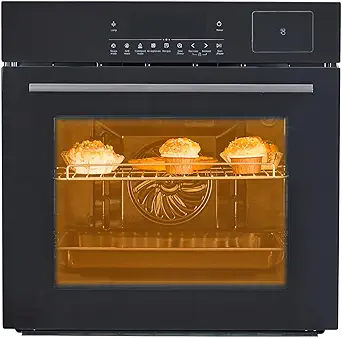 |
| Top Rated A top-rated pick with lots of positive feedback | Empava 24" Single Electric Wall Oven |  |
| Most Popular A crowd favorite that many people choose with confidence | Empava 24" Electric Wall Oven |  |
| Best Seller A high-volume bestseller chosen again and again | ThermoMate 24 Inch Electric Wall Oven |  |
Midea 24" Single Wall Oven MEW24S2AST

| Capacity | 2.5 cubic feet |
|---|---|
| Wattage | 3.26 KW |
| Voltage | 240 volts |
| Heating Method | Convection |
| Cooking Program | Bake, Broil, Convection, Defrost, Roast |
The Midea 24" Single Wall Oven is a compact built-in electric oven that brings convection cooking and an 8-mode control set to standard-depth cabinets. It circulates hot air with a fan for faster, more even baking and roasting, and the 2.5 cubic foot cavity fits family-sized dishes without taking extra wall space. Controls use buttons and a dial for straightforward selection of Bake, Broil, Convection, Roast and Defrost modes, and the removable triple-layer glass door plus easy-clean enamel interior make wiping up spills and grease much quicker. Included accessories like a telescopic runner and wire shelf simplify loading and handling heavier pans. Practical trade-offs are the basic button/dial interface instead of a touchscreen and the single-oven format if you regularly want two separate cooking zones. For a balanced buyer who wants reliable convection performance in a modest footprint, this oven delivers consistent results and easy maintenance at a midrange spec level.
Best for: Buyers who want a reliable, space-conscious built-in oven that delivers even convection baking and easy cleaning for everyday family meals.
Less Ideal for: Those who need dual-oven flexibility, advanced smart controls, or a larger commercial-style capacity should consider other models.
- Convection fan for faster, more even cooking
- 2.5 cu. ft. capacity fits family trays while remaining compact
- Removable triple-layer door improves heat retention and cleaning
- Easy-clean enamel interior wipes down quickly
- Includes useful accessories like telescopic runner and wire shelf
- Basic button and dial controls lack advanced programmability or touchscreen
- Single oven limits simultaneous different-temperature cooking
Verdict: A compact, convection-equipped built-in oven that balances even cooking performance and easy maintenance for typical household use.
JustSmart 30" Built-In Wall Oven

| Heating Method | Convection |
|---|---|
| Fuel Type | Electric |
| Installation Type | Built-In |
| Wattage | 3800 |
| Capacity | 4.8 cubic feet |
This JustSmart 30" built-in electric wall oven is aimed at cooks who want strong performance and capacity in a single unit. It uses 3D convection to circulate air for more even multi-rack baking and roasting, and the 4.8 cu ft cavity with six rack positions (including one gliding rack) makes it practical for holiday roasts or baking multiple trays at once. The 3800W heating system with separate broil and hidden bake elements cuts preheat time and delivers higher-heat capability for browning. The touch glass control panel, delay start, kitchen timer, and included temperature probe add precision for time- and temp-sensitive recipes, while the blue enamel interior and rear light simplify cleanup and monitoring. This is a built-in 240V appliance so installation requires proper wiring and a cutout match. Controls are touch-based, which are sleek but may take getting used to compared with knobs, and the oven is a heavy, full-size unit that suits a permanent kitchen setup rather than temporary use.
Best for: Buyers who prioritize strong, fast cooking and need a roomy built-in oven for multi-rack baking, large roasts, or frequent entertaining.
Less Ideal for: Those seeking a plug-and-play countertop or freestanding solution, or buyers who prefer simple mechanical knob controls should look elsewhere.
- Large 4.8 cu ft cavity with six rack positions supports multi-level cooking.
- 3D convection promotes even results across racks for baking and roasting.
- High-power 3800W system reduces preheat time and improves browning.
- Included temperature probe and delay start enable precise, scheduled cooking.
- Gliding rack eases removal of heavy dishes and the enamel interior is easier to clean.
- Requires 240V hardwiring and a built-in cutout, so not suitable for simple plug-in installs.
- Touch glass controls can be less tactile and take time to learn.
Verdict: Choose this oven when you want a powerful, roomy built-in that speeds preheat and delivers even multi-rack results for performance-focused home cooks.
AMZCHEF 24" Single Wall Oven

| Heating Method | Convection |
|---|---|
| Wattage | 2800 |
| Capacity | 2.72 cubic feet |
| Voltage | 240 volts |
This AMZCHEF 24" single wall oven is a straightforward built-in electric oven aimed at everyday home cooking. It uses a convection fan and a 2800W heating system to reach 120 to 480 degrees Fahrenheit, and offers six cooking modes controlled with simple mechanical knobs and a 2-hour timer. The 2.72 cubic foot interior is roomy enough for family-sized roasts or multiple dishes at once, and the halogen interior light plus three-layer glass door make it easy to monitor food without opening the oven. Practical touches include a child lock and a timer operation tip for short intervals. Expect quick heat-up and even roasting from the convection system, but note the control set is basic compared with models that offer digital presets, sensor cooking, or self-clean cycles. Installation requires a built-in 240V connection and attention to the recommended cutout dimensions. For buyers who want a capacious, no-frills built-in oven that focuses on power and even cooking, this model delivers reliable performance without extra smart features.
Best for: Home cooks who prioritize straightforward, reliable built-in performance and roomy capacity over advanced digital controls or smart features.
Less Ideal for: Buyers who want touchscreen controls, automated cooking programs, or integrated smart-home connectivity should consider other options.
- Powerful 2800W element with convection fan for faster, more even heating
- Spacious 2.72 cu.ft. interior suitable for family-sized dishes
- Simple mechanical knob controls make operation intuitive
- Halogen interior light and triple-layer glass door for easy viewing
- Controls are basic mechanical knobs with no digital presets or smart features
- No self-cleaning function is listed
Verdict: A powerful, roomy built-in convection oven for buyers who want dependable, no-frills cooking performance.
Takywep 24" Single Wall Oven

| Heating Method | Convection |
|---|---|
| Wattage | 3000 watts |
| Voltage | 240 volts |
| Capacity | 2.5 cubic feet |
The Takywep 24" single wall oven is a budget-minded built-in electric oven that brings convection cooking, a 2.5 cubic foot cavity and a touch glass control panel to small kitchens. It uses 3D surround heating and a 3000W heating element on a 240V supply to deliver even browning for roasting and baking, and the convection mode helps speed cook times and promote consistent results across racks. The oven door features three-layer insulated glass so you can monitor food while reducing heat loss, and the digital timer and safety lock add basic convenience and household safety. Practical benefits include a roomy interior for a 24" unit and easy-to-clean stainless steel surfaces, while trade-offs are typical for value-priced appliances: controls are simple rather than feature-rich, and installation requires a 240V hookup and proper built-in clearances. For shoppers replacing an older 24" built-in or fitting a tight kitchen budget, this oven covers core baking and roasting needs without premium frills.
Best for: Buyers on a tight budget who need a functional built-in oven for routine baking, roasting and family meals and who prioritize a roomy cavity over premium extras.
Less Ideal for: Those seeking smart features, professional-level precision controls, or installers who cannot provide a 240V dedicated circuit should consider other options.
- Convection 3D surround heating promotes even cooking across racks
- Spacious 2.5 cu ft interior for a 24-inch built-in oven
- Three-layer insulated glass door improves visibility and reduces heat loss
- Touch glass control panel with digital timer for straightforward operation
- Requires 240V hardwired installation
- Basic feature set without advanced presets or smart connectivity
Verdict: A no-frills, budget-friendly built-in 24" oven that delivers reliable convection performance and a roomy 2.5 cu ft cavity for everyday baking and roasting.
Empava 24" Single Electric Wall Oven

| Fuel Type | Electric |
|---|---|
| Wattage | 2800 watts |
| Installation Type | Built-In |
| Capacity | 2.3 cubic feet |
| Voltage | 240 volts |
This Empava 24" single electric wall oven is a compact built-in unit aimed at delivering even, reliable results for everyday home cooking. It uses a true convection fan to circulate heat for faster, more uniform baking and roasting, and offers seven cooking modes including convection roast, broil and pizza for flexible meal prep. The oven's ceramic interior with hidden heating elements wipes clean easily, while the triple-layer tempered glass door and halogen interior light make it simple to check progress without heat loss. Controls are mechanical knobs, which are durable and straightforward to operate compared with touch panels. The oven includes a rotisserie capability and standard accessories like a broiler pan and rack, and it runs on 240V at 2800 watts for typical household installation. Expect solid day-to-day performance and fewer electronic failure points thanks to the simple control scheme, but note the smaller 2.3 cu ft capacity limits very large roasts and multi-rack baking, and professional-level features like smart connectivity or self-clean high-heat cycles are not provided.
Best for: Buyers who prioritize a dependable, straightforward built-in oven that minimizes electronic complexity and delivers consistent home-cooking results.
Less Ideal for: Those who need large-capacity commercial-style ovens, integrated smart features, or intensive self-cleaning cycles should consider other options.
- True convection fan for more even and faster cooking
- Durable mechanical knob controls that reduce electronic failure points
- Easy-clean ceramic interior with hidden heating elements
- Triple-layer tempered glass door with interior light for safe monitoring
- Includes rotisserie and necessary accessories for basic installation
- 2.3 cu ft capacity is modest for very large poultry or multi-rack baking
- No smart connectivity or high-heat self-clean cycle
Verdict: Choose this oven if you want a compact, built-in electric oven focused on reliable convection performance and simple, durable controls.
Empava 24" Electric Wall Oven

| Heating Method | Convection |
|---|---|
| Fuel Type | Electric |
| Wattage | 3200 watts |
| Voltage | 240 volts |
| Capacity | 2.3 cubic feet |
The Empava 24" electric single wall oven is a compact built-in convection oven designed for household kitchens that need a space-saving but capable range of cooking modes. It offers 10 cooking functions — including convection roast, broil, and a 360° rotisserie — controlled through an LED digital touch panel and supported by a convection fan for more even browning. The oven has a 2.3 cu ft interior with five rack positions and comes with a baking tray and interior halogen lamp so you can check progress without opening the door. Practical touches include a two-layer tempered glass door for safety, an easy-clean enamel interior, and a forced cooling exhaust to protect nearby cabinetry. Important downsides are that it requires 240V hard wiring and a 30-amp breaker, so installation needs planning, and some buyers report mixed reliability and user experience. For kitchens that need a built-in electric oven with versatile cooking modes and a rotisserie feature in a smaller footprint, this unit is a solid option; buyers seeking simple plug-and-play or top-tier reliability may want to compare alternatives.
Best for: Buyers who need a built-in electric oven that maximizes cooking versatility in a compact 24-inch footprint and are willing to arrange proper hard-wired installation and occasional maintenance attention.
Less Ideal for: People who need a simple plug-in range, who cannot accommodate a 240V hard-wired circuit, or who prioritize the highest-end reliability without researching user reports.
- Multiple cooking modes including convection and rotisserie for flexible meal types
- Touch LED control and interior lamp make monitoring and precise settings easier
- 2.3 cu ft capacity with five rack positions fits family meals in a compact footprint
- Easy-clean enamel interior and included baking tray simplify maintenance
- Two-layer tempered glass door and forced cooling exhaust add safety and cabinet protection
- Requires 240V hard wiring and a 30A circuit, so professional installation is likely
- Mixed user feedback on long-term reliability and performance consistency
Verdict: A compact built-in convection oven with 10 cooking functions and a rotisserie that delivers flexible cooking in kitchens that can support 240V hard-wired installation.
ThermoMate 24 Inch Electric Wall Oven

| Capacity | 2.6 cubic feet |
|---|---|
| Wattage | 3100 watts |
| Heating Method | Convection |
| Installation Type | Built-In, Undercounter |
| Voltage | 240 volts |
This ThermoMate 24-inch electric wall oven is a built-in convection oven aimed at replacing a standard single wall oven in a kitchen. It uses a 3100W convection system to circulate heat for faster preheating and more even results, and includes a sensor probe and 12 cooking modes for tasks from bake and broil to rotisserie and keep warm. The interior offers 2.6 cubic feet and multiple shelf positions so you can cook several items at once, and the package includes two oven racks plus a rotisserie kit. Practical touches include a three-layer tempered glass door for better heat retention and a detachable door for cleaning, a halogen interior lamp, child lock and touch controls. The oven runs on 240V and is ETL certified for North American installations. Trade-offs to consider are that it is a 24-inch unit, so it fits smaller built-in openings and has fewer cubic feet than larger wall ovens, and installation requires appropriate 240V wiring and built-in cutout compatibility.
Best for: Buyers who want a factory-quality built-in convection oven that delivers even results and flexible cooking modes while prioritizing safety certifications and straightforward features.
Less Ideal for: Households needing maximum oven capacity or those who cannot accommodate a 240V hardwired installation should consider larger freestanding or different-fit options.
- Powerful 3100W convection system for faster preheating and more even cooking
- 12 cooking modes and a temperature sensor probe for precise, flexible cooking
- 2.6 cu ft interior with 5 rack positions and included racks and rotisserie for multi-dish cooking
- Three-layer tempered glass door and detachable design improve heat retention and cleaning
- ETL certified for US and Canadian electrical safety standards
- Requires 240V hardwired installation which may need an electrician
- Smaller 24-inch footprint offers less capacity than full-size wall ovens
Verdict: A compact, ETL-certified built-in convection oven that gives risk-averse buyers reliable, versatile cooking performance for smaller kitchen openings.
Choosing the Right Built-In Electric Oven: Key Factors to Consider
Temperature Accuracy and Stability
Oven temperature accuracy determines how reliably dishes reach target doneness. Small variances can lead to underbaked centers or overbrowned exteriors, which matters most for baking and precise roasting.
Look for ovens with well-regulated thermostats and even heat distribution. Consistent temperature reduces the need to rotate pans and repeat attempts, and it makes following recipes easier. For people who bake frequently, this is one of the most important factors to prioritize.
Internal Capacity and Rack Configuration
Measured capacity alone does not tell the full story. The internal layout, number of rack positions, and usable height between shelves determine whether large roasts, multiple sheet pans, or tall casserole dishes will fit.
Consider the types of meals you cook: multiple-sheet baking demands wide, flat interiors and evenly spaced rack positions, while roasting large cuts requires deeper cavities and at least one high rack slot. Removable racks and adjustable shelving increase flexibility for varied cooking tasks.
Control Interface and Cooking Modes
Controls shape how easily you can select standard settings and customize cooking programs. Clear dials or well-labeled touch panels reduce mistakes and speed meal prep. Useful modes to look for include conventional bake, convection bake, broil, and specialized presets for items like pizzas or proofing.
Advanced features such as delayed start, multi-stage cooking, or probe-based temperature control can add flexibility but also complexity. Choose an interface that matches how hands-on you are during cooking and how comfortable you are with electronic presets.
Cleaning Features and Interior Finish
Cleaning convenience affects long-term satisfaction. Enamel interiors with smooth surfaces resist stains and wipe down easily. Catalytic liners and self-clean cycles reduce scrubbing, though self-cleaning runs require higher temperatures and occasional cleanup of ash or residues.
Also consider whether racks are easy to remove and whether treated finishes tolerate cleaning cycles. Ease of cleaning keeps the oven performing well and reduces time spent on maintenance.
Installation Fit and Venting
Built-in ovens must integrate with cabinetry and follow clear venting requirements to perform safely and predictably. Correct cutout dimensions, clearance for heat dissipation, and the direction of exhaust all influence where and how the oven can be installed.
If you are replacing an existing unit, matching dimensions speeds installation. For new builds, plan for adequate ventilation and access for service to avoid future issues.
Durability and Serviceability
Construction quality, hinge mechanisms, and the availability of replaceable parts influence how long an oven remains dependable. Robust door hinges and reliable seals maintain temperature stability and reduce heat loss.
Serviceability matters if control boards, seals, or heating elements need replacement. Models with accessible components and clear service documentation are easier to maintain over the long term.
Why Convection Matters
Convection circulation uses a fan to move hot air around the cavity, which can produce more even browning and faster cook times. For cooks who bake multiple trays at once or roast frequently, convection modes deliver more consistent results across rack positions.
Not every recipe benefits from forced air. For delicate pastries, you may prefer conventional bake settings. Look for ovens that allow you to switch convection on or off so you can adapt to different recipes.
- Convection improves browning and reduces hot spots
- Useful for multi-rack baking and large roasts
- Should be optional rather than default for delicate baking
Understanding Oven Capacity Ratings
Manufacturers often list gross volume in cubic feet or liters, but practical capacity depends on rack spacing and cavity shape. A tall cavity with good width can accommodate sheet pans and roasts more effectively than a slightly larger but awkwardly shaped interior.
If you regularly cook for guests or batch-bake, evaluate how many full-size sheet pans or multiple roasting pans will fit simultaneously rather than relying solely on the headline number.
- Check usable shelf positions, not just total volume
- Measure the space needed for your largest cookware
- Consider whether racks slide fully for safe loading and unloading
Control Layouts: Touch Vs Dial
Mechanical dials are straightforward and work well when you want tactile feedback and simple operation. Touch controls provide more programming options and a sleeker look but can be less intuitive for quick temperature adjustments.
Consider how the control layout performs when your hands are messy from cooking. Physical knobs are easier to use with wet or floury hands, while touch panels require cleaner contact and may need more attention to avoid accidental presses.
- Dials offer tactile reliability and ease of use
- Touch panels enable more presets and detailed programming
- Look for clear labeling and responsive feedback in any interface
Installation Checklist for Built-In Units
Before installation, confirm cabinet cutout dimensions, electrical requirements, and the intended oven orientation. Built-in ovens often require a dedicated circuit and precise spacing to allow for heat circulation and door clearance.
Plan for ventilation and access. Leave service gaps that allow a technician to remove the unit if needed without dismantling adjacent cabinetry.
- Verify cutout dimensions against the unit specification
- Confirm electrical circuit and outlet placement
- Allow service clearance for future repairs
Maintaining Performance Over Time
Regularly inspect door seals and clean spills promptly to prevent residues from baking on and reducing efficiency. Replace worn gaskets to maintain temperature stability and energy efficiency.
Schedule occasional checks on heating elements and fan operation. Small issues such as uneven heating or unusual noises rarely self-correct and are easier to fix when caught early.
- Wipe spills after the oven cools to avoid stubborn stains
- Replace damaged seals to preserve temperature control
- Document any changes in cooking performance to inform service decisions
How We Chose the Best Built-In Electric Oven
We prioritized measurable, kitchen-relevant dimensions that predict real-world performance and long-term satisfaction. Core evaluation criteria included temperature accuracy and recovery, because consistent heat affects cooking results for baking and roasting. Capacity and internal layout were assessed for how they support multiple racks and standard cookware sizes. Control clarity and program flexibility were reviewed to ensure users can set temperatures and modes without confusion. Cleaning and maintenance features were weighed for how they reduce hands-on upkeep. Build quality and fitment details were considered to ensure the ovens integrate cleanly into typical cabinetry. We excluded units that rely on niche or unproven heating methods that do not translate to typical home cooking. We also filtered out models with unclear installation requirements or insufficient accessory documentation. The final list reflects products that balance consistent temperature management, practical interior capacity, user-friendly controls, and maintainable finishes.
Our full evaluation process is outlined in our review methodology.
FAQ
Do built-in electric ovens need special ventilation?
Built-in electric ovens usually need clearance for heat dissipation and may direct exhaust into cabinetry or the room. Follow the installation instructions for venting and leave recommended clearances to avoid overheating surrounding materials.
Is convection always better than conventional baking?
Convection is helpful for even browning and multi-rack baking but can be too aggressive for delicate pastries. Many users switch between convection and conventional bake depending on the recipe.
How often should I clean the oven interior?
Clean spills promptly after the oven cools and perform deeper cleaning at regular intervals depending on use. Self-clean cycles can reduce scrubbing but require understanding the process and occasional post-cycle wipe-down.
Can I install a built-in electric oven myself?
Installation often requires following precise cabinet cutouts and connecting a dedicated electrical circuit. While some competent DIYers can install these units, many homeowners choose professional installation to ensure safe wiring and proper fit.
What size oven do I need for large roasts or multiple sheet pans?
Focus on usable internal dimensions and number of rack positions. A wider cavity with multiple full-width rack slots is better for sheet pans, while taller clearances help with large roasts and tall cookware.
Final Verdict
Prioritize temperature control and usable internal layout when choosing a built-in electric oven. Those two factors most directly affect day-to-day cooking results and how many dishes you can prepare at once. Balance control simplicity and cleaning features against the specific cooking you do most often. Decide whether convection and advanced programming will be helpful for your routine, then match the oven size and installation needs to your kitchen layout. Focusing on these tradeoffs will help you select an oven that performs reliably and fits your long-term cooking habits.