
Note: This article contains affiliate links. If you click on these links and make a purchase, we may earn a small commission at no extra cost to you. This helps support our research and content. Read our full affiliate disclosure here.
If you regularly work with oversized or commercial-style cans, a standard kitchen opener may struggle or feel unsafe. Choosing the right can opener for large cans matters because bigger lids need a longer reach, firmer clamping, and stronger cutting components to avoid slipping, jagged edges, or hand fatigue. This guide shortlists the top options designed specifically for larger cans and explains the practical tradeoffs you should consider for durability, ease of use, and safe operation. Below you will find our top picks along with the criteria we used to evaluate cutting capacity, build quality, and everyday usability.
Top Picks at a Glance
| Best Overall The best all-around choice for most situations | Hamilton Beach Smooth Touch Can Opener |  |
| Best Quality Built to a higher standard if you want something more solid | Edlund Old Reliable #1 Manual Can Opener |  |
| Best Value The sweet spot between price and what you get | NUFR Heavy-Duty Can Opener |  |
| Best Budget The cheapest option that still gets the job done reliably | Ultrean Manual Can Opener |  |
| Top Rated A top-rated pick with lots of positive feedback | Graceliving Premium Can Opener GR001 |  |
| Most Popular A crowd favorite that many people choose with confidence | KitchenAid Classic Can Opener |  |
| Best Seller A high-volume bestseller chosen again and again | Cuisinart Electric Can Opener CCO-50BKN |  |
Hamilton Beach Smooth Touch Can Opener

| Operation Mode | Automatic |
|---|---|
| Wattage | 165 watts |
| Material Type | Metal, Plastic |
| Blade Material Type | Stainless Steel |
The Hamilton Beach Smooth Touch is an automatic countertop can opener designed for easy, one-handed use. It uses an easy-push down lever and a side-cutting stainless steel blade to remove lids without leaving sharp edges, which also lets you reuse lids to cover leftovers. The unit handles pop-top and regular cans and its extra-tall profile clears taller cans and jars that smaller openers struggle with. At 165 watts the motor provides reliable, fuss-free operation without manual cranking, and the metal and plastic construction feels sturdy for routine kitchen use. Its simple mechanism makes it quick to align and clean, though it occupies countertop space and is not designed for travel or drawer storage. If you need a heavy-duty, multi-can household opener for everyday cooking and large canned goods, this model performs consistently; if you prefer a compact, manual tool for occasional use, a handheld opener might be a better fit.
Best for: Buyers who regularly open large or tall cans and want a reliable, hands-free solution that reduces sharp edges and speeds routine kitchen tasks.
Less Ideal for: People who need a compact, travel-friendly, or battery-free can opener for occasional use should consider a manual or portable option instead.
- Cuts cans along the side for smooth, safe lids that can be reused
- Automatic operation with easy push-down lever enables one-handed use
- Extra-tall design clears larger cans and taller containers
- Stainless steel blade and metal/plastic build offer durable everyday performance
- Takes up counter space and is not as portable as handheld openers
- Requires mains power and uses 165 watts, so not suitable for off-grid use
Verdict: A dependable automatic can opener built for hands-free, safe opening of large and pop-top cans, making everyday kitchen prep faster and neater.
Edlund Old Reliable #1 Manual Can Opener

| Operation Mode | Manual |
|---|---|
| Material Type | Stainless Steel |
| Blade Material Type | Stainless Steel |
| Size | 11" tall |
| Rated Service | Rated for up to 5,000 cans before parts replacement |
The Edlund Old Reliable #1 is a heavy-duty manual can opener built for commercial kitchens and large cans up to 11 inches tall. It mounts to a countertop via a plated steel base and uses a reversible stainless steel blade to extend service life; the design is rated to open thousands of cans before parts need replacement. In practice it is used as a fixed station opener where staff can quickly secure and rotate large cans for fast, repeatable cutting. The open-frame, nickel-plated cast aluminum body and rust-resistant arbor make it easy to clean and maintain, and replacement parts are straightforward if a blade or gear needs service. It is purely manual, so there is no motorized assistance, and it requires a solid mounting surface and clear counter space. For kitchens that process high volumes of large cans the unit delivers reliable, low-tech durability, but it is overkill for light home use or occasional can opening tasks.
Best for: Buyers who need a durable, high-throughput can opener for kitchens that regularly process large or tall cans and prioritize long service life over compact size or automation.
Less Ideal for: Casual home users or those with limited counter space who only need occasional can opening should consider smaller, portable openers instead.
- Commercial-grade construction for high-volume use
- Reversible stainless steel blade extends service life
- Plated steel base provides stable, countertop-mounted operation
- Designed for easy cleaning and straightforward parts replacement
- Manual operation requires physical effort and a secure mounted location
- Intended for commercial use so it is bulky compared with consumer openers
Verdict: A rugged, countertop-mounted manual can opener built to handle frequent use and very large cans in commercial kitchens.
NUFR Heavy-Duty Can Opener

| Material Type | Stainless Steel |
|---|---|
| Blade Material Type | Stainless Steel |
| Operation Mode | Manual |
| Unit Count | 1 Count |
This NUFR heavy-duty manual can opener is built like a small commercial unit and is intended for frequent use on large cans. It uses a sharp stainless steel cutting wheel and an extended crank so you can clamp the jaws onto a can rim and rotate the handle with minimal wrist strain, which is helpful when opening #10 or other oversized cans. The long, rubber-coated handles improve grip and comfort, and the solid steel body feels durable enough for restaurant or pantry work. A built-in hook doubles as a bottle/jar opener and the compact footprint stores easily in a drawer. Expect straightforward manual operation rather than an electric convenience, and while the metal blade should stay sharp for many uses, heavy daily use will eventually require blade maintenance or replacement.
Best for: Buyers who prioritize a sturdy, no-frills tool for frequently opening large or industrial-size cans and who prefer a durable manual solution over an electric opener.
Less Ideal for: People who want a fully automatic, hands-free can opener or those who prefer a compact travel tool for occasional light use.
- Commercial-grade stainless steel construction for durability
- Long rubber-coated handles for better grip and reduced hand strain
- Extended crank provides mechanical advantage for opening large cans
- Built-in hook adds bottle and jar opening functionality
- Manual operation requires physical effort compared with electric openers
- Blade will eventually blunt with heavy use and may need maintenance
Verdict: Choose this heavy-duty manual opener when you need a durable, ergonomic tool built to handle large cans reliably without electricity.
Ultrean Manual Can Opener

| Blade Material Type | Stainless Steel |
|---|---|
| Operation Mode | Manual |
| Unit Count | 1 Count |
| Color | Black |
The Ultrean Manual Can Opener is a compact hand tool designed to cut smooth edges on cans while also functioning as a bottle opener. It uses a sharp stainless steel cutting wheel and an oversized easy-turn knob to rotate the blade along the lid while an ergonomic soft-touch handle improves grip during use. Typical use is straightforward: clamp the opener on the rim, turn the knob clockwise and guide the tool around the can to remove the lid with a smoother edge than many budget can openers. The stainless cutting wheel and rust-proof construction promise durability for routine kitchen tasks and trips. Because it is fully manual and compact, it is portable for camping or picnics and simple to store. Limitations are inherent to manual operation: it requires hand force for larger or thicker cans, and the small footprint can make it slower on very large commercial cans compared with long-arm or electric models.
Best for: Buyers who prioritize a low-cost, durable manual opener for everyday kitchen use and occasional outdoor trips and who value compact tools that are easy to store.
Less Ideal for: People who frequently open very large commercial cans or who need hands-free, rapid opening should consider a long-arm or electric can opener instead.
- Sharp stainless steel cutting wheel for cleaner, smooth-edge cuts
- Ergonomic soft-touch handle and oversized knob for comfortable turning
- Rust-resistant construction for regular kitchen use and portability
- Compact and lightweight for easy storage and travel
- Manual operation requires significant hand effort on very large or thick cans
- Smaller handheld design can be slower than long-arm or electric can openers for large cans
Verdict: A durable, budget-friendly manual can opener that delivers cleaner, smooth-edge cuts and packs small for storage or travel.
Graceliving Premium Can Opener GR001
| Material Type | Stainless Steel |
|---|---|
| Blade Material Type | Stainless Steel |
| Operation Mode | Manual |
| Unit Count | 1 Count |
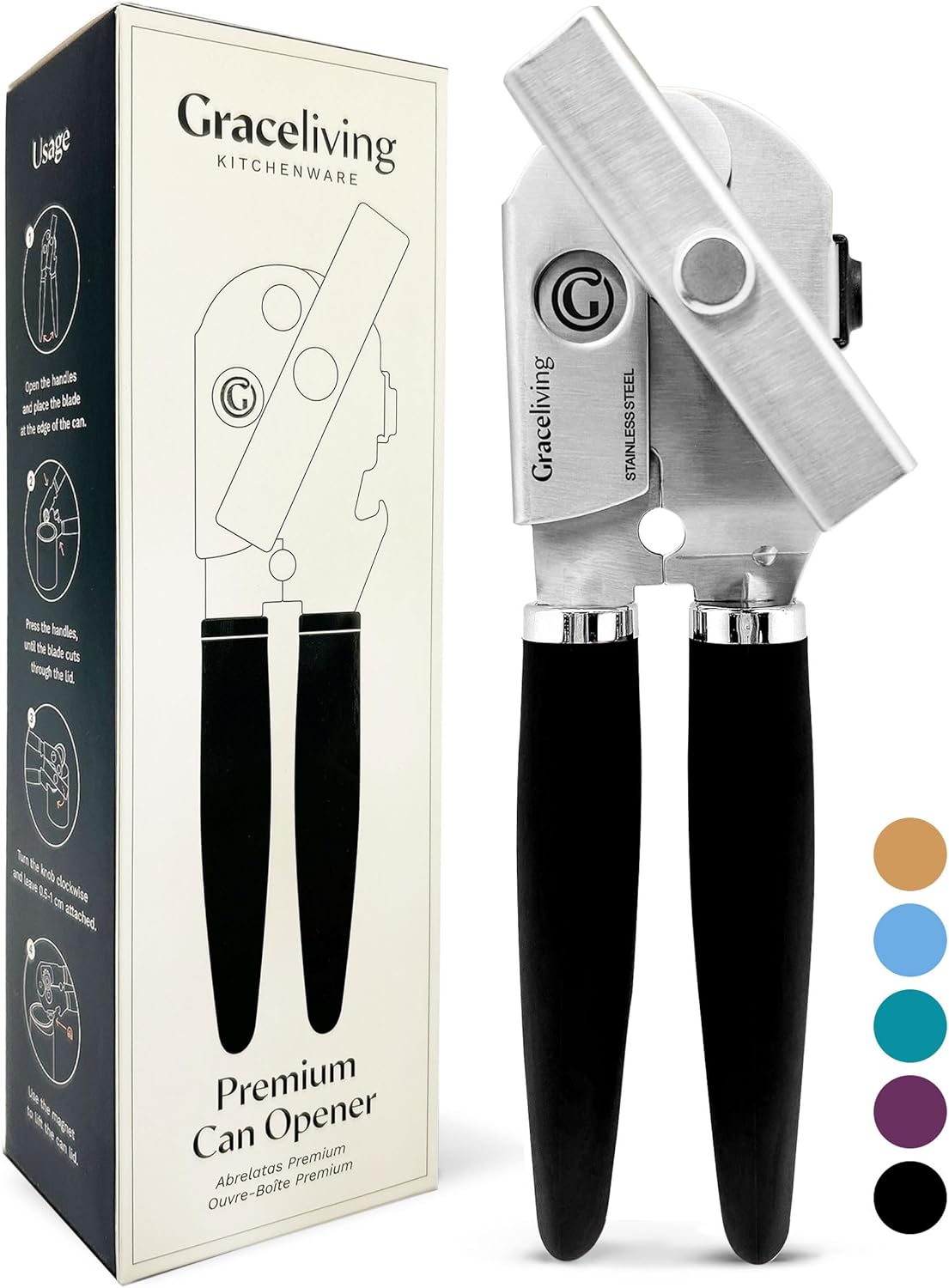
This Graceliving manual can opener is built for heavy use and handled large cans without fuss. Its stainless steel INOXCORE body and precision gears give it a solid, weighted feel and a sharp high-carbon blade that slices lids cleanly to reduce jagged edges. The oversized, unbreakable knob turns smoothly through 360 degrees and the soft-touch non-slip handle keeps the opener steady when tackling wide or thick-rimmed lids. A strong built-in magnet lifts lids off the can so you do not touch sharp edges or chase lids across the counter, and the integrated bottle opener is a handy extra. The manufacturer rates the unit for 300+ uses and the construction feels noticeably more durable than basic models, though it remains a manual tool so very stiff or deformed cans can still require extra effort. If you prefer an electric opener for hands-free operation you will want a different type. For reliability on large cans in a busy kitchen this is a practical, well-made option.
Best for: Buyers who prioritize a durable, long-lasting manual opener for frequent kitchen use and want a tool that handles large cans reliably with a safe, controlled operation.
Less Ideal for: People who need fully hands-free or electric can opening for mobility limitations or very high-volume commercial use should consider an electric or commercial-grade opener instead.
- Reinforced stainless steel body and precision gears for longer durability
- Sharp high-carbon blade produces clean, jag-free cuts
- Oversized smooth-turn knob and soft-touch handle reduce hand strain
- Strong magnetic lid lifter for touch-free, safer lid removal
- Built-in bottle opener adds simple multitool functionality
- Manual operation can be tiring on very stiff, dented, or industrial-size cans
Verdict: A durable, heavy-duty manual opener built to handle large cans reliably while keeping lids lifted and hands safe.
KitchenAid Classic Can Opener

| Material Type | Stainless Steel |
|---|---|
| Blade Material Type | Stainless Steel |
| Operation Mode | Manual |
| Unit Count | 1 Count |
The KitchenAid Classic Can Opener is a straightforward manual tool for opening cans and bottles in everyday kitchens. Its stainless steel cutting wheel is designed to pierce and slice cans cleanly while the oversized knob gives secure leverage for turning, which helps when dealing with larger, tougher lids. The soft, ergonomic handles increase comfort and grip control so it is easier to use for repeated openings or for users with reduced hand strength. The integrated bottle opener adds a handy secondary function without adding bulk. Because it is manual there is no power required and cleanup is quick by hand, but heavy-duty commercial use or extremely large industrial cans may demand a lever-style or electric opener instead. For home cooks who want a durable, no-frills opener that handles most household can sizes reliably, this is a solid pick.
Best for: Buyers who prioritize a reliable, easy-to-use manual opener backed by strong user feedback and want comfortable handling for regular household can sizes.
Less Ideal for: People who need to open very large industrial cans frequently or prefer a hands-free electric solution should consider heavier-duty or powered openers instead.
- Razor-sharp stainless steel cutting wheel for clean, smooth cuts
- Oversized turning knob provides secure grip and easier leverage
- Soft ergonomic handles reduce hand strain during use
- Built-in bottle opener adds convenient dual functionality
- Manual operation can be tiring for very large or numerous cans
Verdict: A comfortable, dependable manual can opener that delivers clean cuts and easy turning for everyday large-can use in home kitchens.
Cuisinart Electric Can Opener CCO-50BKN

| Operation Mode | Automatic |
|---|---|
| Wattage | 60 watts |
| Material Type | Stainless Steel |
| Blade Material Type | Stainless Steel |
The Cuisinart CCO-50BKN is a simple, reliable electric can opener designed for everyday countertop use and hands-free operation. You press the detachable activation lever and the motorized cutter spins to remove lids, while a magnetic lid holder keeps the opened lid from falling into the can. A wide nonslip base helps keep the unit steady during use and the stainless steel cutting blade and drive mechanism are built for consistent performance across common can sizes. The unit runs on a 60-watt motor that handles large cans in routine kitchen tasks without complicated controls or setup. Cleaning is easier than some models because the activation lever detaches for rinsing, though the body is countertop-only and must be wiped down. If you want a straightforward automatic opener that reduces wrist strain and reliably opens a range of cans, this model delivers dependable, low-effort operation, but it is a basic, corded appliance without advanced features like cordless convenience or adjustable clamp settings for oddly shaped containers.
Best for: Buyers who want a low-risk, dependable countertop can opener that minimizes effort—especially useful for households that open large cans frequently and prefer simple, proven appliances.
Less Ideal for: Those needing a cordless or highly adjustable opener for oddly shaped or specialty cans should consider other designs built for portability or variable clamp settings.
- One-touch automatic operation reduces effort and wrist strain
- Magnetic lid holder keeps lids secure and prevents spills
- Wide nonslip base improves stability during use
- Detachable activation lever for easier cleaning
- Stainless steel blade and drive deliver consistent cutting
- Corded design limits placement to near an outlet
- No adjustable clamp or specialty modes for unusually sized cans
Verdict: A straightforward, reliable automatic can opener that delivers hands-free, consistent performance for buyers who prioritize dependable everyday operation.
Choosing the Right Can Opener for Large Cans: Key Factors to Consider
Cutting Capacity and Reach
Large cans vary in diameter and height, so the cutter and guide must accommodate a longer circumference. An opener with extended reach or a long-wheel design wraps more of the lid, which spreads cutting force and reduces jagged edges.
If the mechanism cannot fully engage a larger rim, you will need to re-clamp and re-cut, which risks warped lids and uneven edges. Confirm the maximum can diameter and cutting wheel length for any tool intended for oversized cans.
Blade Material and Replaceability
High-carbon or stainless steel blades hold an edge longer when cutting thicker metal. Blade hardness affects how frequently you will need to replace or sharpen the cutter, which influences lifetime cost and performance consistency.
Models with replaceable blades let you restore cutting quality without replacing the entire unit. If the blade is not serviceable, expect gradual performance loss and possibly more frequent replacement of the whole opener.
Clamping Strength and Jaw Design
Large cans require stronger clamping to prevent slipping under the higher torque needed to cut. Robust jaws or gear-driven clamps keep the opener aligned and reduce lateral movement as you turn the handle.
Poor clamping increases the chance of the cutter chewing into the can wall or producing sharp burrs. Look for designs with wide contact surfaces or multiple engagement points to stabilize the can during cutting.
User Effort and Ergonomics
Turning resistance increases with larger, thicker lids, so ergonomic handles and low-gearing ratios matter. Long-lever or gear-assisted openers reduce the force required and lower hand strain, which is especially helpful for frequent use or users with weaker grip strength.
Handle shape, padding, and non-slip textures affect comfort during long tasks. Consider whether a manual crank or a lever-style mechanism better suits who will use the tool and how often.
Corrosion Resistance and Maintenance
Exposure to acidic foods and moisture accelerates rust on exposed metal parts. Stainless finishes, sealed bearings, or protective coatings extend service life, while open metal gears and uncoated cutters demand more frequent cleaning and drying.
Regular disassembly for cleaning or access to replaceable parts helps prevent performance degradation. Consider whether the design makes it easy to rinse, dry, and service moving parts.
Safety and Edge Finish
How the opener severs the lid affects whether the resulting edges are sharp or safe. Side-cut designs and smooth-cut mechanisms tend to leave less jagged metal than antique top-cut openers.
If you store or handle lids after opening, a cleaner edge reduces the risk of cuts. Also evaluate whether the opener secures the lid after cutting to avoid spinning sharp edges or dropping loose lids into your sink.
Manual Vs. Lever and Rack Designs
Manual crank openers with long handles are familiar and simple, but for oversized cans you may prefer lever-assisted or rack-and-pinion designs that multiply user force. Lever and rack systems can cut through thicker lids with less wrist strain and often provide more consistent alignment around a larger circumference.
Consider how often you will open large cans. For occasional home use a sturdy manual crank might suffice. For frequent or commercial tasks, a lever or geared model reduces fatigue and speeds repetitive work.
- Manual crank: simple, reliable, sometimes lower cost.
- Lever/rack: lower effort, better for repetitive large-can use.
- Gear-assisted: precise cutting and improved stability on wide diameters.
Mounting Options and Workspace Integration
Some openers are designed to clamp to a countertop or attach to a wall, keeping the tool stationary while you turn the can. These mounting options are useful when cans are very heavy or when a non-slip fixed point improves safety and repeatability.
If you have limited counter space, portable models that still deliver strong clamping may be preferred. Evaluate whether the mounting hardware fits your work surface and whether installation is reversible without damaging counters.
- Counter-mounted: best for heavy-duty, high-volume opening.
- Wall-mounted: frees up counter space and stabilizes the tool.
- Portable: easier to store and move but may require more hand effort.
Cleaning, Sanitation, and Food-Safe Surfaces
Large cans often contain acidic or sticky contents that can gum up gears and corrode metal. Choose models with sealed gear housings, easily removable cutters, and smooth surfaces that resist residue buildup.
Frequent cleaning extends the life of the opener and prevents contamination. Look for designs that disassemble without special tools and materials that tolerate repeated washing and drying.
- Sealed bearings reduce food trapping and rust risk.
- Removable blades simplify deep cleaning and replacement.
- Polished stainless parts are easier to wipe sanitary between uses.
Storage, Durability, and Workshop Use
Think about where the opener will live when not in use. Heavier, more durable units survive in busy kitchens or small workshops but need a stable storage spot. Lightweight units are more portable but often sacrifice long-term durability for convenience.
For occasional household tasks you might prioritize compact storage. For heavy or commercial usage, prioritize reinforced construction and materials that tolerate continuous use without bending or wearing.
- Look for reinforced housing or steel frames for durability.
- Wall or under-counter mounts can free workspace and protect the tool.
- Protective covers for blades reduce accidental contact during storage.
Maintaining Sharpness and When to Replace Parts
Even high-quality cutters dull over time when used on thick metal. Regular inspection will show nicked edges or increased effort when turning. Some blades can be resharpened once or twice, but replaceable cutters are the easiest long-term solution.
Keep a small maintenance kit with a soft brush, food-safe lubricant for moving parts, and a replacement blade if the design supports it. This minimizes downtime and keeps cutting performance consistent.
- Inspect blades monthly under heavy use.
- Lubricate gears sparingly with food-safe oil.
- Replace worn cutters before they damage cans or make jagged edges.
How We Chose the Best Can Opener for Large Cans
We focused on tools built to handle cans larger than typical household sizes, prioritizing components and features that directly affect safety and long-term performance. Key evaluation criteria included cutting capacity and blade durability, because a long-lasting, sharp cutter defines how consistently a unit slices through thick metal without deforming the lid. We also measured clamping stability and grip design to ensure the opener stays firmly engaged on taller or wider cans and minimizes slipping. Ergonomics and force required were assessed so even users with limited hand strength can operate the tool reliably. Corrosion resistance and construction materials were reviewed to determine how well units stand up to repeated exposure to acid and moist kitchen environments. Finally, we checked maintenance and ease of cleaning, since food residue and rust can shorten an opener's usable life. We excluded lightweight or novelty openers that lack the reach or clamp strength for large cans and avoided products clearly intended only for standard household sizes. The selections favor designs with reinforced gearing, long-reach cutters, or lever systems that reduce operator effort while maintaining a clean, safe cut.
Our full evaluation process is outlined in our review methodology.
FAQ
Can I use a regular can opener on large commercial cans?
Often a standard household opener will struggle with larger diameters or thicker lids and may slip or produce jagged cuts. For safety and consistent results, choose an opener rated for larger can sizes.
How do I know if an opener can handle a specific can diameter?
Check the product specifications for maximum cutting circumference or diameter and whether the guide wheel or clamping mechanism extends far enough to engage the full rim. Product descriptions that list maximum can height or diameter are the most reliable indicators.
Is a mounted can opener better than a handheld one for large cans?
Mounted openers provide stability and reduce the effort needed to cut very large or heavy cans, making them a good choice for high-volume use. Handheld units can be adequate for occasional use if they feature strong gearing and extended cutting reach.
How should I clean and maintain a can opener used for large cans?
Disassemble removable parts and rinse away food residue after use, then dry thoroughly to prevent corrosion. Periodically check the blade and gears for wear and apply a small amount of food-safe lubricant to pivot points if the design recommends it.
Do electric can openers work well with large cans?
Some electric models are built to handle larger cans, but performance varies by design. For consistent results, prefer electric units explicitly rated for larger diameters and with strong motors and clamping systems.
Final Verdict
Prioritize cutting capacity, clamping stability, and blade durability when choosing a can opener for large cans. Balance ergonomics and gear ratio against how often you will use the tool and whether you need a mounted or portable solution. Regular maintenance and attention to corrosion resistance prolong service life. With these tradeoffs in mind, select the design that matches your frequency of use and workspace so you get safe, consistent cuts and minimal effort.