
Note: This article contains affiliate links. If you click on these links and make a purchase, we may earn a small commission at no extra cost to you. This helps support our research and content. Read our full affiliate disclosure here.
Picking the right coffee grinder matters more than many home baristas expect. For espresso, grind particle uniformity and dose repeatability directly affect extraction, crema, and shot balance. With a sub-$200 budget you can still get a grinder that produces fine, consistent grounds for pressurized portafilters and many home espresso setups. This guide shortlists seven top coffee grinders for espresso under 200 and explains the features that matter most for dialing in shots at home. We evaluated candidates for grind consistency, dose control, and durability so you can find an option that fits your routine. Read on for the selection criteria and practical buying guidance before the product list.
Top Picks at a Glance
| Best Overall The best all-around choice for most situations | Baratza Encore Grinder ENCORE |  |
| Best Quality Built to a higher standard if you want something more solid | MOKKOM 64mm Flat Burr Grinder |  |
| Best Value The sweet spot between price and what you get | Ollygrin Burr Coffee Grinder BG702S |  |
| Best Budget The cheapest option that still gets the job done reliably | SHARDOR Electric Burr Grinder CG835B |  |
| Top Rated A top-rated pick with lots of positive feedback | Breville Smart Grinder Pro BCG820BSS | 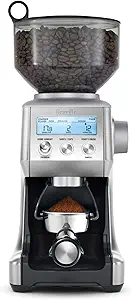 |
| Most Popular A crowd favorite that many people choose with confidence | KRUPS F203 Electric Coffee Grinder |  |
| Best Seller A high-volume bestseller chosen again and again | OXO Brew Conical Burr Grinder |  |
Baratza Encore Grinder ENCORE

| Wattage | 70 watts |
|---|---|
| Capacity | 5 ounces |
| Voltage | 120 volts |
The Baratza Encore is a user-friendly conical burr grinder built for everyday home brewing and entry-level espresso practice. It uses 40mm commercial-grade conical steel burrs and a 70-watt DC motor to deliver consistent, grind-ready coffee across 40 settings, so you can move from espresso to pour-over and French press without swapping machines. Controls are simple: an on/off rocker and a front pulse button for short bursts, and the 5-ounce grounds capacity suits single-serve to small-batch routines. Practical benefits include easy dosing, a small footprint for limited counter space, and Baratza's reputation for replaceable parts and support. Trade-offs are that the Encore is not a timed or doserless electric grinder, so precise single-dosing for high-volume espresso shops is less convenient, and it may be noisy during operation. For home users focused on consistent grind quality across multiple brew methods, the Encore offers durable burrs and straightforward operation, though advanced espresso users seeking built-in dosing or quieter, shop-grade performance may want a more specialized model.
Best for: Buyers who want a reliable, versatile home grinder that handles espresso and filter brewing with consistent results and easy, low-maintenance operation.
Less Ideal for: Commercial users or dedicated espresso purists who need built-in dosing, very low noise, or higher throughput for multiple daily shots.
- 40mm conical steel burrs provide consistent particle size across a wide range of brew methods
- Forty discrete grind settings let you dial in espresso and filter recipes without swapping burrs
- Compact footprint fits small kitchens and countertops easily
- Simple controls with a front pulse button make short burst dosing intuitive
- No built-in timed dosing or electronic portioning for automatic single-dose workflows
- Can be louder than some newer consumer grinders during operation
Verdict: A durable, easy-to-use home burr grinder that delivers consistent, adjustable grinds for espresso and other brew methods, making it a top choice for balanced home coffee setups.
MOKKOM 64mm Flat Burr Grinder

| Burr type | 64mm flat stainless steel |
|---|---|
| Grind settings | 100 settings |
| Power | 260 watts |
| Capacity | 12.35 ounces |
| Power source | AC adapter |
The MOKKOM 64mm Flat Burr Grinder is built for espresso-focused home users who want consistent, repeatable grinds. It uses large 64mm stainless steel flat burrs and a solid all-metal chassis to deliver uniform particle size across a wide range of settings, and the 100-step adjustment lets you dial in fine espresso to coarse brew methods. An LED touch display with a 0.1s precision timer and programmable single/double/top-up modes makes dosing fast and accurate, while the included large hopper and separate single-dose silicone bellow add convenience for batch or single-dose workflows. The grinder also includes an anti-static plasma generator to reduce mess and a removable upper burr for easier cleaning. Expect a relatively quiet low-RPM motor and sturdy metal construction that resists wobble during grinding. It is a purposeful machine for serious home espresso but adds complexity and footprint compared with simple blade or small-conical grinders, and it lacks an integrated scale for weight-based dosing.
Best for: Buyers who prioritize espresso performance and repeatable dosing and want a robust, metal-built grinder they can tweak to extract consistent shots at home.
Less Ideal for: Casual coffee drinkers who prefer plug-and-play simplicity or travelers who need a very compact, lightweight grinder.
- Large 64mm flat stainless steel burrs for uniform espresso-grade grind
- 100 grind settings for fine tuning across espresso and other brew methods
- Precision digital timer with 0.1s resolution for consistent dosing
- All-metal construction and removable upper burr for durability and easier cleaning
- Anti-static plasma generator reduces fines flying and keeps the workspace cleaner
- No built-in weight scale for dose-by-weight workflow
- Larger, heavier machine that takes more counter space than compact grinders
Verdict: If you want a performance-focused home grinder for dialing in espresso with factory-quality build and precise timed dosing, this MOKKOM 64mm flat burr model is a strong choice.
Ollygrin Burr Coffee Grinder BG702S

| Burr size | 40 mm |
|---|---|
| Grind settings | 30 settings |
| Capacity | 10 ounces |
| Wattage | 150 watts |
| Power source | 220 volts |
The Ollygrin Burr Coffee Grinder is a compact electric conical-burr grinder aimed at home espresso enthusiasts who want adjustable grind control without a commercial price. It uses 40 mm stainless steel conical burrs and a gear-reduction motor to grind slowly, which reduces heat and helps preserve coffee aroma. The unit offers 30 grind settings and a 2–12 cup selector so you can dial in fine espresso to coarser French press grinds, while a 10-ounce removable hopper holds enough beans for several doses. Safety and durability features include a friction clutch to protect gears from small stones and built-in overheating protection for the motor. Operation is straightforward with a rotary one-button control, and the upper burr lifts out for cleaning with the included brush. Trade-offs are the 220 V specification and modest 150 W motor, which are fine for home use but mean this is not intended for heavy commercial throughput or high-volume back-to-back grinding.
Best for: Buyers who want a budget-friendly, adjustable burr grinder that preserves flavor and handles regular home espresso or multi-method brewing with simple controls and easy cleaning.
Less Ideal for: People who need a commercial-grade grinder for high-volume cafes or those requiring 110 V compatibility without a step-down transformer.
- 40 mm stainless steel conical burrs for uniform grounds and better flavor extraction
- 30 grind settings let you tailor grind size from espresso-fine to French press-coarse
- Gear-reduction motor reduces heat buildup to protect coffee aroma
- 10-ounce removable hopper with auto-locking system stores beans securely and enables easy removal
- Built-in safety features include a friction clutch and overheating protection
- Designed for 220 V operation which may not match all household power standards
- 150 W motor and compact design are not ideal for heavy continuous commercial use
Verdict: A feature-rich conical-burr grinder that delivers adjustable, low-heat grinding and good capacity for home espresso setups under $200.
SHARDOR Electric Burr Grinder CG835B
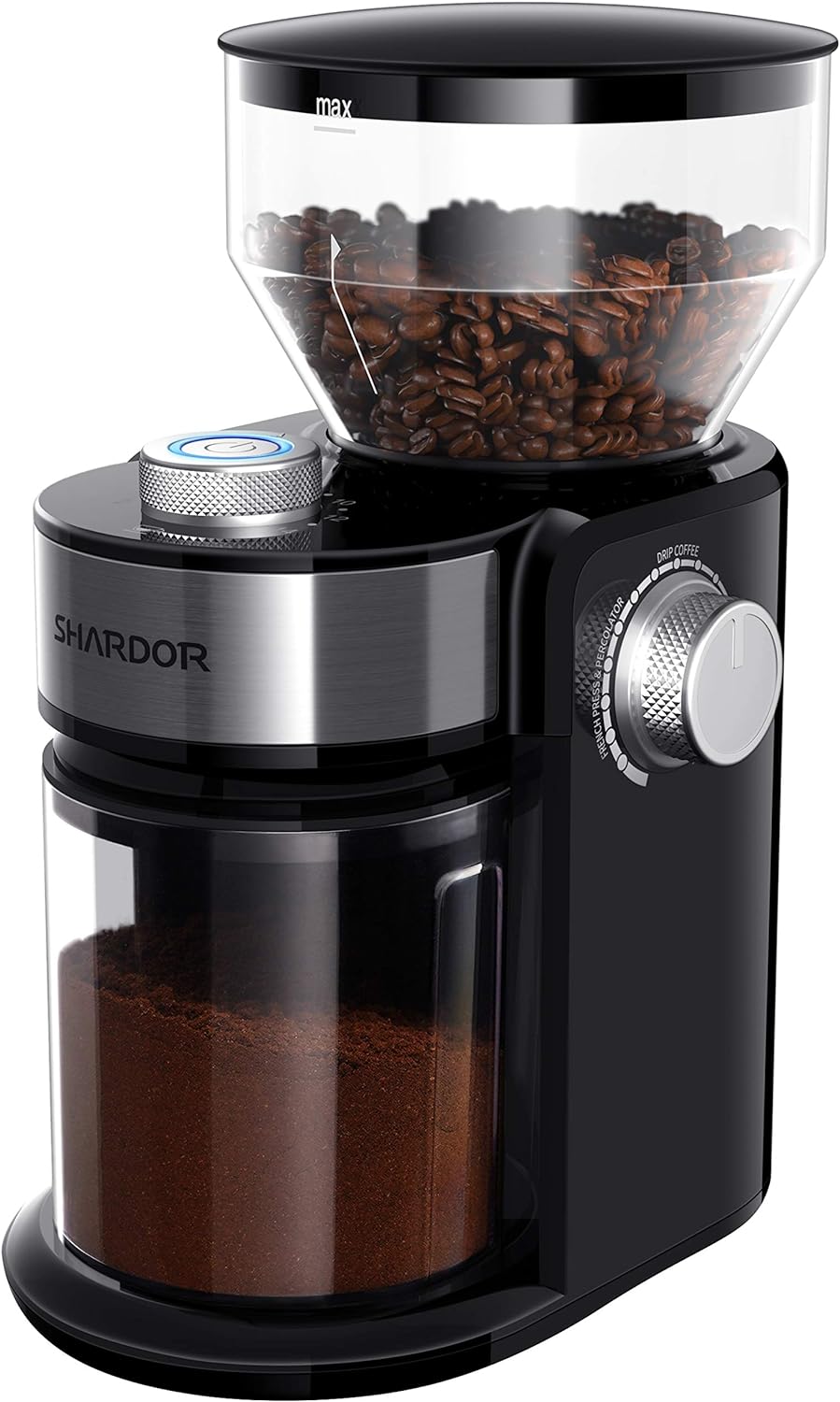
| Capacity | 8.5 ounces |
|---|---|
| Wattage | 150 watts |
| Voltage | 120 volts |
| Grind settings | 16 settings |
The SHARDOR CG835B is a budget-friendly flat burr grinder for home use that offers 16 micro-adjustable grind settings to cover espresso through French press. You set the cup amount with a 2–14 cup timer and the grinder runs automatically, stopping when the selected dose is reached, which keeps waste low and simplifies daily use. The flat stainless steel burrs produce more consistent particle size than blade grinders, and removable components including the bean hopper, grind chamber and a cleaning brush make maintenance straightforward. Safety features such as a dual interlock and built-in overheat protection reduce the chance of accidental starts and motor damage. Practical limitations are its basic dosing control compared with timed or weight-based commercial units and the fixed cup timer means very fine tuning for espresso shots may require a few test runs. The motor and plastic housing are appropriate for light to medium home use but less suited to heavy café traffic. For the price point you get consistent grinding performance and user-friendly cleanup in a compact package.
Best for: Buyers who want an affordable burr grinder that reliably improves flavor over blade grinders and prefer simple, cup-based dosing for everyday home espresso and drip coffee.
Less Ideal for: People seeking cafe-grade, weight-based dosing or heavy daily commercial use should consider higher-end grinders with finer adjustment and stronger motors.
- Flat stainless steel burrs give more consistent grind size than blade grinders
- 16 precise grind settings cover espresso to French press
- 2–14 cup timer and one-touch operation for easy dosing
- Removable hopper and grind chamber plus included brush simplify cleaning
- Safety interlock and overheat protection help prevent misuse and motor damage
- Cup-based timer dosing is less precise than weight-based dosing for espresso puck consistency
- Build and motor are sized for home use rather than continuous commercial workloads
Verdict: A cost-conscious home barista tool that delivers consistent flat-burr grinding and easy cleanup, making it one of the best budget options for espresso under $200.
Breville Smart Grinder Pro BCG820BSS

| Wattage | 165 |
|---|---|
| Voltage | 120 |
| Capacity | 1.1 pounds |
| Bean Hopper Capacity | 18oz |
The Breville Smart Grinder Pro is a countertop conical burr grinder built for precise, repeatable dosing for espresso and other brew methods. You pick one of 60 grind settings on the clear LCD, choose cups or shots, and program grind time in 0.2 second increments so the same dose is delivered each run. It grinds into a portafilter, airtight container or the included grounds container, and the included portafilter cradles and cleaning brush make routine use straightforward. The dosing IQ and digital timer make dialing in espresso shots faster than guessing by eye, and the wide range of settings means you can move from espresso to French press without swapping machines. Trade-offs are typical for burr grinders in this class: it is not the quietest grinder and its stainless steel exterior plus 6.4 pound weight make it less portable, so it suits a dedicated home setup rather than travel or storing away after each use.
Best for: Buyers who prioritize consistent, repeatable doses for home espresso and want a grinder that helps dial in shots without guesswork.
Less Ideal for: People who need a lightweight, ultra-quiet grinder for travel or for storing away between uses should consider other portable models.
- Very fine incremental control with 60 grind settings for espresso through French press
- Digital dosing that programs grind time in 0.2 second increments for consistent doses
- Grinds directly into a portafilter or airtight container for convenient workflow
- Clear LCD that displays grind setting, time and shot/cup selection
- Includes portafilter cradles, grounds container and cleaning brush for out-of-box use
- Relatively heavy and not intended for frequent moving or travel
- Can be louder than some specialty low-noise grinders
Verdict: If you want a reliable, programmable grinder that delivers repeatable espresso dosing and a wide range of grind settings for under $200, this is a top practical choice.
KRUPS F203 Electric Coffee Grinder

| Wattage | 200 watts |
|---|---|
| Capacity | 85 g |
| Voltage | 240 volts |
| Material Type | Plastic |
| Power Source | Electric |
The KRUPS F203 is a simple, no-frills electric blade grinder aimed at home users who want freshly ground beans without a complicated interface. Its 200W motor and stainless steel blades quickly break down beans, spices, and nuts; grind time controls fineness so you can approximate coarse to fine textures for French press, drip or espresso prep. The one-touch button and lid-activated safety cut down the learning curve and reduce accidental starts, and the removable lid doubles as a measuring cup for convenience. At roughly a 3 ounce hopper it is best suited for small households or single-brew sessions rather than high-volume grinding. As a blade grinder it cannot offer the uniform particle size of a burr grinder, so extraction consistency for true espresso lovers will be limited, but it does deliver fast, usable results and is easy to clean and store. For buyers prioritizing quick everyday grinding, straightforward controls, and proven reliability, this is a practical, budget-friendly choice under 200.
Best for: Buyers who want a reliable, easy-to-use grinder for daily fresh grinding and occasional espresso attempts, and who value simple controls and quick results over precision particle uniformity.
Less Ideal for: Serious home baristas seeking consistent, repeatable grind size for true espresso or those who routinely grind large volumes should consider a dedicated burr grinder instead.
- Powerful 200W motor for fast grinding of beans, spices, and nuts
- Stainless steel blades provide durable, uniform chopping action
- One-touch operation with lid-activated safety for simple, safe use
- Removable lid that doubles as a measuring cup for easy portioning
- Compact footprint that stores easily on counters or in cabinets
- Blade grinder design yields less uniform particle size than burr grinders, limiting extraction consistency for espresso-focused users
- Small 3 oz (85 g) capacity is not ideal for large batches or frequent heavy use
Verdict: A compact, dependable blade grinder that gives quick, fresh grounds for everyday brewing when you want simplicity and speed under a $200 budget.
OXO Brew Conical Burr Grinder

| Burr type | 40 mm stainless steel conical burrs |
|---|---|
| Grind settings | 15 settings plus micro-adjustments |
| Hopper capacity | 12 ounces |
| Power | 120 volts |
The OXO Brew Conical Burr Grinder is a practical, user-friendly electric grinder aimed at delivering consistent grounds for espresso and other brew methods. It uses 40 mm stainless steel conical burrs and a dial with 15 grind sizes plus micro-adjustments to let you fine tune from fine espresso to coarse French press, while a one-touch start remembers your last setting for quick repeatability. A large removable hopper holds up to 12 ounces of beans and has a UV-blocking tint to protect beans in sunny kitchens, and the DC motor is designed to minimize heat and vibration so mornings stay quiet. In use it grinds evenly and the remembered setting and simple dial make daily operation straightforward for people who want reliable results with minimal fuss. Downsides to consider are that it is a countertop electric unit so it takes some space and the grind range and precision, while very good for its class, is not as ultra-fine or adjustable as some high-end specialty grinders aimed strictly at advanced espresso tuning.
Best for: Buyers who prioritize consistent, easy-to-use grinding for daily espresso and drip coffee and who prefer a reliable, low-fuss appliance they can trust each morning.
Less Ideal for: Specialty baristas seeking ultra-fine, micrometrically adjustable grinding for competitive espresso tuning should consider a higher-end dedicated espresso grinder.
- 40 mm stainless steel conical burrs for uniform grounds
- 15 grind settings with micro-adjustments for flexible brewing
- One-touch start that remembers last setting for repeatable results
- Large 12 oz removable hopper with UV tint to protect beans
- Quiet DC motor with low vibration suitable for early mornings
- Countertop footprint requires dedicated space
- Not as fine or highly tunable as some premium espresso-only grinders
Verdict: A dependable, easy-to-use conical burr grinder that delivers consistent, repeatable grinds for home espresso without a steep learning curve.
Choosing the Right Coffee Grinder for Espresso Under 200: Key Factors to Consider
Grind Consistency and Particle Distribution
Evenness of particle size has an outsized effect on espresso extraction. A consistent grind reduces overextraction from fines and underextraction from large particles, producing a more balanced shot and better crema.
When evaluating within a budget, focus on grinders with quality burr sets and proven geometry for espresso. Tight tolerances in manufacturing and stable burr alignment help maintain an even distribution over time, which matters more than maximum motor power for home espresso.
Adjustment Precision and Repeatability
Fine control over grind setting is essential for dialing in espresso. Stepless adjustment or a closely indexed stepped system allows small changes that meaningfully affect shot time and flavor.
Repeatability matters as much as the range. Look for clear, verifiable detents, clicks, or reference marks and test whether returning to a saved setting produces the same extracted time and yield.
Dose Control, Retention, and Consistent Output
How a grinder delivers grounds influences workflow and consistency. Timed dosing and straightforward single-dose operation are useful for repeatable shot preparation. Low retention reduces waste and helps you reproduce the same dose when switching beans.
Consider whether the grinder dispenses directly into a portafilter, a catch cup, or a distribution tool and how easy it is to measure dose by weight. High retention can hide changes in grind distribution and make dialing in more difficult.
Burr Material and Longevity
Burr material and size affect both the quality of the grind and how long the grinder stays consistent. Hardened steel burrs are common in this price range and offer a reasonable lifespan. Larger burrs tend to be more stable and produce less friction at fine settings.
Burr replacement availability and the simplicity of swapping parts are also important for long-term ownership. Expect gradual wear; choosing a grinder with accessible spare parts extends usable life within the budget.
Build Quality, Heat Management, and Motor Design
A well-built grinder resists vibration and transmission of heat to the grounds. Excessive heat from the burrs or motor can change extraction by altering bean oils and producing inconsistent results at fine settings.
Motor torque and duty cycle affect performance during long sessions. For home use under typical workloads, a modestly torqued motor with good cooling and solid housing is preferable to a noisy high-RPM unit that creates more heat and noise.
Ease of Use and Maintenance
Daily usability influences whether you will actually use the grinder to its potential. Features like an easy-to-remove hopper, clear grind setting markings, and straightforward cleaning access save time and encourage regular maintenance.
Consider how much disassembly is required to clean the burrs, whether the grinder has sealed electronics to protect against dust, and whether manufacturer guidance or community resources exist for basic upkeep.
Single-Dose Versus Hopper-Fed Workflow
Single-dose grinding is popular among home espresso enthusiasts who prefer to grind only what they need for each shot. This approach reduces stale grounds and makes it easier to switch beans quickly. Single-dose grinders typically have no large hopper and are sized for portability and minimal retention.
Hopper-fed grinders are convenient for daily use with a single bean and reduce the need to refill between shots. They can offer larger capacity and save time for multiple daily pulls, but they may increase retention and require more frequent cleaning to keep oils from building up.
- Single-dose: minimal retention, quick bean changes, better freshness control
- Hopper-fed: higher capacity, convenient for repetitive pulling, potential for more retention
Practical Tips for Dialing in Espresso with an Affordable Grinder
Start with small, controlled adjustments. Move the grind setting one or two notches and pull a shot to see how extraction time and taste change. Small steps can have a large impact on shot quality with fine settings.
Use consistent dosing and tamping routines when testing settings. Keep water temperature and yield targets steady so you are isolating the grinder variable. If you have a scale, measure dose and yield by weight rather than relying on visual estimates.
- Adjust grind, not dose, for initial changes to extraction time
- Weigh dose and yield to remove variables
- Purge a small amount of grounds after each setting change to reduce retained fines
Managing Retention and Static at Fine Settings
Static and retention are common challenges with fine espresso settings. Static causes clumping and uneven dosing while retention hides old grounds that mix with fresh grinds. Simple techniques reduce both issues.
Wiping the chute, using anti-static tools, and occasional low-speed purges can mitigate retention. Some grinders respond well to a small amount of humidity control or silicon-based anti-static measures, but avoid additives that could contaminate flavor.
- Purge a few grams of grounds when changing beans or settings
- Tap or brush the chute gently to break clumps before dosing
- Consider a distribution tool or gentle agitation to settle the dose
Maintenance Routines That Preserve Performance
Regular cleaning of the hopper, burrs, and chute helps maintain consistent grind quality. Depending on roast level and daily usage, schedule a light cleaning weekly and a deeper burr cleaning monthly. This keeps oils and fine particles from altering particle distribution.
When cleaning, follow manufacturer recommendations for disassembly. Avoid harsh solvents and use a dry brush or manufacturer-approved cleaning tablets where appropriate. Keep replacement burrs and simple tools on hand to reduce downtime if parts need swapping.
- Weekly: empty hopper, brush chute and exterior
- Monthly: remove burrs for a deeper clean if the design allows
- Keep replacement burrs available if you grind frequently
When to Consider Upgrading
Even within a sub-$200 budget, grinders vary in long-term capability. Consider upgrading when you hit the limits of adjustment precision, experience persistent retention issues you cannot resolve, or when burr wear significantly increases fines and reduces consistency.
If you move from single shots to heavier home use, or if you begin pursuing competitive or very fine-tuned espresso profiles, a higher-tier grinder with larger burrs and more precise adjustment may be justified.
- Persistent inconsistency despite calibration is a sign to upgrade
- High-volume use may require a more robust motor and cooling
- Desire for near-professional repeatability is another upgrade trigger
How We Chose the Best Coffee Grinder for Espresso Under 200
We prioritized candidates that deliver the core performance home espresso requires: consistent fine grind, stable dosing, and a durable burr set. Our editorial filters favored grinders with stepless or tight-indexed grind adjustments that allow repeatable settings for espresso. We also considered burr material and size because these directly affect particle distribution and longevity. Motor design, cooling, and heat management were assessed to avoid grind chatter and heat buildup at fine settings. Practical usability factors such as hopper capacity, grounds retention, pulse vs timed dosing options, and ease of cleaning were included to reflect everyday use. Finally, we checked build quality and warranty or customer support signals as proxies for long-term reliability. We excluded entry-level blade grinders and any models lacking fine espresso settings or clearly unsuitable burr geometries. Products that required external modifications to work for espresso were not considered. The resulting list focuses on grinders that balance espresso-ready performance with affordability under the given budget.
Our full evaluation process is outlined in our review methodology.
FAQ
Can a budget grinder under $200 make good espresso?
Often yes. Many grinders under this price can produce fine enough, reasonably consistent grounds for home espresso. Expect to spend time dialing in settings and managing retention and static to achieve the best results.
How important are burr size and material for espresso?
Burr size and material influence heat buildup, durability, and particle distribution. Larger burrs and hardened steel are generally better for stability and longevity at fine settings, though design matters as much as raw size.
Should I prioritize single-dosing or a hopper for home use?
It depends on workflow. Single-dosing maximizes freshness and makes bean changes easy. A hopper is more convenient if you pull multiple shots from the same bean each day. Both can work well for espresso if retention is controlled.
How often should I clean the grinder?
Light cleaning of the hopper and chute weekly and deeper burr cleaning monthly is a good starting point. Frequency increases with darker roasts and heavier daily use because oils and fines build up faster.
Does grind retention affect shot quality?
Yes. Retained grounds can mix with fresh grinds and change particle distribution, which affects extraction. Minimizing retention and purging after setting changes helps maintain consistent shots.
Final Verdict
For home espresso on a sub-$200 budget, prioritize grind consistency, adjustment precision, and low retention. These factors most directly affect extraction and help you produce repeatable shots without expensive equipment. Consider whether single-dose or hopper-fed workflow fits your routine and plan for regular maintenance to keep a grinder performing well. Balance the tradeoffs between convenience and control. If you value quick daily pulls from one bean, a hopper-fed unit with reliable dosing may be best. If you switch beans often or want minimal waste, single-dosing and low retention should guide your choice. Focus on the core criteria outlined here to choose confidently.