
Note: This article contains affiliate links. If you click on these links and make a purchase, we may earn a small commission at no extra cost to you. This helps support our research and content. Read our full affiliate disclosure here.
If you usually brew one cup at a time, the right coffee grinder makes a bigger difference than you might expect. A grinder tuned to single-cup portions reduces waste, preserves freshness, and gives you the control to match grind size to your brewing method. This guide focuses on compact, dependable grinders that handle small doses cleanly and consistently. We shortlisted six options that perform well for single-cup use and tested them against practical buyer concerns like grind consistency, dose control, and cleanup. Read on to find the features that matter most for single-cup brewing and which grinder traits best match your routine.
Top Picks at a Glance
| Best Overall The best all-around choice for most situations | FORLIM Portable Burr Grinder CM-002 |  |
| Best Quality Built to a higher standard if you want something more solid | Fellow Ode Gen 2 |  |
| Best Value The sweet spot between price and what you get | CEVING Mini Manual Coffee Grinder | 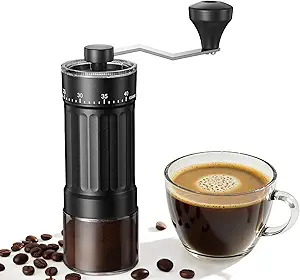 |
| Best Budget The cheapest option that still gets the job done reliably | Wancle Electric Coffee Grinder |  |
| Most Popular A crowd favorite that many people choose with confidence | BLACK+DECKER Coffee Grinder CBG110S |  |
| Best Seller A high-volume bestseller chosen again and again | OXO Brew Compact Conical Burr Grinder |  |
FORLIM Portable Burr Grinder CM-002

| Capacity | 15 g |
|---|---|
| Wattage | 25 watts |
| Voltage | 7.4 volts |
This FORLIM portable burr grinder is built for single-cup coffee lovers who want cafe-style control away from the kitchen. It uses stainless steel conical burrs and an 80-step grind dial that covers espresso through French press ranges, so you can tune grind size for moka pot, pour-over, or espresso. The 15 g single-dose hopper and magnetic grounds cup are optimized for one fresh cup at a time and help keep counters tidy, while the auto-reverse and double-click safe start reduce jams and accidental runs. Cordless USB-C charging makes it convenient for travel, office, or camping and the company rates battery life as roughly two weeks with typical daily use. The aluminum-alloy body and hardened SUS420 burr are described as durable and were tested through many cycles, but the small capacity means this is not suitable when you need to grind for multiple cups or a full pot. Cleaning requires hand-washing removable parts and avoiding immersion of the motorized body. For buyers who prioritize portability and precise grind control for single cups, this grinder delivers a capable, travel-ready solution.
Best for: Buyers who want a travel-ready, single-dose grinder with fine grind control for making one fresh cup at a time whether at home, the office, or on the go.
Less Ideal for: People who regularly grind for multiple cups, groups, or full coffee makers and need larger-capacity or high-throughput grinders.
- 80 grind settings let you dial in sizes for espresso, moka, pour-over, and French press
- USB-C rechargeable cordless design for portable use and about two weeks of typical daily battery life
- Stainless steel conical burrs for more uniform grounds and reduced heat buildup
- 15 g single-dose hopper and magnetic grounds cup reduce stale grounds and mess
- Auto-reverse and double-click safe start help clear jams and prevent accidental activation
- 15 g capacity is limited to one cup at a time and not suited for grinding multiple cups or full pots
- No dishwasher-safe parts; motor body must not be rinsed or immersed
Verdict: A purpose-built, rechargeable single-dose burr grinder that gives café-style grind control in a compact, travel-ready package.
Fellow Ode Gen 2

| Burr size | 64 mm |
|---|---|
| Grind settings | 31 |
| Capacity | 100 g |
| Wattage | 140 watts |
| Voltage | 120 volts |
The Fellow Ode Gen 2 is a single-dose electric burr grinder purpose-built for pour-over, drip, French press, and cold brew rather than espresso. It uses professional-grade 64 mm flat burrs and a two-stage grinding geometry to produce a uniform particle size, and offers 31 stepped grind settings so you can dial in extraction for different brewed methods. The 100 g single-dose bin, magnetic catch cup, anti-static tech, and built-in knocker minimize retention and mess, while the automatic stop and quiet motor make it convenient for everyday single-cup use. Its compact footprint fits easily on a counter and the quick-reference grind guide helps you find a good starting point fast. Expect a premium, user-friendly experience focused on brewed coffee flavor and consistency, though the small single-dose hopper limits batch grinding and the unit is not targeted at espresso users who need finer, high-tolerance settings.
Best for: Home brewers who prioritize flavor and precise grind control for single-cup pour-over, drip, French press, or cold brew and want a tidy, repeatable single-dose workflow.
Less Ideal for: People who need to grind large daily batches or require a grinder specifically tuned for espresso extraction should consider other options.
- Professional-grade 64 mm flat burrs for consistent particle size and improved extraction
- 31 grind settings tailored to brewed methods for precise dialing in
- Anti-static design, knocker, and magnetic catch cup reduce retention and mess
- Automatic stop and quieter motor make single-dose operation simple and neighbor-friendly
- 100 g single-dose hopper is not ideal for grinding larger batches
- Not designed for espresso-level fine grinding or commercial workloads
Verdict: If you want a compact, single-dose grinder that delivers consistent, brew-optimized grinds and minimal retention for better single-cup flavor, the Ode Gen 2 is a top choice.
CEVING Mini Manual Coffee Grinder

| Capacity | 30 g |
|---|---|
| Material Type | Ceramic |
| Power Source | manual winding |
| Adjustable Settings | 40 |
The CEVING Mini Manual Coffee Grinder is built for single‑cup brewing on the go or at home. It uses ceramic conical burrs and an external adjustment ring with 40 settings, so you can dial in grinds from fine to coarse for espresso, pour‑over, or French press. The 30 g bean hopper holds about one small cup worth of beans, and the compact, three‑piece design disassembles for easy cleaning and packing. Because it is hand‑powered, it produces minimal heat and a consistent grind without electricity, but expect a bit of wrist work for multiple cups. The ceramic burrs help preserve flavor and resist corrosion, though ceramic can be more fragile than steel if dropped. Its portability and precise external adjustment make it well suited for travelers and single‑cup brewers, while the limited capacity and manual operation mean it is not ideal for high‑volume daily grinding.
Best for: Buyers who prioritize precise, portable single‑cup grinding and want a compact hand grinder they can take to work, travel, or use for occasional at‑home single cups.
Less Ideal for: Those who need to grind multiple cups quickly, want a hands‑free electric grinder, or prefer a larger hopper for frequent high‑volume brewing.
- 40 external grind settings for fine control across brew methods
- Ceramic conical burrs deliver uniform grind and low heat
- Compact, detachable design makes it portable and easy to clean
- 30 g capacity sized for single‑cup brewing
- Manual operation requires physical effort for multiple or larger batches
- 30 g capacity is small for more than one cup
Verdict: A compact, travel‑friendly hand grinder that gives single‑cup brewers fine, repeatable grind control without electricity.
Wancle Electric Coffee Grinder

| Wattage | 150 |
|---|---|
| Capacity | 60 g |
| Voltage | 120 volts |
| Power Source | AC adapter |
The Wancle Electric Coffee Grinder is a small, no-frills blade grinder designed for quick single-cup or small-batch grinding. You load up to the 60 g cup, press the single control button and pulse until you reach the desired coarseness; the transparent lid helps you watch progress. The unit uses a 150 W motor with stainless steel blades and a plastic body, so it moves fast and works for coffee, spices, nuts, and seeds. It ships with a cleaning brush and is simple to clean by brushing out grounds. Because it is a blade grinder, grind size control depends on timing and short pulses rather than preset settings, so it is best for drip, French press coarse grinds and quick espresso-style preps where consistent particle size is less critical. Its small footprint and one-touch operation make it convenient for budget buyers who want fresh-ground beans for single cups without a steep learning curve. Expect some coarser particles compared with burr grinders and moderate noise during operation, but it delivers a fast, affordable way to upgrade from pre-ground coffee.
Best for: Buyers on a tight budget who want a fast, simple grinder for single cups or small daily use and value compact, easy operation over precision grind control.
Less Ideal for: Users seeking very consistent, grind-size-specific results for specialty espresso or large-batch brewing should choose a burr grinder instead.
- Compact footprint fits small kitchens or dorm rooms
- One-button operation with transparent lid for easy visual control
- 150 W motor and stainless steel blades grind beans quickly
- Works for coffee plus spices, nuts, and seeds
- Includes cleaning brush for straightforward cleanup
- Blade design yields less uniform grind size than a burr grinder
- Small 60 g capacity limits larger or multiple-cup batches
Verdict: A cheap, compact one-touch grinder that gives freshly ground beans for single cups quickly and without fuss.
BLACK+DECKER Coffee Grinder CBG110S

| Capacity | 56.6 g |
|---|---|
| Wattage | 130 |
| Voltage | 110 volts |
| Power Source | Electric |
The BLACK+DECKER CBG110S is a straightforward one-touch blade grinder aimed at small-batch use and single-cup coffee preparation. It uses stainless steel blades and a stainless steel bowl to quickly process coffee beans, herbs, spices, and grains, and the push-button control makes it easy to grind to a range of consistencies by pulsing to taste. A lid-locking safety feature prevents the motor from running unless the lid is securely in place, which reduces spills and accidental starts. Its compact footprint fits easily on a kitchen counter or in a cupboard and the 56.6 g capacity is sized for one to two cups of coffee. Because it is a blade grinder, you should expect less uniform particle size than with a burr grinder, so it works best for drip, French press, or single-cup brews rather than precision espresso. For buyers who want a simple, durable grinder for occasional single-cup use, this model delivers reliable performance with few controls and easy cleanup.
Best for: Buyers who want an affordable, low-effort grinder for single-cup or occasional brewing and who value compact, safe operation backed by many user reviews.
Less Ideal for: People seeking precise, uniform grinds for espresso or advanced brewing techniques should choose a burr grinder instead.
- Stainless steel blades and bowl for durability and easy cleaning
- One-touch push-button control for quick, simple operation
- Integrated lid-lock safety feature prevents accidental starts
- Compact size suitable for small kitchens and single-cup grinding
- Blade grinder design produces less consistent grind size compared with burr grinders
Verdict: A compact, easy-to-use blade grinder that reliably handles single-cup grinding with durable stainless-steel components and simple safety-focused controls.
OXO Brew Compact Conical Burr Grinder

| Capacity | 50 g |
|---|---|
| Voltage | 120 volts_of_alternating_current |
| Burr type | Stainless steel conical burrs |
| Settings | 15 settings, 29 micro-adjustments |
The OXO Brew Compact Conical Burr Grinder brings full-size burr performance to a small footprint, making it a practical choice for single-cup and small-batch brewing. It uses stainless steel conical burrs and offers 15 grind settings with 29 micro-adjustments so you can dial in grind size for pour-over, drip, or French press. The 50 g hopper is sized for about six cups or a single large brew and the integrated spout on the grounds container makes dosing and pouring tidy. Removable upper and lower burrs simplify cleaning and the chuteless design gives easy access to the grind path. Its Tritan Renew hopper and a cord-wrap for neat storage are useful for countertop-conscious kitchens. Limitations include the modest bean capacity and plastic exterior, so it is best suited for daily single-serve use rather than heavy commercial workloads. Noise is typical for a compact electric grinder and very fine espresso-level grinding may be less consistent than with larger, heavier-duty models.
Best for: Buyers who prioritize consistent grind quality in a small countertop package and want an easy-to-clean grinder for daily single-cup brewing.
Less Ideal for: Homes that need large-volume grinding, dedicated espresso enthusiasts seeking commercial-grade tamp-level consistency, or users who prefer metal-bodied, heavy-duty machines.
- Stainless steel conical burrs for consistent grind quality
- Fifteen settings plus 29 micro-adjustments for precise tuning
- Compact footprint with cord wrap suits small countertops or storage
- Removable upper and lower burrs and washable grounds container for easier cleaning
- Tritan Renew hopper made from certified recycled content
- 50 g hopper limits capacity for larger households or batch grinding
- Plastic exterior may feel less robust than metal-bodied grinders
Verdict: A precise, compact conical burr grinder built for single-cup and small-batch home brewing where countertop space and easy cleaning matter.
Choosing the Right Coffee Grinder for Single Cup: Key Factors to Consider
Grind Consistency
Consistent particle size is the single most important factor for extracting evenly when you brew one cup. Inconsistent grind creates overextracted and underextracted particles that show up as uneven flavor in a small brew, and that effect is more obvious with single-cup doses where there is less liquid to balance the extraction.
Look for grinders with burrs rather than blades and with a clear, repeatable adjustment mechanism. Conical and flat burr designs can both produce excellent results, but the key is how predictably a grinder holds its setting across repeated small doses.
Dose Accuracy and Retention
When you grind for one cup, wasting even a few grams changes the dose and the taste. Low retention means fewer grounds staying trapped inside where they stale and alter subsequent doses. Dose accuracy is important whether you weigh coffee or rely on timed pulses.
Choose a grinder that meters small quantities cleanly or offers a straightforward way to dose by weight or by a short timed grind. If you plan to use a scale, look for minimal retention between the burrs and the grounds path so measured output equals what ends up in your cup.
Ease of Cleaning
Daily single-cup users benefit from grinders that are quick to disassemble and easy to brush out. Oils and fine particles accumulate faster with frequent single-portions, so a design that allows easy access to burrs and collection chambers reduces flavor carryover and maintenance time.
Consider grinders with removable burrs or simple grounds chutes and avoid models with hidden crevices that collect residue. Ease of cleaning also affects longevity since regular upkeep prevents buildup that can stress motors or bearings.
Size and Footprint
Single-cup routines usually favor compact equipment. A grinder that fits on a small counter or tucks into a cabinet is more likely to be used daily. Large hoppers and wide bases are unnecessary if you only grind a few grams at a time and can make the device harder to store.
Also consider hopper size only as it relates to convenience. Smaller hoppers reduce stale-bean risk for single-cup drinkers and typically mean less waste when switching beans between cups.
Speed and Noise
How quickly a grinder produces a small dose matters when you want a fast morning cup. Faster motors reduce grind time but can increase heat and noise. For single-cup doses, a balance of brisk speed and moderate noise is ideal to get coffee ready without disturbing others.
If noise is a concern, prioritize grinders engineered for quieter operation or that allow short pulses rather than long continuous runs. Short bursts for small doses also limit heat buildup, preserving flavor.
Durability and Parts Quality
Even with modest daily use, components like burrs, adjustment mechanisms, and motor bearings experience wear. Durable materials and replaceable parts extend useful life and protect performance for the long term.
Seek grinders with robust burr materials and clear manufacturer guidance on replacement parts or serviceability. Sturdier housings resist wobble that can affect grind uniformity over time.
Why Single-Cup Grinding Is Different
Grinding for one cup is a different workflow than grinding for a whole pot. Small doses amplify inconsistencies in grind size and retention, and any stale particles left in the burr path will have a larger proportional impact. That means features that are nice-to-have for batch grinders, like large hoppers or high throughput, are less relevant. Single-cup grinders prioritize clean dosing, compactness, and settings that hold steady between pulls.
- Small-dose retention matters more than hopper capacity
- Adjustment mechanisms should be precise at fine settings
- Ease of cleaning reduces flavor carryover between cups
Manual Vs Electric Grinders for Single Cups
Both manual and electric grinders can serve single-cup drinkers well. Manual grinders are quiet, compact, and give excellent control at small doses. They also avoid the heat and noise of motors, but they require physical effort and can be slower for multiple rounds. Electric grinders offer speed and convenience and are preferable if you want near-instant grinding every time with the push of a button.
- Manual: low noise, low retention, portable
- Electric: fast, consistent, needs more counter space
- Consider your routine and how often you will grind by hand
Setting Grind Size for Common Single-Cup Methods
Different single-cup brewing methods require distinct grind ranges. For pour-over single-cup methods, aim for a medium-fine to medium grind and adjust slightly based on extraction time. For AeroPress or similar single-serve devices, settings can range from fine to medium depending on the recipe. Espresso for single shots demands finer settings and very consistent output, while French press single servings use a coarser setting. When you are dialing in one cup, make small incremental adjustments and record the dose and extraction time for repeatability.
- Pour-over: medium-fine to medium
- AeroPress: fine to medium depending on recipe
- Espresso single shots: very fine, consistent grind
- French press single serve: coarse, uniform particles
Maintaining Freshness Between Single Servings
Because you likely switch beans or flavor profiles between single cups, minimizing the time beans sit in a hopper is important. Consider measuring beans into the hopper right before grinding or using a grinder with a small removable hopper. Clean out residual grounds if changing beans to prevent cross-contamination of flavors.
- Measure beans per cup rather than filling a large hopper
- Brush out the chute and portafilter area between roasts
- Store beans in an airtight container away from light and heat
How We Chose the Best Coffee Grinder for Single Cup
To assemble this list we focused on machines and hand grinders that are optimized for single-cup use, prioritizing reliable dose control and repeatable particle size over extra-large capacities or features aimed at multi-cup brewing. We applied concrete filters to remove products that rely on batch grinding or produce excessive retention at single-cup doses. Core evaluation criteria included grind consistency across settings, dose accuracy for 6 to 18 grams, ease of cleaning and maintenance for daily single-serve use, compactness and footprint for small kitchens, and noise and vibration for early-morning or shared-space brewing. Durability and parts quality were considered to estimate service life under repeated small-dose use. We excluded models designed primarily for commercial, heavy-duty use or those with large bean hoppers that cannot be dosed reliably for one cup. We also excluded grinders without adjustable grind settings or without a clear mechanism for limiting retention. The resulting selection emphasizes devices that make single-cup grinding fast, predictable, and low-maintenance.
Our full evaluation process is outlined in our review methodology.
FAQ
Is a blade grinder OK for single-cup use?
Blade grinders are inexpensive but produce a wide spread of particle sizes, which makes it difficult to get even extraction in a single cup. For the best flavor and control, a burr grinder is recommended for single-cup brewing.
How much coffee should I grind for one cup?
A typical single-cup dose is 10 to 18 grams depending on brew method and desired strength. Weighing your dose is the most reliable way to be consistent, especially with small portions.
Can manual grinders match electric grind consistency for a single cup?
High-quality manual grinders can produce excellent consistency for single-cup doses, often comparable to entry-level electric grinders. The tradeoff is speed and effort, since manual grinding requires physical input and takes longer per dose.
How often should I clean the grinder if I grind one cup daily?
A light brushing of the burrs and grounds path once a week is usually sufficient for single-cup daily use. A deeper cleaning that removes the burrs and cleans the chamber every few months helps prevent buildup and flavor carryover.
Will short timed pulses over-grind coffee for single cups?
Short pulses can work well for single-cup doses if the grinder and burr geometry respond predictably. However, pulsing can introduce variation if the grinder has inconsistent retention or if you do not use a scale to confirm the output.
Final Verdict
For single-cup brewing, prioritize grinders that deliver consistent particle size, accurate small-dose metering, and easy cleaning. Expect to trade off between speed and noise if you want a compact, quiet grinder, or between effort and portability if you choose a manual model. Concentrate on low retention, a stable adjustment mechanism, and serviceable parts to preserve performance over time. With those priorities in mind, you can choose a grinder that reliably produces a better single cup every day.